


 PREV
PREV
10 luovaa käyttötarkoitusta magneettisille lahjapakkauksille
2026-05-19




Custom Retail Packaging is a pack made for one product, brand, sales channel, and delivery route. It joins the insert, retail box, print, labels, and outer shipper into one system. Each part must present the item, protect it, and help staff pack, scan, store, or ship it with less waste.
A jewelry box can look flawless in a render and still fail at the packing table. The chain slips under the insert. The lid rubs the pendant. A large shipper can also erase the savings shown in the box quote.
After reading this guide, you will learn how to choose each part, approve samples, compare costs, test the pack, and write a clear supplier request.
The timing matters. The European Union’s Packaging and Packaging Waste Regulation entered into force on February 11, 2025. Most rules start to apply on August 12, 2026. The European Commission also reports 186.5 kilograms of packaging waste per person in the EU in 2022. Packaging uses 40 percent of the plastics used in the bloc.
Those figures do not tell a brand which box to buy. They do show why material and disposal claims belong in the design brief.
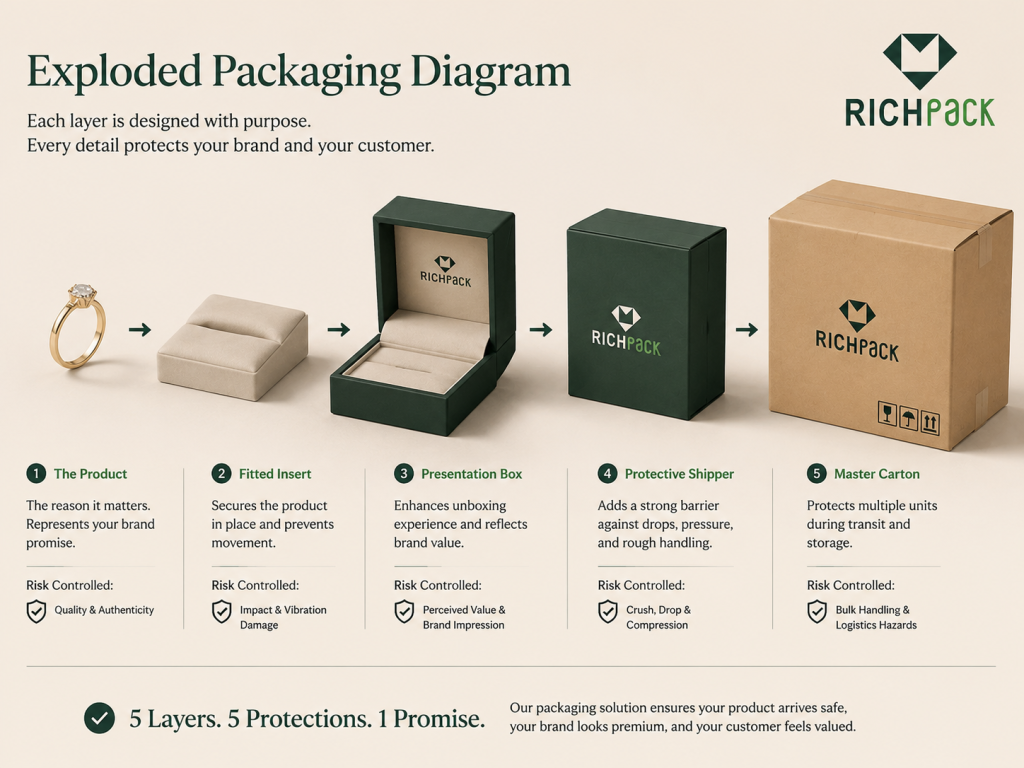
Start with the whole pack, not the prettiest box. It must present and protect the product. It must also carry the right facts and survive delivery.
A complete system may contain six parts:
Small jewelry products expose weak links fast. A rigid box can feel substantial, yet a loose ring slot will still let the piece rotate. The first useful request is therefore not “make the box luxurious.” It is “show how every layer holds, presents, and moves the product.”
Brands that need a coordinated starting point can review custom logoed jewelry boxes before they define the structure and finish requirements.
Stock packaging uses an existing size and structure. Custom packaging changes the dimensions, insert, graphics, materials, or opening action to fit a defined product and brand.
The cheapest route is not always the stock route. A stock box that needs extra tissue, a foam pad, two stickers, and manual trimming can carry more packing labor than a simpler custom structure. Still, stock packaging makes sense while product dimensions or demand remain uncertain.
A practical comparison is available in RichPack’s custom packaging and stock packaging resource. Use it to decide which features deserve tooling and which can remain standard.
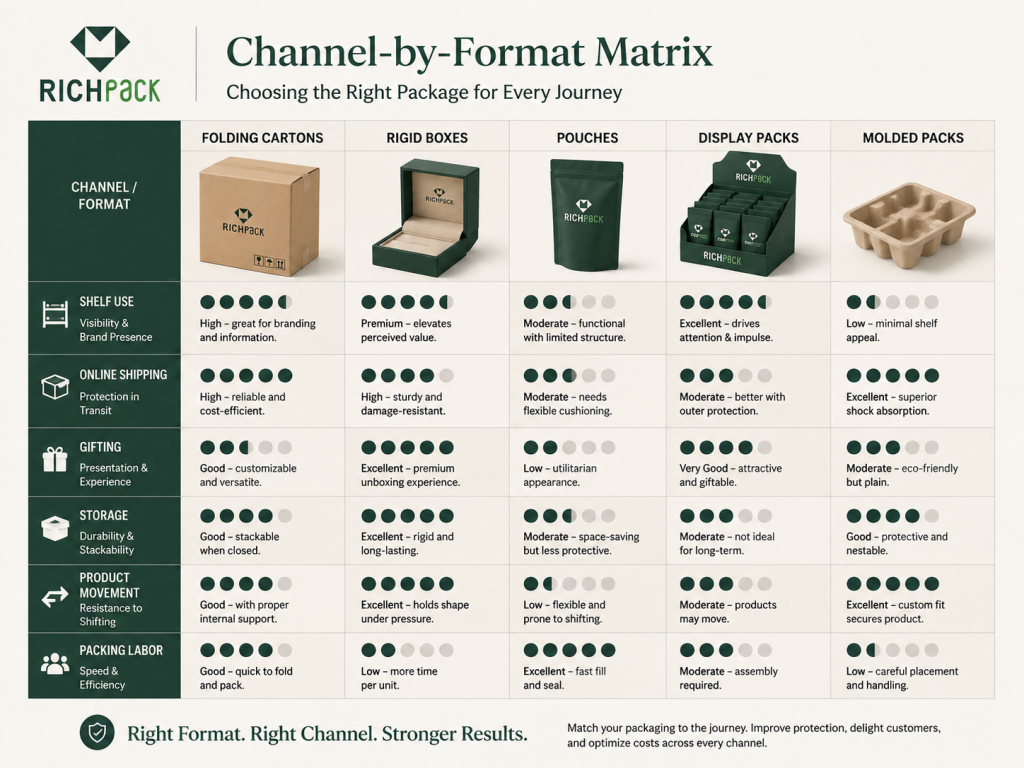
The next table maps each box entity to the traits a buyer must check. Rigid boxes give a strong reveal and storage value. Folding cartons use less freight space and can run faster at scale. Product risk, order size, and packing work decide the fit.
| Ominaisuus | Jäykkä laatikko | Taitettava pakkaus |
| Tuote mallit | Formed dense board shell | Scored paperboard that folds |
| Toimituslomake | Often arrives set up | Often ships flat |
| Käden tunne | Firm and weighty | Kevyt ja raikas |
| Tulostuspinta | Wrapped paper, fabric, or film | Direct print on paperboard |
| Lisää tarve | Common for jewelry | Needed for loose small items |
| Freight space | Higher when set up | Lower when flat |
| Pakkaustyöt | Low if fully assembled | May need forming or locking |
| Parhaiten sopiva | Fine jewelry, gifts, keepsake use | Light goods, sleeves, high-volume runs |
| Pääriski | Storage volume and corner rub | Creasing and low crush strength |
| Buying condition | Stock pack | Mukautettu pakkaus |
| Product dimensions may change | Better fit for the risk | Wait before tooling |
| Launch quantity is uncertain | Lower inventory exposure | Use only with a flexible structure |
| Product scratches or tangles | Often needs added labor | A fitted insert can solve the cause |
| Brand sells through boutiques | Limited control over shelf presence | Better control over size and information |
| Repeat volume is stable | Manual extras may become costly | Fixed costs spread across more units |
Retail packaging presents and identifies the product. Shipping packaging absorbs the knocks, vibration, compression, dirt, and moisture changes that happen after the retail box leaves the clean sample room.
Confusing the two creates a common failure. A magnetic jewelry box reaches the customer inside a thin mailer, one corner crushes, and the product remains unbroken. The item survived, but the gift did not.
Treat the retail box as a protected object when its finish matters. Test the actual selling unit inside the actual shipper, with the real insert, cards, pouch, and closure in place.
A store shelf rewards a clear front panel, compact footprint, scannable code, and quick replenishment. Ecommerce adds parcel handling, dimensional weight, privacy, return packing, and the moment when a customer opens the box without staff present.
GS1 explains that common consumer barcodes encode a Global Trade Item Number for product identification. That means the barcode area cannot be treated as leftover artwork space. Print contrast, quiet zones, curve, texture, and finishing can affect whether the code scans at a counter.
A jewelry brand selling through both channels may keep one inner jewelry box but use two outer systems. The boutique version may use a sleeve with the code and product details. The online version may place the same box inside a fitted corrugated shipper.
Custom work earns its keep when it removes a repeatable problem. Good triggers include a high-value product, visible shelf competition, gift use, several products that need one brand family, or an item that moves, scratches, tangles, or breaks in a standard pack.
Wait until the product dimensions are finalized. Wait until the brand has not tested demand. Buyers often regret the same thing: they chased a lower unit price, approved a large order, then changed a pendant card or product bundle before half the boxes were used.
The clean decision is based on four facts: product risk, sales channel, stable annual volume, and the cost of packing or damage without customization.
The box form shapes the customer view and the packing work. Choose it from the product and route first. Style comes next.
| muodostuu | Paras käyttö | Päävahvuus | Main caution for jewelry |
| Taitettava pakkaus | Lightweight retail products and sleeves | Efficient print area and flat delivery | Needs an insert for small loose items |
| Jäykkä laatikko | Fine jewelry, watches, sets, and gifting | Strong presentation and storage value | Ships with more volume when preassembled |
| Pussi | Travel storage, accessories, and secondary wrap | Low weight and soft hand feel | May allow tangling or point contact |
| Display pack | Cards, counters, peg displays, and shelf units | Product visibility and fast replenishment | Exposed surfaces need scratch control |
| Blister or molded pack | High-volume visibility and precise retention | Repeatable product location | Plastic glare and opening feel may conflict with premium positioning |
Folding cartons use scored paperboard that ships flat and takes print well. They suit lighter items, sleeves, care kits, small accessories, and outer cartons around a separate jewelry holder.
They are less convincing when the box must serve as a keepsake. Thin paperboard also transfers pressure to the product unless the structure or insert creates clearance. For earrings, a paperboard card inside a carton can work well if posts and backs cannot pierce the wall.
Ask for finished board thickness and a made-up sample. A grammage alone does not tell you how the scored carton will feel after printing, coating, folding, and gluing.
Rigid boxes use a formed board shell wrapped with paper, fabric, leatherette, or another decorative surface. They suit rings, necklaces, watches, sets, product launches, and gifts where the box remains part of the ownership experience.
Selaa korurasiakokoelma ja luxury gift box formats to compare hinged, drawer, lift-off lid, and magnetic structures. The hinge and opening path matter as much as the outside finish.
Magnetic closures need enough pull to feel deliberate, but a stronger magnet is not automatically better. The final feel also depends on magnet size, spacing, wrap thickness, board gap, and placement tolerance. A lid that snaps shut in the sample room can pinch a chain if the insert allows the chain to cross the closing path.
A pouch is useful when weight, travel, and soft touch matter. It can protect a polished surface from casual contact and add a second reveal inside a box.
The limitation is movement. A loose necklace can tie itself into a knot, an earring post can press into a plated face, and a drawstring can rub the product during transit. Add a card, divider, or shaped insert when the product needs a fixed position.
Pouches also complicate material claims. A fabric body, synthetic drawcord, metal eyelet, printed logo, and sewn label may follow different disposal paths even when the main fabric sounds simple.
Display packaging lets staff place, scan, and replenish the product with less handling. Common parts include hanging cards, countertop trays, display shippers, sleeves, and cartons with a clear window.
For jewelry, visibility creates a security and abrasion trade-off. A necklace card may show the full piece but leave the chain exposed to fingers and fixtures. A tray may speed service while creating a second stock location that must match the boxed inventory.
Design the display around the staff action. Where does the barcode face? Can a sales associate remove and replace the piece without bending a post or touching the polished center?
A thermoformed blister holds a product in a repeatable cavity. Molded fiber uses a formed pulp structure to create a similar location with a different feel and disposal profile.
Blisters can make sense for high-volume accessories, sealed products, and items that need visibility or tamper evidence. They rarely feel natural for fine jewelry gifting, and glossy plastic can create glare over small reflective products.
Molded fiber can support a paper-led construction, but the cavity still needs a product fit test. Fiber texture, draft angles, edge pressure, and dust all matter around plated or polished jewelry.
Material choice changes stiffness, touch, print, packing speed, storage, and product contact. A material should earn its place through one of those jobs.
Paperboard folds. Corrugated board cushions and resists compression through its fluted structure. Rigid board creates a formed shell with a dense hand feel.
Do not compare them by appearance alone. A small folding carton may use less storage space because it arrives flat. A wrapped rigid box may look better at the counter but occupy far more inbound freight and warehouse volume.
Ask suppliers to state the finished construction, not only a material name. Board grade, thickness, flute, grain direction, wrap paper, adhesive, and corner build all affect performance.
The insert has two jobs: hold the jewelry and control contact. Custom jewelry box inserts can use foam, flocked surfaces, microfiber, velvet, paperboard, molded fiber, or a layered build.
Product shape should drive the choice:
velvet and foam insert comparison helps frame the visible and functional trade-offs. The sample still has to use the real product.
Contact materials deserve their own approval. The Canadian Conservation Institute notes that metals can corrode through reactions with moisture, pollutants, salts, acids, bases, and other chemicals. It also identifies silver as particularly vulnerable to reduced sulfur compounds.
That turns a vague “soft lining” request into specific questions. Does the lining shed? Does the dyed surface transfer under pressure? Do the adhesive and board produce an odor after the closed box sits in a sealed bag?
Käytä korujen sisäkkeiden materiaaliopas as a starting point, then run a finished-pack contact check. A supplier statement about one raw material does not prove the behavior of the assembled box.
A sample reviewed under office lights may spend months in a humid warehouse, a bright store case, or a closed drawer. Wrap paper can scuff, and dark fabric can fade.
Adhesive can soften or produce odor. A tight drawer can become tighter after the wrap and lining absorb moisture.
Build the likely storage conditions into the approval. Check stacked boxes, repeated opening, shelf light, high-humidity exposure where relevant, and a closed-box odor test. If the box serves as long-term storage, repeat the product contact review after conditioning.
Short tests do not predict every year of use. They do expose weak combinations before the order becomes inventory.
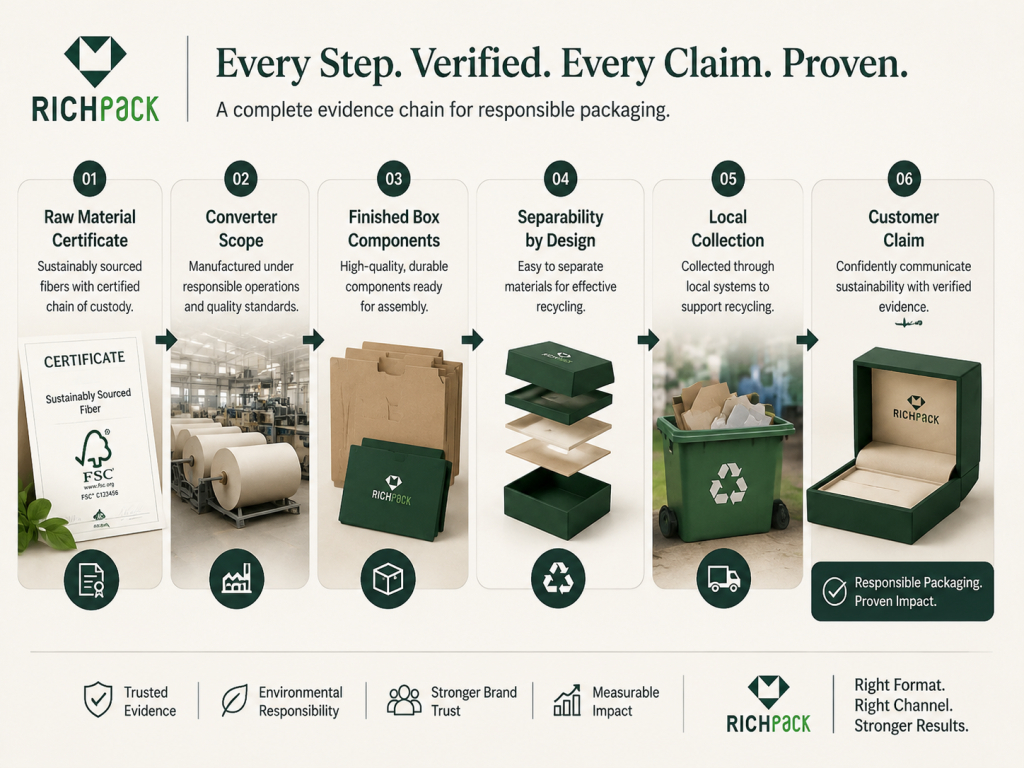
A claim is useful only when the buyer can trace it to the finished construction. FSC labels distinguish FSC 100%, FSC Recycled, and FSC Mix. Those labels describe sourcing categories; they do not prove that every assembled box is recyclable in every market.
The European rules also push packaging toward less waste and economically viable recyclability. For a buyer, that means asking for the material breakdown, certificate scope, supplier chain, separability, coatings, magnets, foam, ribbons, and local collection assumptions.
RichPack’s published premium sustainable packaging project frames the right tension: reduce environmental burden without losing the tactile and gifting functions the product needs. The proof should sit in the specification pack, not in a green color palette.
Good artwork cannot rescue a weak structure. Good structure cannot rescue unreadable product information. The two teams need one approval path.
Place the real product on the table before choosing a box. Record its maximum dimensions, weight, center of mass, sharp points, delicate surfaces, loose parts, and acceptable contact areas.
Then record the route:
A founder may ask for the smallest possible box to save freight. The packer may need finger clearance, while the store may need a larger front panel for the product code. Those constraints belong in the same decision.
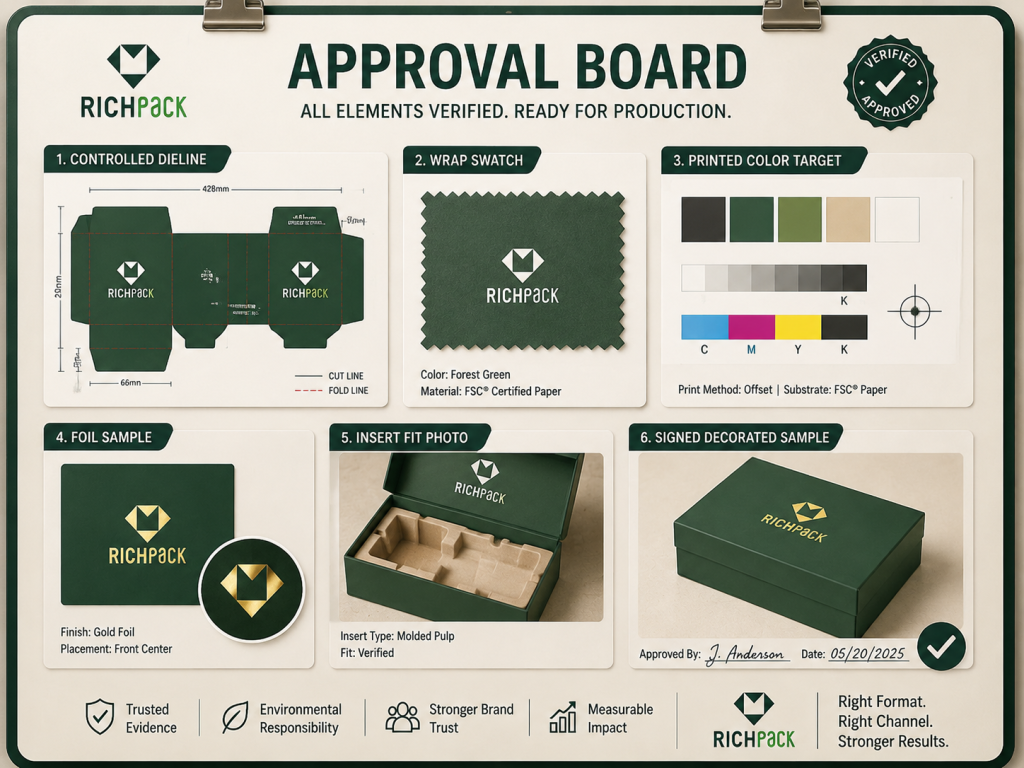
A dieline is the flat production drawing that defines cuts, folds, glue areas, panels, bleed, and safe zones. For rigid boxes, the structure file may also include board parts, wrap turns, hinge gaps, magnet pockets, and insert clearance.
Do not let the graphic designer redraw a supplier dieline from a screenshot. Use the controlled file and preserve its scale. Mark the file version, product version, and units on the approval.
For jewelry inserts, add the product envelope rather than one nominal measurement. A handmade pendant or cast ring may vary enough to turn a neat cavity into a pressure point.
The front panel should answer the first retail question fast: whose product is this, and what is it? Secondary panels can carry the variant, care, origin, warning, product code, barcode, and legal information needed for the target market.
Do not let a foil logo cross a wrapped edge simply because the render looks clean. Do not place a code on a velvet texture because there was no room left. Reserve each functional area before the visual system becomes fixed.
When one box serves several products, separate permanent print from variable data. A common branded box with a controlled label area may lower obsolete inventory without making the pack look improvised.
CMYK handles images and process color. Spot colors help control a critical brand color. Foil adds a reflective layer, while embossing and debossing change the surface. Lamination and coatings alter gloss, touch, rub behavior, and disposal.
The substrate decides what the method can reproduce. Fine type that prints cleanly on smooth coated paper may fill in on textured wrap. A foil that looks warm under one light may turn green or pale under another.
Approve a decorated sample with the actual wrap and finish combination. Keep a physical color reference, foil code, artwork file, and signed sample together.
Opening is only half the experience. The customer also has to remove the jewelry without snagging it, put it back without a diagram, and store it without crushing a chain.
RichPack’s published EFFY jewelry box project records an order of at least 5,000 pieces and a three-week lead time. The documented design used black, white, gray, metallic tones, and brand-specific Jaguar cues. Those choices work as a case because the visual system, box structure, and production scale were considered together.
The useful lesson is not to copy the colors. It is to translate a recognizable brand asset into a surface and structure that production can repeat.
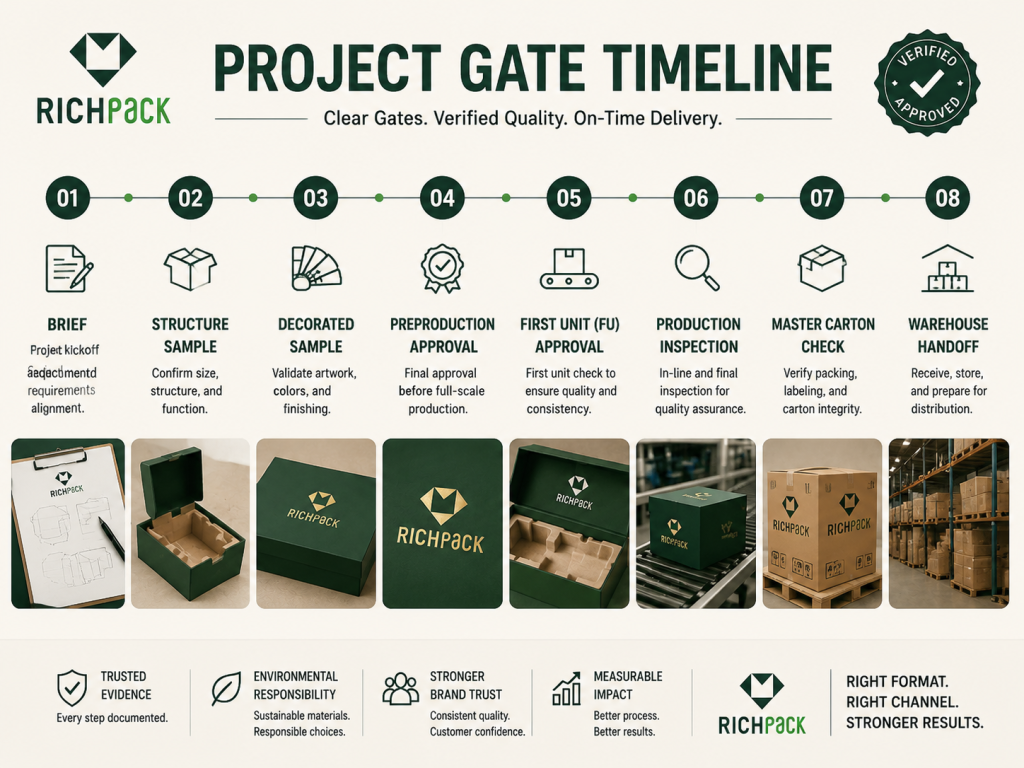
A clean project has visible gates. Each gate answers a different question, and skipping one usually pushes the problem into production.
A packaging brief gives suppliers enough facts to propose the same job. Without it, one quote may include a fitted insert and export packing while another covers only an empty retail box.
Include these fields:
A logo and a mood board are not a brief. They are two inputs inside one.
A white sample checks size, opening, clearance, fit, and basic assembly without final decoration. A printed sample checks color, graphics, finish, texture, and the interaction between decoration and structure.
Neither sample proves bulk consistency. A digital print may not match offset production. A hand-cut insert may fit better than the tool-made version. Write down what each sample approves and what remains open.
Send the real product or a controlled dummy whenever possible. Photos and nominal dimensions miss chain drape, flexible parts, protruding stones, and the way a customer grips the item.
Preproduction approval freezes the inputs that production will follow. It should identify the current dieline, artwork, color target, material codes, board thickness, lining, hardware, insert geometry, packing method, master carton, and approved sample.
This is where quiet changes become expensive. A marketing team changes the care card after the insert tool is approved. The thicker card lifts the necklace, the pendant touches the lid, and the “small artwork update” becomes a structural problem.
Use one change log. A revised file without a matching sample decision should not enter production.
Production control starts with incoming materials and the first made unit. It continues through print, finishing, wrapping, insert assembly, packing, and the final sample drawn from finished goods.
Set observable limits for the defects that matter:
A phrase like “high quality” cannot pass or fail an inspection. A reference sample and defect limit can.
The finished retail box has to fit the people and equipment that pack it. Confirm whether boxes arrive assembled or flat, whether inserts arrive installed, and whether staff add pouches, cards, labels, or tamper seals.
Measure the packing step with real components. A ribbon that takes 25 seconds to tie adds almost seven labor hours across 1,000 orders. That is a planning calculation, not a universal benchmark, but it shows why assembly belongs in the cost review.
Share master-carton counts, carton dimensions, weights, barcode placement, pallet pattern, and handling notes with the warehouse before goods arrive.
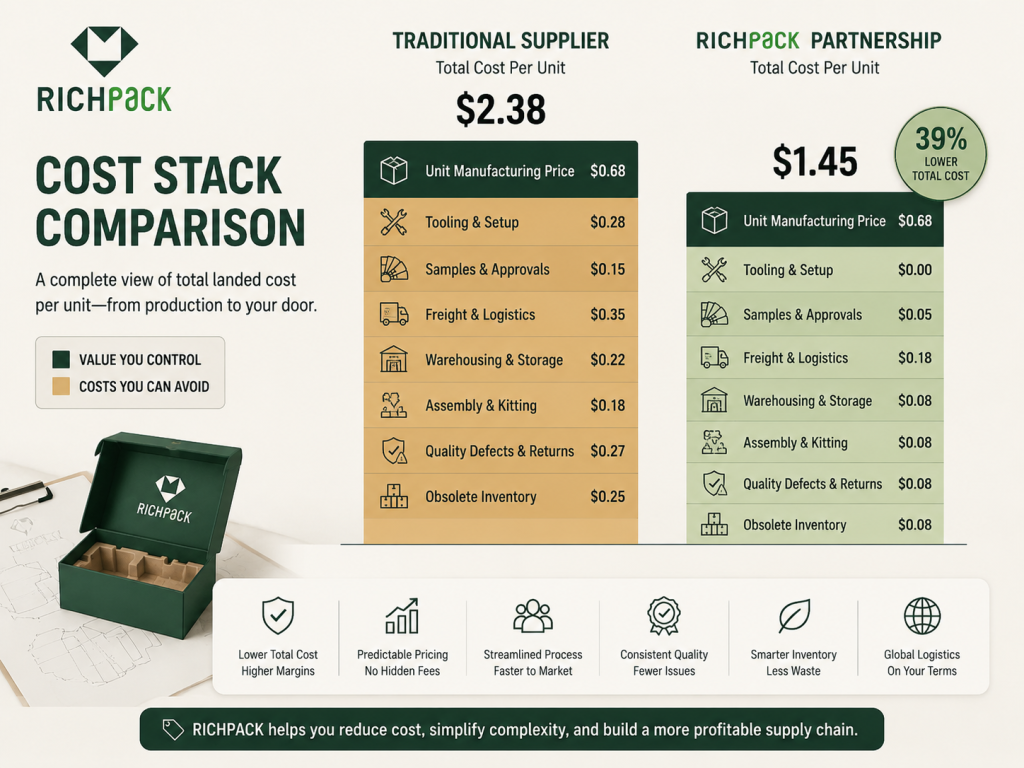
A quoted unit price hides several different costs. Separate them before comparing suppliers.
One-time costs may include structural work, cutting dies, print plates, molds, logo tools, white samples, decorated samples, color proofs, and courier charges. Some tools can serve repeat orders; others change when the size or artwork changes.
Fixed-cost dilution is simple. If a die costs 135, it adds 1.35 at 100 units, 0.27 at 500 units, and 0.135 at 1,000 units. Those figures are math examples, not a supplier quote.
Ask which setup costs return on a repeat order. Also ask who owns the tool and how long the supplier stores it.
Material cost rises with board area, thickness, wrap, lining, insert volume, hardware, and waste. Structure adds machine and hand operations. Finishes add tools, setup, spoilage, and extra inspection.
RichPack’s published cost optimization project describes a growing North American jewelry brand with rings, earrings, and necklaces. The approach simplified low-impact structural details, adjusted the board and wrap combination, and kept a fitted insert and branded finish.
That is the right order of cuts. Remove features the customer barely notices before weakening the structure, fit, or product contact surface.
MOQ comes from more than supplier policy. It can come from material purchase quantities, print setup, tooling economics, machine speed, hand assembly, or a finish vendor’s minimum run.
First-time founders keep running into minimums larger than their launch plan. One response is to share a structure across several products and vary the label, card, sleeve, or insert. Another is to start with a stock base and one controlled custom feature.
RichPackin low MOQ startup packaging project documents a first collection of minimalist rings and necklaces. The solution used a rigid box, fitted insert, textured wrap, and branded application without publishing a one-size-fits-all minimum.
Total landed cost includes the product box, tooling, samples, inspection, freight, duties where applicable, warehouse handling, assembly, storage, damage, and obsolete inventory. A lower factory price can be lost once volume enters the calculation.
Rigid boxes often ship preassembled and carry air. Folding cartons can ship flat but require forming and sometimes gluing at the packing point. Compare master-carton utilization and labor, not only the retail unit.
A supplier near the sales market may quote more per box and less freight. An overseas supplier may offer better structure or scale. Put both routes into the same landed-cost sheet.
Lead time has separate clocks: structural development, sample making, artwork, material purchase, production, inspection, freight, customs, and warehouse receipt. A “three-week production time” does not mean boxes reach the packing table in three weeks.
Plan backward from the date goods must be available, not the public launch date. Add approval time for the brand team and a buffer for sample corrections.
For repeat orders, record which materials are standard and which need a special purchase. The slowest component may be a dyed fabric, custom magnet, special wrap, or branded hardware rather than the box assembly.
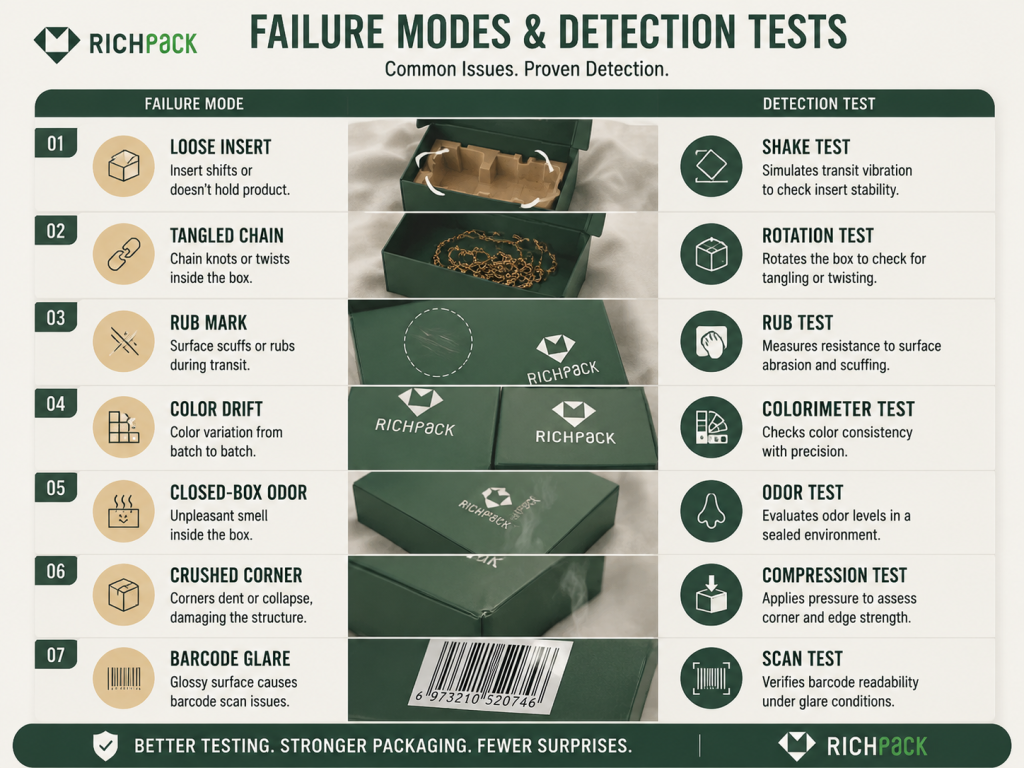
Testing should match the product and route. A small jewelry box does not need every laboratory procedure, but it does need evidence for the hazards it will face.
Start with the simplest check. Insert the real product, close the pack, rotate it, shake it by hand, open it, and remove the item as a customer would. Repeat the cycle.
Look for chain migration, ring rotation, earring-post contact, pressure on stones, watch weight, finger clearance, and damage to the finish. Test the smallest and largest product within the stated tolerance.
The fit should survive normal movement without turning removal into a tug. Too tight is a defect too.
Rub tests expose weak print, foil, wrap, flocking, and dyed surfaces. Use a defined contact material, stroke count, pressure, and condition so the result can be repeated.
Check color under agreed lighting against a physical reference. For odor, close finished samples in a clean bag or container for a set time, then open them away from production smells. Record the condition instead of writing “no odor.”
For jewelry contact, inspect both the product and lining after contact and conditioning. Watch for residue, dye transfer, dulling, scratches, and visible reaction.
ASTM D4169-23e1 gives labs one way to test a shipping unit against a set of delivery hazards. ASTM states that it uses “established test methods at levels representative of those occurring in actual distribution.” The route still decides which test plan fits.
ISTA separates screening tools from general simulations. Its 1-Series challenges package integrity, while the 3-Series models hazards associated with a shipment type. That distinction matters. A quick screen helps compare designs, but it does not prove every distribution route.
Choose the method based on parcel size, weight, carrier route, palletization, and failure risk. Test the complete shipping unit, not an empty retail box.
Put samples into the real workday. Scan the barcode at the intended distance and replenish the shelf. Pick the order from a bin, then add the card and pouch.
Pack the shipper and process a return.
The trial often catches small problems that a lab does not. A glossy sleeve reflects the scanner light. A drawer tab hides under tissue. The box fits the shipper until the warehouse adds a return label pouch.
Ask the person doing the work what slows them down. That answer is usually more useful than another mood-board review.
A golden sample is the approved physical reference for bulk production and inspection. It should carry signatures or a controlled approval record, date, version, and any known limits.
Do not ask the sample to answer questions it cannot answer. One perfect box cannot define acceptable batch color variation or every dimensional tolerance. Pair it with written specifications and defect examples.
Keep a production sample from each order. When a reorder changes shade, opening force, insert fit, or odor, the team can compare physical evidence instead of relying on memory.
A supplier should make risk visible before production. Nice samples matter, but the documents, questions, and response to a failed test reveal more.
Ask what the supplier produces before the first sample. Useful outputs include a controlled dieline, structural drawing, insert drawing, material list, product-clearance review, and packing proposal.
A supplier that only accepts finished artwork may be fine for a standard carton. A high-value jewelry set needs more engineering support because product position, lid clearance, insert recovery, and weight distribution affect the result.
RichPackin räätälöidyt korutarjottimet show the kind of component where dimensions and movement deserve more attention than a logo placement alone.
Ask for material codes and tolerances. “Black velvet” is not a stable specification. Fiber, pile, backing, dye lot, thickness, supplier, and approved swatch can change the way it looks and fits.
For print and finish, ask how the supplier controls color, foil, register, texture, rub resistance, and approved references across repeat orders. If one process is subcontracted, identify who owns the approval and correction.
The answer should describe a control, not a promise. “We match the signed sample under agreed light” is useful. “We always deliver perfect color” is not.
A capable supplier can explain which sample answers which question. The supplier should also state what it checks during production and what report, photographs, measurements, or retained samples the buyer receives.
Ask to see a blank inspection form before ordering. It reveals whether the planned checks match your risk. A jewelry box inspection that lists only outer dimensions and print color misses insert fit, closure, glue, odor, and product contact.
If a test fails, ask how the design changes and who approves the retest. Failure is not the warning. A vague response is.
Compare the reason behind the MOQ. A material minimum may allow several sizes to share one wrap. A printing minimum may allow several artworks on one sheet. A molded insert may need its own tool for every product envelope.
Check whether the supplier can support a small launch and a larger repeat without changing the look. RichPack’s overview of wholesale jewelry box MOQ and pricing can help buyers frame those questions.
Also ask about repeat-order files, retained tools, material substitutions, notice of change, and sample requirements after a long gap.
Name one owner for design questions and one for commercial delivery. Record response times for approvals, change requests, and quality issues.
Compare Incoterms, export packing, documentation, shipment visibility, claims handling, replacement policy, and the location of any stocking program. A low quote with unclear delivery terms can move cost and risk back to the buyer.
| Toimittajan todisteet | Weight in review | What a strong answer contains |
| Engineering output | 20% | Controlled drawings, clearance review, and version ownership |
| Näytteen laatu | 20% | Real product fit and decorated construction |
| Material and print control | 15% | Codes, references, tolerances, and change control |
| Laadukas näyttö | 15% | Test plan, inspection record, defect handling, retained sample |
| Maahantulokustannukset | 10% | Freight, packing, assembly, duties, and inventory assumptions |
| Läpimenoaika ja kapasiteetti | 10% | Separate clocks, reorder plan, and peak-season limits |
| Communication and recovery | 10% | Named owners, response path, and corrective action |
Most rework begins before the machine runs. The cause is usually an open decision that everyone assumed someone else had closed.
A new clasp, thicker care card, longer chain, or added cleaning cloth can change the cavity and lid clearance. If the dieline and insert tool are already approved, the box may need a new insert or full size change.
Freeze a product envelope, not one lucky sample. Record the maximum dimensions, tolerances, flexible parts, and all items packed together.
A render can approve general layout and proportion. It cannot approve texture, odor, opening force, magnet feel, wrap tension, chain behavior, actual color, or the way a customer removes the jewelry.
Buyers who have been burned by custom boxes often describe the same gap: the image looked right, but the object did not work. Approve the object.
A gift box may pass every desk check and arrive with crushed corners because the shipper had excess space. It may also survive a drop while the necklace moves out of its slot and scratches the pendant.
Test the product, insert, cards, retail box, cushioning, shipper, tape, and closure together. The complete unit is what the carrier handles.
Screen color is not production color. A paper certificate is not proof that every box component falls within its scope. A supplier’s “eco” label is not a disposal instruction.
Ask for physical references, component breakdowns, certificate numbers where applicable, and the conditions behind each claim. Keep the approved records with the purchase specification.
A larger order may cut unit cost and raise total risk. The extra boxes need cash, freight, storage, handling, and a plan if the product, label, market rule, or brand identity changes.
Calculate savings against likely usage. If a lower price saves 0.20 per box but requires 5,000 extra boxes, the brand commits another 1,000 before freight and storage. The math is simple. The forecast is the hard part.
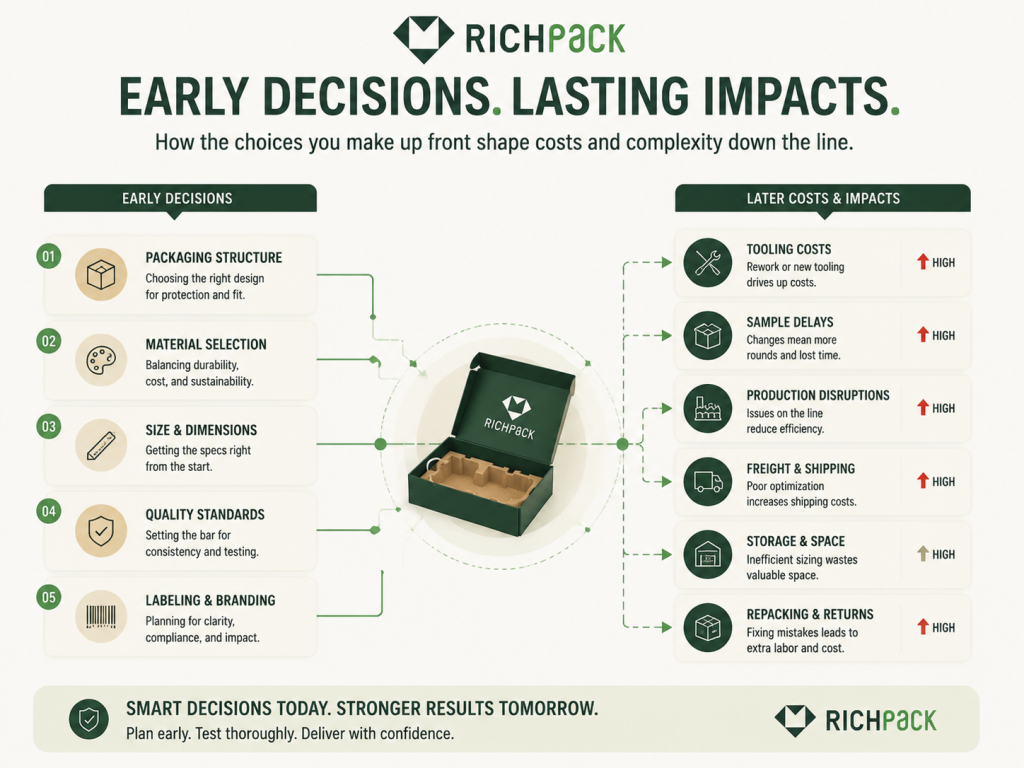
Custom retail packaging is a product-facing pack designed around a specific product, brand, sales channel, and distribution route. It can include a fitted insert, printed carton or rigid box, retail information, and a protective shipping system.
It is worth the investment when customization solves a recurring problem such as movement, damage, slow packing, weak shelf presence, inconsistent branding, or gift presentation. Stock packaging is safer while product dimensions and demand remain uncertain.
Cost depends on size, materials, structure, insert, printing, finish, tooling, quantity, assembly, inspection, and freight. Compare total landed cost and inventory exposure rather than using an unsourced price per box.
There is no single minimum. MOQ may come from material purchases, printing setup, tooling, molding, machine efficiency, or hand assembly. Ask suppliers to explain the constraint and whether shared structures, standard materials, or variable labels can reduce it.
The calendar includes design, structural samples, decorated samples, approval, material purchase, production, inspection, freight, customs, and warehouse receipt. Ask for each clock separately and plan backward from the date boxes must be available for packing.
The safest packaging decision starts with the product and route. Lock the product envelope, sales channel, insert behavior, retail information, shipper, and expected order pattern before spending time on finishes. Then use physical samples and written defect limits to turn the visual idea into a repeatable production standard.
For jewelry brands, Custom Retail Packaging has to do more than look refined. It must keep chains controlled, protect polished surfaces, avoid risky contact materials, survive delivery, scan at retail, and remain practical when a customer stores the piece again.
Send product dimensions, SKU count, order quantity, sales channels, destination markets, target delivery date, and visual references when you discuss a packaging brief with RichPack. Those inputs give the design and supply teams something concrete to solve.
2026-05-19

2024-11-15

2025-04-24
2026-01-25
2025-11-25
2025-10-12
Ihastuttavat söpöt kosmetiikkapakkaukset korostamaan brändiäsi – Richpackin mukautettavat mallit kosmetiikkapakkausmarkkinoille
Katso lisää
Edulliset mittatilaustyönä tehdyt korujen järjestäjät pienillä vähimmäistilausmäärillä | Suunniteltu pienimuotoisille korujen vähittäismyyjille, jotka tarvitsevat mukautettuja pakkauksia
Katso lisää
Edulliset räätälöidyt korurasiat itsenäisille jalokivikauppiaille | Budjettiystävälliset ratkaisut laadukkailla malleilla
Katso lisää
Edulliset korutelineet riippumattomille jalokivikauppiaille | Räätälöity pienille jälleenmyyjille, jotka etsivät tyylikkäitä, mukautettuja näyttöjä edulliseen hintaan
Katso lisää
Ovatko ruskeat paperipussit kierrätettäviä – Opi vihreistä ja ympäristöystävällisistä paperinkierrätyspusseista ja muista kestävistä pakkausvaihtoehdoista
Katso lisää
Art Deco -korupakkaukset: Yhdistä eleganssia ja nykyaikaisuutta ikimuistoiseen pakkauksen purkamiseen Richpackilla
Katso lisää

