

 Roimhe
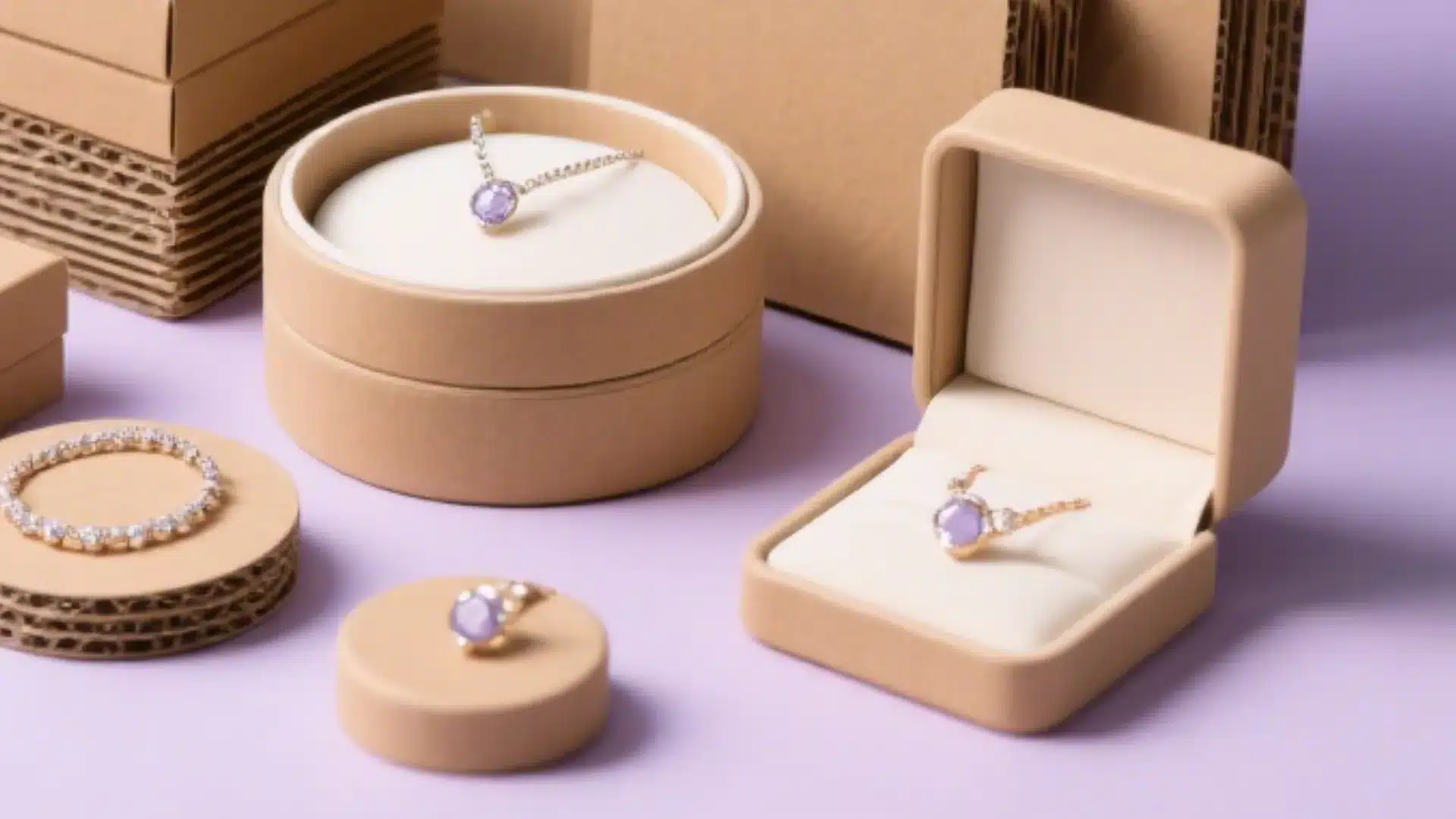
A’ taghadh an tighead bhùird cheart airson bogsaichean mullach is bonn cruaidh
2025-06-11
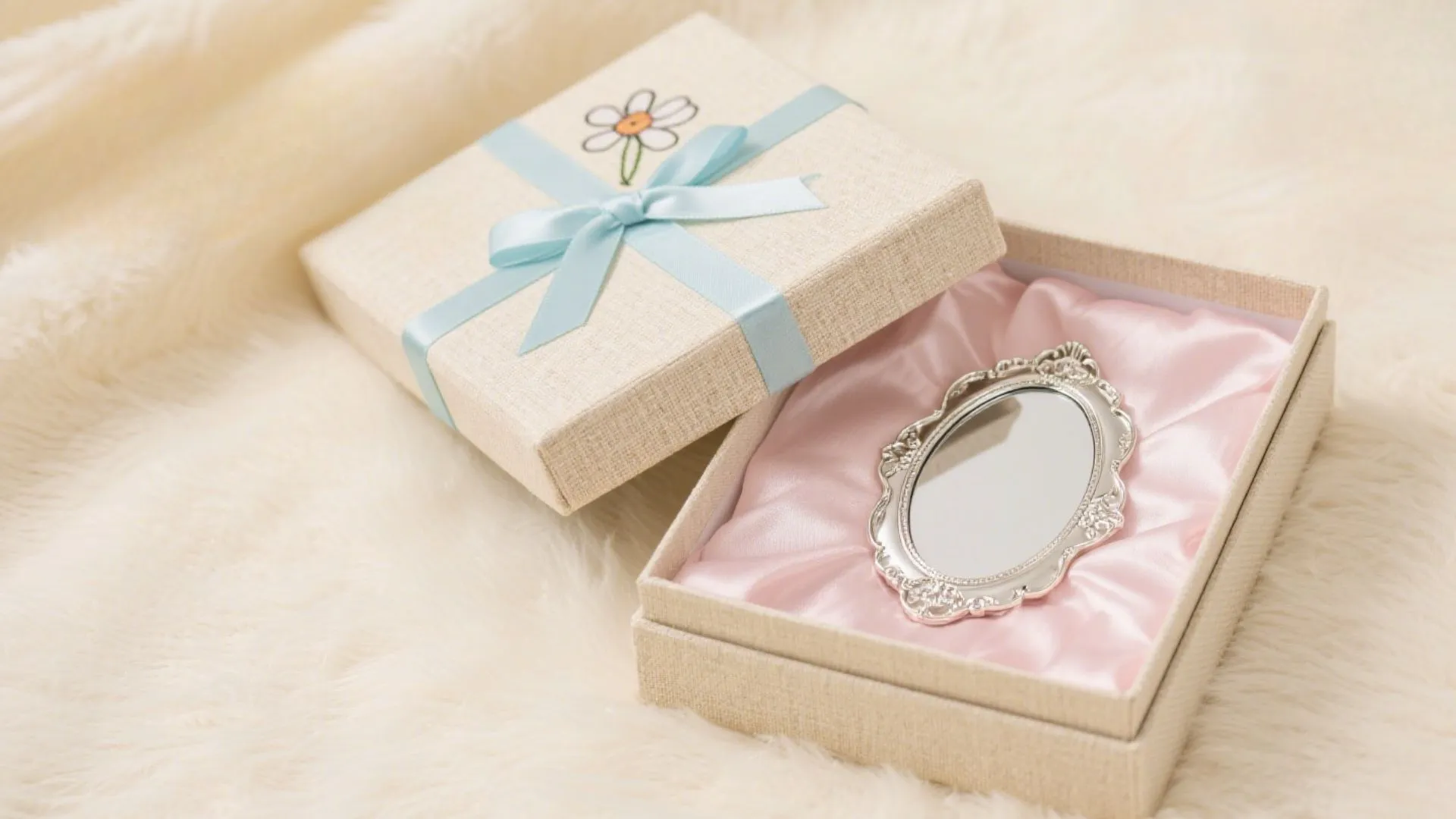



If you are comparing Lid and Base vs. Shoebox Style for Pacadh seudaireachd, you are not just choosing a box shape. You are choosing how your customer first reads your brand.
A lid and base box uses a separate top and bottom. It feels more premium, provides a stronger reveal for the jewelry, and works well with custom inserts. A shoebox-style box is simpler, easier to stack, and often better for higher-volume product lines where speed, storage, and unit cost matter more.
This guide will help you choose the right structure by looking at cost, protection, unboxing, shipping, jewelry type, sustainability, and supplier workflow. You will also get a simple decision framework you can use before sending a custom packaging brief.
| Factor | Bogsa mullach agus bonn | Shoebox Style Box |
| Structair | Separate the lid and base | Simple box with lid-style opening |
| Fit as fheàrr | Luxury jewelry, gifts, sets | Entry collections, ecommerce, bulk SKUs |
| Faireachdainn Premium | làidir | Medium to strong with better materials |
| dìon | Strong with custom insert | Good with the right insert and the shipper |
| Smachd cosgais | tro Mheadhan na | làidir |
| storage | A’ gabhail barrachd àite | Easier to stack |
| Animals | Sònraichte | Math |
| Unboxing | Slow, deliberate, gift-ready | Fast, simple, familiar |
| seasmhachd | Good with FSC paper and molded pulp | Good with right-sized design |
| Buyer Risk | Overbuilding low-price items | Underwhelming high-value pieces |
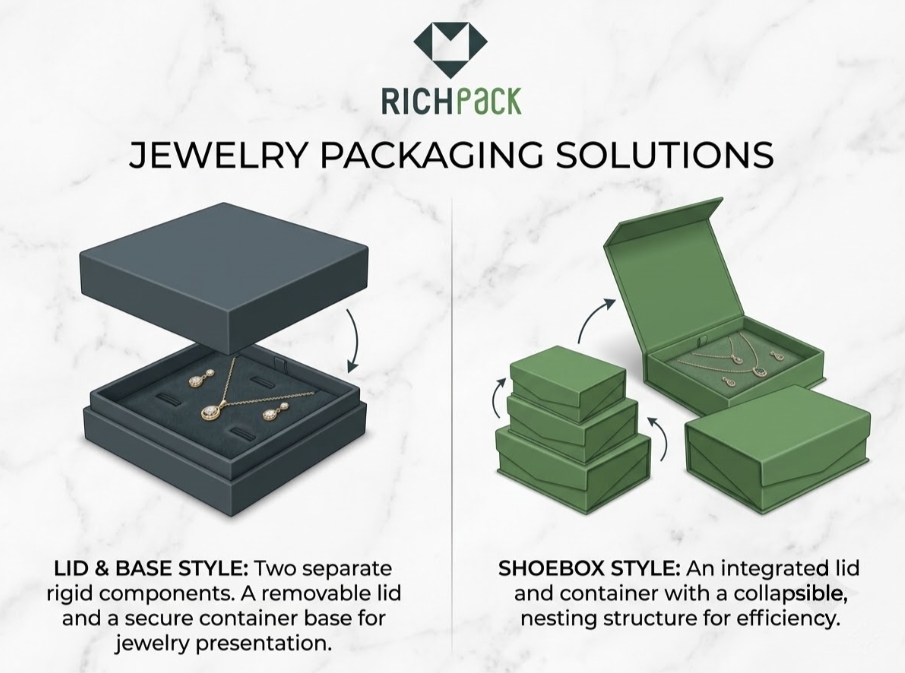
Box names can get messy in packaging. One supplier may say “top and bottom box.” Another may say “lid and base box.” Some markets even use “shoebox design” for a two-piece gift box.
Do not get stuck on the label. Focus on the structure, the opening motion, and the job the box must do.
A lid-and-base box is a two-piece rigid packaging structure with a separate top lid that lifts completely off the base tray. It is mainly used for premium jewelry packaging that needs a stronger reveal, better insert control, and a more gift-ready feel.
In packaging terms, it often belongs to the rigid box family. You may also hear names like two-piece rigid box, top and bottom box, lift-off lid box, or setup box.
This structure works well when the product needs a stronger first impression. Think engagement rings, fine necklaces, limited-edition pieces, or a gift set that needs to feel intentional.
Shoebox style packaging is a practical box structure that opens like a standard shoe box, with a lid-style top and a base that holds the product. It is mainly used when jewelry brands need simple stacking, faster packing, lower storage pressure, and cleaner e-commerce fulfillment.
For jewelry brands, this style makes sense when you need a clean branded box without overcomplicating fulfillment. It can still look premium, but the core value is efficiency.
A small e-commerce jewelry brand may use shoebox-style packaging for everyday earrings, chains, or seasonal drops. It keeps the product presentable while helping the team pack faster.
The confusion comes from supplier language. In some factories, “shoebox style” describes the general lid-over-base shape. In buyer conversations, it often means a simpler, more practical box used for stacking and shipping.
Cleachd an riaghailt seo: ask your supplier for a structure drawing, not just a box name.
A dieline, 3D mockup, or sample will tell you more than a product label. It shows lid depth, base height, board thickness, insert position, and how the jewelry sits inside.
Rigid boxes use a thicker board than folding cartons. That gives them better hand feel, stronger edges, and a more stable shape.
For jewelry packaging, this matters because the product is small yet emotionally valuable. A thin box can make a ¥500 necklace feel like a ¥50 accessory.
The box does not need to be heavy. It needs to feel controlled, clean, and well-matched to the product.
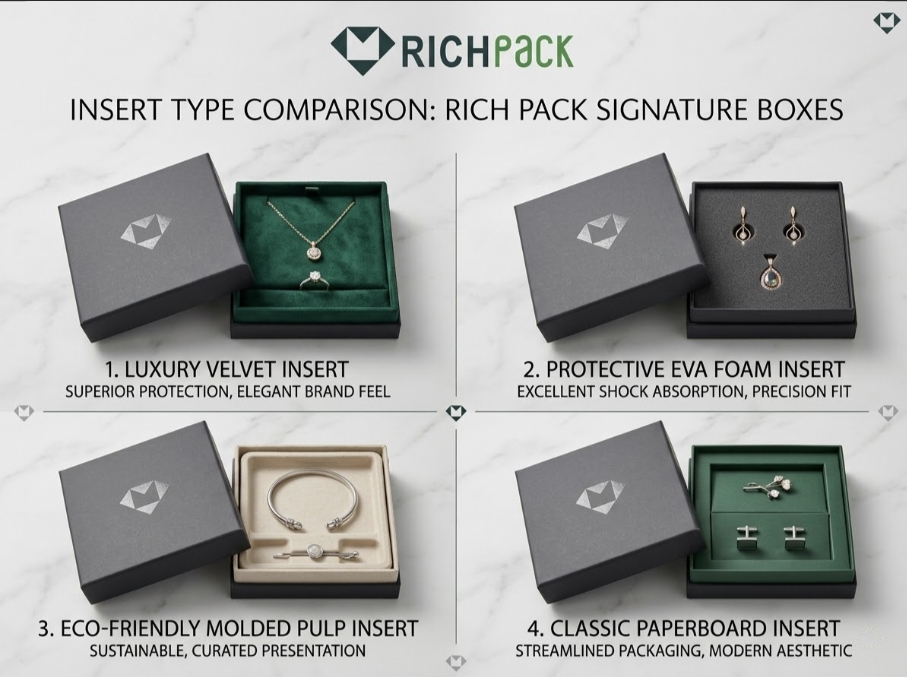
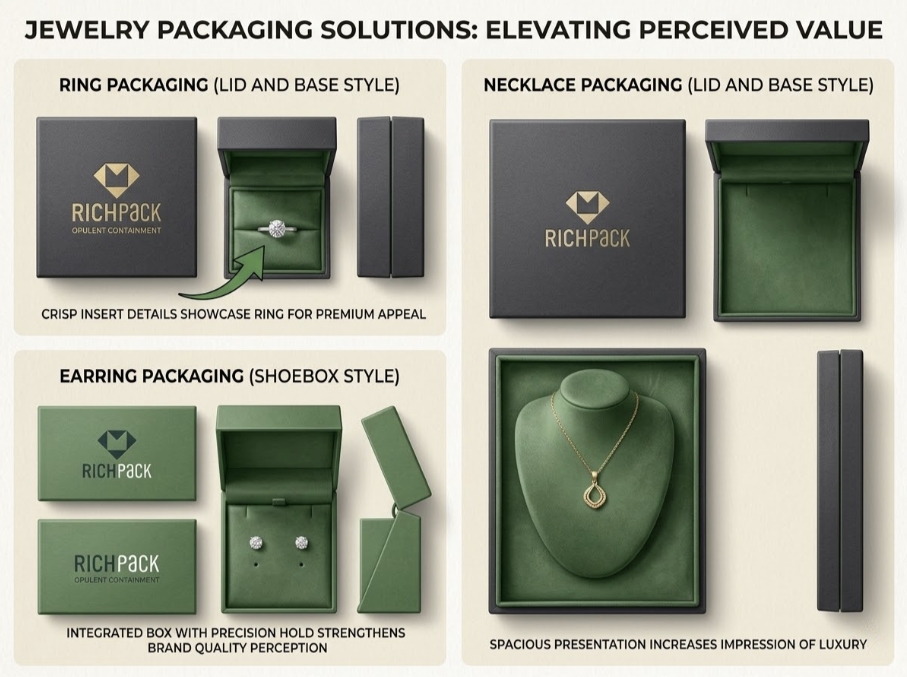
The insert is what turns a nice box into useful jewelry packaging. It holds the ring, chain, earring pair, pendant, bracelet, or set in the right place.
Common insert options include velvet, satin, EVA foam, molded pulp, cardboard, and paperboard. Each one sends a different signal.
Velvet feels classic and gift-ready. Molded pulp feels more sustainable. EVA foam gives clean support and tight tolerance when the shape needs control.
Drawer boxes and magnetic closure boxes are not the main focus here, but they matter in the decision set.
Drawer style works when you want a slow reveal. Magnetic closure works when you want a clean snap and a stronger, premium cue.
Use them when the opening motion is part of the product story. If the goal is only cost control or fast packing, they may add complexity without adding enough value.
Packaging is not decoration. It is a small supply chain system that must protect the product, help the warehouse pack, and make the customer feel good when the order arrives.
This is where the lid, base, and shoebox style start to behave differently.
A lid and base box slow the opening moment. The customer lifts the lid, pauses, and sees the jewelry in a controlled reveal.
That small delay can help high-value jewelry feel more important. It gives the buyer a gift moment before they touch the product.
Shoebox style is more direct. The customer opens it quickly, sees the product, and moves on. That is not bad. It simply fits a different buying moment.
Jewelry is small, but it is rarely simple to pack.
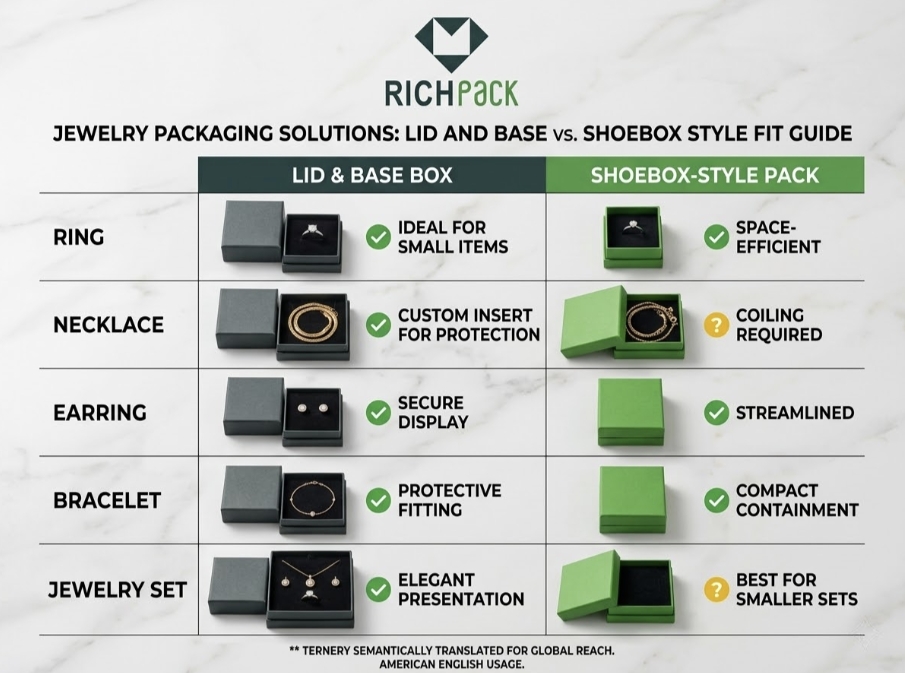
Rings need a slot that holds the band upright. Necklaces need a way to stop chains from tangling. Earrings need paired holes or tabs. Bracelets need length, curve, or soft support.
A lid and base box gives more room for a display-style insert. Shoebox style can work well, too, but it needs careful insert design if the jewelry must stay centered.
Protection starts inside the box, not outside it.
Thin chains, small stones, sharp posts, and polished metal surfaces can move during shipping. If the insert is loose, the box style will not save the product.
Use the lid and base when the piece needs a stronger interior presentation. Use a shoebox style when the product is less fragile or when the outer mailer and inner insert already control movement.
Movement is the hidden enemy in jewelry packaging. It causes scratches, tangles, bent posts, and bad unboxing photos.
A good insert should do three things:
This is where supplier experience matters. A box can look perfect in a render and fail in a drop test.
Gift-ready packaging is not just “pretty.” It should make the buyer feel they can hand it to someone without adding another bag, wrap, or card.
Lid and base boxes usually win here. The lift-off lid, fitted insert, and stronger board make the presentation feel more complete.
Shoebox style can still work for gifting if you upgrade the paper, use a clean insert, and add a branded sleeve or belly band.
The first view after opening matters. If the necklace sits crooked or the earrings shift in transit, the customer sees a problem before they see the product.
Plan the reveal around the product’s best angle. For rings, show the stone. For necklaces, show the pendant. For earrings, show symmetry.
The cheapest box is not always the lowest-cost box. That line sounds boring, but it saves money.
Packaging cost includes unit price, insert cost, finishing, sampling, freight, storage, packing time, damage risk, and inventory pressure.
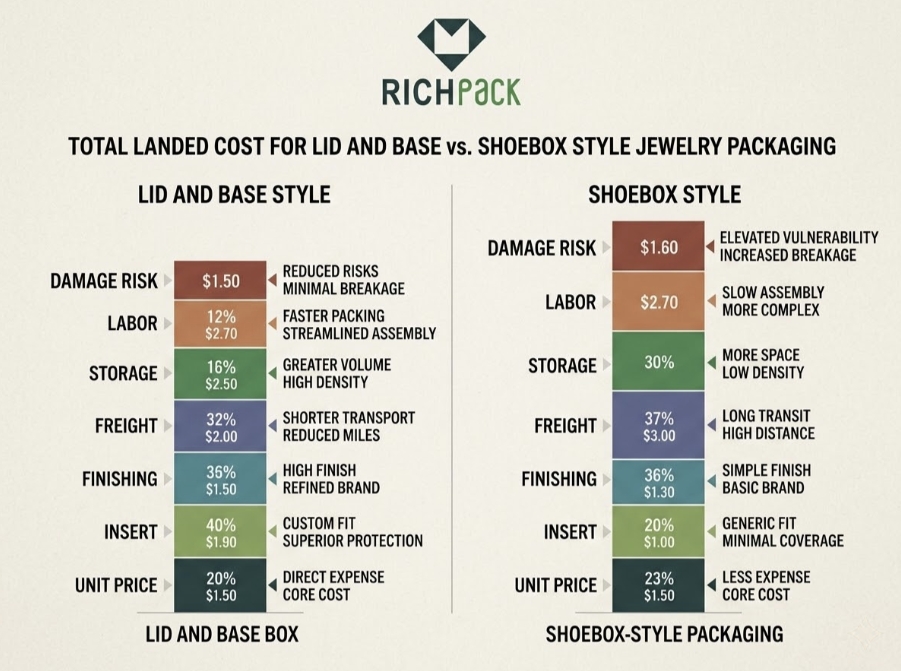
A lid and base box often costs more than a basic shoebox-style box because it uses stronger board, more material, and more finishing options.
But unit price alone is a trap. If the premium structure helps reduce returns, improve gift value, or support a higher price point, the extra cost may make sense.
Shoebox style often wins when the product line has many SKUs, frequent replenishment, and a tighter gross margin.
Landed cost is the real number you should watch. It includes packaging production, freight, duties, storage, handling, and damage-related costs.
A bulky box may look affordable at the factory, but it becomes expensive after international shipping. A right-sized box may look less impressive but protect the margin better.
For e-commerce packaging, right-sizing studies often cite 10-20% shipping cost savings when brands reduce space and control dimensional weight. Use that as a planning range, not a fixed promise, because carrier rules and mailer size change the final number.
For global jewelry brands, this is where packaging becomes a supply chain decision, not a design decision.
Carriers often price shipments by actual weight or dimensional weight, whichever is higher. That means a light but bulky box can cost more to ship.
Jewelry is usually light, so the box size matters a lot. A rigid gift box inside a mailer can create space that still gets charged.
Shoebox-style packaging can help when it stacks tightly and fits standard mailer sizes. Lid and base can still work, but you need to test the final packed carton.
As a practical planning rule, a bulkier rigid lid and base setup may increase dimensional-weight exposure by 15-20% compared with a compact shoebox style packout if it forces a larger outer mailer. The box is light, but the air around it is not free.
Packing speed matters when orders scale.
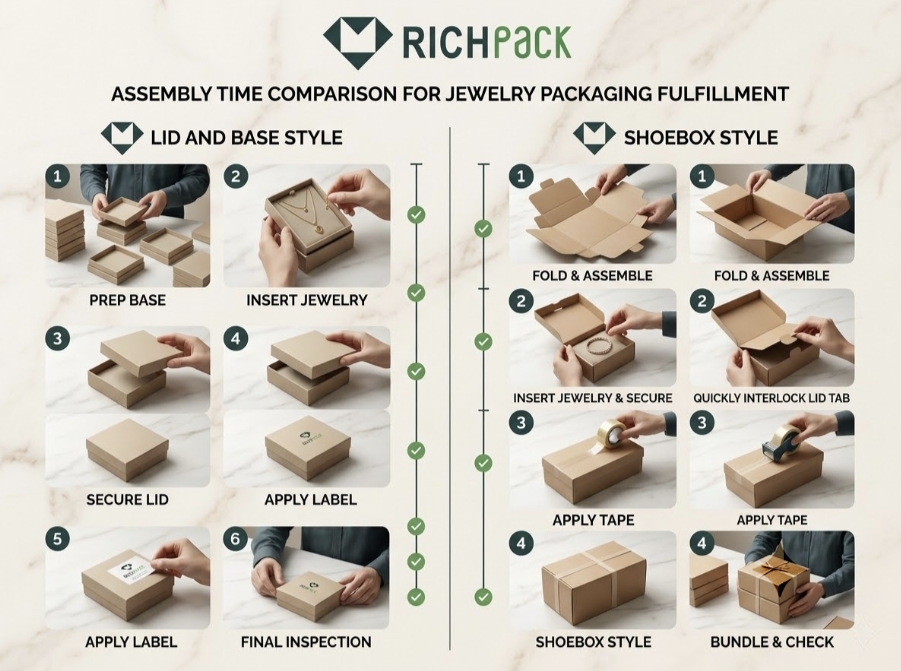
A simple shoebox-style box can be faster for warehouse teams. Staff can insert the jewelry, close the lid, add the sleeve or card, and move to the next order.
A premium lid and base setup may need more steps: tissue, insert check, lid alignment, sleeve, sticker, ribbon, or outer protection. That is fine for luxury orders. It is painful for high-volume, low-price SKUs.
In packing-line planning, switching from a complex rigid set to a streamlined shoebox design can reduce assembly steps by 25-30% for entry-level SKUs. Treat this as a workflow estimate, then verify it with a timed packing test.
MOQ gets tricky when you have several jewelry types, colors, sizes, and seasonal launches.
If each SKU needs a different insert or box size, your real minimum order can grow fast. This creates inventory pressure before the product even sells.
Use a shoebox style for shared-size packaging when the SKU count is high. Use lid and base when the product deserves a dedicated structure.
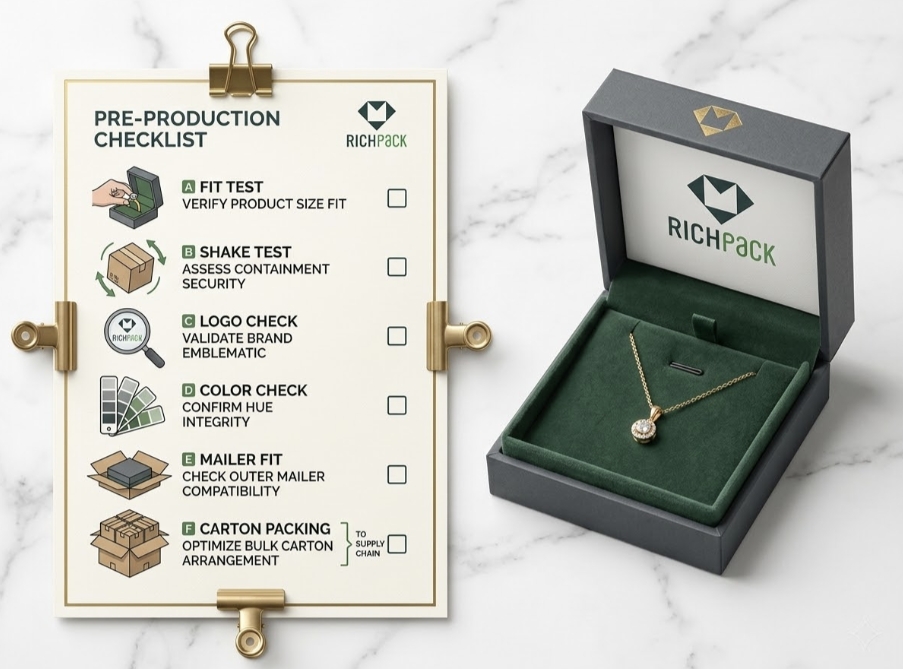
Never approve a custom jewelry box from a flat mockup alone.
Request a physical sample and test the opening feel, insert fit, logo position, color match, and packed shipping size. Then place the sample in the real mailer or retail bag.
A prototype catches the small problems that become expensive after mass production.
The right packaging structure depends on what you sell and what your customer expects after paying.
Do not force every product into the same box. Build a packaging system by price tier, product fragility, and sales channel.
Rings benefit from a centered reveal. The customer expects the ring to sit upright and feel protected.
A lid and base box with a velvet or EVA insert can create that classic jewelry-store moment. It works especially well for engagement rings, wedding bands, anniversary rings, and high-value gemstone pieces.
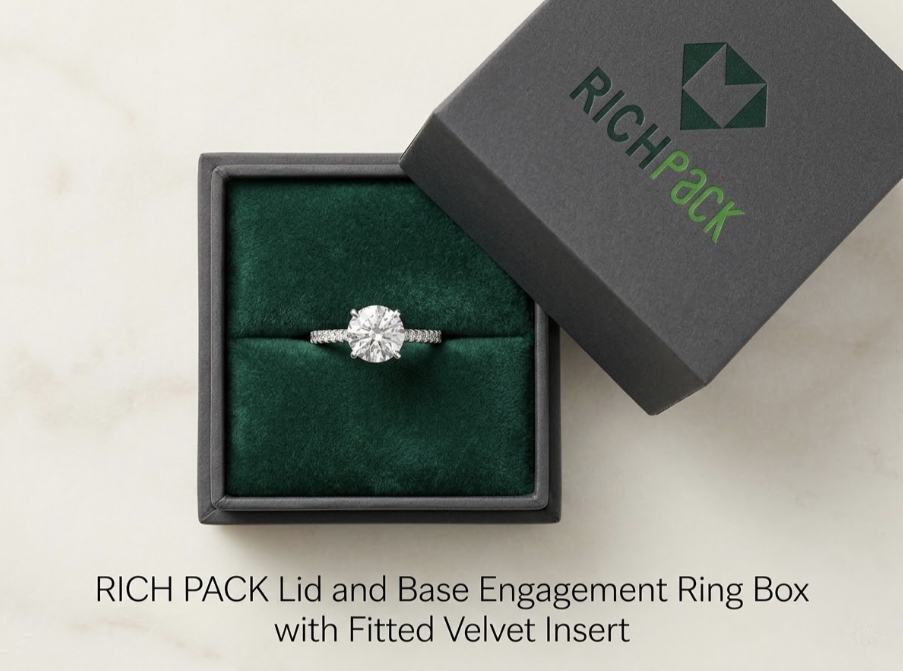
If the ring is low-cost fashion jewelry, a simpler shoebox style or paperboard box may protect the margin better.
Necklaces need controlled contact points. Without them, the chain can tangle, twist, or hide the pendant.
Use a card insert, hook system, ribbon tab, or molded channel. The box style matters less than the way the necklace is fixed.
Lid and base are better for necklace gifting because the pendant can be displayed at the center. Shoebox style is better when speed and storage matter more.
Earrings create a simple but annoying problem: they must stay paired.
A good insert should hold both pieces evenly, protect posts, and keep the pair visible. If one side shifts, the whole presentation looks careless.
Shoebox style can work well for earring collections if the insert is flat and repeatable. Lid and base work better for premium sets or gift orders.
Bracelets and bangles need more space than buyers expect. A box that looks elegant online can feel cramped in real use.
For bracelets, test the curve, clasp position, and removal motion. The customer should not need to pull hard or bend the piece.
The lid and base work well for soft display. Shoebox style works well when the bracelet sits on a card or padded tray.
Jewelry sets need order. A ring, necklace, and earring pair should not compete for space inside the box.
Use modular inserts when the same outer box needs to hold different combinations. This gives procurement teams more flexibility and reduces packaging chaos.
A lid and base structure usually gives a better set presentation. It lets each piece sit in its own zone.
Entry collections need clean packaging, not overbuilt packaging.
If the product is affordable, fast-moving, and often shipped online, a shoebox style can protect the product while keeping costs and warehouse steps under control.
You can still make it branded. Use better paper texture, a clear logo, a simple insert, and a thank-you card.
Packaging should not fight the product price.
A 30-yuan accessory in an overly luxurious box can hurt profit margins. A 900-yuan necklace in a plain, flimsy box can damage customer trust.
Use this rule: the box should make the price feel reasonable. Not cheap. Not wasteful. Reasonable.
The best jewelry brands do not choose one box. They built a packaging system.
That system connects structure, insert, material, finish, SKU plan, sustainability goal, and delivery workflow.
Board choice changes the feel of the box. Greyboard and chipboard are common for rigid boxes. Art paper, kraft paper, textured paper, and specialty wraps create the outside finish.
For premium jewelry packaging, a thicker board can improve hand feel. But thickness also affects freight, storage, and carbon footprint.
Choose the board by product value and channel. Do not choose the thickest board just because it sounds premium.
Finishes should support the brand, not shout over it.
Foil stamping works well for luxury logos. Embossing and debossing add a touch. Soft touch lamination creates a smooth, modern feel. Spot UV can highlight a small detail.
Do not stack every finish on one box. One or two controlled details usually look more expensive than five loud effects.
Sustainable packaging has moved past vague green claims.
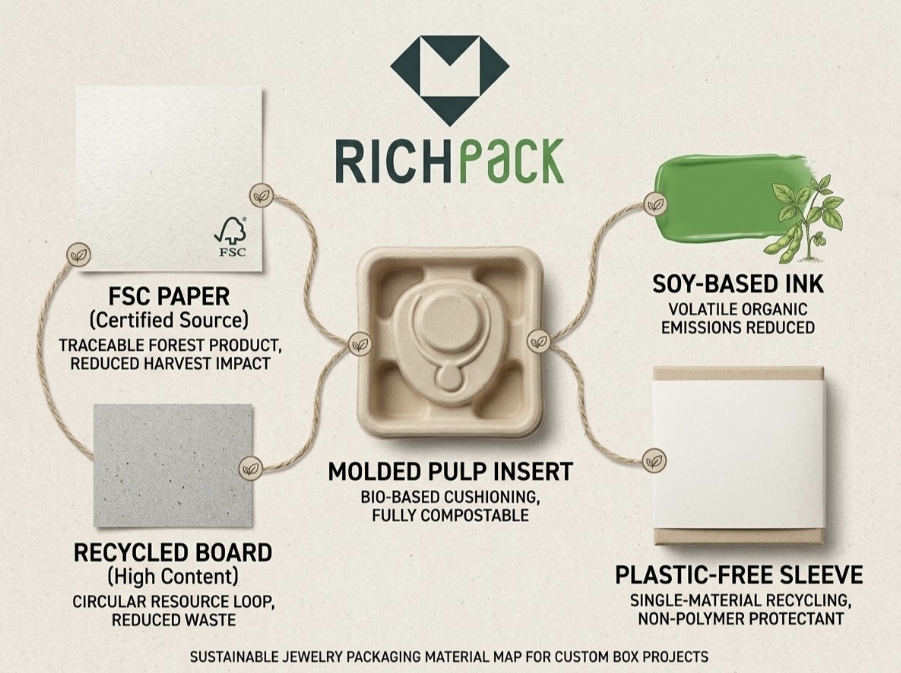
The Sustainable Packaging Coalition’s 2026 trends report points to better data, clearer design guidelines, recyclability assessment, and innovation in hard-to-solve packaging categories. That matters because buyers now ask for proof, not slogans.
For jewelry packaging, useful options include FSC-certified paper, recycled board, molded pulp inserts, soy-based inks, and plastic reduction. Ask suppliers for documentation before using these claims on a product page.
This is one of the most common mistakes in pacadh seudaireachd àbhaisteach.
Brands approve the outside look first. Then the insert gets squeezed into whatever space remains. The result is a pretty box that does not hold the product well.
Start with the jewelry dimensions, movement risk, and customer removal motion. Then design the decoration around that structure.
A good supplier brief saves days of back-and-forth.
Include these details before asking for a quote:
Tip: This brief helps the supplier quote structure, not just surface decoration.
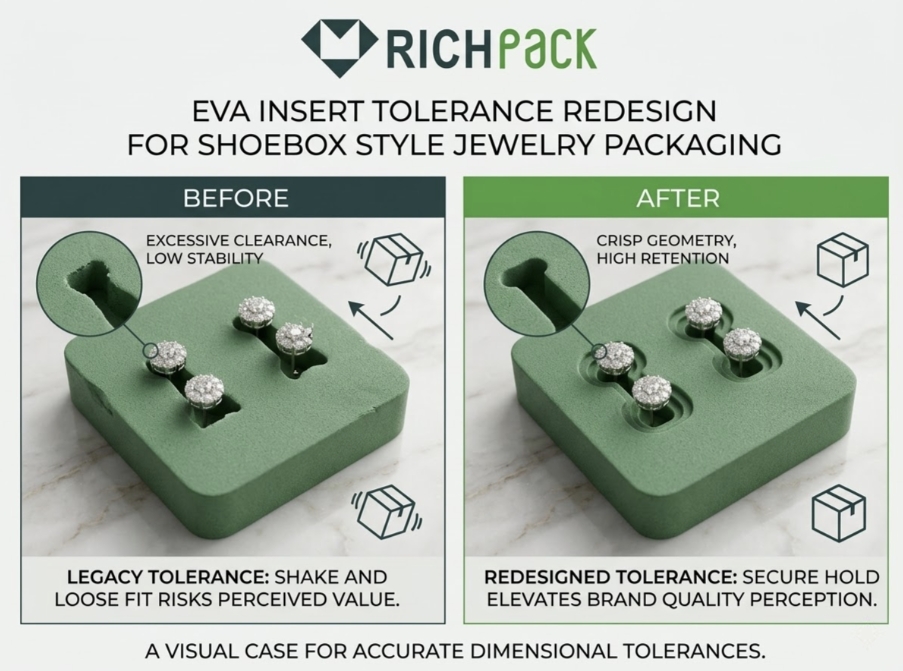
RichPack micro case study: an online jewelry brand selling small earrings had a clean shoebox-style package, but customers reported shifted pairs and bent posts after transit. The fix was not a heavier box. The better fix was a tighter EVA insert tolerance, a slightly deeper card slot, and a mailer-fit check. In internal packing tests, the revised structure reduced visible product movement by about 40% before the brand moved into the next production run.
A good manufacturer should push back when the structure creates risk.
For example, a deep lid may look premium but slow down packing. A beautiful insert may scratch metal if the material is too hard. A large box may raise freight costs without improving protection.
Ask for engineering feedback early. RichPack’s value as a one-stop custom jewelry packaging supplier is not only in making boxes. It is helping brands avoid the wrong box before production starts.
Packaging fails when each step lives in a separate silo.
Design may want a premium reveal. Procurement may want a lower cost. The warehouse may want faster packing. The sustainability lead may want less plastic. The customer only sees the final box.
A better system connects all of these needs before production. That is where one-stop packaging support matters.
Use a simple scorecard before you choose. It keeps the decision practical.
Score each factor from 1 to 5. A higher score means the factor matters more for this project.
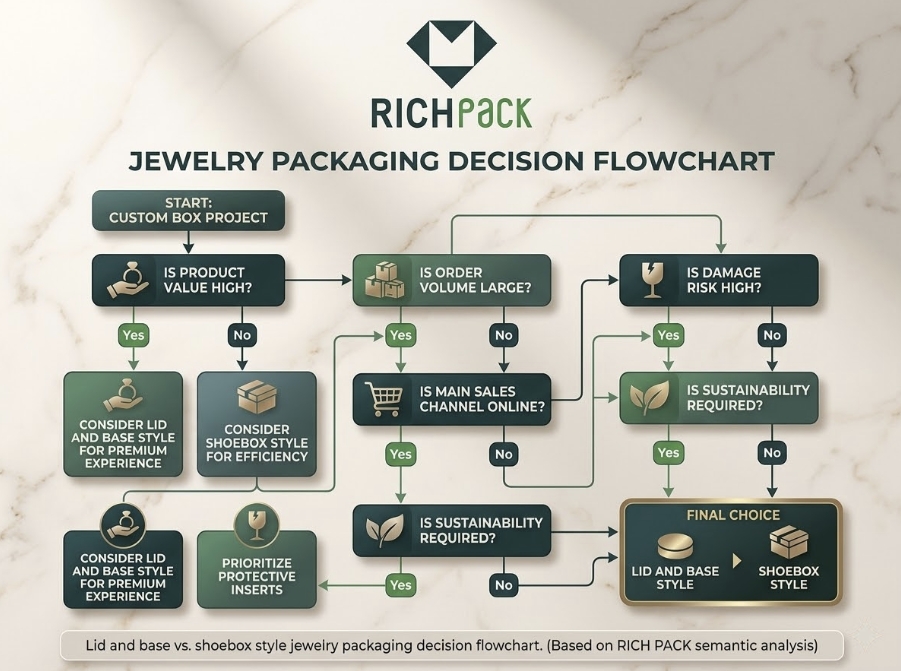
High-value jewelry needs a stronger presentation. Low-value items need smart cost control.
If the product is bought as a gift, a proposal item, a milestone purchase, or a premium set, the lid and base usually earns its place.
If the product is a fast-moving everyday accessory, a shoebox style may be the better business choice.
Volume changes the answer.
For small luxury batches, the box can be more customized. For large wholesale runs, packaging must be easy to repeat, store, and assemble.
Shoebox style is often better when the team handles many orders per day. Lid and base are better when each order carries a higher margin.
Ask one question: what is the customer doing when they open this box?
If they are opening a proposal ring, the moment needs weight. If they are opening a pair of daily earrings from an online order, the moment needs clarity and speed.
Match the box to the emotion behind the purchase.
Warehouse teams notice problems that design teams miss.
Can the box be packed quickly? Does it fit the mailer? Does the lid stay closed? Can staff identify SKUs without opening every box?
If fulfillment is the bottleneck, the shoebox style may outperform a prettier structure.
Sustainability is not one material. It is a set of trade-offs.
A smaller shoebox-style box can reduce space. A lid and base box can use FSC paper and molded pulp, but may use more material.
Choose the option that gives the best total result for your market, product, and customer promise.
Damage risk depends on product shape, insert quality, shipping method, and handling.
Use stronger structure and better inserts for fragile stones, fine chains, sharp posts, and polished surfaces.
Do not assume the outer box fixes everything. Most jewelry packaging damage starts with movement inside the box.
Cleachd an riaghailt shìmplidh seo:
| Ma tha do phrìomhachas | Roghainn nas Fheàrr |
| Premium gift reveal | Lid and base |
| Cosgais talmhainn nas ìsle | Stoidhle bogsa-bhròg |
| Fine jewelry protection | Lid and base with fitted insert |
| High SKU count | Stoidhle bogsa-bhròg |
| Taisbeanadh reic | Lid and base |
| E-commerce efficiency | Stoidhle bogsa-bhròg |
| Luxury set presentation | Lid and base |
| Fast packing | Stoidhle bogsa-bhròg |
| Sustainable minimalism | Depends on size and material |
If you only read one section, use this rule: choose the box that protects the product, fits the channel, and makes the price feel right.
Most packaging mistakes do not look like mistakes in the mockup. They appear later, in shipping, storage, customer photos, or reorder planning.
Catch them before mass production.
A famous jewelry brand may use a heavy, rigid box because its price point supports it.
That does not mean the same structure works for a growing e-commerce brand. The box may eat into the margin, slow packing, and create storage pressure.
Copy the logic, not the surface. Ask why the box works for that brand.
Insert tolerance is boring until it ruins the unboxing.
If the slot is too loose, the jewelry shifts. If it is too tight, the customer struggles to remove the piece. If the material is wrong, it can scratch or leave marks.
Test the actual product in the actual insert before approving mass production.
Overbuilt packaging can make a low-priced product feel wasteful.
It can also hurt profit. More board, more finishing, more freight, and more packing time all show up in the final cost.
For entry collections, clean structure and good fit beat heavy luxury cues.
High-value jewelry needs trust before the customer even touches the product.
If the box feels thin, loose, or generic, the product feels less valuable. That is a bad first impression for fine jewelry, bridal pieces, or premium gifts.
Use stronger structure, better insert control, and cleaner finishing for products that carry emotional weight.
Do not write “eco-friendly” on the box if you cannot explain what makes it better.
Use specific claims: FSC-certified paper, recycled board, molded pulp insert, plastic-free structure, or right-sized packaging.
Buyers and compliance teams trust details. They do not trust green words.
A box can look perfect on a desk and fail in transit.
Run basic shake, drop, compression, and mailer-fit checks before production. For e-commerce jewelry, test the full packout, not only the jewelry box.
The customer does not receive your mockup. They receive the package after the carrier handles it.
Not always. Some suppliers use similar language, but buyers often use these terms differently. A lid and base box usually means a two-piece structure with a separate lid and base. Shoebox style usually means a simpler, practical box format that is easier to stack and pack. Always ask for a structure drawing or sample before approving custom jewelry packaging.
Lid and base are usually better for luxury jewelry packaging because it creates a slower reveal, a stronger structure, and better space for a fitted insert. It works well for rings, necklaces, bridal jewelry, and premium sets. Shoebox style can still look premium if you use better paper, clean printing, and a well-designed insert.
Shoebox style often gives better cost control for large orders because it is simple, stackable, and easier to pack. But the real cost depends on board thickness, insert design, finishing, freight, and SKU count. Do not compare only the unit price. Compare landed cost after shipping, storage, labor, and damage risk.
Yes. Shoebox style packaging can look premium with textured paper, foil stamping, clean typography, a fitted insert, and tight color control. The key is restraint. Do not overload the box with too many finishes. A simple structure with strong material choices can feel more expensive than a busy design.
The best insert depends on the jewelry type. Rings often need velvet or EVA slots. Necklaces need hooks, tabs, or channels to stop tangling. Earrings need paired holes or cards. Bracelets need longer support. Molded pulp or paperboard inserts work well when sustainability is a priority.
Send a clear brief with product dimensions, jewelry type, box style, quantity, SKU count, target market, sales channel, insert needs, logo process, sustainability requirements, timeline, and shipping destination. This helps the supplier quote the full structure, not just a decorated empty box.
Yes. Both lid and base and shoebox style packaging can use FSC-certified paper, recycled board, soy-based inks, paperboard inserts, or molded pulp inserts. The better choice depends on total material use, box size, recyclability, and shipping efficiency. Ask for documentation if you plan to make sustainability claims.
Test the box size, insert fit, opening feel, logo position, color match, finish durability, mailer fit, carton packing, and shipping movement. Use the real jewelry sample, not a placeholder. A small sample issue can become a large production problem if it is missed before mass order approval.
Lid and Base vs. Shoebox Style is not a beauty contest. It is a fit decision.
Choose lid and base when jewelry needs a premium reveal, a stronger structure, and gift-ready value. Choose the shoebox style when the project needs simple stacking, lower landed cost, and faster fulfillment.
If you want a packaging system that fits your product line, channel, and margin, start with the structure first. Then build the material, insert, finish, and supplier brief around it.
Now it is your turn: review your top-selling jewelry SKU and ask one question. Does the current box protect the product, support the price, and fit the way you ship?


2025-06-11

2024-11-29
2025-04-16
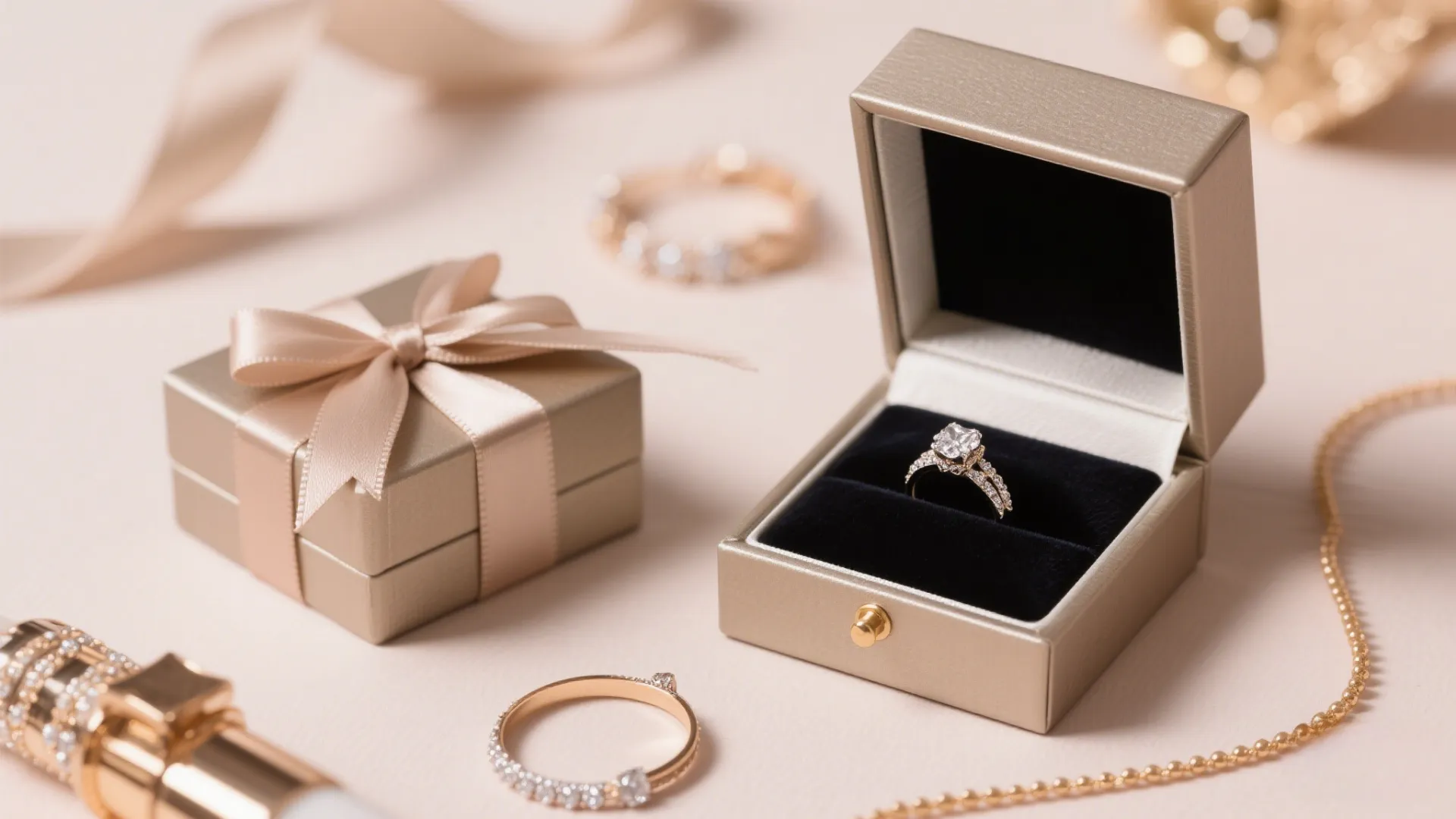
An urrainn dhut bogsa fàinne brèagha a lorg gun mòran a chosg? 'S urrainn dhut. Tha mòran den bheachd gu bheil bogsa fàinne den chiad ìre a' cosg mòran. Ach, chan eil sin an-còmhnaidh fìor. Le beagan rannsachaidh agus na molaidhean ceart, faodaidh tu bogsaichean fàinne saor a lorg a tha a' coimhead eireachdail. Mar eisimpleir, tha mòran roghainnean aig prìs ruigsinneach aig Richpack gun chall càileachd. Faodaidh tu sùil a thoirt air… Cùm a’ leughadh Stoidhle Mullach is Bonn vs. Bogsa Bhrògan: Dè an diofar a th’ ann airson pacadh seudaireachd
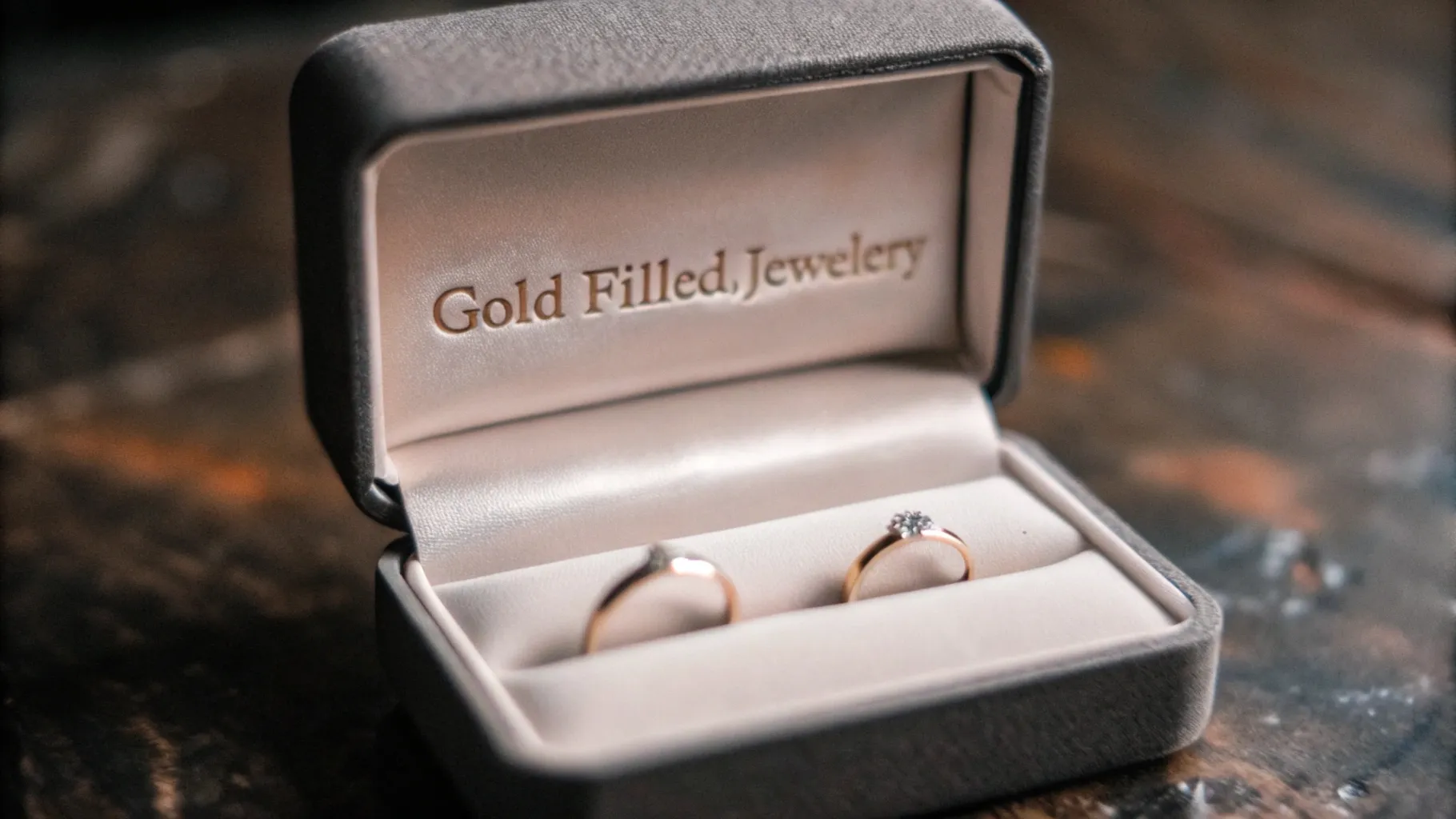
Gach bliadhna, thèid còrr is 3 billean bogsa tiodhlac a cheannach air feadh an t-saoghail rè na saor-làithean. Ach, tha e duilich do mhòran ghnìomhachasan cosgaisean ìosal agus càileachd àrd a chumail. Aig Richpack, tha sinn air a bhith a’ leasachadh ealain a bhith a’ cruthachadh bhogsaichean tiodhlac aig prìs ruigsinneach ach iongantach airson 15 bliadhna. Tha sinn air a bhith ag obair le ainmean mòra mar Tiffany & Co. agus Cartier, a’ dèanamh… Lean air adhart a’ leughadh Stoidhle Mullach is Bonn vs. Bogsa Bhrògan: Dè an diofar a th’ ann airson pacadh seudaireachd
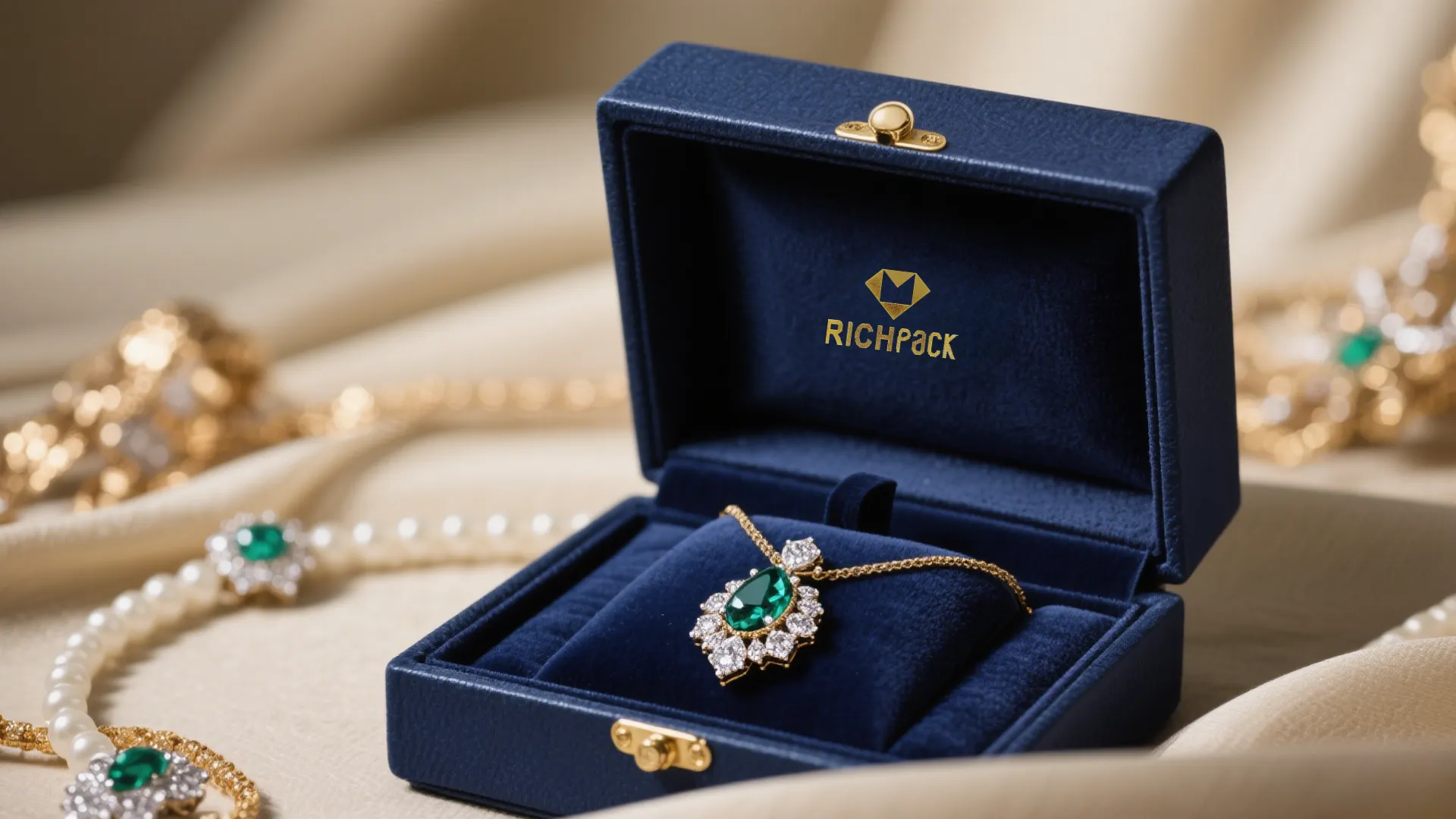
’S e bogsaichean tiodhlac rudan a chithear anns a h-uile àite mun cuairt oirnn, ge bith dè a cheannaicheas tu, cia mheud rud a cheannaicheas tu, tha e coltach gu bheil iad riatanach mar shoitheach airson nithean a ghiùlan (ris an can sinn “pacadh” còmhla). Ach, cha do thuig sinn a-riamh leasachadh a’ bhogsa tiodhlac, ciamar a tha e bho seann amannan… Lean air adhart a’ leughadh Stoidhle Mullach is Bonn vs. Bogsa Bhrògan: Dè an diofar a th’ ann airson Pacadh Seudraidh
Pocannan tiodhlac pàipear kraft donn eco-càirdeil airson pacadh eireachdail - bagaichean tiodhlac Brown Kraft gnàthaichte airson mion-reic, tachartasan, agus amannan fillte iongantach
Pocannan grosaireachd pàipear àbhaisteach Premium airson ceannach seasmhach - Dèan pearsanachadh air bagaichean pàipear Kraft Custom agus pocannan pàipeir gnàthaichte le làmhan le suaicheantas do bhrand
Pocaichean Pàipeir Ath-chuairtichte làidir is maireannach airson pacadh reic | Fuasglaidhean Gnàthaichte Richpack airson bùthan seudaireachd agus stòran seudaireachd e-malairt
Bogsaichean Tiodhlac Leanabh Gràdhach | Pacadh Tiodhlacan Ùr-bhreith is Leanabh Gnàthaichte | Seataichean Tiodhlacan Fras-Leanabh Àrd-inbhe
Faic Tuilleadh
Bogsaichean seudraidh le cuspair ceann-bliadhna: le dealbhadh romansach, air leth freagarrach airson tiodhlacan ceann-bliadhna
Faic Tuilleadh
Pacadh seudan gnàthaichte gnàthaichte is càirdeil don àrainneachd le suaicheantas branda | Air a dhealbhadh airson suaicheantasan seudaireachd a dh’ fheumas pacadh pearsanaichte is uaine
Faic Tuilleadh

