

 Prev
Prev
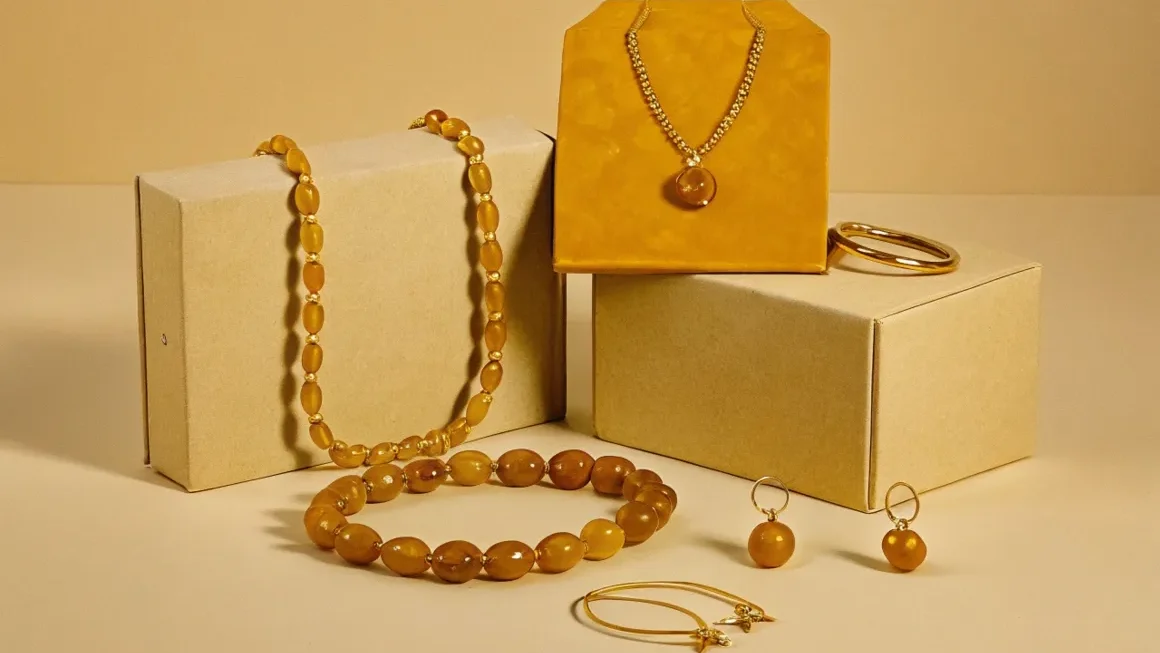
7 Tohutohu Tohunga ki te Waihanga i nga Taakahu Whakapaipai Jade E Hoko Ana
2024-11-26



A customer does not meet your jewelry in a neutral state.
They meet the parcel first. Then the outer box. Then the jewelry box. Then the piece itself. By the time the necklace, ring, or bracelet appears, the customer has already decided whether the order feels careful, cheap, premium, rushed, giftable, or forgettable.
Koinei te take pouaka whakapaipai are not just containers. They are the first physical proof of your brand promise.
Whakautu tere: the best jewelry boxes fit the product, protect it in transit, match the brand price point, create a clean reveal, and scale through sampling, QC, and repeat orders.
| Rohe Whakatau | He aha hei Tirohia | He aha Hei Take |
| Jewelry fit | Size, shape, insert tension | Stops movement, tangling, dents, and weak presentation |
| Te hongere hoko | E-commerce, retail, wholesale, gifting | Different channels need different box structures |
| Rauemi | Paperboard, velvet, suede, leatherette, wood | Signals price point before the jewelry is touched |
| Whakaraupapa | Logo, color, finish, insert, card | Builds brand memory and gift value |
| Raina tuku | MOQ, sampling, QC, freight, reorder consistency | Prevents expensive packaging mistakes at scale |
Here is the framework:
Core idea: choose jewelry boxes based on customer experience and supply-chain risk, not appearance alone.
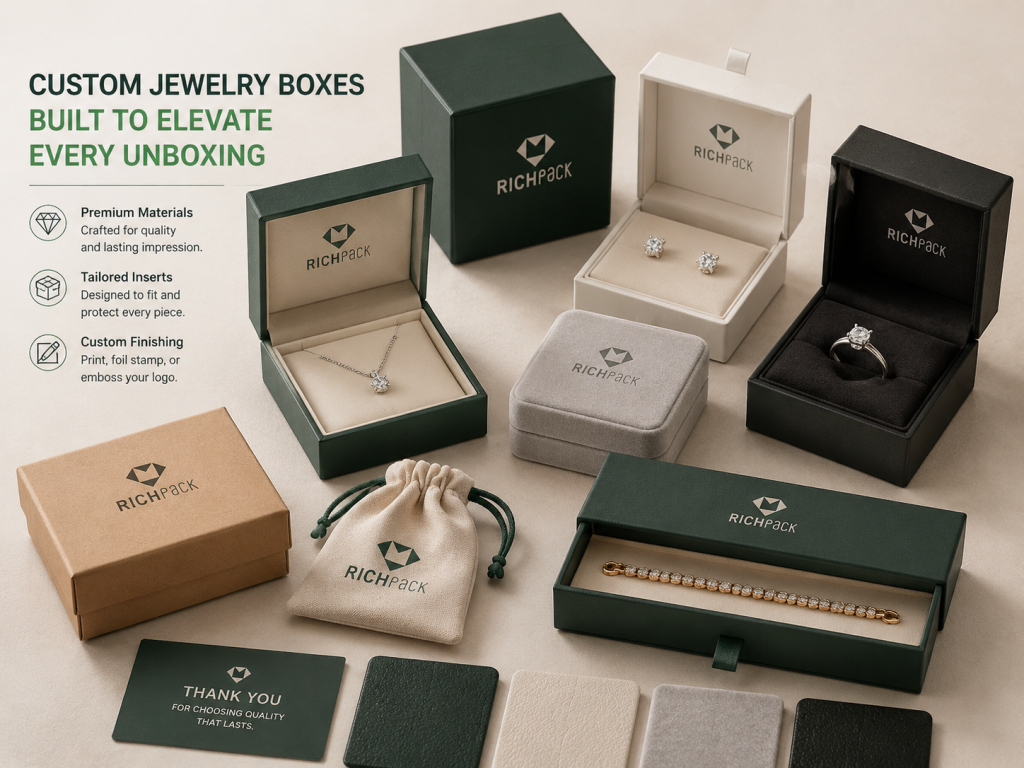
Most brands choose packaging backward.
They see a beautiful box, ask for a logo, and then try to fit every product into it. That looks efficient on paper. It creates problems in real life.
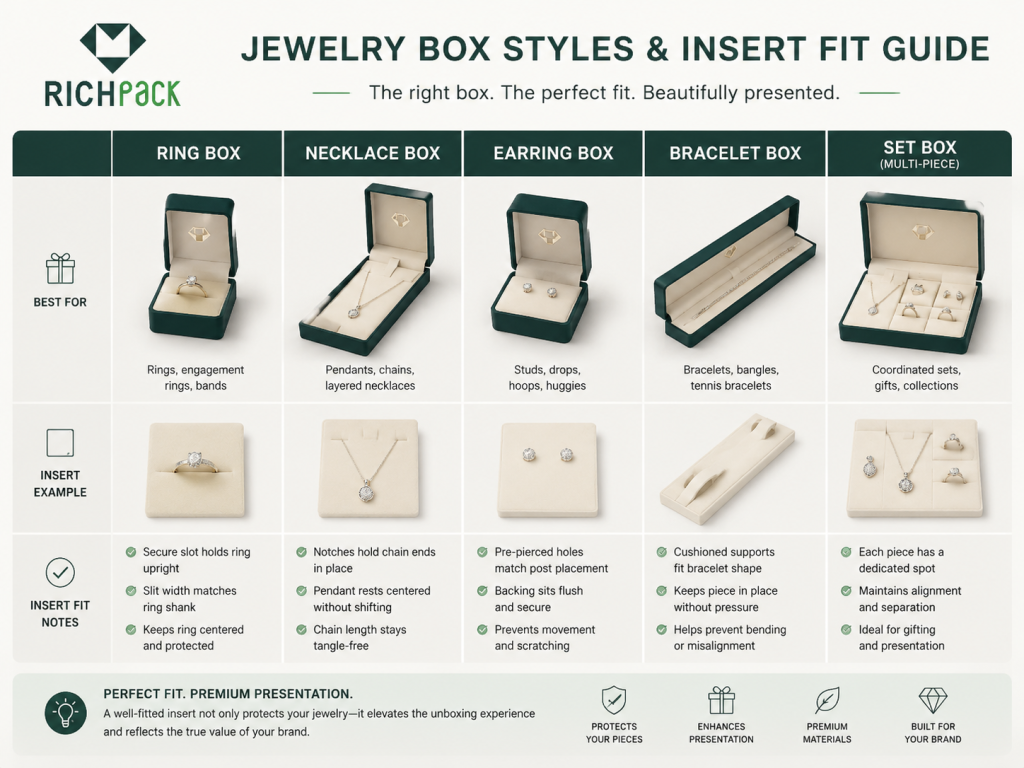
A ring, a necklace, a pair of earrings, and a bracelet all move differently inside a box. They also create different customer expectations. A proposal ring needs tension and drama. A necklace needs control. Earrings need alignment. A bracelet needs space.
Start with the piece. Then choose the box.
Nga pouaka mowhiti carry more emotional pressure than almost any other jewelry box.
A ring does not just need protection. It needs a reveal. If the ring sits too low, the center stone loses presence. If the slot is too loose, the ring tilts. If the hinge feels weak, the moment feels cheap.
For engagement rings, wedding bands, and premium rings, use a rigid ring box with a firm insert. Velvet, suede, or soft-touch lining works because the customer expects a quiet luxury feel.
For e-commerce rings, test two things before bulk approval:
A beautiful ring box that fails the shake test is not premium. It is risky.
Necklaces create one of the most common packaging problems: movement.
A necklace can look perfect during packing, then arrive tangled after shipping. That first customer interaction becomes annoying. Instead of admiring the piece, the customer starts fixing the chain.
whakamahi pouaka tahei with anchor points, tabs, or insert cuts that hold the chain in place. For delicate chains, avoid oversized empty space. For pendant necklaces, make sure the pendant sits in the visual center.
This is where packaging becomes sales psychology. A necklace that arrives ready to wear feels more expensive. A tangled necklace feels careless.
Supplier-side field note: When necklace packaging fails, the problem is often not the outer box. It is the insert. A box can be rigid, beautiful, and still lose the customer because the chain moves freely inside.
Earrings need symmetry.
When a customer opens an pouaka whakakai, both pieces should sit at the same height and angle. If one earring drops lower than the other, the product looks less valuable, even when the jewelry itself is fine.
Use inserts with accurate holes, slits, or cards. For studs, keep spacing tight and balanced. For hoops, give enough depth so the earring does not press against the lid.
This matters for product photos and unboxing videos. Customers often photograph earrings inside the box before wearing them. The box becomes part of the product image.
Bracelets need room.
A soft chain bracelet can sit flat. A cuff or bangle cannot. If the box is too shallow, the lid presses against the jewelry. If the box is too wide, the piece moves during shipping.
For bangles, use a deeper, rigid box or a shaped insert. For charm bracelets, protect raised details from rubbing. For premium bracelets, consider using a pillow insert to create a stronger gift presentation.
Do not force bracelets into a standard necklace box just to reduce SKUs. You may save on packaging, but lose on customer experience.
Jewelry sets need a different logic.
A pouaka huinga-runga should show the relationship between pieces. The necklace, earrings, bracelet, and ring should look intentional together. If every item sits randomly, the set feels like a bundle. If the layout is balanced, it feels like a collection.
For gift sets and wedding jewelry, this can raise perceived value fast.
Use set boxes when you want customers to see the total offer at once. Use separate boxes when each piece has its own story or price point.
Box structure decides how the product feels, ships, stores, and sells.
A jewelry box for boutique retail does not need the same structure as a jewelry box for DTC ecommerce. A wedding gift box does not need the same structure as a wholesale display program.
This is where many brands overspend. They buy the box that looks most premium, not the box that best fits the channel.
Lid and base boxes are the classic choice for jewelry brands.
They feel familiar, clean, and reliable. The customer lifts the lid, sees the piece, and understands the product instantly. This structure works well for rings, earrings, pendants, and small gift sets.
Use lid and base boxes when you want a timeless retail feel. They are also easier to adapt across product categories because you can adjust size, insert, paper, and logo finishing without changing the basic structure.
For wholesale programs, lid and base boxes are often easier to standardize. That matters when you need consistent packaging across stores, markets, or seasonal launches.
Drawer boxes create a slower reveal.
The customer pulls the inner tray out. That movement adds anticipation. It works well for gift jewelry, premium necklaces, and collections where the unboxing moment matters.
The tradeoff is operational. Drawer boxes need better tolerance control. If the sleeve is too tight, the box feels frustrating. If it is too loose, it feels cheap.
Use drawer boxes when the reveal is part of the brand experience. Avoid them when your priority is the lowest freight volume or the fastest packing line.
Pouaka kati aukume feel premium because they give the customer a small physical cue.
That quiet snap matters. It makes the box feel secure and gift-ready. For e-commerce brands, magnetic boxes can help the product feel more expensive after it arrives at the customer’s door.
The risk is cost and weight. Magnetic structures can increase material use, shipping weight, and production complexity.
Use them for hero products, limited editions, wedding collections, luxury sets, and influencer gifting. Do not use them for every SKU if your margins cannot support it.
Travel jewelry boxes are not just packaging. They are kept items.
Customers may use them in a handbag, suitcase, drawer, or dressing table. That gives your logo more time in the customer’s life. It also turns the package into a small brand reminder.
Use travel jewelry boxes for loyalty gifts, holiday campaigns, higher-value sets, or brands that position around lifestyle.
The key is interior layout. A travel box needs compartments, anti-tangle areas, and a secure closure. If it looks good but does not organize jewelry well, customers will not keep it.
Flat-pack jewelry boxes help reduce storage and shipping pressure.
They are useful when you sell at scale, ship internationally, or need lower warehouse volume. They can also support sustainable packaging goals because reduced volume means better logistics efficiency.
The tradeoff is assembly. If your team packs many orders daily, every extra folding step adds labor cost.
Use flat-pack boxes when freight and storage matter more than rigid gift presentation. For premium jewelry, test whether the assembled box still feels strong enough.
| Hanganga Pouaka | Best For | Te Kaha Matua | Kia mataara |
| Lid and base box | Retail jewelry, classic gifting | He āhua rongonui mō te utu nui | Can look generic without a strong finish |
| Pouaka pouaka | Premium reveal, gift sets | Strong unboxing moment | Tolerance must be controlled |
| Pouaka aukume | Luxury, limited editions | Gift-ready feel | Te utu me te taumaha teitei ake |
| Travel box | Repeat-use packaging | Long-term brand exposure | Needs real organizational value |
| Flat-pack box | E-commerce scale, storage control | Lower volume pressure | Assembly time and perceived value |
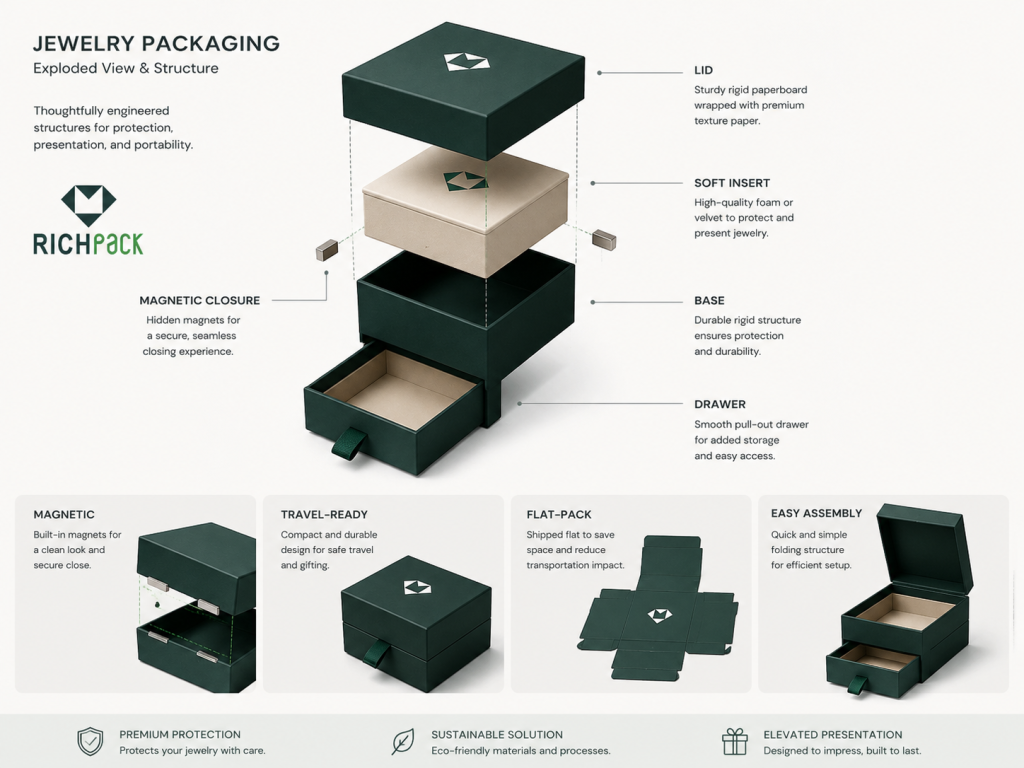
If your team is stuck between several box styles, use a matrix instead of debating taste.
Taste is noisy. A matrix makes the tradeoffs visible.
| hanganga | Manawa Premium | Freight Efficiency | Tere Huihuinga | Best Channel | Whakamahia Ahea |
|---|---|---|---|---|---|
| Taupoki me te turanga | 4/5 | 3/5 | 5/5 | Retail, ecommerce, wholesale | You need a safe, classic structure |
| Pouaka pouaka | 4/5 | 2/5 | 4/5 | Premium gifting, campaigns | You want a slower reveal |
| Magnetic rigid box | 5/5 | 2/5 | 5/5 | Luxury, influencer kits | You can support a higher unit cost |
| Travel jewelry box | 5/5 | 2/5 | 5/5 | Loyalty, sets, lifestyle brands | You want repeat use after purchase |
| Flat-pack box | 3/5 | 5/5 | 2/5 | E-commerce scale, international shipping | Storage and freight costs matter most |
A flat-pack box can dramatically improve pallet and carton efficiency because boxes ship flat before assembly. In practical packaging programs, changing from a pre-assembled rigid hinged box to a flat-pack structure can increase pallet loading by up to 300%, depending on box depth, board thickness, and carton layout.
That does not mean every brand should switch to flat-pack boxes. It means freight volume should be part of the packaging decision, not an unpleasant surprise after sampling.
Ture o te koromatua: if a box is mostly air, you are paying to ship air.
Material is the fastest way customers judge your price point.
This does not mean expensive material always wins. It means the material must match the jewelry, the brand, and the selling channel.
A recycled paper box can feel premium when the design is clean. A velvet box can feel cheap when the insert is loose. A wooden box can feel special, or it can feel heavy and outdated.
Do not choose material by trend. Choose it by brand promise.
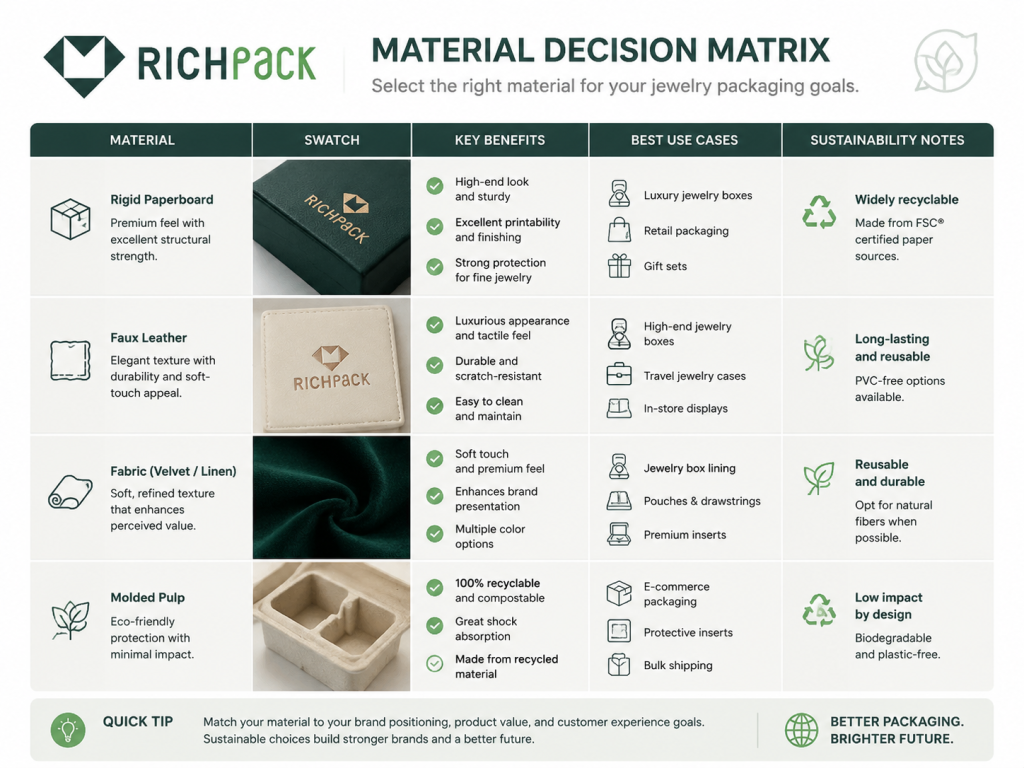
Use this matrix before choosing materials.
| Rauemi | Best For | Tohu Moni | Te Raru Whakahaere | Te Taurite o te Oranga Tonutanga |
| Rigid paperboard | Custom jewelry boxes, wholesale programs | Clean, modern, flexible | Corner cracking, paper batch variation | Strong when FSC or recycled paper is used |
| wereweti | Rings, gift jewelry, luxury moments | Soft, emotional, traditional | Dust, lint, color inconsistency | Weak unless used selectively |
| Tuhinga | Premium minimal brands | Quiet luxury, soft touch | Marking and cleaning issues | Medium, depends on the material source |
| Te Taakapa | Formal retail, men’s jewelry, watches | Durable, structured, classic | Can conflict with eco positioning | Ngoikore ki te waenga |
| Wood | Keepsake sets, heritage collections | Permanent, collectible | Weight, freight cost, grain variation | Medium if responsibly sourced |
| Te penupenu kua whakarewahia | Whakapaipai whakapaipai taumau | Honest, natural, modern | He iti ake te āhua o te papai tuku iho | kaha |
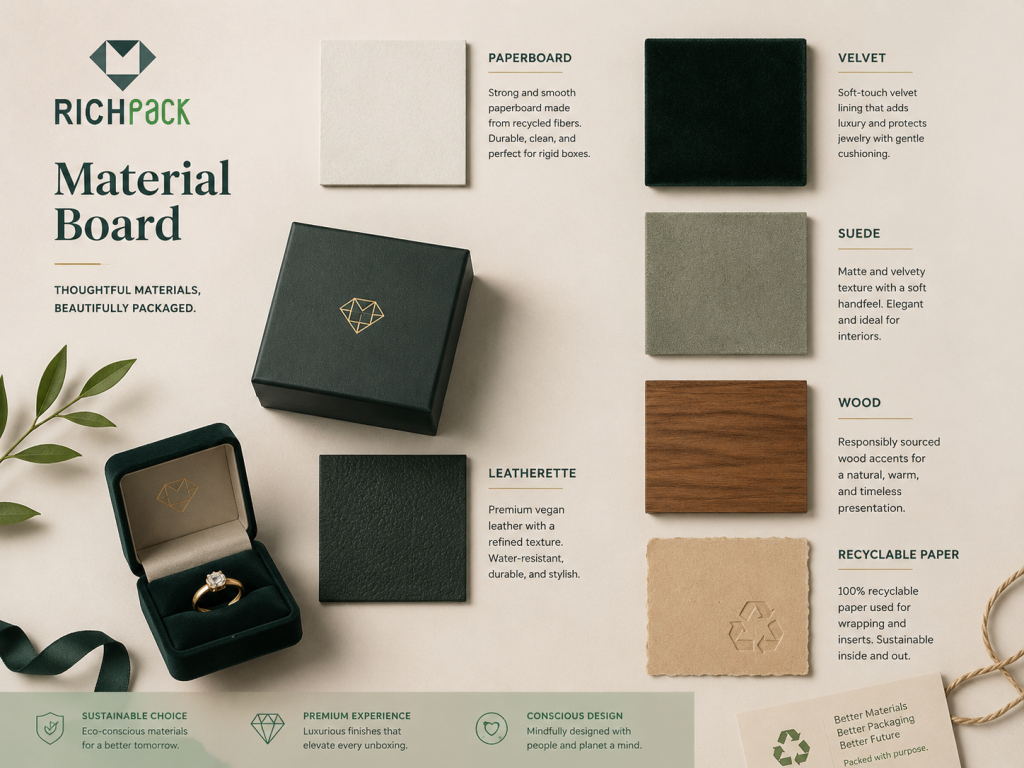
Paperboard is one of the most practical materials for pouaka whakapaipai ritenga.
It works for retail, ecommerce, gift packaging, and wholesale programs. It can be wrapped, printed, embossed, foil-stamped, textured, laminated, and paired with different inserts.
For growing brands, paperboard gives the best balance of cost, customization, and scalability.
Use paperboard when you need:
Paperboard is not a downgrade. Poor paperboard is a downgrade. A well-built, rigid board with the right finish can look premium without creating unnecessary weight.
Velvet and suede create instant softness.
They work especially well for rings, earrings, bracelets, and high-emotion gift pieces. Customers connect the soft surface with care, protection, and luxury.
The risk is dust, lint, and inconsistent color. Dark velvet can show particles. Light suede can pick up marks. If you use these materials, ask for real production samples, not only digital mockups.
A useful test is simple: photograph the sample under harsh light. If dust, glue marks, or color unevenness show up, customers will notice too.
Leatherette jewelry boxes sit between classic luxury and practical production.
They can feel structured, durable, and gift-ready. They work well for men’s jewelry, watches, bracelets, and premium retail sets.
Use leatherette when your brand wants a stronger, more formal feel. Avoid it if your positioning is light, minimal, organic, or sustainability-first.
Material must support the story. If your product page talks about recycled values, a heavy leatherette box can create a message mismatch.
Pouaka whakapaipai rakau are powerful when the goal is permanence.
They suit keepsake products, anniversary gifts, heritage jewelry, high-ticket sets, and limited editions. A wooden box tells customers the jewelry is meant to last.
The tradeoff is weight, cost, and consistency. Wood grain varies. Shipping weight rises. Surface finishing needs control.
Use wood selectively. It is a strong choice for hero products, but not always the best choice for every order.
Sustainable jewelry packaging is no longer a side feature.
Bain and Fedrigoni reported in 2025 that luxury packaging is moving toward greener, lighter, and smarter solutions. Their report said more than 30% of luxury packaging sales are expected to use sustainable solutions within three years. It also found that reducing packaging weight and volume ranked as the top supply-chain sustainability priority among surveyed executives.
This matters for jewelry brands because customers now notice waste. They may accept beautiful packaging, but they dislike oversized boxes, excessive plastic, and vague eco claims.
Use practical sustainability choices:
The Forest Stewardship Council defines FSC labels as a way to show that forest-based materials come from responsible sources. If you use FSC paper in jewelry packaging boxes, make that claim specific and visible.
Do not say “eco-friendly” if you cannot explain the material. Use specific claims that customers can understand.
The insert is where many jewelry packaging boxes either win or fail.
Customers may remember the color of the box. Your operations team remembers the insert. It controls movement, prevents scratches, keeps the piece centered, and decides whether the product arrives ready to admire or ready to untangle.
EVA foam works when you need structure and a repeatable fit.
It can be cut for rings, earrings, pendants, and sets. It holds shape well and gives the product a clean appearance. The risk is that plain EVA can feel too technical if the surface is exposed.
Use EVA foam under a paper, velvet, suede, or fabric surface when you want better holding power without making the box look industrial.
Flocked blister inserts work well when the jewelry shape needs a molded seat.
They are useful for earrings, sets, and pieces that need a stable visual layout. The flocked surface adds softness, while the formed structure helps with positioning.
The risk is tooling and fit accuracy. If the mold is wrong, the whole batch feels wrong.
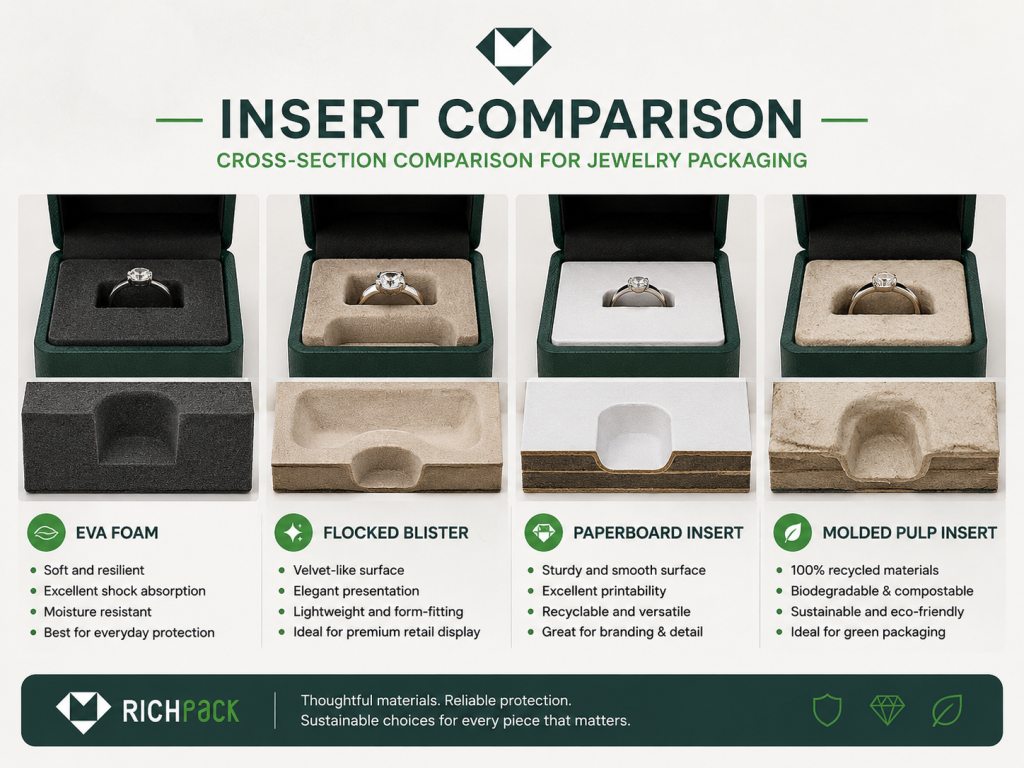
Molded pulp is becoming more relevant for brands that want sustainable jewelry packaging without vague green claims.
It can replace plastic trays in some packaging systems. It also sends a clearer material message because customers understand paper-based forms faster than mixed plastic structures.
The tradeoff is finished. Molded pulp feels natural and responsible, but not always luxurious in the traditional sense. It works best for minimalist, modern, responsible, or lifestyle-led brands.
Paperboard inserts are flexible and easy to brand.
They can be folded, die-cut, printed, wrapped, or combined with fabric. They work well for lightweight jewelry and gift sets where full foam support is not needed.
They also help reduce plastic use. For large wholesale custom jewelry boxes, that can matter across thousands of units.
Velvet and suede inserts still have a place.
Use them when touch is part of the purchase. Engagement rings, wedding jewelry, anniversary sets, and luxury jewelry boxes often need that soft reveal.
Just test dust, shedding, and color transfer before bulk production. A premium insert that sheds fibers onto jewelry is not premium.
Unboxing is not decoration.
It is the customer’s first proof that your brand keeps its promise. Before they wear the jewelry, they touch the box. They open it. They judge the weight, color, logo, lining, and fit.
That moment can increase confidence. It can also expose weak decisions.
Color tells customers where to place your brand.
Black, navy, burgundy, ivory, and deep green often create a premium mood. Kraft, cream, sage, and soft gray can support a natural or sustainable feel. Bright colors work for playful, fashion-led brands.
Do not copy a luxury color just because it looks expensive. If your jewelry is delicate and romantic, a heavy black box may feel too cold. If your brand is modern and minimal, too much gold foil can feel dated.
Choose color by product line, not personal taste.
Logo finishing is where many brands overdo it.
Foil stamping, embossing, debossing, and spot UV can all work. The problem starts when the logo is too large, too shiny, or placed without breathing room.
For jewelry boxes, restraint usually looks more expensive.
Use one strong logo treatment. Then let texture, color, and structure do the rest. If the jewelry is the hero, the box should frame it, not compete with it.
Watch the production details:
These are small defects. Customers read them as brand quality.
The insert is the hidden sales tool.
Customers may not talk about inserts, but they feel the difference. A tight insert makes the jewelry look intentional. A loose insert makes the box feel cheap.
For rings, use slots with the right tension. For necklaces, use tabs that stop tangling. For earrings, use holes or cards that keep alignment. For bracelets, use pillows or shaped supports.
From a supply-chain view, insert fit is also a damage-control tool. A better insert can reduce product movement, surface scratches, and customer complaints.
The first touch is small, but it matters.
A lid that opens smoothly, a drawer that slides with resistance, a magnetic closure that snaps cleanly, or a soft lining that feels stable can all raise perceived value.
Think of Apple packaging. The product is not jewelry, but the lesson applies. The experience feels controlled because every touchpoint has friction, timing, and order.
Jewelry packaging should do the same at the right budget level.
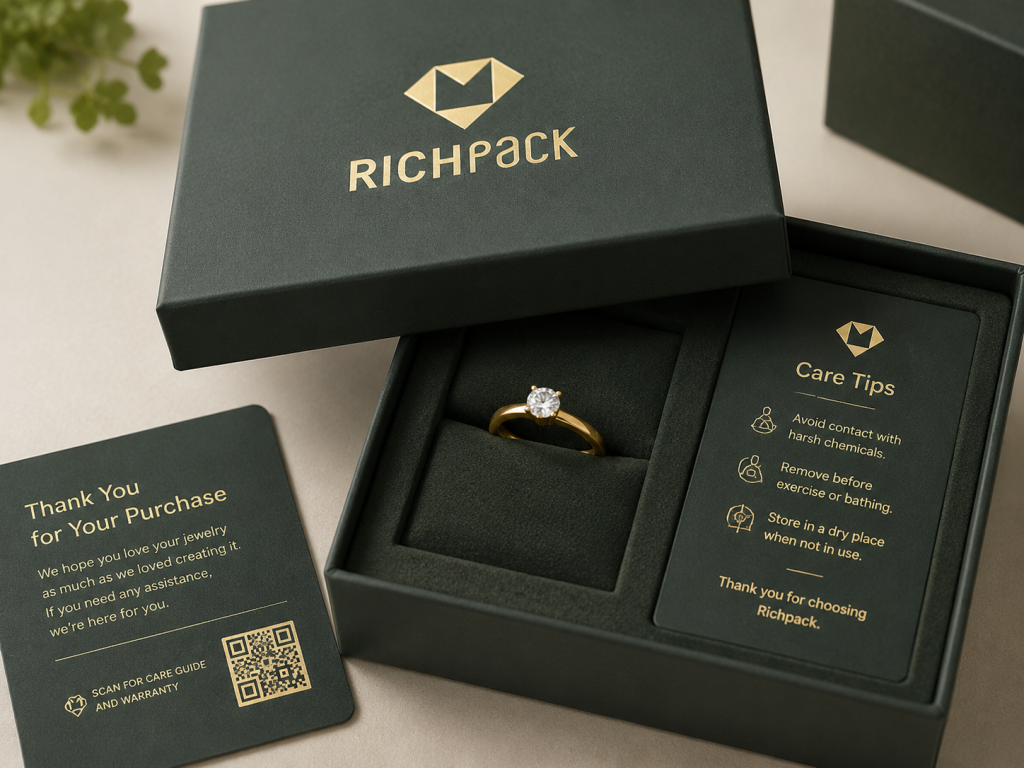
QR codes, care cards, polishing cloths, warranty cards, and origin notes can improve the unboxing moment.
But only add them when they help the customer.
A QR code can link to care instructions, styling ideas, authentication, warranty registration, or a brand story. A card can explain materials, plating care, gemstone meaning, or gift message options.
Do not add paper just to look premium. Add information that reduces customer questions or increases emotional value.
Customers do not always say, “Your packaging system failed.”
They say the necklace arrived tangled. They say the gift box came dented. They say the color looked different from the website. They say the product did not feel like the price.
That is packaging feedback.
In unboxing content, the box often appears before the product. Treat that first frame as part of your brand system.
A necklace that arrives tangled creates friction before delight.
This is not only a customer-service problem. It changes how the buyer feels about the whole order. For delicate chains, the insert needs anchor points, not just a soft pad.
Industry case: a DTC necklace brand can use the same outer rigid box and still improve customer experience by changing only the insert. Add two chain tabs, center the pendant, and reduce empty movement. The box looks similar, but the arrival experience changes completely.
A luxury jewelry box can arrive damaged if the mailer is weak.
The customer does not care that the product inside survived. They bought a gift-ready moment. A dented box breaks that moment.
For e-commerce, test the full packing system: jewelry box, insert, tissue, pouch, mailer, carton, and label placement.
Retail buyers notice color drift fast.
If one reorder comes in slightly warmer, cooler, darker, or glossier than the first batch, the shelf presentation starts to look messy.
Industry case: a retail chain using custom jewelry boxes across several stores needs color standards before reorders. The issue is not only Pantone selection. It is paper batch, lamination, foil tone, and production tolerance.
Wedding and holiday packaging has one unforgiving rule: late packaging loses the moment.
A perfect box arriving after campaign photography, retail setup, or wedding fulfillment is useless.
Industry case: a wedding procurement buyer may approve a premium gift box too late because the sampling time was ignored. The better process is to work backward from the event date: sample, revision, pre-production proof, production, inspection, freight, customs, and receiving.
Customers may not know the rigid board thickness or insert density.
They still feel a cheap touch. Loose lids, weak hinges, thin inserts, rough edges, and noisy drawer friction all reduce trust.
This is why jewelry packaging boxes should be tested by hand, not only reviewed in mockups.
Pretty samples can fool you.
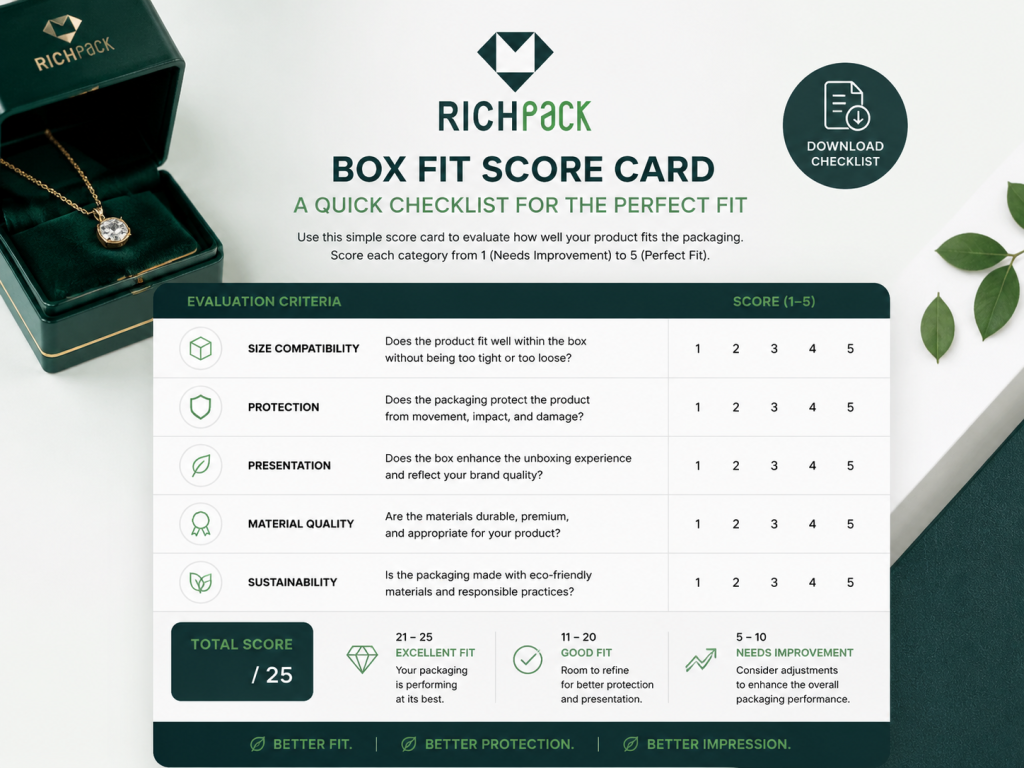
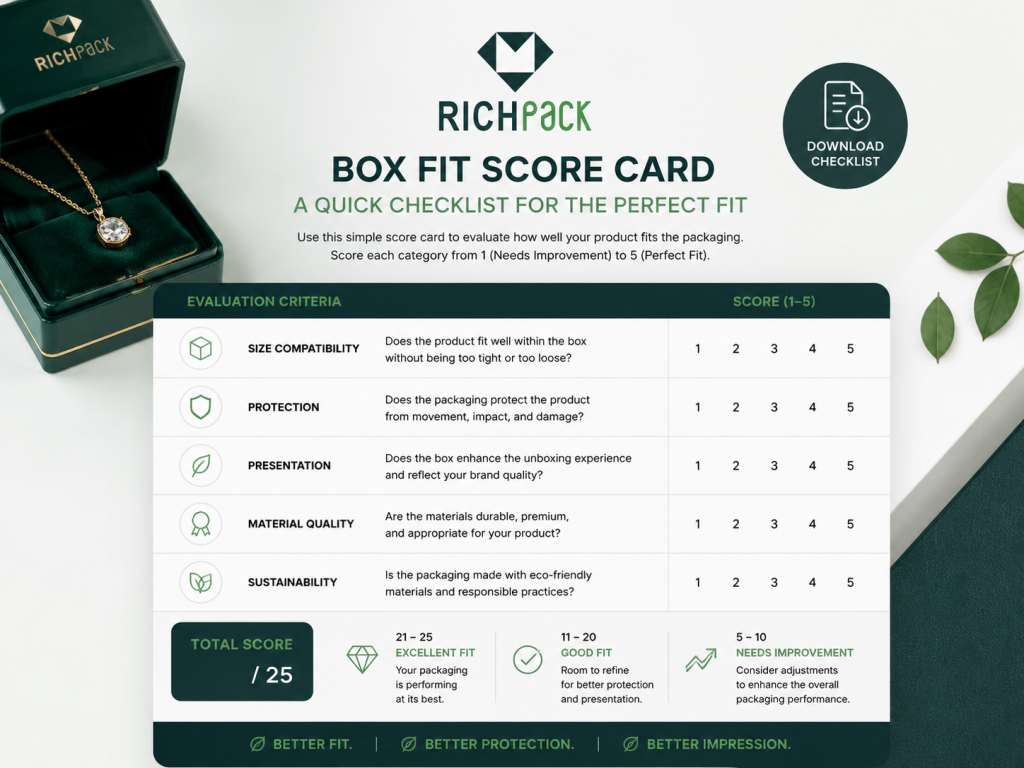
Use a simple score before approving custom jewelry boxes, luxury jewelry boxes, or wholesale jewelry boxes. Score each factor from 1 to 5.
Download our Box Fit Scorecard as a PDF or Excel template before you approve samples. It turns packaging decisions into a checklist that your founder, purchasing manager, designer, and supplier can all use.
| Tuhinga | He aha hei Tirohia | Bad Sign | Good Sign |
| Huhua hua | Jewelry movement inside the box | Chain tangles, ring tilts, earrings shift | The piece stays centered after movement |
| Touch quality | Lid, drawer, closure, lining | Weak hinge, rough slide, loose closure | Smooth movement and stable feel |
| Brand match | Color, texture, logo, finish | Looks cheaper or louder than the jewelry | Supports price point without shouting |
| Shipping survival | Mailer, carton, compression | Dents, scuffs, crushed corners | Box arrives gift-ready |
| Reorder control | Color, material, insert, logo position | Batch drift, glue marks, inconsistent fit | Repeat order matches the approved sample |
Score rule: anything below 20/25 needs revision before bulk production.
This framework is simple, but it prevents expensive mistakes. It also helps founders, purchasing managers, and brand directors discuss packaging with the same language.
A jewelry box has to survive the real world.
It moves through production, packing, cartons, warehouses, freight, customs, delivery vans, and finally, the customer’s hands. A box that looks good only on a sample table is not enough.
This is where supply-chain thinking gives you an advantage.
Never approve bulk production from a beauty sample alone.
Test the actual jewelry inside the box. Close it. Shake it. Ship it to yourself. Photograph it after arrival. Then open it as a customer would.
Use this quick approval checklist:
Use this checklist before paying for mass production.
Protection is not only about the outer box.
The full system includes the jewelry box, insert, tissue, pouch, outer mailer, carton, humidity control, and packing method. If one part fails, the customer blames the brand.
For e-commerce, pay close attention to compression. A premium gift box can still arrive dented if the outer mailer is weak.
For wholesale, check carton strength and stacking. Store teams do not want crushed presentation boxes before products even reach the shelf.
Oversized boxes feel luxurious at first.
Then the freight bill arrives.
Packaging volume affects storage, carton count, shipping cost, carbon footprint, and warehouse handling. This is why lighter and smaller luxury packaging is becoming more important.
Anei tetahi tauira ngawari.
A pre-assembled rigid jewelry box may ship with a lot of empty interior space. A flat-pack version of the same presentation size ships collapsed. If the flat-pack version lets you load 4 times as many units per pallet, pallet density increases by 300%. That can significantly reduce unit sea freight cost, warehouse space, and carton handling.
The exact savings depend on box size, carton layout, route, freight rate, and order quantity. But the principle is reliable: smaller shipping volume lowers pressure on logistics costs.
Do not reduce the size until the jewelry feels cramped. Reduce wasted air. A compact box with a strong insert often feels more premium than a large empty box.
Standardization helps brands scale.
If every SKU needs a different box size, your purchasing, storage, packing, and reorder processes become harder. You also increase the risk of packing mistakes.
A smart jewelry brand often starts with a small box system:
This gives you flexibility without turning packaging into chaos.
The first order is not the real test.
The reorder is.
A supplier must keep color, paper texture, logo position, insert fit, closure feel, and carton packing consistent across batches. This matters for retail chains and larger jewelry groups because inconsistent packaging weakens shelf presentation.
Ask your jewelry box manufacturer how they control:
If the supplier cannot explain quality control, the lowest quote is not a bargain.
Time to market is where packaging quietly hurts brands.
A box can be beautiful and still fail the launch if it arrives too late for photography, retail setup, influencer seeding, or wedding delivery. Packaging should be planned like a product component, not like a disposable accessory.
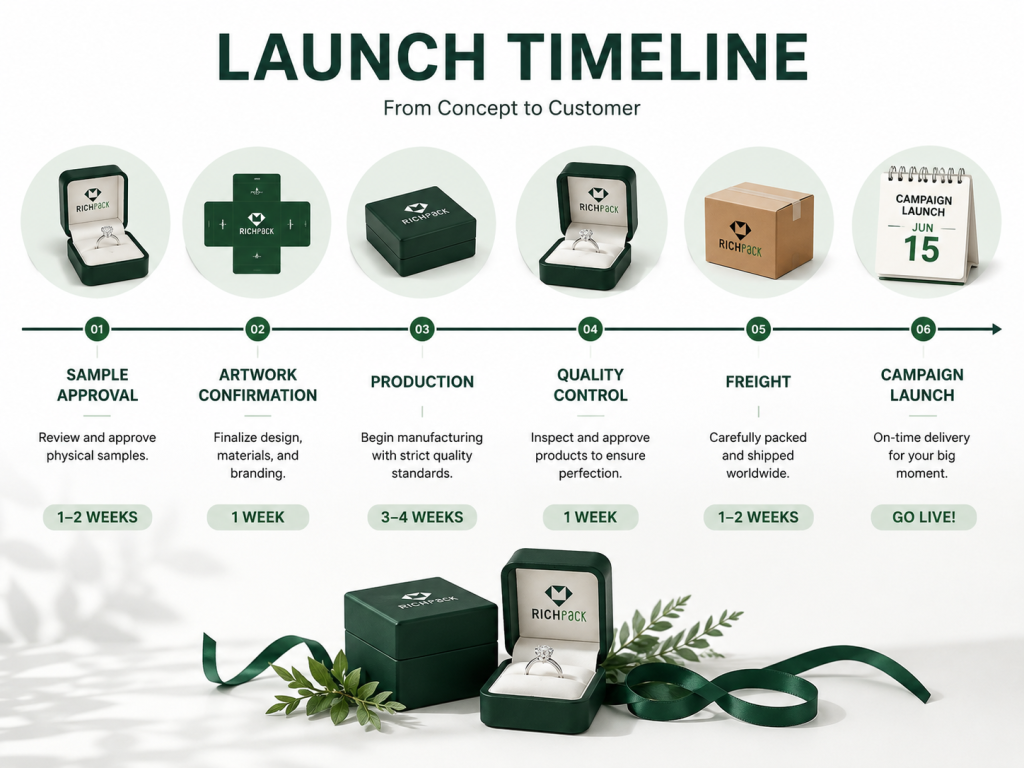
For custom jewelry boxes, a realistic timeline is usually 30 to 60 days after the brief is clear. Complex luxury jewelry boxes, new tooling, special materials, or large wholesale programs can take longer.
| wāhanga | Wā Angamaheni | He aha e tupu |
| Brief and material direction | 1-3 ra | Confirm jewelry type, size, quantity, budget, market, and style |
| Structural sample | 5-10 ra | Test box size, insert fit, opening feel, and protection |
| Artwork and finish proof | 3-7 ra | Confirm logo, foil, color, paper, texture, and placement |
| Tauira i mua i te whakaputa | 7-12 ra | Approve near-final materials and workmanship |
| Te whakaputanga nui | 15-30 ra | Produce, assemble, finish, and pack boxes |
| QC and packing | 2-5 ra | Check color, logo, closure, insert, carton packing |
| Te waka rererangi | 5-10 ra | He tere ake, he utu nui ake |
| Utanga moana | 25-45+ ra | Slower, lower unit freight cost for large orders |
For a serious product launch, start packaging planning 8 to 12 weeks before the target launch date. If the box is part of campaign photography, start earlier.
Rush packaging fails when every detail is still open.
If timing is tight, reduce variables. Choose one box structure, one material family, one logo finish, and one insert direction. Save the complex seasonal experience for the next order.
Fast does not mean careless. It means fewer moving parts.
Custom jewelry boxes are worth it when packaging affects trust, pricing, gifting, or repeat purchase.
They are not always needed on day one. A new brand can test products with stock boxes. But once you know which SKUs sell, packaging should become part of your brand system.
That means buyers are not only browsing box ideas. They are looking for suppliers and branded packaging options.
Stock boxes are useful for testing.
If you are launching a small batch, testing a new style, or validating a collection, stock jewelry boxes reduce risk. You can move faster and avoid overbuying.
The limit is brand memory. Stock boxes rarely create a distinctive unboxing experience. Customers may like the jewelry, but they may not remember the brand as clearly.
Use stock boxes for experiments. Do not build your long-term brand identity around them.
Custom jewelry boxes help customers remember you.
Your color, logo, texture, insert, and card all work together. The box becomes part of the product experience.
This matters most when:
Custom jewelry packaging boxes work best when the box is not treated as decoration. Treat it as a repeatable customer touchpoint.
Wholesale custom jewelry boxes make sense when you have repeatable demand.
Once you know your ring, necklace, or earring line sells consistently, custom wholesale packaging can reduce unit cost and improve brand consistency.
The key is forecasting. Do not order huge quantities just to chase a lower unit price. Factor in storage cost, style changes, seasonal rebrands, and cash flow.
A lower unit cost can become expensive if boxes sit in a warehouse for a year.
This is the packaging rule most brands learn late.
Spend first on structure and insert fit. Then spend on decoration.
A perfect foil logo cannot save a weak box. A beautiful color cannot fix a loose insert. A premium ribbon cannot hide poor closure.
If your budget is limited, prioritize in this order:
This is not glamorous. It works.
The cheapest jewelry box is not always the most profitable.
Look at the full return:
A box that costs slightly more can still be better if it protects margin, improves reviews, or supports a higher perceived value.
| kōwhiringa | Te Whakamahi Pai | painga | Risk |
| Stock jewelry boxes | Early testing | Fast and low commitment | Weak brand memory |
| Nga pouaka whakapaipai ritenga | Te whare waitohu | Stronger identity and unboxing | Needs design and sampling time |
| Wholesale custom boxes | Repeat SKUs | Better unit cost and consistency | Inventory and forecast risk |
If you only read one part, spend on fit, structure, and customer experience before you spend on decoration.
A clear brief saves time and money.
If you contact a jewelry box supplier with only “I need a luxury box,” you will get vague answers. If you provide product type, size, quantity, budget, material direction, finishing, and delivery market, you get useful options faster.
Start with the jewelry.
Measure the product, not just the outer box you like. Include product height, chain length, pendant size, ring profile, earring drop length, bracelet diameter, and set layout.
If you already use a pouch, card, polishing cloth, or care booklet, include those dimensions too.
The box must fit the full experience, not only the jewelry piece.
Quantity changes everything.
A 300-piece test run, a 3,000-piece reorder, and a 30,000-piece retail program need different production planning. The budget also changes the material and finishing options.
Share your expected quantity range early. A good supplier can suggest which structure fits your MOQ, timeline, and cost target.
If you need packaging for a launch date, work backward from delivery. Include sampling time, revisions, production, inspection, sea or air freight, customs, and warehouse receiving.
Good logo files prevent bad results.
Send vector files when possible. Include Pantone, CMYK, or brand color references. If your brand uses metallic foil, confirm foil color with physical samples.
Screens lie. Paper absorbs color differently. Foil looks different under warm and cool light.
Ask for a pre-production sample before final approval when color matters.
Do not request every finish at once.
Pick the finish that supports your brand. A minimal brand may need debossing on textured paper. A bridal brand may need soft ivory paper with gold foil. A bold fashion brand may use color contrast and spot UV.
Ko nga whiringa noa ko:
Use fewer details with better execution.
Supplier capability matters as much as design.
Ask how sampling works. Ask what happens if the color is off. Ask how quality is checked before shipping. Ask how cartons are packed. Ask whether the supplier can support global delivery.
This is where a one-stop packaging partner helps. RichPack’s value is not only in making a box. It is helping brands move from design to material selection, sampling, production, quality control, and delivery.
For jewelry brands selling outside China, this matters. You need packaging that looks good and arrives on schedule.
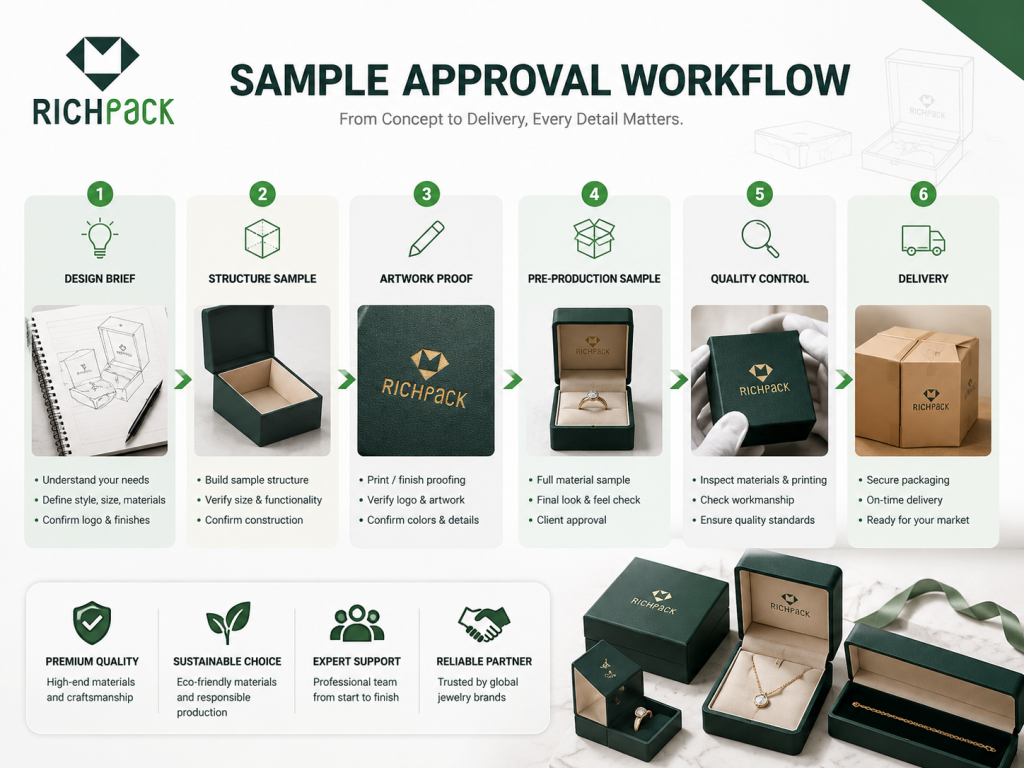
RichPack fits brands that need more than a box vendor.
A growing jewelry brand often needs design guidance, material comparison, sample revisions, custom inserts, logo finishing, quality inspection, bulk production, and global delivery. Managing those steps with separate vendors slows the launch and increases mistakes.
RichPack’s strongest fit is high-end custom packaging for brands that want one-stop support from design to delivery.
Use RichPack when you need:
Do not treat this as a hard sell. Treat it as risk control. When packaging affects launch timing, perceived value, and customer experience, a one-stop partner reduces the number of places where mistakes can happen.
Packaging mistakes are easy to miss because they look small.
Customers notice them instantly.
A box can photograph well and still feel weak.
Thin board, loose closure, poor glue, and soft corners make the packaging feel cheap. Customers may not know the technical reason, but they feel the result.
Always touch the sample. Open it several times. Press the corners. Check the hinge or lid. If it feels weak in your hand, it will feel weak to the customer.
Insert fit is where many jewelry boxes fail.
A loose insert creates movement. A tight insert can damage delicate pieces. A shallow insert can press jewelry against the lid.
Treat the insert as part of the product display. It should hold, frame, and protect the jewelry at the same time.
Packaging sets expectations.
If the box feels cheaper than the jewelry, customers question the price. If the box feels far more expensive than the jewelry, customers may feel the product itself is underwhelming.
Match packaging to the price point you want customers to believe.
Sustainability claims need proof.
Customers are tired of vague green language. If you use FSC paper, say that. If the box is recyclable, explain which parts. If the box is reusable, design it for real reuse.
Do not use sustainability as decoration. Use it as a material and design decision.
Bulk ordering before testing is dangerous.
A small issue becomes expensive when repeated across thousands of boxes. Logo position, color shift, tight drawer sleeves, weak magnets, insert shedding, and dented corners can all become batch-level problems.
Test first. Approve carefully. Then scale.
The best jewelry boxes for small brands are rigid paperboard boxes with a clean logo, secure insert, and flexible sizing.
Start with two or three core sizes. Add custom finishes once your best-selling products are clear.
Yes, custom jewelry boxes are worth it for e-commerce stores when they improve unboxing, brand memory, and shipping protection.
For low-ticket test products, stock boxes may be enough. For repeat SKUs, gifting products, and premium collections, custom jewelry boxes can support higher perceived value and better customer experience.
Rigid paperboard, velvet, suede, leatherette, wood, textured paper, and well-fitted inserts can make jewelry boxes look luxurious.
The real luxury signal is not one material. It is the combination of structure, fit, finish, color, and touch.
Most jewelry brands should start with three to five jewelry box sizes.
Use one size for rings and earrings, one for necklaces, one for bracelets, one for sets, and one optional gift or campaign box. This keeps operations simple while covering most product needs.
Jewelry boxes help boost sales by improving perceived value, increasing giftability, reducing damage, and making the brand easier to remember.
They do not replace product quality. They make product quality easier for customers to feel.
Jewelry boxes usually refer to the visible box that holds or presents the product. Jewelry packaging boxes can include the broader packaging system: rigid box, insert, pouch, card, outer mailer, carton, and shipping protection.
For ecommerce and wholesale brands, think in systems. A beautiful jewelry box still fails if the full packaging system cannot protect the order.
Choose jewelry boxes as a brand system, not as a container.
Start with the jewelry. Match the structure to your channel. Use materials that fit your price point. Spend on insert fit and protection before decoration. Then build a custom packaging system that can scale.
If you want high-end custom jewelry boxes without managing design, sampling, materials, production, and delivery separately, RichPack can help you build the full packaging solution from concept to shipment.
Now it is your turn: audit your current jewelry box. Does it protect the product, support your price point, and create a customer moment worth remembering?


2024-11-26

2025-06-11
2025-05-06
E ai ki te rangahau a Accenture, neke atu i te haurua o nga kaihoko i kii ka pai ratou ki te utu nui ake mo nga hua toimau ka taea te whakamahi, te hangarua ranei. Ahakoa i roto i te waahi papai, he mea nui te ahua o nga whakapaipai whakapaipai ki nga taonga whakapaipai. Ko nga uara pumau a nga waitohu me nga otinga whakangao pai-taiao ka awe i nga kaihoko me nga…
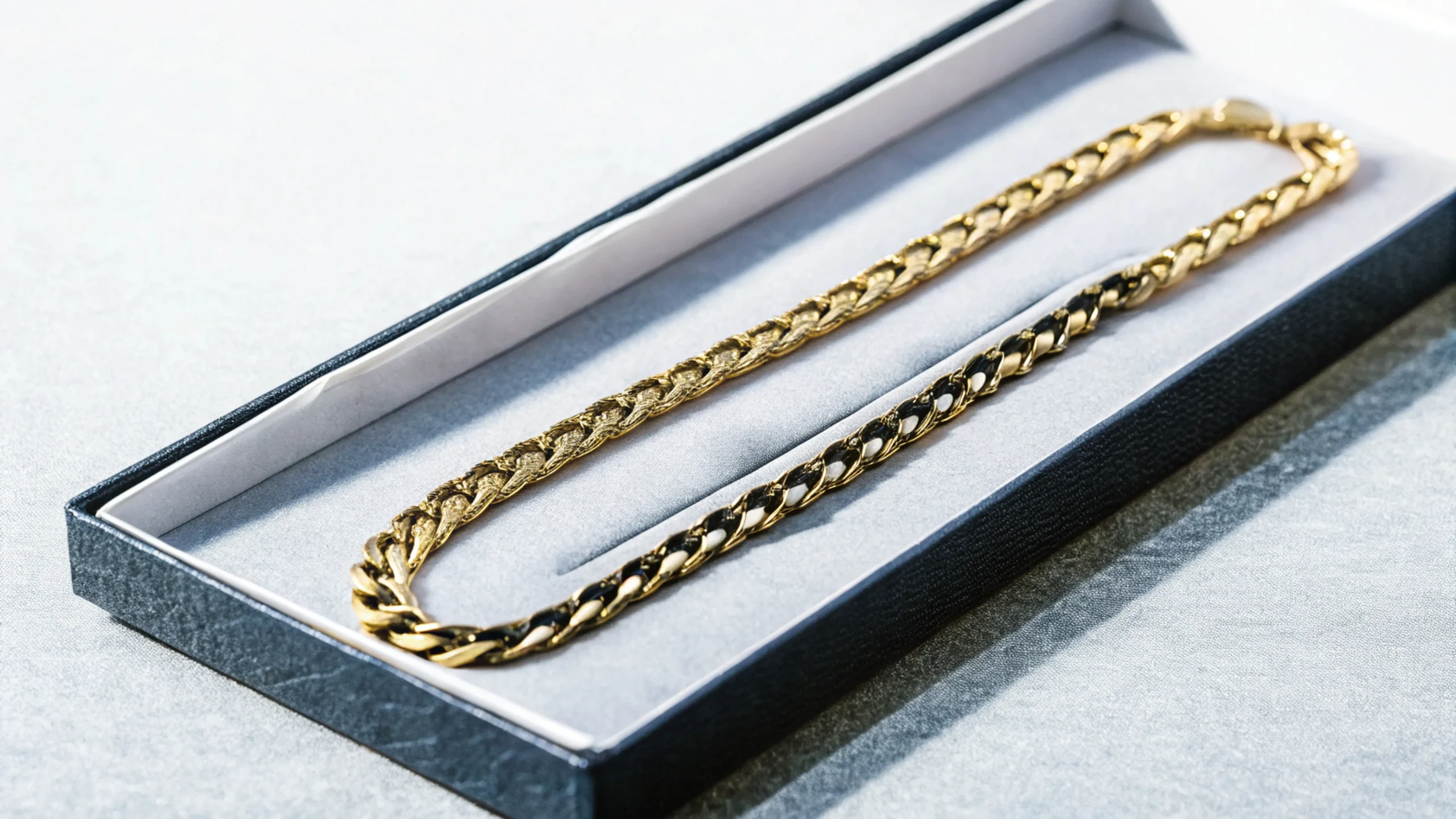
Me tiaki pai to tahei mekameka pouaka—ahakoa he mekameka pouaka koura mo nga tane, he mekameka pouaka hiriwa hihiko ranei, he pai te rokiroki me te whakaahua kia noho kore kaporeihana, he parakore, he tika te whakaatu.
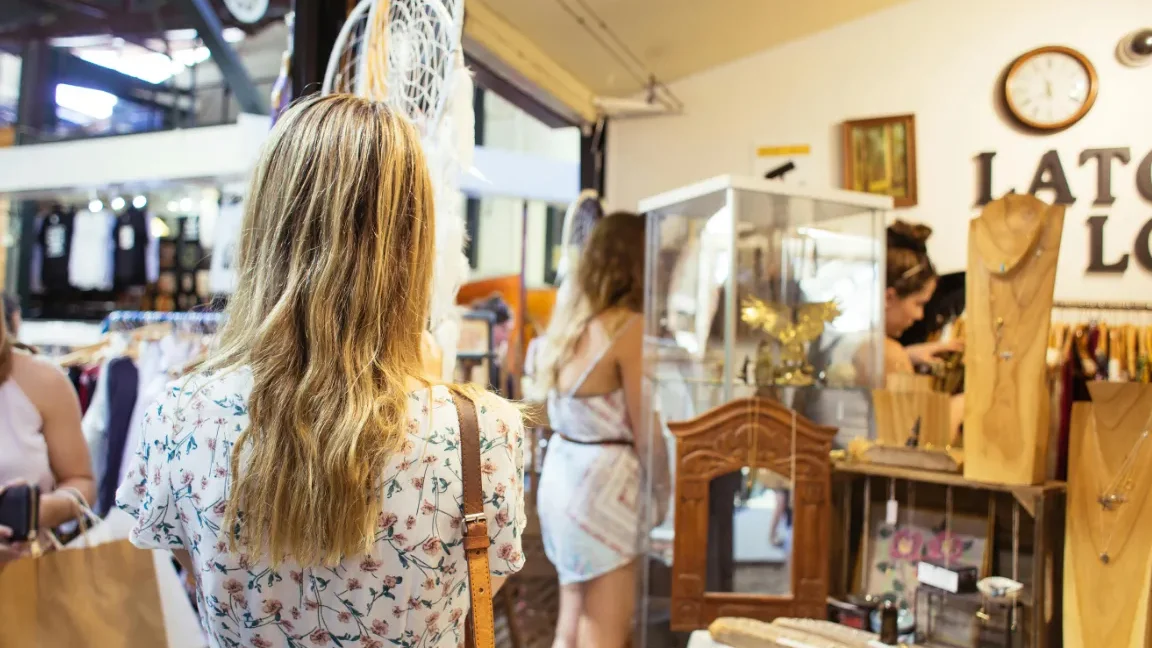
Inaianei kua huri katoa te aro o te ahua ki nga reanga rangatahi penei i a Gen Z, engari e kore e taea te whakahee ko te 70% o nga hoko whakapaipai ka mahia e nga pakeke 25-50 (Generation X me Y), me te nuinga o nga wahanga no nga mano tau. E ai ki te rangahau, he 157.9% te nui o te whakapaunga o nga mano tau ki runga… Haere tonu te panui Me pehea te whiriwhiri i nga pouaka whakapaipai e pai ai nga kaihoko me te whakanui i nga hoko.
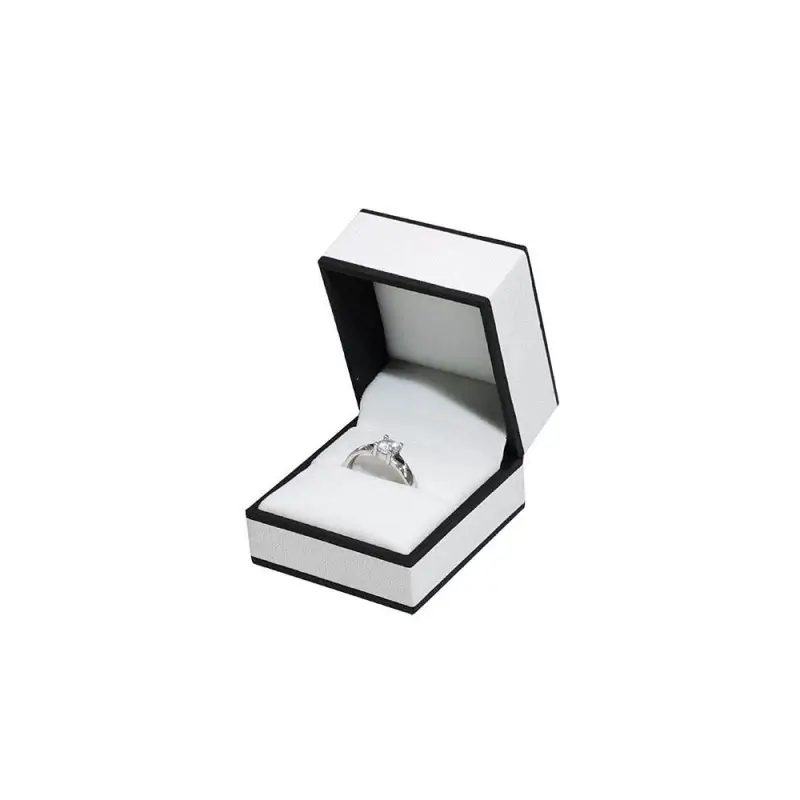
Whakapaipai Taonga Whakapaipai me te Hanga Tauira Tere | Hoahoa Whakaritea mo nga Tohu Motuhake | Nga Taahuri Tere

Whakapaipai Taonga Taiao mo nga Toa Taonga Iti | He mea whakahiato mo nga Kaihanga Rei e hiahia ana ki te Kaakaariki me te Parani mo te Whakapaipai i roto i nga Roroiti Iti
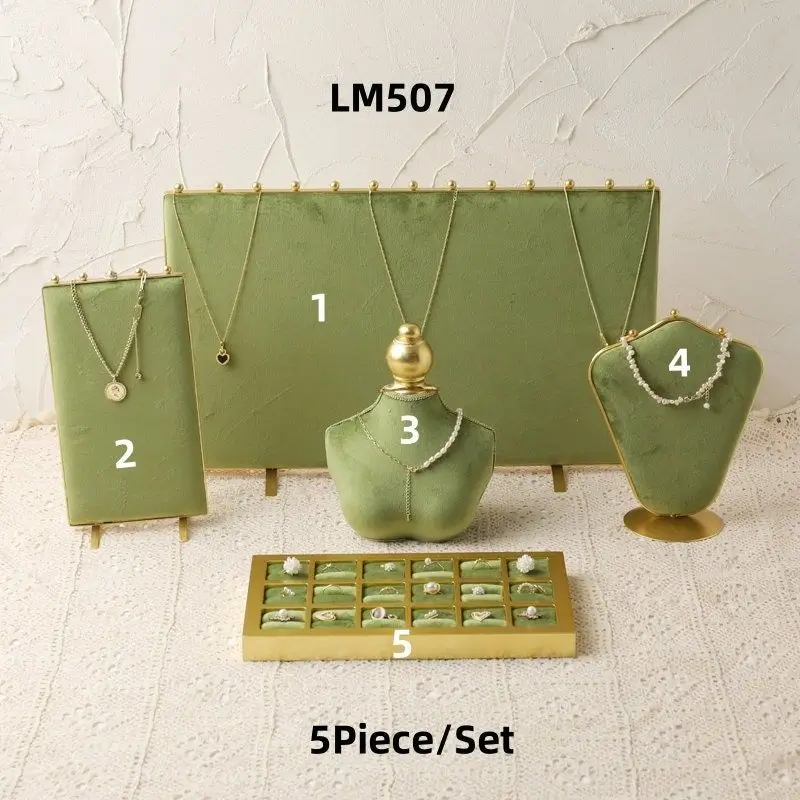
Ko nga Whakaaturanga Taonga Ritenga mo nga Toa Taonga Iti | He tino pai mo nga Kaihoko Taonga e hiahia ana ki nga otinga whakaatu ahurei me te utu utu
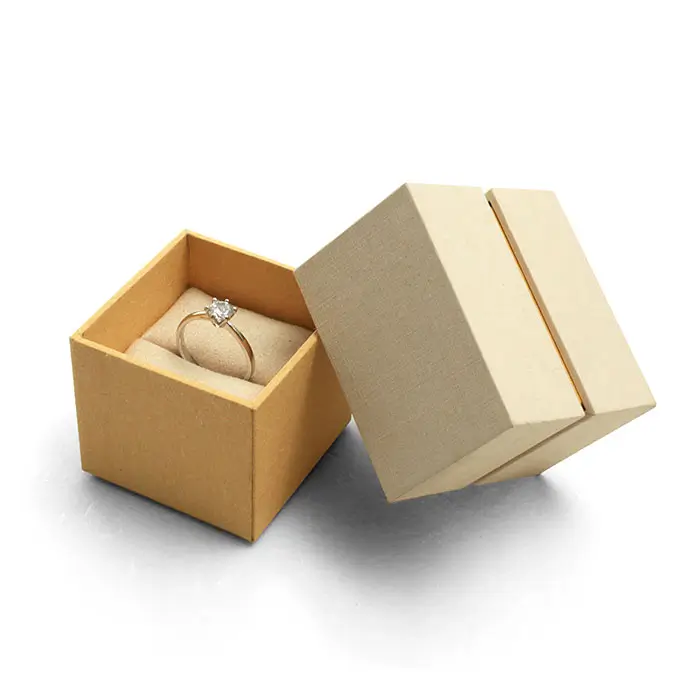
Pouaka Koha utu utu me nga Hoahoa Ritenga mo nga Kaihanga Taonga | Whakataunga Whakataunga Whakapaipai | Kei te waatea nga whiringa putea-hoa
Tirohia atu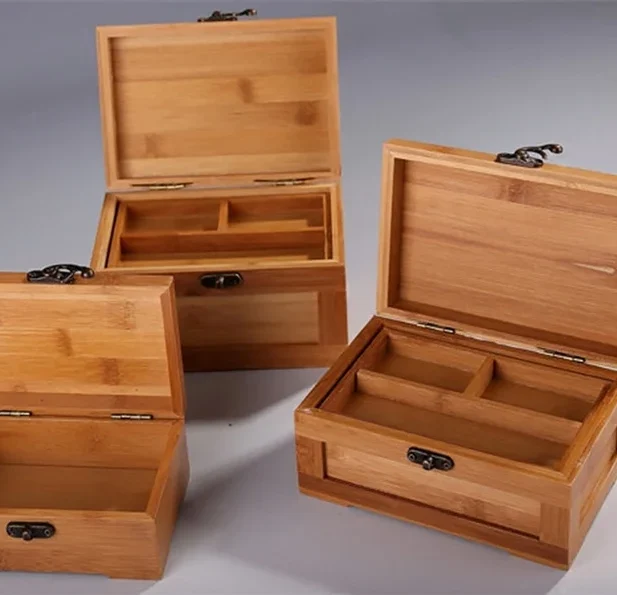
Nga Pouaka Whakahoahoa Rakau Rakau Bamboo me nga waahanga maha | Rokiroki Hoa-Rauo me te Mahi mo nga Waitohu Eco-Concious
Tirohia atu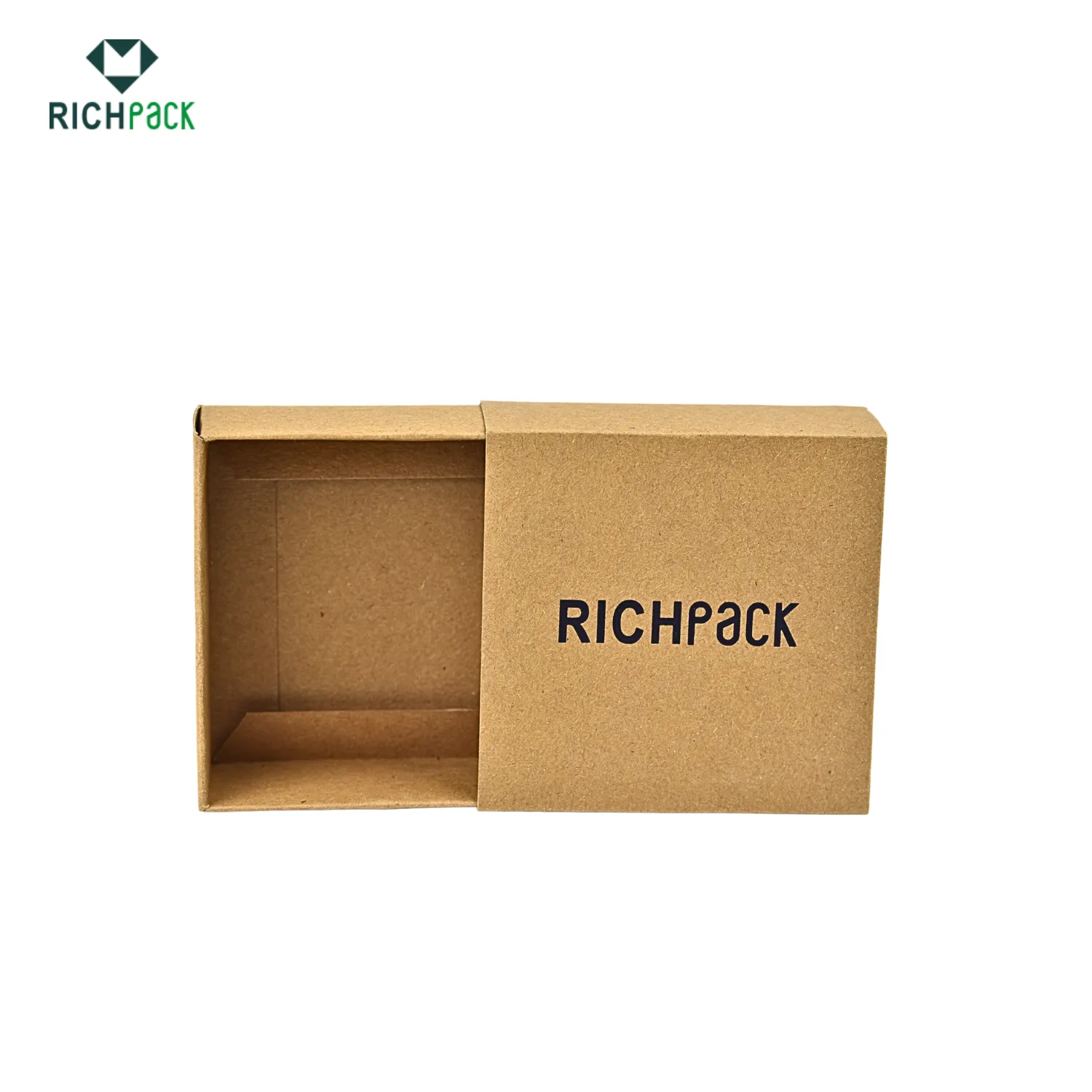
Whakapaipai Taonga Whakapaiora me nga Hoahoa Whaiaro mo nga Kaihokohoko | He pai mo nga Kaihanga Rei e pirangi ana ki nga Rongoa Puka Kaakaariki me te Waitohu
Tirohia atu

