

 Prev
Prev
4 Stili ta' Basktijiet tal-Ġojjellerija li Ma Jistgħux Ikollok Għal Marka ta' Ġojjellerija
2025-05-13



You spot the number, and your stomach drops. Packaging is eating 28% of your retail price. You’re shipping 180 necklaces in 4.20 boxes, and you’re not even sure if that’s reasonable. Cut costs and risk looking cheap. Keep spending and watch your margins disappear.
That tension is exactly what this guide dissolves.
Most jewelry brands are overspending on packaging AND underdelivering on the unboxing experience at the same time. They’re paying for thick velvet inserts nobody notices while their customers complain about boxes that won’t stay closed. This guide fixes both problems.
Hawn dak li nkopru:
The first question nobody asks is whether they’re already spending too much. Most brand owners have no idea what their packaging actually costs per unit, let alone whether that number is reasonable.
On average, jewelry packaging should cost between 2-6% of retail price, specifically ranging from 0.30 for economy items to 12+ for luxury bespoke pieces. Below is a pricing breakdown showing recommended packaging budgets across four jewelry price tiers, based on data from packaging suppliers and DTC brands across North America and Europe. Use this to immediately identify whether your current spend falls within, above, or below the recommended range for your product category.
| Firxa tal-Prezzi tal-Prodott | Packaging Budget (USD) | Livell | Why This Range Works |
| Taħt $ 50 | 0.30-0.30-0.80 | Economy + functional | Price-sensitive buyers care about the product, not the box. Over-investing here kills margins. |
| 50-50-150 | 0.80-0.80-2.00 | Mid-range + branding | This is where unboxing starts to influence whether customers come back. |
| 150-150-300 | 2.00-2.00-4.50 | Premium + experience | Packaging is part of the product at this price. Under-invest here, and customers feel short-changed. |
| $ 300 + | 4.50−4.50−12.00+ | Luxury + bespoke | Custom inserts, magnetic closures, premium materials. Every detail tells the story. |
The baseline most packaging consultants use is 10-40% of retail. That range is too wide to act on. Here is the more useful breakdown by product tier.
Products priced under 50 typically justify economy-tier packaging at 0.30-0.80 per unit. Anything above 0.80 at this price point is margin bleed. The customer bought a $35 pair of earrings. They are not expecting a luxury unboxing, and spending more here does not convert better.
At the 50−50−150 tier, unboxing begins to matter. Customers in this range make considered purchases and notice the presentation. Budget 0.80−0.80−2.00 per unit, enough to create a clean, brand-forward experience without over-engineering.
For products at 150−150−300, you’re in a territory where packaging is part of the product experience. Customers here have higher expectations. Budget 2.00−2.00−4.50 per unit.
Luxury pieces above 300 justify a premium investment. Custom inserts, rigid boxes, premium materials. The 300 justifies a premium investment. Custom inserts, rigid boxes, premium materials. The $4.50-$12.00+ range is not extravagant. It is brand communication.
The 10-40% guideline exists because it covers the full spectrum from economy to luxury positioning. But using it as your benchmark is like using “somewhere between 10 and 100” as a budget for dinner. The range is meaningless without knowing where you fall. Your correct benchmark is the tier table above, not the general range.
Three signals tell you you’re overspending. First, you cannot calculate your exact cost per unit in under 60 seconds. Second, you’re using the same packaging configuration for products that differ by $150 or more in price. Third, your packaging invoices are growing faster than your revenue.
The fix is always the same: calculate your current cost per unit, compare it to the tier benchmark, identify the SKUs most misaligned, and make targeted swaps.
Sometimes spending more on packaging saves money overall.
If a poorly fitted insert lets a necklace shift during shipping and 1 in every 80 pieces arrives damaged, you’re looking at replacement cost, reshipping cost, and a lost customer. A 1.20 precision-molded insert instead of a 0.60 foam pad prevents damage at a net savings when the damage rate is above 1.5%.
Before removing any protective element, calculate your expected damage rate at that product’s transit risk level. If the removal increases damage by more than 0.3%, the material savings will not cover the damage cost.
Total cost per unit = (Material + Production labor + Fulfillment labor + Freight allocation + Storage allocation) / Units shipped
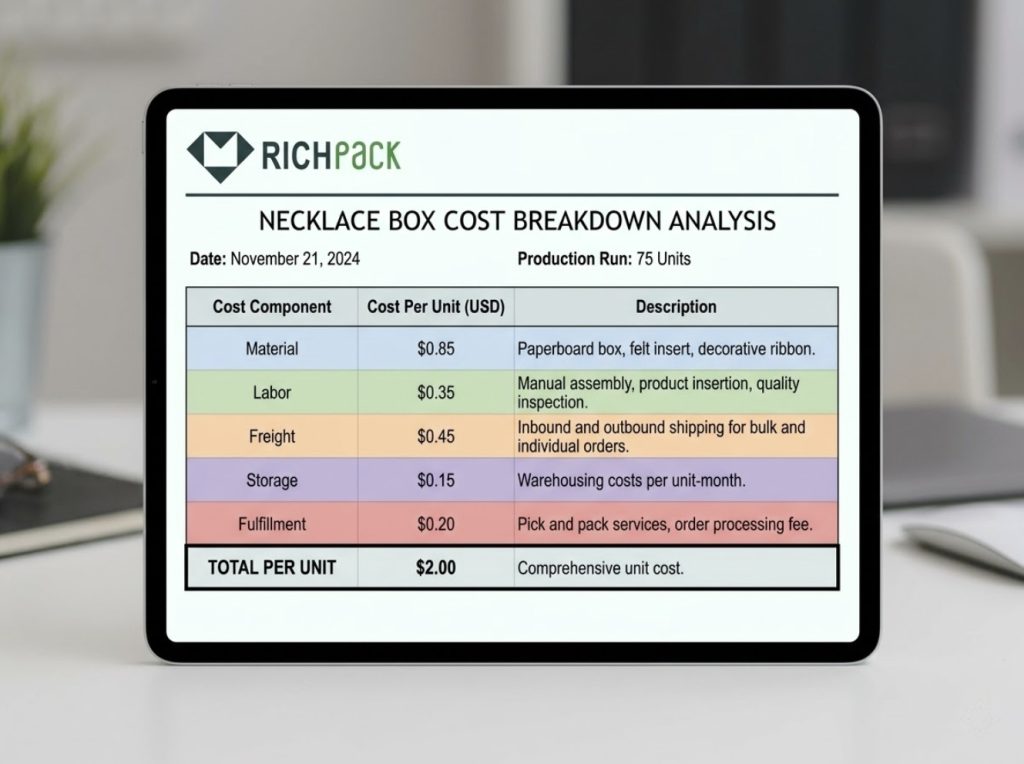
Most brands track only material cost. They order boxes at 0.85 each and call that their packaging cost. They never add the hand-folding labor at 0.35 per box, the dimensional weight freight charge at $0.45 per unit, or the storage allocation for slow-moving inventory.
When you run this full calculation, the actual cost per unit is often 40-60% higher than the material-only number. That is the blind spot that makes brands think they’re spending 28% when they’re actually spending 38-42%.
Here is the mental block that keeps brand owners from making any changes. The moment someone says “reduce packaging costs,” the imagination runs to thin cardboard, flimsy boxes, and customers opening parcels to find their $200 ring rattling in bubble wrap.
That scenario is real, but it is a choice, not an inevitability.
The assumption that lower cost equals lower quality is the single biggest mistake in packaging strategy. It causes brands to overinvest in material thickness while underinvesting in the details customers actually notice.
For decades, expensive packaging meant thick materials, heavy boxes, and lots of layers. Customers learned to read those signals. A rigid velvet-lined box meant luxury. A thin paperboard box meant budget.
Those signals are legacy signals. They are artifacts of an era when manufacturing was limited. Modern manufacturing changes this equation. Precision engineering, tight tolerances, precise magnetic-closure resistance, and exact insert fit. These create a premium feel that has nothing to do with board thickness or material cost.
Not the GSM of the cardboard. Not whether the greyboard is 1,400 gsm or 1,800 gsm.
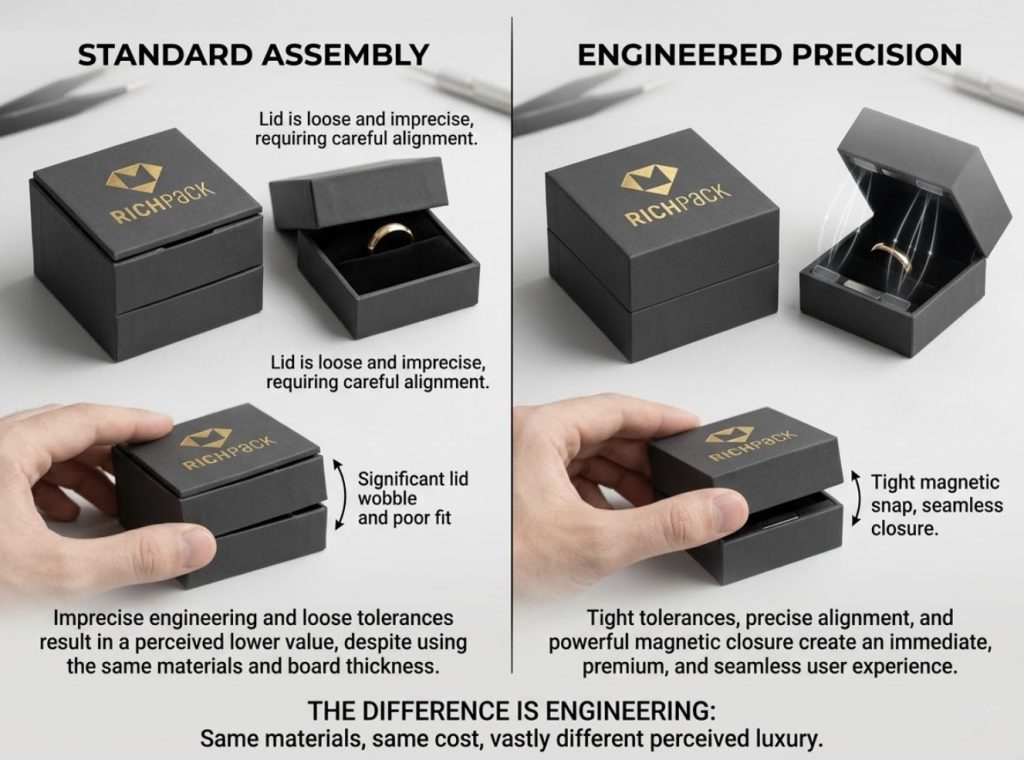
What registers is whether the box feels solid when picked up. Whether the opening mechanism works smoothly and feels deliberate. Whether the insert holds the piece in a way that feels protective rather than loose. Whether the overall presentation tells a coherent story.
Thickness does not create any of these sensations. Precision does.
A magnetic closure with precise resistance. The sweet spot is a closure that requires intentional pressure to open and provides tactile feedback as it engages. That level of engineering costs almost nothing more than a loose-fitting lid. But the experience difference is enormous.
Insert precision. An insert that holds a piece at exactly the angle it was photographed on your website creates a cognitive resonance. The customer sees the piece in the box, and it matches their expectation. That is the sensation that gets shared on social media.
Surface finish. Matte soft-touch paper, spot UV on a logo, and debossed lettering. These finishing choices read as premium at any price point. They add minimal cost over standard print and create the visual and tactile identity that customers associate with your brand.
A 2mm greyboard box with a precision-constructed magnetic closure feels more premium in the hand than a 5mm box with a loose-fitting lid. The customer cannot measure board thickness with their fingers. They can feel whether the box is well-made.
The brands getting this right are the ones that stopped trying to impress through volume and started impressing through precision. Sustainable packaging at the right price point does not cheapen a brand. It modernizes it.
Customers under 40, your core DTC demographic, actively read material choices as brand statements. Recycled pulp, FSC-certified board, water-based inks. These are not budget compromises. They are category signals.
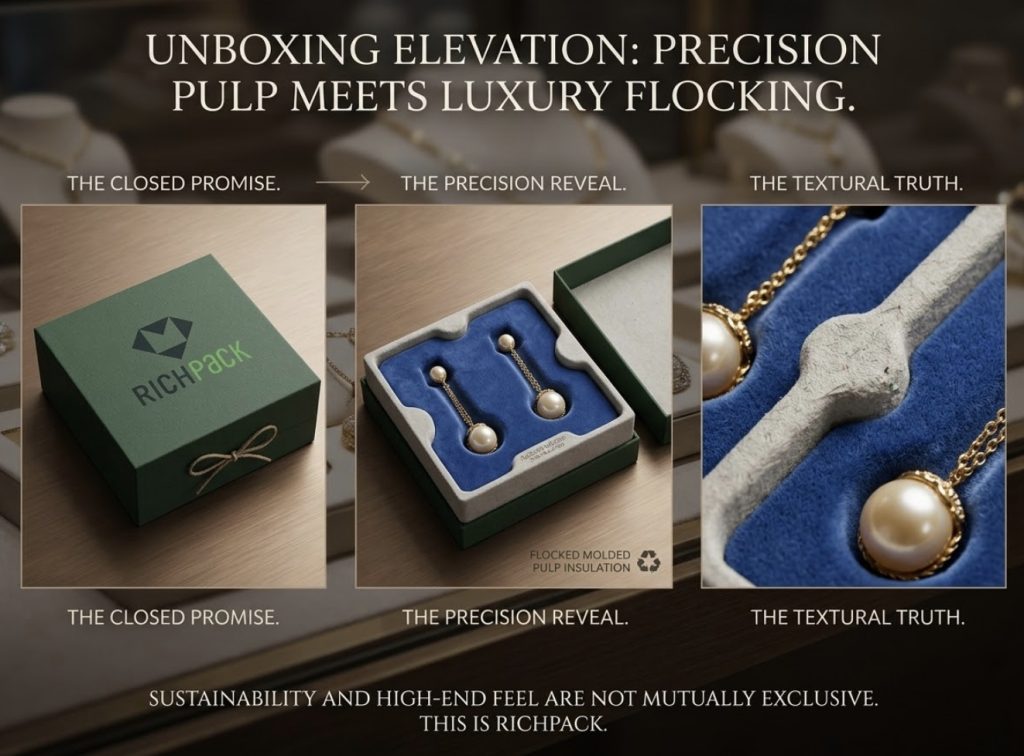
When a customer opens your box, and the insert is made from molded pulp, when they can see and feel the fibrous texture of agricultural waste material repurposed into something beautiful, that is a story. That story is shareable on social media. It is memorable. And it cost 40-50% less than the velvet it replaced.
Customers who care about sustainability are 3x more likely to share their unboxing experience online. Unboxing ASMR videos, the tactile sound of opening a well-engineered box, the snap of a magnetic closure. These are the details that drive organic reach on TikTok and Instagram. Your packaging is a content engine you may have been ignoring.
A mid-tier jewelry brand tested this directly. They reduced per-unit packaging cost from 2.50 to 1.60 by removing the outer sleeve, eliminating the double-layer foam insert, and switching from a rigid hinged box to a single-layer magnetic carton with a molded pulp insert.
Customer feedback mentions of “elegant” and “ritualistic” increased by 12% after the change.
The reason cutting costs improved the experience was simple: they invested the savings into the details that actually matter. A magnetic closure with precise resistance. A molded pulp insert that fits like a glove. A clean outer surface that feels considered.
The fastest path to cutting packaging costs 20-35% without touching brand experience is the simplest concept in this guide: stop buying the same box for every product.
One-size-fits-all packaging is a margin destroyer. It forces you to either over-protect cheap items or under-protect expensive ones. Neither is good for business.
On average, jewelry packaging should cost between 0.35 and 2.20 per unit for most fashion pieces, with significant savings available through tiering alone. The tiering matrix below shows economy, mid-range, and premium packaging configurations across six common jewelry categories. Use this to identify where your current configurations are mismatched.
| Tip dehbijiet | Economy Tier | Mid-Range Tier | Livell Premium | Firxa ta 'Spejjeż |
| imsielet stud | Paperboard box + sticker seal | Folded carton + branded insert card | Rigid box + foam insert + logo stamp | $ 0.35 - $ 2.20 |
| drop imsielet | Pouch + mailer | Paperboard box + satin insert | Rigid box + custom-molded insert | $ 0.50 - $ 3.00 |
| ġiżirajjen | Flat box + ribbon | Magnetic carton + foam pad | Rigid hinged box + velvet insert | $ 0.60 - $ 4.50 |
| Bracelets/Bangles | Sleeve + poly bag | Rigid carton + cardboard divider | Rigid box + form-fit foam insert | $ 0.45 - $ 3.50 |
| ċrieki | Mini cardboard box | Folded carton + thin foam insert | Rigid box + plush insert | $ 0.25 - $ 2.00 |
| arloġġi | Bubble wrap + rigid mailer | Rigid box + cushion insert | Wooden box + movement holder | $ 1.00 - $ 15.00 + |
Think about what happens when a 45 silver ring shares the same packaging as a 185 gold bracelet. If you buy the box to protect the 185 pieces, you’re spending too much on the 45 pieces. If you buy the box to serve the 45-piece, you’re under-protecting the 185-piece.
There is no win. Either you’re hemorrhaging margin on the low-value SKU, or you’re accepting damage claims on the high-value one.
Tiered packaging solves this by matching protection level to product value. The ring gets a 0.35 paperboard box. The bracelet gets a 1.80 rigid box with a divider. You stop paying for the wrong things.
Start with your product line. Group items by retail price: under 50, 50, 50-150, 150, 150-300, above 300, above 300. Then assign a packaging tier to each group. The assignment is not just about price. It is about what the packaging needs to communicate.
A 75 pair of earrings sold through a boutique retailer needs different packaging than the same 75 pair shipped directly to a consumer. Retail packaging can be lighter because it does not face the postal system. DTC packaging needs transit protection.
Ring packaging deserves special attention because it is the highest-volume category for most jewelry brands and the most commonly over-packaged.
A $45 sterling silver ring does not need a velvet-lined rigid box. A paperboard box with a thin foam insert performs just as well in protection and customer perception at that price point. The velvet insert is money you’re spending to feel good about yourself, not to serve the customer.
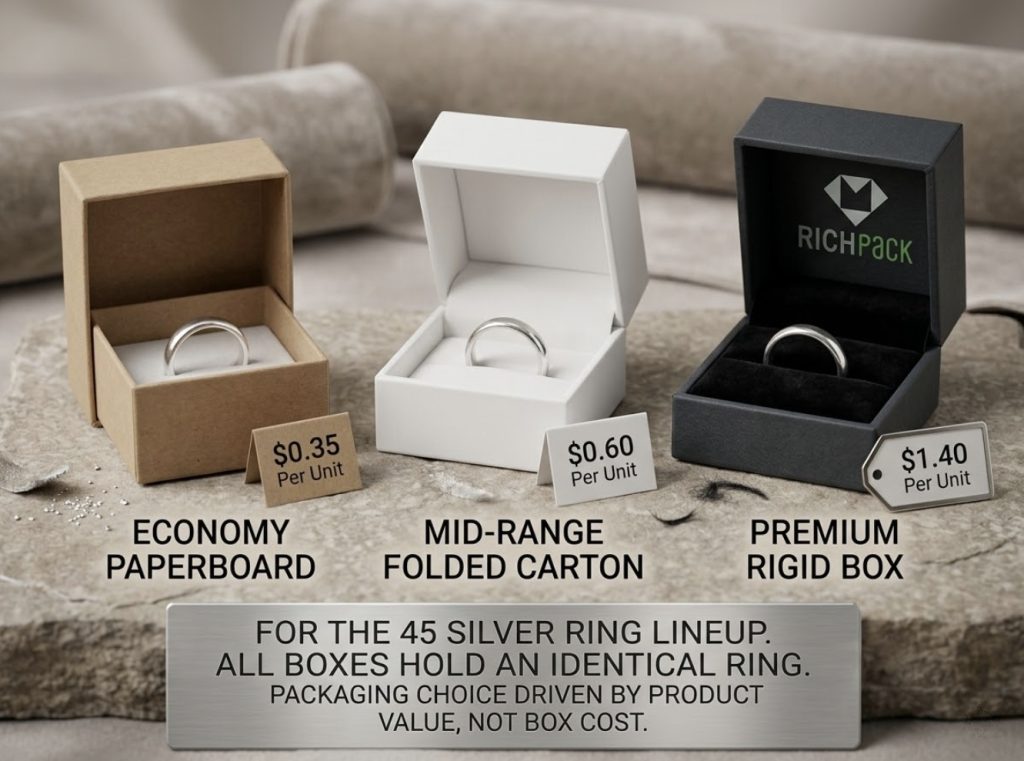
Where do you actually need rigid boxes for rings? Pieces above $150 and fine jewelry with fragile settings (prong-set stones, tension settings, pave). For everything else, the rigid box is a habit costing you money. For affordable ring boxes that do not sacrifice quality, explore RichPack’s wholesale ring box options.
Necklaces and pendants have one primary enemy: tangling. Your insert strategy should be built around preventing the chain from moving, not around wrapping the piece in layers.
A channel insert, a trough cut into the foam or pulp that the chain sits in, keeps the necklace flat and prevents tangling at a fraction of the cost of a full velvet-lined tray. For pieces under $100, a flat box with a ribbon closure and a foam pad under the pendant point is more than adequate.
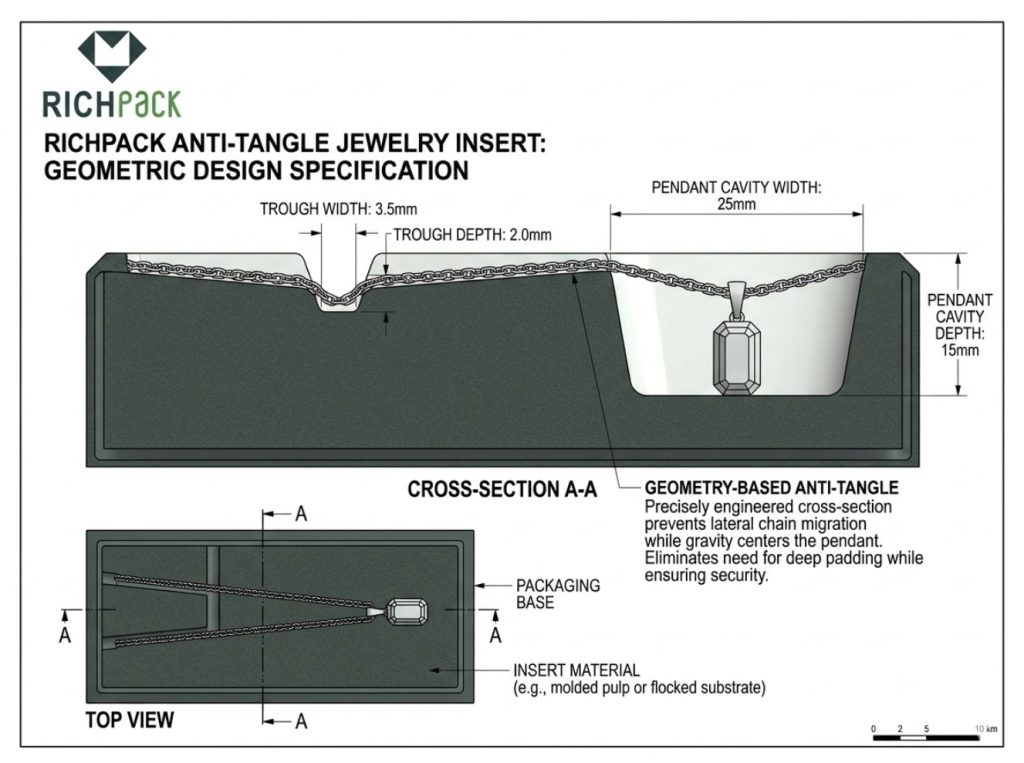
For necklaces above $150, a rigid hinged box with a velvet insert and a chain channel keeps the piece protected and presents beautifully. Browse necklace packaging box options designed for tangle-free presentation.
Watches are the trickiest category because there is a huge difference between a 60 fashion watch and a 600 mechanical watch, and they have the same shipping vulnerability.
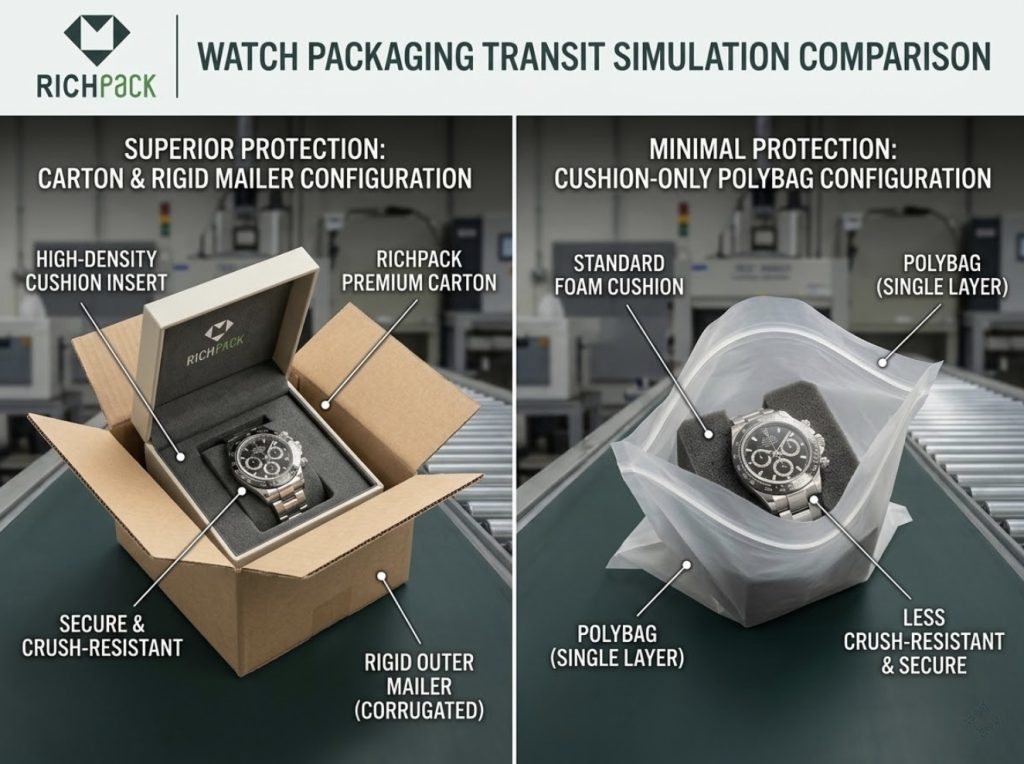
The answer is not to put everything in a luxury box. It is to segment by value. Watches under 100 can ship in a rigid box with a simple cushion insert. Watches above 100 can ship in a rigid box with a simple cushion insert. Watches above 250 need rigid boxes with movement-specific holders that prevent the watch face from contacting the box surface during transit.
Never ship a watch without a rigid outer container. Even with inner protection, watches need the structural integrity of a rigid box to survive carrier handling. See custom watch box options for protection solutions at every price point.
Channel-specific decisions often mean running two packaging configurations for the same SKU. Online orders go into a rigid box with an outer shipping carton. In-store display pieces go into a lighter branded sleeve.
Online packaging must survive the postal system. Store packaging must survive a walk to the car and a browse on the display table. The requirements are completely different.
The incremental cost of dual configurations is almost always worth it when you factor in the reduction of damage claims from transit. A brand shipping 1,000 units per month might spend an extra 200 per month on dual configurations. If that prevents even two damage claims at 60 per claim, it breaks even. It typically prevents far more than that.
Material costs drive 40-55% of total packaging spend. This is where most brands look first when they want to cut costs, and where most brands make their biggest mistakes.
The fear around material substitution is real but misdirected. Brands worry that switching materials will be visible to customers and damage brand perception. What they do not consider is that many material upgrades they’re paying a premium for are invisible to customers, while being very visible to their CFO.
On average, the right material substitution cuts material costs by 30-50% while keeping the same protection performance and brand feel. Before switching any material, evaluate it against four criteria: cost reduction percentage, durability and protection performance, eco-score, and brand fit. A substitution that scores high on cost but low on durability fails. One that scores high on all four is a winner.
The benchmarking table below compares traditional materials against their proven alternatives across four key dimensions, based on current pricing data and production performance records from packaging manufacturers.
| Materjal Tradizzjonali | Alternattiva | Tnaqqis tal-Infiq | durabilità | Score Eko | Brand Fit | Best Għall |
| Velvet + foam insert | Molded pulp + light flocking | 40-50% | Medja | Għoli | Għoli | Earrings, pendants, lightweight pieces |
| Rigid lid box | Single-layer magnetic carton | 25-35% | Medja | Medja | Medja | Silver jewelry, fashion pieces under $100 |
| Hot foil + blind embossing | Spot UV + debossing | 30-40% | istess | istess | Għoli | Outer branding on mid-range boxes |
| Full-color printed insert | Single-color debossing | 20-30% | istess | istess | Medja | Inner dividers, instruction cards |
| Foam EVA insert | Recycled PET insert | 15-25% | Għoli | Għoli | Medja | Rings, bangles, firm structural support |
Molded pulp deserves more attention than it gets. Made from sugarcane bagasse, bamboo pulp, or recycled paper, molded pulp inserts can be shaped to fit any piece precisely. The surface can be flocked; electrostatic flocking applies a fine fiber coating to create a velvet-like texture at roughly 50-60% of the cost of traditional velvet-lined foam.
For earrings, pendants, and lightweight pieces, the substitution is nearly invisible to customers. The flocked surface looks and feels premium. The protection performance is equivalent. The cost savings are real and substantial.
The additional benefit for brands selling in the EU and UK markets: molded pulp meets the EU Packaging and Packaging Waste Regulation (PPWR) requirements. A substitution that cuts cost AND positions your brand better for regulatory compliance is a rare win-win. Explore sustainable packaging options from RichPack that meet EU standards.
The perception gap between rigid board and quality paperboard is larger than the performance gap for most applications. A 1,200-1,500 gsm greyboard box with a quality paper wrap performs identically to a 2,000 gsm rigid box in customer hands, provided the construction and closure mechanism are sound.
The heavier board gives you nothing the customer can feel or see. What the customer feels is the opening mechanism, the insert fit, and the surface finish. Those are engineering choices, not material thickness choices.
The key is matching the paperboard grade to the product weight. A 1,400 gsm greyboard box with a rigid construction handles a 150-piece necklace just fine. The same box for a 400-piece with a heavy bracelet might need to move up to 1,600 gsm to provide adequate structural support. Match the grade to the weight, not to the price. For a full breakdown of material options, see how to choose the best materials for jewelry boxes.
Beyond molded pulp, the sustainable options that perform well include recycled greyboard, same cost as virgin board, identical performance, stronger sustainability story. Water-based inks for print, same cost as solvent-based, better for food-contact safety and brand positioning. Biodegradable polybags, 20-30% more expensive than standard polyethylene, but justified in EU markets and for sustainability-focused brands.
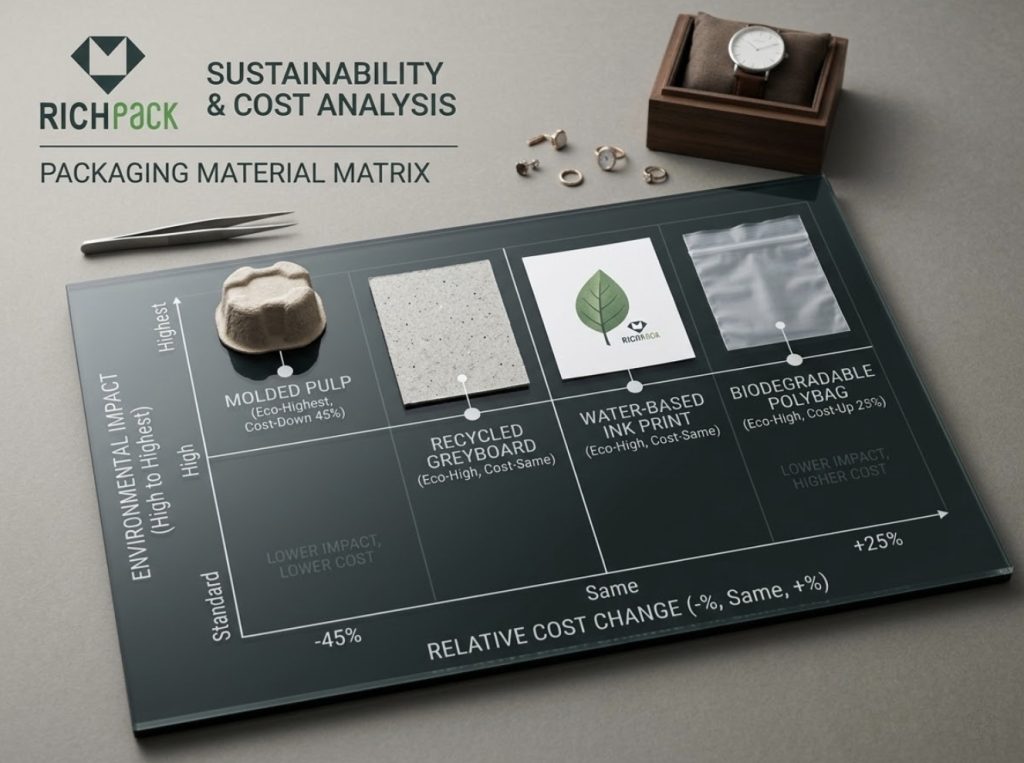
What does not perform well yet at competitive cost: biodegradable rigid plastic trays, plant-based magnetic closures. These are emerging categories that will mature in the next 2-3 years. For now, the cost and performance do not justify the switch for most applications.
High-end watches and fine jewelry above $500. At that price point, customers expect and receive rigid boxes as part of the purchase ritual. Substituting a folding carton at that tier signals a category downgrade that customers notice and often comment on in reviews.
This is one tier where you should not chase material savings. The brand damage from an under-engineered box at the luxury tier exceeds the cost savings from the substitution.
Here is the cost center that silently eats margins while nobody is watching: dimensional weight.
Carriers, UPS, FedEx, USPS, do not charge by actual weight for large, lightweight packages. They charge by dimensional weight, calculated as (L x W x H) / DIM divisor. For domestic US shipments, the DIM divisor is 139 for UPS and FedEx. For international shipments, it is 166 or higher.
DIM weight dictates shipping costs. Box height increases DIM weight. Flat-pack designs reduce box height. Every extra inch of box height is a direct freight charge. This is not theoretical. This is a line item on every shipping invoice.
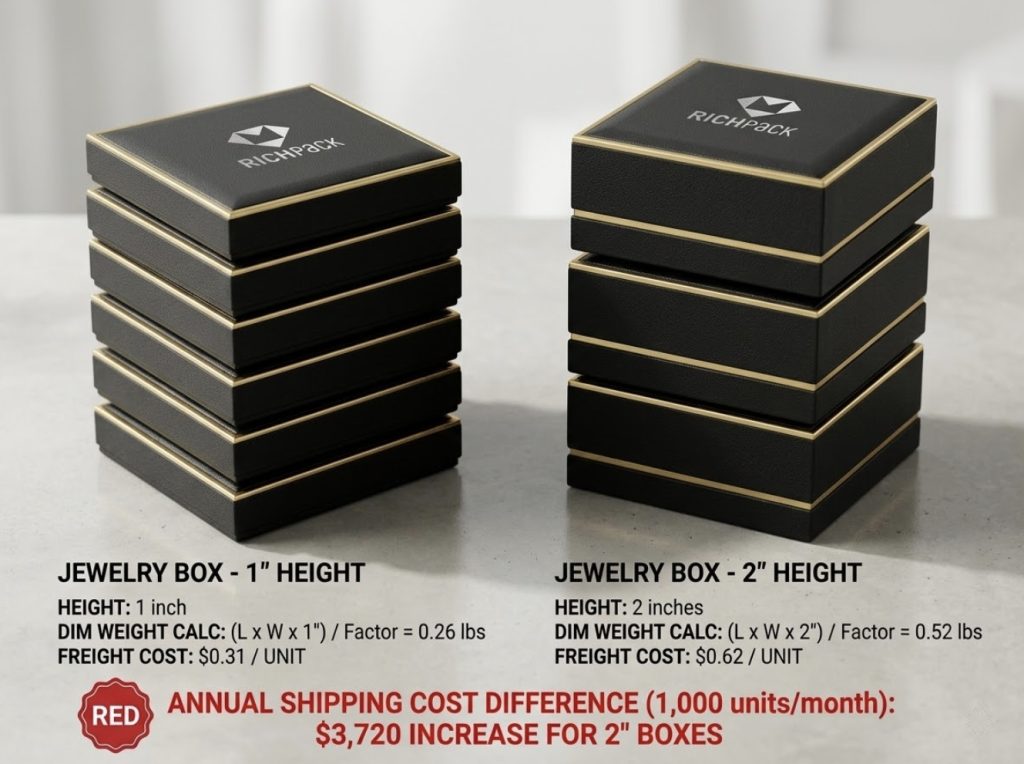
A box that is 1 inch taller than it needs to be adds volume to every shipment. If you’re shipping 1,000 units per month in a 6 x 6 x 2″ box versus a 6 x 6 x 1″ box, the taller box costs you roughly 50% more in dimensional weight charges.
The math: (6 x 6 x 2) / 139 = 0.52 DIM weight in pounds. (6 x 6 x 1) / 139 = 0.26 DIM weight in pounds. At 1.20 per pound of DIM weight, that is 0.62 versus 0.31 per unit in freight. 310 more per month for the same product in the same carrier.
Those numbers add up fast at scale. If you’re using a 3PL (third-party logistics) provider, they may already be flagging DIM weight surcharges on your invoices. Ask them to pull a dimensional weight analysis on your top 5 shipping SKUs. You will be surprised.
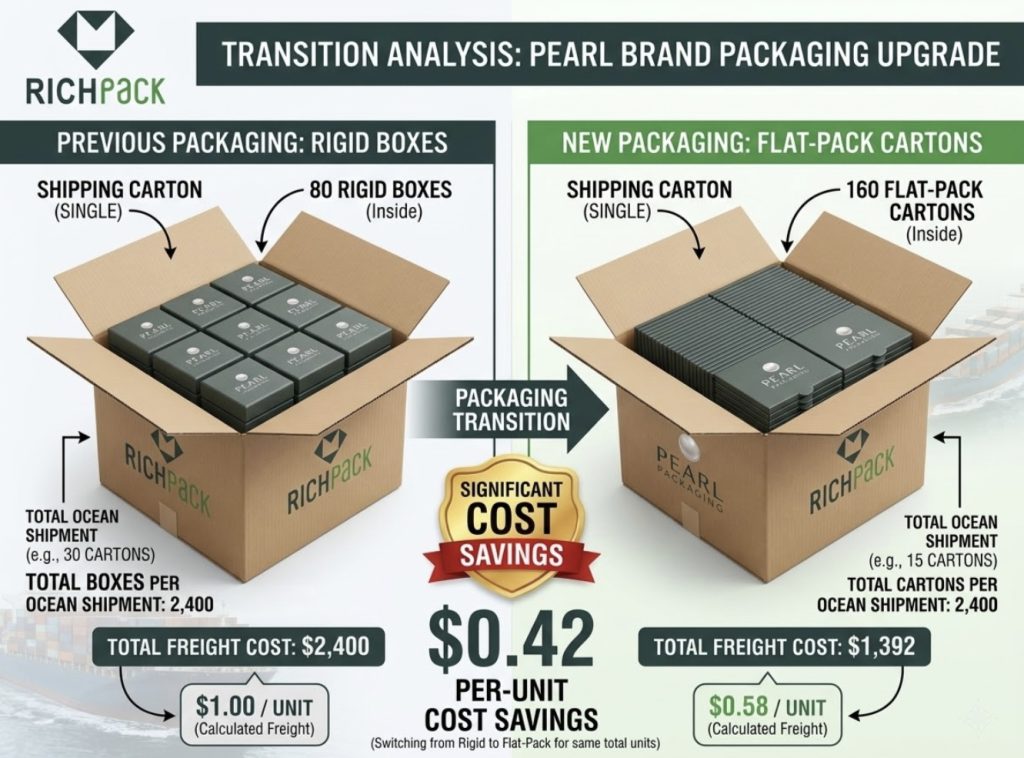
The structural change that saved one pearl brand 42% on ocean freight: switching from square rigid boxes at 1.8″ thickness to flat magnetic cartons at 0.9″ thickness. Same shipping carton. Same piece of jewelry. The same carton went from holding 80 units to holding 160 units. Ocean freight cost per shipment dropped from $2,400 to $1,392. That is $1,008 saved per shipment, on a product where margins were already thin.
Stampa tal-ROI: Flat-pack design saves 0.35 per unit in freight plus 0.35 per unit in freight plus 0.25 per unit in labor. On 1,000 units per month, that is 600 saved per month, or 7,200 per year, compared to the same product in a rigid box.
Flat-pack versus rigid. Which saves more total cost? For most DTC brands shipping internationally, flat-pack wins on total cost even when material cost is slightly higher.
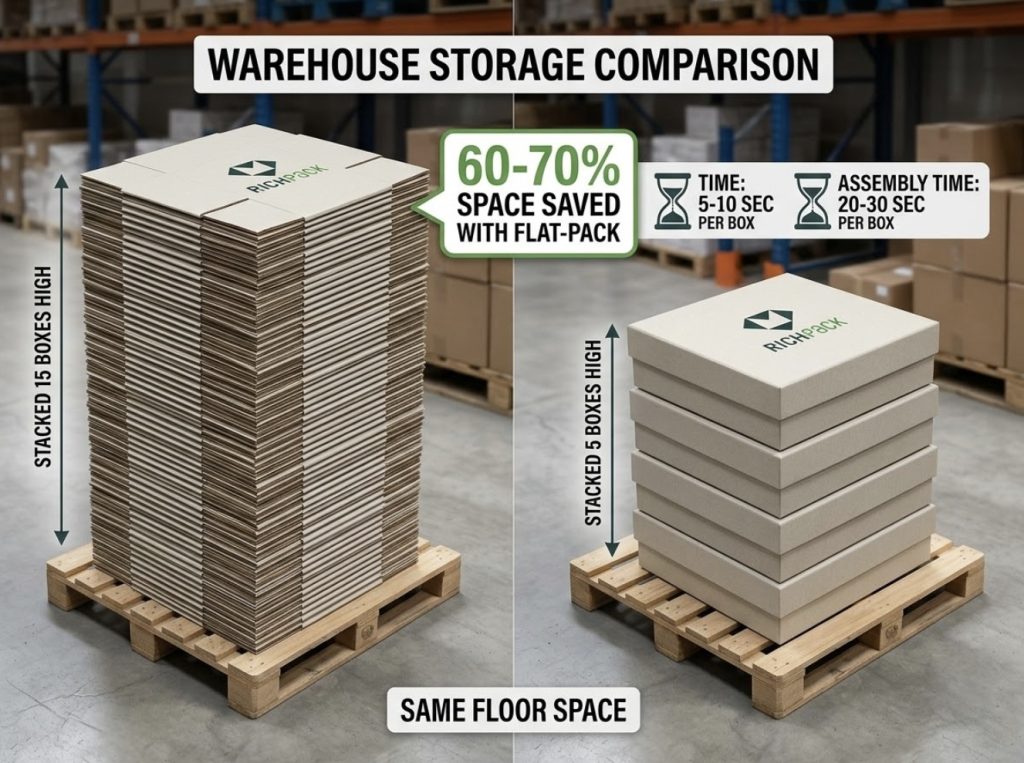
Why? A flat-pack carton ships and stores flat. You receive them collapsed, saving up to 70% of storage space. Assembly is 5-10 seconds per box with a trained packer versus 20-30 seconds for folding a rigid box by hand. For brands doing 500+ units per month, the labor savings from flat-pack alone can be 0.15−0.40 per unit. Combined with the freight savings from reduced box dimensions, the total cost advantage of flat-pack over rigid construction is typically 20-35% at scale.
The key is matching the insert design to the actual protection requirement, not over-engineering based on habit.
A ring needs a cavity that holds it snugly, not a 2″ thick foam block. A necklace needs a channel or trough that prevents tangling, not a deep velvet-lined tray. A pair of earrings needs a shallow recess that keeps the posts from shifting, not a deep foam insert that buries the piece.
Reduce thickness by redesigning the insert first. A well-designed insert uses geometry to protect rather than mass. A ring cavity 12mm deep and 18mm wide holds a size 6 ring perfectly at any box thickness. A foam block 40mm thick and loosely packed does a worse job at twice the material cost.
Every millimeter of excess board, every unnecessary flap, every oversized margin adds material cost and packing time. A well-designed die-cut reduces board waste during production by 15-25% compared to a standard template. That waste reduction flows directly into unit cost savings.
Work with your supplier’s die-cut engineer on this. They know their tooling and their waste patterns better than anyone. A 20-minute conversation about your current waste rate can lead to a die-cut redesign that pays back in 2-3 production runs.
Custom box shapes look distinctive on a shelf and in unboxing photos. They also cost 30-60% more per unit than standardized shapes and come with longer lead times, typically 25-45 days versus 10-15 days for standard sizes.
For brands under 3 years old or selling fewer than 3,000 units per month of any single SKU, the premium for custom shapes rarely pays back in brand value. Standardized shapes with custom branding elements, logo stamps, belly bands, and custom print achieve 80% of the brand expression at 40% of the cost. Explore custom jewelry box options that balance branding with cost efficiency.
Every fold, every magnetic strip, every custom die-cut adds assembly time and failure points. A box that requires 4 creases and 2 magnets takes longer to assemble and has more things that can break during use.
Simple construction is not a budget compromise. It is an engineering decision that reduces failure rates, speeds up fulfillment, and cuts labor costs simultaneously.
Calculate the assembly cost per box for your current construction. If a box takes 25 seconds to assemble by hand and your packer is earning $18 per hour, that is $0.13 in labor per box. A redesign that reduces assembly to 10 seconds saves $0.08 per box, which equals $800 per 10,000 units shipped.
Here is where most small to mid-sized jewelry brands leave money on the table: they treat their packaging supplier relationship as transactional instead of strategic.
A transactional relationship means you order when you need things, compare prices each time, and have no leverage. A strategic relationship means you have volume commitments, standardized specifications, and a supplier who treats your account as worth investing in.
Creating a packaging BOM (Bill of Materials) is the first and most important step in supplier negotiation. Most brands have 6-12 different box SKUs, 4-8 insert configurations, and 3-5 outer bag or mailer types.
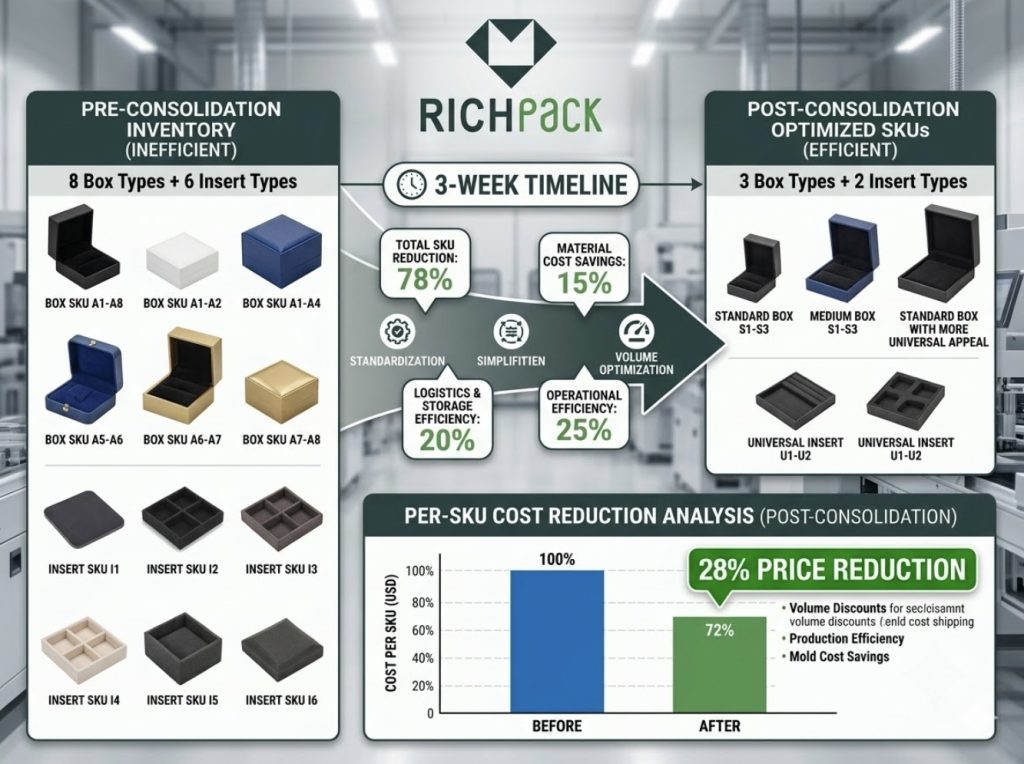
A BOM standardizes these to 3-4 box types, 2-3 insert types, and 1-2 outer options. Fewer SKUs means larger volumes per SKU, which means lower per-unit pricing from your supplier.
One brand that did this well: selling 100,000 jewelry pieces annually, they consolidated their packaging from 8 box types and 6 insert types down to 3 box types and 2 insert types. The volume increase per SKU earned them a 28% price reduction. Annual packaging material cost went from 58,000 to 40,000. The consolidation project took 3 weeks of work.
Consolidating suppliers is not always the right call, but the consolidation of SKUs almost always is.
Spreading your orders across 4 different packaging suppliers fragments your purchasing power. Each supplier sees a smaller order and gives you a smaller discount. One supplier who sees your full annual volume has an incentive to price competitively to win and keep the account.
The negotiation frame: you’re not asking for a discount. You’re offering a larger share of your business in exchange for volume pricing. The distinction matters because it frames the conversation around value exchange rather than charity.
This is the specific negotiation tactic that most brands fail to use. Most packaging suppliers offer their best pricing to customers who commit to annual volume and provide a forecast.
The commitment gets you pricing. The forecast gets them to pre-produce materials and hold inventory, reducing their lead time risk.
The structure that works: provide a 12-month rolling forecast by SKU. Commit to a minimum annual volume, even if it is not binding, it signals intent. In exchange, negotiate a price hold for 12 months and priority production scheduling. Suppliers hate uncertainty more than they hate discounted pricing.
First, ask about MOQ by SKU versus MOQ by total order. Many suppliers will reduce the per-SKU MOQ if you increase total order volume. Ordering 3 SKUs at 500 units each might have the same total cost as 1 SKU at 1,500 units, but the logistics are better for you.
Second, explore split shipments. Some suppliers will agree to a lower MOQ if you commit to 2-3 shipments over 6 months rather than one large delivery. This reduces your storage burden while keeping the supplier’s production run efficient.
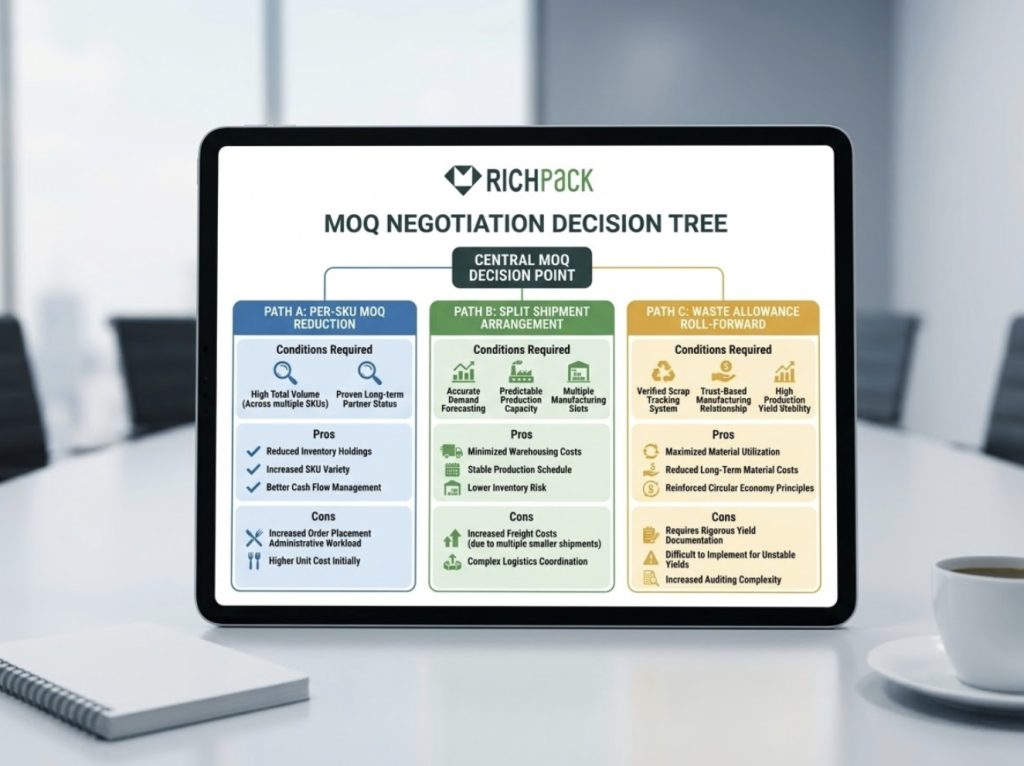
Third, ask about waste allowance. Suppliers typically produce 5-10% over your MOQ to account for production errors. Negotiate to have that excess applied to future orders rather than paid for and discarded.
Only when you’re selling 5,000+ units per month of a single product line, and you have exhausted all other cost reduction options.
Private label means owning your own tooling, die-cut molds, printing plates, magnetic strip applicators, which is a capital investment of 2,000−2,000−15,000 per tool. The per-unit savings at that volume can justify it, but run the math first.
Calculate: (Tooling investment) / (Monthly units x Per-unit savings) = Months to break even. If that number is under 12 months and you have the cash flow, private label makes sense. If it is 18+ months, the risk outweighs the reward for most early-stage brands. Working with an experienced jewelry packaging factory like RichPack can help you model these scenarios before you commit.
The deepest assumption in jewelry packaging is that more equals better. More layers. Thicker board. Bigger boxes. More tissue paper. More foam.
What if the opposite is true?
The brands with the most talked-about unboxing experiences in recent years are not the ones with the thickest boxes. Glossier built a cult following with minimalist white boxes and pink bubble wrap. Mejuri, which grew from a startup to a multi-million dollar brand, used simple black boxes with minimal branding as its signature. The common thread is intentionality, not investment.
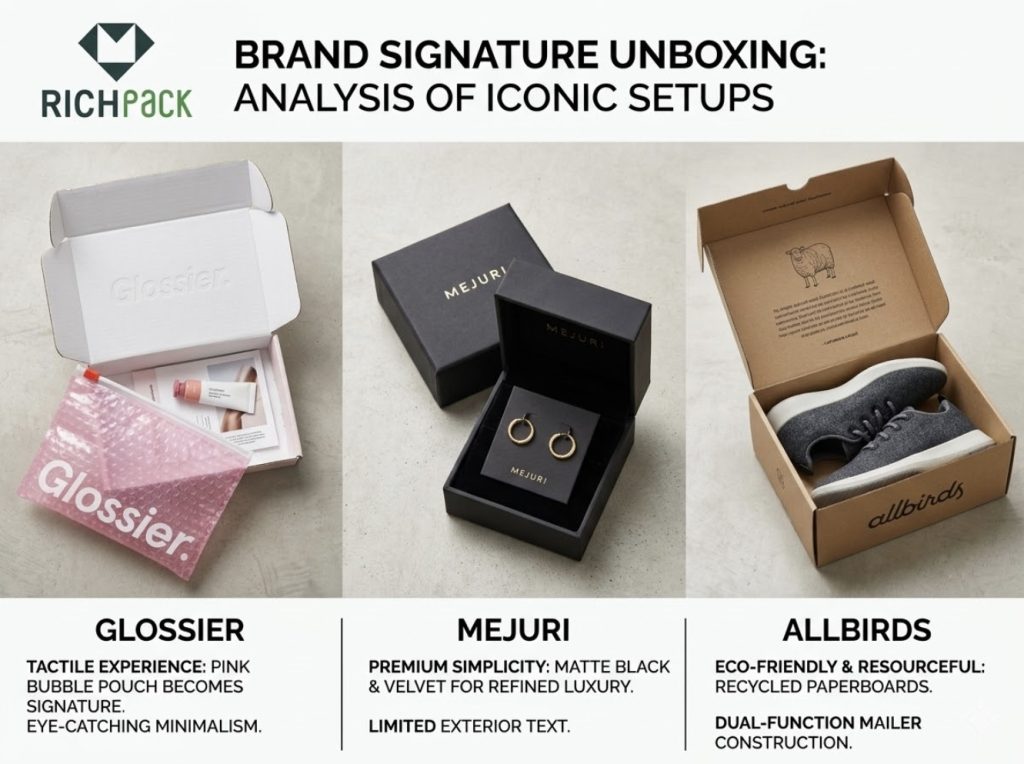
What customers remember about unboxing is not how much there was. It is how it felt. The snap of the magnetic closure. The resistance as the box opens. The reveal moment when the piece first catches the light. These sensory details are what get captured in unboxing ASMR videos, the very content that drives organic social media reach for DTC jewelry brands.
A 2mm greyboard box with a precision-constructed magnetic closure feels more premium in the hand than a 5mm box with a loose-fitting lid. The customer cannot measure board thickness with their fingers. But they can feel whether the box is well-made.
The weight of the box in their hand before they open it. The resistance of the closure mechanism is not too easy, not too stiff. The moment the piece is revealed. The sound the packaging makes. The scent, if there is one.
These are sensory experiences that have nothing to do with board thickness or insert material. And most of them cost almost nothing to engineer well.
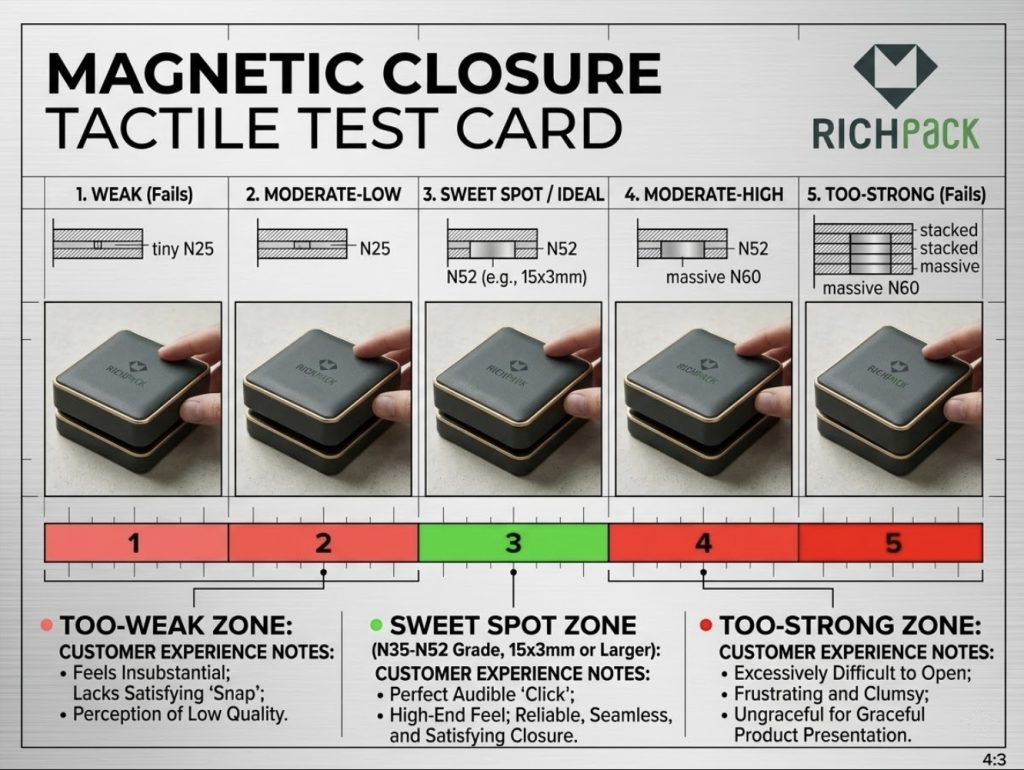
Two things determine whether a magnetic closure feels premium: closure resistance and release resistance. A magnetic closure that is too weak feels cheap; it opens without resistance. One that is too strong frustrates the customer.
The sweet spot is a closure that requires intentional pressure to open and provides tactile feedback as it engages. N35-N52 grade neodymium magnets, 15x3mm or larger, provide this level of feel. The cost difference between a weak magnet and a proper one is fractions of a cent per box.
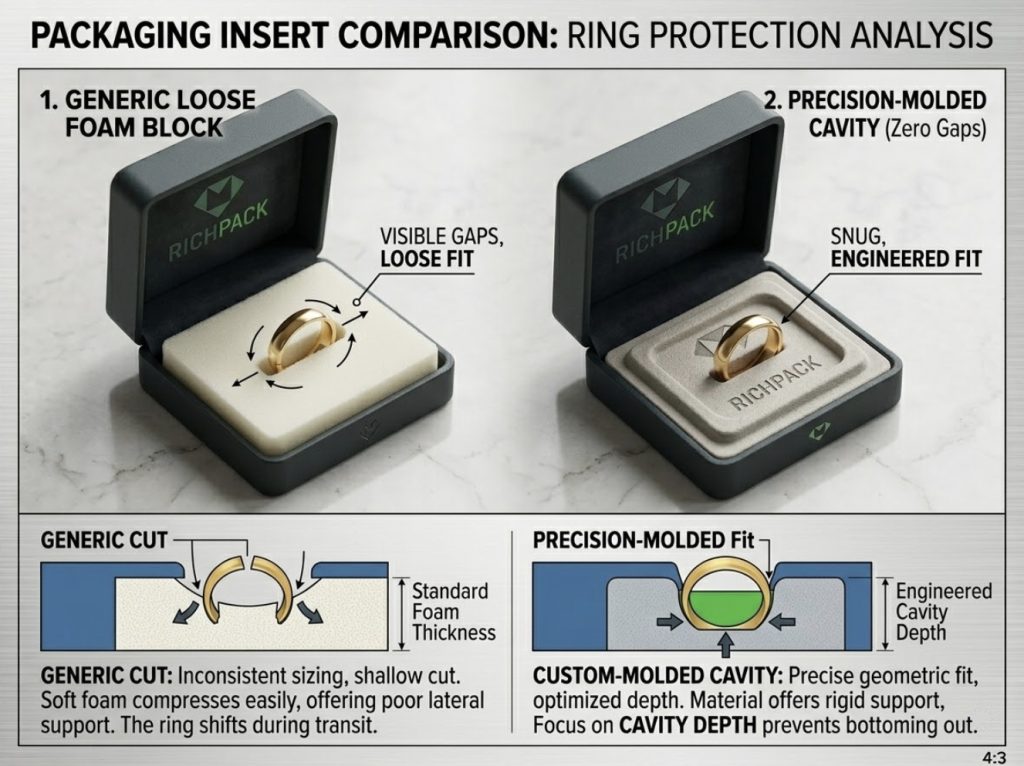
This is the detail most brands underinvest in. An insert that holds a piece at exactly the angle it was photographed on your website creates a cognitive resonance. The customer sees the piece in the box, and it matches their expectation.
An insert that is too loose, too deep, or misaligned creates a subtle disappointment that customers often cannot articulate but definitely feel. They describe it in reviews as “the box looked different than expected” or “it did not look like the picture.”
Precision insert design is not expensive. It requires knowing your piece dimensions exactly and designing the cavity to match, not using a generic foam block and hoping it works. Explore inserzjonijiet tal-kaxxa tal-ġojjellerija tad-dwana designed to match your specific pieces.
When a customer opens your box, and the insert is made from molded pulp, when they can see and feel the fibrous texture of agricultural waste material repurposed into something beautiful, that is a story.
That story is part of the unboxing experience. It is shareable on social media. It is memorable. And it cost 40-50% less than the velvet it replaced.
Customers who care about sustainability are 3x more likely to share their unboxing experience online. You are not just cutting costs. You are building a content engine. Explore għażliet ta 'ippakkjar sostenibbli that double as brand stories.
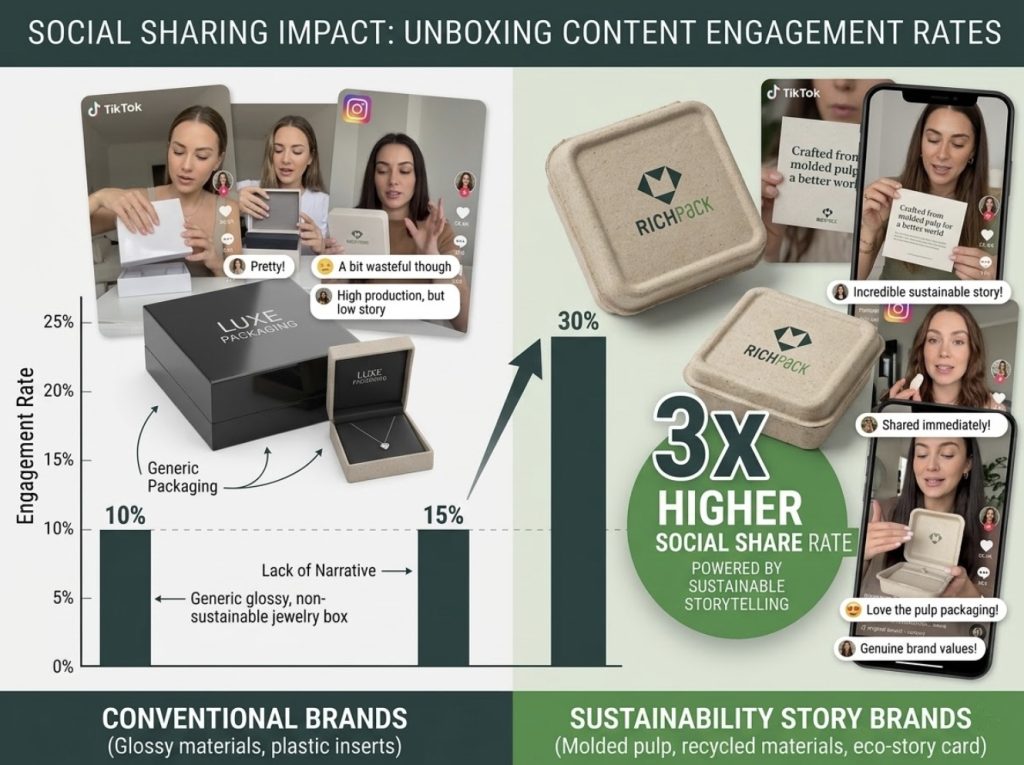
When the core brand message is quality over quantity. When the target customer is design-aware and sustainability-conscious. When the price point is mid-range, 50−50−200, rather than ultra-luxury.
For brands in this space, minimalism with precision beats excess with compromise every time.
Every cost reduction strategy has failure modes. Here are the five that show up most often in packaging reengineering projects gone wrong.
This is the cost reduction that ends up costing more. The math is simple: a damaged jewelry piece generates a return, a replacement, reshipping costs, and often a lost customer.
A $0.40 foam insert upgrade that prevents one return per 200 units shipped pays for itself immediately. Before removing any protective element, calculate your expected damage rate at that product’s transit risk level.
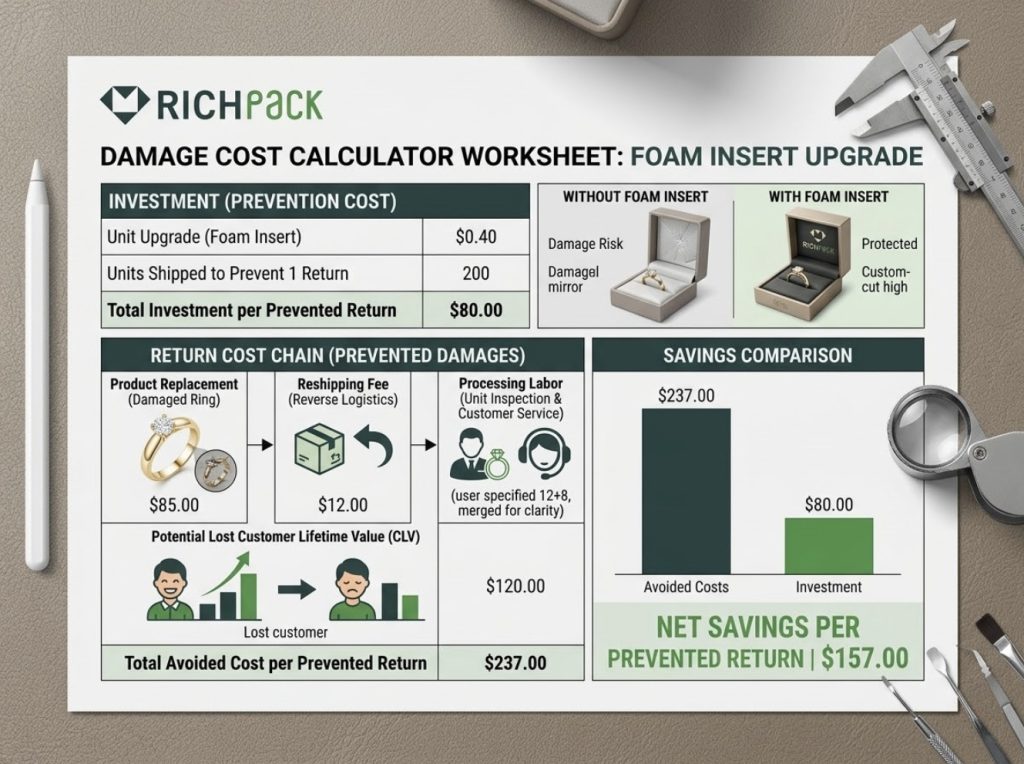
The threshold is clear: if the removal increases damage by more than 0.3%, the material savings will not cover the damage cost.
Custom boxes with your logo are a brand asset. Generic brown boxes are a commodity.
The mistake is not investing in custom branding. It is over-investing in the box while neglecting the insert, closure, and overall experience.
A 0.35 paperboard box with a custom logo stamp is more brand-forward than a 1.80 rigid box with generic printing and no brand identity. Every box is a brand touchpoint. Do not waste that opportunity by using generic packaging. Explore affordable custom jewelry packaging for small businesses.
Labor is typically 15-25% of total packaging cost per unit, and it is the line item most brands never optimize.
A box that takes 25 seconds to assemble by hand costs 0.25−0.25−0.50 more per unit in labor than a design that takes 10 seconds. Material substitution that increases assembly time can actually raise your total cost despite saving on material.
Before switching any material, calculate the full cost impact, including labor. The spreadsheet that only shows material savings is incomplete.
Automated polybagging and automated label application are efficient at scale. They are also responsible for a significant percentage of customer complaints about packaging damage and mis-shipments in DTC brands.
The brand experience is not a place to maximize automation ROI. Human inspection of finished orders, even at a sample rate, prevents the viral negative review that automation savings cannot offset.
Set a QA checkpoint: inspect 5% of finished orders. Track damage and mis-shipment rates. If they exceed 0.5%, your automation is costing you more than it saves.
The physical unboxing experience is one of the highest-ROI investments a jewelry brand can make. Customers who have a strong unboxing experience are 3-5x more likely to share on social media and 2-3x more likely to repurchase.
Saving $0.30 per unit on packaging while losing one social share per 50 orders is a net negative.
The unboxing moment is not a cost center. It is a marketing channel. Every dollar you cut from it is a dollar you removed from your marketing budget. For packaging trends driving the best unboxing experiences in 2026, see the top jewelry packaging trends.
This comparison comes up constantly in jewelry packaging discussions, so let us settle it directly.
Flat-pack boxes ship collapsed and take up 60-70% less storage space. Assembly takes 5-10 seconds per box. They cost 20-35% less per unit in freight when you factor in dimensional weight.
Flat-pack makes sense for DTC brands shipping 500+ units per month, especially internationally. If your product fits in a flat profile, flat-pack almost always wins the total cost calculation.
Rigid boxes feel more premium out of the box. They require no assembly. They stack cleanly on retail displays.
Rigid is the right choice for luxury pieces above $200, in-store sales, and brands where the unboxing moment is the primary marketing channel. For watches and high-value pieces, rigid construction is worth the premium.
Most DTC jewelry brands benefit from using both. Start with a flat-pack for your core SKU line. Reserve rigid boxes for your premium and luxury tier products.
This hybrid approach typically saves 25-35% on total packaging cost while keeping the brand experience strong at the tiers that need it. You get the cost efficiency of flat-pack where it matters and the premium feel of rigid where customers will notice.
If you’re currently using rigid boxes across your product line and want to explore flat-pack alternatives, here is how to approach it.
First, audit your top 5 shipping SKUs by volume. For each SKU, calculate the current freight cost per unit using your carrier’s DIM weight formula. Get a flat-pack prototype quote for the same product. Compare total cost: (freight savings) minus (any material cost difference) = net savings per unit.
Second, test the flat-pack version in your fulfillment process before committing to a full production run. Flat-pack assembly requires a different workflow, and the learning curve can affect your first few weeks of throughput.
Third, communicate the change to your customer service team. The box will look different. Make sure they know it is intentional, not a mistake.
Strategy without execution is just a document. Here is the implementation sequence that keeps you from getting stuck in planning while delivering results in 90 days.
Calculate your current cost per unit using the formula in Section 1. Benchmark it against the tier table. Identify the 2-3 products where your current packaging spend is most misaligned with the recommended range. These are your quick wins.
For those products, source one alternative material or a tier configuration. Get samples. Test the protection performance. Get a quote for 1,000 units. If the numbers work, switch the order for your next production run.
No redesign, no supplier change, no SKU consolidation. Just targeted swaps on the products where you’re most overspending. Expected savings: 10-20% reduction in packaging cost per unit for the targeted SKUs.
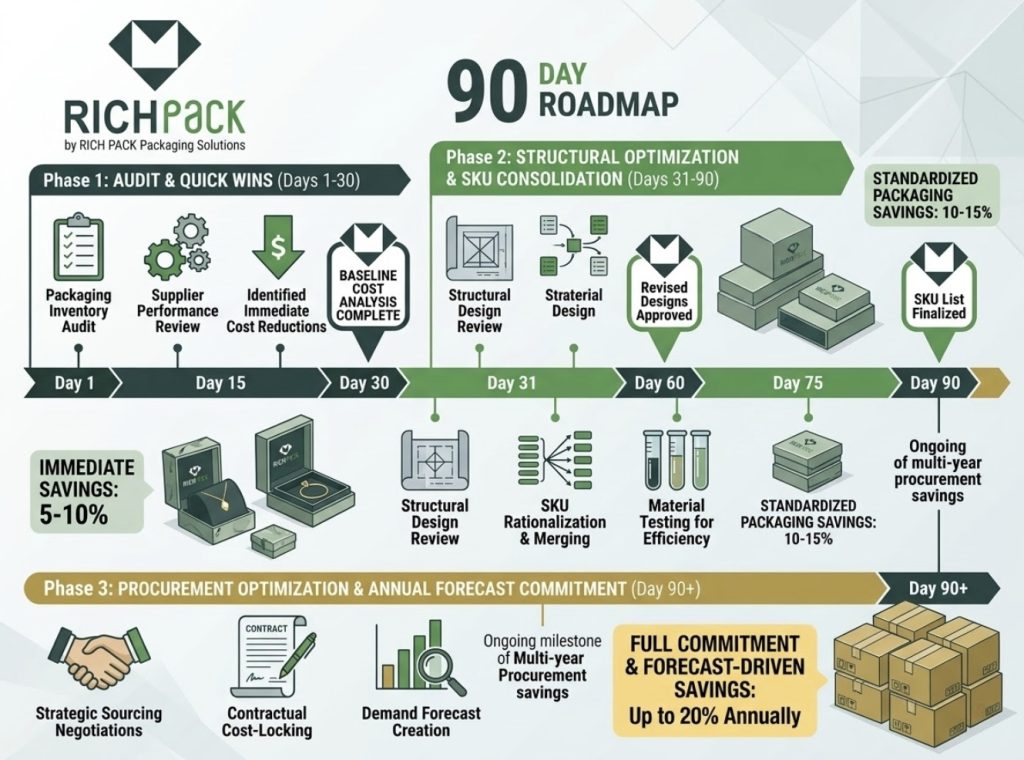
This is where you tackle the box design. Evaluate your current box dimensions against dimensional weight. Get freight quotes for your current configuration and for a reduced-thickness alternative. Run the math on flat-pack versus rigid for your volume.
If flat-pack makes sense, work with your supplier on a prototype. If dimensional weight savings exceed the material substitution cost, implement the structural change. Update your BOM with the new specifications. Lock in pricing with your supplier for the new configuration.
Simultaneously, begin the SKU consolidation conversation. Map your current 6-12 packaging SKUs to a target of 3-4. Get a volume pricing quote for the consolidated SKU set.
Expected savings: 15-30% reduction in total packaging spend through structural optimization and SKU consolidation.
With your consolidated SKU list and 90-day volume history, approach your supplier with an annual forecast commitment. Negotiate a 12-month price hold. Use the cost reduction data from Phases 1 and 2 as leverage; you have real numbers showing your volume and your commitment to a long-term partnership.
Evaluate your sustainability positioning. If you’re using virgin materials, explore recycled alternatives. If you’re not communicating your material choices on your packaging or website, start.
Establish your packaging QA process. Set a damage rate threshold, typically under 0.5% for well-packaged jewelry. Track it monthly. Every spike in damage rate is a signal that your packaging configuration needs adjustment, before it becomes a customer experience problem.
Three metrics matter: cost per unit, damage rate, and customer experience score. Track all three monthly.
Cost per unit tells you whether the changes are saving money. Damage rate tells you whether the protection is adequate. Customer experience score, measured through review sentiment, social mentions, and repeat purchase rate, tells you whether the unboxing experience is intact.
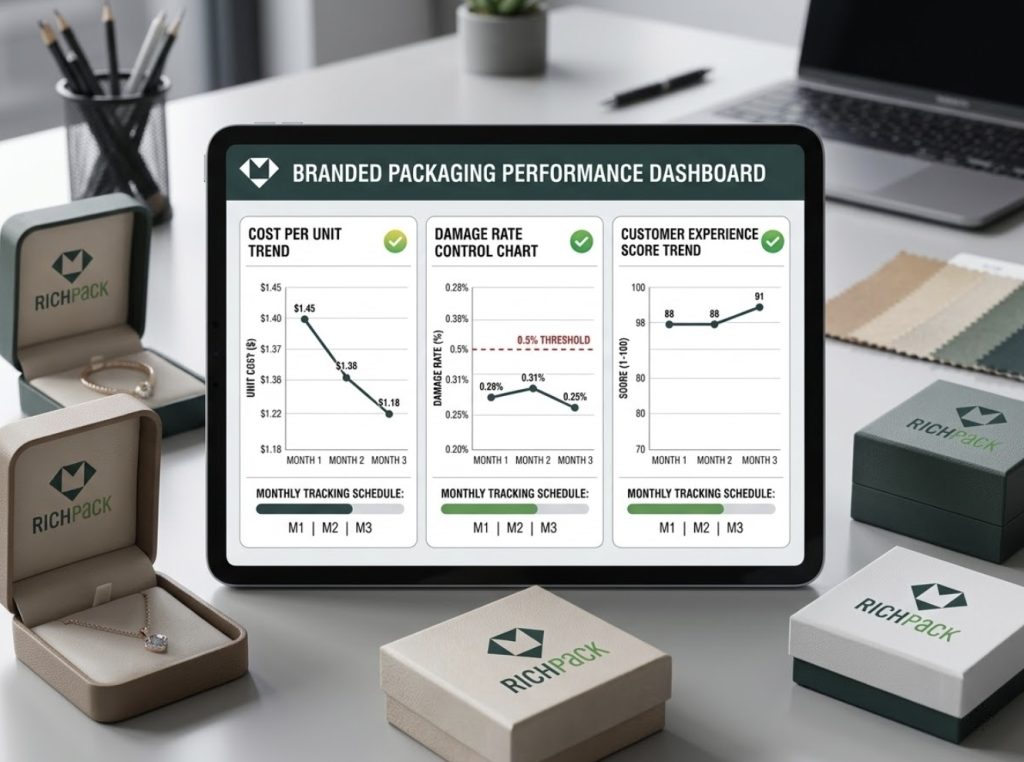
If cost per unit drops but damage rate rises, you’ve cut the wrong thing. If cost per unit drops and damage rate holds, but customer experience scores fall, the changes are hurting you in ways that will take months to show up in revenue.
For most jewelry brands, packaging should represent 2-6% of the retail price, depending on the tier. Products under 50 typically justify 0.5−1.5%. Those priced 50-150 justify 1.5−3%. Items 150-300 justify 3−6%. Products above 300 can justify 6% or higher, especially when packaging is a core brand differentiator. Track your actual cost per unit quarterly and compare against these ranges to identify overspending before it compounds.
Small businesses face the same cost pressures as larger brands but with less purchasing leverage. The most effective starting point is tiering: review every SKU and match its packaging tier to its price point. A 45 ring does not need the same packaging as a 145 ring. Standardizing to fewer box SKUs also helps; even at 500-1,000 units per month, consolidating from 5 SKUs to 3 can earn meaningful volume discounts. Finally, explore regional suppliers who serve your geographic market, as shorter shipping distances reduce freight costs significantly.
Some sustainable options cost more. Others cost less. Molded pulp from agricultural waste, sugarcane bagasse, and bamboo pulp typically costs 40-50% less than velvet-lined foam inserts. Recycled greyboard costs roughly the same as virgin board. Biodegradable polybags can cost 20-30% more than standard polyethylene but are justified in EU markets and for sustainability-focused brands. The sustainability cost premium, when it exists, is most justified for brands selling in EU and UK markets where regulations are tightening, and for brands whose core customer demographic actively values environmental responsibility.
For transit protection, the best materials are those that immobilize the piece without adding unnecessary weight. Molded pulp inserts, EVA foam cut to precise dimensions, and corrugated dividers all perform well. For outer packaging, corrugated mailers with bubble lining work for items under 100. Rigid boxes with outer carton protection are necessary for pieces above 100. Rigid boxes with outer carton protection are necessary for pieces above 150 or for watches at any price point. Always test your configuration with a transit simulation, ISTA 2A or equivalent, if you’re introducing a new configuration for high-value items.
Total packaging cost per order equals material cost per unit plus production labor cost per unit plus fulfillment labor cost per unit plus freight cost per unit plus storage or allocation cost per unit, divided by units per order. Most brands track only material cost. Adding labor and freight often reveals that the actual cost per order is 40-60% higher than the material-only number. Use this full calculation when benchmarking against industry standards and when making packaging configuration decisions.
Absolutely. Standard-sized boxes from packaging suppliers are significantly cheaper per unit than custom-cut boxes, come with shorter lead times, 10-15 days versus 25-45 days, and require no tooling investment. Standard boxes work well for brands in growth phases or for SKUs with volumes under 2,000 units per month. Custom branding elements like logo stamps, belly bands, and sticker seals can be added to standard boxes to maintain brand identity at a fraction of the cost of fully custom boxes.
Customization costs depend on the type and extent of customization. Logo printing on a standard box typically adds 0.05−0.05−0.25 per unit. Custom box size or shape adds tooling costs of 500−500−3,000 per tool plus a per-unit premium of 10-20% over standard pricing. Custom inserts require custom tooling of 300−300−2,000 per tool. Magnetic closure customization adds 0.10−0.10−0.30 per unit. For most brands, the most cost-effective customization strategy is a standard box with custom branding applied through stickers, stamps, or sleeves rather than custom construction.
Standard MOQs for custom jewelry boxes typically range from 500 to 2,000 units per SKU, depending on the supplier and the complexity of the box construction. Simpler constructions, folding cartons, and paperboard boxes typically have MOQs of 500-1,000. More complex constructions, rigid boxes, magnetic closures, and custom inserts typically require 1,000-2,000 per SKU. MOQs can often be negotiated down in exchange for longer production timelines or volume commitments across multiple SKUs. Some suppliers also offer sub-MOQ prototyping runs at premium pricing for brands that want to validate a design before committing to full production.
For most DTC jewelry brands shipping 500+ units per month, flat-pack boxes win on total cost. They save 20-35% when you factor in freight and storage. Rigid boxes are better for luxury-tier products and in-store display. Most brands benefit from a hybrid approach: flat-pack for core SKUs, rigid for premium pieces.
The biggest mistake is tracking material cost while ignoring labor and freight. Most brands think their packaging costs 0.85 per unit when it actually costs 1.40 per unit once you factor in assembly time and dimensional weight charges. The second biggest mistake is using the same packaging for a 45 product and a 185 product. Tiering alone typically saves 20-35% on total packaging spend.


2025-05-13

2024-11-18
2025-03-14
Matul il-Milied, kif tiżgura l-kunsinna fil-ħin u ta’ kwalità għolja tal-ippakkjar tar-rigali tal-Milied filwaqt li tikkontrolla l-ispejjeż permezz ta’ strateġiji effettivi tal-katina tal-provvista saret sfida ewlenija għall-intrapriżi. Dan jaffettwa r-reputazzjoni fit-tul u l-pożizzjoni tagħhom fis-suq. Dan l-artiklu ser jintroduċik 5 strateġiji tal-katina tal-provvista li jistgħu jżidu r-redditu fuq l-investiment (ROI) ta’… Kompli aqra Kif Tnaqqas l-Ispejjeż tal-Ippakkjar tal-Ġojjellerija Mingħajr ma Tnaqqas il-Marka Tiegħek
L-ippakkjar tal-ġojjellerija personalizzat mhux biss jagħmel il-ġojjellerija tiegħek tidher sabiħa. Jiffoka fuq il-ħolqien tat-taħlita perfetta ta’ materjali, disinji, u tekniki li tassew jirrappreżentaw il-marka tiegħek u jissodisfaw l-aspettattivi tal-klijenti tiegħek. Il-fehim tat-termini u t-tekniki ewlenin fl-ippakkjar personalizzat huwa kruċjali għal kwalunkwe bejjiegħ tal-ġojjellerija jew maniġer tal-marka. Jgħinek tiddisinja ippakkjar aħjar u... Kompli aqra Kif Tnaqqas l-Ispejjeż tal-Ippakkjar tal-Ġojjellerija Mingħajr ma Tnaqqas il-Marka Tiegħek
Iċ-ċrieket tad-deheb abjad għandhom storja li ilha tiżviluppa għal żmien twil. Lura fiż-żmien, id-deheb abjad ħareġ bħala alternattiva trendy għad-deheb isfar tradizzjonali. Malajr infirex, speċjalment għaċ-ċrieket tal-ingaġġ u biċċiet ta’ ġojjellerija fancy. U minn meta kont f’din il-fabbrika, rajt kemm hu importanti li tqabbel dawn l-isturdament... Kompli aqra Kif Tnaqqas l-Ispejjeż tal-Ippakkjar tal-Ġojjellerija Mingħajr ma Tnaqqas il-Marka Tiegħek
Ippakkjar ta 'ġojjellerija tad-dwana għal Marki Żgħar ta' dehbijiet | Soluzzjonijiet Personalizzati għal Distinct Branding | Perfetta għal Swieq Niċċa

Kaxxa Versatili tal-Anniversarju Richpack – Imfassla għall-Kapitlu ta' Kull Storja ta' Mħabba
Soluzzjonijiet ta' Ippakkjar ta' Rigali Zero-Skart għal Ħwienet Online | Ippakkjar Eco-Friendly u Customizable | Soluzzjonijiet Sostenibbli tal-Kummerċ Elettroniku
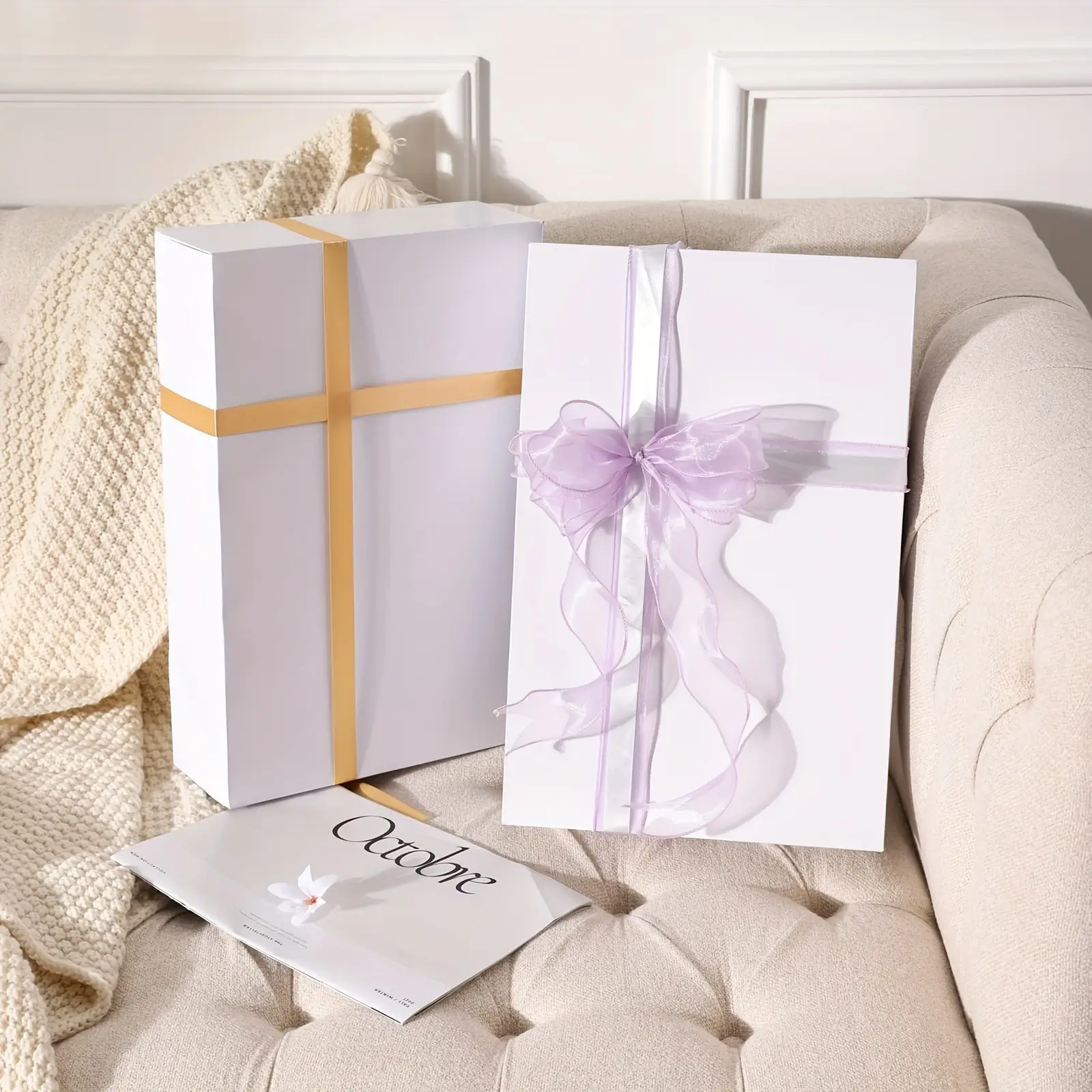
Ibni l-Kaxxa tar-Rigali Tiegħek | Kaxxi tar-rigali customizable għal kull okkażjoni Daqsijiet sħaħ Materjali varji biex Agħżel il-fornitur tal-ippakkjar Richpack
Ara aktar
Każijiet ta 'ġojjellerija tal-ivvjaġġar roll-up konvenjenti | Ħażna Spazjali Effiċjenti u Protettiva għal Jewelers li Jeħtieġu Soluzzjonijiet Kompatti għal Ħażna ta' Ġojjellerija On-the-Go
Ara aktar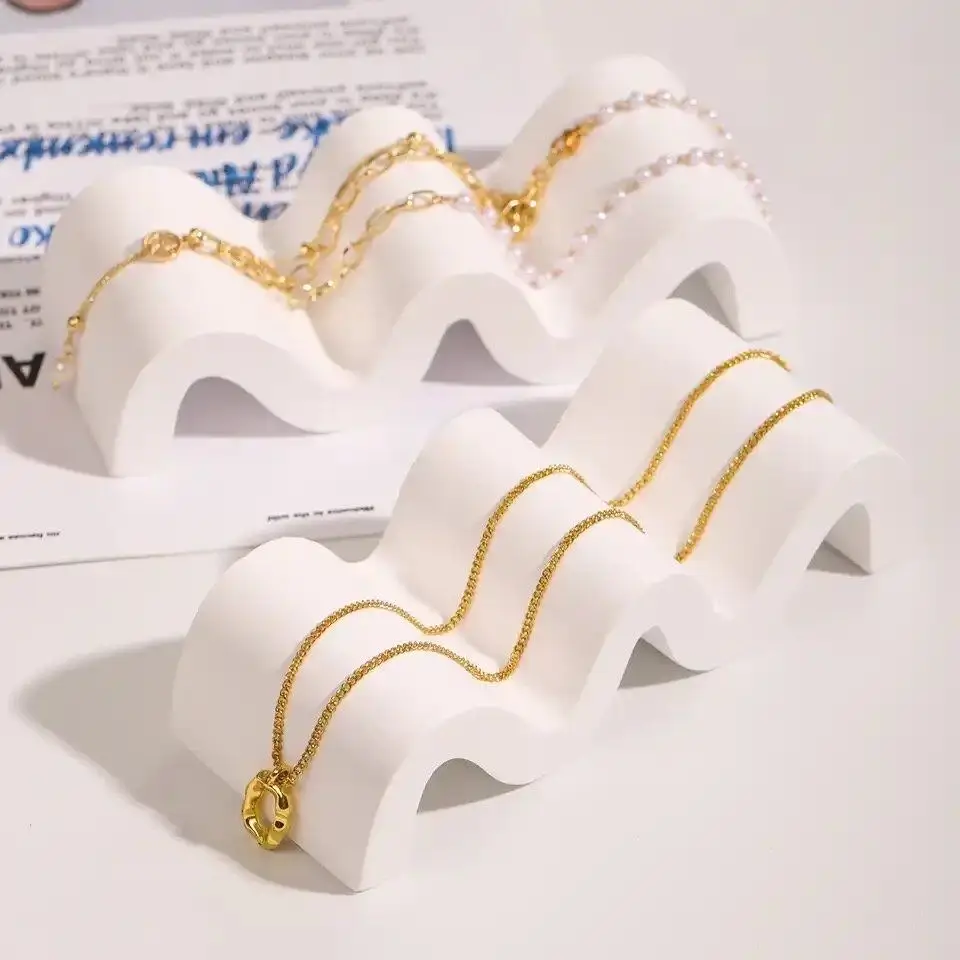
Ideat kreattivi tal-wiri ta' dehbijiet minn Richpack għal preżentazzjonijiet tal-isturdament | Ideat Uniċi tal-Wiri tal-Necklace għall-Bejgħ bl-Imnut ta 'ġojjellerija u Marki ta' Lussu
Ara aktar

