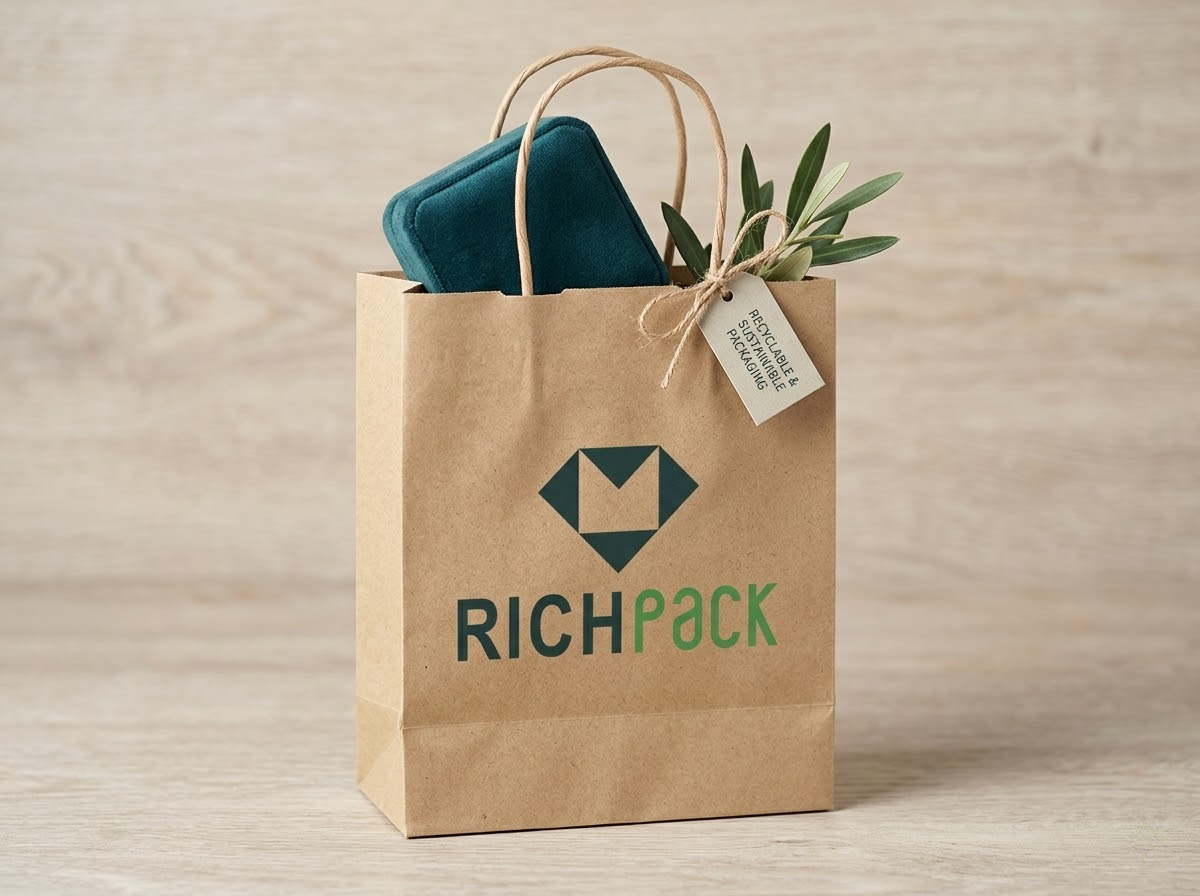



Taga pepa kraft stay popular because they solve four business problems at once: sustainability pressure, brand presentation, carrying performance, and packaging cost control.
If you sell in retail, food service, gifting, or ecommerce, you need packaging that looks right, carries weight, and supports your brand story. Kraft paper bags do all three without forcing you into complex packaging systems.
This guide breaks down what makes a bag a kraft paper solution so effective, where kraft bags fall short, and how to choose the right spec for your business.
Popularity does not happen by accident. A kraft paper bag stays in demand because it fits real buying behavior, not just packaging trends.
The best-performing packaging formats usually check multiple boxes at once. Kraft paper bags do exactly that.
Plastic fatigue is real. Brands, retailers, and food service operators face growing pressure to cut single-use plastic and prove they are doing it in visible ways.
Kraft paper bags help because the switch is easy for customers to understand. Unlike technical sustainability claims that need a footnote, a paper bag sends a message instantly.
Grand View Research estimates the global kraft paper bag market reached USD 4.50 billion in 2024 and projects it to hit USD 5.89 billion by 2030. That growth does not come from aesthetics alone. It comes from regulation, procurement standards, and consumer expectations.
Packaging is physical. People judge it before they read a slogan.
Natural brown kraft has a tactile, honest look that works well for boutique retail, bakeries, coffee brands, wellness products, and gift packaging. It feels simple, but not careless.
White Kraft creates a cleaner and more polished look. That makes it useful when you want brighter printing, sharper contrast, or a more elevated retail finish.
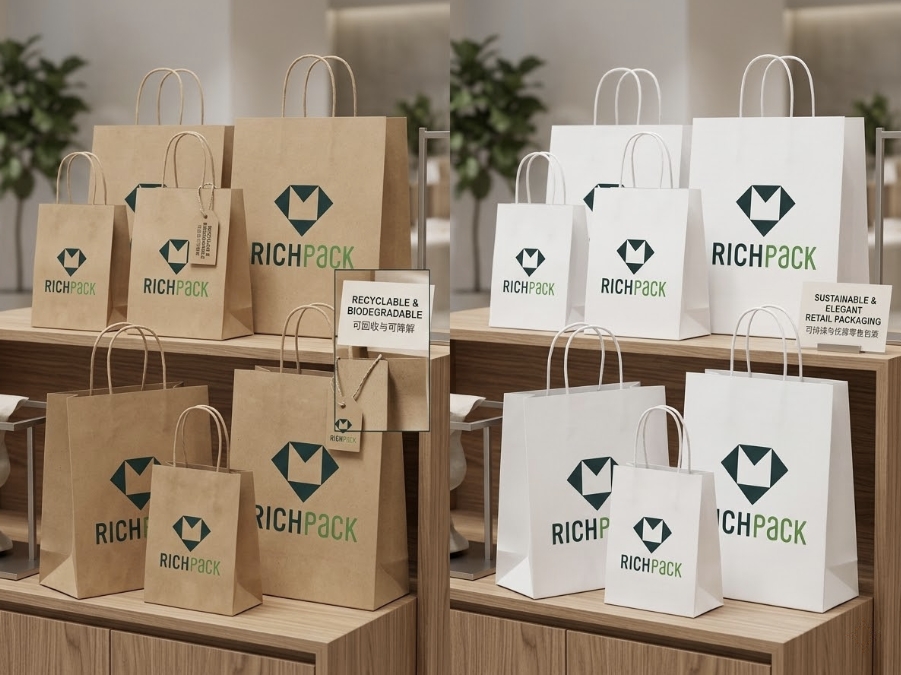
This is one reason Kraft paper gift bags scale so well. They are not the cheapest packaging format in every case, but they often give you the best visual return for the spend.
A rigid box can create a luxury moment. It also costs more, stores worse, and adds shipping bulk. A Kraft paper bag gives you a lighter, faster, and more flexible format when you do not need full structural packaging.
That matters for growing brands. You can improve brand presentation without turning every order into a premium packaging project.
Versatility drives popularity. A packaging format that only works in one channel rarely becomes a default choice.
Kraft paper bags work across grocery, takeout, apparel, events, beauty, jewelry, gift shops, and store pickup. Grand View Research also notes that food service held more than 26.5% of the end-use share in 2024, which shows how important everyday practicality is in this category.
The format changes by use case, of course. A bakery bag, a jewelry gift bag, and a retail shopping bag should not share the same spec.
A bag is mobile media. Once it leaves the counter, it starts working as a brand asset.
That is why Kraft paper bags with handles remain a strong choice for shops, events, and premium gifting. Customers carry them through malls, streets, offices, and social spaces. Your logo travels with them.
Good packaging does not need to shout. A clean logo, the right bag size, and strong proportions often create more recall than overdesigned packaging.
Flexibility matters in procurement. Not every business wants the same level of customization at the same time.
Stock Kraft paper bags work for quick launches, pop-up events, and budget-sensitive operations. Custom kraft paper bags make more sense when your store traffic, gifting program, or brand identity depends on consistent presentation.
That dual path is a major reason the category stays popular. You can enter fast and upgrade later.
Many buyers use paper bags and kraft bags as if they mean the same thing. They do not.
Kraft paper has a specific material logic behind it. That logic affects strength, print behavior, cost, and final look.
Kraft means strong. The term comes from German, and that is not just packaging trivia.
The Kraft process is designed to produce stronger wood pulp fibers than many ordinary paper-making methods. Britannica traces the process to Carl F. Dahl, whose work helped define the material category that packaging buyers still rely on today.
This matters because strength is not a marketing adjective here. It is built into the material identity.
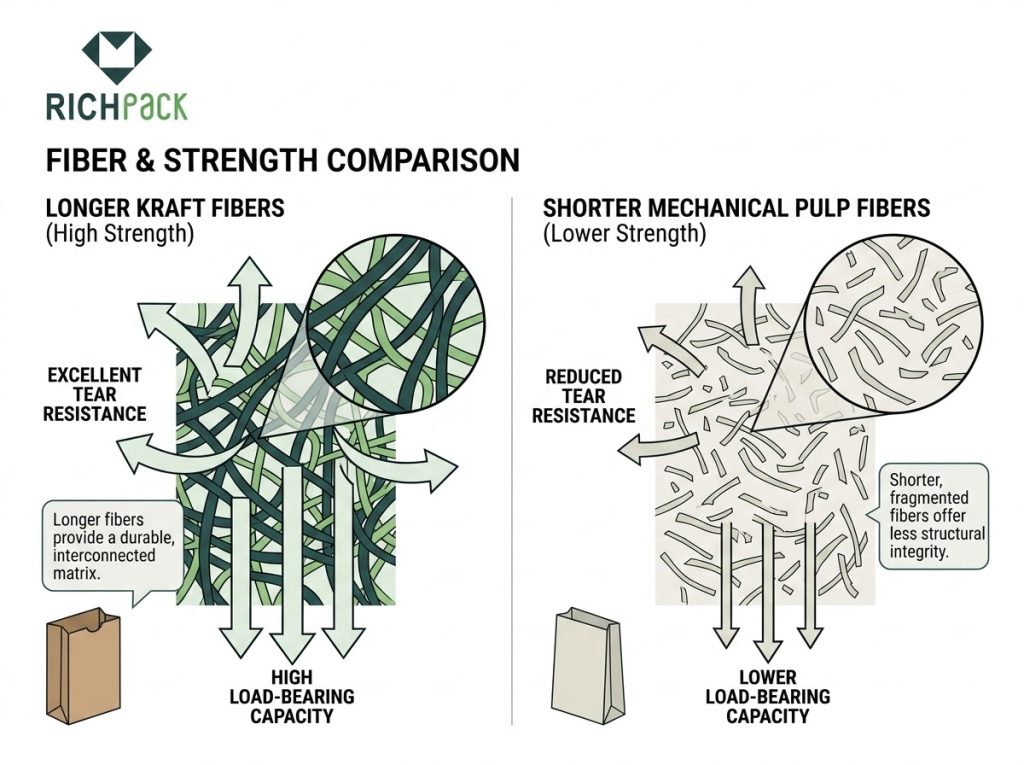
Fiber length changes result. Longer fibers improve tear resistance and carrying strength.
That is because the kraft process uses sulfate pulping, which removes much of the lignin while preserving more fiber length than mechanical pulping. In simple terms, the process is less destructive to the fibers, so the finished sheet keeps more of the long-fiber strength that helps a bag resist tearing.
That is why a Kraft paper bag can feel tougher than a generic paper alternative at a similar size. It usually handles fold stress, daily carrying, and moderate weight better.
Do not oversimplify this, though. Performance still depends on GSM, bottom fold structure, handle attachment, and how the bag is used.
Color changes brand meaning. Brown kraft and white kraft are not just two shades of the same choice.
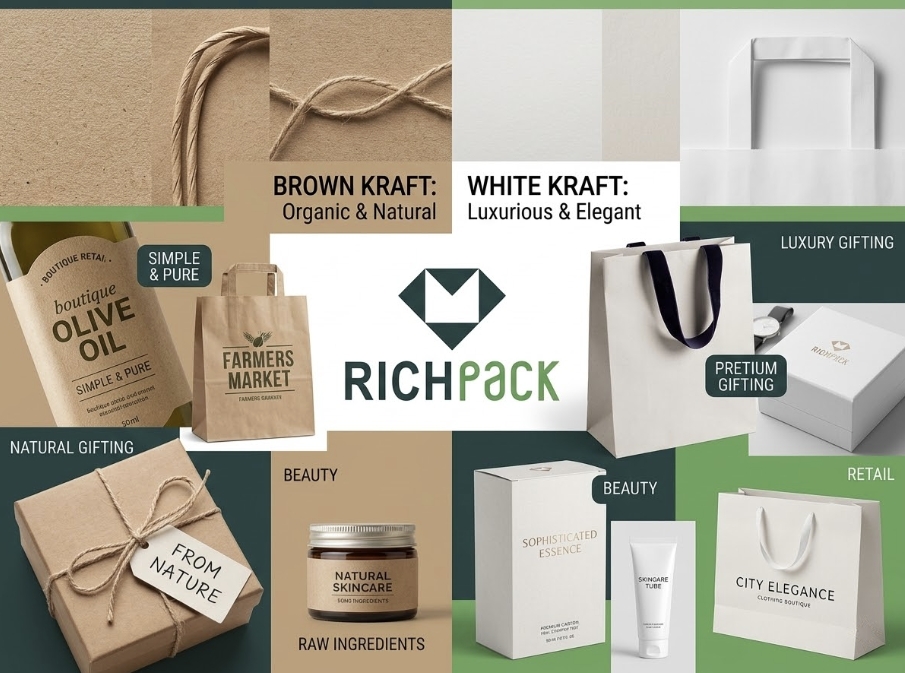
Brown kraft signals natural, earthy, minimal, and eco-conscious. White Kraft feels cleaner, brighter, and more refined for graphic presentation.
If your brand sells handmade products, organic food, or rustic gifting, brown kraft usually feels more aligned. If you need higher print contrast or a more polished shopping bag, white kraft often wins.
Structure decides whether a bag performs well or fails in public.
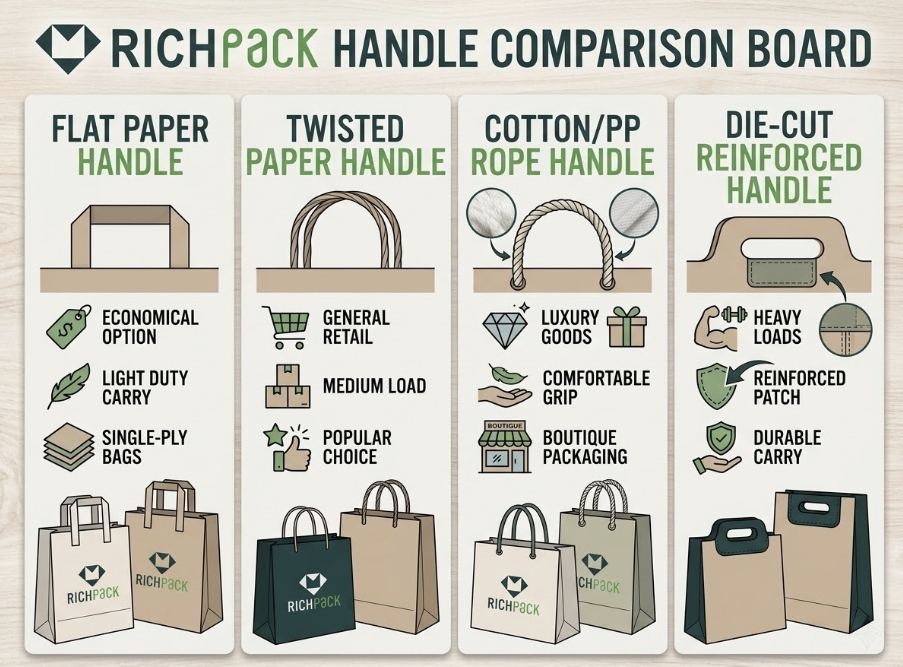
A twisted paper handle can work well for many retail bags. A flat handle often suits food service and takeout better. Rope handles push the bag further into premium retail territory.
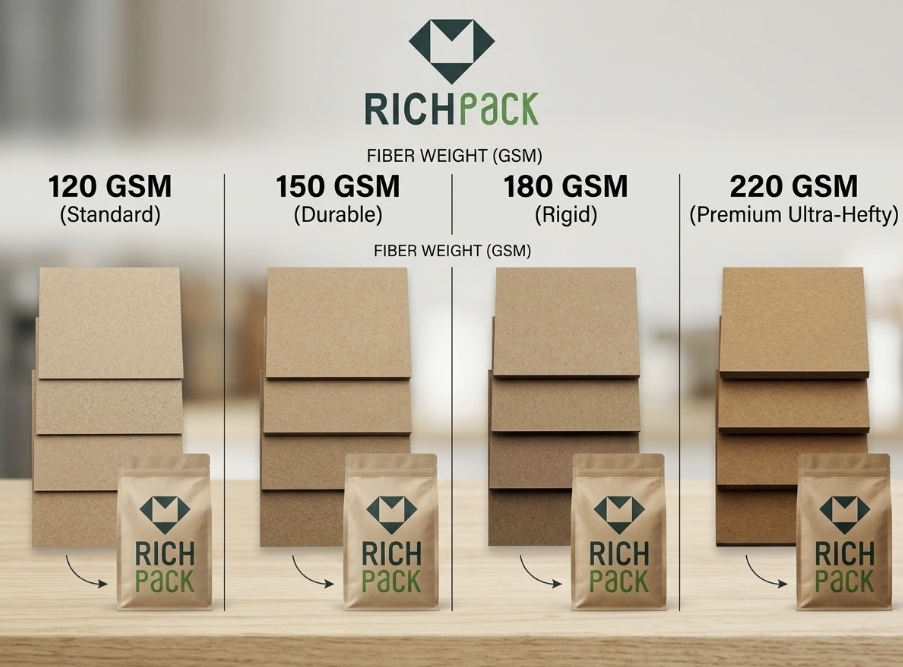
GSM also matters more than many first-time buyers expect because it changes how the bag feels, how it carries, and what products it can handle.
| GSM Va'aiga | Fautuaina Faʻaaoga | Tulaga masani |
| 100 i le 120 GSM | Mea mama | Jewelry, cards, small gift items, lightweight accessories |
| 130 i le 150 GSM | Standard retail use | Cosmetics, apparel, accessories, boutique shopping, and everyday gift bags |
| 160 i le 180 GSM | Premium retail use | Multi-item purchases, better handfeel, stronger branded shopping bags |
| 180 to 250 plus GSM | Heavy or high-value use | Bottles, gourmet foods, dense products, premium gifting with reinforced structure |
Treat those numbers as a starting framework, not a promise. Real load performance also depends on bag size, bottom construction, handle reinforcement, and carrying distance.
This distinction matters during sourcing. A generic paper bag may hit a price point. It may not deliver the brand feel or load performance you need.
Kraft paper bags usually offer a better mix of strength, texture, and natural visual appeal. That is why so many businesses use them for branded carry bags instead of treating them like a commodity item.
Think of it like packaging material selection in the same way buyers compare EVA foam and PU foam in box inserts. Surface feel, durability, and use case all change the right answer.
Popularity grows when a packaging format helps both marketing and operations. Kraft paper bags do that better than most people realize.
They are not only about being recyclable or trendy. They help you build a business case.
Sustainability cues influence perception fast. Customers often decide whether a brand feels modern or behind the curve in seconds.
A Kraft paper bag makes your packaging look more aligned with responsible sourcing and plastic reduction. That matters in food service, boutique retail, beauty, jewelry, and corporate gifting.
You still need accurate claims. Recyclable is not the same as compostable, and local recycling access matters. But the format itself supports a stronger sustainability story than plastic in most customer-facing settings.
Brand visibility is one reason custom kraft paper bags keep growing. You can print logos, slogans, seasonal artwork, and simple patterns without forcing the bag into a complicated finish system.
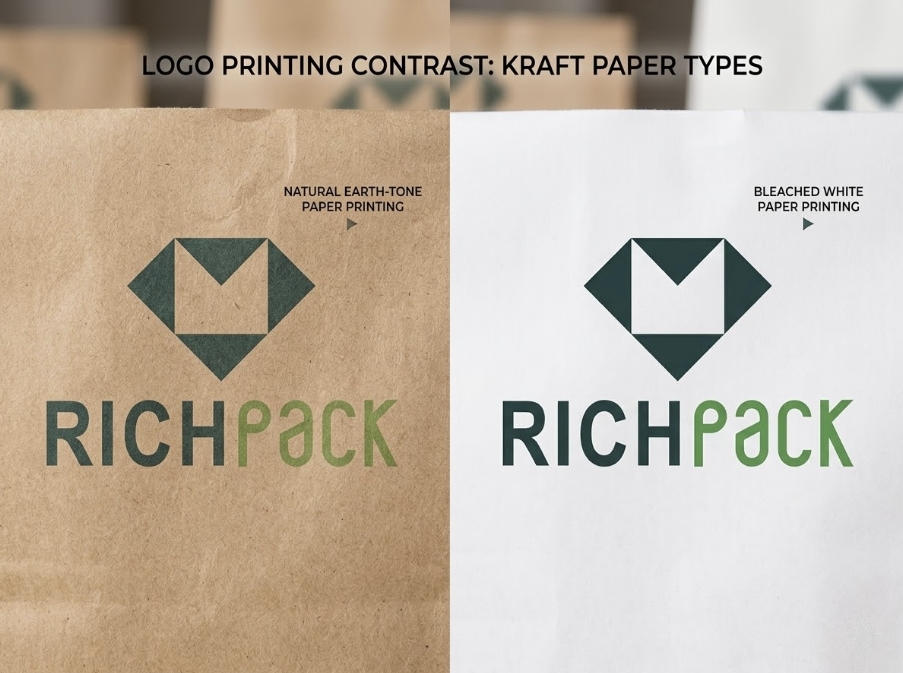
Brown Kraft tends to work best with bold, high-contrast artwork. White kraft gives you more freedom when color accuracy matters.
If you want foil stamping, embossing, or richer detail, you need to match the surface and print method carefully. Do not assume every design that looks good on a screen will translate well onto natural kraft stock.
Packaging experience starts before the product is opened. The carrying moment matters.
A sturdy kraft bag with the right handle and clean print can make an in-store purchase feel more valuable. That is especially useful for jewelry, beauty, boutique fashion, and gift packaging.
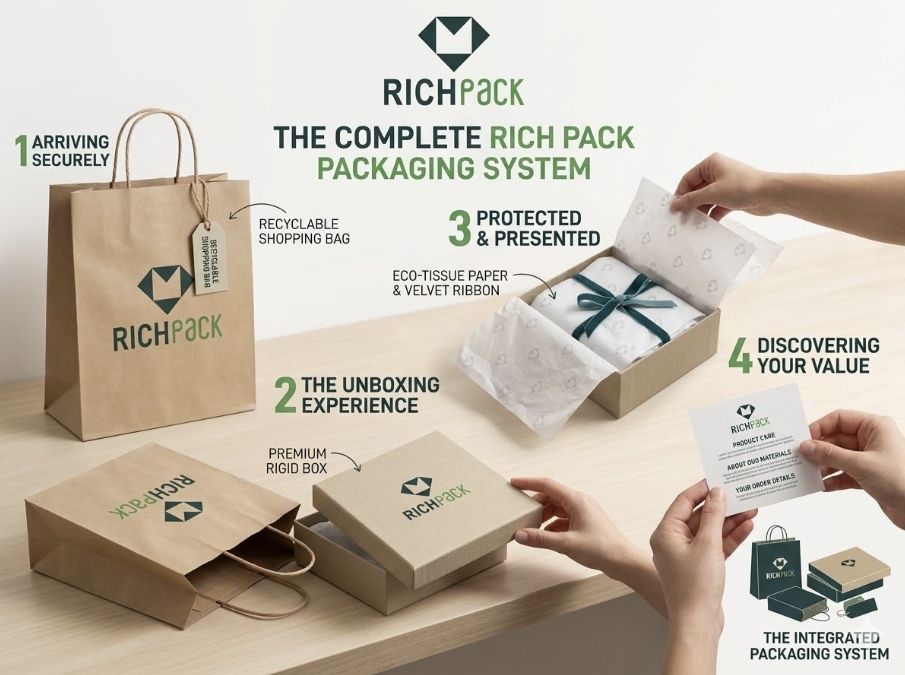
If your product also ships in a branded box, the bag should connect naturally with that system. A customer who sees your shopping bag, box, ribbon, and insert working together reads the brand as more intentional.
A good packaging category scales across SKUs. That lowers sourcing complexity.
You can use kraft paper gift bags for small jewelry items, larger retail bags for apparel, and takeout formats for food service without leaving the material family. That keeps your brand language more consistent.
It also helps during growth. You can expand a product line without reinventing the packaging stack every quarter.
Space costs money. Packaging that stores flat gives you operational breathing room.
Kraft paper bags are easier to pack, warehouse, and replenish than bulkier premium packaging formats. That makes them attractive for retailers with limited backroom space and brands managing multi-location inventory.
They also support faster restocking cycles. For operations teams, that is not a small detail. It is part of the value story.
This is where the format becomes commercially useful. You can start with lower customization, test response, and move into higher-volume branded orders when demand proves out.
That is why kraft paper bags wholesale remains such an active search theme. Buyers are not just asking what the product is. They are asking when the volume math starts working.
For growing brands, this path reduces risk. You avoid overbuilding too early while keeping room for stronger brand expression later.
Good packaging advice needs friction. If an article only lists benefits, it reads like a sales sheet.
Kraft paper bags are useful, but they are not perfect. Knowing the weak spots helps you buy smarter.
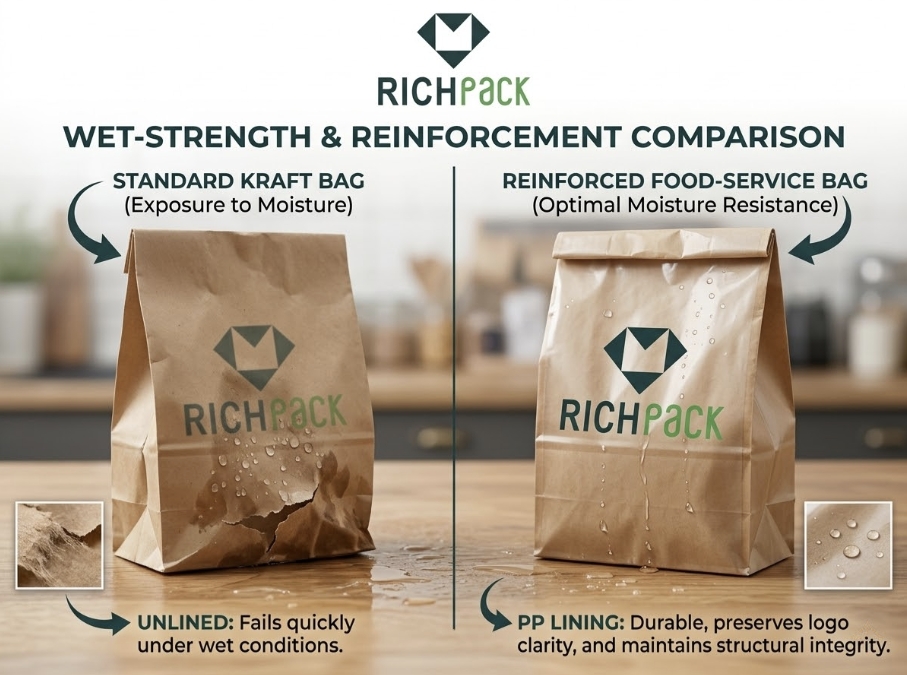
Paper and moisture do not always get along. That is the simple truth.
If your bags will face rain, refrigeration zones, greasy food, or humid storage, standard kraft may struggle. Food service brands often need grease resistance, barrier features, or a more suitable bag structure.
Do not sell a sustainability story and then ignore use conditions. A failed bag hurts the customer experience faster than a weak ad campaign.
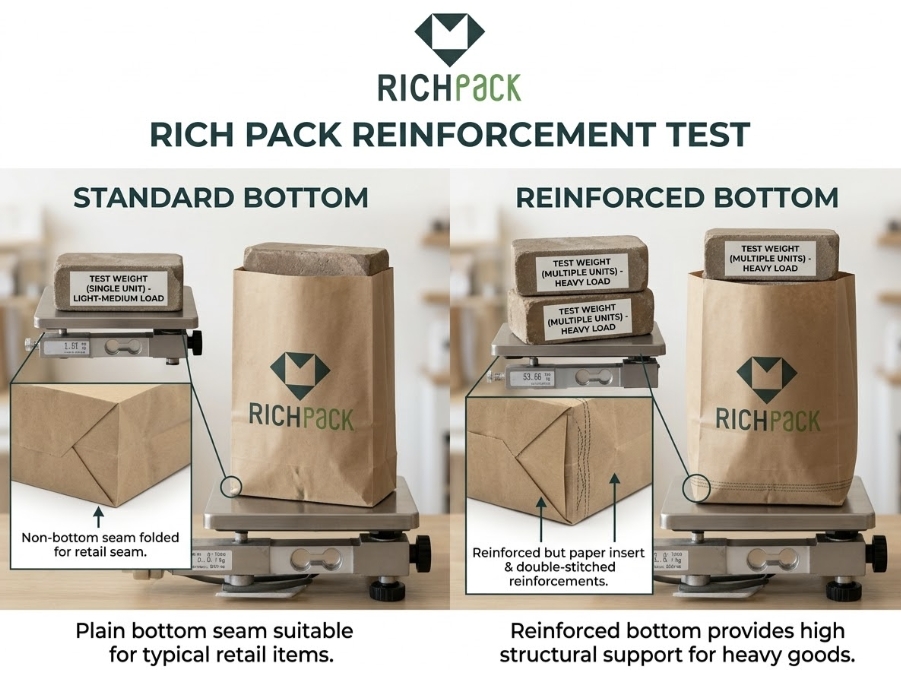
Not every bag should carry wine bottles, heavy glass, or dense product bundles. Weight stress exposes bad specs fast.
If you sell heavier products, look at reinforced bottoms, stronger handles, and higher GSM. In some cases, a two-ply structure or a different packaging format makes more sense.
A beautiful bag that fails at the door is worse than a plain bag that works.
Natural kraft can limit graphic freedom. Brown stock is beautiful, but it does not behave like a bright white canvas.
Fine lines, pastel tones, and subtle gradients may lose clarity. White ink can help, but not every print method handles it equally well.
If artwork is central to your brand, request pre-production samples. Do not approve custom printed kraft paper bags from mockups alone.
A low-cost bag can look expensive online and disappointing in person. This is a common sourcing mistake.
Thin paper, loose handles, poor folding, and muddy print quality send the wrong message. For premium brands, customers notice those details immediately.
This is why price-only buying fails. Packaging quality shows up in the customer’s hand, not just in the quote sheet.
Paper does not give you a free pass on green messaging. Buyers are more skeptical now, and they should be.
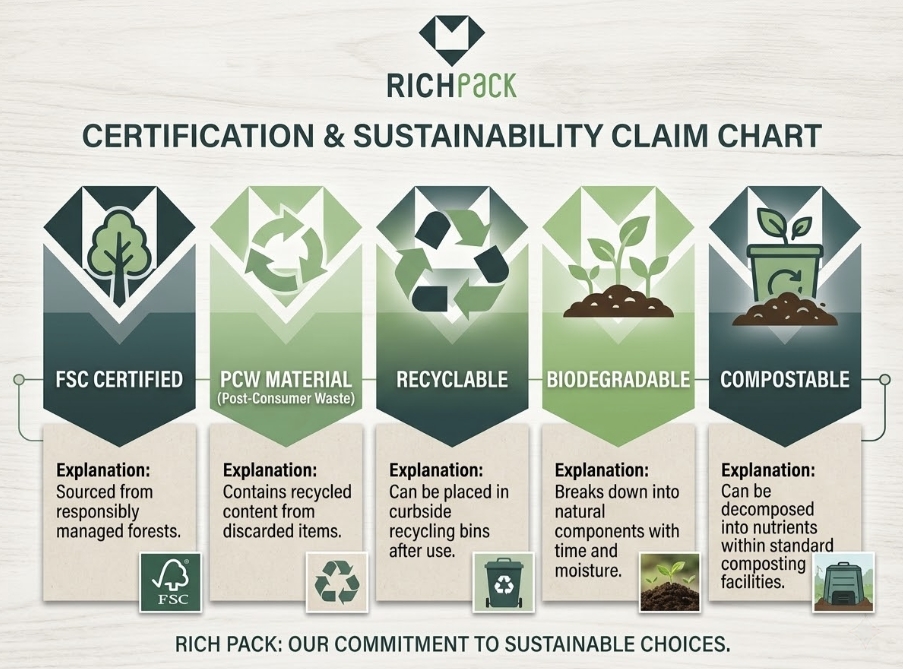
Recyclability depends on local systems. Biodegradable and compostable are not interchangeable. If you want stronger sustainability evidence, ask for FSC-certified fiber and a clear PCW percentage for post-consumer waste.
That wording matters. FSC-certified means the virgin fiber source follows responsible forest management standards. PCW, short for Post-Consumer Waste, tells buyers how much recycled material came from paper already used by consumers, not just factory scrap.
Compostability also needs context. Some kraft papers may break down more easily than plastic, but coatings, laminations, wet-strength additives, inks, and handles can change the result. If a supplier says compostable, ask whether that means industrial composting, home composting, or only uncoated paper under specific disposal conditions.
Do not overpromise. Clear language builds more trust than inflated eco claims.
The right bag is not the most popular. It is the one that matches your product, sales channel, and brand intent.
Start with use case, then move to structure, then finish. Do not reverse that order.
Weight comes first. A light jewelry item, a pastry box, and a fashion purchase do not need the same bag structure.
Look at the dimensions, weight distribution, and carrying distance. A small item with sharp edges can stress a bag in ways a soft but bulky item does not.
If you skip this step, every other packaging decision gets weaker.
Retail purchase, event gifting, takeout pickup, and ecommerce handoff all create different expectations.
A jewelry brand may need a smaller bag that supports a premium reveal. A takeout operation needs speed, stackability, and handle comfort. A supermarket needs volume, repeat use, and cost efficiency.
Packaging should match the moment customers interact with it, not just the product category.
This is one of the most important visual decisions. Brown kraft feels warmer and more grounded. White Kraft feels cleaner and more elevated.
If your identity leans natural, handmade, organic, or artisanal, brown kraft usually makes more sense. If your graphics need crisp color or your brand aims for polished minimalism, white kraft is often the stronger move.
Use the surface to support your story. Do not fight your own brand language.
Handles shape both comfort and perception. They are a functional detail with branding consequences.
Use flat handles when speed and practicality matter. Use twisted paper handles for standard retail carry. Use rope handles when you want a more premium bag experience.
Personalized kraft paper bags often look stronger when the handle style matches the brand tier instead of copying whatever competitors use.
Stock bags make sense when speed matters more than differentiation. They are useful for short campaigns, market testing, and fast replenishment.
They also help if your business is still learning what size, color, or handle style works best. You can reduce risk before moving into deeper customization.
That makes stock a strategic choice, not a compromise.
Custom becomes worth it when repeat exposure matters. If customers see your bag often, the bag should work harder for the brand.
Custom kraft paper bags usually pay off for boutique retail, gifting, jewelry, beauty, events, and brands building a recognizable store experience. The more your packaging appears in public or on social media, the more the return grows.
If your brand already invests in custom boxes, inserts, tissue, or ribbons, the shopping bag should not be the weak link.
Wholesale buying saves money only when the specification is right. Ordering more of the wrong bag is not a cost advantage.
Use this checklist before you place a larger order.
Start with proof, not promises. Ask what GSM the supplier recommends and what load the bag is built to carry.
A practical buying shortcut looks like this:
| Bag Need | Suggested GSM Range | Faʻaaoga Masani |
| Malamalama-tiute | 100 i le 120 GSM | Jewelry, accessories, small giveaways |
| Everyday retail | 130 i le 150 GSM | Standard shopping bags, cosmetics, and light apparel |
| Fa'atauga fa'apitoa | 160 i le 180 GSM | Better handfeel, higher perceived value, multi-item purchases |
| Tiute mamafa | 180 to 250 plus GSM | Bottles, gourmet products, heavier merchandise, reinforced gift bags |
If possible, request testing details or at least real samples with realistic weights inside. A bag that looks fine on a table may fail once it moves through real handling.
Print method changes the outcome. Flexo, offset, and digital each have strengths and limitations.
Ask how the chosen process handles line sharpness, dark stock, white ink, and color consistency. This is especially important for logo-driven retail packaging.
A supplier that cannot explain print trade-offs clearly is already telling you something.
Pricing is only part of the sourcing equation. MOQ and lead time shape your inventory risk.
Ask how quickly the supplier can repeat an order, not just ship the first one. A good first run matters. A reliable second and third run matter more.
For seasonal campaigns or store rollouts, timing failures can cost more than a slightly higher bag price.
Claims need evidence. If recycled content, FSC sourcing, or food-contact suitability matters, verify it before production.
Ask the supplier three simple questions. Is the paper FSC certified? What PCW percentage does the sheet contain? What documents support recyclable, recycled, or compostable claims?
This protects both your brand and your procurement team. It also helps you avoid fuzzy sustainability language later in marketing.
Documentation may not excite customers, but missing documentation creates real problems.
Samples should be tested, not admired. Put the real product inside. Carry it. Store it. Stress it.
If the bag is for food service, test it for moisture and warmth. If it is for retail, test it with the actual customer carry weight and shelf handling.
Consistency is a brand asset. A bag that changes color, handle quality, or print sharpness across runs weakens recognition.
This is where a packaging partner matters more than a low quote. If you are also sourcing rigid boxes, pouches, or insert systems, it helps to align them under one broader packaging strategy.
That is also where natural internal linking can support your content strategy. A page about Kraft paper bags should connect naturally to your guides on custom gift boxes, retail packaging, or branded jewelry packaging solutions.
The choice between brown and white kraft often decides the entire look of the finished bag. Use the table below to make the call faster.
| Factor | Kraft enaena | Kraft Pa'epa'e |
| Brand signal | Natural, earthy, rustic, eco-conscious | Clean, polished, premium, modern |
| Fa'atusatusaga lolomi | Best for bold and simple graphics | Better for bright colors and detailed artwork |
| Fa'aauau le manatu | Strong immediate eco cue | Still strong, but less raw and natural |
| Tulaga fa'aoga sili | Organic products, boutique retail, bakery, handmade goods | Jewelry, beauty, gifting, premium retail |
| Tulaga tau | Often more cost-efficient | Often slightly higher, depending on finish and print |
This is usually the next buying question. Use stock when you need speed. Use custom when the bag needs to build the brand.
| Factor | Stock Kraft Bags | Custom Kraft Bags |
| saosaoa | Faster to source | Longer setup and production |
| aasa | Limited | Strong logo and design control |
| MOQ pressure | Lower | Maualuga i le tele o tulaga |
| Sili mo | Events, testing, short-term use | Retail programs, premium gifting, long-term brand use |
| Fuafuaga tau | I lalo ifo i luma | Better value when brand exposure matters |
You should not choose the same Kraft paper bag for every channel. Match the structure to the selling environment.
| Pisinisi Faapisinisi | Recommended Bag Direction |
| Bakery or takeout brand | Flat-handle or food-service kraft bag with grease-aware spec |
| Boutique retail | Twisted-handle kraft shopping bag with clean logo print |
| Fa'ailoga mea teuteu | Smaller white or brown kraft gift bag with premium handle choice |
| Fa'ameaalofa fa'apitoa | Custom printed bag with stronger visual presentation |
| E-commerce store pickup | Durable retail bag sized for fulfillment handoff |
Yes, in many customer-facing situations, they are a better fit for brand image and sustainability goals.
They usually create a more responsible impression, support stronger visual branding, and align better with plastic reduction efforts. They are not automatically better in every wet or heavy-load scenario, so fit still matters.
No, not everywhere.
Many kraft paper bags can be recycled, but local recycling rules decide what is accepted. Food contamination, coatings, and mixed materials can also affect recyclability.
Yes, if the specification is right.
Luxury retail does not require a rigid box for every purchase. A well-made kraft bag with the right paper weight, clean print, and premium handle can work very well for jewelry, beauty, apparel, and gifting.
Rope handles or twisted paper handles are usually the best place to start.
The final choice depends on the price tier, bag size, and brand feel you want. Rope handles push the bag more premium. Twisted paper handles keep a balance of strength, cost, and style.
Choose brown for natural warmth and white for cleaner visual precision.
Brown Kraft fits earthy and artisanal branding. White kraft fits brands that need brighter print contrast or a more polished retail look.
They make sense when repeated brand exposure matters.
If customers carry the bag in public, photograph it, or connect it with your store experience, custom branding usually pays off. This is especially true for boutique retail, gifting, beauty, and jewelry packaging.
Kraft paper bags stay popular because they solve practical business needs without compromising presentation.
They support sustainability goals, work across channels, scale from stock to custom, and give brands a simple way to look more intentional. The real win comes when you choose the right structure, surface, handle, and sourcing plan instead of buying on price alone.
If you are building a stronger packaging system, start with the bag spec that matches your product and your brand. Then connect it with the rest of your packaging, from boxes to inserts to the full unboxing experience.





 Muamua