
 PREV
PREV
10 bästa alternativen till plastförpackningar för exklusiva smycken
2024-11-19
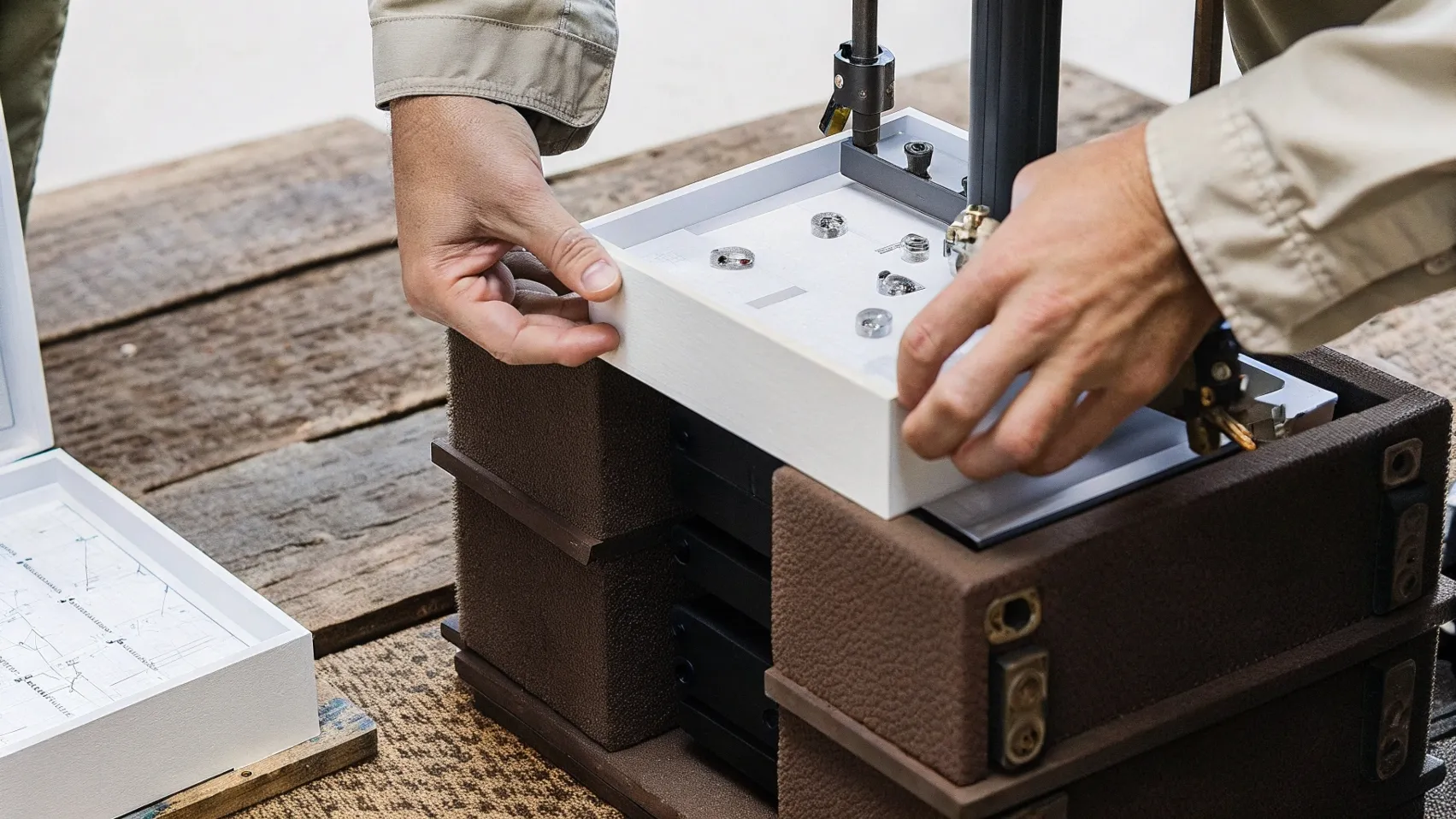



En safirring kan se felfri ut när den lämnar studion och ändå anlända med mittstenen lös eller bandet vridet ur sin position. Ytterkartongen kanske inte uppvisar några synliga skador. Det är det som gör transportfel så frustrerande: många av dem inträffar inuti lådan, där vibrationer, små stötar, foderfriktion och några millimeters spelrum kan motverka smycket i timmar.
En seismisk testprocess för smyckesförpackningar utvärderar hur ett färdigt förpackningssystem presterar när värdefulla smycken utsätts för transportvibrationer, stötar, fall, kompression och rutinmässig hanteringsbelastning. I detta sammanhang avser "seismisk" upprepad rörelse och stöt under distribution. Det betyder inte att ett smyckeskrin har certifierats för jordbävningar.
"Nasa-nivå" behöver samma typ av tydliga gränser. Här betyder det disciplinerad teknisk granskning, dokumenterad testning, spårbara beslut och kontrollerade korrigerande åtgärder. Det betyder inte att NASA har godkänt eller certifierat ett smyckespaket.
För ett lyxigt smyckesmärke är den verkliga frågan enkel: kommer ringen, halsbandet, klockan, pärlsträngen eller ädelstenssetet fortfarande att vara säkert, rent, otrasslat och redo att presenteras efter den faktiska leveransrutten? En vacker ask ensam kan inte svara på det. Primärasken, insatsen, fodret, förslutningen, ytterkartongen, dämpningen och kvalitetsregistret måste alla fungera tillsammans.
RichPack-designer specialanpassade smyckesaskar för högvärdiga föremål med hela systemet i åtanke, från struktur och bilagor till provgranskning och leveransplanering.
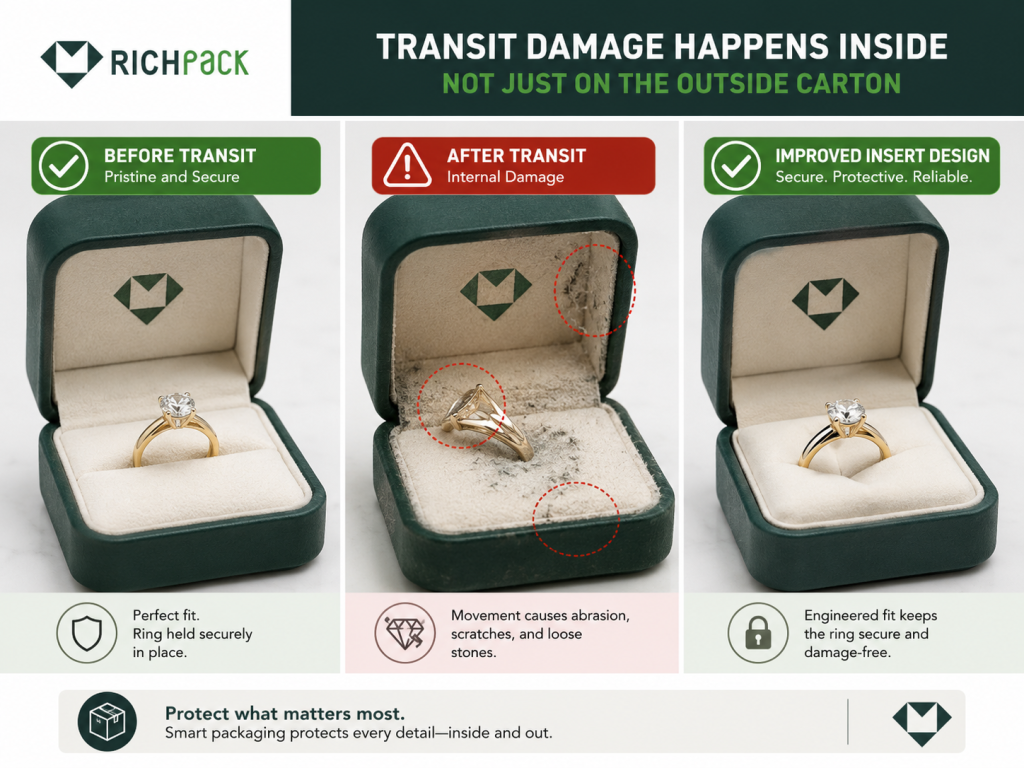
Ett seismiskt test av smyckesförpackningar är ett kontrollerat sätt att se hur en förpackning reagerar på upprepad rörelse och hanteringskraft. Det ersätter ett vagt påstående som "skyddande förpackning" med observerbara bevis: godkänt, underkänt, omdesignat och testat igen.
Rörelse visar om passformen är rätt. Stöten visar var strukturen är svag. Inspektionen visar vad kunden skulle ha sett.
Ett seismiskt test av smyckesförpackningar utsätter det färdiga smyckespaketet för distributionsrisker som vibrationer, stötar, fall och kompression. Målet är att bekräfta att smycket förblir fixerat, rent, otrasslat, oskadat och lämpligt för försäljning efter transport.
Ordet ”färdig” spelar roll. En pappersmodell eller ett tomt prov kan visa färg, form och ungefärlig storlek. Det kan inte bevisa skärhållfasthet, fodrets nötningsbeständighet, stängningsstyrka eller hörnhållbarhet under rörelse.
För smyckesförpackningar betyder seismisk inte ett jordbävningskodtest. Det hänvisar till den upprepade rörelsen som orsakas av paketbilar, transportband, flygfrakt, lagerstapling, leverans till sista milen och manuell sortering.
Dessa krafter kan rotera en ring i sitt skåra, gnugga ett hänge mot sammet, öppna en svag magnetisk flik eller låta en kedja krypa ut ur sin kanal. En rörelse kan vara ofarlig. Hundratals små rörelser kan skapa synliga skador.
NASA:s riktlinjer för förpackning och transport betonar krav på rutt, miljö, hantering, förvaring, dokumentation och speciella designkrav. Den inställningen är användbar för lyxsmycken eftersom produkten är liten, värdefull och känslig för rörelse.
En metod på NASA-nivå förlitar sig inte på gissningar. Den frågar: Vad kan misslyckas? Hur ska vi testa det? Vem godkänner resultatet? Vad förändras om paketet misslyckas?
Inget test kan garantera att varje paket kommer att överleva alla tänkbara transporthändelser. Testning ersätter inte försäkring, transportörsdisciplin, mottagningsinspektion eller korrekt lagerhantering.
Det bevisar inte heller officiellt godkännande från NASA. Om en leverantör använder språk på "NASA-nivå" utan att visa standarder, profiler, foton och register över korrigerande åtgärder, ska frasen behandlas som ett påstående som behöver bevis.
Testning är mest värdefullt när smyckesvärde, ömtålighet, lanseringsrisk eller komplexitet vid leverans gör misslyckanden dyra. Det är särskilt användbart för upphöjda stenar, fina kedjor, pärlor, opaler, pläterat silver, klockor, displayset och presentförpackningar för detaljhandeln.
Testning är också smart när ett varumärke ändrar inläggningsmaterial, ytterkartongstorlek, förslutningstyp, distributionsväg eller leverantör. En liten förändring kan skapa en ny rörelseväg.
Kunder upplever sällan transportskador som "ett förpackningsproblem". De upplever det som slarvig frakt.
Ett dokumenterat test kan minska behovet av utbyten, återbetalningar, omarbetningar, supportärenden och interna tvister. Det ger inköps-, kvalitets-, förpacknings-, logistik- och varumärkesteam en gemensam dokumentation istället för konkurrerande åsikter baserade på hantering i provrummet.
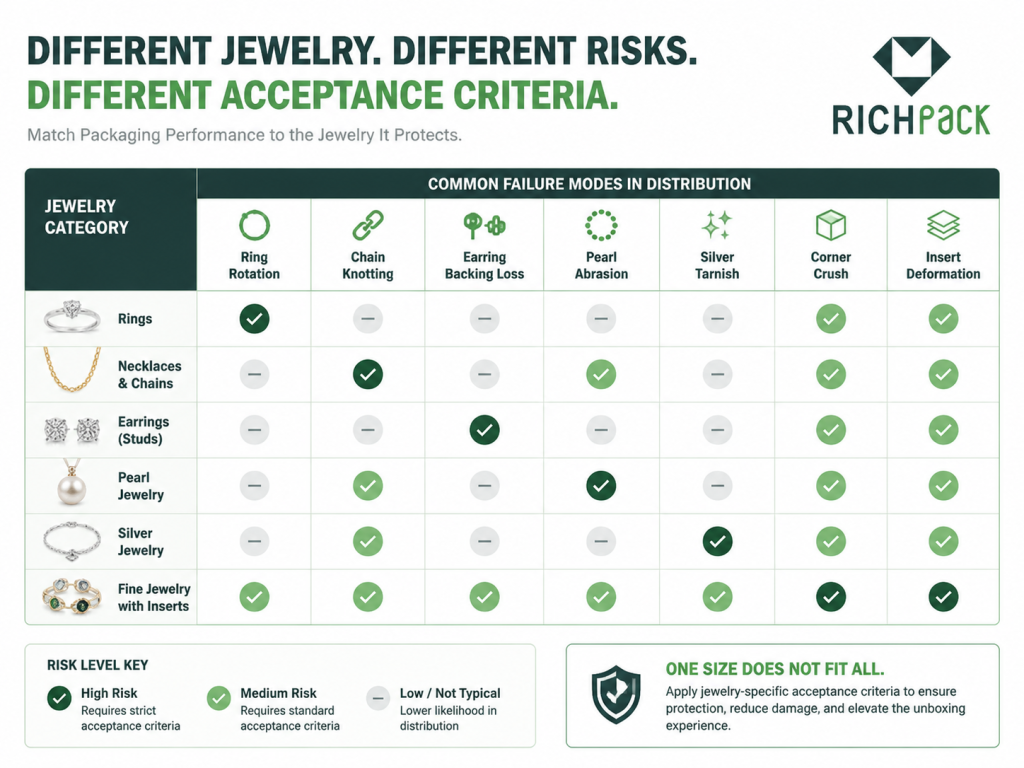
Bra testning börjar med smyckets beteende, inte maskinen i labbet. Ringar roterar. Kedjor kryper. Pärlor nöts. Örhängen avslöjar toleransproblem snabbt.
Varje produkttyp misslyckas på olika sätt, så förpackningen bör bedömas utifrån den del den skyddar.
| Smycketyp | Troligtvis misslyckad transport | Förpackningskontroll för att kontrollera | Köparens varningsskylt |
| Upphöjd stenring | Stenknackning, kloförskjutning, ringrotation | Spårgrepp, kronavstånd, topptryck | Ringen roterar fritt i insatsen |
| Fint halsband med kedja | Trassel, kink, spännspänning | Kanaldjup, spännficka, halkfri yta | Kedjan korsar sig själv efter ett skaktest |
| Stud örhängen | Liten delförlust, efter böjning | Håltolerans, baksidesretention | Örhängesstiftet vickar i kortet |
| Pärla eller opalbit | Ytslitage, tryckmärken | Mjukt foder, lågfriktionskontakt, ingen hård kant | Ädelstenen vidrör locket eller kartongväggen |
| silver~~POS=TRUNC smycken~~POS=HEADCOMP | Matthet, luktöverföring, missfärgning | Syrafritt papper, antikoleransbarriär, fuktighetskontroll | Fodret luktar kemikalier eller fäller fibrer |
| Klock- eller displayset | Tung rörelse, krossat hörn | Viktstöd, styv bricka, kompressionsmotstånd | Brickan böjer sig under produktens vikt |
Upphöjda stenar behöver både vertikalt utrymme och sidoåthållning. En skåra som bara greppar bandet kan fortfarande göra att kronan träffar locket eller vrids under vibrationer.
Det uppenbara felet är en sprucken eller lossad sten. Det tystare felet är presentationen: ringen anländer lätt vriden, lutad eller inpressad i fodret, vilket gör att den ser ut att vara hanterad innan kunden ens rört vid den.
Kedjor beter sig som en tråd under vibrationer. Om kanalen är för grund eller om spännet inte har någon särskild ficka kan kedjan krypa över insatsen och knyta.
En halsbandsinsats bör kontrollera kedjans bana, hängsmyckets position och spännet separat. Ett halsband som fotograferar bra under provtagning kan fortfarande misslyckas efter ett kort rörelsetest.
Örhängen avslöjar snabbt toleransproblem. Ett löst hål möjliggör rotation. Ett trångt hål kan böja stolpen under packning.
Bakstyckena behöver en egen bevaringsplan. Om ett bakstycke faller ner i hörnet av lådan ser kunden en saknad komponent även när själva örhänget är okej.
Pärlor och opaler är känsliga för nötning och tryck. Deras yta kan visa märken innan hårdare ädelstenar visar någon synlig förändring.
För dessa delar bör inspektionen fokusera på kontaktpunkterna efter testning, inte bara om föremålet höll sig på plats. En mjuk insats är inte säker om den släpper fibrer, fångar upp grus eller skapar friktion.
Silver kan missfärgas när förpackningsmaterial släpper ut svavel, syror, fukt eller flyktiga föreningar. Rörelser kan förvärra problemet genom att sprida rester över ytan.
Materialkompatibilitet bör granskas tillsammans med vibrationsprestanda. En stark insats går fortfarande inte bra om fodret påverkar smyckets finish.
Klockor och displayset ökar vikten. Den vikten kan böja ett bricka, försvaga ett gångjärn, komprimera skum eller krossa en pappskuldra under stapling.
Förpackningen bör testas med den faktiska produktvikten eller en korrekt matchande docka. En lättare ersättning kan få en svag struktur att se acceptabel ut.
En smyckeskrin skyddar presentationen. En fraktkartong skyddar detaljhandelslådan från distributionsvägen.
Båda lagren måste testas tillsammans. En styv låda kan fortfarande vara krossad vid ankomst om försändelsen har glipor i hörnen, svaga kompressionszoner eller för mycket utrymme.
Ett seismiskt test bör inte bedöma lådan ensam. Den testade enheten bör vara den kompletta förpackningsstapel som kunden, återförsäljaren eller lagret faktiskt kommer att motta.
Det primära smyckesasket ger upphov till uppackningsupplevelsen och det första lagret av skydd. Kartongkvalitet, gångjärnsstruktur, lockets passform, omslagsmaterial och hörnkonstruktion påverkar alla hur kraften rör sig genom förpackningen.
En styv ask kan kännas exklusiv och ändå ge in stötar i insatsen. Testning bör kontrollera både askens utseende och hur smyckena inuti rör sig.
Insatsen styr direkt smyckets rörelse. Den kan vara skum, gjuten massa, kartong, en flockad bricka, en sammetsbeklädd struktur, en mikrofiberkanal eller ett specialanpassat stansningssystem.
En bra insats gör mer än att bara fylla utrymme. Den avgör var kraft absorberas, var kompression tillåts och var smyckena aldrig får vidröra varandra.
Fodret vidrör produkten, så det måste kontrolleras med avseende på friktion, fiberavgivning, färgöverföring, lukt, nötning och kemisk kompatibilitet. En lyxig yta ska skydda smyckets finish, inte bara se raffinerad ut.
Sammet, mockaliknande tyg, mikrofiber, satin, papper och belagd kartong beter sig olika under vibrationer. Rätt val beror lika mycket på smyckets yta som på varumärkets färgpalett.
Magnetiska lock, tryckknappar, hylsor, bandlås och gångjärnsförsedda lock behöver alla rörelsekontroll. Om en förslutning öppnas något under vibration kan insatsen förskjutas eller så kan smycket skava mot locket.
Öppningsmotståndet ska kännas mjukt för kunden men förbli stabilt under distribution. För mycket motstånd kan också skada ömtåliga förpackningar under distribution.
Den sekundära utskickslådan skyddar detaljhandelskartongen från transportband, fall, stapling och kanttryck. Den ska förhindra att kartongen rör sig inuti kartongen samtidigt som den fortfarande ger utrymme för dämpning där det behövs.
Varumärken testar ofta innerförpackningen och glömmer ytterkartongen. Det är en anledning till att premiumförpackningar kommer med krossade hörn.
Dämpningen kontrollerar kraftöverföringen mellan detaljhandelskartongen och kartongen. Pappersfyllning, formpressad massa, wellpapp, skumdukar, luftkuddar och bikakepapper komprimeras alla på olika sätt.
Det bästa valet beror på produktens vikt, kartongstorlek, leveransväg, fuktexponering och hållbarhetsmål. En lösning som fungerar för ett hänge kanske inte fungerar för ett armbandsur.
Orienteringsetiketter och hanteringsanteckningar kan hjälpa, men de bör inte vara den centrala skyddsstrategin. Transportörer kan rotera, stapla och kasta paket trots instruktioner.
Ett paket ska överleva rimlig felhantering utan att förlita sig på perfekt mänskligt beteende. Etiketter stöder systemet; de ersätter det inte.
Ett enda perfekt prov kan dölja produktionsvariationer. Limvolym, magnetplacering, skärdjup, foderspänning och skivtjocklek kan variera över en batch.
Testprover bör representera verklig produktion, särskilt när beställningen inkluderar flera storlekar, färger, insatser eller säsongsomslag. RichPack stöder detta genom stöd för design av smyckesförpackningar och granskning i stickprovsfasen.
Ett smyckesmärke behöver inte bli ett testlabb. Det behöver tillräckligt med standardiserat språk för att begära en trovärdig plan och förstå rapporten.
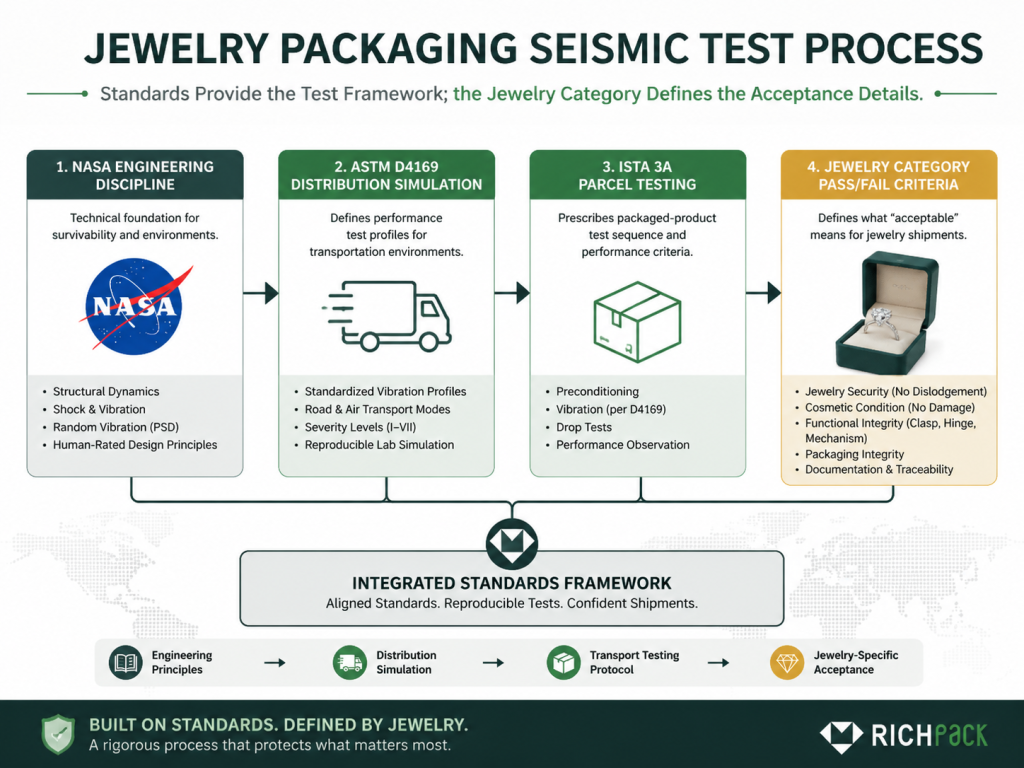
Standarder definierar vägen. Smycken definierar godkännandekravet. Rapporter bevisar arbetet.
NASA:s förpackningsriktlinjer betonar transportsätt, miljökontroll, lagring, omdistribution, särskilda förpackningskrav och teknisk dokumentation.
För smyckesförpackningar är den användbara lärdomen disciplin: definiera faran innan du väljer struktur.
NASA:s vibrations- och stötanläggningar använder dynamiska tester för att verifiera om hårdvara tål kraftiga rörelser och stötar. Smyckesförpackningar tillämpar en mycket lägre riskversion av den logiken.
Den praktiska metoden är fortfarande användbar: simulera rörelse, observera fel, dokumentera resultatet och revidera systemet före release.
ASTM D4169 organiserar transportrisker genom distributionscykler och säkerhetsnivåer. Det kan inkludera hantering, vibration, kompression, stötar och andra tester baserat på rutten.
För smyckesmärken hjälper ASTM-språket leverantörer och laboratorier att diskutera risker mer exakt, särskilt för grossist-, internationella och högvärdiga leveranser.
ISTA 3A används ofta för individuellt förpackade paket som skickas via paketleveransnätverk. Den kan passa varumärken som skickar färdiga smyckesaskar direkt till kunder eller återförsäljare.
Standarden hjälper till att strukturera diskussioner om fall, vibrationer och kompression. Varumärket behöver fortfarande smyckesspecifika godkännandekriterier, eftersom ett paket kan passera medan halsbandet inuti ser oacceptabelt ut.
Slumpmässiga vibrationer återspeglar verkliga transporter bättre eftersom lastbilar, flygplan, transportörer och pakethantering inte skakar vid en ren frekvens. Tester med fast frekvens kan avslöja resonans men är smalare.
Om ett paket bara klarar ett grundläggande skakningstest eller en kontroll med en frekvens, fråga vilken verklig fara det resultatet representerar.
Säkerhetsnivån återspeglar den simulerade ruttens allvarlighetsgrad. En diamantinfattning med högt värde som transporteras internationellt förtjänar en striktare plan än en billig berlock som skickas lokalt.
Allvarlighetsgraden bör återspegla produktvärde, ömtålighet, ruttens längd, transportörens hantering, klimatexponering och uppskjutningskostnad. Mer omfattande tester är inte alltid bättre om de inte matchar den faktiska rutten.
En skräddarsydd plan är användbar när smycket är ovanligt ömtåligt, insatsen är komplex eller rutten inkluderar mässor, distributionspartners eller internationella överföringar.
Standarder utgör en grund. Smyckesspecifika kriterier kompletterar planen: ingen stenrörelse, ingen kedja som trasslar sig, ingen synlig foderöverföring, ingen öppning av stängningen, ingen hörnknölning och ingen kundsynlig skrapning.
En stark testbrief förhindrar vaga godkännanden. Den anger vilken produkt som testas, vilken rutt som simuleras, vilka skador som är viktiga och vem som har befogenhet att godkänna ändringar.
Börja med den exakta artikelnummern, inte en bred produktfamilj. En solitärring, ett tennisarmband och ett lagerhalsband har olika rörelserisker.
Risknivån bör återspegla detaljhandelspris, stenhöjd, metallfinish, ytmjukhet och kundens löfte. Brudsmycken förtjänar vanligtvis strängare trösklar än en reklamberlock.
Skriv ner rutten från fabriken till kunden eller återförsäljaren. Inkludera hantering av exportkartong, lagerförvaring, paketleverans, överföring till återförsäljare, leverans till evenemang och eventuella returer.
Ett paket designat för en rutt kan misslyckas på en annan. Mässtransporter, flygfrakt och paketleverans stressar förpackningar på olika sätt.
Ett prov är en demonstration, inte en testplan. En bättre granskning använder flera färdiga prover tillverkade av produktionsliknande material och, när det är möjligt, olika kartongpositioner.
För högrisklanseringar, testa tillräckligt många prover för att avslöja variationer. Om budgeten bara tillåter ett litet test, dokumentera den begränsningen tydligt.
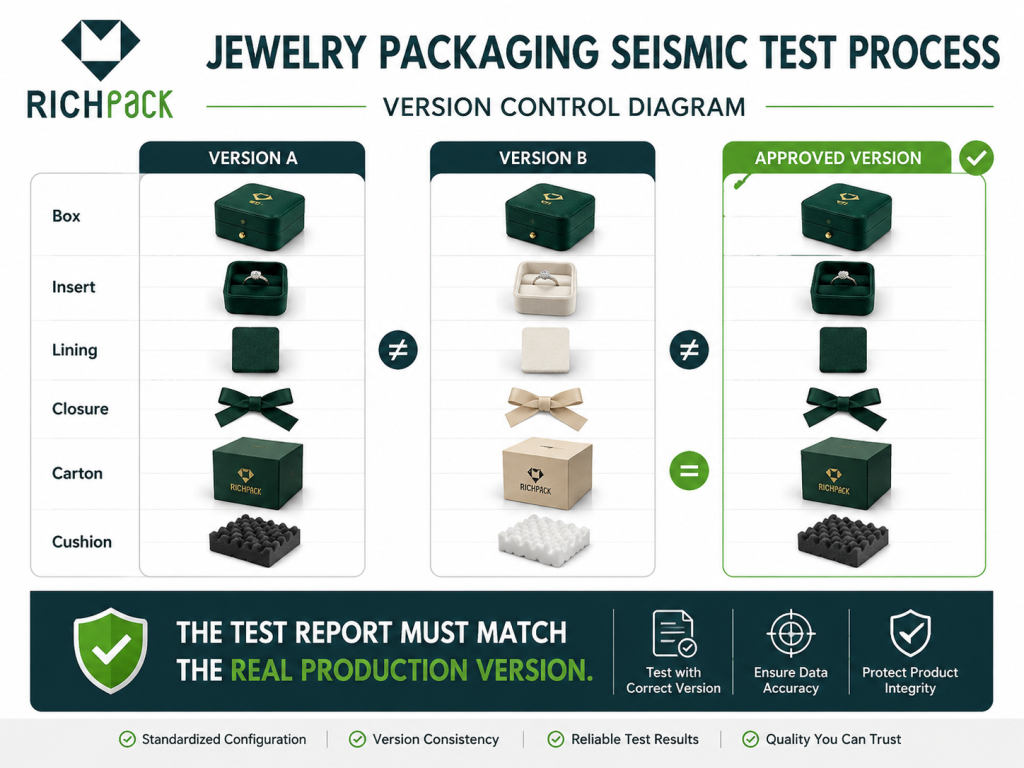
I beskrivningen ska den exakta kombinationen av låda, insats, foder, förslutning, kartong och dämpning identifieras. Om två insatsdesigner jämförs behöver varje version en egen etikett.
Versionshantering förhindrar förvirring senare. Utan den kan en tidigare rapport hänvisa till en struktur som aldrig når produktion.
Kosmetiska förändringar kräver en skriftlig tröskel. Ett dolt märke under insatsen skiljer sig från en skav på locket som syns vid uppackning.
Definiera vad som är acceptabelt för smycken, inlägg, foder, detaljhandelsask och ytterkartong. Lyxmärken bör sätta strängare gränser för kundvända ytor.
Undvik vagt språkbruk som ”ingen skada”. Använd observerbara kriterier: inga lösa stenar, inga böjda stolpar, inga kedjetrasslar, inget pärlslitage, ingen matthet, ingen spännspänning och ingen förskjuten klockarm.
Om förstoring krävs, ange inspektionsmetod. En köpare bör inte upptäcka skador endast under fotografering eller uppsättning i butik.
Godkännande bör inte ligga hos någon som bara granskar förpackningen visuellt. Kvalitet, förpackning, varuhantering, logistik och varumärkesteam kan alla behöva input.
Attesteraren måste ha behörighet att pausa produktionen om ett fel uppstår. Det är syftet med testning innan massordrar släpps.
Provberedning kan avgöra testets framgång eller misslyckande. Om produkten, materialet, förslutningen eller kartongen inte matchar produktionen blir resultatet endast en grov screening.
Använd riktiga smycken eller nappar som matchar vikt, form, finish och ömtålighet. En lätt platsmarkör kan inte avslöja kompression av insatsen, stängningsspänning eller ytfriktion.
För dyra föremål kan viktade dockor användas för tidig screening, följt av riktiga prover för slutgiltigt godkännande. Rapporten bör ange vilka som användes.
Använd riktiga material för kartong, omslag, foder, magneter, lim, band, skum, papper och kartong. Tidiga prototyper är användbara, men ersättningsmaterial kan bete sig annorlunda under påtryckningar.
Ett prov tillverkat med ersättningsfoder kan vibrera och ändå gå sönder senare på grund av fiberöverföring eller risk för missfärgning.
Behåll orörda kontrollprover från samma batch. De ger en tydlig jämförelse för eftertestfoton, färgförskjutningar, fiberrörelser och känsla av stängning.
Kontroller minskar antalet argument eftersom teamet kan jämföra testade och otestade prover sida vid sida.
Fotografera smycken, insatsen, fodret, askhörnen, förslutningen, kartongen och stoppningen före testet. Använd konsekvent belysning och vinklar.
Bra foton förvandlar åsikter till bevis. De hjälper också till att identifiera om skadorna orsakades av strukturen, materialet, förpackningen eller hanteringen.
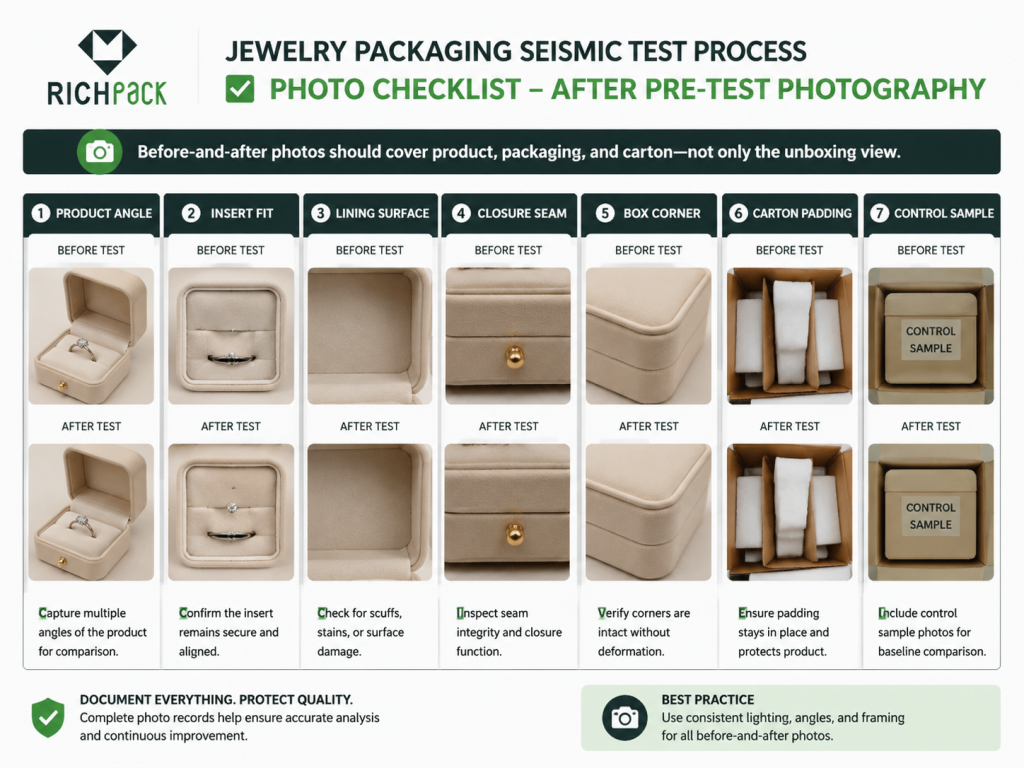
Registrera produktvikt, kartongmått, bruttovikt och avstånd för insatser. Dessa uppgifter påverkar fallrespons, staplingsbelastning och hantering av bärare.
För set med flera delar, registrera viktfördelningen. En tung hängsmycke på ena sidan kan förskjuta sig mer än samma totala vikt centrerad i ett bricka.
Kontrollera stängningen och insatsens passform före formell testning. En svag magnet eller lös insats bör korrigeras innan testet börjar.
RichPacks arbetsflöde för kvalitetskontroll av förpackningar kan hjälpa till att anpassa provinspektion med testberedskap.
Fuktighet kan mjuka upp kartong, förändra fodrets känsla och påverka risken för missfärgning. Skötseln är viktig när smycken ska utstå klimatförhållanden eller förvaras.
Rapporten bör ange om proverna konditionerades. Om inte, gäller resultatet endast den testade miljön.
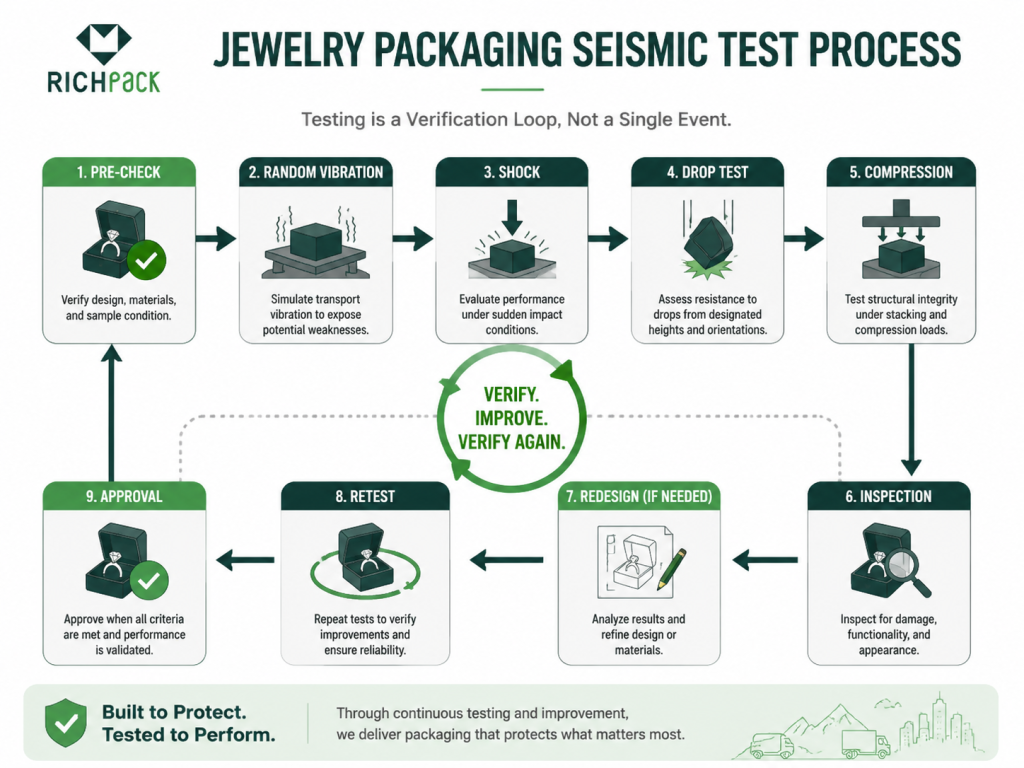
Testsekvensen bör återspegla rutten. Vibrationer minskar. Stötar, stötar. Fall, slag. Kompression, krossning. Riktiga paket upplever dessa påfrestningar i kombination.
Ett slumpmässigt vibrationsbord exponerar paketet för ett brett rörelseområde. Många slumpmässiga vibrationsprofiler av pakettyp körs cirka 30 till 60 minuter per orientering, medan ASTM D4169-distributionscykler kan definiera varaktighet efter rutt, fordonstyp och säkerhetsnivå.
Det är inte bara siffran som är poängen. Profilen måste matcha hur smycket faktiskt kommer att röra sig.
Rapporten bör ange profil, varaktighet, orientering och paketets skick. En kort, odokumenterad skakning räcker inte för en värdefull lansering.
Paket transporteras på olika sidor, kanter och hörn. Att testa endast en orientering kan missa ett fel som uppstår när lådan rullar i sidled eller upp och ner.
Inkludera förväntad transportposition och rimliga felhanteringspositioner. Smycken går ofta sönder när gravitationen ändrar kontaktpunkten inuti insatsen.
Stötar simulerar plötsliga krafter från sortering, lastning, paketöverföringar och hantering. Testet kontrollerar om smycket hoppar till, förslutningen förskjuts eller kartongen överför kraft till detaljhandelsförpackningen.
Stötar kan avslöja svagheter, men vibrationer gör det inte. En hängsmycke kan sitta kvar under vibrationer och lossna efter en skarp stöt.
Falltestning simulerar hanteringshändelser på ytor, kanter och hörn. ISTA 3A-paketprogram använder vanligtvis flera fall från höjder kopplade till paketvikt, ofta runt 30 till 12 cm för många paketvikter.
Sekvensen bör matcha paketstorlek, vikt, rutt och vald standard. Inspektion efter större fall kan avslöja när felet börjar.
Kompressionstestning kontrollerar om kartonger, detaljhandelslådor, brickor och insatser klarar staplingstryck. Planering i ASTM D4169-stil kan koppla kompressionsbelastning till lagringstid, stapelhöjd och förpackningsvikt.
Ett paket kan klara falltestet och ändå misslyckas vid förvaring. Axlar, fackväggar och klockkuddar förtjänar noggrann inspektion efter komprimering.
Ordning är viktigt eftersom skador ackumuleras. Vibrationer kan lossa en kedja innan ett fall skapar den slutgiltiga trasseln.
Testplanen bör förklara sekvensen. Om paketet omdesignas bör omtestet använda samma sekvens om inte rutten ändras.
Vid svåra fel kan kameror eller sensorer visa rörelser som ögat missar. En ring kan studsa i en springa i millisekunder, eller ett hänge kan träffa locket bara under en skarp händelse.
Dessa verktyg krävs inte för varje projekt, men de är användbara när fel upprepas och orsaken är oklar.
Dokumentationen bör inkludera utrustning, datum, operatör, provversion, testprofil, kriterier för godkänt/icke godkänt, foton och observerade fel.
Om en leverantör säger att paketet har testats, be om dokumentationen. Pappersspåret är en del av skyddssystemet.
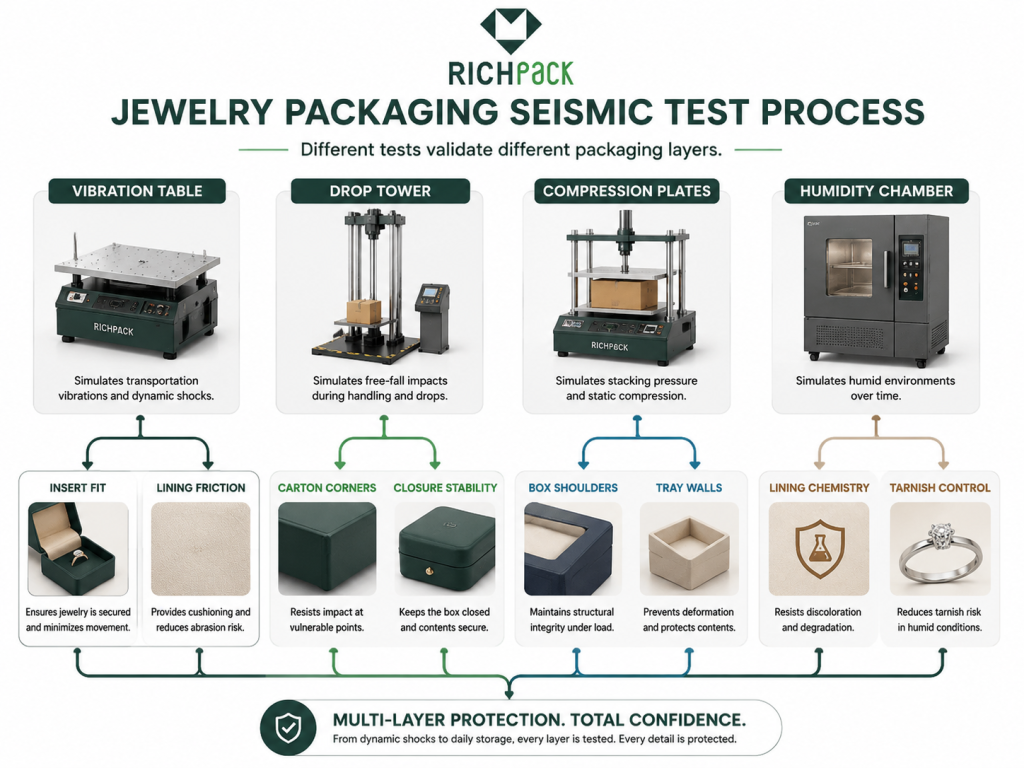
Inspektionen bör vara långsammare än testet. De användbara ledtrådarna är ofta små: en fiber på en silverkedja, en förskjuten ringvinkel, en svag gnidning på locket eller en magnet som känns svagare.
Mät hur långt smycket har rört sig från sin ursprungliga position. Rörelsen kan synas genom rotation, vinkelförändring, kedjans bana, tryckmärken eller förskjutna delar.
Repeterbara rörelser behöver en strukturell åtgärd. Att säga till packarna att "placera dem försiktigt" löser inte vibrationsbeteendet.
Upphöjda inställningar bör kontrolleras för lutning, löshet och kontaktmärken. Även om stenen förblir säkert placerad kan en förskjuten presentationsvinkel skada kundens förtroende.
Använd förstoringsglas när produktvärdet motiverar det. Ett litet problem med en stift kan bli ett stort krav efter att kunden har använt plagget.
Kedjor ska hållas i sin avsedda bana utan knutar, spännen drar eller hängsmycken svänger. En särskild spännficka förhindrar ofta ett av de vanligaste felen.
Om trassling uppstår, kontrollera kanaldjup, ytfriktion, pendlingsfrigång och packningsmetod. Skärgeometrin behöver ofta mer än en kosmetisk justering.
Leta efter fibrer på smycken, skavmärken på stenar, matta fläckar på pläterad metall och märken på fodret. Rörelse kan förvandla ett mjukt material till en slipande kontaktpunkt.
Inkludera lukt- och färgobservationer. Lyxförpackningar förlorar snabbt förtroendet när de luktar kemikalier eller lämnar rester.
Hörn och gångjärn visar hur kraften rörde sig genom förpackningen. En liten kläm på förpackningen kan förstöra presentupplevelsen även om smycket överlever.
Gångjärnsutmattning påverkar också uppackningen. Om locket känns löst efter testet kan förpackningen se begagnad ut.
Stängningsfel kan vara subtila. Locket kanske inte öppnas helt, men ett litet mellanrum kan låta insatsen röra sig eller skapa skavlinjer.
Kontrollera justering, stängningsljud, öppningskänsla och om stängningen fortfarande håller efter upprepad rörelse.
Matthet och lukt kan uppstå efter materialkontakt, fuktighet och rörelse. Silver- och pläterade smycken behöver särskild uppmärksamhet eftersom de kan reagera med förpackningens kemi.
Om missfärgning uppstår, granska hela materialstapeln: lim, papper, skum, färgämne, ytbehandling och foder.
Inspektera kartongens hörn, räfflor, sömmar, tejp och kompressionszoner. En svag kartong kan göra att en väl utformad innerförpackning går sönder innan kunden ser den.
Synliga signaler för kunden inkluderar repiga lock, damm på fodret, förskjutna smycken, lösa inlägg, krossade hörn, lukt och förpackningar som känns ompackade.
Lyxmärken bör inkludera presentationsfel i kriterierna för godkänt/icke godkänt. Kunden bedömer hela ankomstögonblicket.
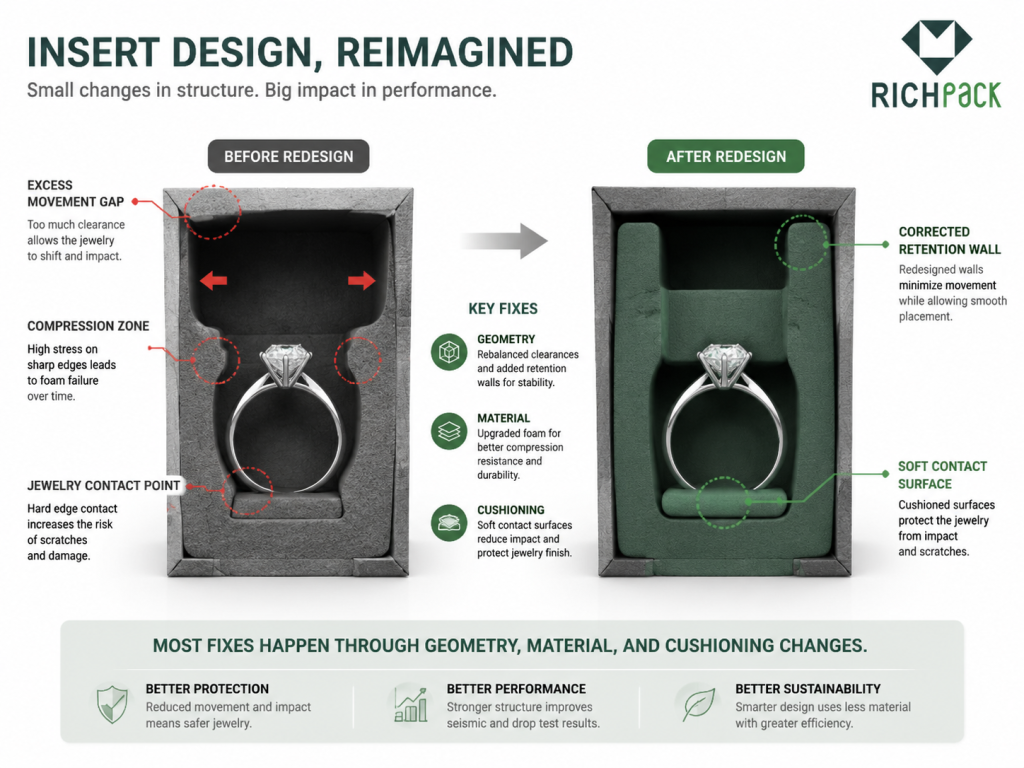
Ett misslyckat test är endast användbart om det ändrar paketet. Fel identifierar det svaga lagret. Omdesign åtgärdar det. Omtestning bevisar att lösningen fungerade.
Byten av skärinsatser kan innefatta snävare spår, djupare kanaler, låsfickor, upphöjda stöd, tryckavlastningszoner eller separata hålrum för små delar.
För ringar, fokusera på kronans frigång och bandets grepp. För halsband, fokusera på kanalens bana och hängets stabilitet.
Dämpningens densitet styr hur kraft absorberas och överförs. För mjuk kan bottna. För fast kan överföra stötar.
Testa dämpningen med den verkliga produktvikten och kartongstorleken. Densitet kan inte väljas enbart från en katalog.
Byte av foder kan åtgärda risken för nötning, fiberavlossning, lukt eller missfärgning. Rätt material beror på smyckets yta och förväntad förvaringstid.
Mikrofiber, sammet, satin, flockpapper och bestruket papper har alla sina nackdelar. RichPacks förpackningsmaterial för smycken sidan kan stödja materialdiskussioner före provtagning.
Skydd mot missfärgning kan innefatta behandlade papper, barriärpåsar, säkra foder, kontrollerade lim och fuktighetsmedveten förpackning.
Barriären måste fungera med varumärkets visuella standard. Skyddande förpackningar kan fortfarande se eleganta ut om de planeras tidigt.
Omdesign av stängningen kan innebära starkare magneter, bättre inriktning, justering av hylsan, förstärkning av gångjärn eller sekundär fasthållning.
Om en förslutning går sönder efter vibrationer, inspektera både förslutningen och insatsen. Intern rörelse kan trycka mot locket.
Förbättringar av ytterkartong kan inkludera starkare kartong, tätare passform, hörndynor, gjuten massa, pappersstoppning eller justering av kartongstorleken.
Tomrumsfyllningen bör inte tillåta att förpackningen färdas. En låda som flyter inuti en stor kartong blir ett stötobjekt.
Hållbara material kan fungera bra, men de behöver fortfarande testas. Formpressad massa, pappersdämpning, återvunnen kartong och plastfria strukturer beter sig olika under kompression och fukt.
Godkänn inte ett material bara för att det låter bra på en reklamationsblankett. Testa det mot smycket, rutten och uppackningsstandarden. RichPack kan hjälpa till att utvärdera hållbara förpackningsalternativ mot skyddsbehov.
Omdesign kan påverka verktyg, MOQ, enhetskostnad, provtid och packningsarbete. Köpare bör granska dessa kostnader före massproduktion.
En liten justering av insatsen kan vara enkel. En ny gjuten tråg- eller kartongstorlek kan förändra ledtider och lagerplanering.
En testrapport ska hjälpa en köpare att fatta ett produktionsbeslut. Ett ord som säger ”godkänd” räcker inte. Om rapporten saknar exempeldetaljer, profiler, foton och kriterier är den ofullständig.
| Rapportfält | Vad den ska visa | Varför det gäller |
| Standard och rutt | ASTM, ISTA, anpassad profil eller ruttantagande | Bekräftar att testet matchar transportrisken |
| Exempelversion | Versioner för låda, insats, foder, kartong och kudde | Förhindrar godkännande av fel struktur |
| Utrustning och profil | Vibration, fall, stöt, kompressionsinställning | Visar att testet var kontrollerat |
| Fotogalleri | Före- och efterbilder | Bevisar att synligt tillstånd förändrats eller förblivit stabilt |
| Kriterier för godkänt/icke godkänt | Produkt- och förpackningströsklar | Definierar vad "skyddande" betyder |
| Korrigerande åtgärder | Vad som förändrades efter misslyckandet | Visar om leverantören lärde sig av resultatet |
| Testa om posten | Nytt resultat efter omdesign | Bekräftar att fixen fungerade |
Rapporten ska ange standardrutt, distributionscykelrutt eller anpassad rutt. Om ingen standard gäller ska ruttantagandet ändå skrivas.
Ett pakettest täcker inte automatiskt palltransporter i grossistledet, evenemangsöverföringar eller internationell frakt.
Exempelbeskrivningen ska ange förpackningens storlek, insatsmaterial, foder, förslutning, kartong, stoppning, smyckesdocka eller riktig produkt samt versionsnummer. Bilderna ska matcha beskrivningen.
Versionsnummer förhindrar kostsam förvirring. Köpare behöver veta om det testade exemplaret är det som ska sättas i produktion.
En användbar rapport sammanfattar vibrationernas varaktighet, fallsekvens, kompressionsbelastning, stötar, orientering och relevanta miljöförhållanden.
Köparen behöver inte alla labdetaljer, men resultatet ska vara repeterbart.
Fotona ska visa produktens position, insatsens skick, fodrets yta, stängning, lådans hörn, kartongens skick och eventuella felmärken. Använd samma vinklar före och efter.
För lyxförpackningar avslöjar foton ofta problem som en enkel godkänd/icke-godkänd-linje missar.
Kriterier bör skrivas före testning. De bör inkludera skador på smycken, kosmetiska förändringar, förpackningens struktur, förslutningens prestanda och skick vid uppackning.
Om kriterierna skrivs efter resultatet blir testet lättare att ursäkta.
Felanteckningar bör vara specifika: kedjan flyttad från kanalen, magneten öppnad, locket gnuggat med pärl, insatsen komprimerad, kartonghörnen krossade eller fodret överfört fiber.
Exakt felspråk pekar direkt på omdesignen.
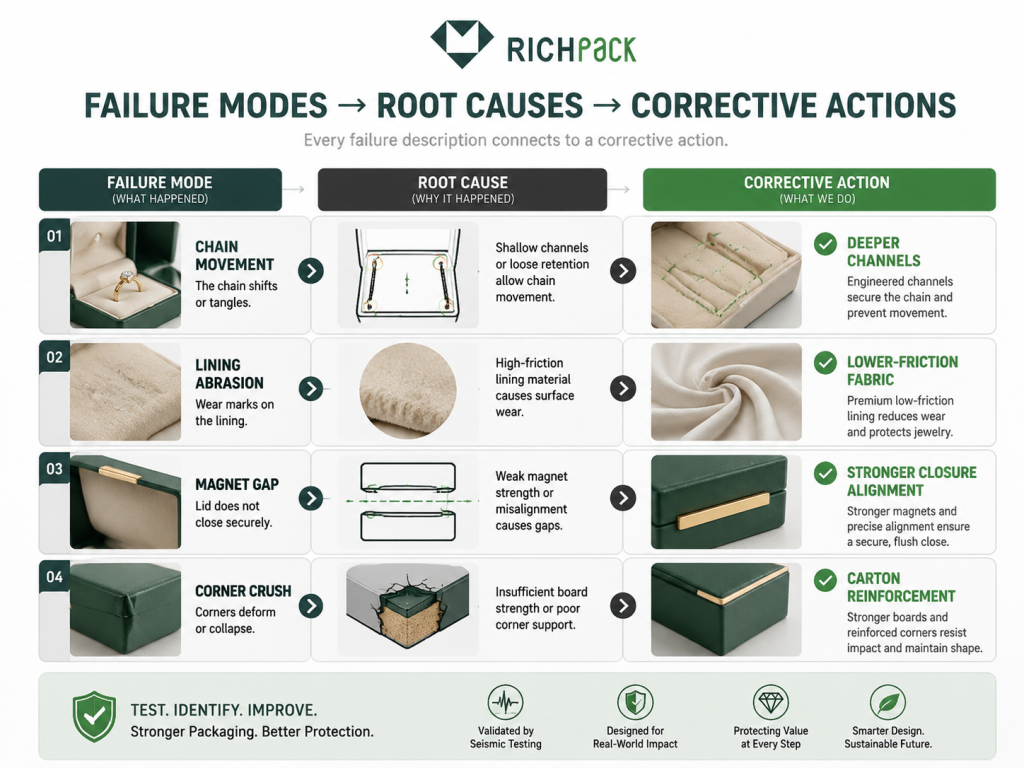
Korrigerande åtgärd bör ange vad som har ändrats, varför det har ändrats och vilken exempelversion som inkluderar ändringen.
Exempel inkluderar djupare kanal, foder med lägre friktion, starkare magnet, reviderad dämpningstäthet eller minskat kartongtomrum.
Ett misslyckat paket bör testas om efter omdesign. Rapporten bör visa om samma kriterier användes och vem som godkände den slutliga versionen.
Produktionen bör inte påbörjas med ett odokumenterat muntligt godkännande.
Leverantörsfrågor förvandlar tester från ett försäljningsargument till en arbetsbeskrivning. Använd dem innan du godkänner prover, särskilt för premiumsmycken, internationella rutter och snäva lanseringskalendrar.
Fråga om leverantören använder ASTM D4169, ISTA 3A, intern screening eller en anpassad ruttbaserad plan. Fråga sedan varför den planen passar din leverans.
Svaret bör ange försäljningsväg, förpackningsstorlek, produktvikt och risknivå. Om svaret bara är ”vi testar alltid”, fortsätt fråga.
Fråga om testet inkluderar smycken, inlägg, detaljhandelsask, ytterkartong, stoppning, etiketter och slutlig förpackningsmetod. Ett test endast med ask är begränsat.
Den slutliga packade enheten ska matcha den faktiska leveransen. RichPacks anpassade smyckeskrinsinsatser kan ses över tillsammans med fraktplanen.
Fråga efter alla material som kommer i kontakt med eller sitter nära smycket: foder, papper, skum, självhäftande zon, påse, antikoleransskikt och tryckta eller färgade ytor.
Materialkontakt är en skyddsfråga, inte bara ett estetiskt val.
Fråga efter antalet prover och om proverna använder produktionsliknande material. Fråga också om testet använder riktiga smycken, viktade dockor eller tomförpackningar.
Ett litet urval kan vara bra för tidig screening. Det bör inte presenteras som fullständig garanti för en lansering med högt värde.
Fråga vilka märken, skavmärken, bucklor, lukt, fiberöverföring, glipor i locket och rörliga insatser som räknas som fel. Lyxförpackningar bör sätta en strängare standard än vanliga fraktkartonger.
Kunden ser först förpackningen. Kosmetiska fel kan skada förtroendet även om smycket överlever.
Be om foton från samma vinklar före och efter testet. Om leverantören inte kan tillhandahålla dem är rapporten svårare att lita på.
Foton hjälper också merchandising-, logistik- och kvalitetsteam att snabbt samordna sig.
Fråga om omdesignprocessen innan fel uppstår. Leverantören bör kunna förklara eventuella ändringar av inlägg, foder, förslutning, kartong och kudde.
En stark leverantör behandlar misslyckanden som designfeedback, inte förlägenhet.
Fråga om de färdiga kartongerna skickas individuellt, i huvudkartonger, på pallar eller via paketnätverk. Rutten förändrar stressprofilen.
RichPacks stöd för förpackningsdistribution kan hjälpa till att koppla kartongplanering till hur färdiga varor faktiskt transporteras.
Testning kostar mindre när den planeras tidigt. Det blir dyrare när förskjutning, missfärgning eller fel på kartongen uppstår efter att tryckta lådor, gjutna bilagor och lanseringsdatum redan är låsta.
Kör tidig screening efter det första funktionella provet. Kör slutlig validering efter att produktionsliknande material anlänt.
Den bästa tiden är efter att strukturen är klar, men innan verktyg och storskaliga inköp minskar flexibiliteten. RichPacks program för anpassade smyckesförpackningar kan placera prover runt det fönstret.
Leveranstiden för prover beror på struktur, material, tryck, insatskomplexitet och verktyg. Enkla kartonginsatser rör sig vanligtvis snabbare än gjutna eller flermaterialsystem.
Avsätt tid för en misslyckad omgång. En plan utan omtestfönster är en risk för schemat.
Intern screening kan upptäcka uppenbara problem tidigt: lösa insatser, svaga magneter, kedjerörelser, kartongpassning och fodermärken.
Formella laboratorietester ger starkare dokumentation för transporter med högre risk. Använd båda när värdet motiverar det: screena tidigt och validera sedan den slutliga strukturen.
Omtestning kan förlänga antalet dagar eller veckor, beroende på provförändringar och tillgång till labbet. Det bör byggas in i projektkalendern.
Att hoppa över ett misslyckat omtest flyttar ofta kostnaden över till returer, byten och märkesreparationer.
Ändringar av bilagor och kartonger kan påverka MOQ och verktyg. En stansad pappersbilaga kan ändras snabbt, medan verktyg för gjuten massa eller skum kan kräva mer planering.
Upphandlingen bör fråga vilka förändringar som är billiga och vilka som kräver nya verktyg.
Anbudsförfrågan bör innehålla produkttyp, smyckesvikt, leveransväg, målkartong, askstorlek, materialrestriktioner, hållbarhetsmål, provantal, testförväntningar och godkännandekriterier.
Lägg till foton eller ritningar när det är möjligt. En tydlig offertförfrågan minskar gissningsbehovet för leverantörer och gör det lättare att jämföra offerter.
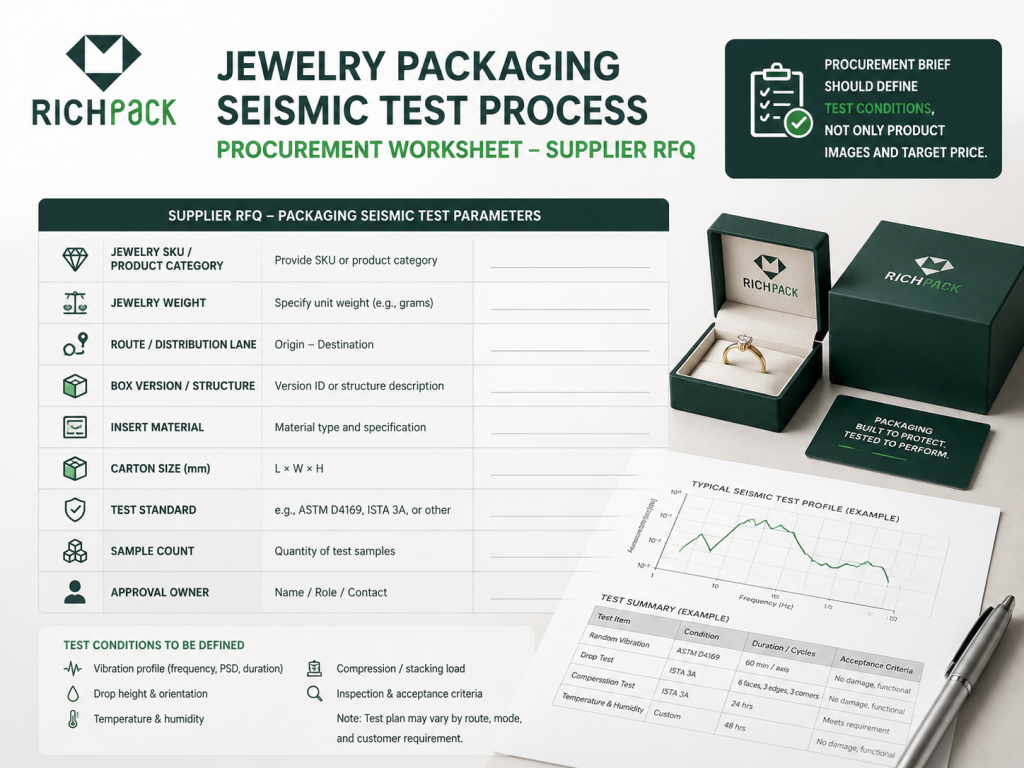
Använd tredjepartstestning när leveransvärde, återförsäljarkrav, försäkringsrisk, ruttkomplexitet eller varumärkesrisk är hög.
För program med lägre risk kan det räcka med leverantörsgranskning och stark dokumentation. Beslutet bör motsvara risken, inte lanseringens ego.
Ett seismiskt test av smyckesförpackningar är en kontrollerad process som kontrollerar om ett färdigt smyckespaket kan hantera rörelser och transportstress samtidigt som smycket hålls säkert och redo att användas som present.
En fullständig granskning kan innehålla:
1. Vibration för att avslöja lösa insatser, kedjekrypning och ytfriktion.
2. Stöt för att avslöja plötslig rörelse, svaghet i stängningen och överföring av stötar.
3. Falltestning för att avslöja fel i kartong, hörn och produktposition.
4. Kompression för att avslöja staplingsskador, svagheter i brickan och deformation av lådan.
Inte exakt. Vibrationstestning är en del av processen. Inom smyckesförpackningar hänvisar seismiskt språk vanligtvis till en bredare rörelse- och stötanalys.
En komplett plan kan innefatta slumpmässig vibration, stöt, falltestning, kompression, inspektion, omdesign och omtestning.
Nej. Små leveranser med låg risk kan behöva endast strukturerad leverantörsgranskning och dokumenterade stickprovskontroller.
ASTM- eller ISTA-liknande tester blir mer användbara när smyckesvärdet är högt, fraktvägarna är komplexa, återförsäljarens krav är strikta eller tidigare transportskador har uppstått.
Tidig screening kan använda en liten grupp produktionsliknande prover. Lanseringar med högre risk bör testa tillräckligt många prover för att avslöja variationer mellan insatser, förslutningar, kartonger och förpackningsmetoder.
Det exakta antalet beror på produktvärde, ruttrisk, materialvariationer och budget. Rapporten bör alltid ange hur många prover som testades.
Misslyckande kan innefatta:
1. Lösa stenar, förskjutna spetsar eller böjda stolpar.
2. Kedjan trasslar sig, spännet stressar eller hängsmyckes rörelse.
3. Pärlslitningar, matthet, fiberöverföring eller lukt.
4. Öppning av stängning, krossade hörn, deformation av insatsen eller kollaps av kartong.
Lyxförpackningar bör också räkna med kundsynliga presentationsskador.
Ja. Skyddande förpackningar kan kännas lyxiga när förvaring, foder, förslutning och kartongstruktur är utformade tillsammans.
Misstaget är att lägga till skrymmande skydd efter att designen är klar. Bygg skyddande lager tidigt, så kan de stödja uppackningsupplevelsen istället för att bekämpa den.
Fråga vilka fellägen för smycken de testar för, vilka förpackningslager som ingår, vilken standard eller rutt de använder, hur många prover som testas och vilka foton eller rapporter du kommer att få.
Fråga sedan vad som händer efter ett misslyckande. En trovärdig leverantör bör ha en omdesign och omtestning av processen.
Skydd av högvärdiga smycken kommer inte bara genom att göra asken tjockare. Det kommer från ett testbart system: produktrisk, insatsgeometri, kontaktmaterial, förslutningskontroll, ytterkartongstyrka, dämpning, antaganden om rutt, inspektionskriterier och dokumenterad omdesign.
En seismisk testprocess för smyckesförpackningar ger köpare ett praktiskt sätt att godkänna systemet före massproduktion. Det hjälper också leverantörer att använda bevis istället för adjektiv.
Om ert team förbereder en premiumlansering, leverans till återförsäljare, ett evenemangskit eller ett internationellt smyckesprogram, be RichPack om en granskning av förpackningsstrukturen och testberedskapen. Börja med den verkliga produkten, den verkliga rutten och det verkliga misslyckandet ni inte har råd att se i en kunds händer.
För projektbevis och exempeldiskussion, granska anpassade förpackningsprojekt or begär en granskning av förpackningstestet.


2024-11-19


2024-10-23
2024-10-10

Smyckesförpackningar är ett nyckelelement i att bygga ditt varumärkes identitet och kundupplevelse.
Richpack · 6 förpackningsstrategier för Napier Jewelry Napier Jewelry är ett varumärke med en rik historia som går tillbaka till tidigt 20-tal. Exceptionella Napier smyckesförpackningar är avgörande för att behålla den prestige och attraktionskraft som samlare och entusiaster förväntar sig. Oavsett om det är en utsökt sammetsfodrad Napier smyckeshalsbandslåda eller en lyxig vintage... Fortsätt läsa NASA – Level Protection: A Complete Breaky of the Jewelry Packaging Seismic Test Process

Har du besvärats av problem med passform av kosmetiska förpackningar? På Richpack är vi specialiserade på skräddarsydda kosmetiska boxlösningar för grossister och återförsäljare. Från exakta designtjänster till prototyper och expertsamarbete, vi erbjuder full support för att lösa problem med passform av kosmetiska förpackningar. 1. Vanliga orsaker till problem med passform av kosmetiska förpackningar När kosmetiska förpackningar inte passar produkterna... Fortsätt läsa NASA – Nivåskydd: En fullständig uppdelning av den seismiska testprocessen för smyckesförpackningar
Bedårande söta förpackningar för kosmetika för att lyfta ditt varumärke – anpassningsbara mönster för kosmetiska förpackningsmarknaden av Richpack
Visa mer
Anpassad kartong Papper Kosmetisk förpackning Köp papperslåda,Spik
Visa mer
Skräddarsydda kosmetiska förpackningar för lyxiga skönhetsprodukter | Idealisk för varumärken som behöver eleganta och skräddarsydda förpackningslösningar
Visa mer