

 ANTERIOR
Guía 2026: ¿Dónde encontrar cajas de regalo con tapa a precios asequibles?
2025-05-28
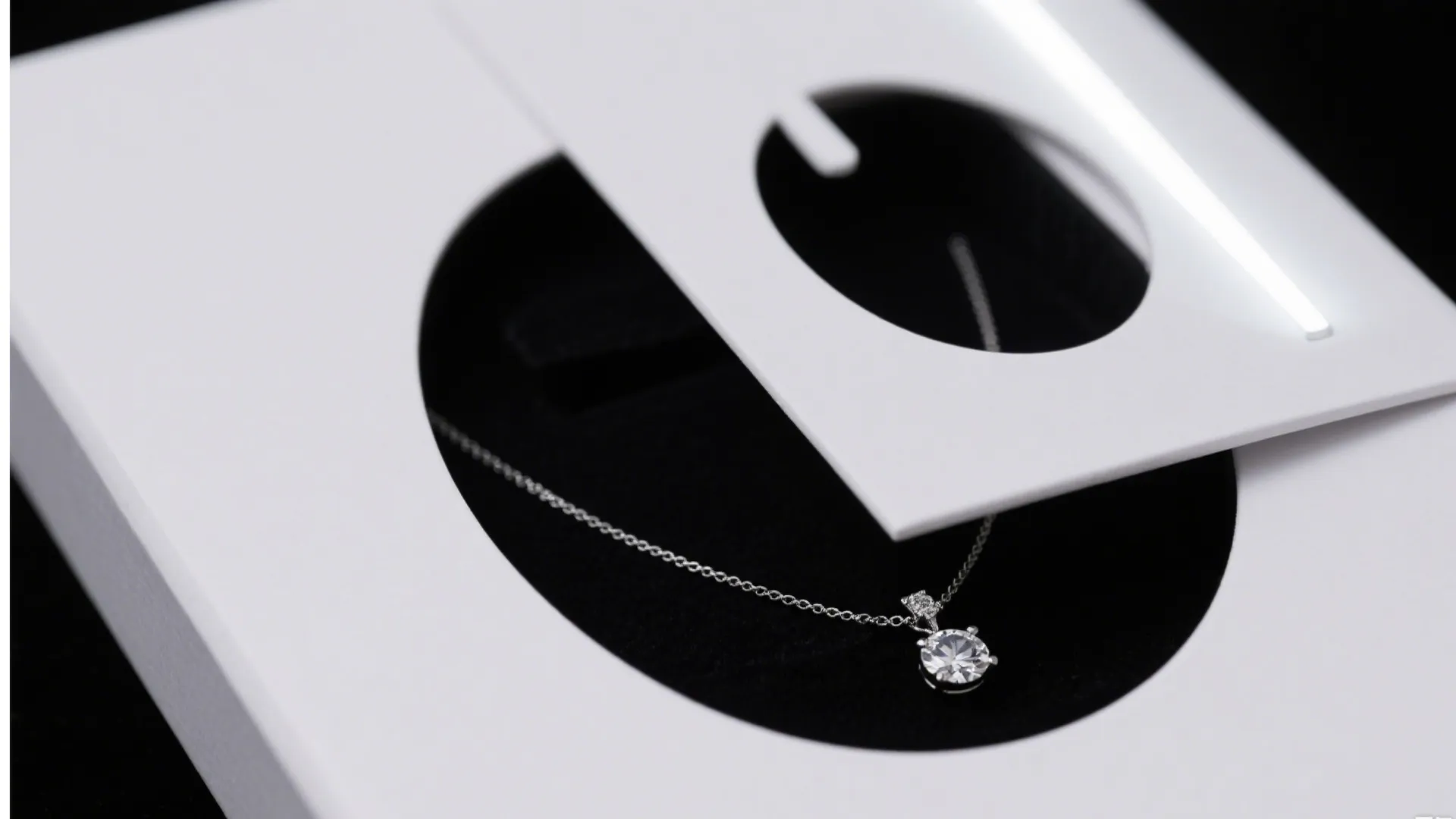



A caja blanca simple Parece sencilla hasta que tiene que proteger un producto, abrirse sin problemas, encajar con una tapa, sujetar un inserto, resistir el envío y, además, lucir de alta calidad en manos del cliente. Es ahí donde el troquelado transforma el valor de una simple caja blanca.
Esta guía te enseña a troquelar formas en cajas blancas lisas para regalos, joyería, sets de venta al por menor y pedidos al por mayor. Aprenderás la terminología básica del troquelado, los datos que los compradores deben verificar, el lenguaje que usan los proveedores de materiales y los pequeños detalles estructurales que a menudo determinan si una caja se ve barata o lista para regalar.
Si solo vas a leer una cosa, lee esto: Una simple caja blanca se convierte en un producto de alta gama cuando la estructura hace el trabajo antes de que comience la decoración.
Una caja blanca lisa no es solo una superficie en blanco. Es un producto estructural.
El troquelado controla esa estructura. Decide cómo se pliega, cierra, abre, exhibe, protege y adapta la caja a los pedidos repetidos.
Empieza por la forma antes de hablar del color, el logotipo o el acabado.
Una caja blanca sencilla puede ser una caja plegable, una caja con tapa y base, una caja con cajón, una caja para envíos o una caja rígida para joyas. Cada forma transmite un mensaje de compra diferente.
Una caja plegable transmite ligereza, practicidad y economía. Una caja con tapa rígida sugiere que está lista para regalar, que el proceso es más lento y que es de mayor calidad. Una caja con cajón sugiere sorpresa. Un sobre de envío sugiere comercio electrónico y logística.
Esa elección afecta a algo más que la apariencia:
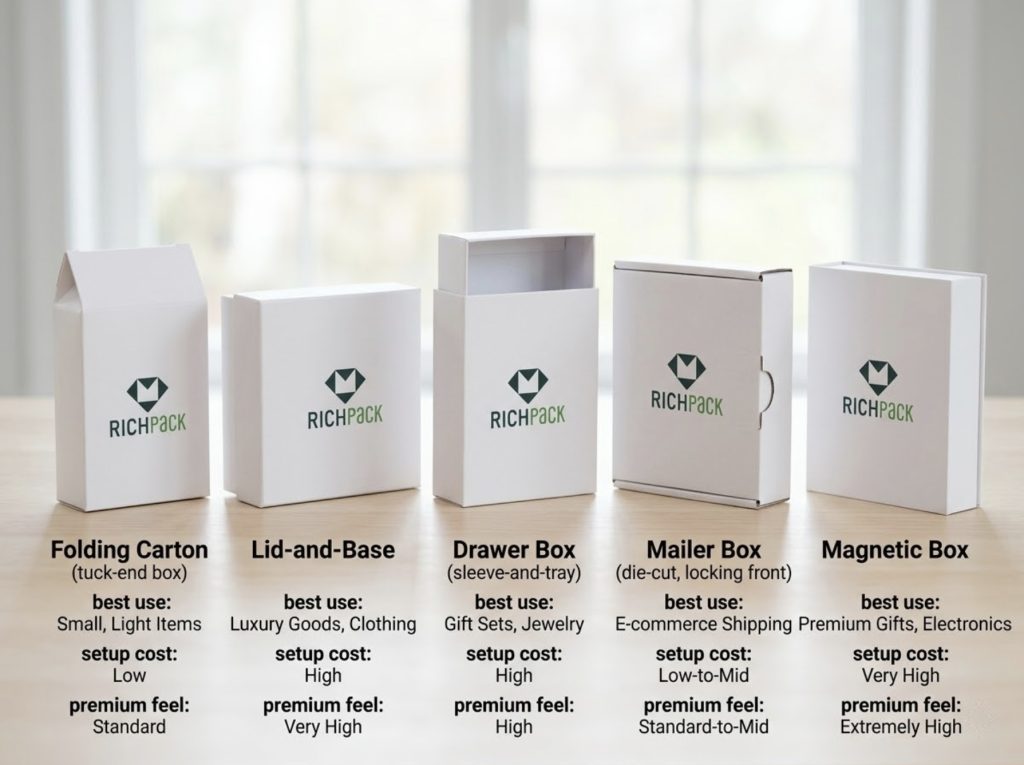
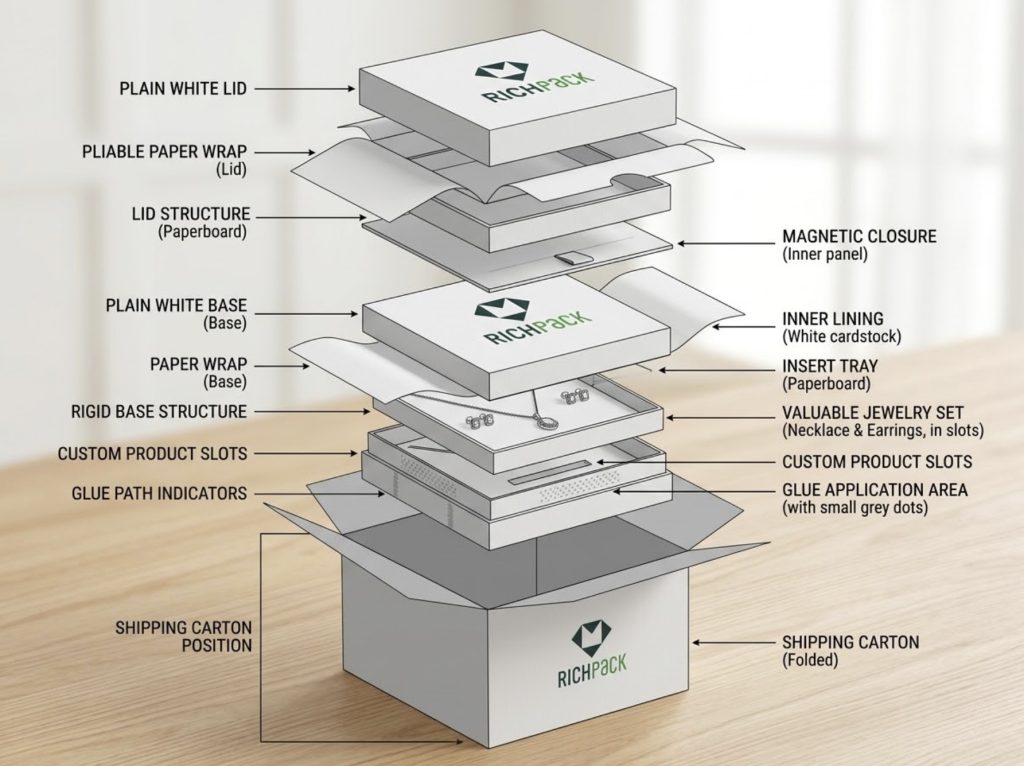
Una buena caja blanca sencilla es un sistema de piezas.
La tapa, la base, las paredes laterales, las solapas, los insertos, las líneas de plegado, las zonas de encolado y el método de embalaje de la caja deben funcionar en conjunto. Si una parte falla, toda la caja da una mala impresión.
Para el embalaje de joyas, esto importa aún más. ring, pulsera, collar, o un par de Pendientes Es lo suficientemente pequeño como para moverse dentro de la caja. Si el inserto está suelto, el producto parece de peor calidad incluso antes de que el cliente lo toque.
Piensa en la caja como si fuera un juego de Lego. La superficie blanca es solo lo primero que ves. El verdadero valor reside en cómo encajan todas las piezas.
No consideres el blanco como vacío.
El empaque blanco ofrece contraste, serenidad y flexibilidad. Es ideal para marcas de joyería que buscan una imagen limpia, colecciones de marca propia, sets de regalo de temporada y distribuidores mayoristas que abastecen a numerosos minoristas.
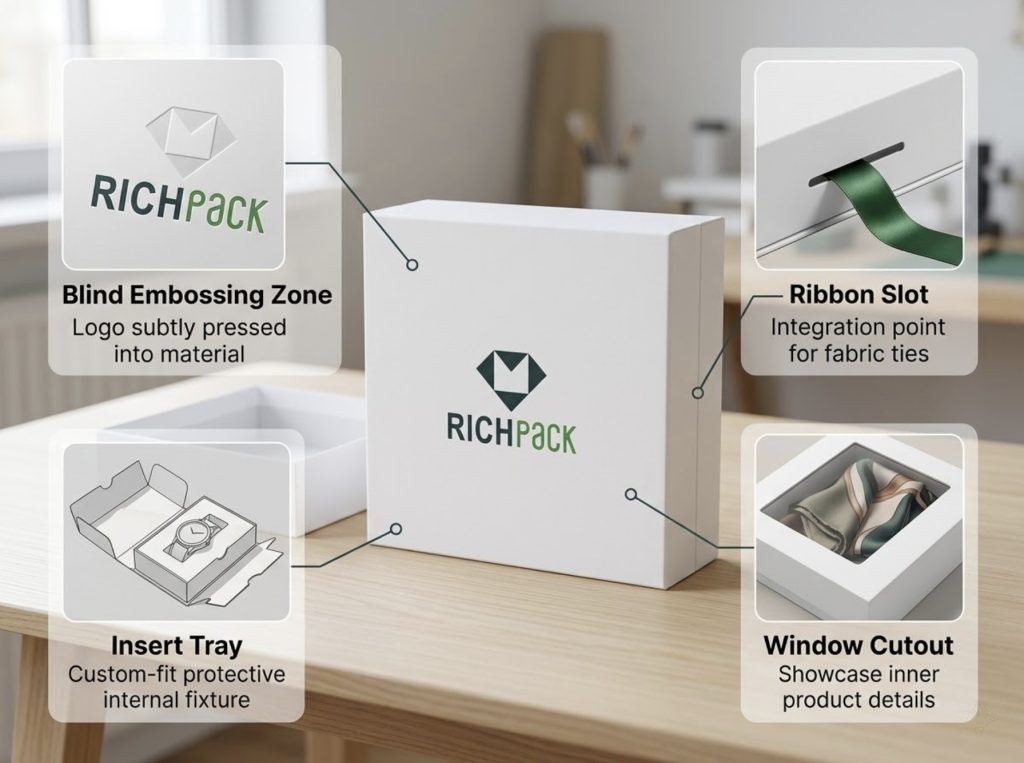
El troquelado permite aprovechar al máximo la superficie blanca sin necesidad de impresión a todo color. Se puede añadir una ventana troquelada, una ranura para cinta, una solapa de cierre limpio, un área para el logotipo en lámina metálica o un inserto que sirva de soporte para el producto, como una bandeja de presentación.
En lugar de cubrir la caja con gráficos, utilice la estructura para que el producto parezca intencional.
La estética es más importante que la decoración.
Una caja blanca sencilla con tapa puede parecer de alta gama, incluso sin logotipo, si la tapa se desliza con la resistencia adecuada. Sin embargo, esa misma caja puede dar una impresión de baja calidad si la tapa vibra o se atasca.
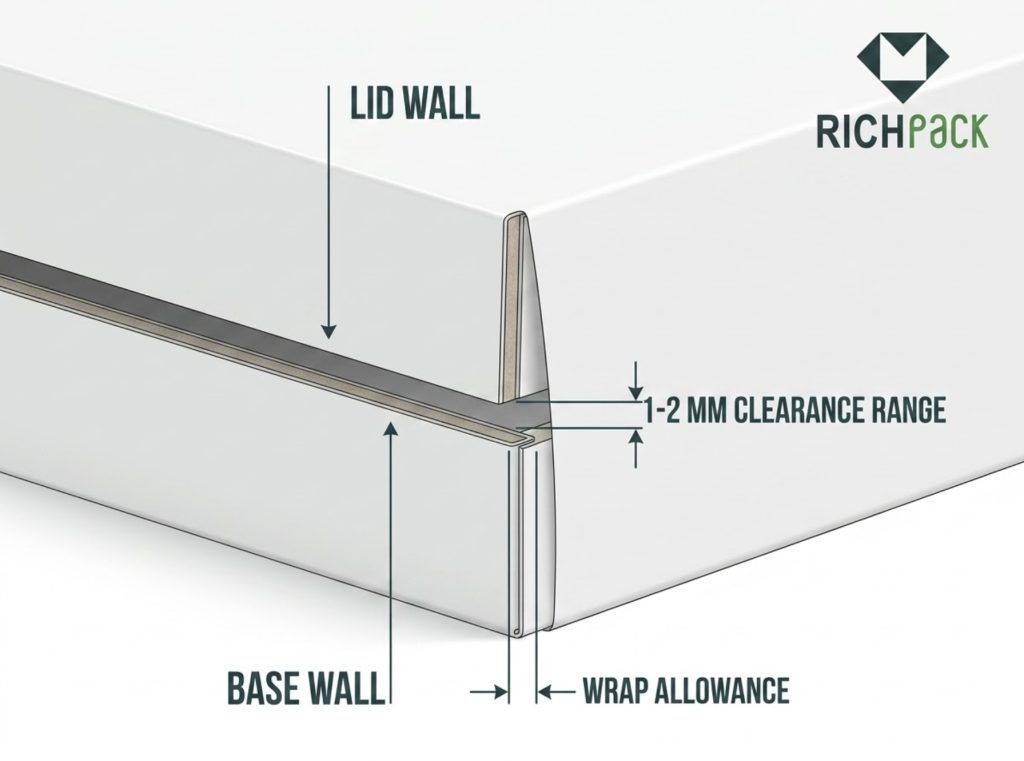
En la producción, esa sensación proviene de la tolerancia. La tolerancia es el pequeño espacio permitido entre las piezas para que la caja pueda abrirse, cerrarse y apilarse correctamente.
Para cajas de regalo rígidas con tapa y base, una tapa de calidad suele requerir un espacio libre de entre 1 y 2 mm, dependiendo del grosor del cartón, el papel de embalaje, la humedad y el acabado. En el caso de las cajas plegables, la tolerancia puede ser menor debido a que el cartón es más delgado y la estructura se flexiona más.
El ingeniero estructural jefe de RichPack lo expresa de esta manera: “El cliente no ve la tolerancia en una hoja de especificaciones. La siente cuando la tapa se cae, se detiene o raspa.”
En el caso de una caja de regalo para joyas, una pequeña diferencia de color puede causar un daño real:
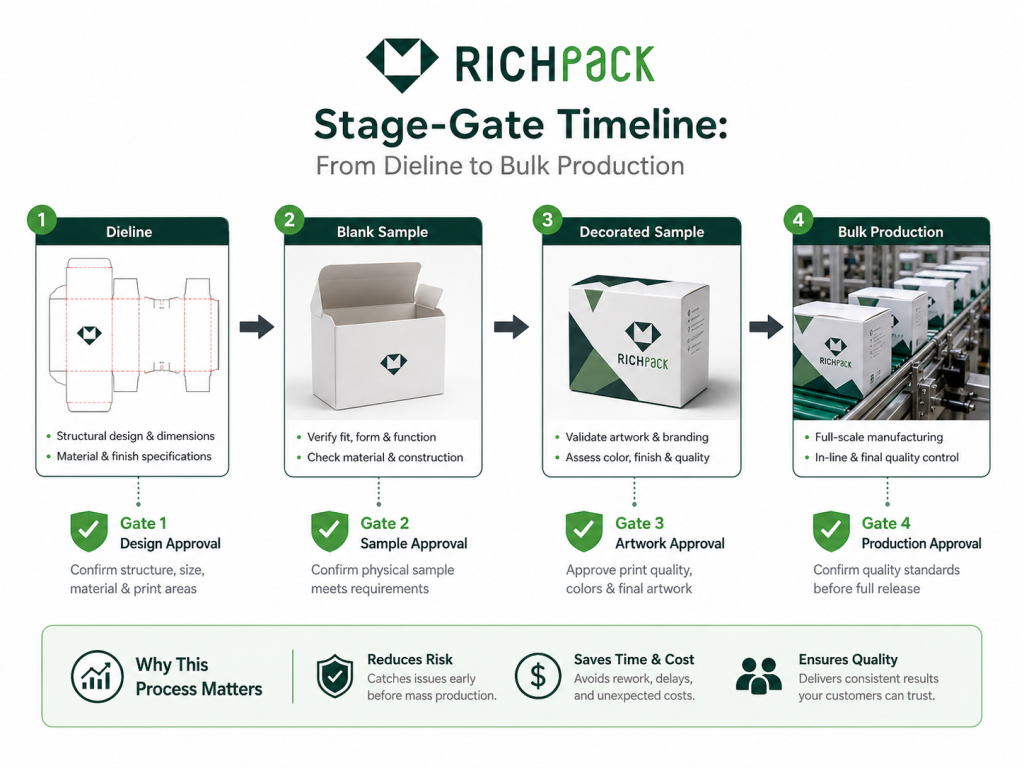
Por eso, la aprobación de la muestra no es una mera formalidad. Es la primera prueba real de la experiencia del cliente.
El troquelado ayuda a los compradores a ahorrar dinero en aspectos que no aparecen en el primer presupuesto.
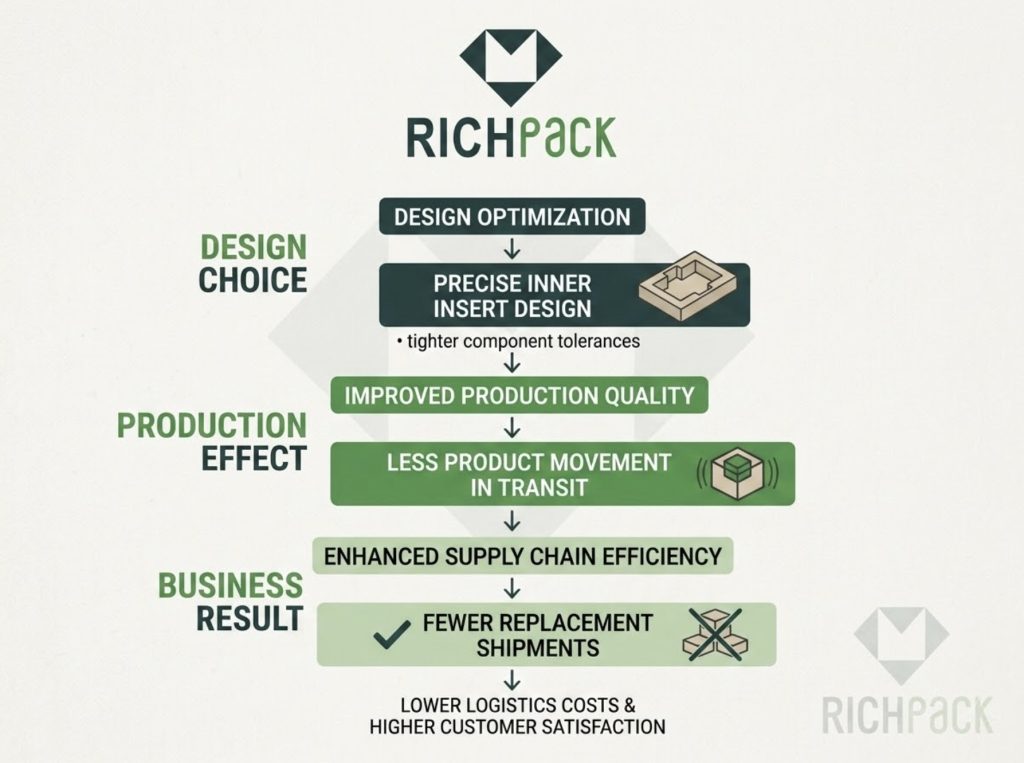
Un inserto de mejor calidad puede reducir las devoluciones por movimiento del producto. Un plegado más limpio puede reducir el tiempo de ensamblaje. Un troquelado más preciso puede reducir el desperdicio de cartón. Un troquelado repetible puede mantener la uniformidad en los pedidos mayoristas de cajas blancas lisas mes tras mes.
| Opción de troquelado | Lo que cambia | Valor del comprador |
| Tolerancia de la tapa | Sensación de apertura y ajuste del cierre | Mejor desempaquetado y menos muestras rechazadas |
| Insertar recorte | Posición del producto | Menos movimiento y una pantalla más limpia |
| recorte de ventana | Visibilidad del producto | Mejor experiencia de compra en tiendas cuando sea necesario. |
| Pestaña de bloqueo | Cierre de caja | Menos cinta adhesiva y embalaje más rápido |
| Línea de puntuación | Calidad de plegado | Menos grietas en el cartón blanco |
| Línea de troquelado compartida | Repetir la consistencia del pedido | Mayor facilidad para escalar a mayoristas |
| forma eficiente para el cartón | Volumen empaquetado | Menor presión de peso dimensional en el envío |
Los mejores equipos de empaquetado no solo se preguntan cómo se ve, sino también cómo se comporta después de que se hayan enviado 5,000 unidades.
El troquelado suena técnico, pero la idea básica es simple.
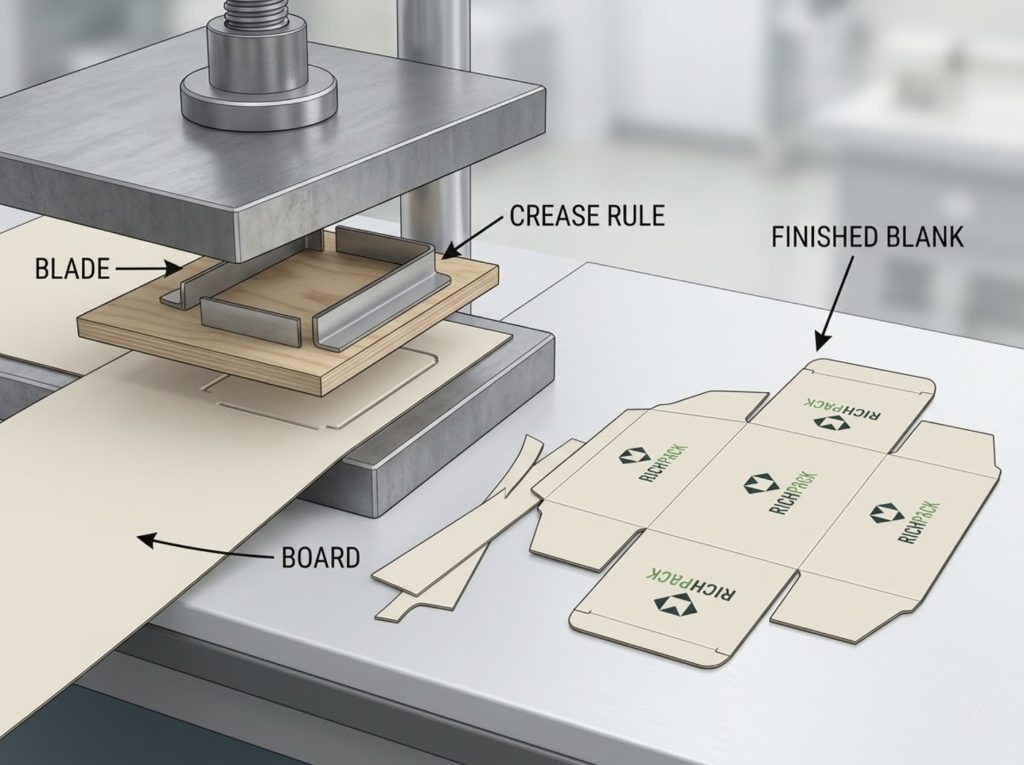
Es el proceso de utilizar una herramienta con forma específica o un sistema de corte digital para cortar, doblar, marcar o perforar el material de embalaje y convertirlo en una estructura de caja repetible.
Un troquel es la herramienta que le da forma a la caja.
Para muchas cajas de cartón y cartulina, la herramienta es una matriz de corte de acero. Funciona como una cuchilla con un patrón personalizado, diseñada para una estructura de embalaje específica.
PakFactory, OXO Packaging y Premium Custom Boxes describen el troquelado como una forma de crear envases con formas precisas a gran escala. Esa precisión es la clave. Un solo troquel homologado puede ayudar a crear miles de cajas con los mismos pliegues, aberturas e insertos.
Para un blanco liso joyeroEl troquel puede dar forma a la caja exterior y al inserto. Esas dos piezas deben coincidir, o el producto nunca quedará bien colocado.
Un troquel es el plano para la caja.
Muestra dónde se cortará, doblará, marcará, perforará, pegará e imprimirá el material. También indica el sangrado y las zonas seguras para que la ilustración o la aplicación de láminas no queden demasiado cerca del borde.
Un principiante puede leer una línea de troquelado buscando cuatro señales básicas:
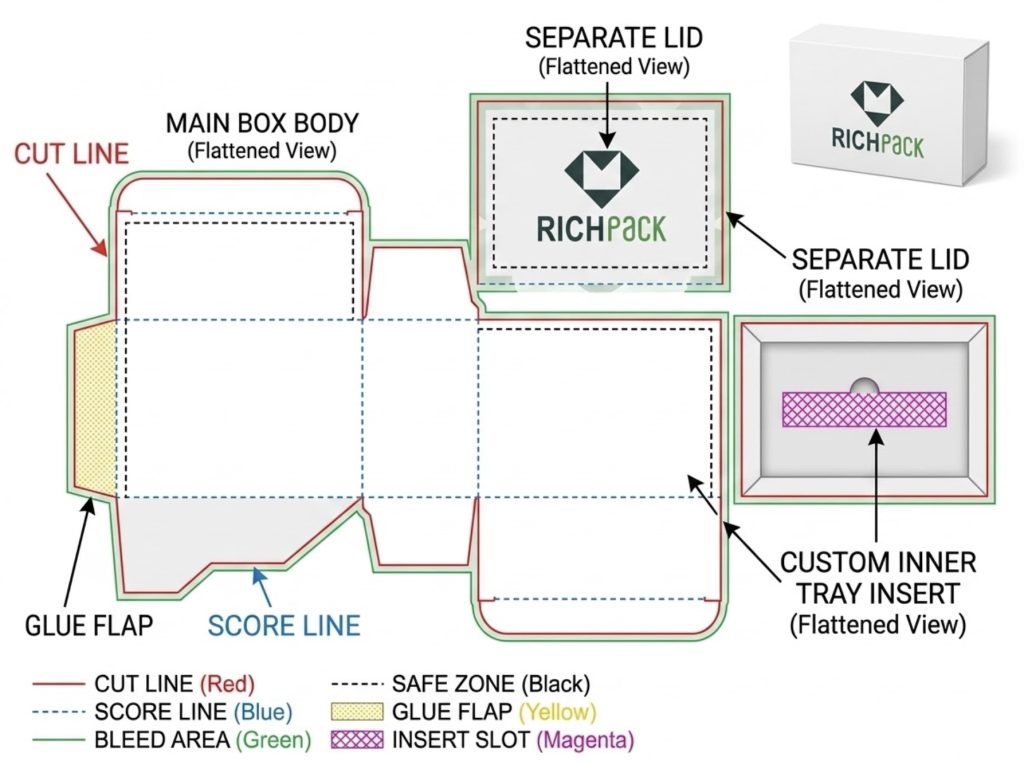
FEFCO utiliza un sistema de códigos internacionales para el diseño de embalajes de cartón ondulado. Esto es importante porque el embalaje necesita un lenguaje estructural común, no términos vagos como "caja normal" o "caja de regalo".
Se realiza un corte a través de la tabla.
Una puntuación no lo hace. Crea una trayectoria de plegado para que el tablero se doble donde debe.
Esta diferencia es fácil de pasar por alto, pero afecta la apariencia de una caja blanca simple al tacto. Un mal corte crea bordes débiles. Un mal hendido crea pliegues torcidos o marcas visibles en la superficie blanca.
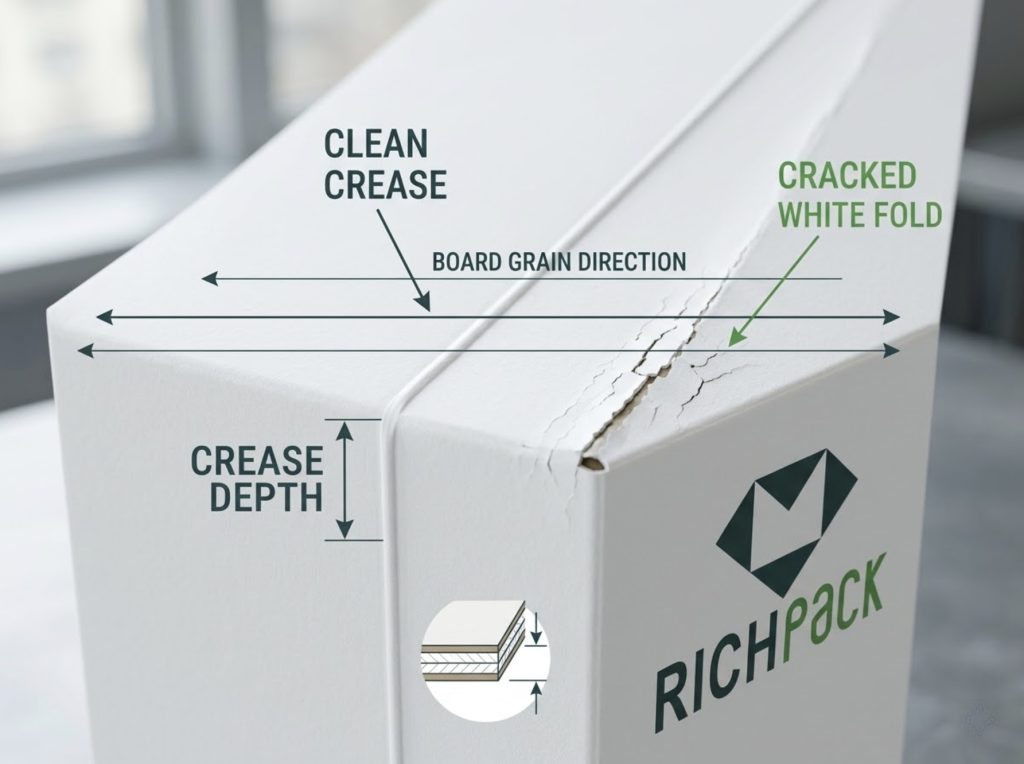
En las cajas blancas lisas para regalos, la línea de pliegue suele ser más visible de lo que los compradores esperan. El cartón blanco muestra rápidamente marcas de presión, grietas y bordes irregulares.
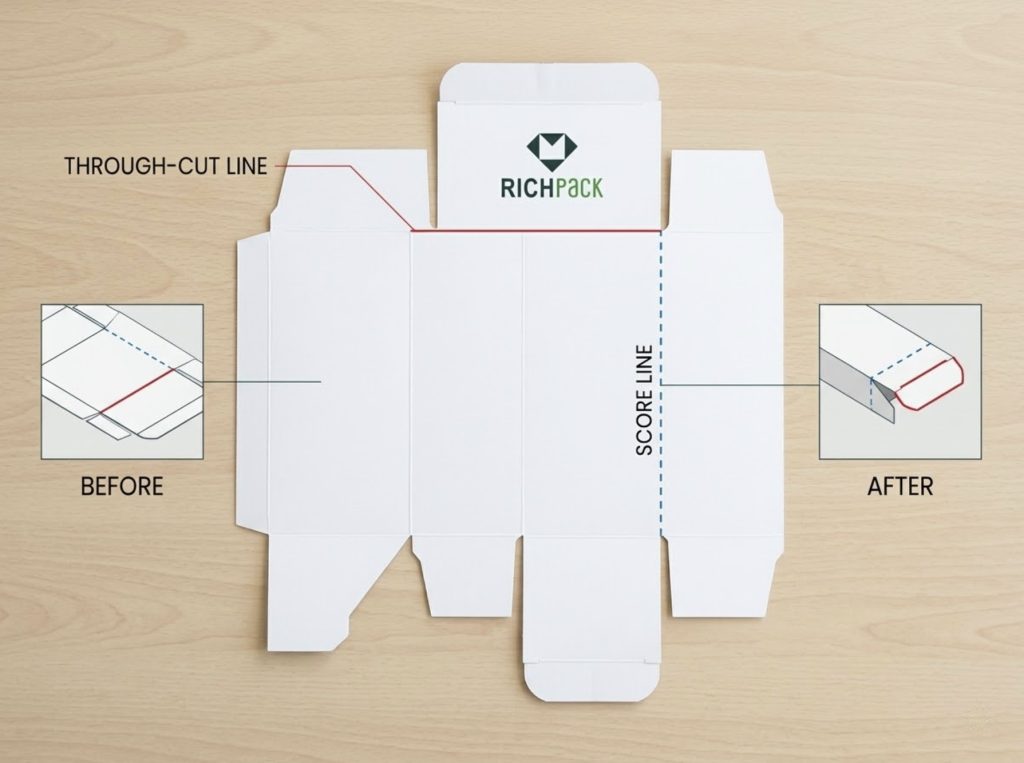
El plegado añade una hendidura controlada al material.
Ayuda a que el cartón más grueso se pliegue sin agrietarse. Esto es importante para el papel blanco estucado, el cartón SBS, el cartón C1S, el cartón C2S, el papel kraft blanco y las cajas rígidas con papel envuelto.
Mitchell Lincoln explica que el embalaje troquelado puede implicar cortar, marcar, doblar y perforar. Ese pequeño detalle del proceso se convierte en un verdadero problema para el comprador cuando el cartón blanco se agrieta a lo largo de un pliegue después del ensamblaje.
Un pliegue bien hecho resulta invisible. Un pliegue mal hecho es lo primero que nota el cliente.
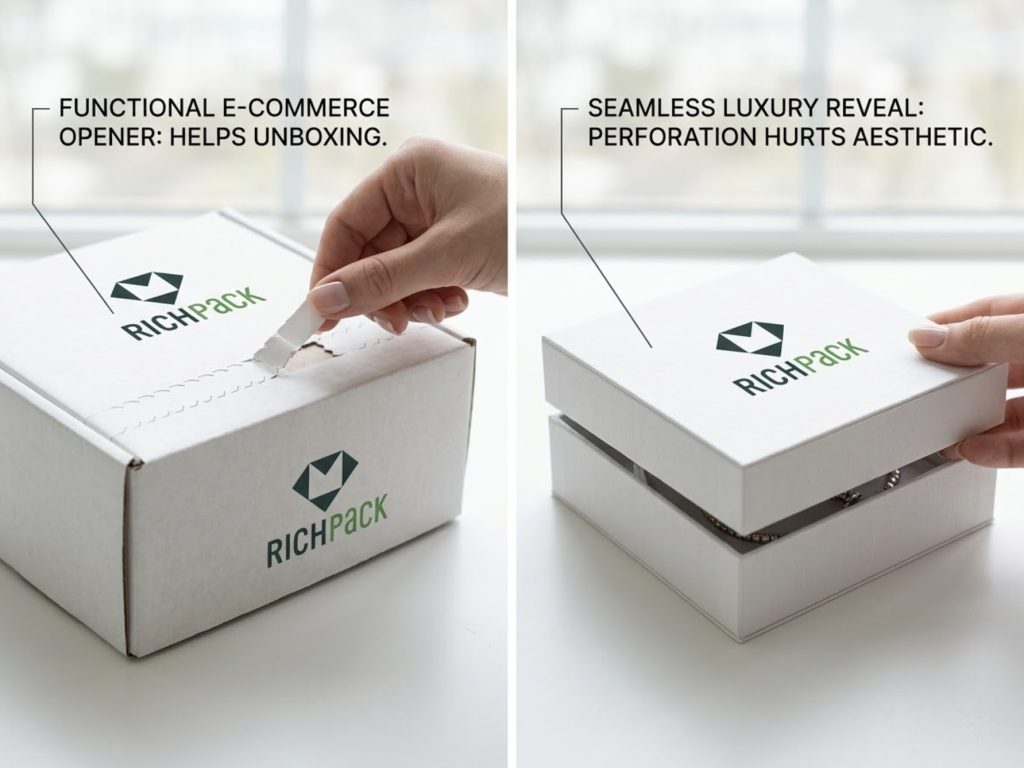
La perforación crea una línea de desgarro controlada.
Funciona bien para kits de muestras, correos de comercio electrónico, paquetes de exhibicióny un embalaje de regalo de fácil apertura. También puede ayudar al cliente a abrir una caja sin romper la estructura principal.
Utilice perforaciones solo cuando mejoren la experiencia. Un joyero de lujo generalmente no necesita una tira desprendible. Un set de regalo por suscripción o un sobre de muestras sí podrían necesitarla.
La regla es simple: Añade un rastro de lágrimas cuando la velocidad importa, evítalo cuando el ritual importa.
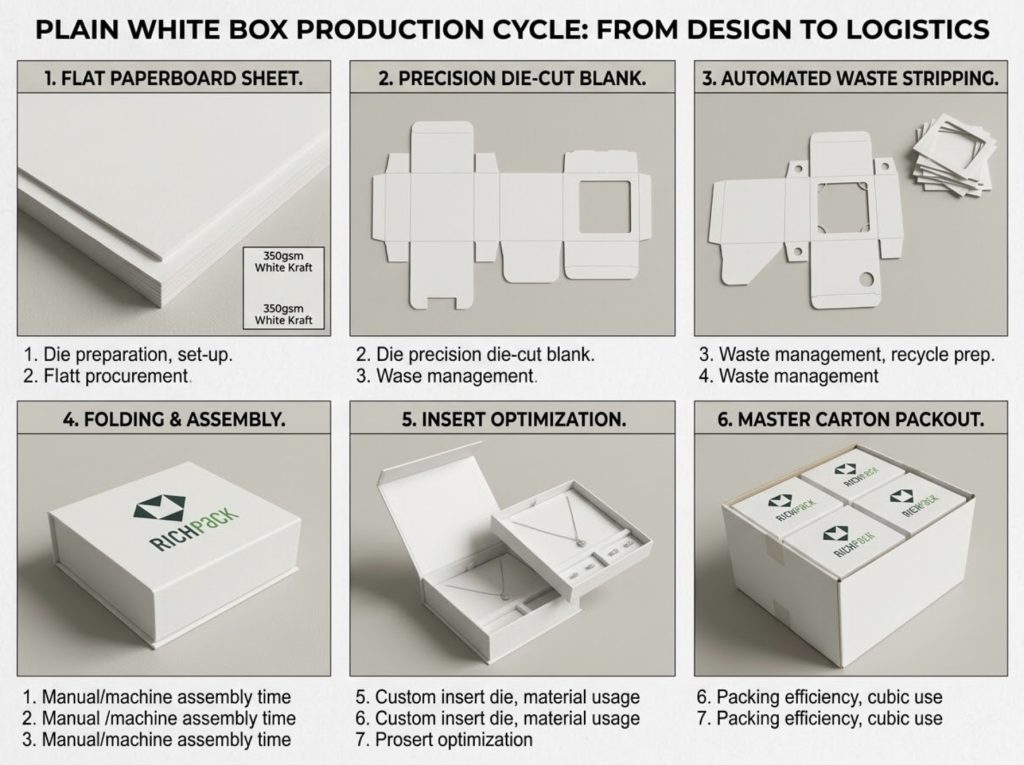
El proceso de troquelado no termina cuando se corta el tablero.
Es necesario retirar los residuos. A continuación, se debe plegar la caja, pegarla, colocar el inserto y realizar controles de calidad.
Esto es importante para los equipos de la cadena de suministro, ya que el tiempo de ensamblaje se convierte en costo laboral. Una simple caja blanca que luce impecable en un prototipo puede resultar costosa si los trabajadores necesitan tiempo adicional para desplegar pequeñas ventanas, alinear los insertos o ajustar las tapas.
Pregunte a su proveedor cómo se pliega la estructura, cómo se ensambla y dónde se requiere manipulación manual.
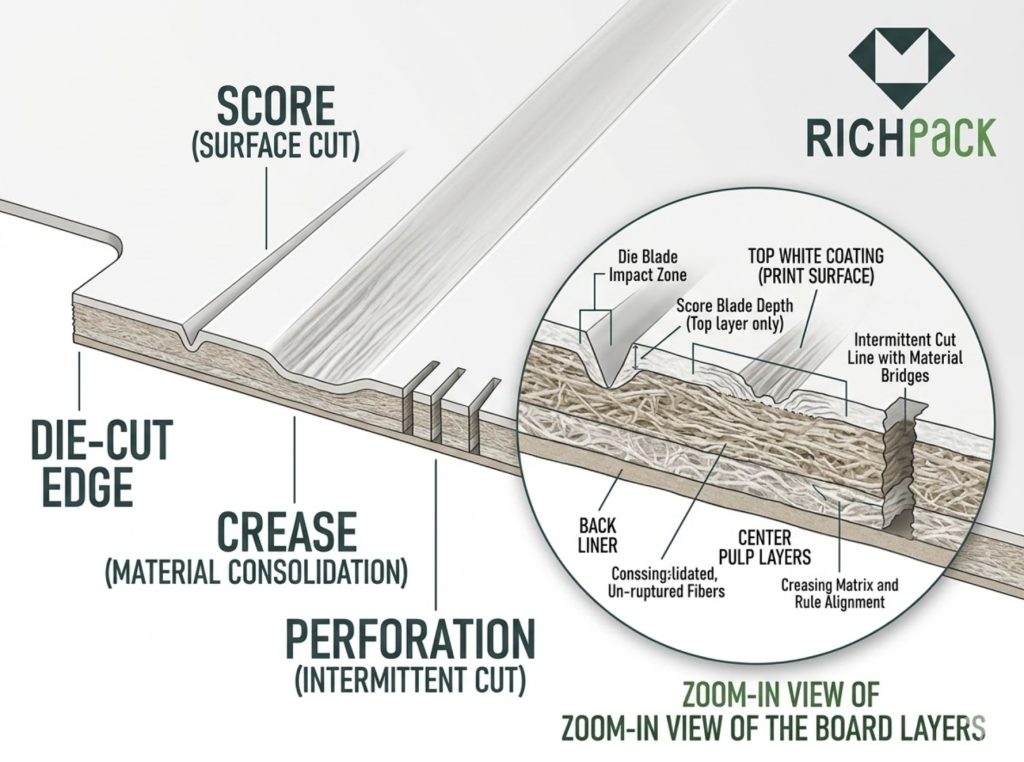
Esta es la sección visual que muchas guías de empaquetado omiten.
Un borde troquelado, una hendidura y un pliegue no modifican el tablero de la misma manera. El borde se corta para abrirlo. La hendidura se presiona para doblarlo. El pliegue forma una bisagra más profunda y controlada.
En el caso de los envases blancos, esa diferencia importa porque el borde del cartón y la línea de pliegue quedan expuestos. Un borde cortado de forma irregular puede parecer gris. Un pliegue débil puede agrietar el revestimiento blanco. Una hendidura superficial puede dificultar el plegado.
| Detalle de la estructura | ¿Qué sucede con la Junta Directiva? | Lo que ve el cliente |
| borde troquelado | La tabla está cortada | Suavidad de los bordes y color de la fibra |
| Línea de puntuación | La tabla tiene ranuras más profundas. | Dirección y rectitud del pliegue |
| Línea de pliegue | La tabla tiene ranuras más profundas | Pliegue más limpio en papel más grueso |
| Perforación | La tabla está parcialmente cortada | Trayectoria de lagrimeo controlada |
Aquí es donde el troquelado pasa del lenguaje de la fábrica a la experiencia del cliente.
En el caso del empaquetado de regalos y joyas, las mejores características no son llamativas. Son los pequeños detalles estructurales que hacen que la caja transmita una sensación de calma, seguridad y cuidado.
El ajuste de la tapa es una de las maneras más rápidas de evaluar la calidad del embalaje.
Una tapa que se cierra demasiado rápido da sensación de ser barata. Una tapa que se agarra con demasiada fuerza resulta molesta. Una tapa que se desliza con poca resistencia da sensación de control.
En el caso de una caja blanca sencilla con tapa, el troquelado controla las dimensiones exteriores, el grosor de la pared, el margen para el envoltorio y el espacio libre para la tapa. Estos detalles determinan si la caja se percibe como un regalo o como un contenedor de almacenamiento.
Por regla general, las tapas rígidas de alta calidad para cajas de regalo suelen necesitar entre 1 y 2 mm de espacio libre. Las tapas delgadas para cajas plegables pueden necesitar menos, mientras que las de cartón rígido envuelto pueden necesitar más, ya que el envoltorio de papel y el pegamento añaden grosor.
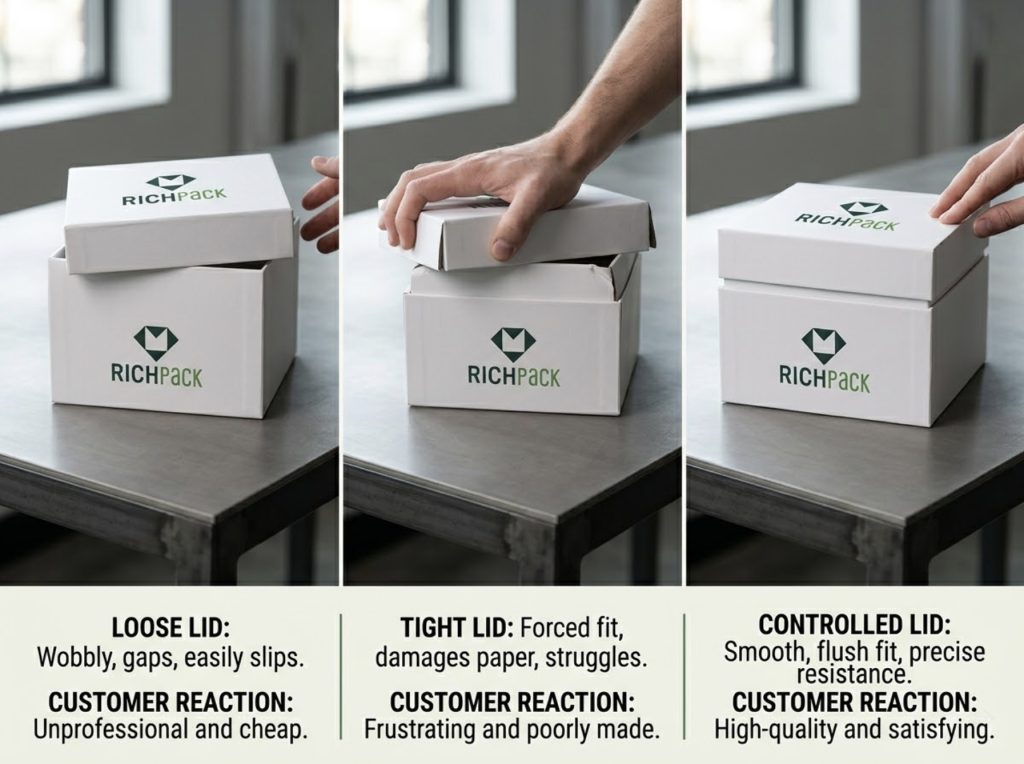
En los envases de joyería, el ajuste de la tapa también protege el inserto. Si se presiona demasiado, la tapa puede rozar con terciopelo, espuma, cinta o tarjetas de cartón.
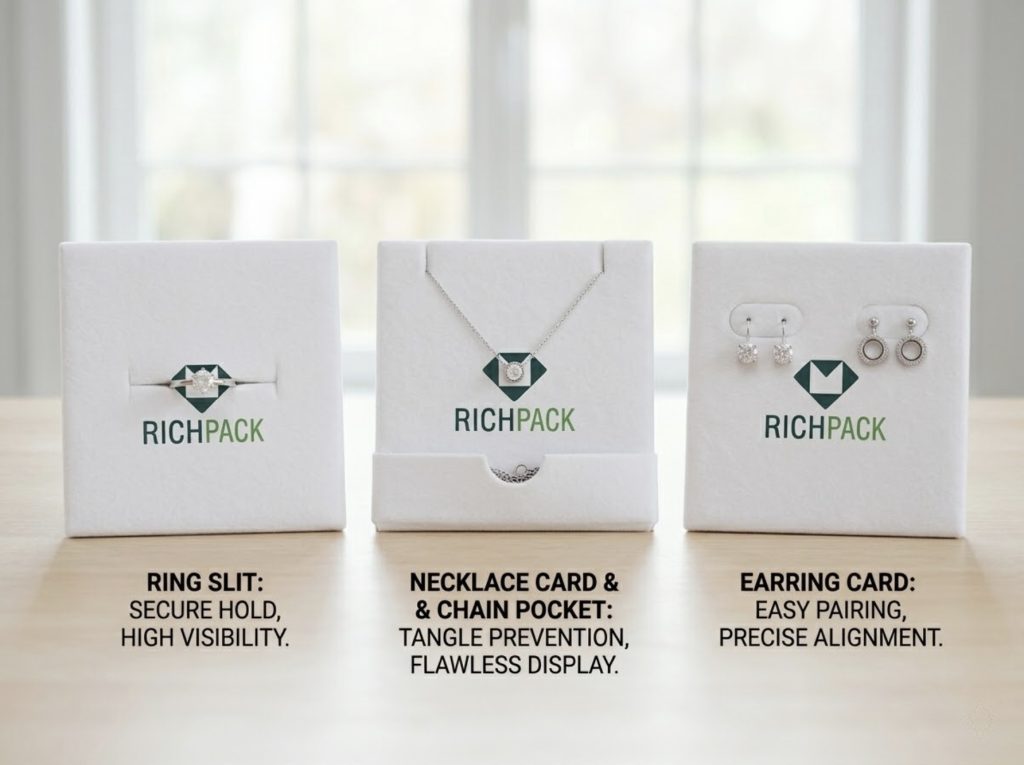
El inserto es la parte que la mayoría de las marcas subestiman.
Para los anillos, el corte puede ser una hendidura estrecha en espuma o terciopelo. Para los collares, puede ser una tarjeta con pequeñas ranuras y un hueco oculto para la cadena. Para las pulseras, puede ser una bandeja elevada o un soporte curvo.
Un sencillo joyero blanco necesita que el inserto cumpla tres funciones:
Hemos visto cómo pequeñas marcas de joyería invierten demasiado en el acabado exterior y muy poco en el ajuste de los pendientes. La caja luce bien en las fotos, pero los pendientes se mueven durante el transporte y llegan presionados contra la tapa.
Un inserto mejor habría solucionado el problema antes del envío.
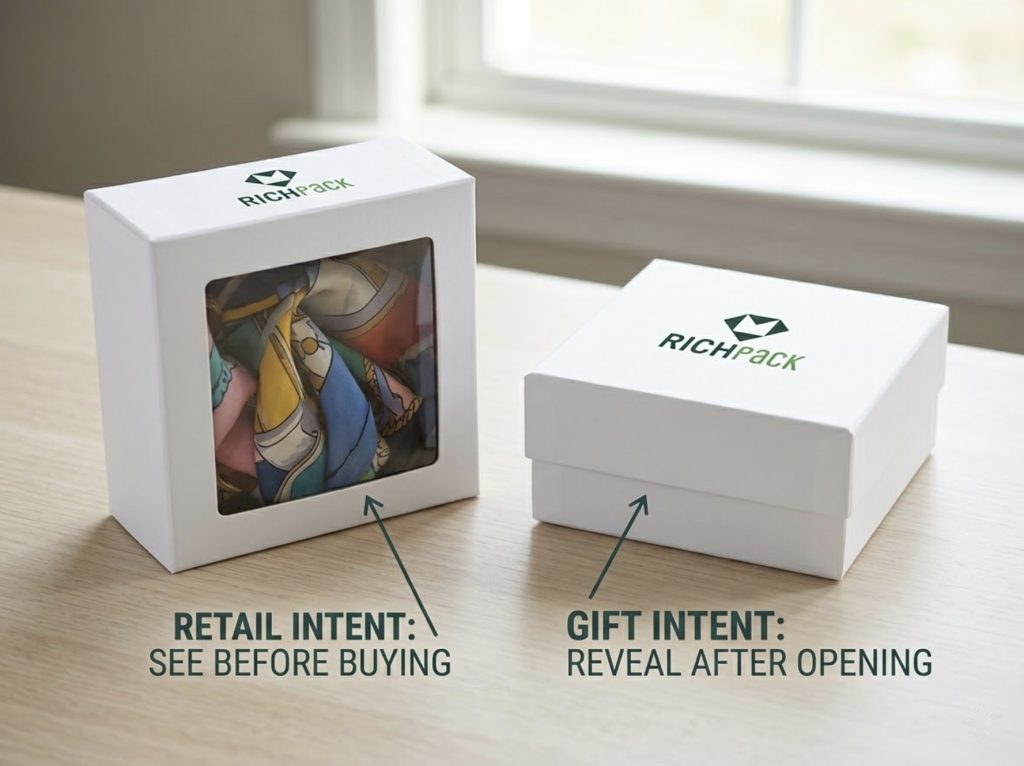
Los recortes para ventanas son útiles, pero no siempre son de primera calidad.
Una ventana puede ser útil cuando el producto necesita visibilidad en el estante. Funciona para velas, obsequios, pequeños regalos, accesorios y kits de muestras.
En joyería fina, una vitrina puede reducir el misterio. Sin embargo, esto no siempre es bueno. Muchos clientes prefieren ver la joya al descubierto, no solo un adelanto.
Utilice esta sencilla regla:
| Tipo de Producto | Ajuste del recorte de la ventana | Por qué |
| Accesorios de moda | Fuerte | Ayuda a navegar y a seleccionar colores. |
| Regalos para eventos | Fuerte | Muestra el artículo rápidamente |
| Muestras de suscripción | Fuerte | Reduce la confusión |
| Joyería fina | Selectivo | Reveal suele dar una sensación de mayor calidad. |
| Paquetes de exhibición al por mayor | Fuerte | Ayuda a los distribuidores a vender más rápido. |
Una caja blanca lisa con ventana puede tener un aspecto limpio. Solo necesita suficiente espacio en los bordes para que el cartón no se rompa ni se deforme.
Los pequeños cambios pueden ser muy beneficiosos.
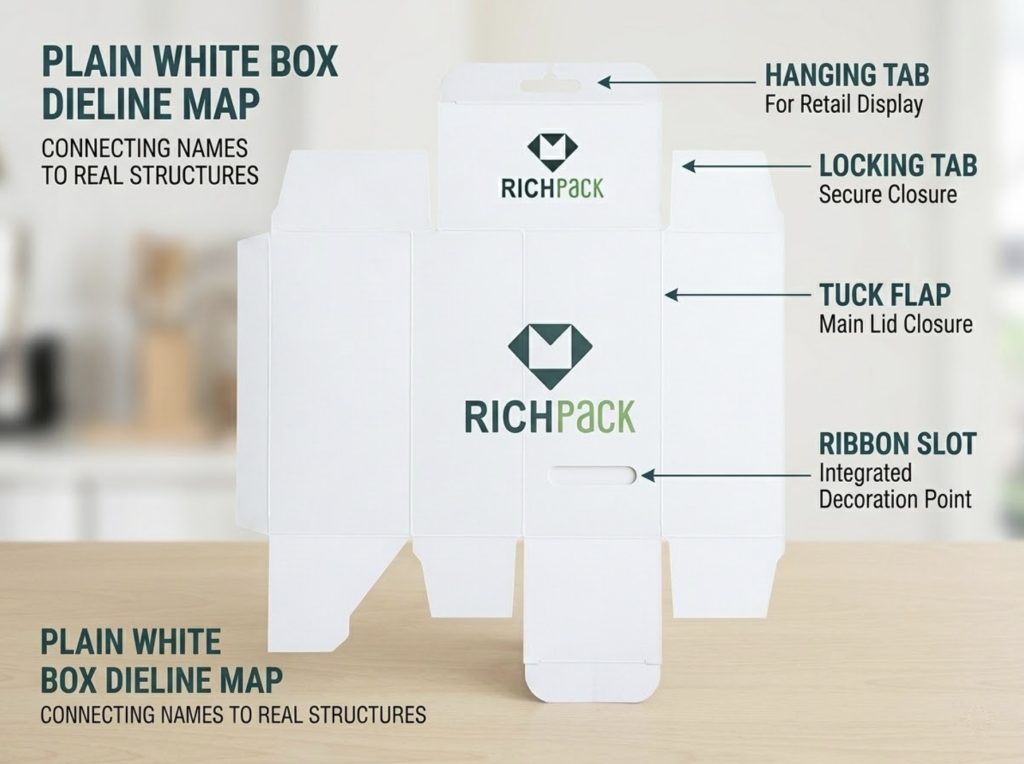
Una ranura para cinta permite guiar una lengüeta de apertura. Una solapa con cierre permite cerrar una caja plegable sin necesidad de cinta adhesiva. Una lengüeta de bloqueo permite sujetar un sobre durante el envío. Una lengüeta colgante permite convertir una caja blanca en un expositor para puntos de venta.
Estas características no son decoración. Son microestructuras.
Para los distribuidores, esto es importante porque una sola línea de empaque en caja blanca puede servir para varios canales de reventa. Cambiando la ranura, la pestaña o el inserto, el mismo estilo visual puede adaptarse a joyas, cosméticos, accesorios y estuches de regalo de marca.
El empaquetado tiene su propio ritmo.
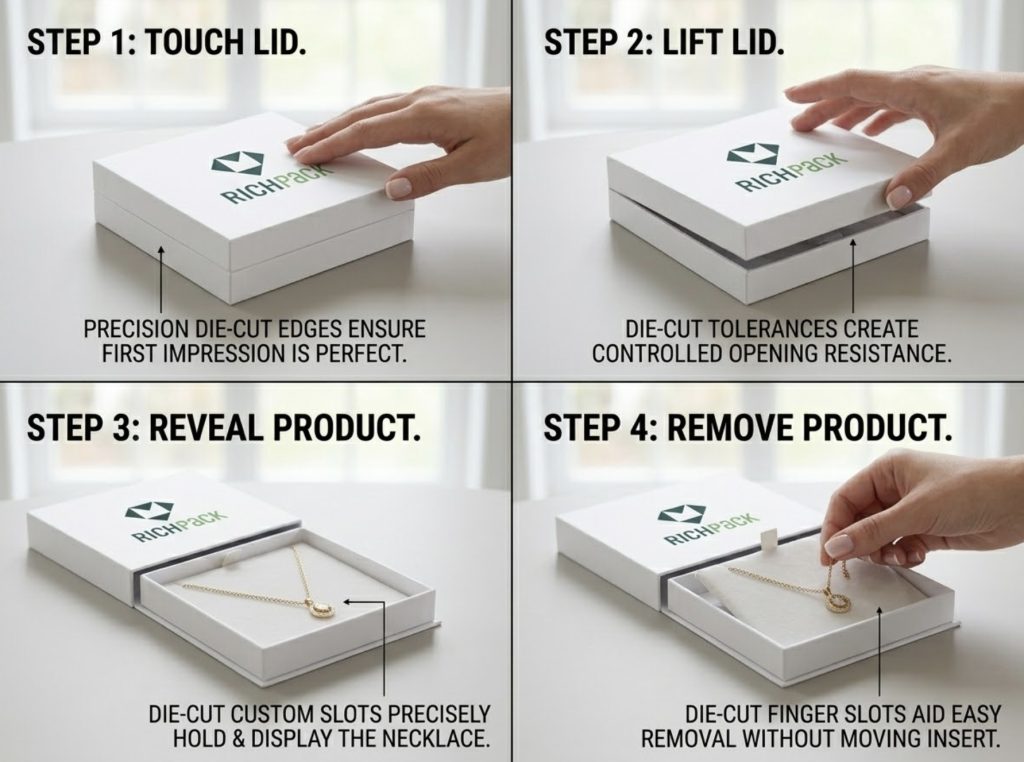
El cliente levanta, desliza, tira, se detiene y observa el producto. El troquelado controla ese ritmo mediante la holgura de la tapa, los rieles del cajón, los canales de la cinta, la altura del inserto y la ubicación del recorte.
Esta es la experiencia de desempaquetado de la que hablan las personas en reseñas y publicaciones en redes sociales. Los clientes rara vez mencionan que el troquelado fue preciso. Simplemente dicen que la caja se sentía bien, se abría fácilmente o hacía que el regalo pareciera caro.
Dicho de forma sencilla, esa retroalimentación representa un logro estructural.
Los productos pequeños requieren un embalaje más preciso.
Una cadena de collar puede enredarse. Los pendientes pueden rayar. Un anillo puede girar. Una pulsera puede golpear la tapa si el inserto está demasiado bajo.
Los insertos troquelados reducen ese movimiento. Además, facilitan el empaquetado, ya que el personal puede ver exactamente dónde va cada producto.
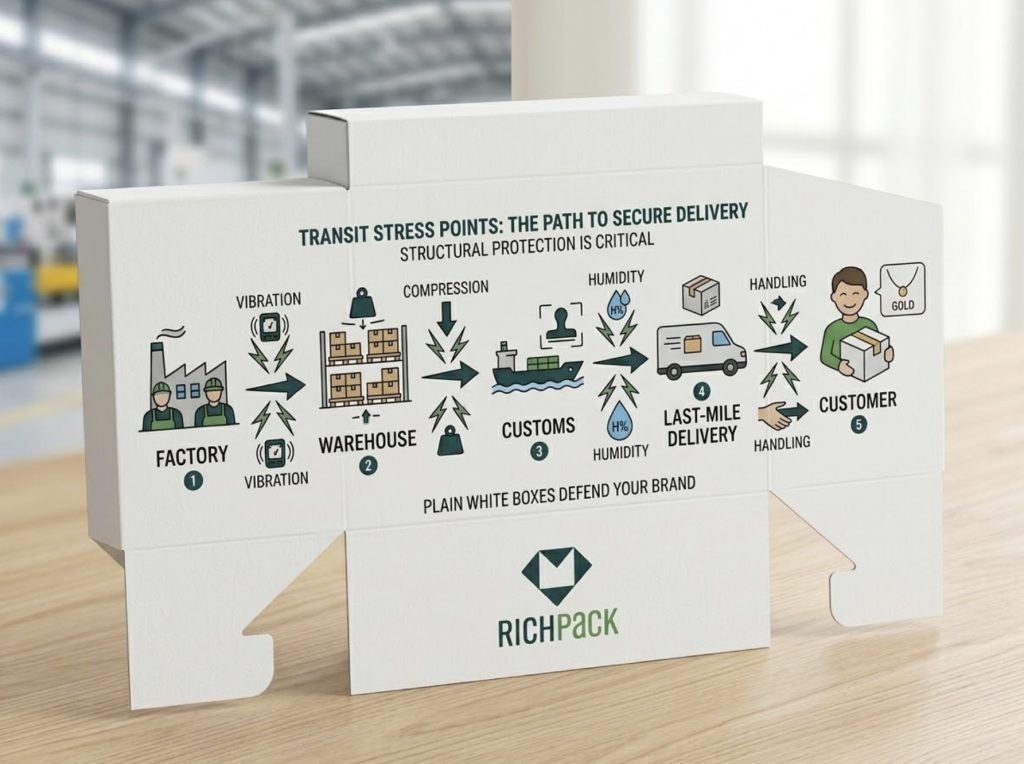
Para las marcas que venden a nivel internacional, esto se convierte en un problema de la cadena de suministro. El paquete puede pasar por manipulación en almacén, transporte aéreo, inspección aduanera, entrega local y recogida por parte del cliente. La caja debe resistir mucho más que una simple sesión de fotos.
No todos los métodos de troquelado se adaptan a todos los pedidos.
Elija el método en función del material, el tamaño del pedido, el nivel de detalle y la rapidez con la que necesite las muestras.
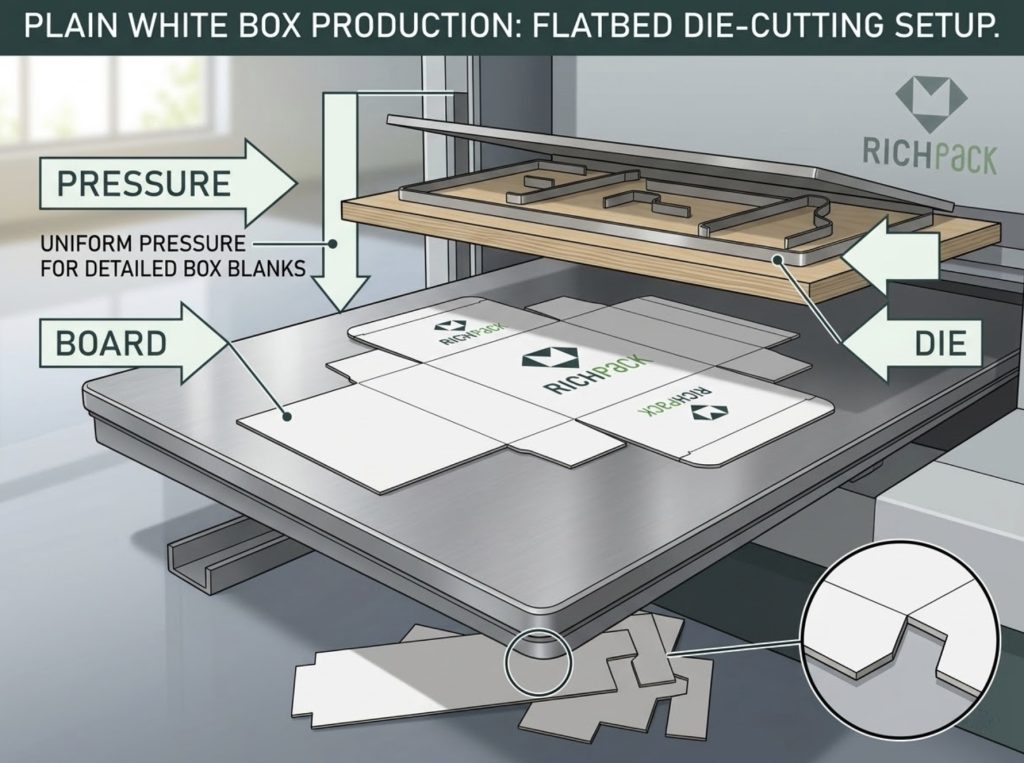
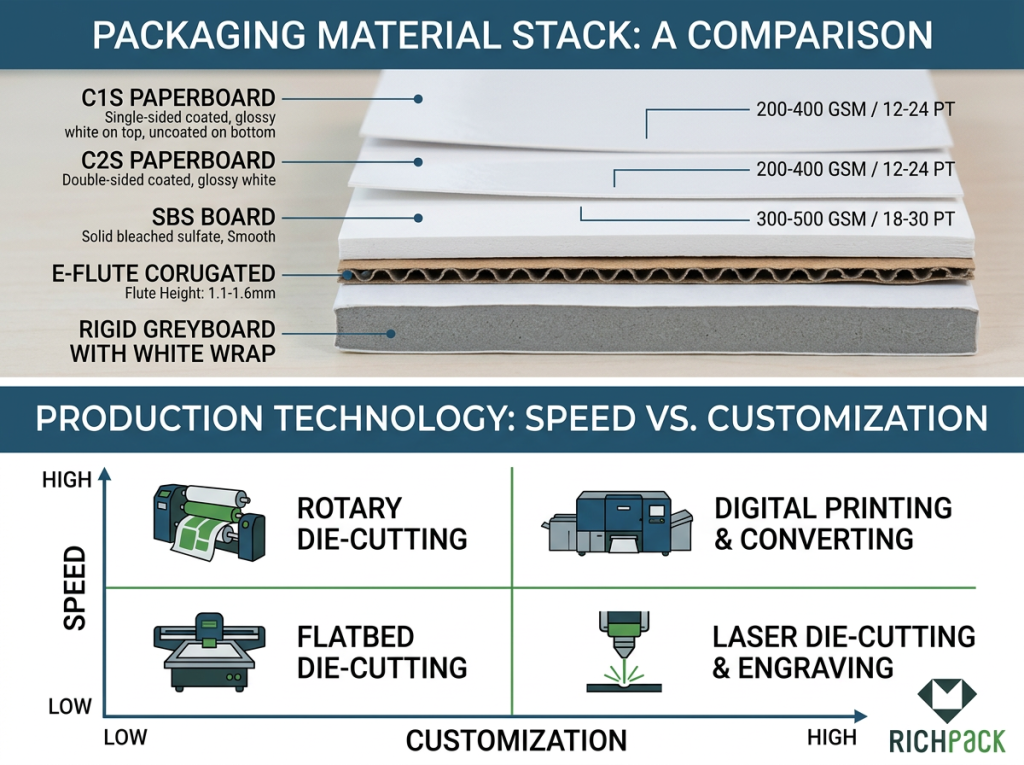
El troquelado plano funciona bien para cartón más grueso, formas precisas y estructuras personalizadas.
Es habitual en cajas plegables, componentes de cajas rígidas, cajas de regalo y tiradas de producción pequeñas y medianas. El material se coloca plano mientras el troquel lo presiona.
Utilice una plataforma plana cuando su caja blanca lisa necesite pliegues limpios, aberturas para inserciones, ventanas o características estructurales detalladas.
La disyuntiva está planteada. Se necesita un troquel, y la configuración debe ser la correcta antes de que comience la producción en masa.
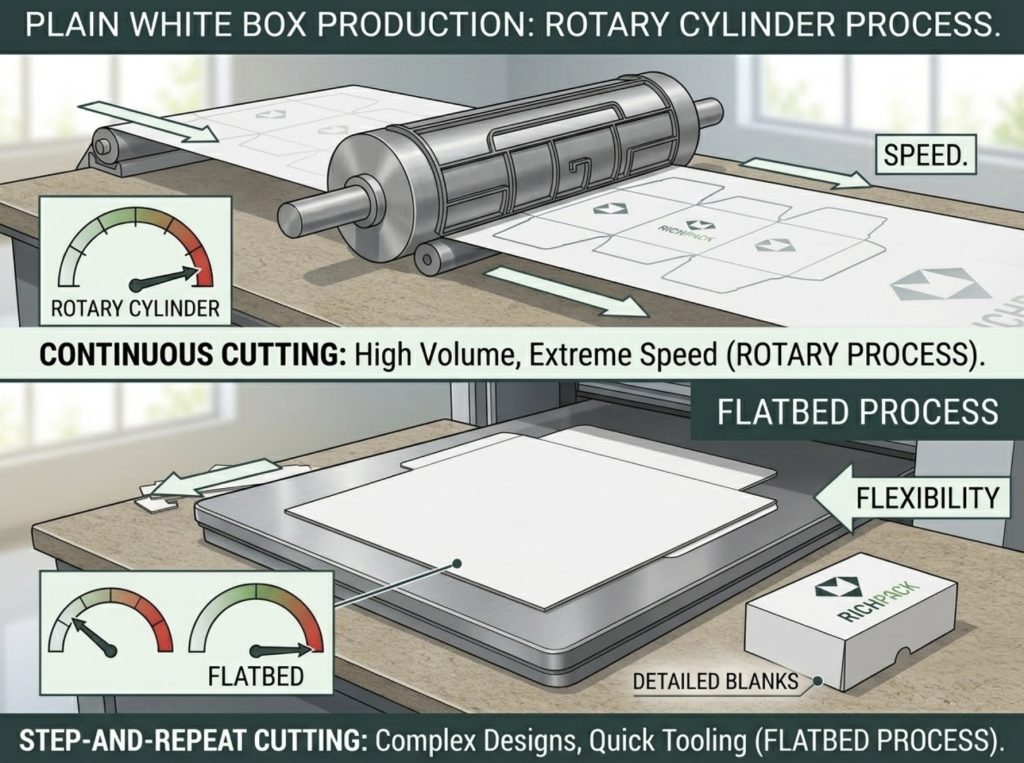
El troquelado rotativo está diseñado para la velocidad.
Utiliza un cilindro giratorio y funciona bien cuando se necesitan muchos cortes repetidos. Puede ser ideal para el embalaje de grandes volúmenes, el etiquetado y la producción repetitiva.
Para la venta al por mayor de cajas blancas sencillas, una máquina rotativa puede tener sentido cuando la estructura es estable y el volumen es lo suficientemente alto como para justificar la instalación.
No elijas un motor rotativo solo porque suene eficiente. Elígelo cuando el volumen, el material y la estabilidad del diseño coincidan.
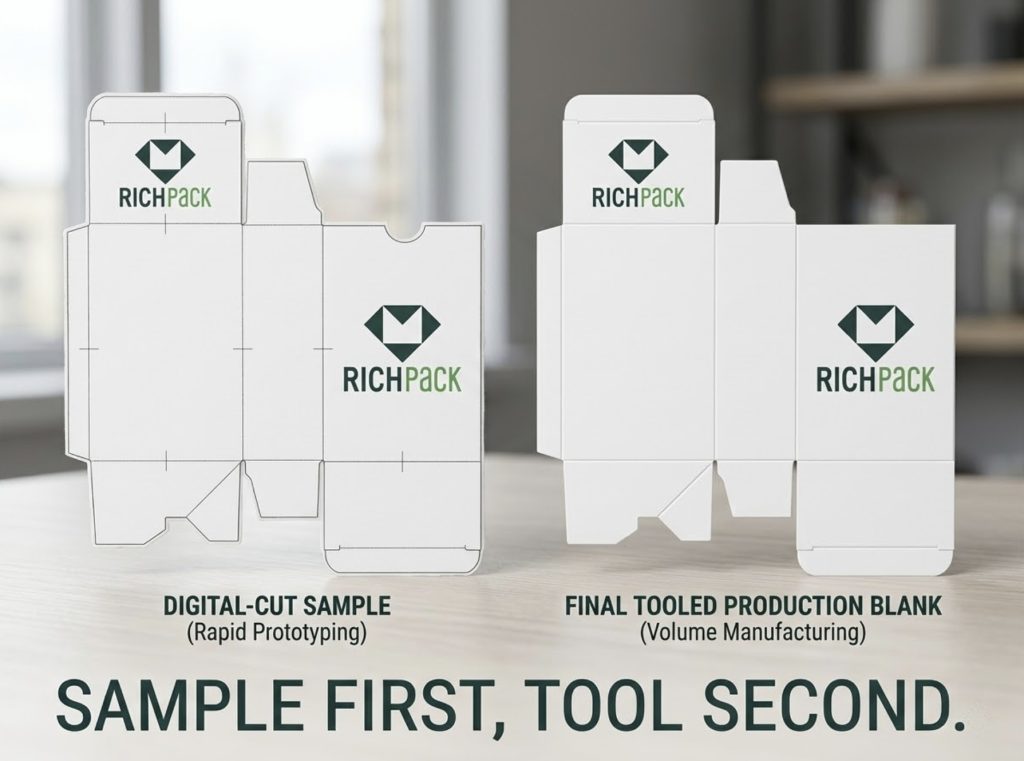
El corte digital o láser resulta útil durante la fase de muestreo.
Puedes probar el troquelado, comprobar la tapa, revisar el inserto y ver si el producto encaja correctamente antes de finalizar el utillaje.
Printed Group señala que los diseños para proyectos de troquelado suelen requerir elementos bien definidos, un diseño de impresión preciso y archivos de maquetación. Esta misma lógica se aplica a las muestras de embalaje.
Prototipar primero cuando la caja tenga:
Una muestra cuesta menos que una mala producción.
La materia lo cambia todo.
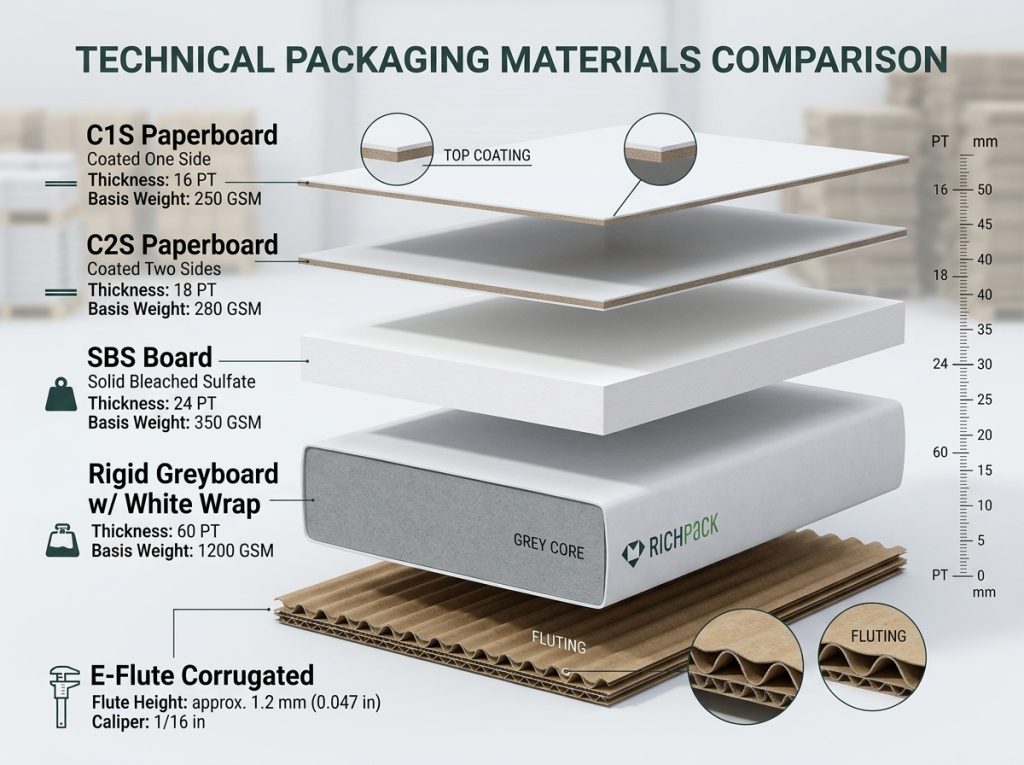
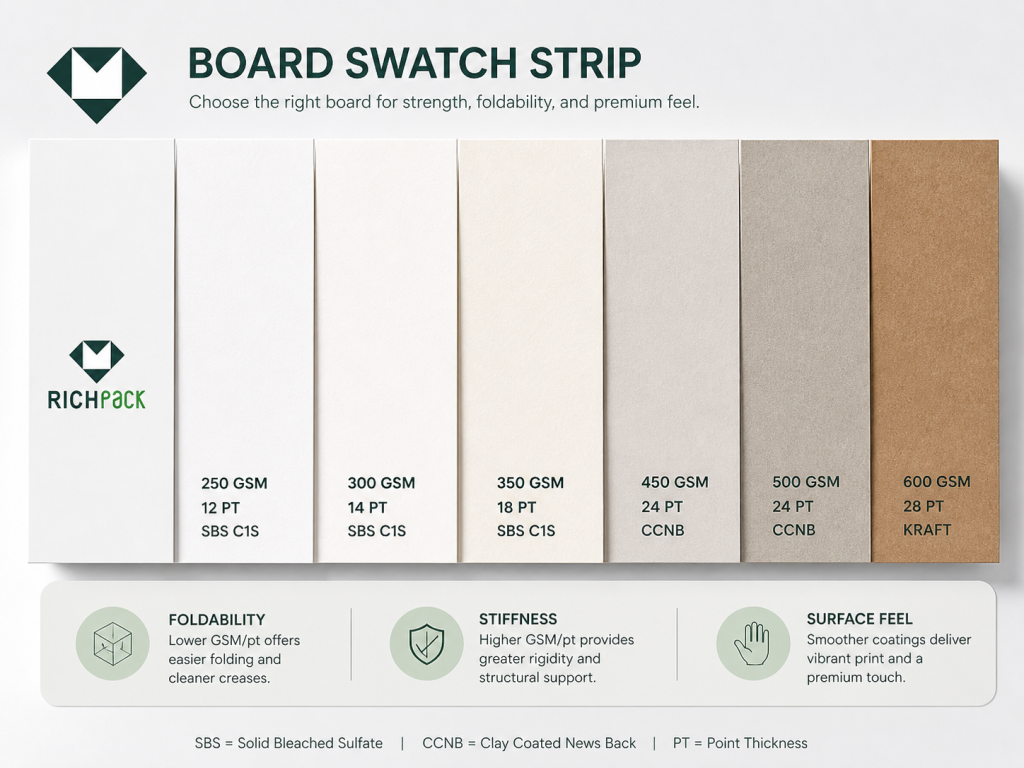
El cartón fino se pliega fácilmente, pero puede parecer frágil. El cartón grueso se siente de alta calidad, pero requiere un mejor plegado. El papel blanco estucado tiene un aspecto limpio, pero puede presentar grietas. El cartón corrugado protege bien, pero puede no ser adecuado para la presentación de joyas finas.
Los proveedores suelen hablar en GSM o PT. GSM significa gramos por metro cuadrado. PT significa espesor en puntos, donde 1 PT equivale a 0.001 pulgadas. Para muchas cajas de regalo de cartón, los compradores pueden encontrar rangos como de 300 a 400 GSM o de 18 a 24 PT, mientras que las cajas rígidas suelen utilizar cartón gris más grueso recubierto con papel impreso o especial.
También puede encontrar cartón C1S y C2S. C1S significa recubierto por una cara. C2S significa recubierto por ambas caras. Para cajas blancas de venta al por menor, el C1S ofrece un exterior limpio a la vez que reduce los costos del interior. El C2S puede dar una apariencia más limpia a ambas caras, pero puede modificar el comportamiento de plegado y el costo.
Para cajas de envío blancas sencillas, típicas del comercio electrónico, se suele utilizar cartón corrugado de flauta E, ya que es fino, imprimible y más resistente que el cartón plano para el transporte. Además, resulta útil cuando la caja debe proteger el producto sin que parezca voluminosa.
Para el empaquetado de regalos, la elección del material debe coincidir con el canal de venta:
| Canal de ventas | Mejor dirección de los materiales | Razón |
| Estantería de venta al por menor | C1S, C2S, SBS o tablero rígido | Superficie más limpia y mejor visualización |
| Envíos de comercio electrónico | Sobre de cartón corrugado de flauta E | Mejor protección con espesor controlado |
| Regalos de joyería | Tablero rígido con inserto | Mejor revelación y retención del producto |
| Reventa al por mayor | Línea estandarizada de cartón | Pedidos repetidos más sencillos |
| Colección sostenible | Papel con certificación FSC o cartón reciclable | Mayor confianza del comprador |
La elección de materiales no es solo una decisión de sostenibilidad. Es una decisión estructural.
Utilice una comparativa de métodos antes de solicitar un presupuesto.
| Método | Uso recomendado | Coste de instalación | Velocidad | Control de tolerancia | Riesgo del comprador |
| Troquelado plano | Cajas de regalo, insertos y cartón más grueso | Media | Media | Alto | Una configuración deficiente puede retrasar el muestreo. |
| Troquelado rotativo | Ejecuciones repetidas de alto volumen | Más alto | Alto | Alto | No es ideal para diseños inestables. |
| Corte digital | Prototipos y pruebas de baja tirada | Bajo | Media | Medio a alto | El coste unitario puede aumentar a gran escala. |
| Corte por láser | Detalles finos y muestras | Bajo a mediano | Más Bajo | Alto | Las marcas de quemaduras pueden ser importantes en la pizarra blanca. |
No preguntes qué método es el mejor. Pregunta qué método se ajusta a esta caja, a este material, a esta cantidad y a este plazo.
En el sector del embalaje al por mayor, el troquelado permite ahorrar dinero o, por el contrario, generar residuos de forma silenciosa.
La primera unidad te enseña la estructura. Las siguientes 10,000 unidades ponen a prueba tu sistema.
La tarifa de troquelado es el costo de utillaje para una estructura personalizada.
Ese coste puede resultar molesto en el primer pedido. Se vuelve menos doloroso cuando la caja se repite en distintas temporadas, referencias o tiendas.
Para la venta al por mayor de cajas blancas lisas, la pregunta más acertada no es si puedo evitar el costo del troquel, sino si este troquel reducirá los costos y los errores en pedidos repetidos.
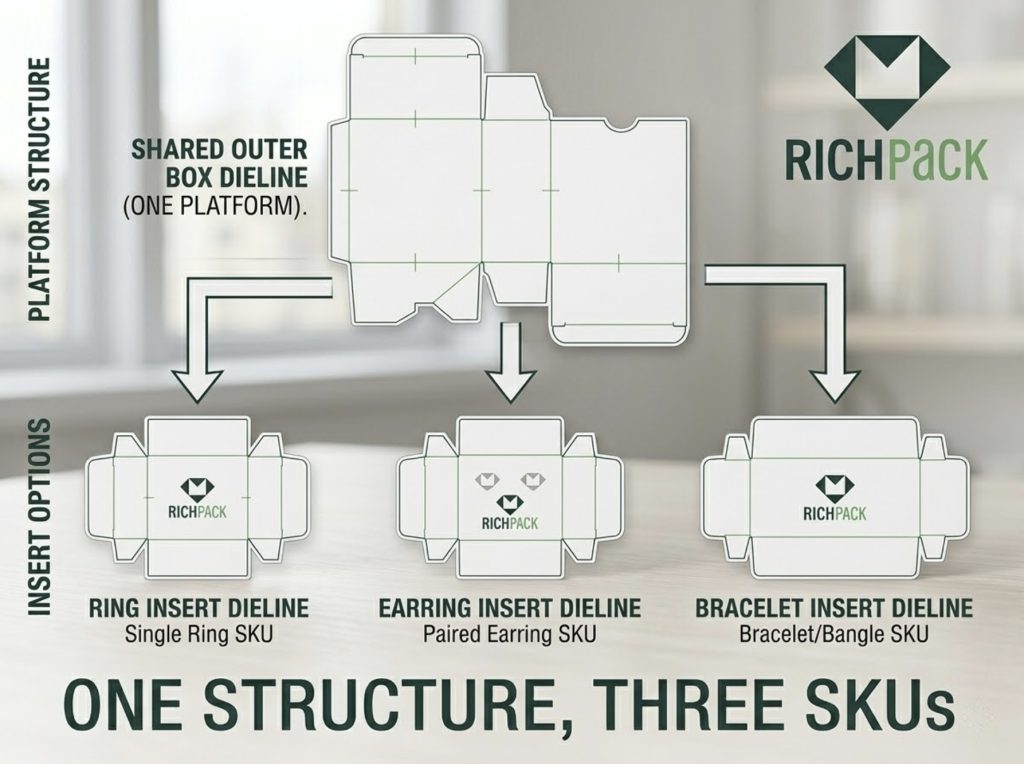
Si un mismo molde permite fabricar una caja para anillos, una caja para pendientes y una caja para pulseras con solo cambiar el inserto, la estructura se convierte en una pequeña plataforma de embalaje.
El equipo de diseño estructural de RichPack suele tratar el primer troquel aprobado como un recurso reutilizable, no como un dibujo de un solo uso. Esta mentalidad ayuda a las marcas a gestionar los pedidos repetidos de forma más eficiente y rápida.
La cantidad mínima de pedido (MOQ) influye en algo más que el precio.
Un MOQ bajo puede ayudar a una nueva marca a tantear el mercado. Un MOQ más alto puede reducir el coste unitario, estabilizar la compra de materiales y hacer más viables los insertos personalizados.
El riesgo reside en pedir demasiado antes de comprobar la estructura. Si la tapa queda ligeramente ajustada o el inserto es incorrecto, un pedido grande se convierte en inventario obsoleto.
Utilice esta secuencia:
Esa secuencia protege el flujo de caja y la confianza en la marca.
Un mejor ajuste reduce el desperdicio oculto.
Si el producto se coloca correctamente, se necesita menos material de relleno. Si la caja cierra herméticamente, se necesita menos cinta adhesiva. Si el inserto sujeta bien el artículo, se reduce el riesgo de daños.
Esto es importante porque los residuos de embalaje no solo representan material sobrante, sino también reprocesos, envíos de reemplazo, tiempo de atención al cliente y reseñas de baja calidad.
Para un embalaje sostenible, no empieces con eslóganes. Empieza con la adecuación.
La precisión del troquelado puede reducir la presión sobre el carbono de una manera muy práctica.
Una caja blanca lisa del tamaño adecuado puede reducir el espacio vacío, el tamaño de la caja principal, el espacio en el palé y los costos de envío aéreo transfronterizo. Esto puede disminuir la presión del peso volumétrico, que es como las empresas de transporte calculan el precio de los envíos en función del volumen del paquete en lugar de solo del peso real.
Aquí radica el aspecto matemático de la cadena de suministro que los compradores suelen pasar por alto. Una caja que solo mide 10 mm de más puede no parecer un desperdicio en un escritorio. Sin embargo, en 20 000 unidades, esa altura adicional puede afectar la cantidad de cajas, la carga de palés, el espacio de almacenamiento y el costo del flete.
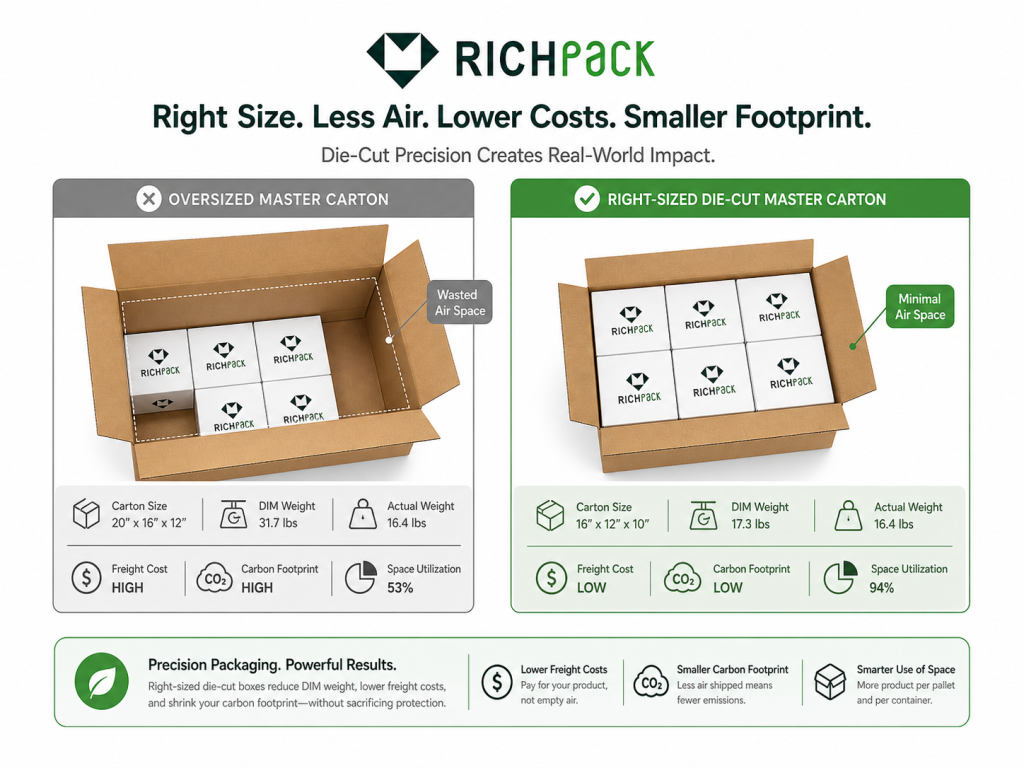
La caja más ecológica no siempre es la más delgada. Se trata de la estructura que protege el producto con el menor volumen desperdiciado.
La coherencia es la verdadera prueba de fuego.
Una muestra de excelente calidad no sirve de mucho si el pedido a granel cambia de forma, color, textura de la tapa o ajuste del inserto. Los equipos de compras se preocupan por la repetibilidad, ya que un empaque inconsistente genera problemas posteriores.
Los mejores proveedores controlan:
Una caja blanca lisa deja al descubierto las inconsistencias más rápidamente que un embalaje impreso con muchos detalles. No hay dónde ocultar el defecto.
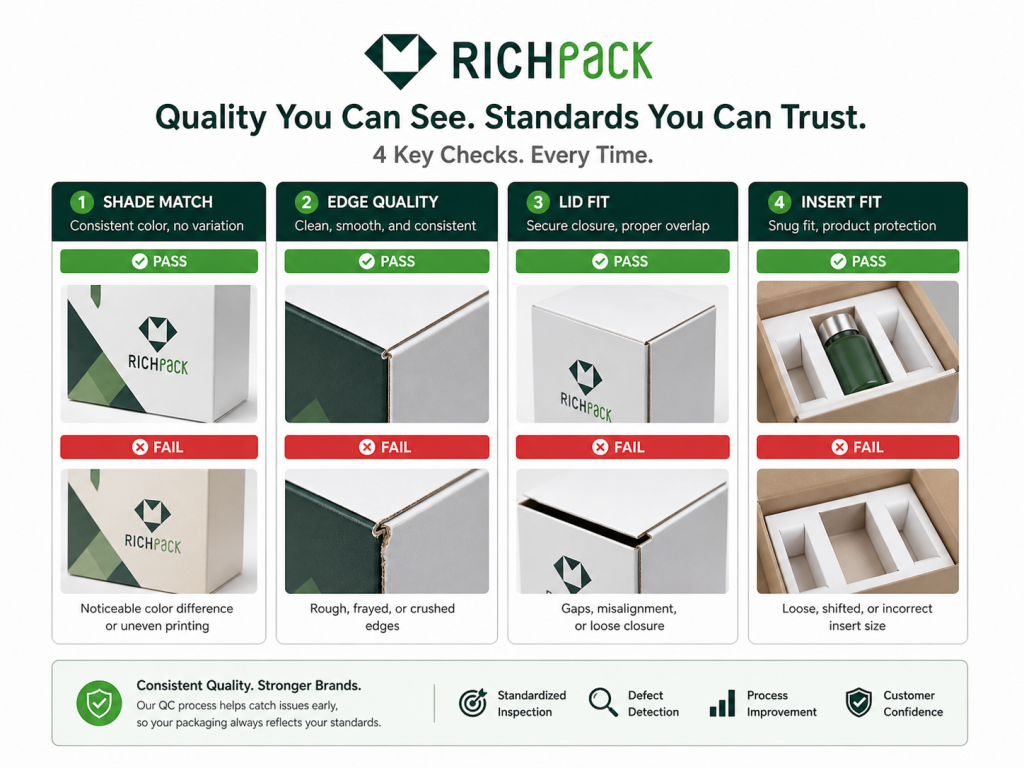
La mayoría de los retrasos comienzan con instrucciones vagas.
Los compradores solicitan una caja de regalo blanca lisa, pero no especifican el tamaño del producto, el estilo del inserto, el tipo de tapa, el método de envío, el acabado, el precio unitario objetivo ni la fecha límite.
Eso obliga al proveedor a adivinar. Adivinar genera revisiones.
Envíe un informe al proveedor que incluya:
Los datos de entrada claros permiten obtener presupuestos más rápidos y reducir el número de rondas de muestreo.
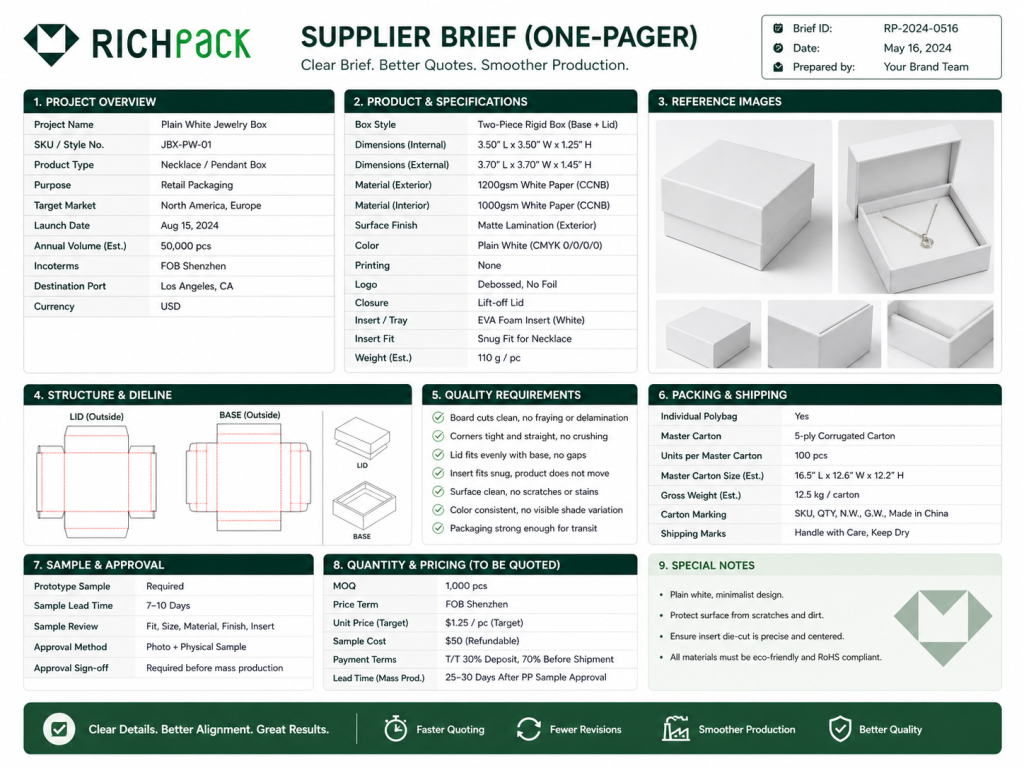
Los envases de lujo tienen peso.
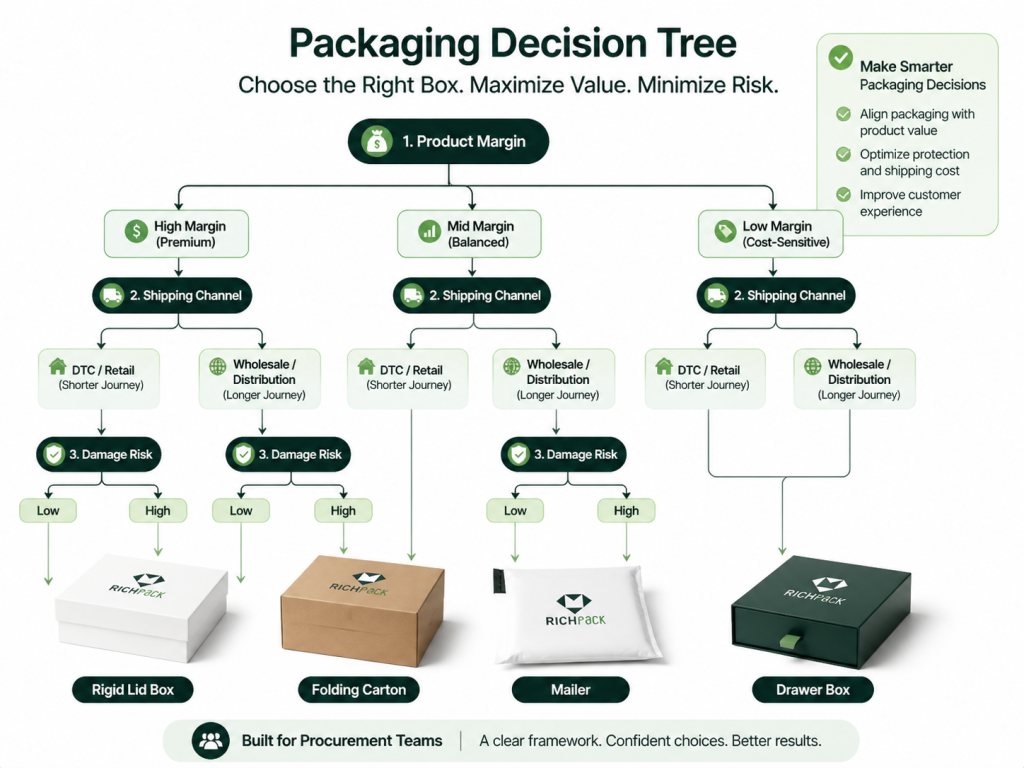
Una caja más gruesa y rígida da una mejor impresión, pero puede aumentar el costo del envío, el tamaño de la caja y el espacio de almacenamiento. Una caja plegable más ligera ahorra costos, pero puede que no le dé a la joyería la suficiente presencia.
La mejor opción rara vez es la caja más pesada. Se trata de la estructura más ligera que aún protege el artículo y cumple con la promesa de la marca.
En el caso de una marca de joyería, una caja con tapa rígida puede ser la más adecuada para anillos de alto margen. Una caja plegable blanca, más ligera y sencilla, con un inserto troquelado, podría ser mejor para dijes de menor precio vendidos a través de distribuidores.
Utilice el margen, el canal y el riesgo de daños para elegir la estructura.
Un informe detallado sobre el proveedor ahorra más tiempo que una larga cadena de correos electrónicos.
Úsalo para convertir tu idea de diseño en una caja blanca simple y fabricable.
Empiece por el producto, no por la caja.
Mide el largo, el ancho, la altura, el peso y los puntos frágiles. Observa si el producto se raya, se enreda, se dobla, gotea o necesita un ángulo de exposición específico.
Para joyería, indique el tipo exacto de producto. Un collar requiere sujeción de la cadena. Los pendientes requieren alineación de pares. Un anillo requiere una ranura firme o un soporte elevado.
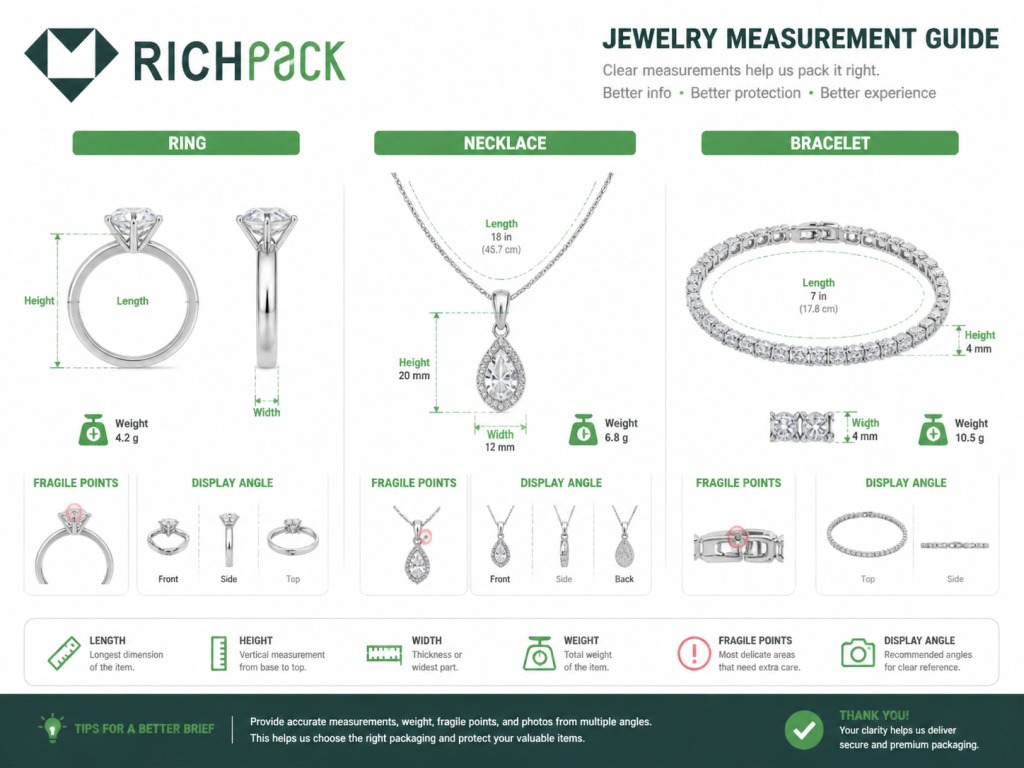
Elija el formato de la caja según el caso de uso.
| Formato de caja | mejor uso | Solidez | Cuidado |
| Cartón plegable | Regalos ligeros y paquetes para la venta al por menor | Económico | Sensación menos premium |
| Caja con tapa y base | Joyas y regalos de alta gama | Fuerte revelación | Requiere una tolerancia precisa en la tapa. |
| Caja de cajones | Accesorios y sets de regalo | Desempaquetado impactante | Más detalles de montaje |
| Caja magnetica | Regalos de alta gama | Cierre premium | Mayor coste y peso |
| caja de correo | Envíos de comercio electrónico | Ajuste de tránsito más robusto | Sensación de regalo menos formal |
No elijas un formato solo porque se vea bien en un catálogo. Elígelo porque se ajusta al recorrido del producto.
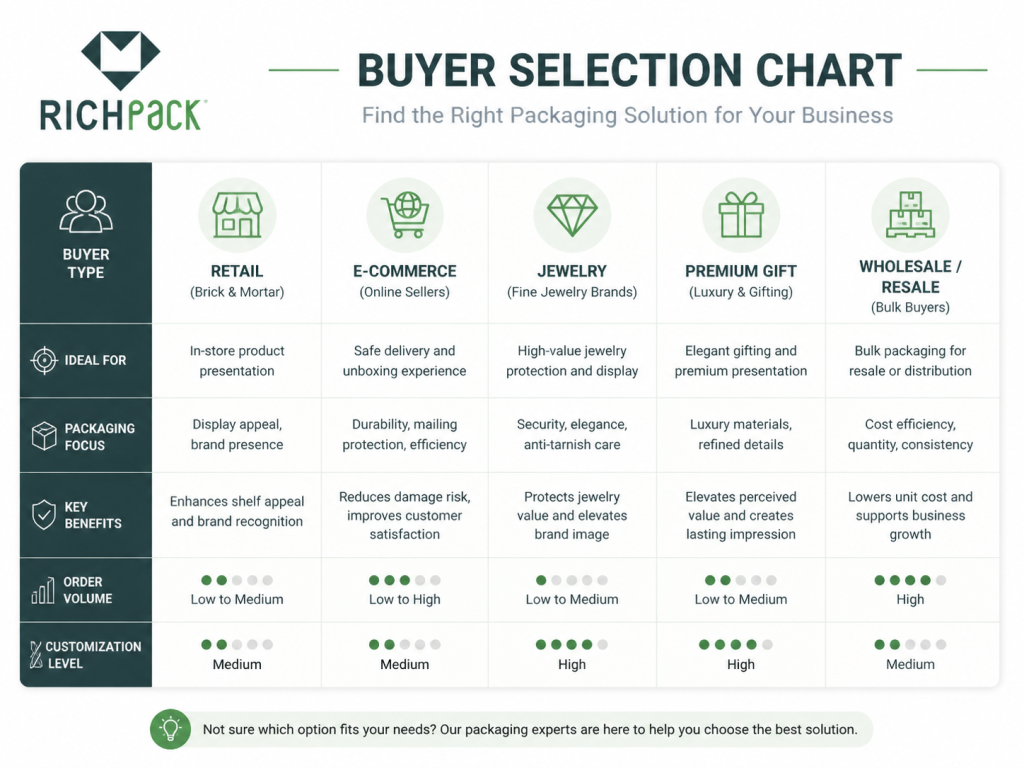
El folleto informativo debe coincidir con el valor del producto y el riesgo de envío.
Los insertos de cartón son económicos y reciclables. Los insertos de espuma sujetan firmemente los productos pequeños. Los insertos de terciopelo ofrecen una sensación de alta calidad. La pulpa moldeada permite un posicionamiento sostenible.
Para un joyero blanco sencillo, un inserto híbrido suele ser una buena opción. Una base de cartón aporta estructura, mientras que el terciopelo o la espuma añaden agarre y suavidad en la zona de contacto con el producto.
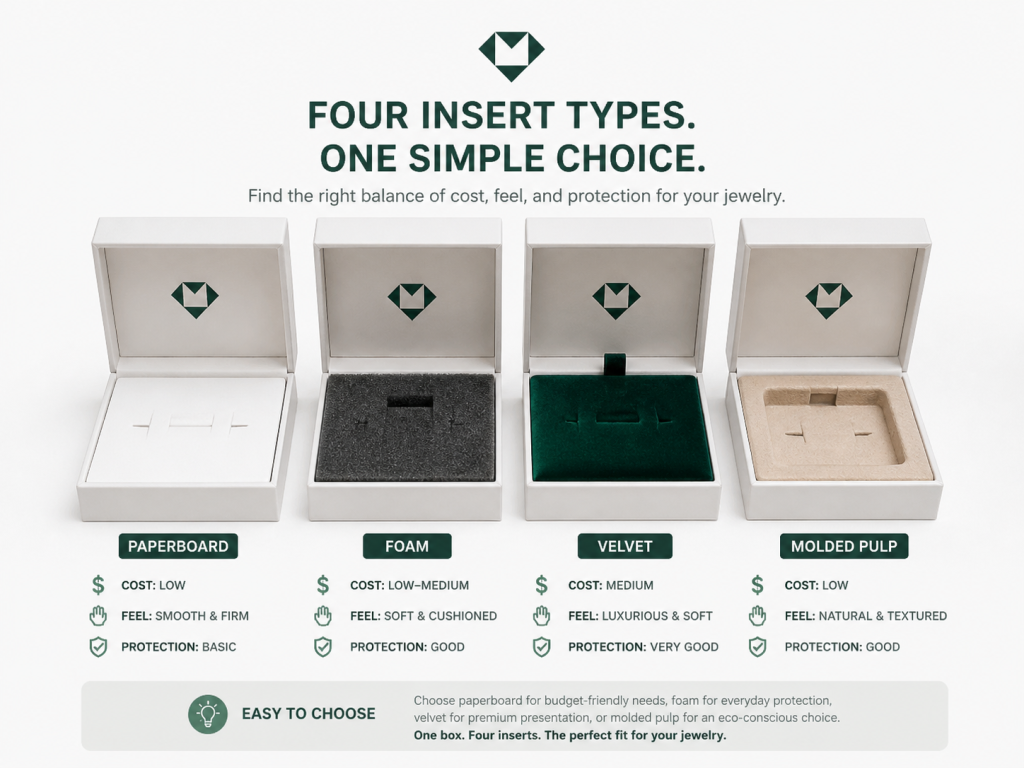
Enumera todos los cortes que tienen una función.
¿Necesitas una ventana, un asa, una ranura para cinta, una ranura para collar, un orificio para pendiente, una lengüeta para colgar, una solapa, una lengüeta de cierre o una tira desprendible? Inclúyelo en el folleto.
No dé por sentado que el proveedor deducirá estos detalles a partir de un panel de inspiración. Un panel de inspiración muestra gusto. Un troquelado muestra producción.
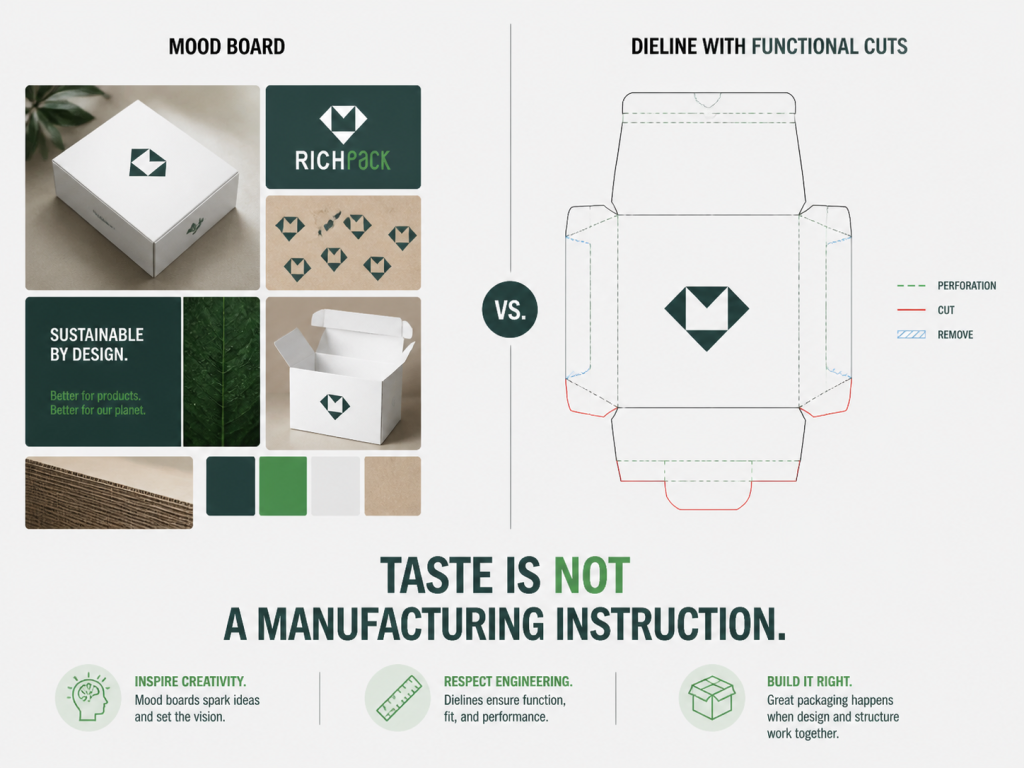
El color blanco liso no significa que esté sin terminar.
Puedes añadir estampado en caliente, relieve, bajo relieve, barniz UV selectivo, un logotipo en relieve, una banda de papel, una cinta o una etiqueta removible. El truco está en mantener el acabado alineado con la estructura troquelada.
Si un logotipo se coloca demasiado cerca de un pliegue, puede deformarse. Si la lámina metálica se coloca demasiado cerca de un recorte, aumenta el riesgo de problemas de registro.
Mark terminó la colocación antes de tiempo, por lo que la línea de troquelado la protege.
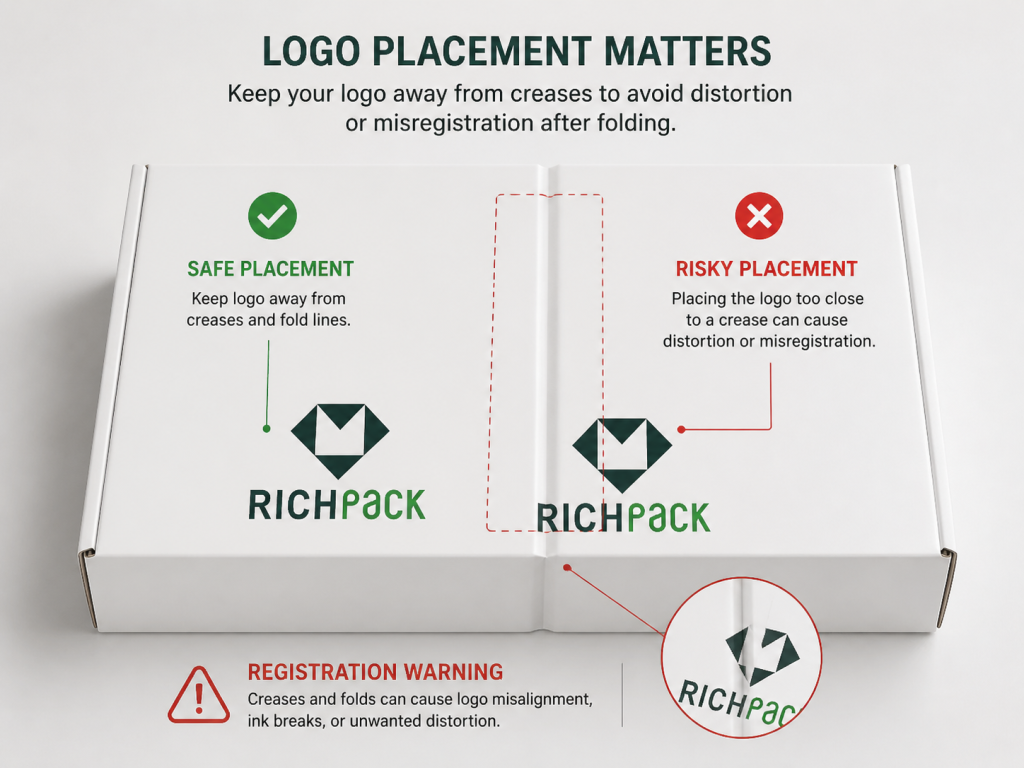
Nunca omitas una muestra física para una estructura personalizada.
Una representación gráfica puede mostrar las proporciones. No puede mostrar la resistencia de la tapa, el agrietamiento por pliegues, el agarre del inserto, la rigidez del tablero ni las marcas de la superficie.
Pruebe la muestra como si fuera un cliente:
Ahí es donde se evidencia la debilidad del empaque.
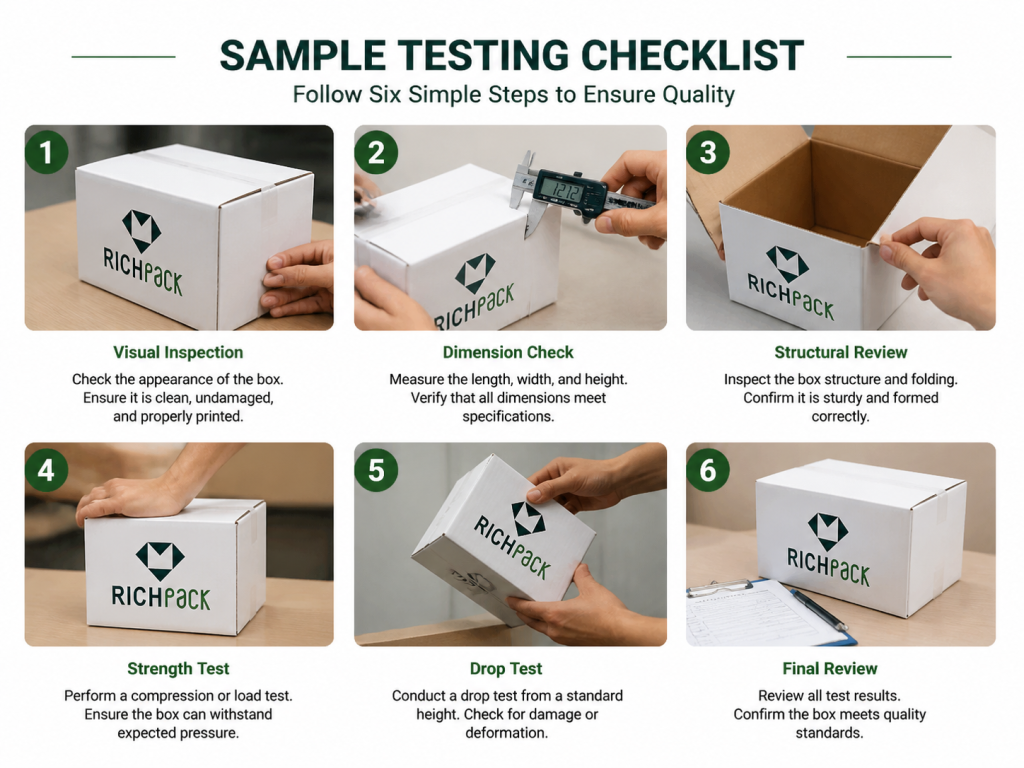
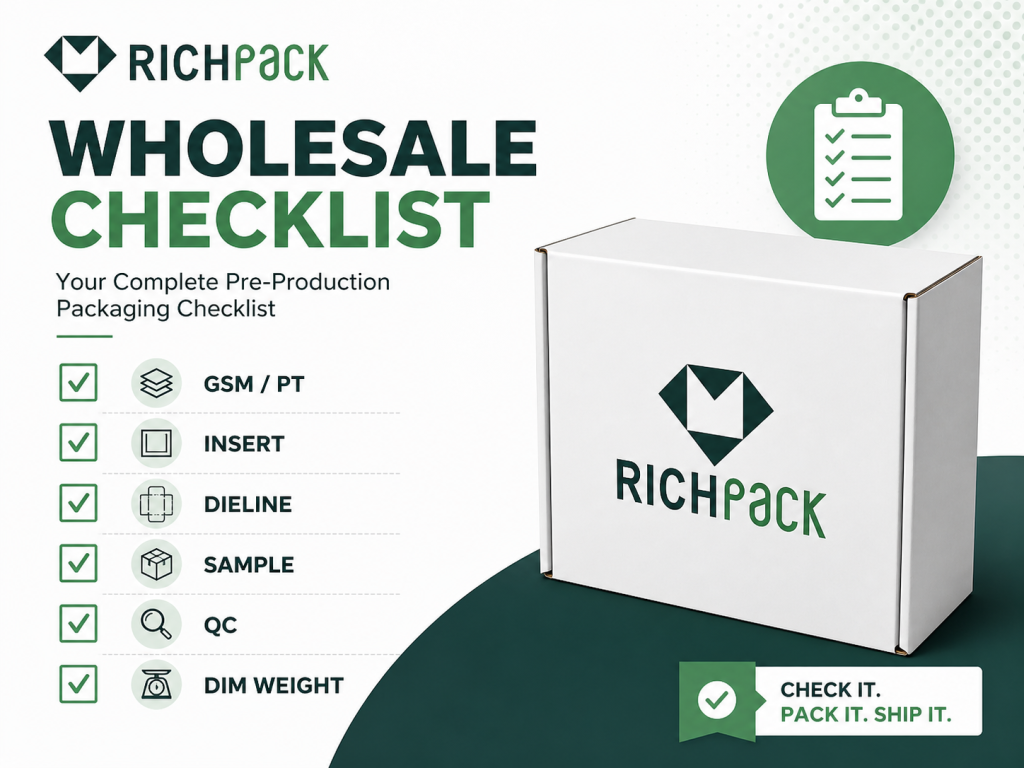
Utilice una lista de verificación antes de aprobar la producción.
| Parámetro | Qué confirmar | POR QUÉ ES IMPORTANTE |
| Dimensiones | Tamaño del producto y de la caja interior | Evita el movimiento y los problemas con la tapa. |
| Material | GSM, PT, C1S/C2S, flauta E, cartón rígido | Controles de tacto, plegado y fuerza |
| recuadro | Forma, agarre y material | Protege la presentación del producto |
| Termine | Logotipo, lámina, textura, recubrimiento | Controla la percepción de la marca |
| Cantidad | Previsión de MOQ y reordenamiento | Afecta al utillaje y al coste unitario. |
| Cronograma | Plazos para muestras y pedidos al por mayor | Evita retrasos en el lanzamiento. |
| Entregas | Destino y embalaje de cartón | Controla el peso DIM y el riesgo de daños |
| QC | Puntos de inspección | Protege la consistencia de los pedidos repetidos. |
Esta es la diferencia entre comprar cajas y construir un sistema de embalaje.
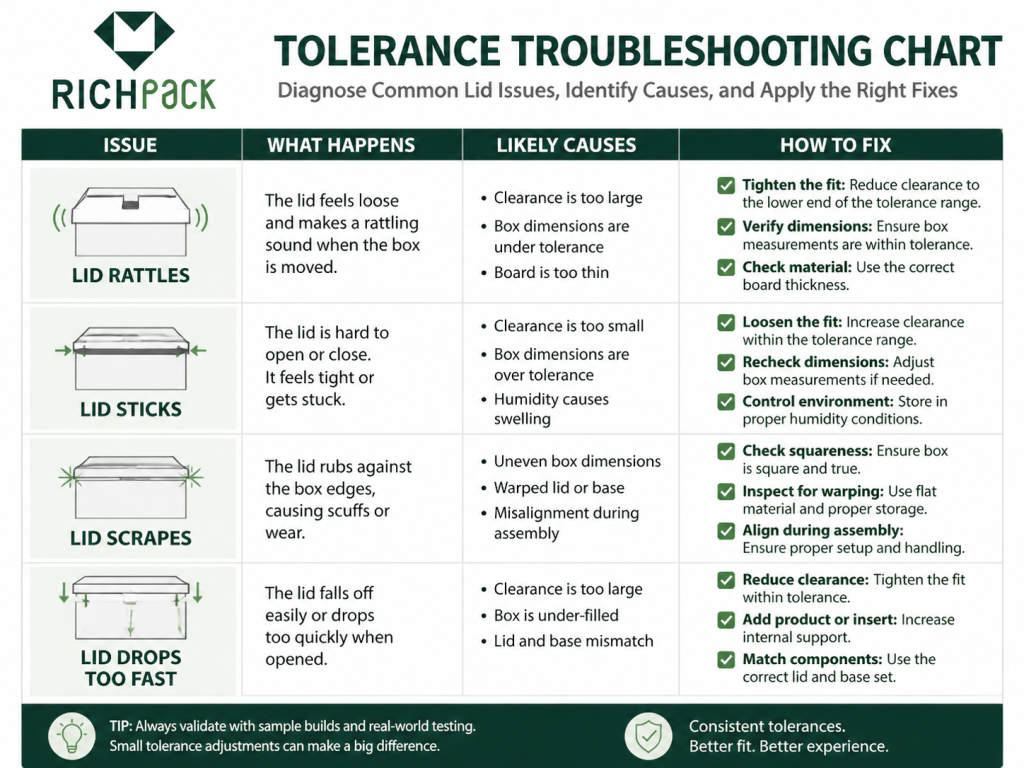
El embalaje blanco liso no tiene ningún tipo de camuflaje.
Cada borde débil, tapa suelta, pliegue defectuoso y diferencia de color se nota más rápidamente que en una caja impresa con muchos detalles.
Una tapa defectuosa puede arruinar una buena caja.
Demasiado suelto da sensación de descuido. Demasiado apretado da sensación de frustración. Demasiado superficial da sensación de fragilidad. Demasiado profundo puede ralentizar el momento inicial.
Solicitar controles de tolerancia durante el muestreo. Realizar pruebas con productos reales, prospectos reales y en condiciones de embalaje reales.
Para cajas rígidas de alta calidad, utilice el margen de holgura de 1 a 2 mm como punto de partida, no como una regla fija. El grosor del cartón, el papel de embalaje, el pegamento, el recubrimiento, la humedad y el tamaño de la caja influyen en el ajuste final.
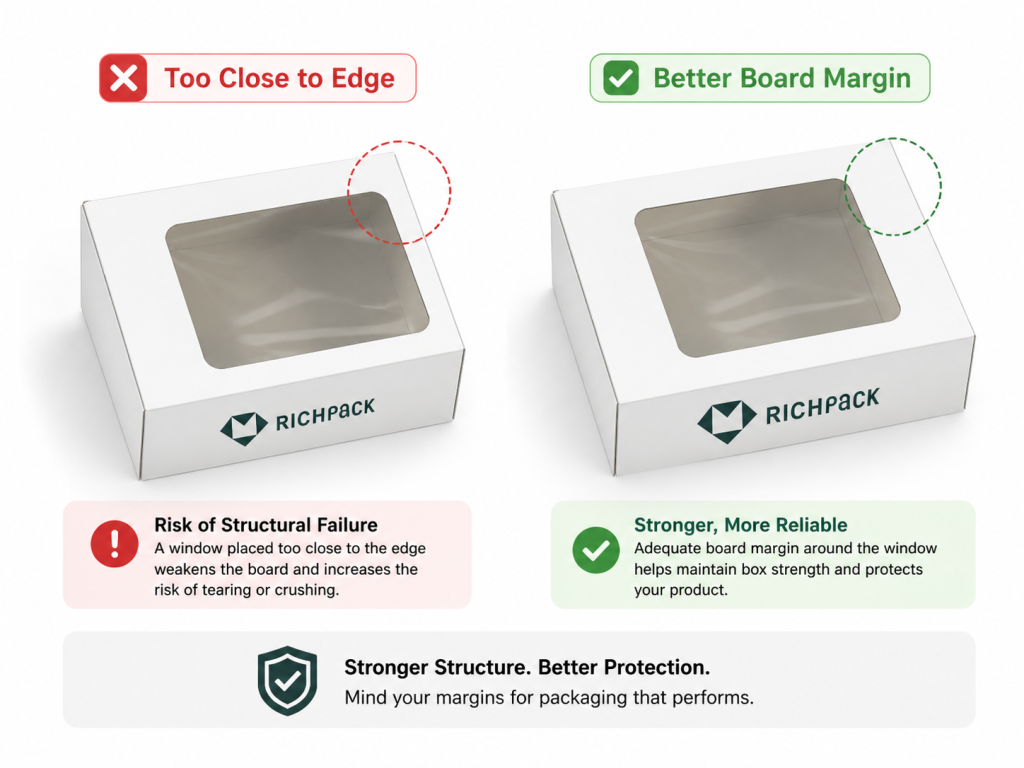
Los recortes necesitan espacio.
Una ventana, manija o ranura colocada demasiado cerca de un borde puede debilitar el tablero. También puede provocar desgarros durante el montaje o el transporte.
Este es un problema común cuando los equipos diseñan únicamente desde la vista frontal. La caja se ve limpia en la pantalla, pero la estructura falla en los bordes.
El tablero incorrecto hace que el blanco se vea peor.
Una tabla delgada puede curvarse. Una tabla revestida puede agrietarse si el pliegue no es el adecuado. Una tabla rugosa puede parecer sostenible, pero quizás no combine con joyas de lujo.
Solicite muestras del tablero a su proveedor antes de aprobar una muestra completa. El tacto es importante en este caso.
Utilice la terminología adecuada en su solicitud. Pregunte al proveedor si recomienda 300 g/m², 350 g/m², 400 g/m², 18 PT, 24 PT, C1S, C2S, cartón gris rígido o cartón ondulado de flauta E, según su caso de uso.
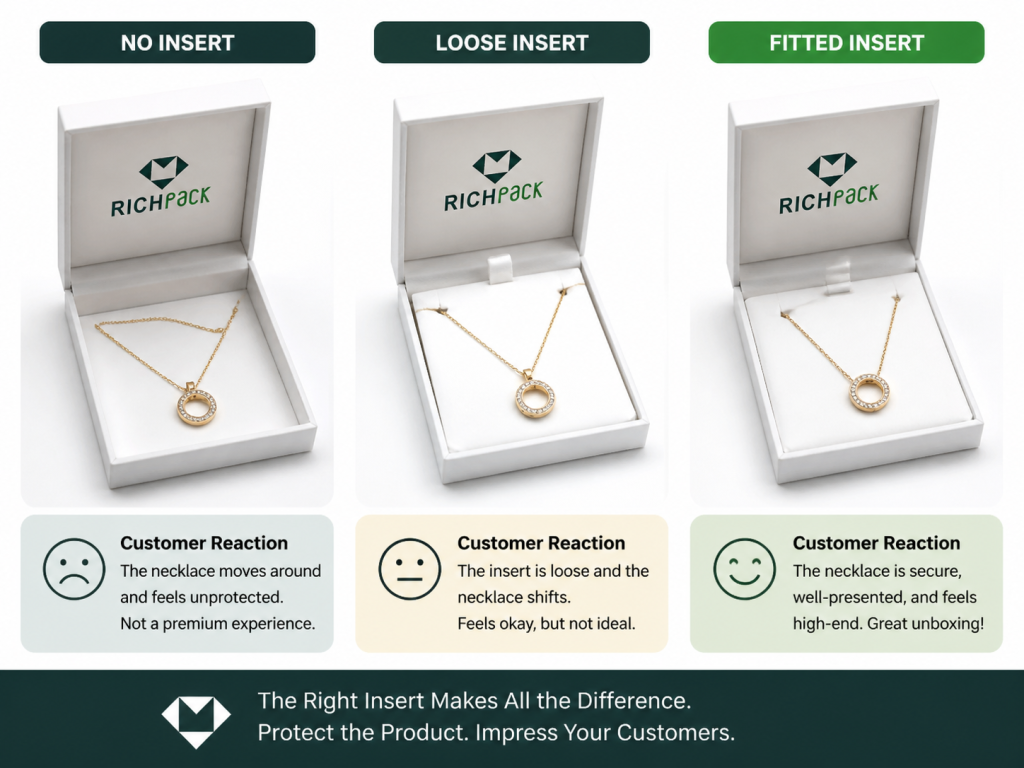
Una caja sin el inserto adecuado está incompleta.
El exterior puede parecer limpio, pero el interior puede estar en mal estado. Esto sucede a menudo con productos pequeños porque los compradores se fijan en la tapa y se olvidan del mecanismo.
En el caso de las joyas, el folleto informativo debe responder a una pregunta: ¿el producto tendrá exactamente el aspecto que el cliente espera cuando se abra la tapa?
Si la respuesta es no, corrija el inserto antes de corregir el logotipo.
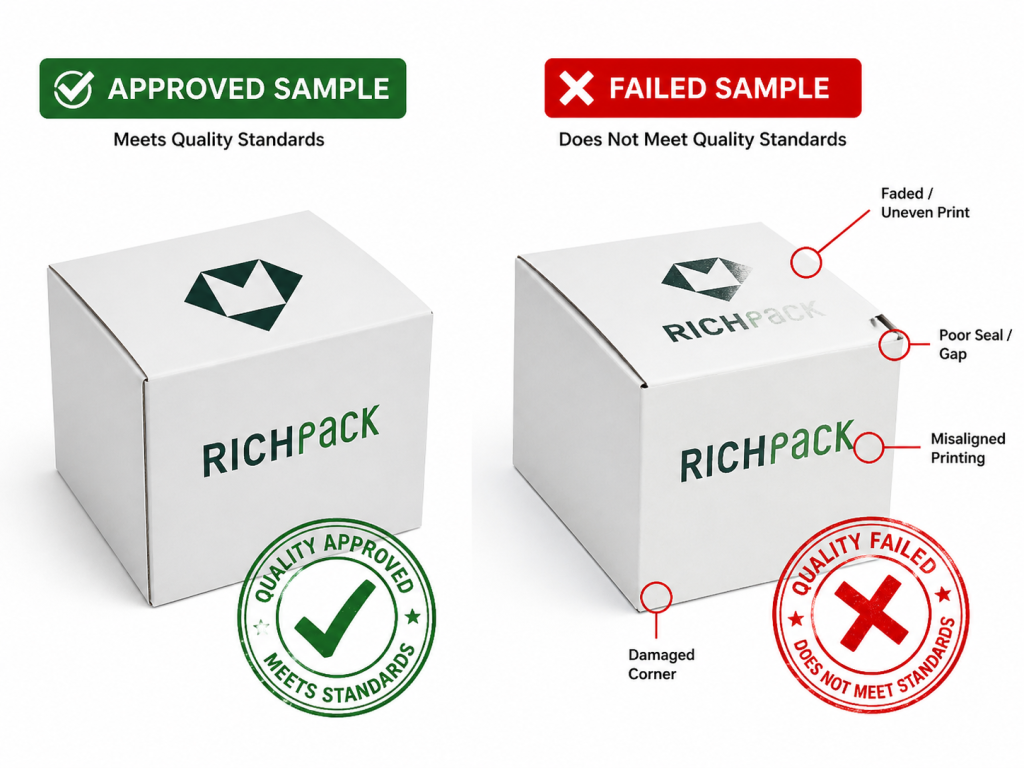
Omitir muestras es el atajo más costoso.
Es posible que al principio ahorres unos días y luego pierdas semanas debido a retrabajos, devoluciones o quejas de los compradores.
Una muestra ayuda a detectar:
Para cajas blancas lisas personalizadas, la aprobación de la muestra no es opcional. Es un control de calidad.
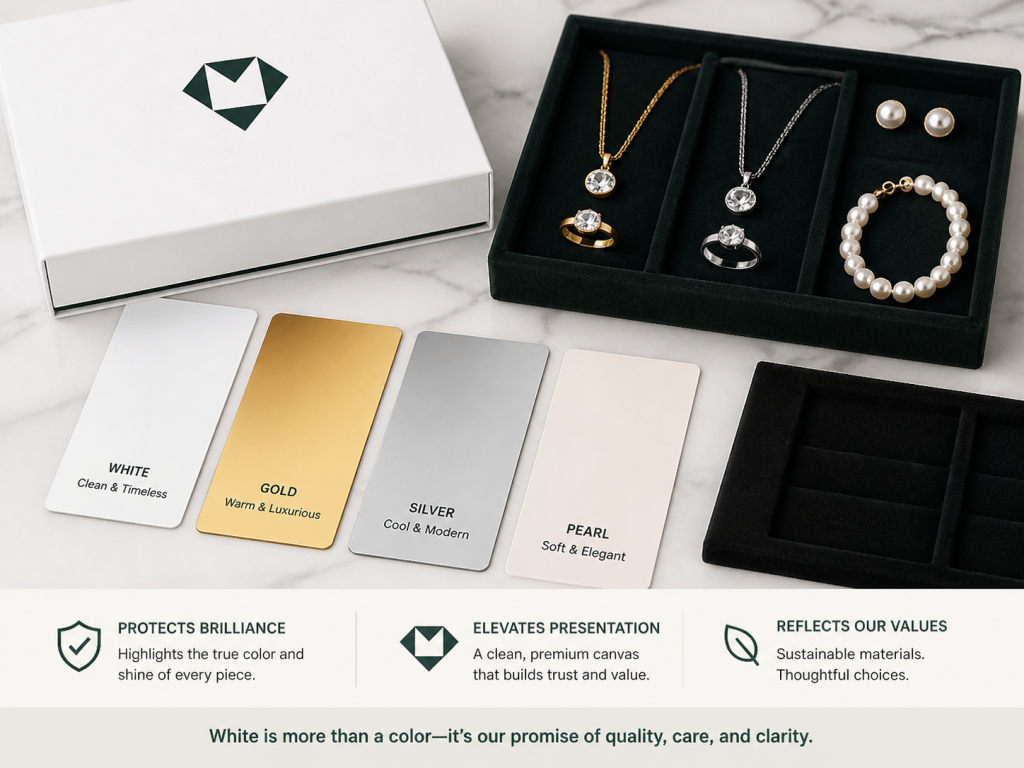
El blanco tiene matices.
El blanco frío, el blanco cálido, el blanco azulado, el blanco marfil, el blanco mate, el blanco revestido y el blanco kraft no se sienten igual. Bajo la iluminación comercial, la diferencia se hace más evidente.
Esto es importante para las marcas de joyería porque el color del metal, el color de la piedra preciosa, el color del inserto de terciopelo y el acabado del logotipo reaccionan sobre la superficie blanca.
Adapta el color blanco al producto, no solo a la guía de la marca.
Una caja blanca sencilla es un embalaje estructural ideal para regalos, joyas, productos minoristas, envíos de comercio electrónico, muestras, obsequios para eventos y líneas de embalaje al por mayor. Los compradores la eligen por su diseño limpio, flexible y fácil de adaptar a diferentes tipos de productos. Mediante troquelado, la misma caja blanca puede convertirse en una caja de regalo con tapa y base, una caja plegable, una caja con cajón o un joyero con un inserto personalizado.
El troquelado da forma a una caja blanca simple creando los cortes, pliegues, hendiduras, perforaciones, ranuras, ventanas, pestañas e inserciones que conforman la estructura final. Transforma cartón plano en un diseño de empaque repetible. El resultado es un mejor ajuste, una apertura más limpia, una sujeción más firme del producto y un empaque de caja blanca simple más uniforme en la producción en masa.
Una caja blanca sencilla es ideal para el empaquetado de joyas cuando la tapa, el inserto, el material y el acabado están diseñados específicamente para el producto. La superficie blanca impecable crea una base elegante, mientras que el inserto mantiene anillos, pendientes, pulseras o collares en su lugar. En una caja de joyería blanca sencilla, el ajuste de la tapa y la sujeción del inserto son más importantes que una decoración recargada.
La mejor caja blanca lisa con tapa es aquella que se ajusta al peso del producto, el canal de venta, el riesgo de envío y el objetivo del desempaquetado. Una caja rígida con tapa y base funciona bien para joyería y regalos de alta gama. Una caja plegable con tapa puede ser más adecuada para productos minoristas ligeros. Una caja con cierre magnético es mejor para desempaquetados de alta gama, pero suele ser más cara y aumenta el peso del envío.
Las cajas blancas lisas para pedidos al por mayor requieren troquelado personalizado cuando la estructura se repite en varias unidades, referencias o canales de venta. Si bien el costo del troquelado aumenta el precio de configuración, puede mejorar la uniformidad, reducir errores de empaquetado y facilitar la repetición de pedidos. El troquelado personalizado es especialmente útil cuando la caja necesita tapa, inserto, ventana, cierre o una abertura especial.
El troquelado de una caja debe incluir líneas de corte, líneas de plegado, líneas de hendido, áreas de sangrado, zonas seguras, solapas de encolado, notas sobre el material, dimensiones y ubicación del inserto. Si la caja tiene ventana, ranura para cinta, pestaña para colgar o perforación, márquelo también. Un troquelado claro ayuda al proveedor a fabricar la caja correctamente y reduce las revisiones de muestras.
El troquelado puede reducir los residuos de embalaje cuando la estructura se ajusta perfectamente al producto y evita el uso de material de gran tamaño. Un mejor ajuste puede reducir el uso de relleno, cinta adhesiva, cajas de cartón sobredimensionadas, envíos de reemplazo y productos dañados. La clave está en las pruebas. Un diseño troquelado que parezca eficiente en pantalla aún necesita una muestra real para confirmar su resistencia, ensamblaje y rendimiento durante el envío.
Elija un proveedor que pueda gestionar la estructura, el material, los insertos, el acabado, el muestreo, el control de calidad y la entrega en un solo flujo de trabajo. Para cajas blancas sencillas, solicite muestras de cartón, muestras físicas, revisión del troquelado, opciones de insertos y estándares de control de calidad para grandes volúmenes. Si vende joyería, elija un socio de empaque que comprenda la protección de productos pequeños, la presentación de alta calidad y la producción mayorista repetida.
Una caja blanca lisa solo lo es en apariencia. El troquelado le da la forma, los pliegues, el ajuste de la tapa, el inserto y la abertura que la hacen útil, protectora y lista para regalar.
Si planea producir en masa cajas blancas sencillas para regalos o joyería, pruebe la estructura antes de aumentar el pedido. RichPack puede ayudarle a convertir esa caja blanca en blanco en un sistema de embalaje completo, desde el troquelado y los insertos hasta la producción y la entrega.


2025-05-28


2024-11-18

2024-11-29
Richpack · Custom for Love. Compra pulseras de corazón personalizadas con empaque exclusivo para un regalo especial. ¡Hola! Hablemos de algo especial: regalos que salen del corazón. Ya sabes, esos regalos que dicen: "Pensé en esto porque significas mucho para mí". ¿Qué mejor manera de expresar esas cosas profundas...? Continúa leyendo: Cómo el troquelado le da forma a tu caja blanca.
¡Hola! Sabemos que el oro blanco le da un brillo único a una alianza y a un delicado collar. Pero déjenme decirles: si no lo cuidan adecuadamente, ese magnífico brillo puede desvanecerse, dejando joyas opacas y sin vida. Llevo años cuidando joyas y estoy aquí para compartir todos los consejos de expertos sobre cómo mantener sus… Continúen leyendo Cómo el troquelado le da forma a su caja blanca simple.
Richpack · Cómo incorporar elementos de lujo en el empaquetado de joyas de jade para piezas de alta gama. Se espera que en 2032 el mercado mundial de empaquetado de lujo alcance un valor de US$28.23 millones, lo que pone de manifiesto la creciente demanda de soluciones de empaquetado de lujo. Como parte del sector del empaquetado de joyas de lujo, el empaquetado de joyas de jade ha recibido gran atención recientemente. El empaquetado de lujo Richpack eleva… Continúe leyendo Cómo el troquelado le da forma a su caja blanca simple.

Mejore el almacenamiento de relojes para hombre: descubra el estuche individual de cuero sintético para relojes de pulsera, joyas y exhibidores de Richpack.
Cajas de regalo al por mayor para Navidad | Cajas de regalo navideñas Richpack con tapas para exhibiciones minoristas y obsequios navideños
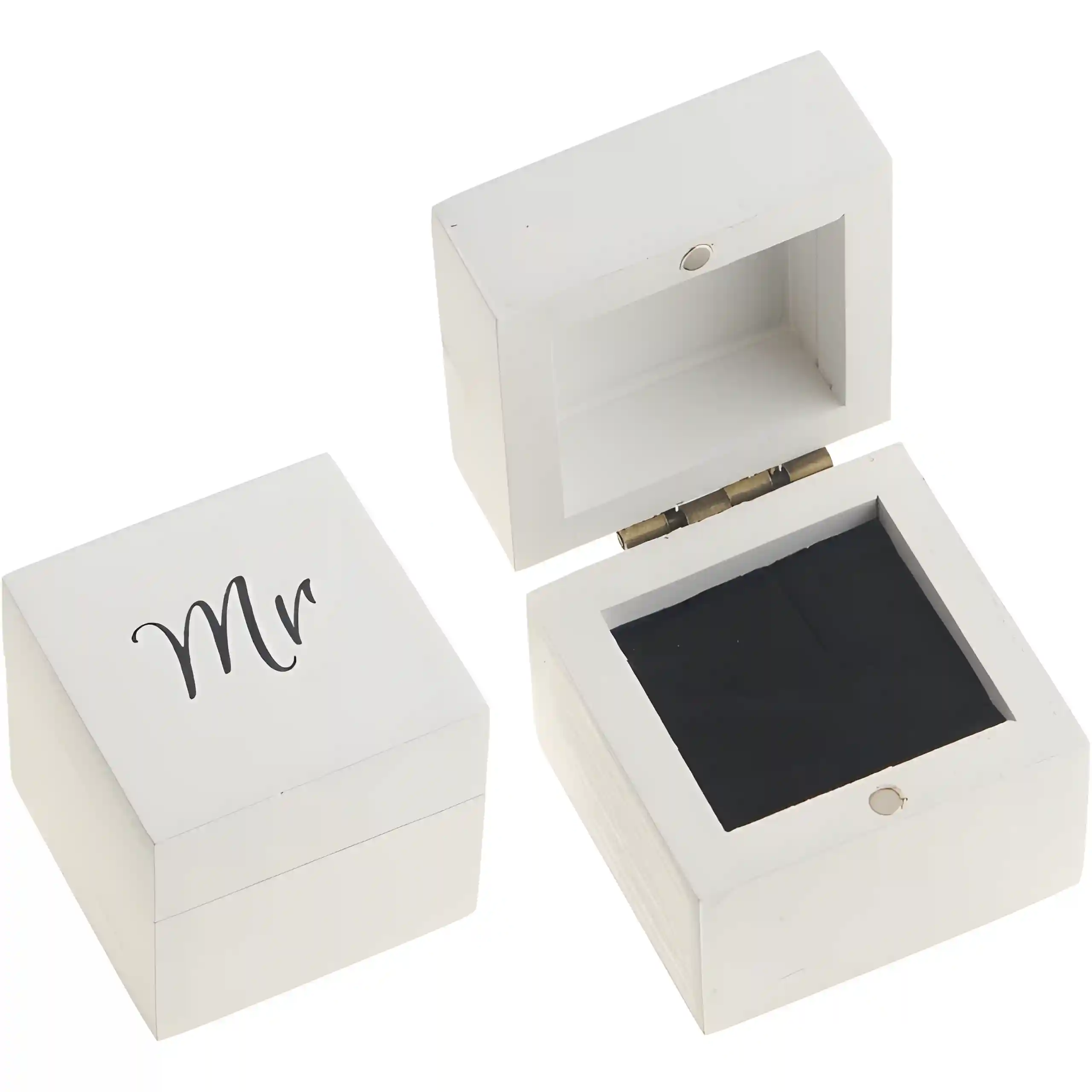
Joyeros de madera blanca con acabado brillante o mate | Cierre seguro, logotipo personalizado | Richpack Bulk Supply
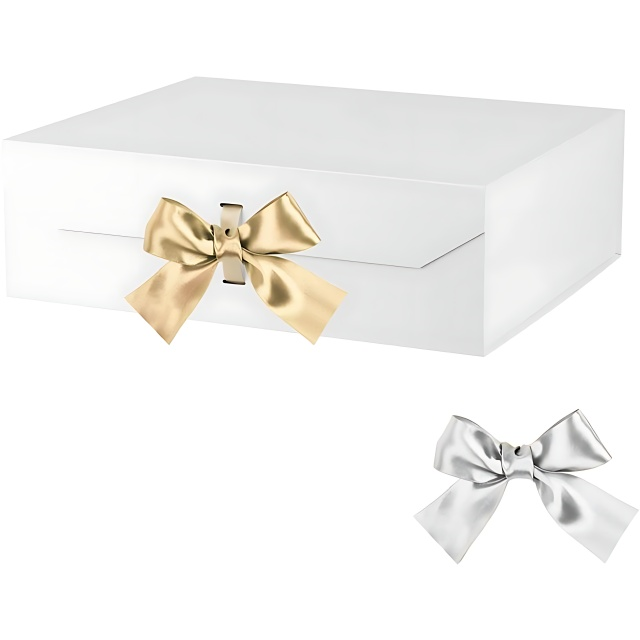
Caja blanca grande con tapa para conjuntos de joyas | Caja rígida blanca con superficie limpia | Envíos a granel personalizados de Richpack
Ver más
Bolsas de regalo en blanco y negro: clásicas y resistentes: presente obsequios elegantes para cualquier ocasión
Ver más
Cherished Richpack Anniversary Memory Box: protege y revive tus momentos más preciados
Ver más

