


Pick the wrong wood and your jewelry box undermines the product inside it.
I’ve sourced and specified wood for hundreds of custom jewelry packaging projects, and the material choice significantly impacts everything: perceived value, durability during shipping, how well a finish holds up, and whether a box actually protects what’s stored in it.
This guide covers the 6 best woods for handmade jewelry storage: walnut, cherry, maple, cedar, mahogany, and bamboo. For each one, you’ll get the real properties that matter for jewelry packaging. Not just how it looks, but how it performs. Ultimately, a practical framework helps you match the right wood to your specific brand and customer.
Not ready to read the full guide? Here’s the short version.
The overall best woods for custom jewelry boxes are walnut, cherry, maple, cedar, mahogany, and bamboo.
| Wood | Janka Hardness | Best Use Case | Sustainability |
| Walnut | 1,010 lbf | Premium fine jewelry, keepsake boxes | Moderate |
| Cherry | 950 lbf | Heirloom and bridal collections | Good |
| Maple | 1,450 lbf | Modern brands, white/engraved boxes | Good |
| Cedar | ~350 lbf | Interior lining, tarnish protection | Good |
| Mahogany | ~900 lbf | Traditional luxury, large production runs | Variable |
| Bamboo | ~1,380 lbf | Eco-positioned brands, cost-sensitive runs | Excellent |
Read on for the full breakdown of each material, what to avoid, and how to match the right wood to your brand.
Wood is not a generic material. Two boards can look similar and behave completely differently under a router, in humidity, or after a year of daily use.
Here’s what actually separates good jewelry box wood from the rest.
A jewelry box takes more physical abuse than most people expect.
It gets shipped in a courier box, handled by retail staff, set on countertops, and opened and closed hundreds of times. A soft wood shows dents and surface marks quickly. Those marks signal poor quality before a customer has even looked at the jewelry inside.
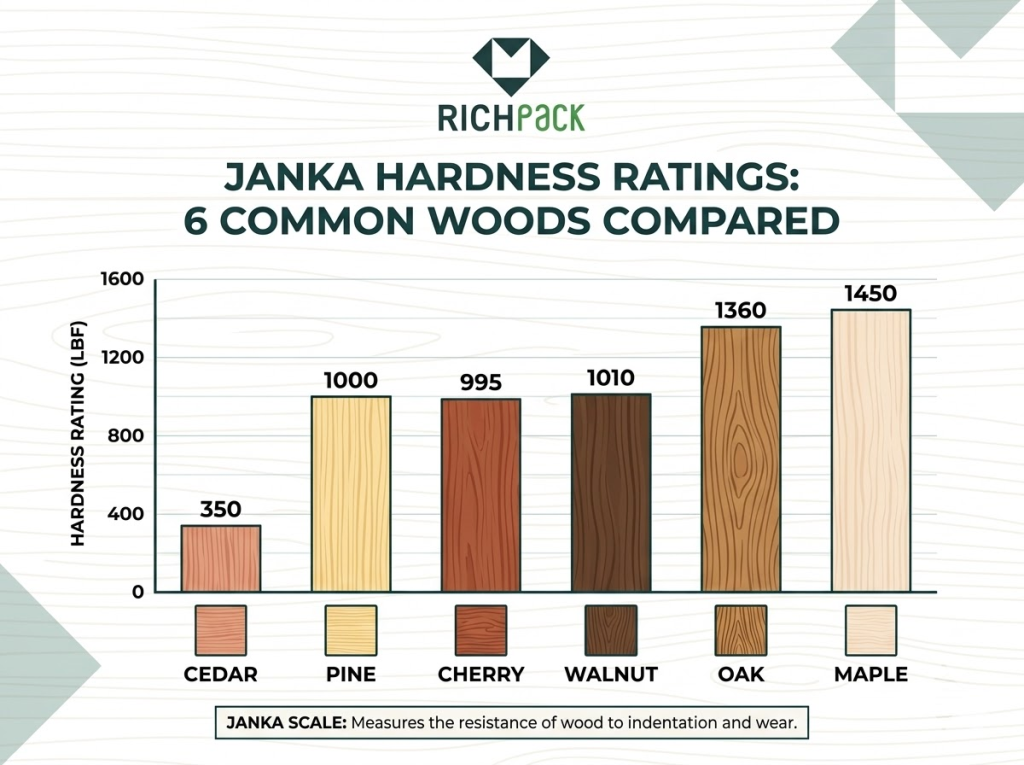
Hardness is measured on the Janka scale. For exterior jewelry box panels, you want a rating above 900 lbf. Hard maple sits at 1,450 lbf, black walnut at 1,010 lbf, and cherry at 950 lbf. Cedar, at roughly 350 lbf, is too soft for exterior use under heavy handling. It has other properties that make it valuable, though.
Grain affects how a wood looks and how well it holds a finish.
Fine, closed-grain species like maple and cherry create smooth, consistent surfaces that take laser engraving, foil stamping, and lacquer cleanly. Open-grain species like oak can produce uneven results unless the surface is carefully filled and prepared first.
Beyond finish quality, grain carries a visual message. Walnut’s dark, flowing figure reads as sophisticated. Cherry’s subtle warmth reads as artisan and classic. Maple’s near-white consistency reads as modern and minimal. The grain you choose is part of the brand communication. It’s worth treating it that way.
Some woods do more than hold jewelry. They actively protect it.
Eastern red cedar is the clearest example. Its natural oils slow the tarnishing process on sterling silver and copper-based alloys and repel insects. This is why cedar liners appear in antique wooden jewelry boxes that have survived a century of use. The protection is chemical, not just structural.
Walnut and mahogany also contain natural oils that resist moisture absorption and help maintain a stable interior environment. Humidity fluctuation is one of the primary causes of tarnish and metal oxidation, so this property matters more than most buyers realize when specifying materials for long-term storage.
Workability determines how cleanly a wood responds to hand tools, router bits, and joinery.
Cherry and walnut are both excellent for fine woodworking. They cut without tearout, hold detail in carved or routed profiles, and sand to a consistent surface. Mahogany is forgiving and dimensionally stable during the build process, which is why it’s been the standard material for fine furniture and instrument cases for generations.
Bamboo behaves more like a laminated hardwood than a timber species. It cuts cleanly, machines predictably, and doesn’t present the grain-direction challenges that solid wood can.
Material cost scales fast when you’re ordering hundreds or thousands of units.
Maple and cherry are widely available in North America at mid-range prices. Walnut costs more but is still commercially accessible. Mahogany varies considerably. Genuine Honduras mahogany is now CITES-regulated and expensive, while African mahogany (Khaya) is a widely used substitute with similar visual and working properties at a lower price point.
Bamboo is typically the most cost-effective option at production volumes, partly because of its fast regrowth cycle. At any volume, it’s worth clarifying species and grade with your supplier rather than assuming “mahogany” or “walnut” refers to a single consistent material.
Each wood on this list has a specific use case where it outperforms the others. None of them is universally the best choice. The right answer depends on your brand, your customer, and how the box will actually be used.
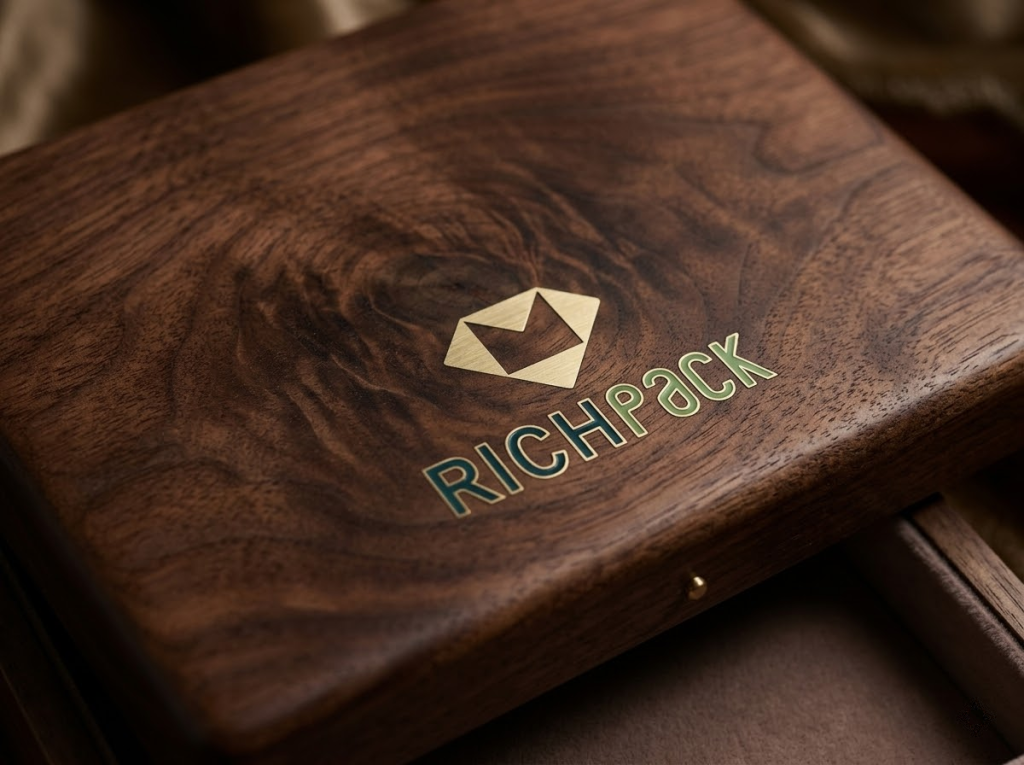
Walnut is the default premium choice for high-end jewelry packaging, and for good reason.
Its deep chocolate-brown color and sweeping grain figure communicate luxury without being ornate. There’s nothing fussy about walnut. It reads as quietly expensive, which makes it a natural fit for fine jewelry brands that want the packaging to reflect the quality of what’s inside.
At a Janka hardness of 1,010 lbf, it holds up well under daily handling. Walnut takes oil and lacquer finishes exceptionally well, developing a surface depth that looks genuinely rich rather than coated.
Cherry is the most interesting wood on this list, because it changes.
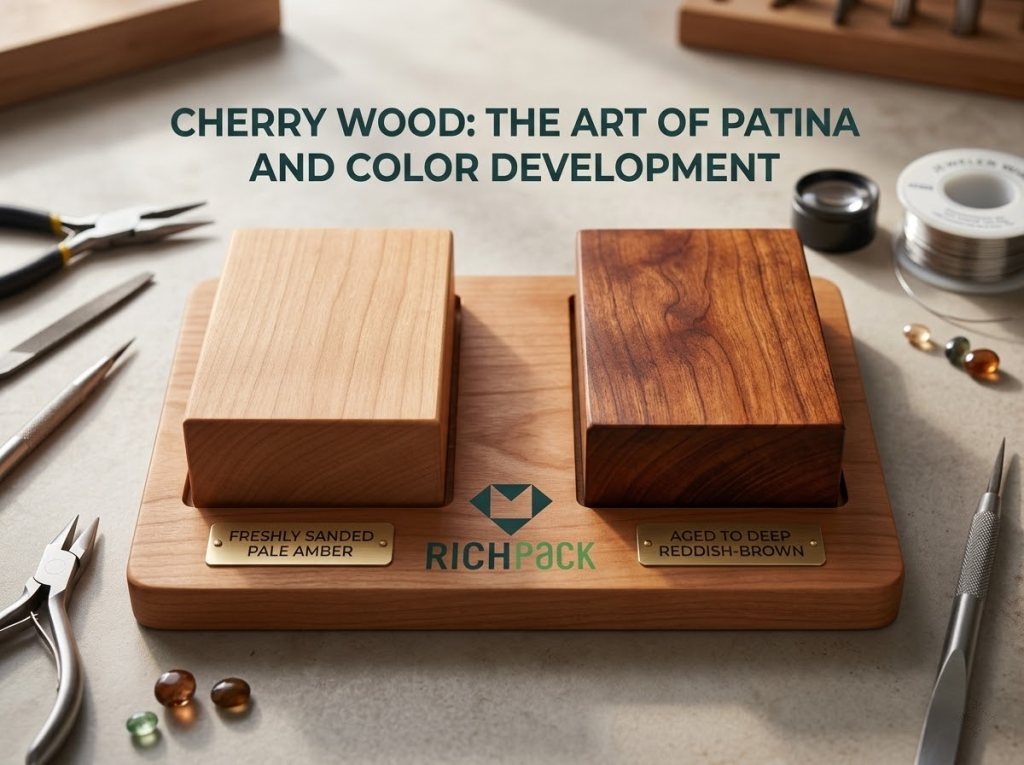
Freshly milled cherry has a pale, almost peachy amber tone. Over months of light exposure, it deepens into a rich reddish-brown with a natural luster that no stain can replicate. A cherry jewelry box at the factory and the same box in a customer’s home a year later look like different, better versions of the same thing.
This aging quality makes cherry uniquely suited for heirloom-positioned jewelry brands. The box doesn’t degrade over time. It develops. Cherry has a Janka hardness of 950 lbf, cuts cleanly in any direction, and takes a clear finish that lets the natural color evolution continue unimpeded.
Maple is the right choice when the wood needs to disappear into the brand.
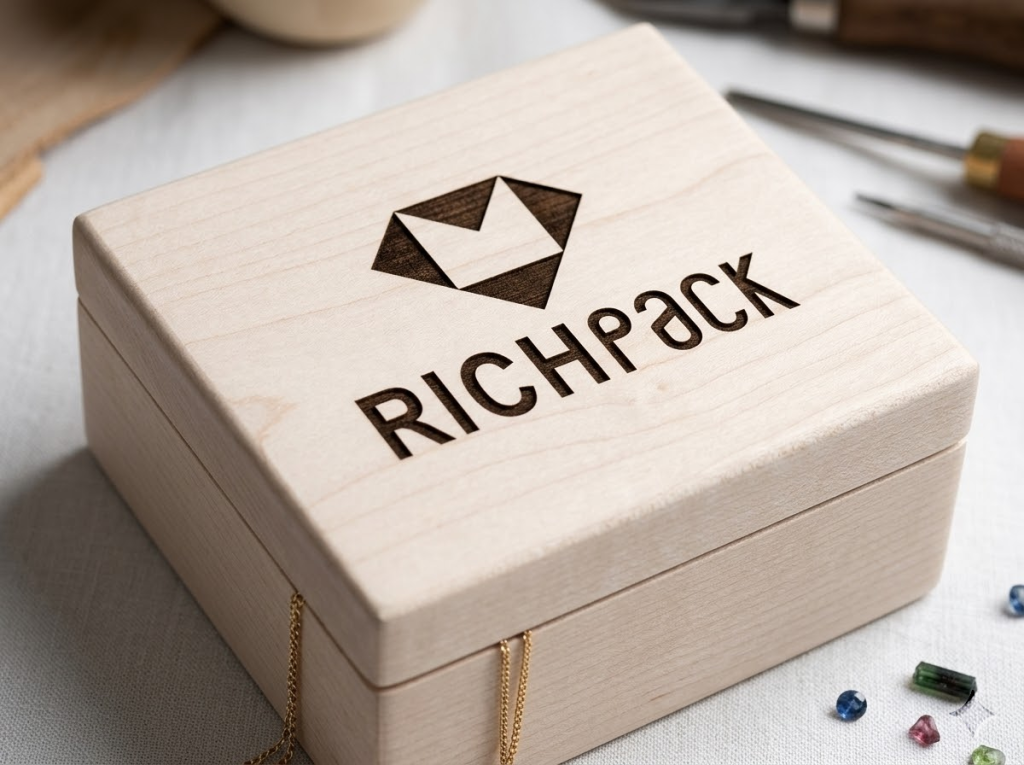
Its near-ivory color and fine, consistent grain create a neutral surface that doesn’t compete with custom printing, engraving, or painted finishes. If your brand calls for a white wooden jewelry box or any light-toned palette, maple is almost always the answer.
With a Janka hardness of 1,450 lbf, the highest on this list, maple is also the most scratch-resistant option. For retail environments where a box gets picked up, examined, and set back down repeatedly, this durability matters. Maple’s tight grain also produces the sharpest laser-engraving results of any species here. Fine brand marks come out clean and consistent at scale.
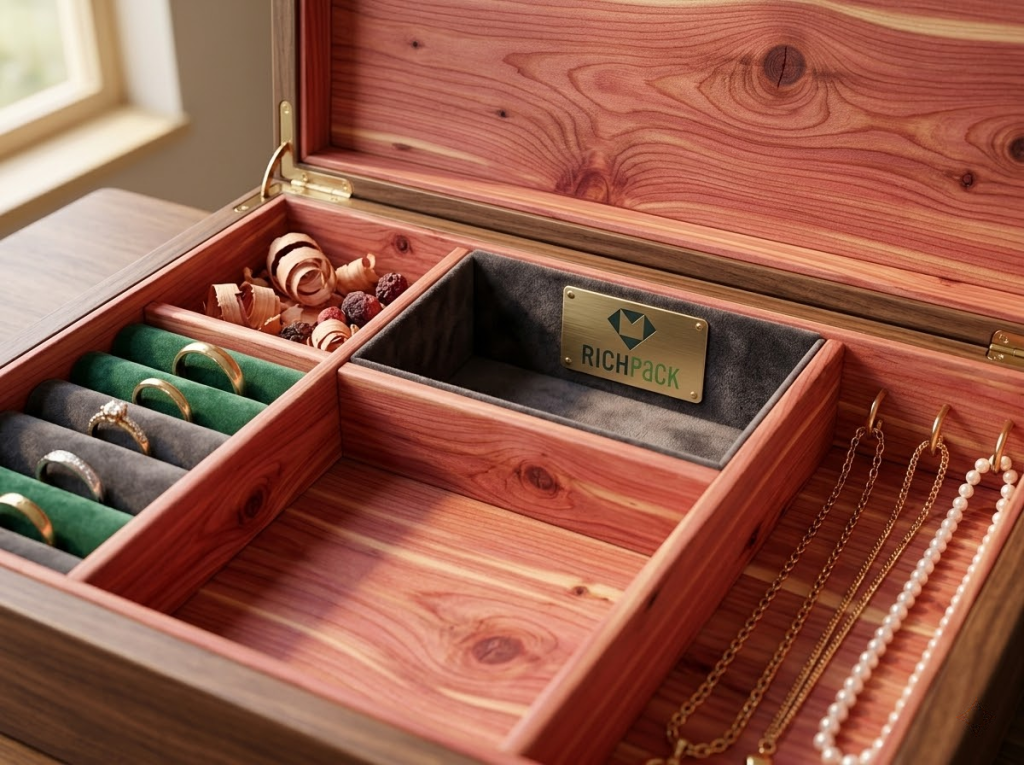
Cedar works differently from every other wood on this list.
Eastern red cedar doesn’t just store jewelry. Its natural oils actively slow tarnishing on sterling silver and copper alloys, and the aromatic compounds repel insects. This is the same chemistry that makes cedar the lining material in vintage jewelry box wooden designs and antique wooden jewelry boxes that have preserved pieces for generations. The protection is real and measurable, not just marketing language.
In practice, cedar is best specified as an interior lining rather than an exterior shell. Its Janka hardness of roughly 350 lbf makes it too soft for exterior panels under regular handling. Pair a harder exterior (walnut, mahogany, or maple) with a cedar interior lining, and you get structural durability outside with functional protection inside.
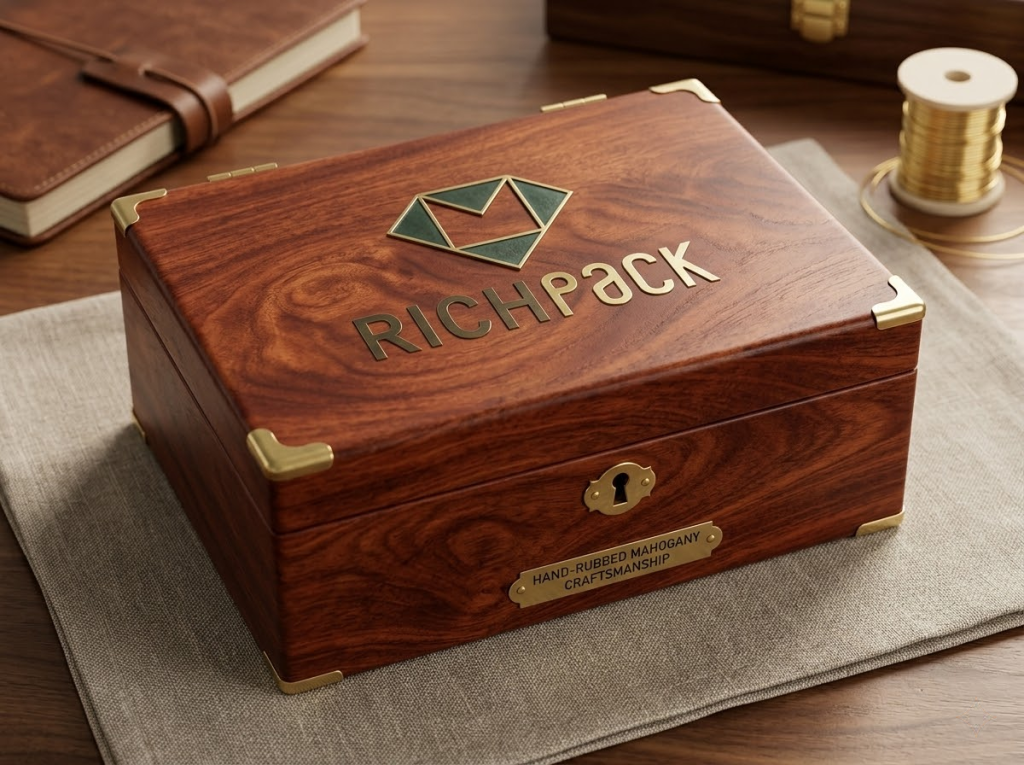
Mahogany has been the benchmark material for fine cases, instrument boxes, and jewelry storage for over a century. Its reputation is earned.
The key advantage of mahogany isn’t color or grain. It’s stability. Mahogany resists warping and shrinking through changes in temperature and humidity better than most species available at commercial scale. This matters when you’re shipping jewelry boxes across climate zones, from a factory in a humid coastal city to a retail store in an arid interior market. A lid that doesn’t close perfectly because the wood moved in transit is a quality failure that reflects on the brand, not the shipper.
Mahogany also accepts virtually every surface treatment cleanly. Lacquers, stains, oil finishes, hand-applied wax, and decorative inlays all sit consistently on its surface. This reliability at scale is why traditional jewelry brands and department store positioning have relied on it for decades.
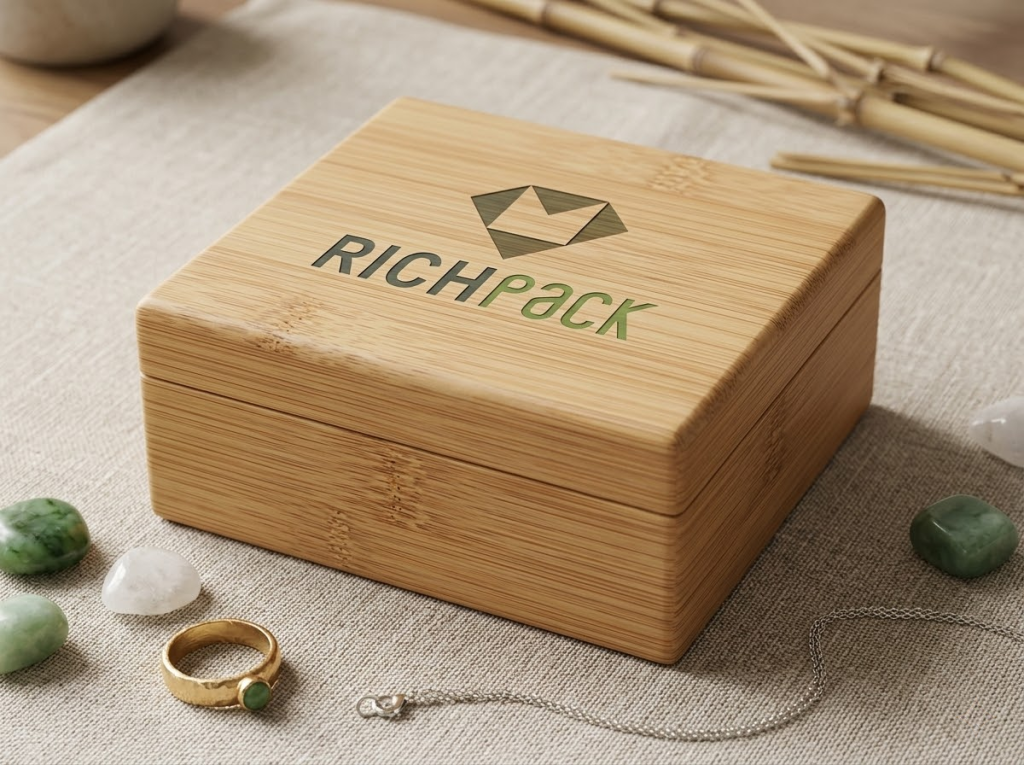
Bamboo is the sustainability argument, and it’s a legitimate one.
It regenerates in 3 to 5 years, compared to 20 to 80 years for the hardwoods above. For jewelry brands targeting consumers who actively evaluate packaging sustainability, bamboo provides a verifiable environmental credential that other materials on this list cannot match. This is an increasingly large segment in most Western markets.
Technically, bamboo is a grass rather than a timber. At production maturity, though, its density and mechanical properties are comparable to medium-hardness woods. It cuts cleanly, machines predictably, and finishes to a smooth, contemporary surface. The linear grain pattern photographs well and has a clean, contemporary quality that suits modern brand aesthetics.
Bamboo also tends to be the most cost-effective material on this list at volume, partly because of its fast growth cycle and increasingly developed supply chain.
The six options above each have a clear use case. The decision comes down to matching the material to your brand’s visual identity, your customer’s expectations, and how the box will actually live in the world.
Here’s how to think through it.
The wood’s visual character should reinforce your brand identity. Not distract from it.
Walnut and dark mahogany read as traditional luxury. Maple reads as modern and minimal. Cherry reads as artisanal and warm. Bamboo reads as consciously sustainable. Cedar, as a lining material, reads as functional care.
A mismatch is more damaging than most brands expect. I’ve seen a contemporary fine jewelry brand pack their rings in mahogany boxes, a wood their customers associated with their grandfather’s study. The disconnect undercut the brand positioning at the moment of opening, which is exactly when packaging needs to do its job.
The box’s lifecycle matters as much as its first impression.
A box that will sit on a dressing table for decades needs different properties than one that functions primarily as gifting packaging. Long-term storage favors dimensional stability (mahogany, walnut), aromatic protection (cedar lining), and resistance to humidity changes. Gift-first applications favor visual impact, finish quality, and engraving clarity.
Retail display applications have their own requirements: scratch resistance matters most when a box is handled by staff and customers dozens of times a day before it ever reaches its final owner.
The most expensive wood is rarely the most important variable in a box that looks and feels premium.
In most jewelry packaging contexts, the finish quality, interior lining, and hardware communicate perceived value more than the specific wood species. A well-executed maple box with quality suede lining will outperform a poorly finished walnut box at a higher price point. Budget by allocating to the elements that the customer actually perceives: the exterior finish and interior presentation. Not the wood species alone.
Not all finishing techniques perform equally across all species.
Laser engraving produces the sharpest results on maple and cherry. Walnut and mahogany engrave well, but with lower natural contrast. Filling engraved marks with metallic paint is a common solution. Foil stamping and silk-screen printing work across smooth-grained species with proper surface preparation, but grain consistency matters for registration at scale.
For light or painted colorways, bamboo and maple provide the most neutral base. For natural wood aesthetics where grain character is part of the appeal, walnut, cherry, and mahogany have the strongest natural figure.

Get clear answers to these before committing to a material:
Knowing what not to use is as useful as knowing what to choose.
Several commonly available wood species look viable but create real problems in jewelry storage applications. Here’s what to skip and why.
Pine is inexpensive, widely available, and completely wrong for fine jewelry boxes.

Its Janka hardness sits around 380–870 lbf depending on species. That’s too soft for exterior panels that will see regular handling. Pine also contains natural resins that can leach out over time and transfer onto finishes or interior linings. Dovetails and mitered corners in pine have a tendency to open up as the wood moves with humidity, which ruins both the appearance and the structural integrity of the box.
For budget-conscious applications, bamboo or maple provide far better results at comparable or only slightly higher cost.
MDF (medium-density fiberboard) and particleboard are not woods. They’re engineered wood composites bonded with adhesives. They’re common in mass-market furniture because they’re cheap, flat, and consistent.
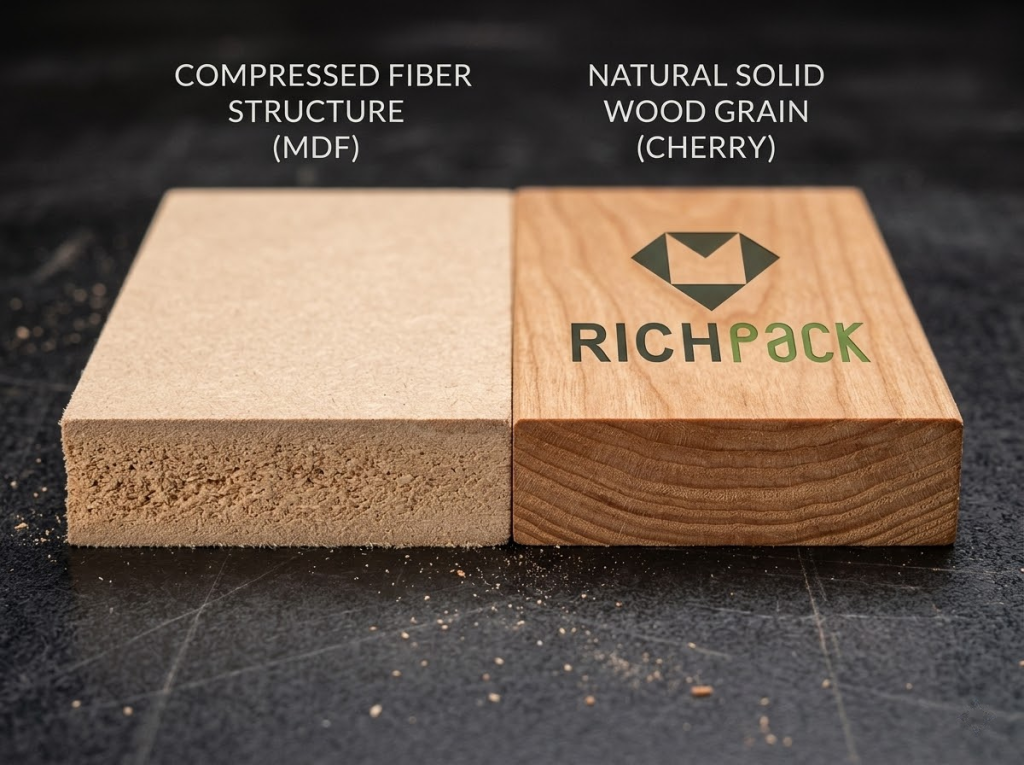
The problems with jewelry packaging are significant. MDF absorbs moisture readily, swells at edges and corners, and does not hold screws or hardware well over time. It also off-gasses formaldehyde from the binders. That’s a real concern for enclosed spaces where delicate materials like pearls and treated metals are stored. A box that looks polished from the outside can be MDF with a veneer; ask your supplier directly if you need to verify what you’re getting.
Red oak is a genuine hardwood, strong, durable, and widely respected for flooring and furniture. For fine jewelry boxes, though, its open grain structure creates finishing challenges that most production environments handle poorly.
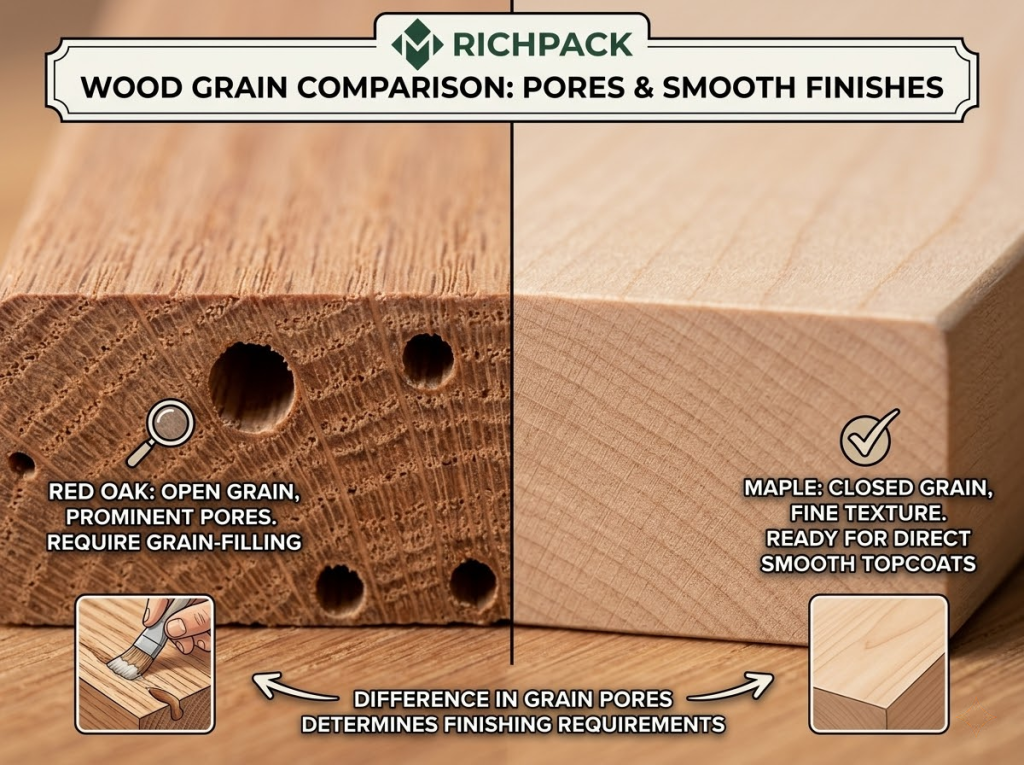
Oak’s large pores require grain-filling before a smooth lacquer or paint finish can be applied. Without this step, the surface telegraphs the grain texture underneath any coating. The result is a slightly rough or pitted finish. This is manageable for skilled custom woodworkers, but inconsistent in production runs.
There’s a second issue that matters specifically for jewelry storage: red oak contains high concentrations of natural tannins. In an enclosed space, those tannins release acidic compounds that accelerate oxidation and tarnishing on silver and other reactive metals. This is the exact opposite of what cedar does. Cedar actively slows tarnishing. Oak actively speeds it up. For custom jewelry packaging at volume, closed-grain, low-tannin species deliver more reliable results on every dimension that matters.
Walnut is the most consistent all-around choice for premium handmade jewelry storage. It combines above-900 Janka hardness, a naturally rich finish, and excellent workability across joinery and surface treatments. Cherry is the better choice for brands positioning around heirloom quality and the natural aging of materials. For the cleanest branding surface, especially for engraving, maple outperforms both.
Cedar is safe and beneficial for most metal jewelry, particularly sterling silver, where its natural oils measurably slow tarnishing. The one nuance: aromatic cedar should not be in prolonged direct contact with pearls, coral, or porous treated gemstones. The natural acidity of cedar oils can affect organic and treated surfaces over time. A fabric barrier resolves this for boxes storing mixed jewelry types.
Maple is the standard choice for a white wooden jewelry box or any light-painted finish. Its pale, consistent grain provides the most neutral base, and its density means paint and lacquer sit on the surface without grain telegraphing through. Cherry and bamboo are reasonable alternatives depending on the specific tone, but maple is the most reliable starting point.
Maple produces the sharpest laser-engraved results. Its fine grain gives clean, high-contrast marks with consistent depth. Cherry engraves similarly well. Walnut engraves cleanly but with lower natural contrast because of its dark base color; filling engraved marks with gold or silver is standard practice. Mahogany engraves well at coarser detail scales but shows less definition on fine brand marks.
Bamboo is the strongest sustainability option by raw regrowth rate: 3 to 5 years versus decades for any timber species. Among conventional wood species, FSC-certified North American maple, cherry, and walnut from managed forests are the most defensible claims. Whatever you specify, ask your supplier for sourcing documentation. Making sustainability claims without verifiable sourcing creates brand risk, not brand equity.
Wood choice is a brand decision as much as a material one.
Walnut signals modern luxury. Cherry signals heirloom craft. Maple signals clean contemporary design. Cedar signals real, functional protection. Mahogany signals proven, reliable premium. Bamboo signals a brand that thinks about what comes next.
Each of these materials has earned its place in quality jewelry packaging. The right fit depends on who your customer is, what the box will be used for, and what story your packaging needs to tell at the moment it’s opened.
If you’re sourcing custom wooden jewelry boxes and want to get the specification right from the first production run, RichPack works with all six species across a full range of finishes, linings, and production volumes. Get in touch. We’ll help you match the material to the brand.

Just submit your email to get exclusive offers (reply within 12 hours)





 PREV
PREV