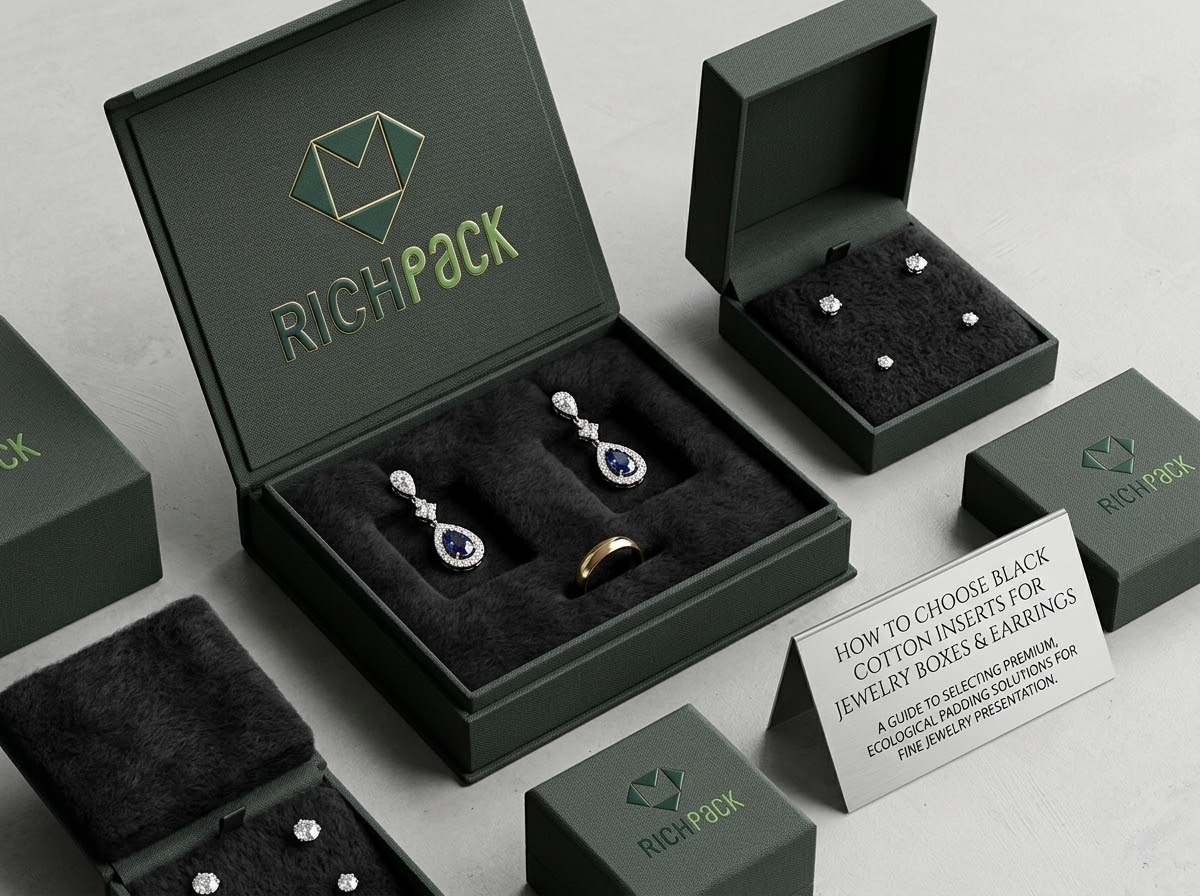


I’ve worked with jewelry brands across price points — from indie designers doing 500 units to established labels running 50,000-piece seasonal collections.
The one thing they all eventually figure out: the insert determines how the jewelry feels before anyone touches it.
Black cotton inserts are the most requested format for a reason. This guide breaks down exactly how to choose the right one — for your earring styles, your box types, and your brand.
Before you start comparing suppliers, it helps to understand what makes black cotton inserts different from other packaging materials.
A jewelry insert is the shaped inner component that holds pieces in position and presents them when the lid opens.
Black cotton inserts use a structured core — usually compressed cardboard or low-density foam — wrapped tightly in a cotton facing. The cotton layer protects the jewelry surface, absorbs minor impact during shipping, and creates a clean presentation backdrop.
The insert does three things at once: it secures the piece, it presents it, and it signals quality before the customer has touched anything.
Black works optically. Against a black background, gold reads warmer, silver reads crisper, and gemstones pull focus the way they’re meant to.
Cotton works tactually. It has a weight and softness that synthetic linings don’t replicate. When a customer opens a box lined with well-made cotton, the material communicates care — before they’ve even looked at the jewelry inside.
That combination — visual contrast plus tactile quality signal — is why black cotton became the default for mid-to-high-end jewelry packaging worldwide.
Each material has a different role depending on your brand positioning and price point.
| Material | Appearance | Feel | Best fit |
| Black cotton | Clean, matte | Soft, structured | Premium and custom brands |
| Black velvet | Rich, plush | Luxurious, deep pile | High-jewelry and gift retail |
| Black foam | Minimal | Firm, functional | Protective shipping, lower price point |
Cotton sits between velvet and foam — more refined than foam, more versatile than velvet.
Not all black cotton inserts are the same format. The type you need depends on what jewelry you’re packaging.
A flat cotton-wrapped pad that sits inside the base of the box. No slots, no cutouts.
Flat pads work for stud earrings that push through a thin card layer, or for display-style boxes where the jewelry rests on a surface rather than being held in place.
They’re the simplest format and the easiest to source at low MOQ.
A cotton-wrapped card with pre-cut slots that hold earring posts, pendants, or small rings.
This is the most common format for earring packaging. The slots grip the post and keep the piece upright and centered when the lid opens.
Slot width and depth matter — too tight and posts bend, too loose and pieces shift during shipping.
A horizontal bar or curved form wrapped in cotton, designed to hang hoop earrings or display curved pieces without distorting them.
Hoops need a different support geometry than posts. A slotted card insert will scratch or misshape a hoop. A T-bar or curved bar insert holds the shape correctly and presents it cleanly.
A multi-level insert with different zones for different piece types — earrings in one section, a ring in another, a pendant in a third.
Tiered trays are common in gift sets and multi-piece collections. They require precise interior dimension planning, since each tier needs to fit within the box without compressing the pieces above or below.
Inserts cut to a specific shape to cradle a unique piece — an irregular pendant, a statement earring, a sculptural object.
Die-cut inserts require a cutting die, which adds tooling cost. But for signature pieces or hero products, a custom-fit insert communicates that the packaging was designed specifically for that piece.
Earring packaging fails most often because the insert wasn’t chosen with the specific earring geometry in mind.
Post earrings need a slot that grips the post firmly enough to keep the piece upright, but not so tightly that the post bends during removal.
Standard slot width for stud posts is 1.5mm to 2mm. If your posts are thicker — common on heavier statement studs — spec a wider slot with a firmer cotton facing to maintain grip.
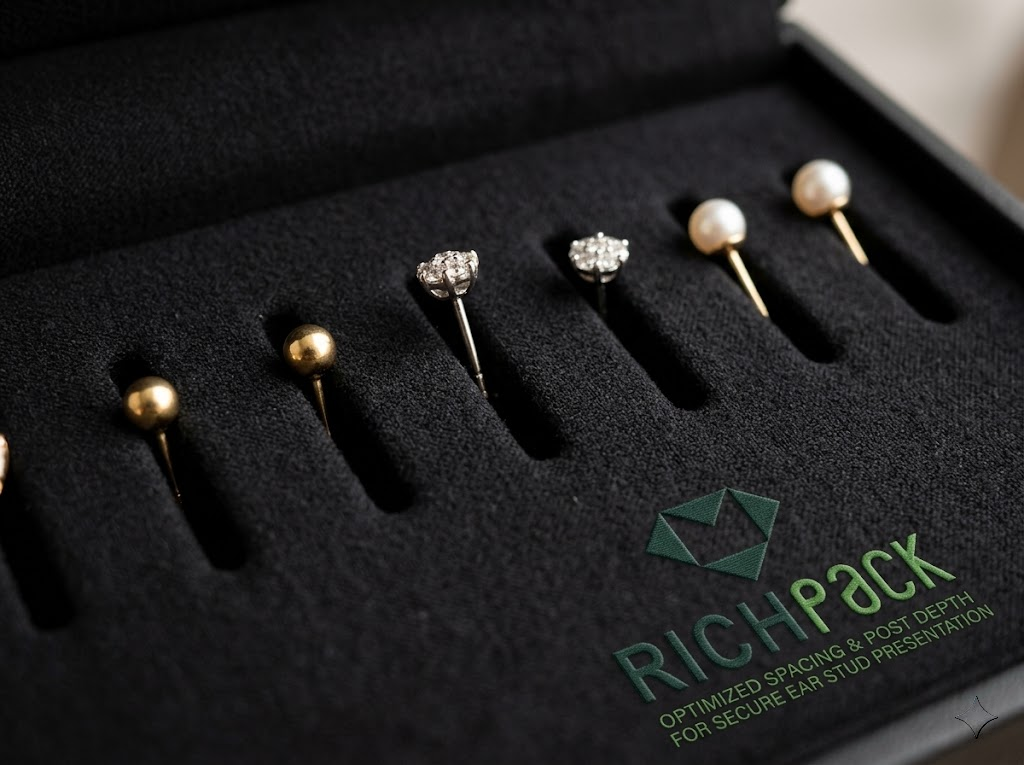
Drop earrings need both post grip and clearance for the hanging element.
The insert slot should hold the post at the top while leaving enough vertical space below so the dangle hangs freely without pressing against the box base. Measure your longest dangle and confirm the insert depth allows clearance.
For heavy drops, the slot needs to support the weight without the cotton facing tearing at the slot edge over time.
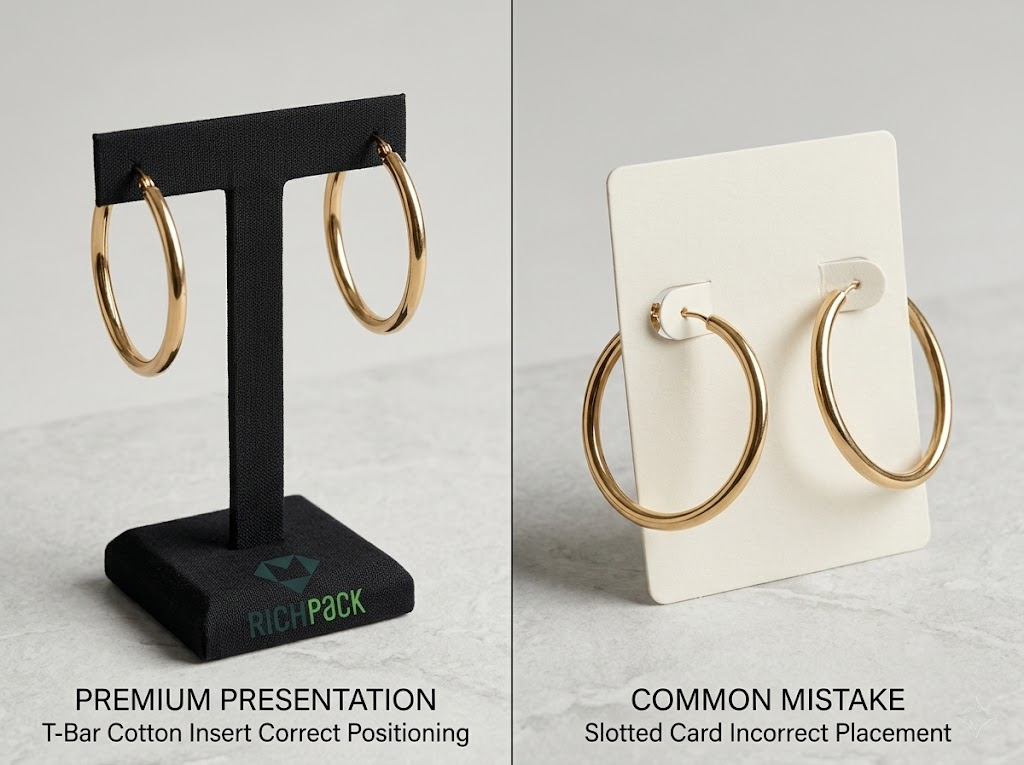
Hoops are the most commonly mispackaged earring type.
A slotted card insert designed for posts will scratch or deform a hoop. Hoops need a T-bar or curved form that matches the inner hoop diameter. The support should contact the inside of the hoop, not the outer face.
Oversized earrings — architectural, sculptural, or heavily textured pieces — often don’t fit standard insert formats at all.
For statement pieces, a die-cut insert or a flat cotton pad with a custom card overlay is usually the right call. The goal is to support the piece without the insert being visible or competing visually with the earring itself.
When packaging two or more pairs together, the spacing between slots matters as much as the individual slot fit.
Slots placed too close together cause earrings to touch during shipping. A minimum of 15mm between adjacent posts is a practical baseline for most earring types. For pieces with wider or more complex silhouettes, increase that spacing or move to a tiered tray format.
Inserts don’t exist in isolation — they have to work with the box they sit inside.
Ring boxes use a narrow, tall insert — a ring roll or a slot cut into a thick cotton pad — that holds the band at an angle for presentation.
The insert height determines how much of the ring is visible when the lid opens. Too low and the ring disappears into the box. Too high and the lid won’t close cleanly.
For rings with high settings or large stones, confirm that the stone clears the box lid interior when closed.
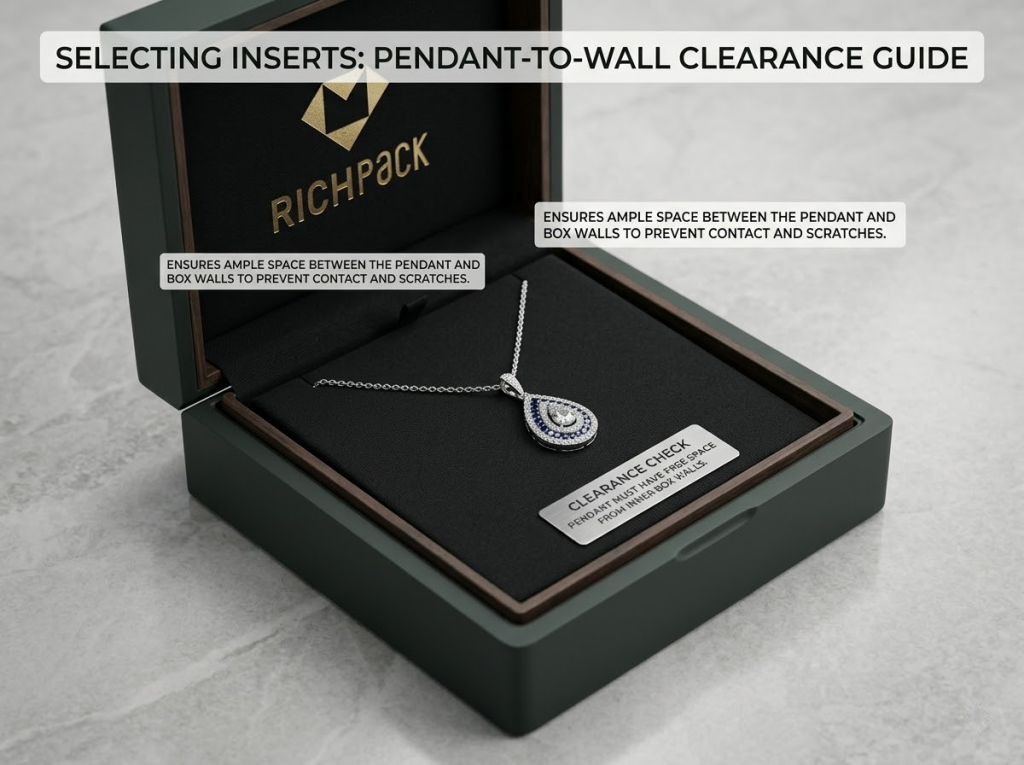
Necklace inserts are typically flat pads with a small hook or slot at the top to hang the clasp and a curved base to support the pendant.
The box depth needs to accommodate the full pendant drop without the piece folding or pressing against the base. Chain necklaces are often coiled and placed flat — in that case, a flat cotton pad with a shallow recess works better than a hanging insert.
Bracelets need a curved or cylindrical insert that matches the inner diameter of the piece.
A bracelet placed flat on a pad shifts during shipping and arrives tangled or scratched. A properly sized bracelet pillow — a cotton-wrapped cylindrical form — holds the piece in shape and presents it cleanly.
Bangles are rigid and can usually sit on a flat pad without shifting, but a snug-fit cylinder insert prevents rotation marks on the inner surface.
Gift sets require insert planning from the earliest design stage, not as an afterthought.
Map out which pieces go in which zone, then design the insert around actual piece dimensions — not standard sizes. The most common mistake is designing the box exterior first and then trying to fit the insert inside whatever space is left.
Leave clearance between compartments. Pieces from adjacent zones shouldn’t be able to touch, even if the box is tilted or dropped.
The insert type affects how the box functions — not just how it looks.
For hinged boxes, the insert needs to sit flush against the base without pushing up against the lid when closed. Two-piece boxes give more vertical flexibility but require the insert to be stable without a lid holding it in place.
If you’re using a magnetic closure box, confirm the insert doesn’t interfere with the magnet position — a misaligned insert can weaken the closure or cause the lid to sit unevenly.
Ordering inserts without the right specifications is one of the most expensive mistakes in packaging production. Here’s what to verify before you commit.
Not all cotton facing is the same weight or weave. A loose, low-GSM cotton facing pills, sheds fiber, and compresses unevenly after a few open-close cycles.
Ask for the GSM (grams per square meter) of the cotton facing. For presentation packaging, 180gsm is a practical minimum. For premium positioning, 200gsm and above gives a noticeably more substantial feel.
Density of the core matters too. A core that’s too soft will compress over time and let pieces shift. A core that’s too rigid won’t conform to irregular jewelry shapes.
Black dye transfers. Especially onto silver, white gold, and uncoated metals.
Request a colorfastness test report — specifically for crocking (dry and wet transfer). The relevant standard is AATCC 8 or ISO 105-X12. If a supplier can’t provide documentation, that’s a red flag.
Run your own test before production: press a damp white cloth firmly against the insert surface for 30 seconds. Any color transfer will show up immediately.
Get slot dimensions in writing — width, depth, and spacing between slots.
Production tolerance of ±0.5mm is standard. Anything looser creates inconsistency across a run — some slots too tight, others too loose. If you’re sourcing inserts separately from boxes, confirm the insert outer dimensions match your box interior exactly. A 1mm mismatch leaves a visible gap or prevents the lid from closing cleanly.
Custom insert MOQs typically run from 500 to 2,000 units per SKU. Standard formats — flat pads, basic slotted cards — are often available in lower quantities from stock suppliers.
Always order a production-representative sample before committing. Specify that the sample should use the same cotton grade, same core density, and same slot tolerances as the production run. Some suppliers send upgraded samples that don’t reflect what they actually produce at scale.
These five questions will tell you quickly whether a supplier is worth working with:
1. What is the GSM of your cotton facing, and what core material do you use?
2. Do your inserts pass colorfastness testing — can you share the AATCC 8 or ISO 105-X12 report?
3. What are your slot dimension tolerances across a production run?
4. Can I order a production-representative sample before committing to MOQ?
5. What is your lead time for custom die-cut inserts from approved sample to delivery?
A supplier who answers all five clearly — with documentation — is one worth working with.
Customization is where black cotton inserts go from functional to brand-defining.
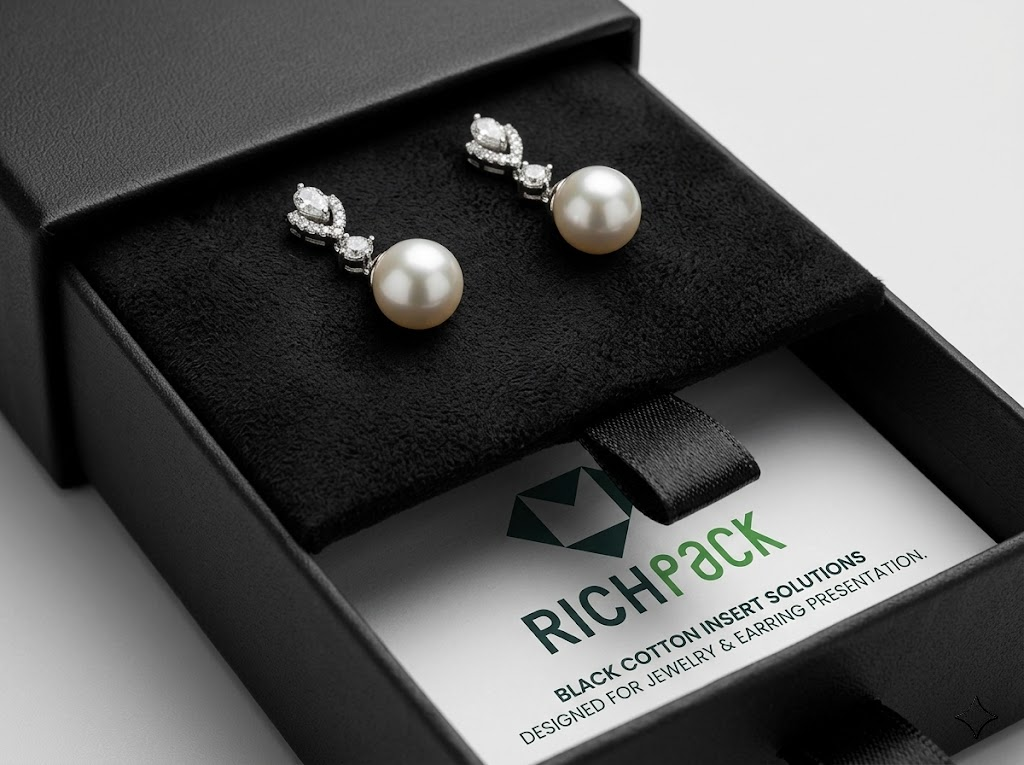
A printed logo card — placed on top of or beneath the insert — adds brand presence without changing the insert construction. It’s the lowest-cost customization with the highest visibility impact.
Ribbon pulls are a thin ribbon tab stitched into the insert base that lets customers lift the jewelry cleanly and deliberately. It’s a small detail. But it reads as considered, and customers notice it.
Black cotton inserts are versatile across exterior box finishes. The combinations that consistently work:
Avoid pairing black inserts with pale pastel exteriors unless the contrast is intentional — it can read as unfinished rather than designed.
An insert doesn’t exist alone. It’s part of a system: the insert, the box, the tissue or fill material, the outer envelope or bag, the ribbon or seal.
The strongest packaging suites are designed as a system from the start — not assembled from separate sourcing decisions. When every element uses the same cotton grade, the same black tone, and the same finish quality, the result reads as intentional.
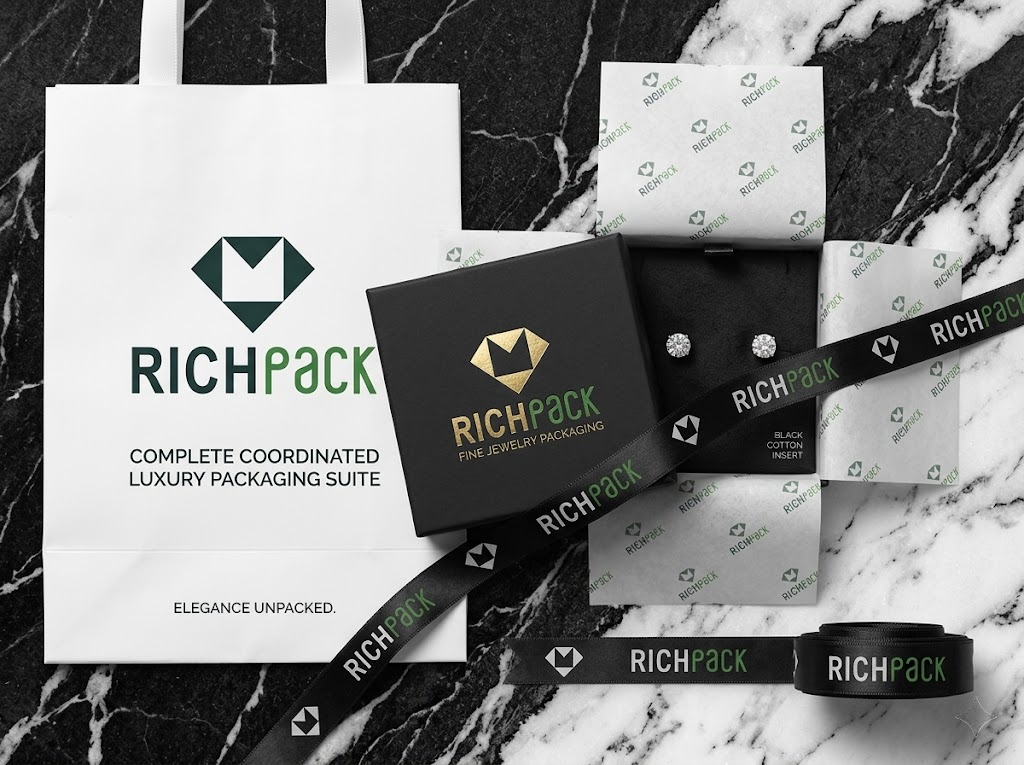
Source inserts, boxes, tissue, and ribbons from four different suppliers create four sets of MOQs, four production timelines, and four potential quality inconsistencies.
A full-service packaging partner handles design, production, and quality control across every component. For brands scaling past their first few thousand units, this is usually the more efficient — and more consistent — path.
Standard custom inserts (custom dimensions, standard construction): 2 to 3 weeks for samples, 3 to 4 weeks for production after approval.
Die-cut custom inserts: 3 to 4 weeks for samples, 4 to 6 weeks for production.
Factor in shipping time and buffer stock. If you’re launching a new collection, start the packaging process at least 8 weeks before your target ship date.
Yes — as long as the cotton passes colorfastness testing. Untreated black dye can transfer onto silver, white gold, and uncoated metals. Any reputable supplier will have a test report. If you’re working with a new supplier, run a transfer test before committing to production.
For custom dimensions and die-cut formats, most suppliers require 500 to 2,000 units per SKU. Standard slotted cards and flat pads are often available in smaller quantities. If you’re early-stage, ask about mixed-SKU MOQs — some suppliers combine formats to meet a single minimum.
Choose inserts with a tightly woven cotton facing rather than a loose-pile finish. Loose cotton sheds more readily onto textured or prong-set pieces. A smooth, tight weave holds together and leaves less residue on jewelry surfaces.
Yes. Most suppliers produce multiple insert formats in a single order as long as you meet the per-SKU MOQ. Specify each format with its own dimension sheet and confirm the supplier has produced that format at your required tolerance before.
From approved sample to delivery: 5 to 8 weeks for standard custom inserts, 8 to 12 weeks for complex die-cut formats. Build in an extra buffer when working with a new supplier for the first time.

Just submit your email to get exclusive offers (reply within 12 hours)





 PREV
PREV