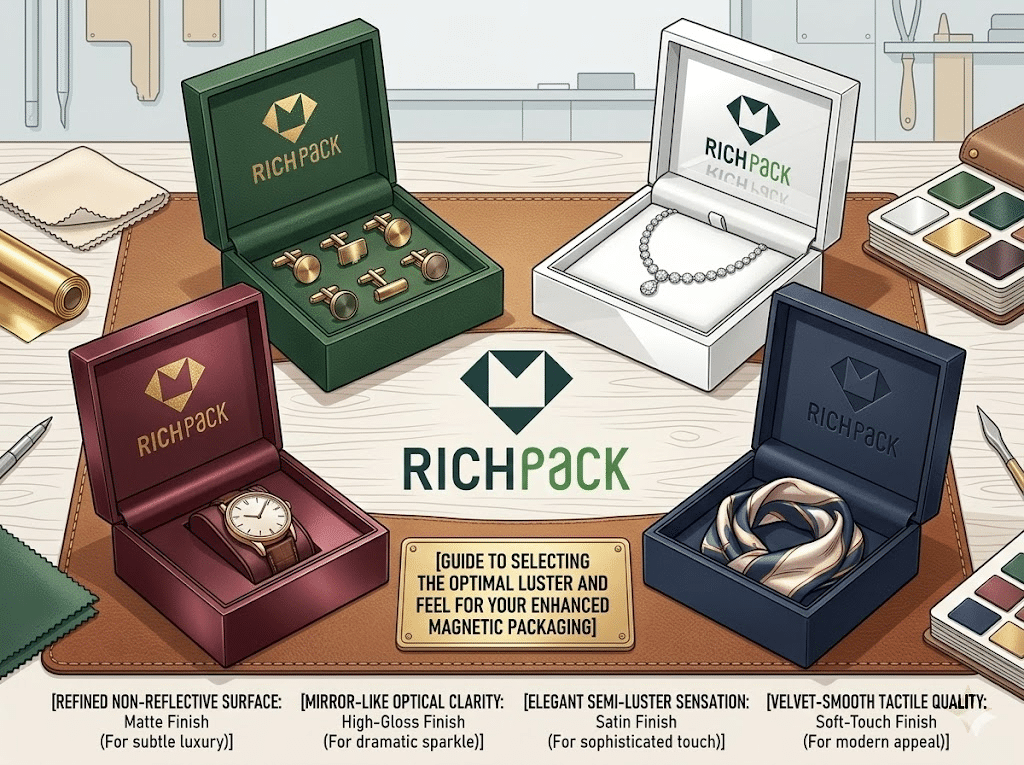


Before a customer reads your logo, lifts the lid, or sees the product inside, they notice one thing first: the surface of the box.
That outer finish does more than decorate a package. It sets expectations. A matte box can feel restrained and elevated. A gloss box feels brighter and more energetic. A soft-touch surface adds a sense of luxury before the unboxing has even begun. In short, the finish helps tell the story of what kind of brand you are—and what kind of product experience the buyer should expect.
The business impact is not small. According to a 2025 report by BrillPack, 81% of consumers have purchased a new product purely because the packaging caught their eye, and 52% are more likely to make repeat purchases from brands that invest in premium packaging. That makes finish selection more than a design preference. It is a brand and conversion decision.
This guide walks through the main finish options used for custom magnetic gift boxes, including what each one looks like, how it feels in hand, where it works best, what it costs, and which combinations tend to perform well. You’ll also find practical advice on lead times, common mistakes, and how to match a finish to your brand position, industry, and budget.
By the end, you should have a usable decision framework—not just a long list of packaging terms.
Many brands spend weeks refining the logo, colors, and photography for a launch. Then the box finish gets chosen at the very end, often as a quick supplier-side decision. In practice, that order should be reversed: finish is one of the first things customers perceive, so it deserves attention early.
A magnetic gift box is handled before it is opened. That first contact creates an immediate quality signal.
Research published in the Journal of Product & Brand Management found that matte finishes score 5.01 for perceived “sincerity,” while glossy surfaces score 4.60 for “competence and modernity.” In other words, surface treatment is already communicating personality traits on your behalf.
That is why many prestige beauty and lifestyle brands lean heavily on matte-laminated rigid boxes. The finish supports the brand message before the product ever enters the conversation.
Packaging is visual, but it is also tactile. The hand often decides what the eye later justifies.
A peer-reviewed study in Marketing Letters (Springer, 2019) found that surface texture influences product perception at the point of contact—consumers form quality judgments from feel alone, independent of visual cues.
For magnetic gift boxes, that insight matters. A velvety or softly coated exterior can make the unboxing feel more considered, more premium, and more gift-worthy. That reaction happens quickly, often before the customer can explain it in words.
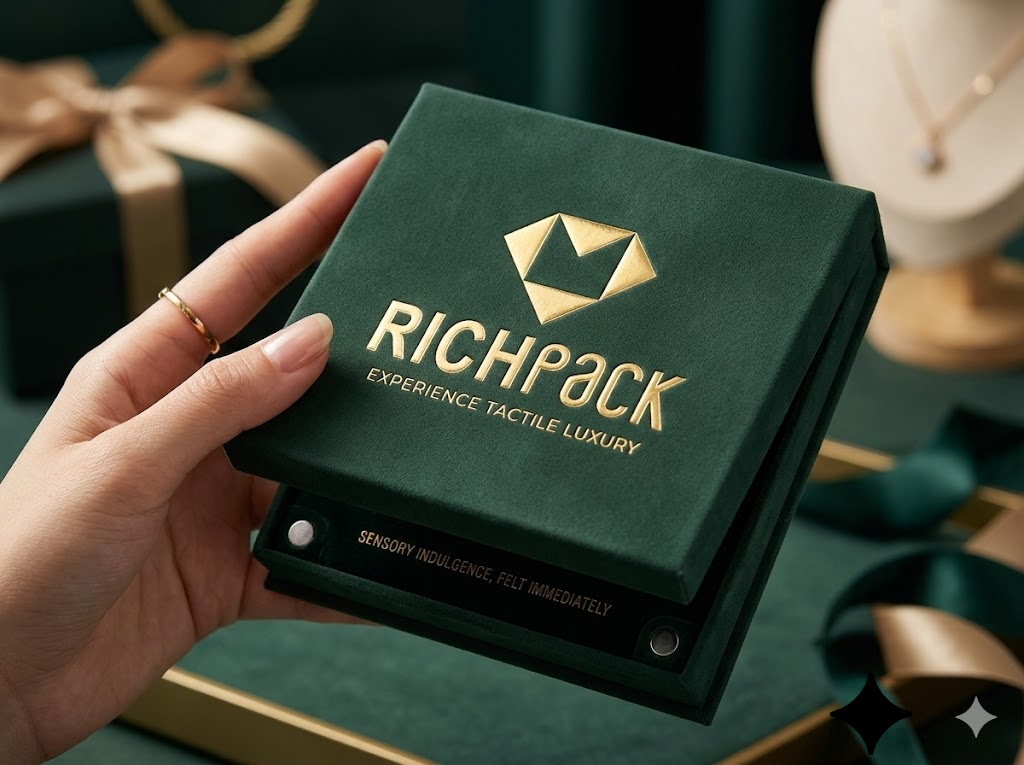
A well-finished box can make the product inside feel more valuable. This matters for premium DTC brands, gifting programs, and any product where presentation is part of the offer.
The same BrillPack 2025 study found that consumers who receive products in high-quality packaging are 52% more likely to make repeat purchases. So while a finish upgrade may only add a modest amount to your packaging cost, it can support repeat purchase behavior, referrals, and a stronger overall brand impression.
For many brands, adding roughly $0.30–$0.80 in finish value to a custom magnetic gift box can materially improve the perceived value of a $50–$200 gift set.
Finishes are not just decorative layers. They affect print setup, color appearance, and special-effect registration.
For example, coating thickness and film sheen can alter how color appears on the final box. A deep navy may look rich under one finish and flatter under another. Soft-touch film can warm some tones slightly; heavy gloss can shift the way printed color reflects under real lighting.
The same is true for foil stamping and embossing. Both depend on precise registration and substrate compatibility. If the substrate or finish changes late in the process, artwork may need adjustment, and tooling may need recalibration.
That is why experienced packaging teams decide to finish early—not after the design is already locked.
Even non-expert consumers notice when packaging feels “off.” They may not identify the exact reason, but they register the mismatch.
A luxury skincare line in a glossy, neon-heavy box may feel more promotional than premium. On the other hand, an energetic gifting brand in a plain, untreated kraft box may feel underdeveloped instead of artisanal.
Finish works best when it supports the full brand equation: category, target customer, price point, tone, and expected experience.
If you request quotes for custom magnetic gift boxes, these are the finishes you are most likely to encounter. Each creates a different visual and tactile signal.
Matte lamination uses a thin outer film that reduces glare and diffuses light. The result is a smooth, flat surface that feels polished without being flashy.
This is one of the most widely used finishes in premium packaging because it communicates control, restraint, and sophistication. It also tends to hide fingerprints better than gloss, which makes it practical for rigid boxes that will be handled often.
The limitation is tactile simplicity. Matte looks elegant, but on its own, it does not create much texture. If you want more sensory impact, matte is often paired with soft-touch coating, foil stamping, or embossing.
Gloss lamination adds a reflective outer film that increases shine and boosts color saturation. If your design relies on bright tones, strong contrast, or shelf impact, gloss can make those elements feel more vivid.
It is often used for more attention-grabbing packaging, including promotional sets, festive launches, and graphic-heavy product lines.
The tradeoff is handling visibility. Gloss tends to show fingerprints, smudges, and light scratches more easily, especially on darker surfaces. That does not automatically make it a poor choice—but it does mean you should test a physical sample in realistic lighting before approving production.
Soft-touch lamination gives the box a matte appearance with a velvety, almost peach-skin feel. It is one of the strongest options if your goal is to create a distinctly premium first impression.
This is a popular finish for beauty, fragrance, jewelry, and luxury gift packaging because it turns the box itself into part of the product experience. It encourages touch, slows down the unboxing moment, and creates a more memorable sensory impression.
Soft-touch also works especially well with foil stamping or spot UV, because the contrast between a soft background and a reflective accent feels intentional and high-end.
Spot UV is a clear, glossy coating applied only to selected areas—often a logo, a pattern, or a key graphic. On a matte box, that selective shine creates contrast without changing the whole surface.
It is one of the most efficient ways to elevate branding. A matte black box with a spot-UV logo generally looks more deliberate and premium than the same box with a standard printed mark.
Spot UV usually requires an additional production step, so it adds a modest cost and a small amount of lead time. For many medium and large orders, however, the visual payoff is strong relative to the added cost.
Foil stamping applies a metallic film—such as gold, silver, rose gold, copper, or holographic tones—to the box using a heated die. Unlike printed metallic ink, foil catches light in a crisp, unmistakable way.
This makes it especially effective for logos, names, initials, and simple brand marks. It is one of the most recognizable finish treatments in premium packaging because it instantly conveys formality and emphasis.
Both hot foil and cold foil are available. Hot foil generally offers sharper edges and stronger reflectivity. Cold foil, applied through UV adhesive, can support finer details and gradient-like effects at a lower unit cost depending on the project.
Embossing raises a design above the surface; debossing presses it inward. In both cases, the effect comes from form rather than color.
These treatments are especially useful when you want customers to feel the brand mark as well as see it. A simple debossed logo on a soft-touch magnetic gift box can look restrained, premium, and highly intentional.
One important production note: embossing and debossing usually perform best on assembled, non-collapsible rigid boxes. The denser, glued structure gives the die enough resistance to create a clean impression.
Beyond the standard finish set, several specialty options can be useful for sustainability goals, higher-touch gifting, or logistics-heavy packaging needs.
Kraft finish typically uses unbleached paperboard with little or no lamination. The result is a raw, fibrous, natural-looking surface that signals authenticity, craft, and environmental awareness.
A peer-reviewed study published in Marketing Letters (Springer, 2019) confirmed that uncoated and matte surfaces increase consumers’ perception of product naturalness, which directly lifts purchase intent in applicable categories.
That makes Kraft a strong option for organic skincare, botanical wellness, and sustainability-led product lines. If your eco story is central to your brand, kraft or aqueous-coated board may support that story more effectively than standard plastic film lamination.
Pearlescent coatings contain fine reflective particles that create a subtle shimmer. The effect is more restrained than foil—less mirror-like, more luminous.
This finish tends to work well for bridal packaging, beauty sets, limited editions, and premium gifting, where softness and elegance are more appropriate than bold contrast.
It pairs especially well with white, blush, champagne, pale gold, and other light palettes.
Holographic foil breaks light into shifting, rainbow-like reflections. It is naturally attention-grabbing and tends to photograph well, which makes it useful for social-forward packaging, seasonal gifting, or youthful lifestyle brands.
That said, it usually works best as an accent rather than an all-over treatment. Applied selectively—to a logo, edge detail, or one panel—it can feel modern and premium. Used too broadly, it can quickly start to read as novelty packaging.
Dark boxes, especially matte black and deep navy ones, often show hairline scratches during transit, retail handling, or warehouse movement. Anti-scratch lamination is designed to solve that problem.
Visually, it resembles standard matte. Functionally, it offers better surface resistance. If your boxes will be shipped in bulk, stored for long periods, or handled by multiple people before final sale, this upgrade is often worth the extra spend.
It is particularly relevant for magnetic gift boxes wholesale orders moving through retail or fulfillment channels.
Aqueous coating is a water-based protective layer applied on press. It can create either a light gloss or matte effect, dries quickly, and contains fewer VOCs than many solvent-based alternatives.
For brands prioritizing recyclability and lower environmental impact, this is often the most practical protective finish. Many recyclable packaging frameworks are compatible with aqueous-coated board.
The compromise is performance. It is generally less resistant to moisture and abrasion than film lamination, so it is best suited to gift boxes that do not need to withstand heavy handling or humid shipping conditions.
A premium exterior followed by a plain grey chipboard interior can weaken the reveal. The inside of the box is part of the experience and should support the same brand message as the outside.
Common interior options include:
The best interior choice depends on the exterior strategy. A soft-touch outside with satin lining creates a cohesive, premium feel. A kraft outside with a custom-printed liner creates a more personal, crafted effect.
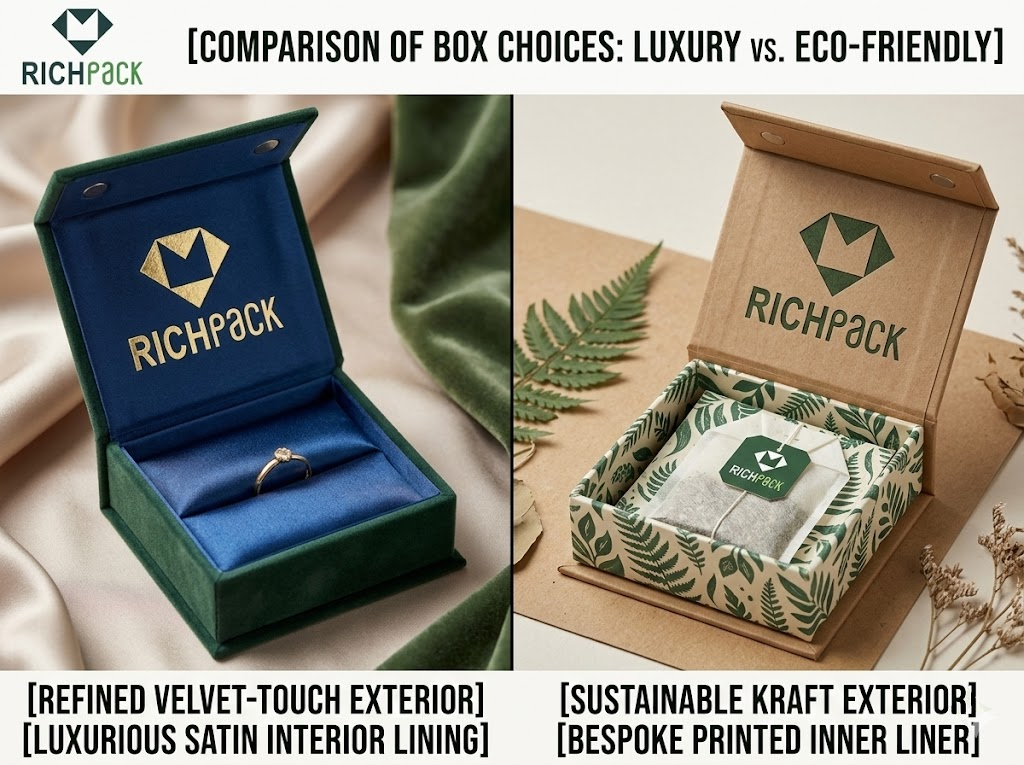
With so many options available, the better question is not “Which finish is best?” but “Which finish fits the product, customer, and brand story best?”
A useful way to narrow the choice is to align the finish strategy with the brand tier.
Ultra-luxury
Premium / polished
Eco / artisanal
Consumers often develop expectations within a category, and packaging that aligns with those expectations can feel more credible.
Beauty and skincare
Matte lamination remains the dominant finish at premium tiers. Soft-touch is increasingly common for hero SKUs and gift sets. Spot UV is often used to highlight the logo while keeping the overall design minimal.
Jewelry
Soft-touch or velvet-feel exteriors, often paired with velvet or satin interiors, are common. Debossed logos work well because the box often becomes part of the keepsake experience.
Corporate gifting
Matte lamination with foil-stamped branding is a common B2B standard. Custom printed interiors can add messaging, event-specific customization, or company storytelling. Collapsible magnetic gift boxes with matte finishes are also popular because they ship flat and assemble later.
DTC ecommerce
The box has to survive transit and still deliver a strong unboxing moment. Matte with spot UV or foil is a dependable combination. Anti-scratch lamination becomes more useful as volume and warehouse dwell time increase.
Combine Finishes With Restraint
The best packaging usually does not use the most finishes. It uses the right combination of finishes with a clear hierarchy.
A classic premium stack is: matte lamination (base) + soft-touch coating (texture) + foil stamping or spot UV (accent). This works because each layer has a job. One sets the tone, one adds feel, one creates focus.
For brands with a tighter budget, matte lamination + spot UV is often the strongest entry point. It creates visible contrast, feels polished, and avoids the extra tooling cost of foil or embossing.
A practical rule: finishes should support one another, not compete for attention.
Finishes vary widely in how they affect cost, and not all upgrades deliver equal return for every brand.
The key is not choosing the cheapest finish. It is choosing the finish that best supports the value of the product being presented.
Standard matte or gloss laminated magnetic gift boxes often run about 10–14 business days after artwork approval. Specialty finishes can extend that timeline.
Foil stamping and embossing require die fabrication, typically adding 3–5 days on first runs. Pearlescent or holographic materials may also require extra sourcing time if the stock is not already on hand.
If your packaging uses multiple special treatments, plan finish selection at least 4–6 weeks before your target in-hand date—more during seasonal peaks such as Q4, Chinese New Year, or Mother’s Day.
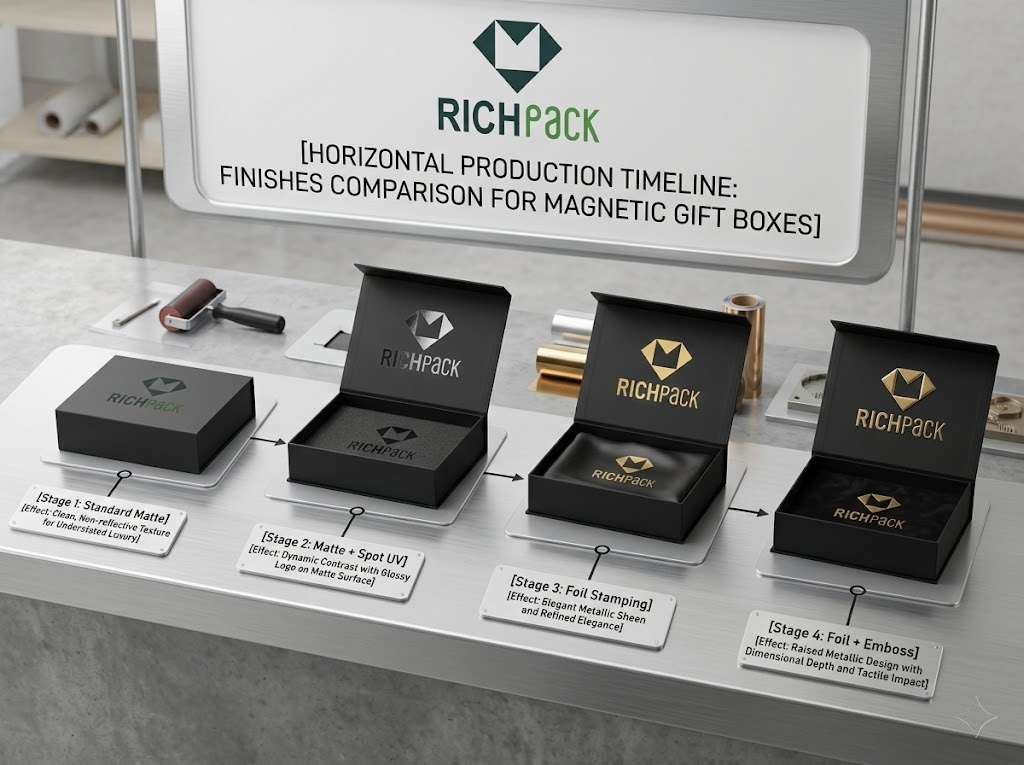
Even experienced buyers make predictable errors when they choose finishes too quickly or too late. These are the ones most worth avoiding.
Gloss often looks strong in mockups and sales decks. In real handling conditions, especially on dark boxes, it can collect visible fingerprints almost immediately.
If you are considering gloss on black, navy, or similarly dark substrates, ask for a physical sample and handle it under realistic conditions before committing.
Gold foil on a dark surface can look elegant—but only if the design is bold enough and the contrast is clear enough.
Very small type, fine lines, or intricate marks may lose sharpness. When detail matters, simplify the artwork or explore alternative foil methods better suited to fine reproduction.
The inside of the box is often the emotional peak of the unboxing moment. If the interior feels unfinished, the reveal loses impact.
A custom-printed liner is often a cost-effective way to improve the inside experience. For more premium product lines, satin or velvet lining can reinforce the value signal.
This is one of the most common process errors. Finish affects color, texture, and production registration. If the finish is selected late, the design may no longer perform as intended on the final box.
The better workflow is simple: choose the target finish early, then design for it.
Luxury rarely comes from stacking every available treatment. A box with gloss, holographic foil, spot UV, and embossing can feel crowded rather than elevated.
A more reliable formula is: one dominant base finish, one supporting texture or accent, and one focal highlight.
Matte lamination is the single most widely used finish in luxury magnetic gift box production. It’s favored by premium beauty, jewelry, and corporate gifting brands for its clean, sophisticated look and its compatibility with secondary effects like foil stamping and spot UV. When paired with soft-touch coating, it creates the tactile depth that defines ultra-premium packaging. Brands like Chanel, Apple, and Jo Malone consistently choose matte-laminated rigid boxes to signal restrained elegance at the first point of contact.
Yes — and this is one of the most effective finish combinations in luxury packaging. Matte lamination provides the clean, non-reflective base; foil stamping adds a precise metallic accent (typically on the logo or brand name) that creates strong visual contrast. The combination works because the two finishes serve different functions — one recedes, one pops. For best results, keep the foil area geometrically clean and simple. Fine-line detail can lose sharpness in the foil transfer process, particularly with standard hot foil on complex artwork.
Soft-touch lamination carries a modest cost premium over standard matte — typically in the range of 5–15% higher per unit, depending on box size and order volume. At most orders above 300 units, the per-box cost difference is relatively small compared to the significant lift in perceived quality it delivers. For brands in the premium or ultra-luxury segment, soft-touch is often treated as a baseline specification rather than an upgrade, because the tactile experience it creates is so strongly associated with high-end packaging in the market.
Matte lamination and anti-scratch lamination are both strong choices for dark-colored boxes — especially matte black, deep navy, and forest green. Standard matte hides fingerprints better than gloss, while anti-scratch lamination adds scuff resistance that’s worth the small premium if the boxes will be shipped frequently or handled in retail environments. Avoid standard gloss lamination on dark-colored magnetic gift boxes unless you’ve tested the sample thoroughly — gloss on dark substrates reveals handling marks quickly, which undermines the premium positioning you’re trying to build.
Standard finishes like matte and gloss lamination typically have no impact on MOQ — most custom magnetic gift box suppliers set their base MOQ at 100–300 units regardless of these treatments. Special finishes involving tooling — foil stamping, embossing, and debossing — require die fabrication, which adds a one-time setup cost that makes very small orders less economical. At 500+ units, foil and embossing become much more cost-effective per box. If you’re testing a new finish for the first time, request a pre-production sample or prototype before committing to the full run.
Aqueous coating is the most commonly recyclable finish for rigid magnetic gift boxes. It’s water-based, low in VOCs, and compatible with most recyclable packaging certification programs. Kraft board with no lamination is the most minimal option overall — though it provides limited surface protection. If full recyclability is a hard requirement, avoid BOPP or PET film laminations (including standard soft-touch), as plastic film can complicate the recycling stream. Some suppliers now offer bio-based soft-touch coatings as a more sustainable alternative — worth asking about if environmental certification is a brand priority.
Embossing and debossing produce their best results on assembled (non-collapsible) rigid magnetic gift boxes. The fixed chipboard construction provides the structural resistance needed for a clean, deep die impression. On collapsible magnetic boxes — which use thinner, scored boards designed to fold flat — the substrate lacks the rigidity for precise relief work, and fold lines near edges can interfere with registration. For collapsible magnetic gift boxes, spot UV or foil stamping are better option for adding logo definition and a premium surface detail.
Ideally, decide your finish before the artwork is finalized — not after. Coating thickness and film sheen both affect how colors render on the finished box. Gloss lamination makes colors appear more vibrant; matte and soft-touch can slightly shift color tone on certain Pantone shades. Foil and embossing require specific design parameters and substrate compatibility checks. Sharing your finish specification with your designer from the beginning lets them calibrate contrast ratios, color selections, and design element scale to perform correctly on the chosen surface — saving you a costly revision round later.
The finish on a magnetic gift box is not a minor cosmetic detail. It shapes the first impression, influences perceived value, and helps determine whether the packaging feels aligned with the product inside.
If you are choosing among finishes, start with three questions:
1. What brand signal do you want the box to send?
2. How will the box be handled—in retail, ecommerce, gifting, or all three?
3. Which finish combination supports that goal without adding unnecessary complexity?
From there, the path becomes clearer. Matte remains the safest premium baseline. Soft-touch adds tactile luxury. Spot UV and foil create focus. Kraft and aqueous coating support sustainability-led brands. And in every case, a physical sample tells you more than a digital render ever will.
At richpkg, we help beauty brands, jewelry labels, and corporate gifting teams develop custom magnetic gift boxes with finish strategies designed for both visual impact and real-world performance. From sampling through production, we work through the details with you.
Finish works best when it supports the full brand equation: category, target customer, price point, tone, and expected experience.

Just submit your email to get exclusive offers (reply within 12 hours)





 PREV
PREV