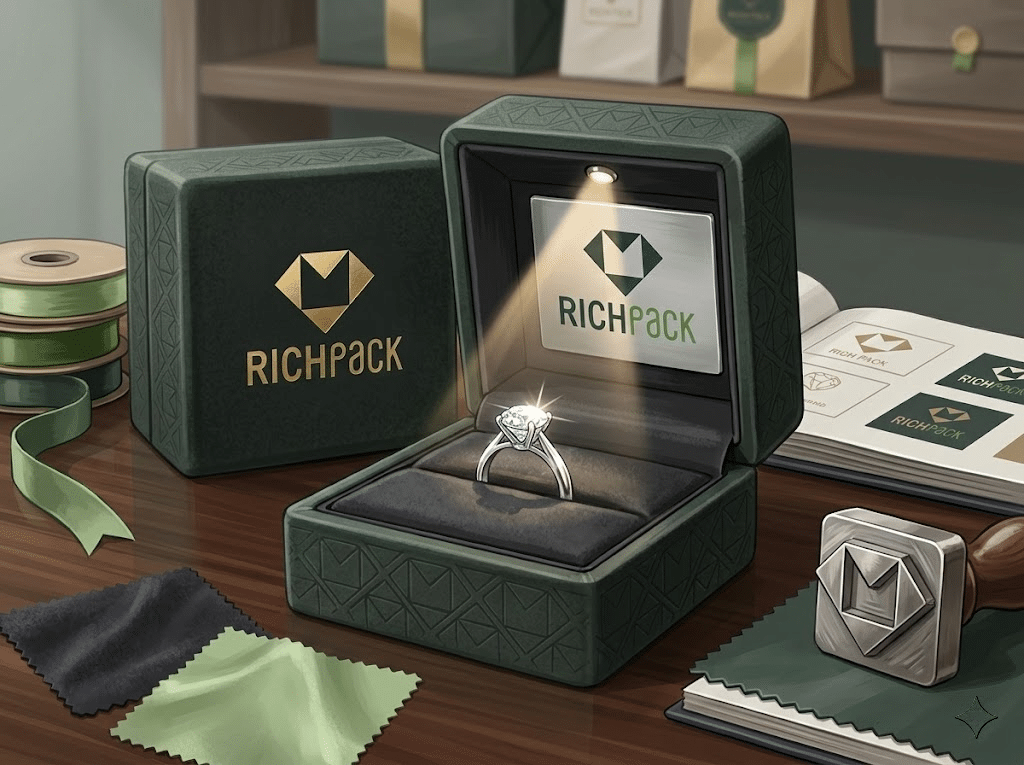



The lid opens. Light floods the stone. For one second, your customer sees only the ring — lit exactly as you planned.
That moment is not an accident. It is built.
Most jewelry brands put everything into the piece itself. Then they lose the reveal with plain packaging that falls flat. A well-made luxury ring box with light fixes that. It turns a handoff into a moment. It turns a buyer into someone who films it, posts it, and tells their friends.
This guide covers every choice you need to make. You will learn which LED setup is best for your brand. You will see which materials work best with built-in lighting, how to add your branding, and how the full production process works. You will also learn how to choose a supplier who can deliver. Whether you run a fine jewelry label, an e-commerce store, or source private-label packaging as an OEM buyer, this is your road map.
Before picking materials or LED types, it helps to know what a lighted ring box does for your brand. The business case is stronger than most buyers expect.
According to a 2025 Influencer Marketing Hub report, jewelry unboxing videos receive over 14 billion views per year on YouTube. Jewelry ranks in the top five product categories on the platform. When a customer films your box opening and light hitting the ring, that clip becomes content. It gets shared on Instagram, TikTok, and YouTube at no cost to you.
The numbers back the investment. According to a 2026 Richpack industry report, 61% of online shoppers link premium packaging to higher brand quality. The same report found that 40% would share a product on social media if the packaging was unique enough. A well-made, lighted ring box meets both tests at once.
The commercial case is clear. Rolex’s LED-lit watch presentation boxes drove a 140% rise in social mentions after launch. According to data cited by CaratX, the result shows illuminated packaging is not cosmetic — it is a brand tool with measurable output.
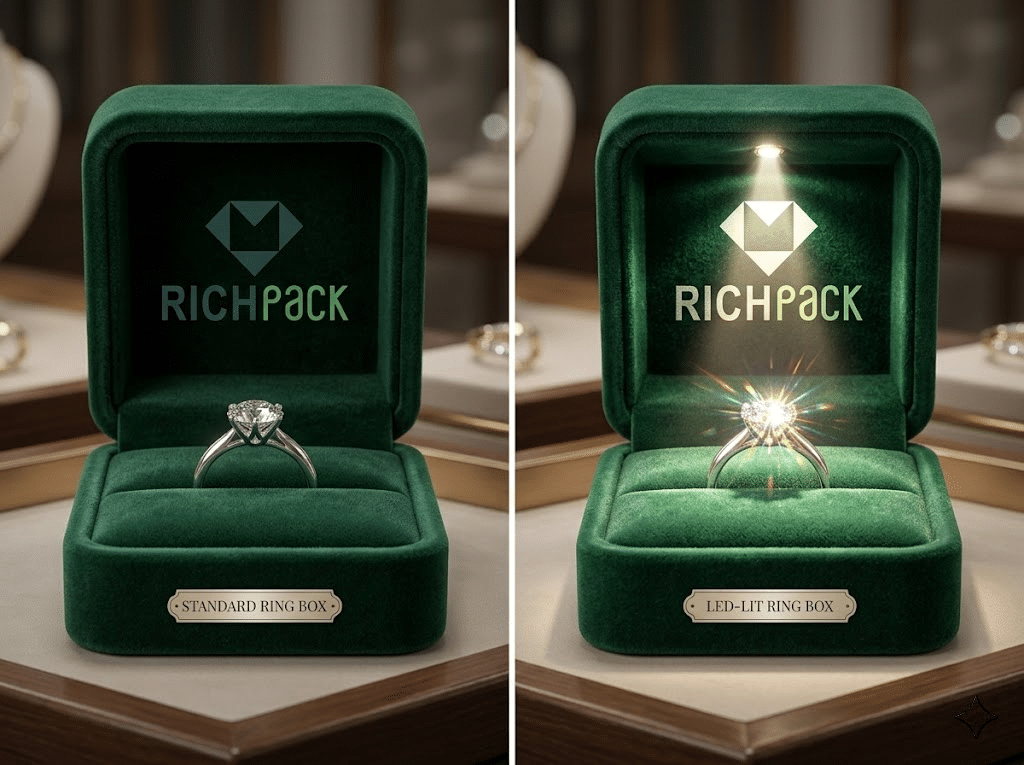
Diamond brilliance is not built in — it is triggered by light. Fine jewelry looks different under a well-aimed display light than in a regular room. The right angle and color temperature bring out a stone’s fire, sparkle, and depth.
Retail studies confirm that jewelry displays with targeted lighting see a 15% to 20% sales lift over unlit cases. When your ring box opens, and the LED turns on, it matches the effect of a pro display. That happens right at the moment your customer receives the piece.
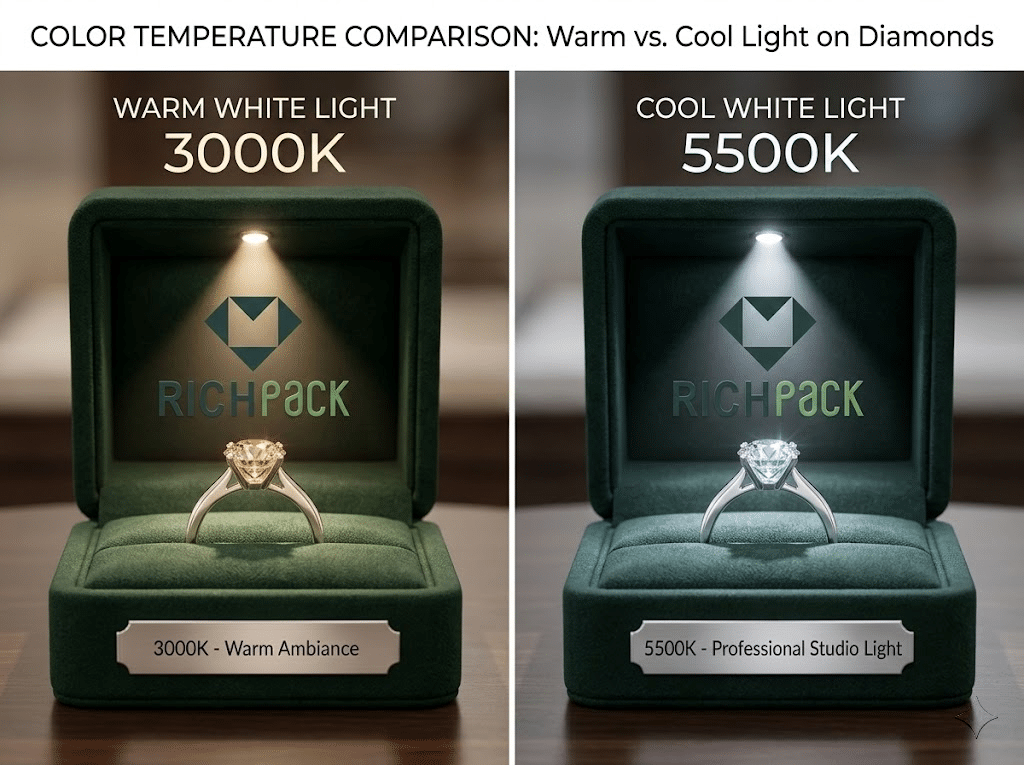
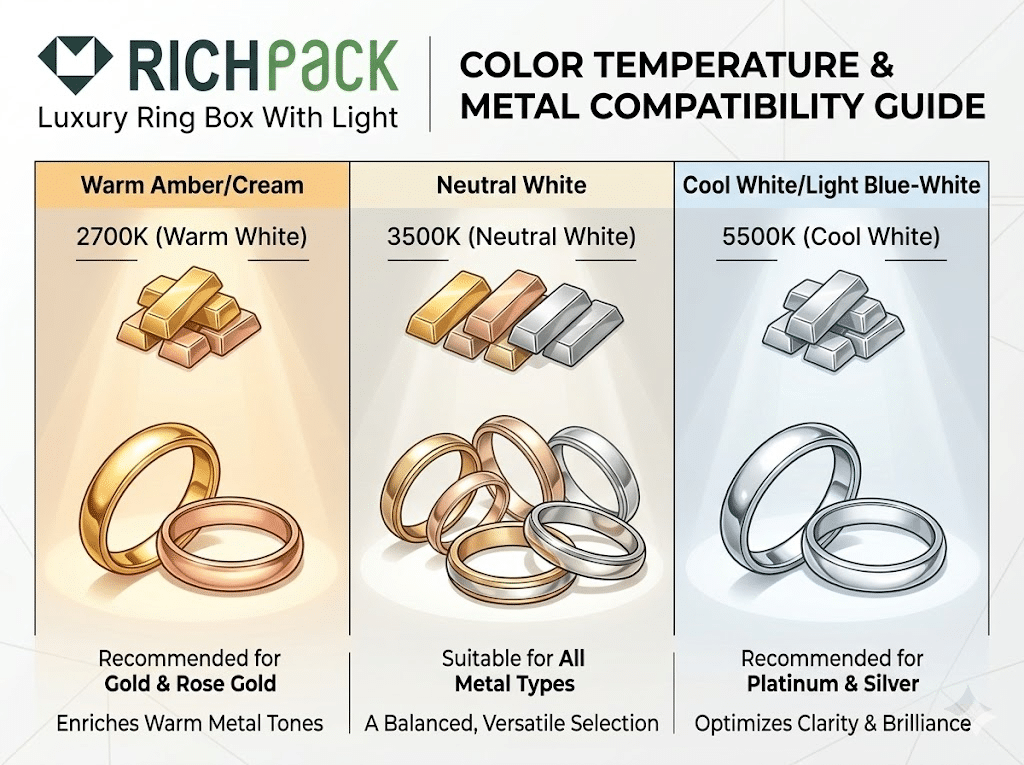
Two color temperatures lead the market, and each serves a different purpose:
Picking the wrong color temperature is a common brand mistake. A quick sample test before your bulk order prevents it.
A 2025 Luxury Packaging Association report found that custom ring and necklace boxes can raise a brand’s price point by up to 20%. According to research cited by CaratX, premium packaging drives a 30% rise in consumer willingness to pay. That figure comes from a Harvard Business School study on perceived craftsmanship.
The takeaway is direct: your packaging is not a cost — it is a revenue tool. For B2B buyers sourcing a jewelry brand, the lighted ring box is not an add-on. It is part of the product.
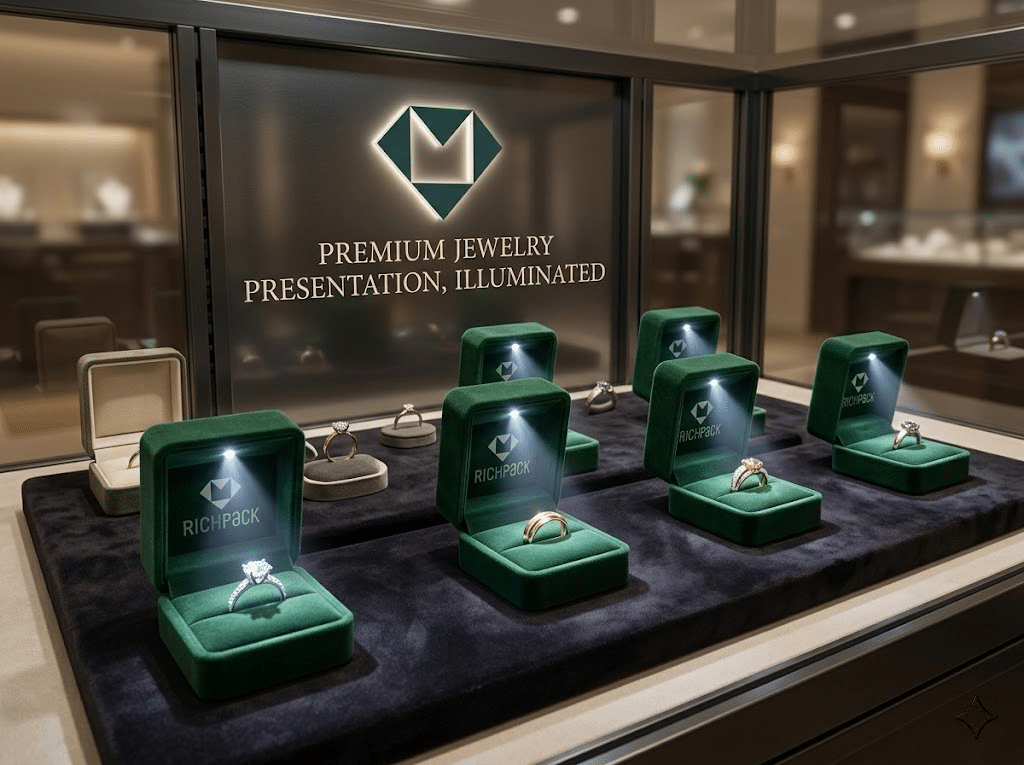
A lighted ring box not only shines at the moment of delivery. It works on the retail floor too.
According to retail studies cited by Richpack, jewelry displays with built-in lighting see a 15–20% rise in in-store sales conversion over unlit setups. When a customer walks up to a showcase, and an LED ring box is open, the stone glows under a warm beam. Their eye goes to the ring before they read a single price tag.
For brands selling through boutiques or multi-brand retailers, this matters. Your packaging becomes part of your display plan. Lid-activated or motion-sensor LEDs mean your retail partner’s staff do not need to manage the lighting. The box handles it on its own.
Buyer expectations for jewelry packaging have shifted a great deal over the past three years. In 2019, a $2,000 engagement ring came in a standard velvet clamshell box — and that was fine. Today, that same buyer, or their partner filming the moment, expects more.
According to a 2025 Richpack industry analysis, self-gifting now makes up 35% of jewelry market transactions. This group shares and posts purchases online at much higher rates than traditional gift buyers. The packaging is read as a signal: Does this brand care about the moment as much as I do?
A lighted ring box answers that question right away. It shows care, craft, and intention — which is what luxury jewelry buyers expect at $500 and above.
In crowded markets — DTC jewelry brands, independent boutiques, cross-border e-commerce — the product photo and the unboxing video are often the first thing a new buyer sees. At that point, your packaging is your brand.
A plain matte box with a foil stamp looks clean, but it does not stick in memory. A box that opens to a ring bathed in warm LED light creates a visual impression. That impression shapes the next purchase, the review a customer writes, and whether their friend asks, “Where did you get that?”
The math is simple. If your competitors at the same price point have moved to lighted boxes and you have not, your packaging works against your product. If you are the first in your category to do it well, the gap shows up in every photo and every video.
LED setups vary far more than most buyers realize. The trigger type, color temperature, and power source each shape the customer experience in a different way. They also affect your cost per unit, lead time, and long-term upkeep.
If you are not sure which to pick, order a hands-on sample of both the lid-activated and motion-sensor types. The difference is clear in person.
Color temperature uses the Kelvin (K) scale to show how warm or cool a light looks. You do not need to know the science — just the practical guide:
Ask any supplier you are considering to send ring photos taken under both warm and cool LED setups before you lock in a color. You cannot change it after the bulk run.
One detail often missed in supplier talks: confirm the battery slot is open without tools. If retail staff need a screwdriver to swap a CR2032, they will skip it. Your lights will go dark within weeks of hitting the floor.
Yes — with no caveats. Modern LEDs put out almost no heat and very little UV light. Standard halogen and fluorescent bulbs create far more heat and UV risk than any LED source in use today.
For heat-sensitive or organic stones — opal, pearls with resin coatings, or certain treated gems — LED is the safest display option available. If a supplier or customer raises this concern, the answer is quick and direct.
LED brightness is measured in lumens. For ring box use, the key question is simple: how much contrast do you want between the lit interior and the space around it?
For proposal boxes opened in a dim restaurant or at home, use a lower-brightness LED (50–100 lumens). It creates a soft, warm effect that fits the moment. For retail display boxes in a bright boutique or department store, you need more output — 150–250 lumens. That level cuts through ambient light and makes the stone stand out.
When you brief your supplier, state the intended use: home gift delivery, retail showcase, or photo and social content. Ask them to show you sample ring photos at their suggested brightness level. This one step cuts the most common post-production surprise.
Standard LED ring boxes work in one mode: on or off. For most brands, that is enough. But a small and growing number of premium brands have moved to smarter setups with real practical benefits.
These features cost more — typically a $3–$8 per unit premium. For high-jewelry brands where the packaging is a small share of product value, the added cost is easy to justify.
Material choice shapes three things at once: how the box looks, how it feels in the hand, and how well it works as a backdrop for the LED inside. These three do not always point the same way. That is why material selection deserves more thought than most buyers give it.
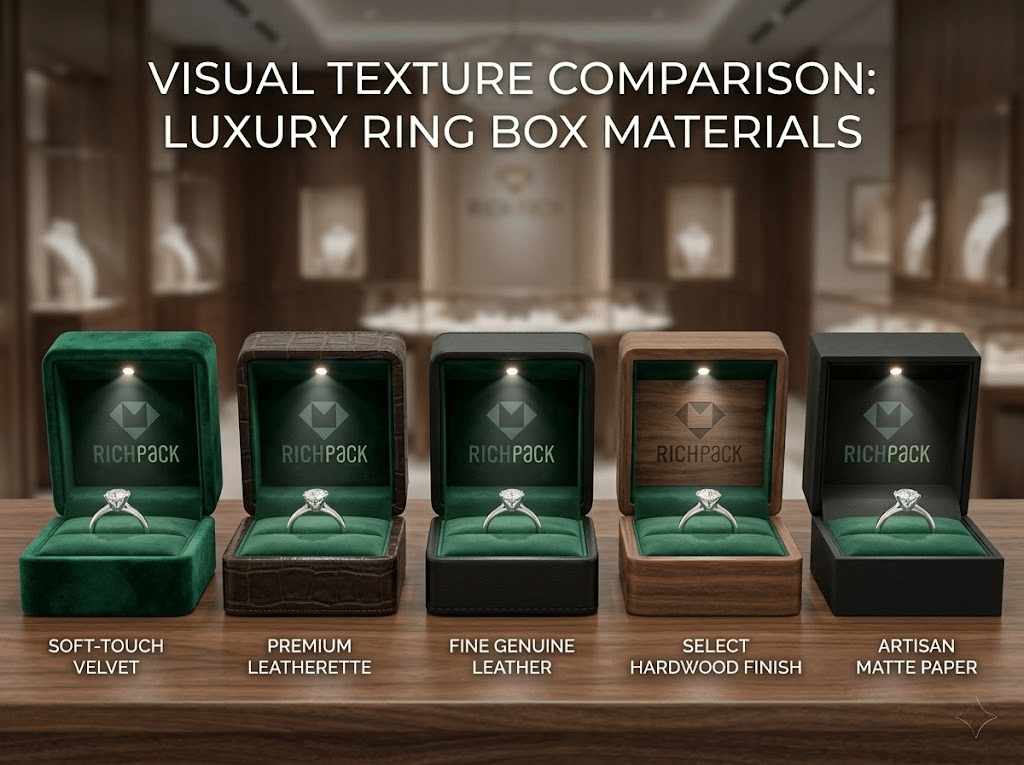
The interior lining is where the LED works, which makes this choice more important than it looks.
Key rule: dark, matte linings make LED ring boxes perform best. A deep black or charcoal velvet absorbs stray light and draws the eye to the ring. Glossy or bright linings bounce LED light back and create hotspots that compete with the stone.
Avoid patent leather, glossy fabric, or bright-white linings in any LED ring box. They photograph poorly and weaken the light reveal.
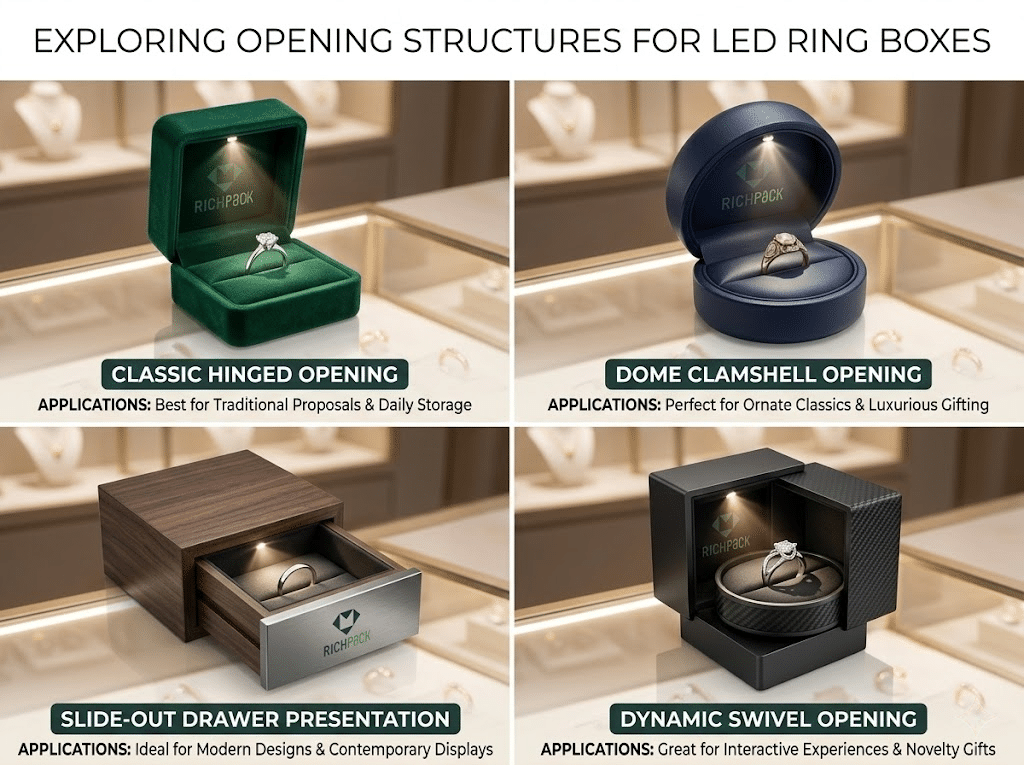
Not every ring box design fits LED integration equally. Four formats have proven track records:
Sustainability is no longer a niche point in luxury jewelry packaging — it is a baseline expectation. A 2023 GIA study found that 81% of jewelry buyers factor sustainability into their purchase decisions. That preference extends to packaging choices.
Practical sustainable options for LED ring boxes include:
For brands that lead with sustainability, adding these materials to your brief costs little and signals a real commitment. For brands that simply want to avoid risk as supplier audits become common in luxury retail, FSC board and rPET linings are the smart baseline.
Not every material fits every price point. Pairing the wrong material with your product tier is one of the most common brand positioning errors in custom packaging.
A working framework:
| Price Tier | Exterior | Interior | LED Type |
| Entry luxury ($200–$500) | Matte paper-wrapped rigid board | Velvet | Lid-activated, CR2032 |
| Mid luxury ($500–$2,000) | Leatherette or premium velvet | Micro-suede | Lid-activated, AAA |
| High luxury ($2,000–$10,000) | Genuine leather or wood | Silk, satin, or foam-backed suede | Motion sensor or USB rechargeable |
| Fine/high jewelry ($10,000+) | Custom lacquer, carbon fiber, or precious wood | Hand-stitched silk | Dual-mode USB rechargeable |
These are guides, not fixed rules. Brand strategy can call for premium materials at lower price points if the packaging is part of a deliberate brand-elevation plan. What the framework prevents is the reverse. Using entry-level materials for a high-jewelry tier creates a trust gap the moment a customer touches the box.
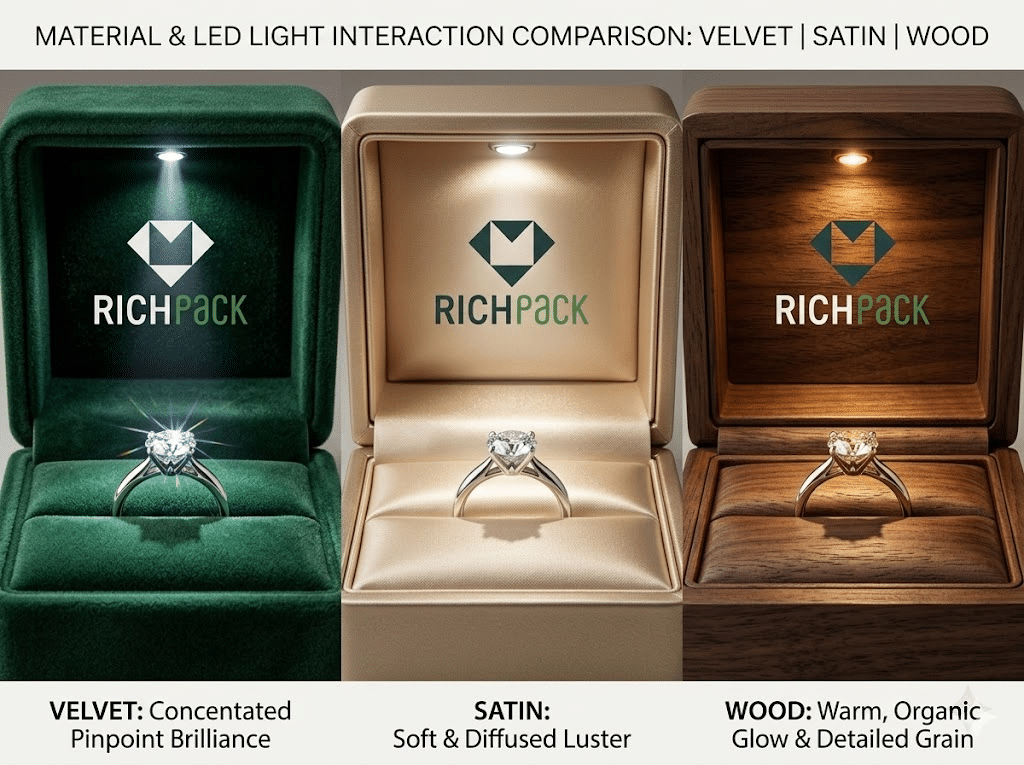
Every material reacts to your LED in a different way. Most buyers do not think about this until the sample arrives and the light looks wrong.
Knowing these interactions before you commit to a material combination cuts one of the most common sample revision cycles in custom LED box production.
The LED makes the ring look great. Your branding makes the box yours. These two elements need to work together — which means your branding choices must account for the LED interaction, not just the exterior look.
The interior is where most brands miss an opportunity — and where the LED creates a unique chance.
Put your brand name or logo on the inside lid, directly above the ring slot. When the lid opens and the LED turns on, your brand name lights up with the ring. The customer’s eye moves from the light to the logo to the stone — a three-second brand moment that happens by design.
Additional interior touches worth adding:
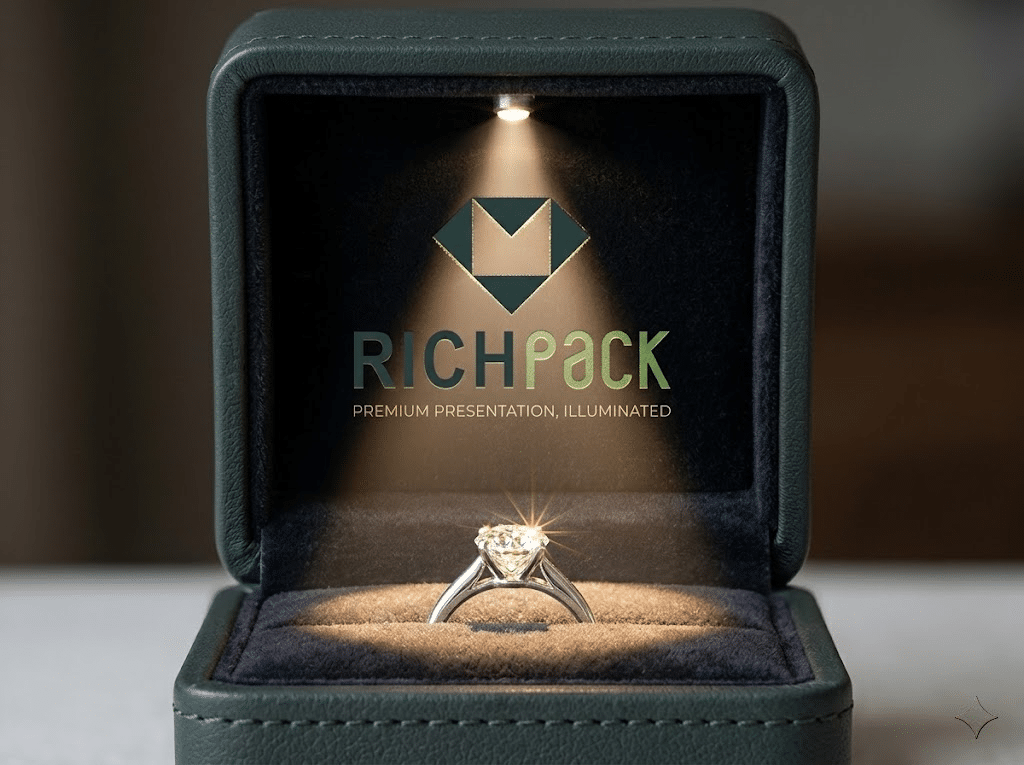
Your lighted ring box does not stand alone. The customer sees it inside an outer shipper, removes tissue paper, finds your card nearby, and puts the box in a pouch. Every piece should feel like it belongs to the same brand.
Keep your Pantone use consistent. Use the same texture family across the box and pouch. Pick one finish and stick to it — all matte, or all satin, not both. These choices build a brand identity that compounds with every order. Brands like Cartier and Van Cleef & Arpels invest heavily in this coherence. Their packaging has become a cultural reference point in itself.
Plan your full packaging suite at the same time as your ring box. The extra cost is small. The brand value is not.
Your branding output is only as good as the logo file you provide. This is one of the most skipped details in custom packaging briefs — and it causes more revision cycles than any other single issue.
What suppliers need:
Sending a correct, production-ready logo file on the first brief typically saves 7–10 days in the sampling cycle.
A lighted ring box outlives most packaging. Customers keep them. They sit on dressers, in drawers, on shelves. The box becomes a jewelry storage piece that lives in a home for years — sometimes decades.
This creates a branding window that most jewelry packaging does not have: long-term, in-home impressions at no added cost.
For brands that want to use this, consider:
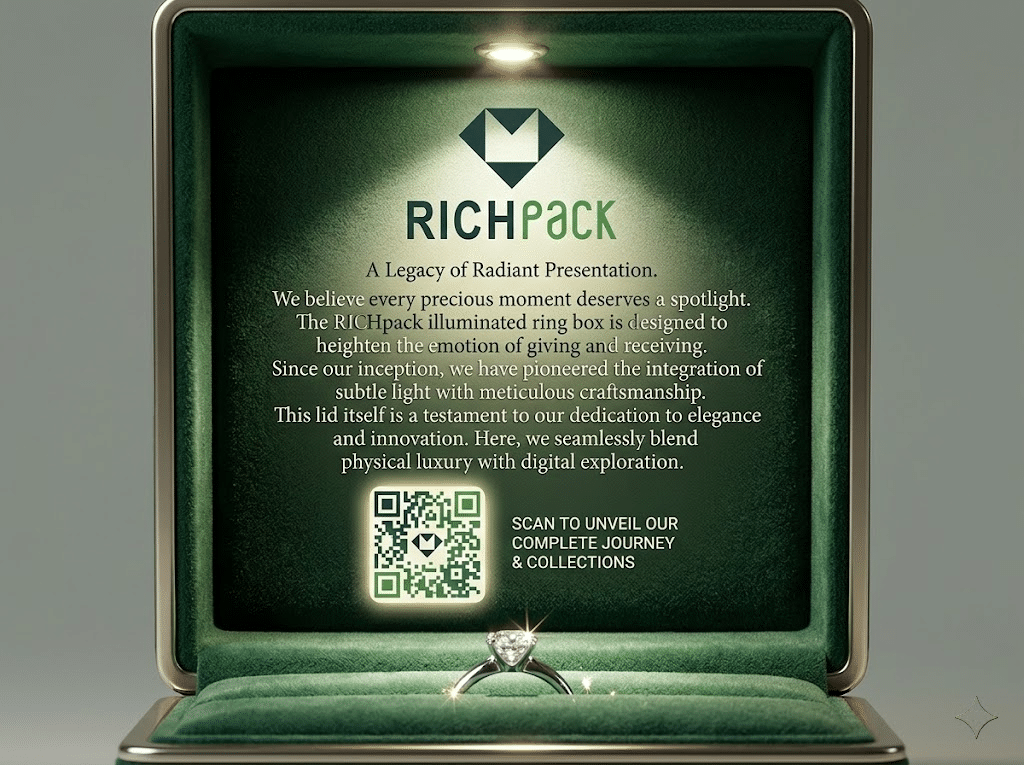
A growing number of D2C jewelry brands now add a QR code or NFC chip to the inside of their ring boxes. It is a small, discreet element that connects the physical unboxing moment to a digital brand experience.
When scanned, the code can open a personal video message, a certificate of authenticity, a brand story film, or a product care guide. For limited edition or high-jewelry pieces, the QR can link to an ownership record or resale authentication page.
The build is simpler than it sounds. A small QR code can be UV-printed on the interior lining or included as a foil-printed insert card. The NFC route needs a small chip embedded in the box — now a standard offering at many full-service packaging suppliers.
Adding QR to an existing ring box design typically costs under $0.50 per unit. The brand interaction it creates cannot be matched through any other channel. Picture a customer who just opened a lighted ring box and is watching a personal video from the jeweler.
Knowing the process prevents the most common and costly errors: a brief that is too vague, skipped samples, or lead times that are badly underestimated.
A strong brief is the base of every good custom LED ring box order. Before you contact any supplier, write down the following:
The more specific your brief, the more useful your sample and quote will be. Vague briefs produce generic results.
Never place a bulk order for custom LED ring boxes without approving a physical sample first. This is a firm rule.
When your sample arrives, check each of the following:
Sample production typically costs $50–$150 per unit and takes 7–14 business days. That cost almost always saves money by catching problems before they become bulk-order issues.
Here are the real numbers most supplier websites do not show:
Minimum order quantities (MOQ):
Unit pricing ranges:
Production lead times (after sample approval):
Seasonal planning note: If you need boxes for Q4 gift season, place your order by late August at the latest. Every year, jewelry brands miss peak season because they start the process in October.
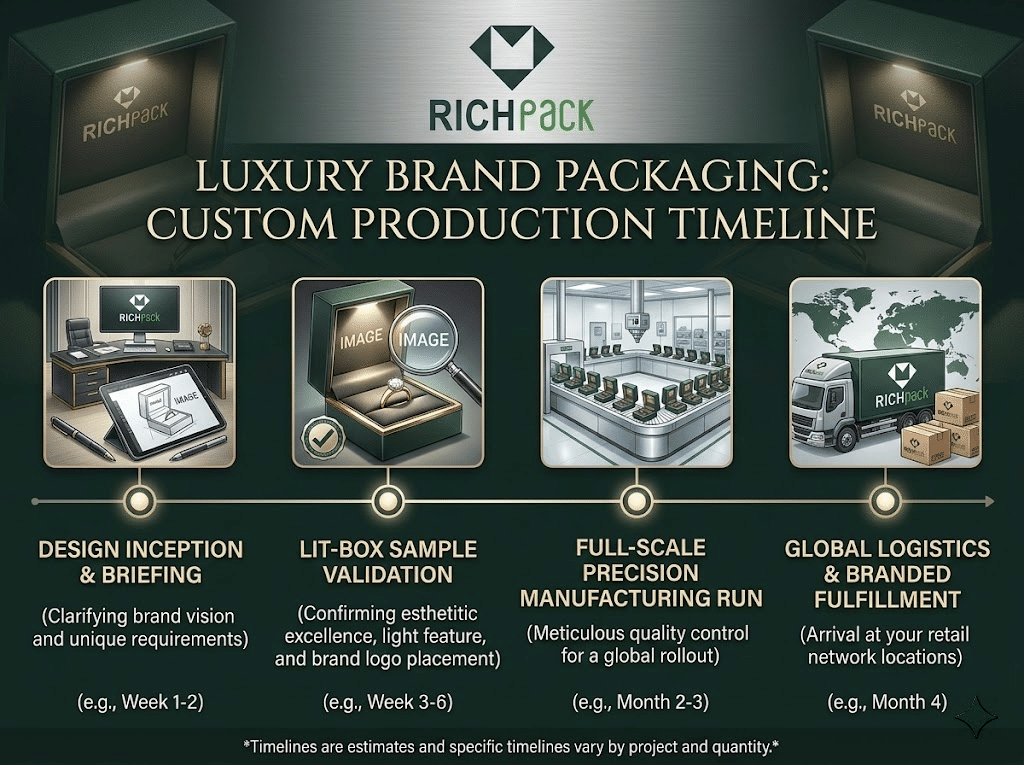
Once bulk production starts, ask for two quality checkpoints:
Before production starts, confirm in writing: your defect acceptance rate, the supplier’s policy on LED failures, and the batch standard for logo placement. These talks are far easier before production than after delivery.
Custom LED ring box production is not on demand. Every order needs a 4–7 week production window. That means your packaging stock must be managed ahead of time, not in reaction to shortages.
Practical inventory planning rules:
Brands that always have on-brand packaging ready are the ones that treat packaging as inventory — not a last-minute purchase.
The end of production is the start of learning. Brands that improve their packaging quality over time do so because they track each order in writing — not from memory alone.
After each delivery, record the following:
This record becomes your starting point for the next order negotiation. Documented performance history gives you real grounds to ask for quality improvements. You can push for better pricing on repeat orders or firmer lead time commitments — all backed by data.
The gap between a good LED ring box and a poor one almost always comes back to supplier selection — not the design brief.
1. “Can you show me production samples of LED ring boxes you have made for other brands?” Ask for actual product photos, not renders. Ask to see the LED turned on inside the box.
2. “What is your battery life rating, and how was it tested?” A credible supplier will give a specific number — “approximately 40 hours of active use under standard CR2032.” Answers like “very long” or “high quality” are warning signs.
3. “Do you offer Pantone color matching for the exterior?” If they cannot confirm this, your color will shift between production runs — a real problem for brand consistency.
4. “What is your LED component defect rate on past orders?” The accepted benchmark for LED failures in packaging is under 2%. Ask how they handle defective units after delivery.
5. “How do you control LED brightness consistency across a full batch?” LED components can vary between batches from the same chip maker. A solid factory tests LED brightness on a sample from each batch before assembly.
A product-only supplier offers a standard LED ring box and adds your logo via imprint. Turnaround is fast, cost is low, and the design range is limited. Good for brands that need a clean baseline fast but are not building a signature packaging identity.
A full-service packaging partner handles structural design, material sourcing, sample rounds, LED integration, Pantone color matching, and branding as one workflow. The process takes longer and costs more per unit. But the result is packaging that your competitor cannot copy by placing the same order from the same catalog.
For jewelry brands building toward premium or luxury positioning, a full-service relationship delivers results that a product-only approach cannot.
Not every packaging supplier has equal skill in LED builds. A factory that does well with rigid paper boxes and foil stamping may source its LED parts from a third-party electronics vendor. That creates a quality control gap that often only shows up after bulk delivery.
Before committing to a supplier for a lighted ring box order, verify the following:
Certifications are not a quality guarantee, but missing certifications are a meaningful signal in supplier review.
ISO 9001: The global quality management standard. A supplier with ISO 9001 certification runs documented, audited processes for production consistency, defect tracking, and corrective action. It is the baseline for any serious factory. For jewelry packaging buyers, it means your custom LED box is made within a repeatable process — not improvised from run to run.
BSCI / SEDEX: Social compliance audits that verify labor standards, working conditions, and supply chain ethics. European and North American luxury retailers increasingly require these before approving a new packaging supplier. If you sell through department stores or premium retail chains, your packaging supplier may need to pass these audits before your products can be stocked.
SGS / Bureau Veritas / Intertek approval: Third-party quality inspection certifications. Suppliers that have passed multi-category audits with these agencies have been checked by an outside party — not just self-certified.
For brands selling to premium retailers or working in markets with strict import standards (EU, UK, US), certified suppliers are a smart choice. They protect you from supply chain problems and compliance costs down the line.
Most brands treat their first custom LED ring box order as a one-time transaction. The brands with the most consistent, best-quality packaging treat their supplier as a long-term partner — and manage that relationship with care.
Practical steps for a lasting supplier relationship:
The best packaging partnerships in luxury jewelry are built over multiple years. They run on clear communication, tight specs, and shared accountability — not annual lowest-bid sourcing.
These errors show up again and again. Each one is preventable with the right brief.
A bright white, cream, or glossy interior bounces LED light in every direction. The result is uneven illumination and visual noise. The ring does not stand out — it just sits in a generically lit box.
The fix: Use a dark, matte interior — deep black, charcoal, navy, or dark forest green velvet or micro-suede. The contrast between the dark lining and the lit stone creates the spotlight effect that makes LED ring boxes worth the investment.
A warm white LED in a box built for a platinum and diamond solitaire will make the stone look slightly yellow. A cool white LED in a yellow gold vintage box will feel harsh and clinical — the opposite of what the piece calls for.
The fix: State your metal type and stone in the design brief. Ask the supplier to photograph your sample ring under both 3000K and 5500K LED before you confirm a color temperature.
Battery slots that need a coin or screwdriver to open are a hidden retail failure. Store staff stop replacing batteries. Within weeks, your LED display boxes sit dark in the showcase.
The fix: Specify a tool-free, thumb-access battery tray in your design brief. It is a simple ask — and it keeps your retail investment working as intended.
A well-made LED ring box arriving inside an unbranded corrugated outer box creates a sharp drop in the customer experience at the final moment of delivery.
The fix: Plan your outer shipper, tissue paper, ribbon, and thank-you card as part of the same project. The LED ring box is the focal point — but it needs a consistent set of supporting pieces to land well.
Custom LED ring boxes with full branding need 4–7 weeks of production time. Brands that start the process in October for December delivery miss the season or accept rushed work that cuts quality corners.
The fix: Map your seasonal peaks and plan backward. For December gifting, start your brief in August. For Valentine’s Day, start in November. The brands that deliver great packaging every season are the ones that plan months.
A luxury ring box with light is a premium jewelry presentation box with a built-in LED system that turns on when the lid opens, lighting the ring inside. Unlike standard ring boxes, lighted versions are built for both brand presentation and sensory impact. The light draws the eye to the stone at the reveal moment, matching the effect of a professional jewelry display. Jewelry brands use them for engagement and proposal presentations, retail display cases, and e-commerce unboxing moments built for social media sharing.
For most jewelry brands, a lid-activated (micro-switch) trigger gives the best mix of performance and cost. It turns on the moment the lid opens — no button needed — creating a clean, cinematic reveal. Push-button triggers work well for retail cases where the light needs manual control. Motion-sensor triggers are the premium option. They activate before the lid fully opens and suit flagship products or high-jewelry presentations where every sensory detail matters.
MOQ depends on the supplier and the level of customization. For stock LED boxes with a logo imprint, many suppliers start at 100–200 units. For fully custom LED ring boxes — new structure, brand color, and full branding — expect a minimum of 300–500 units. Proprietary Pantone-matched colors often need 500+ units to cover material and setup costs. If you are launching for the first time, start with a smaller order from a supplier that accepts lower MOQs. Validate the packaging with your buyers, then scale to full custom on your next order.
After sample approval, standard custom LED ring box production takes 25–35 business days. Fully custom structures — new box architecture, proprietary materials, or USB-rechargeable LED systems — typically need 40–50 business days. Add 7–14 days for sample production before the bulk clock starts. Plan for 8–10 weeks from brief to delivery for most custom LED ring box projects. Add 2 weeks of buffer for sample revision rounds.
For colorless and near-colorless diamonds (D–J color grades) in platinum or white gold, a cool white LED in the 5000–6500K range produces the most dramatic sparkle. The cooler, bluer light brings out diamond fire and scintillation. For diamonds in yellow gold or rose gold settings, a neutral white (3500–4000K) often works better. The cooler end of the spectrum can clash with warm metal tones. When in doubt, test your specific ring under both color temperatures before confirming your order.
Yes. Most full-service packaging suppliers offer Pantone color matching for exterior materials. Velvet, leatherette, and paper-wrapped exteriors all accept precise color specs. Provide your Pantone Matching System (PMS) reference number in your design brief. Note that MOQs for Pantone-matched production are usually higher — 500+ units — due to dyeing or special coating runs. For brands without a fixed Pantone reference, most suppliers can match a physical color swatch or a high-resolution brand asset file.
Yes. LED lights put out very little heat and almost no UV light — far less than the halogen or fluorescent bulbs in most retail settings. There is no documented risk to diamonds, sapphires, rubies, emeralds, or other hard gemstones from standard LED exposure. For heat-sensitive or organic materials like opal, treated stones, or pearls with synthetic coatings, LED is the safer choice. Its low heat output makes it better than traditional light sources for these gems. For long-term jewelry storage, keep pieces in a closed box away from direct light. The LED is made for the reveal moment, not for continuous use.
LED consistency across units is a real production variable, especially for large orders that draw from multiple chip batches. To protect against variation, ask your supplier to run a brightness calibration test on a sample from each production batch before assembly. Ask about their incoming quality control (IQC) process for LED parts. For orders above 500 units, consider stating a maximum acceptable deviation — typically ±10% luminance tolerance — in your purchase contract. Third-party inspectors like SGS or Bureau Veritas can run on-site AQL checks for large orders. They verify LED output as part of a full quality review before the shipment leaves the factory.
A luxury ring box with light is not a packaging upgrade. It is a brand experience delivered at the most emotional moment in jewelry retail. Done well, it brings out the diamond’s brilliance, gives customers a moment worth filming, and raises the perceived value of everything your brand represents.
The path from concept to finished product runs through four core choices. Pick the right LED setup for how your customers engage with the box. Choose the right materials for your brand’s look. Apply branding that makes the box uniquely yours. And work with a supplier built on technical depth and quality follow-through.
Ready to build your brand’s signature lighted ring box? Request a sample, share your brief, and let the reveal do the work.





 PREV
PREV