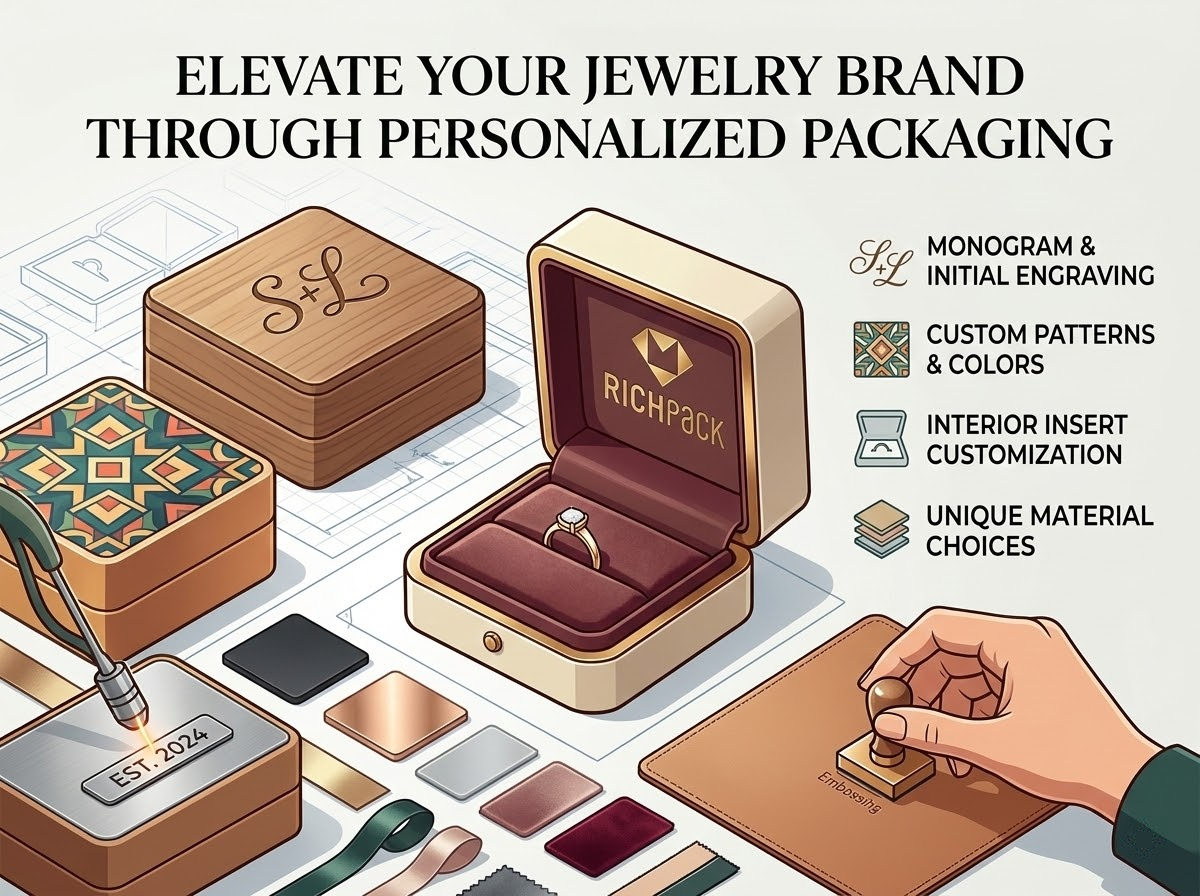


You’ve built a jewelry brand you’re proud of. But if customers only receive an ordinary, plain box, that sense of luxury will disappear right away.
Even before customers see the jewelry inside, the great experience is already ruined. Personalized jewelry boxes can solve this problem for you. They can turn every delivery into a memorable brand experience for your customers.
In this guide, I will teach you step by step how to personalize custom jewelry boxes. After reading it, you will know the best box styles, high-quality materials, printing methods to make your brand logo stand out, and how to mass-produce custom jewelry gift boxes while keeping costs under control.
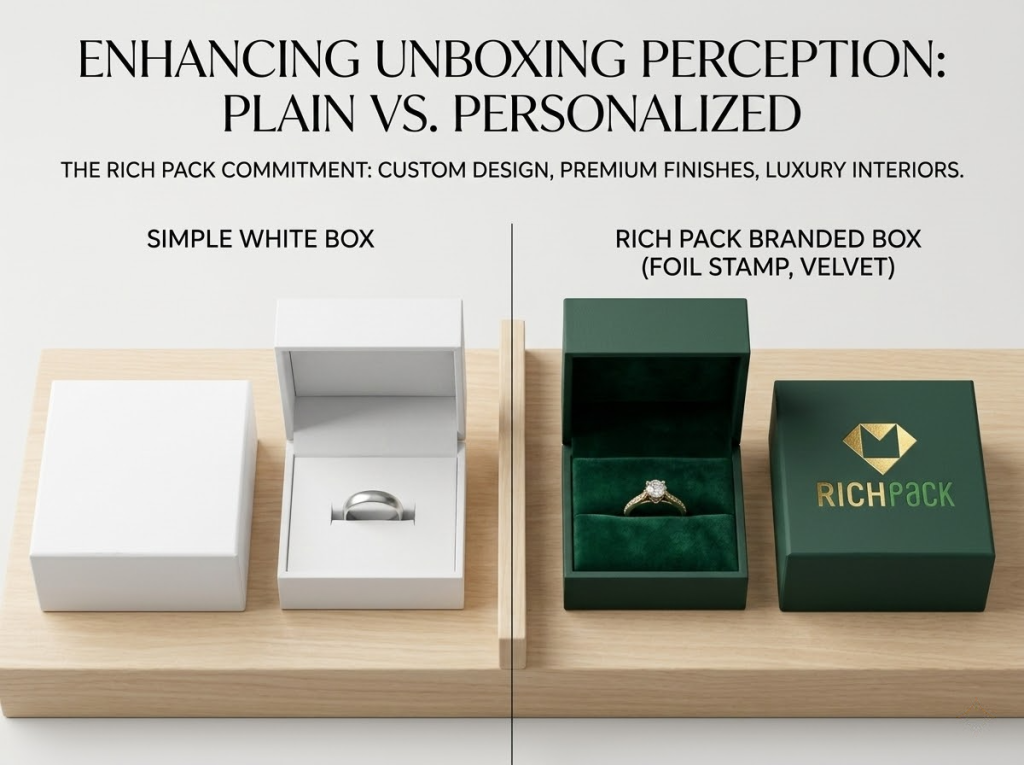
Most jewelry brands only see boxes as a necessary item for shipping. But brands that succeed through repeat purchases and social media sharing view them as a way to increase revenue.
There is no denying that custom jewelry packaging is one of the most underrated brand assets in the industry. And it costs far less to do it well than most people think.
Customers first see the packaging, not the ring or necklace inside. This first moment sets the emotional tone for all later experiences.
A well-designed personalized jewelry box makes customers feel they made a smart choice even before they open it.
A survey by Dotcom Distribution, a U.S. e-commerce shipping company, shows that 40% of consumers are more likely to buy again from brands that offer beautiful packaging. This is not just for looks. It shows customers your brand cares about their shopping experience.
For mid-to-high-end jewelry brands, the unboxing moment is one of the most valuable parts of the customer experience. And the cost of improving packaging is much lower than most other costs in your marketing.
Packaging is not just for holding products. It changes how people feel about them.
A ring in a matte black rigid box with a gold foil logo will seem worth $300, even if it only retails for $150. The same ring in a plain cardboard jewelry box will look like it is worth just $50.
Plenty of research proves this effect. Data from the Paper and Packaging Board shows that 70% of consumers say packaging design influences their buying decisions. When your custom box sends a message of high quality, customers will feel better about the product inside and be more likely to leave positive reviews.
This is especially true for emotion-driven purchases like jewelry. A luxurious unboxing experience increases emotional value. That is the real power of beautiful, branded packaging.
When your customers receive a beautiful and eye-catching personalized jewelry box, they can’t help but share it. Without you needing to remind them, they will take photos and videos and post them online. This is free, natural word-of-mouth marketing.
A popular unboxing video can bring you more targeted traffic than weeks of paid ads. And what makes people share is often the packaging itself, because the jewelry is still inside the box.
Brands that use custom jewelry packaging with special details — such as high-quality finishes, exclusive brand colors, and ribbon pull designs — always get more shares on social media than brands that use plain, off-the-shelf boxes.
That’s because custom packaging makes the jewelry box a great gift on its own. Customers who get a beautiful branded gift box are also more likely to recommend your brand to their friends.
According to McKinsey & Company, brands that offer personalized customer experiences have 40% higher revenue than those that do not. Packaging is one of the easiest ways to deliver personalization on a large scale.
When you also consider lower return rates, higher customer lifetime value, and natural social sharing, upgrading from standard packaging to custom jewelry packaging usually pays for itself within two to three order cycles.
Here is a simple cost calculation: A standard jewelry box costs about $0.30. A custom hard box with gold stamping costs about $1.20. If this upgrade increases the repeat purchase rate by just 5% for 1,000 customers who spend an average of $180 each, you will earn an extra $9,000. The extra packaging cost is only $900. The return on investment is 10 times higher.
A pendant priced at 400 dollars is wrapped in a thin plastic bag. This sends a silent but clear message: the brand lacks sincerity. Customers will notice it right away, even if they cannot put it into words.
What are the consequences? Lower ratings, more return requests, and a brand image that conflicts with its pricing strategy. Packaging that matches product quality creates a consistent experience, leaves a long-lasting impression, and brings customers back.
A jewelry box not only protects the item during shipping but also shows the brand’s values the moment customers receive it.
The box structure you choose will determine all subsequent designs, such as lining style, material selection, printing area, and shipping costs.
There are five main types of custom jewelry packaging boxes:
You can make your choice based on product type, pricing, and your customers’ purchasing channels.
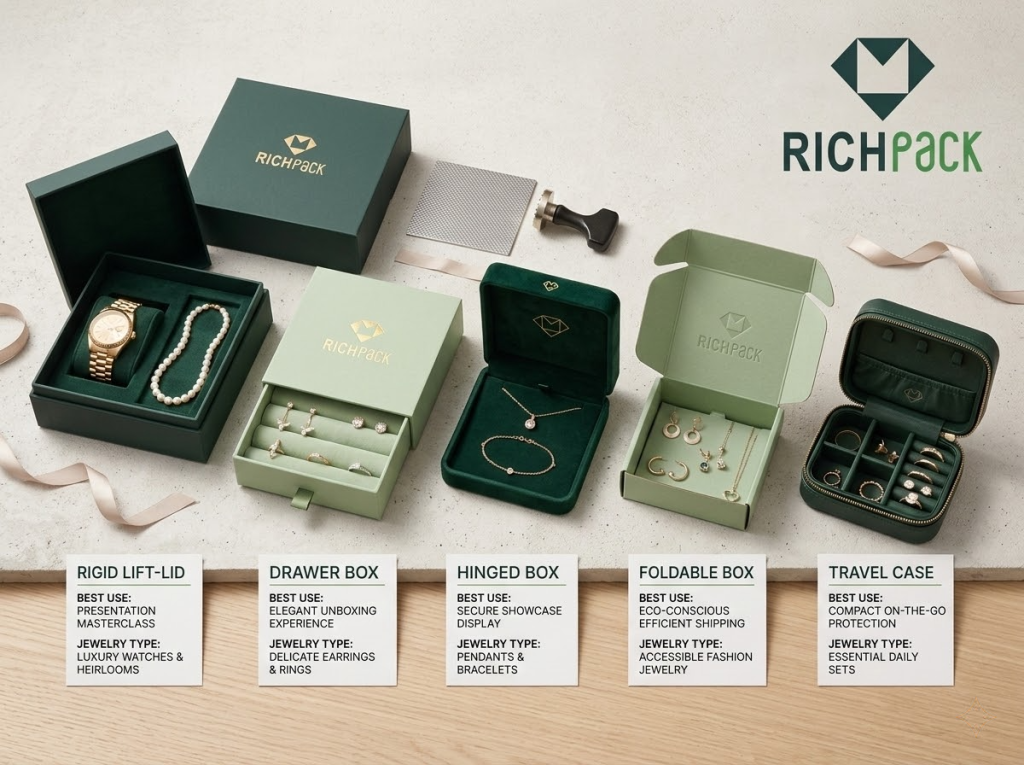
Rigid lift-lid boxes, also known as fixed gift boxes, are the gold standard for high-end jewelry display. This two-piece design includes a box base and a separate lid. When opened, it slowly shows the contents inside and highlights quality and texture before customers see the product. The weight and structure of the gift box itself convey value for the brand.
These gift boxes are ideal for holding necklaces, bracelets, and full jewelry sets. They stack neatly on retail shelves and do not deform easily. For brands that sell through wholesale or physical stores, this style has enough structural strength to meet display needs.
There are many choices for customizing these gift boxes. The outer box can be covered with custom-printed paper, faux leather, velvet, or other special materials. The inside uses custom-cut liners, including EVA foam, flocked sponge, or EPE pearl cotton. These hold the jewelry firmly in place and enhance the luxurious feel.
Drawer gift boxes come with an inner box that slides out from the outer case. The sliding motion alone feels ceremonial and is perfect for short videos on Instagram and TikTok.
If you want customers to film unboxing videos on their own, these custom gift boxes are usually the best choice.
This style works great for ring sets, earring sets, and small pendants. The outer and inner boxes are two separate printing surfaces. You can print your logo on the outer box and warm, thoughtful text on the inner one. It is also one of the most premium packaging options available today.
For e-commerce brands looking to boost social sharing, drawer gift boxes consistently get more user-generated content shares than other styles.
Hinged jewelry boxes feature a classic flip-top design. They are the most common packaging in the jewelry retail industry. This well-known design feels reliable. They are small and perfect for holding rings, earrings, and small pendants.
Their biggest advantage is that they close securely. Once you place jewelry inside and close the box, it will not open accidentally during shipping or display. In retail settings, hinged jewelry boxes can stand upright. They look neat and attractive, making them ideal for store displays.
Custom hinged jewelry boxes can be made of faux leather, velvet, or textured paper. You can also add a hot-stamped brand logo, choose a custom lining color, and use a special insert. This style is dependable and practical. It works well for jewelry at all price points.
Foldable rigid boxes, also known as foldable gift boxes, can be shipped flat and assembled in seconds. Compared with pre-assembled rigid boxes, they greatly reduce shipping volume and cut logistics costs by up to 60%, while the finished product remains high-end and delicate.
For e-commerce brands with large orders, custom foldable jewelry boxes are usually the most cost-effective choice. The boxes can be printed with full-color patterns and support gold stamping and spot UV finishing. Custom inserts can also be added inside. The only downside is that the boxes need to be folded by hand before packing, but this is easy for most warehouse teams.
Foldable packaging boxes are often a smarter choice if your brand ships overseas or needs large-scale storage.
A personalized travel jewelry box is a compact zippered or hinged case designed for easy on-the-go storage. It has evolved from a simple accessory into a high-end brand touchpoint. These jewelry boxes are especially popular with brands that target travelers and gift-givers.
Including a custom-branded travel jewelry box as part of a purchase package keeps the brand visible in customers’ daily lives. Every time customers pack for a trip, they see the brand logo. This method costs very little per exposure but builds long-term brand memory.
Travel jewelry boxes can be made of faux leather, fabric, or rigid, structured materials. They can be personalized through embossing, debossing, and custom linings, making them an ideal gift that customers will actually keep.
Before you choose a box style, measure your jewelry carefully. Measure the jewelry itself and leave enough space for display. A ring box usually needs an interior space of 2 inches × 2 inches × 1.5 inches. A bracelet box needs a wider and shallower size.
A jewelry set box should have several compartments to keep each piece from moving. Movement during shipping must be avoided. A custom box that is the wrong size can make jewelry shift, scratch, or tangle, wasting all the money you spent on a custom design. Before you place a production order, provide your supplier with the exact interior dimensions and request a physical sample.
The choice of materials determines the jewelry box’s appearance, how it feels when customers hold it, its durability during shipping, and the cost of each box. The right materials depend on your price range, brand style, and whether environmental protection matters to your customers.
| Material | Best For | Price Tier | Key Benefit |
|---|---|---|---|
| Rigid Paperboard | Most jewelry types | Mid–High | Full print customization |
| Velvet / Suede | Rings, earrings, pendants | High | Tactile luxury feel |
| Wooden | Heirloom and heritage brands | Premium | Durability + lifetime keepsake |
| Leatherette (PU) | Contemporary and minimalist brands | Mid–High | Sleek, trendy aesthetic |
| Kraft / Recycled Board | Eco-conscious brands | Mid | Eco-friendly credibility |
Cardboard is the core material in the custom jewelry box industry. It is strong enough to protect delicate jewelry, lightweight enough to keep shipping costs reasonable, and compatible with nearly all printing techniques, including four-color offset printing, gold stamping, embossing, and special lamination.
For brands that need full-color outer box printing and precise Pantone color matching, cardboard is the most reliable base choice. It can be wrapped with specialty paper, textured film, or fabric, offering great design flexibility without using high-end base materials.
Most wholesale custom jewelry boxes on the market use cardboard as their core material for good reason. Jewelry boxes made from high-quality cardboard can also be easily customized with templates or dies, making the design process more efficient and controllable for most brands.
As soon as customers touch the box, the velvet and suede texture immediately shows a sense of luxury. This soft surface gives people a feeling of high quality, which no printing process can achieve alone.
These two materials can be used both as outer packaging and inner lining, and both uses bring obvious effects.
When used as a lining, velvet prevents jewelry from being scratched and creates visual contrast to make accessories stand out more. A diamond ring placed on dark navy velvet looks more valuable than on ordinary white foam. When it comes to lining colors, simple and affordable personalized designs are ignored by most brands.
Here is a comparison of the three main materials for inner padding:
Wooden jewelry boxes feel completely different from those made of cardboard or faux leather. They stand for permanence, craftsmanship, and brand heritage. Customers do not throw away wooden boxes. They keep, display, and use them for a long time. This creates long-term brand exposure that cardboard packaging cannot match.
Wooden boxes can have brand logos and patterns made by laser engraving. They can be painted or dyed to match brand colors. Their inner compartments can also be customized. Making them is more complex than making cardboard boxes. So each piece costs more and takes longer to produce.
For jewelry brands that sell items for over $200, or brands that want a luxury keepsake box for their products, a custom wooden jewelry box is a high-value investment. When the jewelry box feels like a gift itself, it is also perfect for giving as a present.
A practical rule of thumb: Packaging costs should be about 3%–8% of the jewelry’s retail price. A $50 pendant only needs a simple printed paper box. A $500 pendant works well with a hard-flocked box with gold stamping. Jewelry priced at $2,000 requires wooden or shaped hard packaging that already feels like a premium gift.
Packaging that is too cheap for high-end jewelry will lower the product’s perceived value. Over-packaging affordable jewelry will cut into profits without real returns. By getting this ratio right, your investment in packaging will pay off and add value by increasing customer repeat purchases.
According to the 2024 Nielsen IQ Global Survey, 73% of consumers are willing to change their shopping habits to reduce their impact on the environment. Eco-friendly custom jewelry boxes are gradually becoming a real competitive advantage, especially in the North American and European markets.
High-quality eco-friendly materials include FSC-certified paperboard, kraft paperboard, bamboo materials, as well as water-based inks and coatings. Custom kraft boxes printed with a simple brand logo look just as stylish as traditional packaging. The difference is that your brand can also share its commitment to sustainability.
Brands that use eco-friendly packaging generally get better media coverage and more positive customer reviews. This works especially well among consumers aged 25 to 40.
Whether under retail lighting, in unboxing videos, or in customers’ hands, printing effects and surface finishing determine how your brand looks in real-life situations. Choosing the right combination of processes can create a unique identity for your custom packaging that has both tactile and visual appeal, and is not easy to copy.
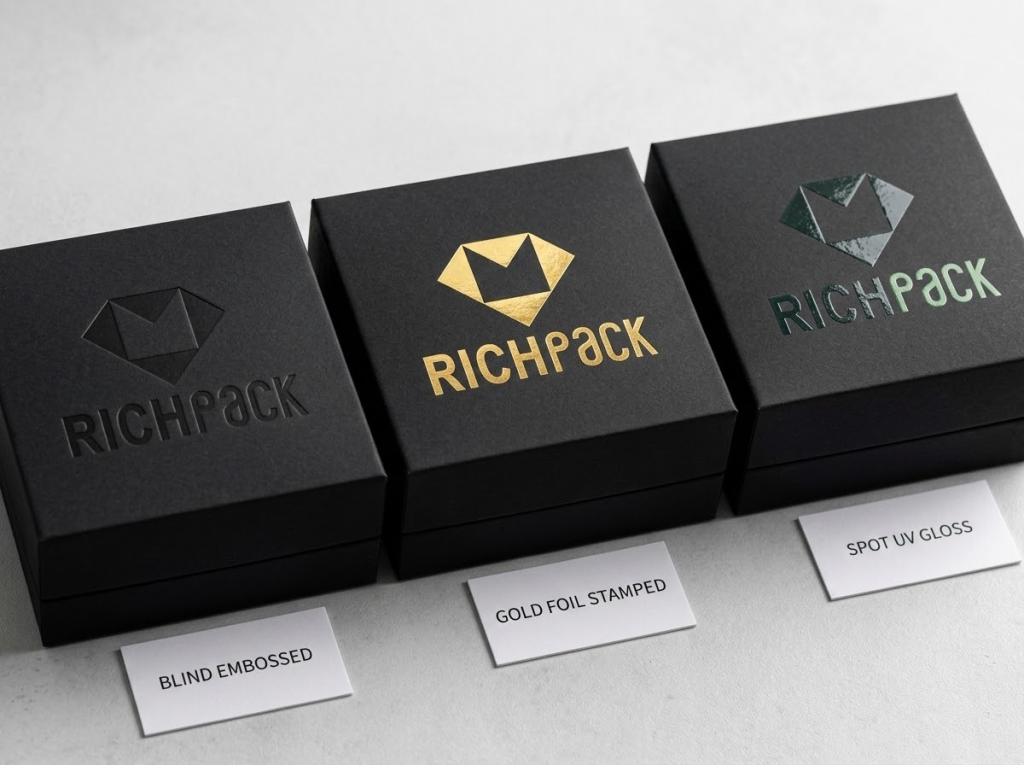
Here are the five most common surface finishes for custom jewelry boxes. They differ in visual effect, texture, cost, and best uses. You can use this guide to decide which finish best matches your brand.
| Technique | Visual Effect | Tactile Feel | Cost Add-On (per unit) | Best For |
|---|---|---|---|---|
| Blind Embossing | Subtle raised texture, no color | Pronounced 3D relief | $0.08–$0.20 | Minimalist brands on matte surfaces |
| Foil Stamping (Gold/Silver) | Mirror-bright metallic shine | Smooth, flat | $0.15–$0.40 | Brands with gold or silver jewelry lines |
| Spot UV Coating | High-gloss on matte background | Light texture contrast | $0.10–$0.30 | Dark boxes that need shelf impact |
| Emboss + Foil Combined | Raised metallic logo | 3D + smooth metallic | $0.25–$0.55 | High-end retail and gift tiers |
| Debossing | Pressed-in logo, refined look | Subtle depression | $0.08–$0.18 | Minimalist brands; leatherette boxes |
How to choose: If your jewelry is made of gold or silver, use matching gold foil stamping to make the product and package visually consistent.
If your brand is simple and focuses on quality, debossing on a matte surface looks cleaner and more upscale. Spot UV coating works best as an accent finish, especially when there is a strong contrast between glossy and matte areas.
Color is the fastest brand signal in packaging. Research from Loyola University Maryland shows that color can boost brand recognition by up to 80%. For jewelry brands that attract customers through visual appeal, a unique color scheme is not optional—it is fundamental to the brand.
Modern printing technologies, such as offset printing, digital printing, and Pantone Matching System (PMS) color matching, can accurately reproduce colors on every part of custom packaging: the outer box surface, lining, inserts, ribbons, and wrapping paper. Pantone matching ensures the colors on gift boxes match those on official websites and in-store displays perfectly.
When choosing colors, consider how they look on camera. Rich, bold shades like navy blue, emerald green, burgundy, and matte black stay consistent in different lighting. Light colors often look dull in natural light and too bright under store LED lights, so they require more careful color adjustment.
The inside of a custom jewelry box is where customers truly experience your brand. When they open the box, the interior is the first thing they see. A well-designed lining shows you care about every detail, not just what’s on the surface.
Interior customization options include:
For brands selling sets, multi-compartment inserts hold each piece securely, making unboxing like viewing a carefully arranged display. A jewelry box does more than protect jewelry—it showcases it and brings out its full beauty.
What customers remember most are often the small details. Ribbon pulls in your brand’s special color make opening the box feel like unwrapping a gift. Magnetic clasps that close with one touch let customers feel quality right away. A brand plaque on a wooden jewelry box turns an ordinary box into a nice keepsake.
Custom ribbons are well worth it. Different effects come from choosing the color (matched to Pantone numbers), width (10 mm to 25 mm), and material (satin, ribbed, or organza).
The strength of the magnetic clasp should match the box’s weight. Hardware colors like gold, silver, matte black, and brushed nickel should match your brand’s metal tones. These small details turn a good custom box into an unforgettable, beautiful piece.
A well-run custom jewelry box project goes through six clear stages.
Most quality issues do not happen during production, but before it starts: unclear specifications, wrong design file settings, or skipping the proofing process to save time.
Doing every step well shortens the delivery time and protects your investment.
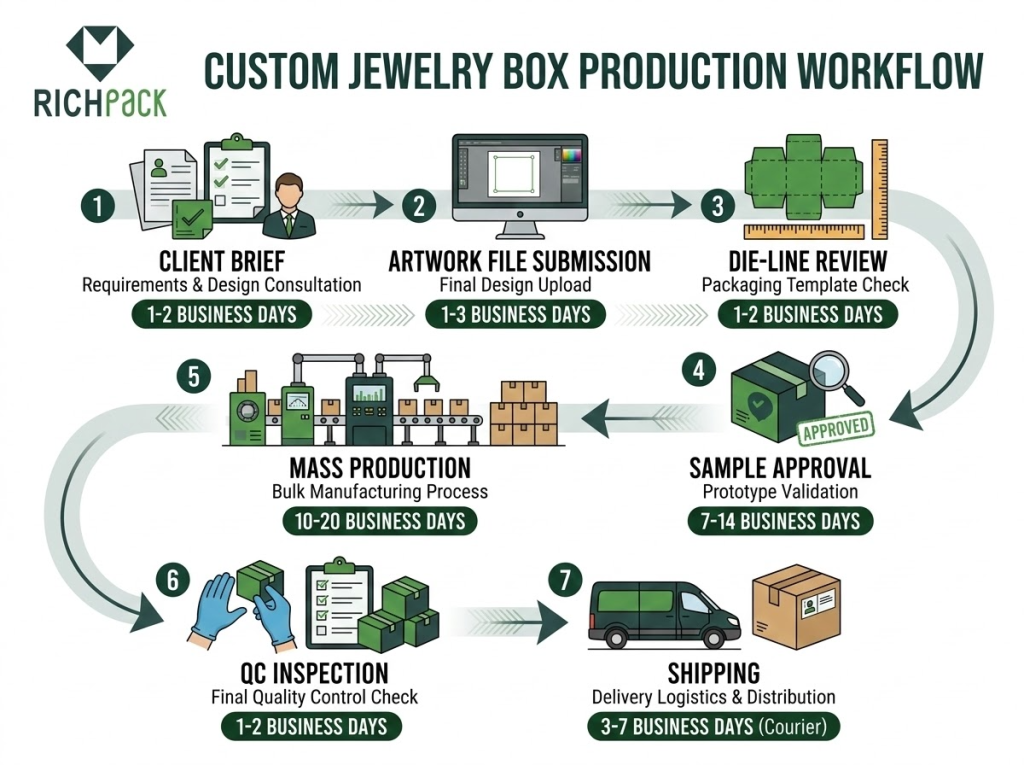
Before you open design files or contact suppliers, be clear about three things: your brand visual identity (Pantone colors, fonts, and vector logo files in .ai or .eps format), your product’s price point (which decides the right materials and production quality), and your target customers’ aesthetic preferences (minimalist, detailed, eco-friendly, classic vintage, or modern simple).
These three points will shape all your later design choices. A custom box for a brand targeting eco-conscious millennials looks nothing like one for a brand aimed at classic luxury collectors—even if the jewelry itself is similar.
You must put all this information into a one-page packaging brief before you reach out to any suppliers.
If you are new to the design process, many full-service suppliers can provide 3D models or digital previews before production. These models let you see the final look and make changes before any real production costs are added.
When measuring your jewelry, you need to measure not just the piece itself, but also the space it needs to be displayed perfectly. Pendants require enough room to lie flat without bending. Rings need slots that hold them upright. Bracelets need deep enough grooves to sit neatly in place.
Leave a 5–10 mm gap on each side between the jewelry and the inside of the box. This makes space for the lining material and keeps the jewelry from looking cramped inside. When working out the outer dimensions from the inner ones, remember to include the thickness of the box walls.
Mistakes at this step can be costly. A custom box that is the wrong size may damage the jewelry during shipping and waste all the effort you put into the outer packaging design.
Most suppliers require design files in Adobe Illustrator (.ai) or PDF format. All text must be converted to outlines, with a resolution of 300 DPI and a 3-millimeter bleed on all four sides. You must know that die lines are structural templates that mainly show fold and cut lines, and they need to be on separate layers from your design artwork.
Each brand color should have a specified Pantone (PMS) number to ensure accurate color during printing. If you use four-color printing (CMYK), please provide both the Pantone number and its closest CMYK values. This helps suppliers match the colors as precisely as possible.
Some suppliers offer free design help or proof review services when you first start working with them. You should definitely use this service. It is completely free and can save you weeks of back-and-forth communication during the design process.
Never approve an order for custom-printed jewelry boxes before you receive a physical sample. Colors on the screen are very different from the actual printed results. Stamping depth also varies among different suppliers. Material weight and texture may not match what the specification sheet describes.
Before mass production, always ask your supplier for a pre-production approval sample. Most professional suppliers charge between $50 and $200, depending on how complex the design is.
This cost is usually well worth it. Finding problems like mismatched colors at the sample stage can save you thousands of dollars in rework costs.
Checking the sample also makes sure the jewelry fits perfectly in the inner slots. If there are any size errors, you can fix the die-cut template before mass production starts.
Once the design is approved, the standard production time is 20 to 35 business days. Shipping from Asia to North America or Europe takes an additional 10 to 20 business days. With one extra week for customs clearance, the total time from order placement to goods arrival in the warehouse is 8 to 12 weeks.
Plan for busy sales seasons:
Production slots at top suppliers fill up quickly before these dates. The most common reason brands that planned to use custom packaging end up with ready-made boxes is that they ordered too late.
A good supplier does more than just make boxes. They also offer design guidance, structural design, material sourcing, sample making, quality control, and logistics support. This kind of full-service custom packaging partner can shorten the time from idea to finished product and help you avoid costly mistakes along the way.
When evaluating suppliers, you can ask to see: custom jewelry packaging examples that match your price range, customer references, standard material sample cards, minimum order quantity lists grouped by box style and complexity, and a clear explanation of what sample fees include. You should also ask if they offer free design support or 3D modeling services. Both show that the supplier has a proven and reliable design process.
Ready to work together? Before placing a full production order, you can get a free quote and request samples to see and feel the difference in quality for yourself.
Ordering 100 boxes is just a trial, while ordering 2,000 is a strategic move. The difference between them is not just quantity; it also involves minimum order quantity, price tiers, production scheduling, and inventory management.
Brands that successfully scale their custom jewelry box wholesale business treat order management as a supply chain task, not a temporary job.
The minimum order quantity for wholesale custom jewelry boxes varies based on the style and complexity. Here are the general reference standards:
These minimum order quantities are set because production costs, such as mold making, plate preparation, and material adjustment, must be spread over enough products to keep the unit cost reasonable.
If your current order is less than 500 pieces, you can choose a semi-custom option (using ready-made box styles with custom printing) and move to full customization as your business grows.
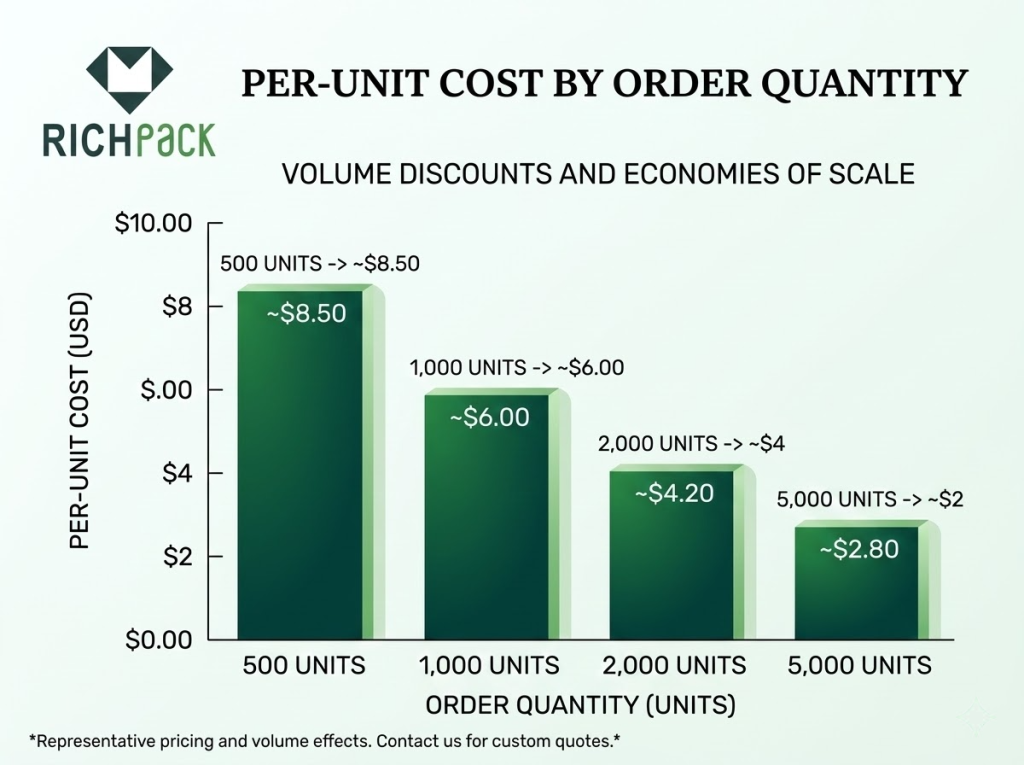
When the order quantity increases, the cost per item drops significantly. For one type of packaging box, the unit cost is $2.50 when you order 500 pieces, but only $1.20 when you order 2,000 pieces. The price difference comes from upfront costs like mold making, printing plate preparation, and sample proofing being spread over a larger order.
The most efficient approach is to order enough to reach the next price level if storage allows. Buying a six‑month supply at a lower unit cost is almost always better than purchasing a two‑month supply at a higher cost. Wholesale prices for custom jewelry boxes usually have tiered volume discounts. You can ask your supplier for a price list in advance to make budget planning clearer and more controllable.
Many brands launch seasonal packaging. They use heart-shaped wrapping paper for Valentine’s Day, gold foil decorations for the holiday season, and light pink liners for Mother’s Day. Seasonal designs help brands connect better with customers and create a sense of urgency to buy, but they require planning.
However, the most efficient method is to use a standard custom gift box as the base structure and only change the wrapping paper, ribbons, and seasonal inserts.
This way, you only need to keep one core gift box in stock. By switching out decorative accessories, you lower minimum order requirements and make inventory management easier. Be sure to order seasonal packaging styles at least 16 weeks before your target season.
Custom jewelry boxes are usually shipped flat or pre-assembled on pallets. Flat, foldable boxes take up much less space. For the same pallet size, you can fit 10 times more flat boxes than pre-assembled ones.
Store custom packaging in an area with stable temperature and low humidity. Moisture can warp cardboard, flatten velvet, and weaken glue. If you can’t control the temperature, ask your supplier for moisture-resistant coating or plastic bags as standard packaging.
Bulk orders only make sense if your design stays unchanged for at least six months, your monthly usage is enough to sell out the stock during that time, and the unit price for bulk purchases is at least 20% lower than for small‑quantity orders.
If your brand is growing fast or you update designs often, placing small, frequent orders may be a smarter choice even if the unit price is higher.
After all, many expanding brands have made this costly mistake: buying 3,000 boxes printed with last season’s logo in one order and getting stuck with them.
The custom jewelry box market has changed rapidly over the past two years. Minimalist aesthetics have replaced elaborate decorations and become the mainstream style for high-end brands. For many retail buyers, sustainability has shifted from a brand storytelling tool to a real purchasing requirement.
Digital technologies such as QR codes, NFC tags, and augmented reality experiences are gradually being integrated into packaging that was once entirely physical. Brands that keep up with these trends early can create timeless designs. Those who ignore them may end up with packaging that looks outdated when it reaches customers.
More and more jewelry brands are putting QR codes inside custom jewelry boxes. These codes can link to product certificates, brand story videos, care guides, or membership sign-up pages. In this way, jewelry boxes become digital gateways that keep brands connected with customers even after the physical purchase.
Forward-thinking brands are also trying to put NFC tags inside hard box lids. Customers only need to tap them with a phone to check product authentication, register warranties, or use augmented reality features. This is especially effective for fighting counterfeits and building product-linked membership systems.
FSC-certified paperboard, soy-based inks, bamboo materials, and water-based coatings have shifted from high-end niche products to mainstream demands in the custom jewelry packaging market.
Brands that still use non-eco-friendly packaging are increasingly falling short of consumer expectations, especially in Europe and North America.
The extra cost of sustainable materials is lower than most brands expect. In many cases, switching to eco-friendly materials adds less than 10% to the unit cost when order quantities are similar.
The benefits for brands—such as gaining trust from eco-conscious consumers, getting better media coverage, and aligning with retail partners’ sustainability programs—far outweigh this small cost increase.
Today’s mainstream style for high-end jewelry packaging is restrained and carefully crafted minimalism. A matte black rigid box features only a hot-stamped brand logo, while a custom unprinted kraft paper box is sealed with the brand’s wax seal.
A white box has nothing more than an embossed border. The less decoration, the more precise the sense of quality.
This reflects an overall shift in the aesthetic preferences of luxury consumers. They are moving from elaborate branding to understated sophistication. Brands that once used multiple printing techniques on custom packaging are now simplifying their designs. They rely on material quality and one or two iconic details to convey their brand image, resulting in a more elegant final look.
Limited-edition packaging launches have gradually become independent marketing events. For example, a jewelry brand uses custom hand-painted gift boxes for its summer collection, or exclusive packaging designed by collaborating artists for holiday sets. These practices create a sense of scarcity and publicity that ordinary packaging cannot match.
Such launches also have clear business goals. They justify the higher prices of seasonal limited collections and give loyal customers a real reason to buy again. When packaging becomes a collectible keepsake, the bond between the brand and consumers grows stronger—an effect no discount code can achieve.
For most jewelry brands, augmented reality packaging is still in its early stages, but its development direction is clear. Some brands print AR trigger patterns inside the box lid. When customers scan them with their phones, they get an exclusive brand experience. They can try on jewelry virtually on their wrists, watch messages from the brand founder, or learn the story behind the product through interactive content.
For brands targeting Gen Z and millennial consumers, AR unboxing creates a unique highlight in a highly competitive market.
Today, the technical barrier has dropped greatly. Brands can use this technology without a large enterprise-level budget. If you want to improve your brand experience beyond physical stores, this direction is worth trying.
Most custom packaging problems are predictable and preventable. Brands that have gone through a difficult production cycle often make the same mistakes:
Every mistake can be fixed once you know what to look for.
Most people easily put all their creativity into the look of a logo, such as its design, color, and material. But in reality, the core of the customer’s experience lies inside. A custom box with an amazing exterior but a messy, ill-fitting interior will send a confusing message to customers right away.
Before you finalize the exterior design, you must first make a prototype of the interior. Make sure the inner lining holds the specific item in place so it does not shift. Also, check that the lining’s color complements the jewelry instead of clashing with it.
In the end, you need to make sure the item is easy to take out and put back. Many customers who store jewelry in these boxes use them often.
A $300 gold ring in a thin cardboard jewelry box with only a thin layer of foam inside will immediately cause cognitive dissonance.
This kind of packaging sends customers a message that what they bought is not worth proper protection. This impression is hard to change. And it often shows up in negative reviews, even when the reviews do not mention the product itself.
You must match the quality of materials to the value of your product. Spending on the right materials makes up only a small part of the retail price. But a poor customer experience leads to returns, bad reviews, lower repeat purchase rates, and more.
These small problems cost far more than just making the box right in the first place.
As jewelry brands grow, their packaging can become inconsistent when they add new product lines, price tiers, or sub-brands. Different box styles, unaligned logo placement, and mismatched inner lining colors don’t just look unprofessional—they quietly erode the brand equity you’ve worked hard to build.
You can create a packaging brand guide that clearly defines box styles, material standards, Pantone colors, logo placement rules, and inner lining standards for each product tier.
Finally, share this guide with all suppliers involved in making your packaging. Consistency across every custom box is what makes a brand feel legitimate. This consistency is also key to keeping customers trusting you as you launch new price points.
In custom jewelry packaging, the most common operational mistake is underestimating the time needed for every step. Brands used to stock packaging are often surprised to find that a custom order takes 8 to 12 weeks from request submission to warehouse delivery. Seasonal demand peaks can add even more time to this schedule.
Include lead times in your product launch calendar right at the start of each season’s planning. If your new collection launches in April, order your packaging in early January. Treating packaging as an afterthought in product development is the top avoidable reason brands end up shipping with stock boxes, even though they planned to use better packaging.
Most suppliers set a minimum order quantity of 500 to 1000 pieces for fully custom-printed jewelry boxes. Some digital printing specialists can take smaller orders, but the unit cost will be much higher. If you are just starting, semi-custom options—standard structured boxes with custom printing—are an affordable way to get packaging with your brand logo, while gradually moving toward full customization and better wholesale prices.
Standard production takes 20–35 business days from artwork approval, plus 10–20 business days for sea freight to Western markets. Budget 8–12 weeks total from purchase order to warehouse delivery. During peak seasons — Q4 holiday, Valentine’s Day — add 2–4 weeks to your turnaround time. Order early to avoid stockouts during the periods when packaging matters most.
Foil stamping is the most popular choice for jewelry box logos because the metallic finish aligns with the aesthetic of most jewelry lines. For minimalist brands, blind embossing on matte material looks cleaner and more sophisticated. Spot UV works well as a supporting technique. Avoid relying only on digital print for logo application on premium boxes — it lacks the tactile quality that high-end custom printed jewelry packaging needs.
Some suppliers offer no-minimum custom printing on stock box shapes using digital printing. Printing options and material choices are more limited compared to full custom production, but it’s a viable path for testing designs or very small gift runs. Expect per-unit costs 3–5× higher than an equivalent custom box at 500+ units.
Rigid pre-assembled boxes give you the highest-quality unboxing experience but cost more to ship because of the volume they take up. Foldable rigid boxes deliver a comparable finished product and ship flat — cutting logistics costs by up to 60%. If you’re shipping internationally or storing large quantities, foldable boxes are usually the more practical and cost-efficient choice without sacrificing presentation quality.
FSC-certified paperboard is the most widely available eco-friendly option and the most cost-effective at scale. Kraft board looks stylish and natural — it works especially well for artisan and organic brand aesthetics. For finishes, request water-based coatings and soy-based inks, and avoid PVC laminates if full recyclability matters to your brand’s sustainability positioning.
Budget 3–8% of the jewelry’s retail price for packaging. For a $100 piece, that’s $3–8 per box — achievable with a quality printed rigid box at wholesale quantities. For $300+ pieces, $10–20 per box enables premium materials with foil stamping, embossing, and custom interior inserts. Costs drop significantly with volume: brands ordering 1,000+ units per style routinely get high-quality custom printed jewelry boxes at $2–5 per unit.
Personalizing your custom jewelry boxes is one of the highest-return decisions a jewelry brand can make. The right box style, finest quality material, and finishing technique transform packaging from a cost line into a brand asset — one that drives repeat purchases, social sharing, and real customer loyalty.
Start with your brand identity. Match your materials to your price point. Master two or three personalization techniques that feel distinctly yours. Plan your production timelines before you need them.
If you’re ready to elevate your packaging and elevate your brand, get a free quote and request free design support from a full-service packaging partner today.
What personalization technique are you planning to try first? Reach out to explore custom jewelry boxes wholesale with a team that handles the full process from brief to delivery.

Just submit your email to get exclusive offers (reply within 12 hours)





 PREV
PREV