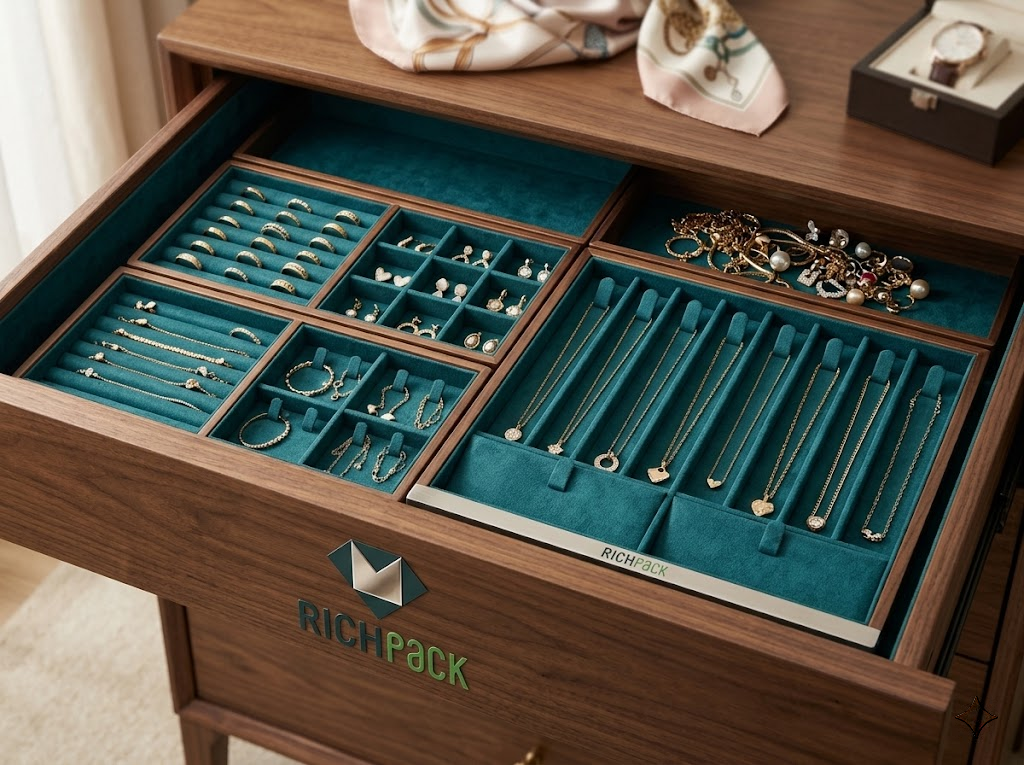


Most jewelry storage problems start the same way.
You open the drawer, reach for a necklace, and spend the next three minutes unraveling it from a bracelet. The earring you want is there — but its pair is not. Your favorite ring is somewhere under a pile of things that should not be in the same space.
This is not a “you” problem. It’s a storage problem. And drawer jewelry trays solve it.
In this guide, I’ll show you:
Whether you’re organizing a personal collection or managing jewelry storage for a retail environment, this is the system that works.
Traditional storage was designed for small collections and simple habits. Once a collection grows past a handful of daily pieces, the old methods stop working.
A deep jewelry box looks organized from the outside. Inside, it’s a different story.
Necklaces overlap. Clasps catch on each other. Earring pairs drift apart after a few days of use. The harder a piece is to find, the less often it gets worn — and in a retail or workshop setting, that same disorder slows handling and makes the presentation feel careless.
Storage damage often happens quietly, before you notice it.
Rings rub against bracelet clasps. Pendants press into softer surfaces. Silver pieces sit close together in spaces that trap humidity and residue. A traditional box rarely separates fine jewelry well enough. When pieces share one space, contact damage becomes part of the system.
Good storage should make selection easier — not harder.
Most old jewelry boxes do the opposite. They bury pieces under layers, lids, and mixed compartments. That’s a visibility problem. If a collection is hard to see, it becomes hard to use well. For retailers, it also affects how customers and staff interact with the product.
Tabletop stands and small boxes work for a handful of daily pieces. They break down fast when rings, earrings, chains, bracelets, and watches all need proper storage at the same time.
That’s when the improvising starts: pouches, dishes, spare drawer corners. It looks manageable for a week. Then it becomes clutter again.
Professional jewelers and premium retailers rarely rely on mixed-storage boxes for active collections. They use divided trays, ring rolls, necklace channels, and shallow drawer inserts — because those systems are easier to protect, scale, and maintain.
The good news? You can build the same kind of system at home.
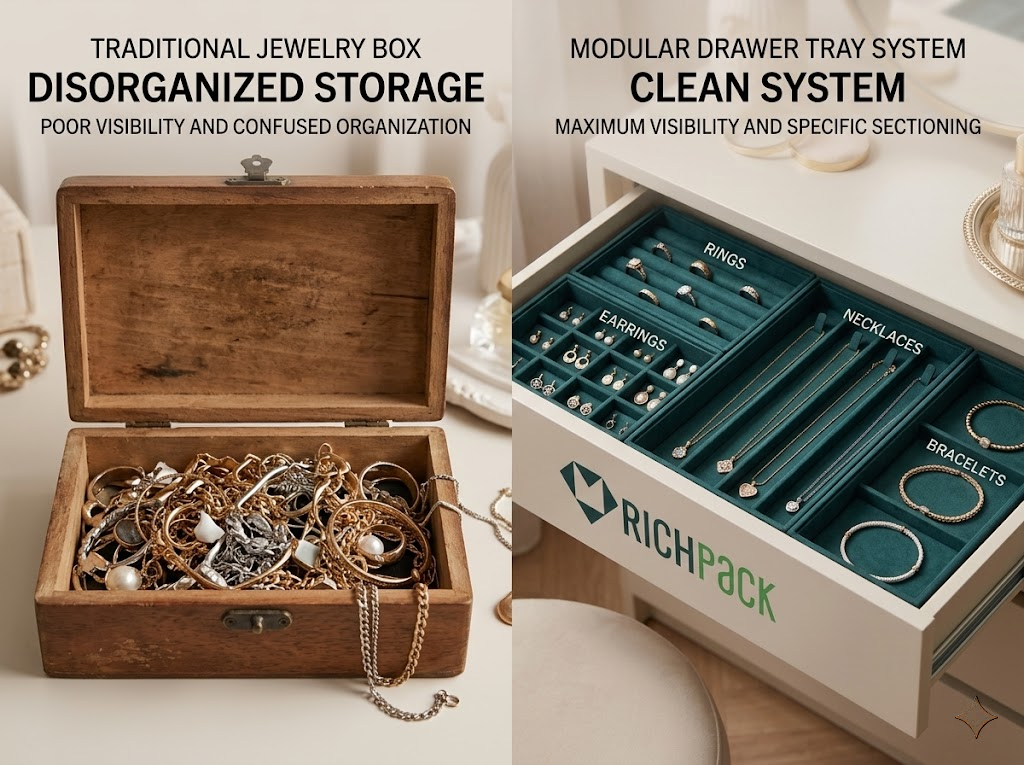
Drawer jewelry trays work because they replace random storage with controlled placement. Instead of asking your jewelry to adapt to one container, a good tray gives each category the right kind of space.
A proper jewelry tray insert gives every piece a defined home.
Ring rolls support bands upright. Small compartments keep earring pairs together. Long channels give chains room to lie flat without twisting. When pieces stop rubbing against each other, scratches, tangles, and finish wear drop significantly.
Velvet-lined jewelry trays for drawers are especially effective for fine jewelry — the surface is soft, stable, and far less abrasive than hard plastic dividers.
Flat storage changes how a collection feels to use.
Instead of digging through layers, you open the drawer and see everything at once. That visibility makes selection faster — and it helps people actually wear more of what they own.
For a business, that same benefit improves workflow. Staff spend less time searching, resetting, or untangling product before a customer interaction.
One of the biggest strengths of drawer storage is flexibility.
A single tray handles a small daily collection. Stackable jewelry trays for drawers scale with a growing assortment without forcing a complete reset. You can expand by category, use frequency, or product type without destroying the structure that already works.
The shift isn’t just cosmetic. It’s behavioral.
When jewelry is easy to see, easy to reach, and easy to return to its place, people actually keep the system going. That’s what changes traditional jewelry storage in a lasting way.
For brands and retailers, it also adds commercial value. Better organization supports cleaner presentation, smoother customer interaction, and a more premium storage story around the product itself.
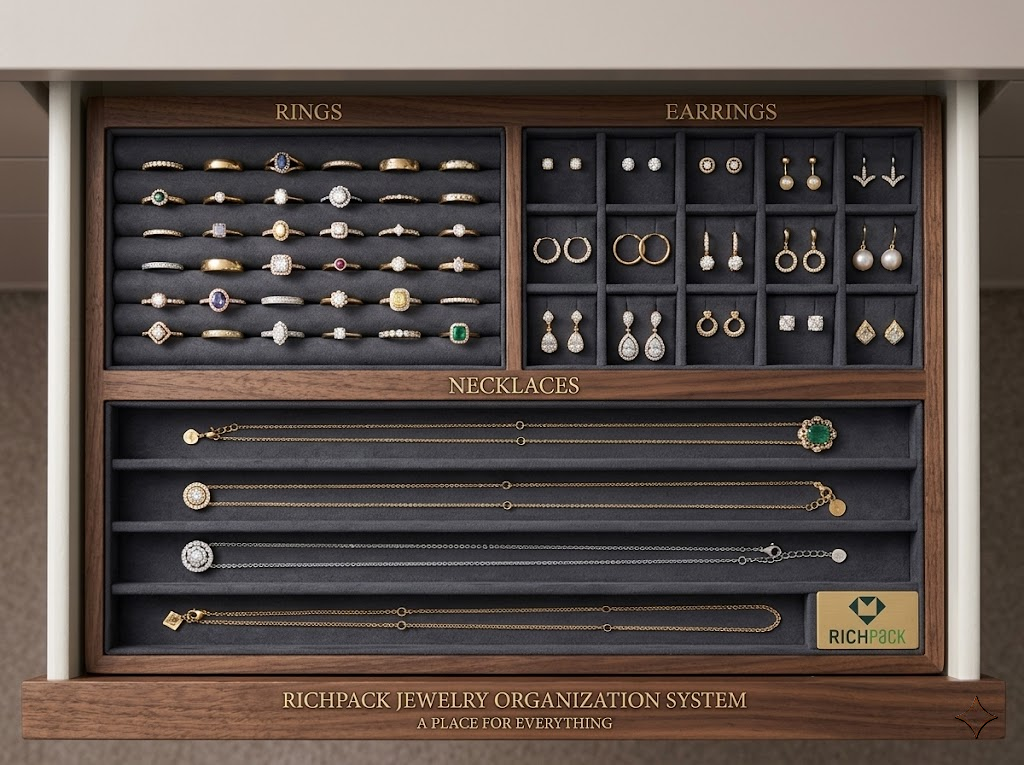
Not every tray works for every collection. The right choice depends on material, drawer depth, product mix, and how premium you need the presentation to feel.
Here’s a quick comparison before we go deeper:
| Tray Type | Best For | Protection Level | Visual Finish |
| Velvet lined | Fine jewelry, gemstones, premium retail | High | Luxury |
| Felt lined | Mixed collections, everyday use | Medium | Clean/neutral |
| Acrylic | Fashion jewelry, high-turnover stock | Low–Medium | Minimal |
| Stackable inserts | Limited drawer depth, multi-category | Varies | Varies |
| Custom trays | Brands, retail environments, and branded packaging | High | Fully branded |
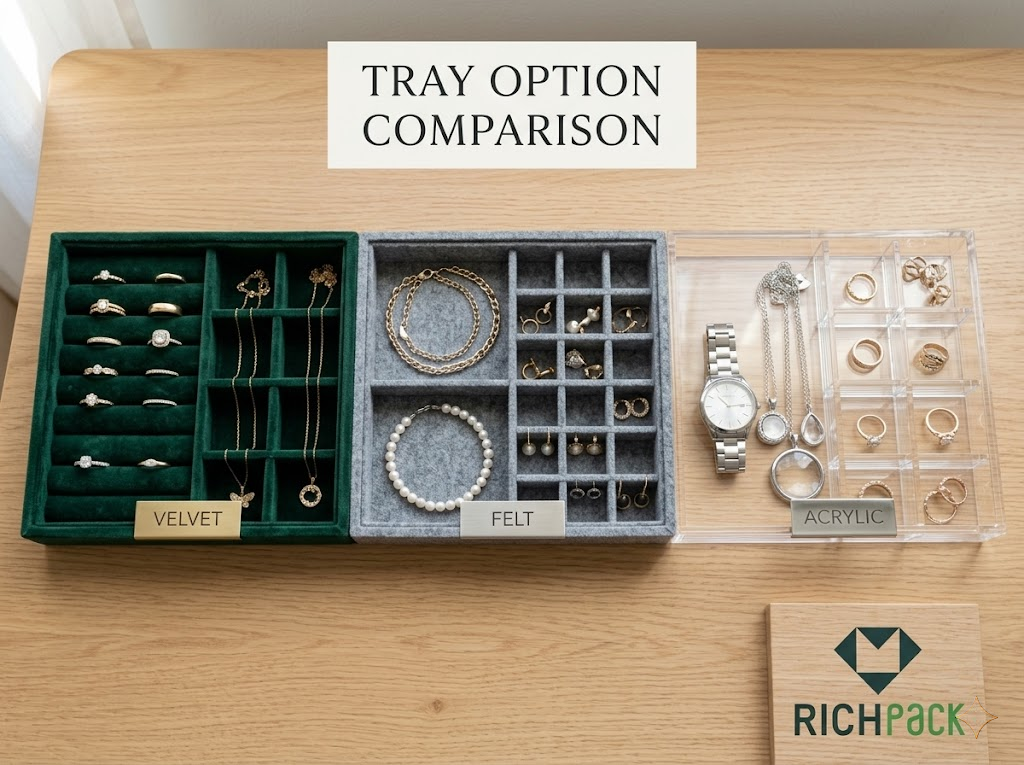
Velvet jewelry trays for drawers are the strongest choice for fine jewelry, gemstones, and premium collections.
The surface is soft, reduces friction, and gives the drawer a luxury finish. In premium retail and branded packaging systems, velvet also signals care, quality, and elevated perceived value — before the customer even touches the product.
Felt-lined jewelry organizer trays for drawers offer a practical middle ground.
They protect better than hard plastic, cost less than many velvet options, and handle mixed collections well — everyday jewelry alongside a few higher-value pieces. If the goal is a clean function without overbuilding the system, felt is usually the right starting point.
Acrylic jewelry trays for drawers are useful when visual access is the priority.
Small items are easy to spot, and the surface wipes down quickly. They suit fashion jewelry, high-turnover assortments, and operational environments where speed matters more than softness. The tradeoff is real, though: acrylic is efficient, but it doesn’t create the same premium feel as velvet or felt.
Stackable inserts maximize vertical space without turning a drawer into chaos.
They work especially well when a collection spans multiple categories, but the drawer doesn’t have much horizontal room. Keep discipline here: the top layer should hold the most-used pieces, and lower layers support occasional-use or seasonal items.
Custom jewelry trays for drawers are where storage becomes brand infrastructure.
A custom tray can match real product sizes, brand colors, collection logic, and even packaging standards. For jewelry brands, that matters: a branded tray doesn’t just store the product — it frames how the customer sees it, how staff handles it, and how the brand communicates care and consistency.
At RichPack, we work with jewelry brands to design custom tray systems that fit their product and their presentation standards. Reach out if you want to explore a custom solution.
Here’s how to set up a drawer jewelry tray system that holds up in real use. Let’s go through each one.
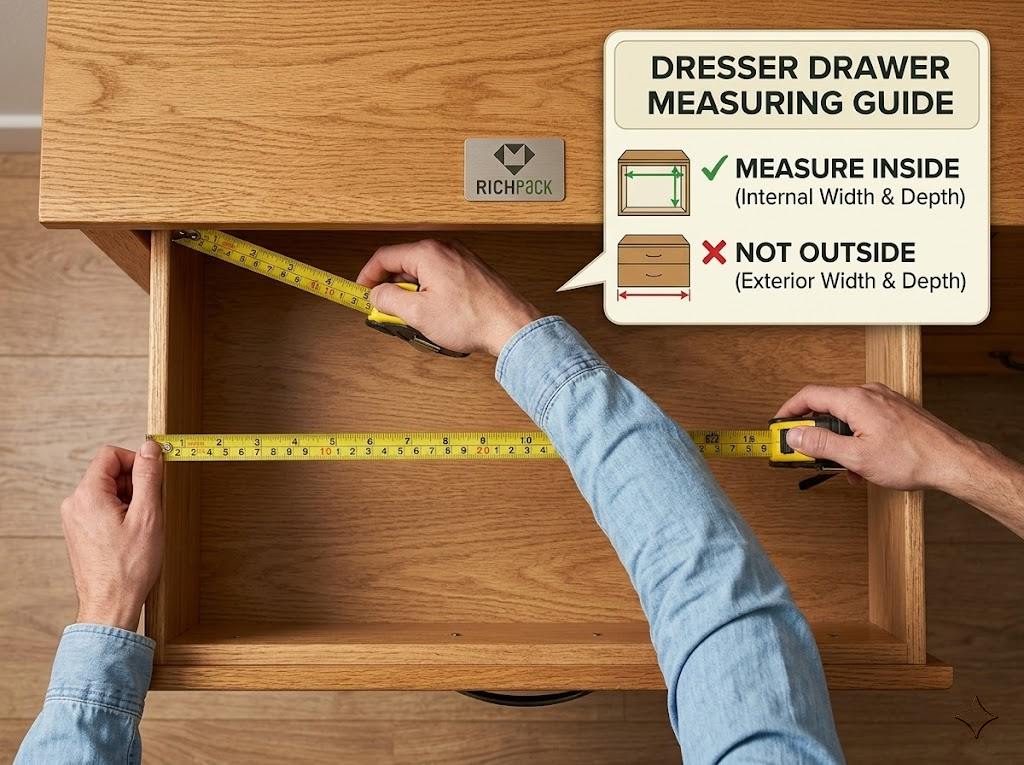
Always measure the usable inside space of the drawer — not the exterior dimensions.
Drawer walls, slides, and construction details reduce the actual fit area. A tray that’s too loose shifts around and wastes space. A tray that’s too tight creates pressure and awkward access. Measure width, depth, and height before you order anything.
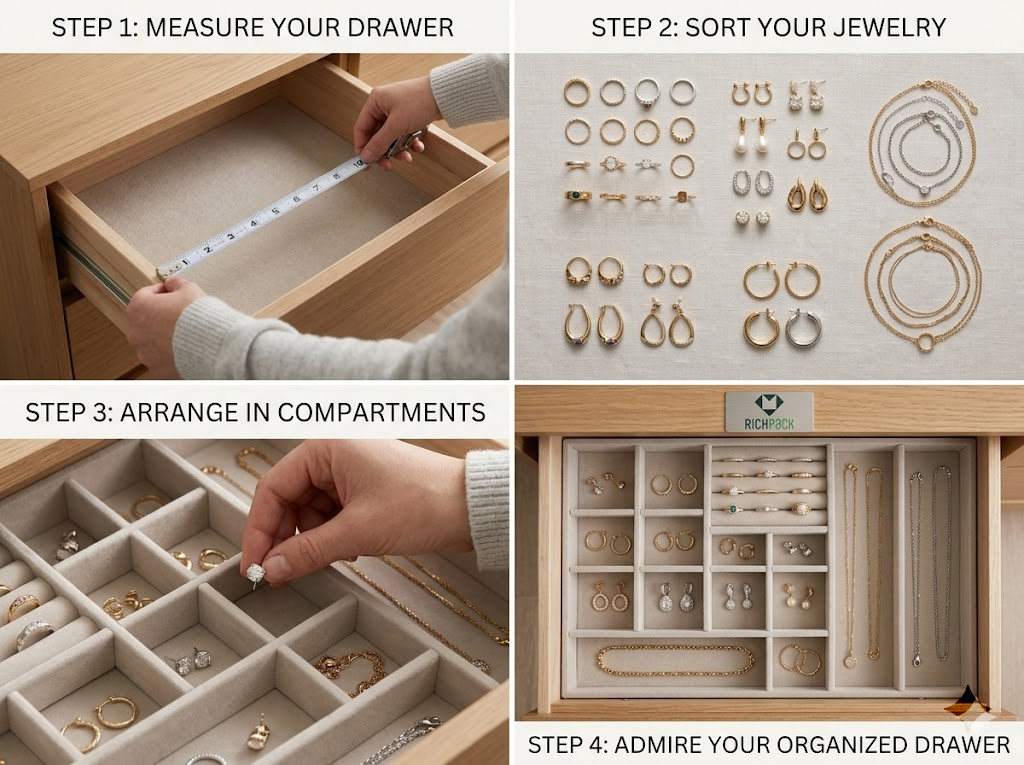
Before you touch the tray, lay everything out and sort it.
Organize by type (rings, earrings, necklaces, bracelets), then by frequency of use, then by sensitivity. Daily pieces should not share space with occasional items. Fine chains should not be treated the same way as chunky statement bracelets.
Sorting first prevents the most common mistake: building a neat-looking system that still fails in real use.
Each compartment should match a storage function — not just a size category.
Ring rolls for rings. Small squares for studs. Long channels for chains. Wider areas for cuffs, watches, or statement pieces. If the layout doesn’t match the collection, the system becomes decorative instead of useful.
If you’re using modular or stackable jewelry trays for drawers, keep the logic simple.
Fast-moving pieces go on top. Lower-use items go underneath. For retail and workshop teams, this also keeps best sellers and active inventory in the most accessible position, while reserve or seasonal stock stays protected below.
Open and close the drawer several times after setup.
Watch for movement, snagging, overcrowding, or pieces making contact with each other. A well-set drawer should feel stable and quiet. If anything still shifts or looks crowded, the layout isn’t finished yet.
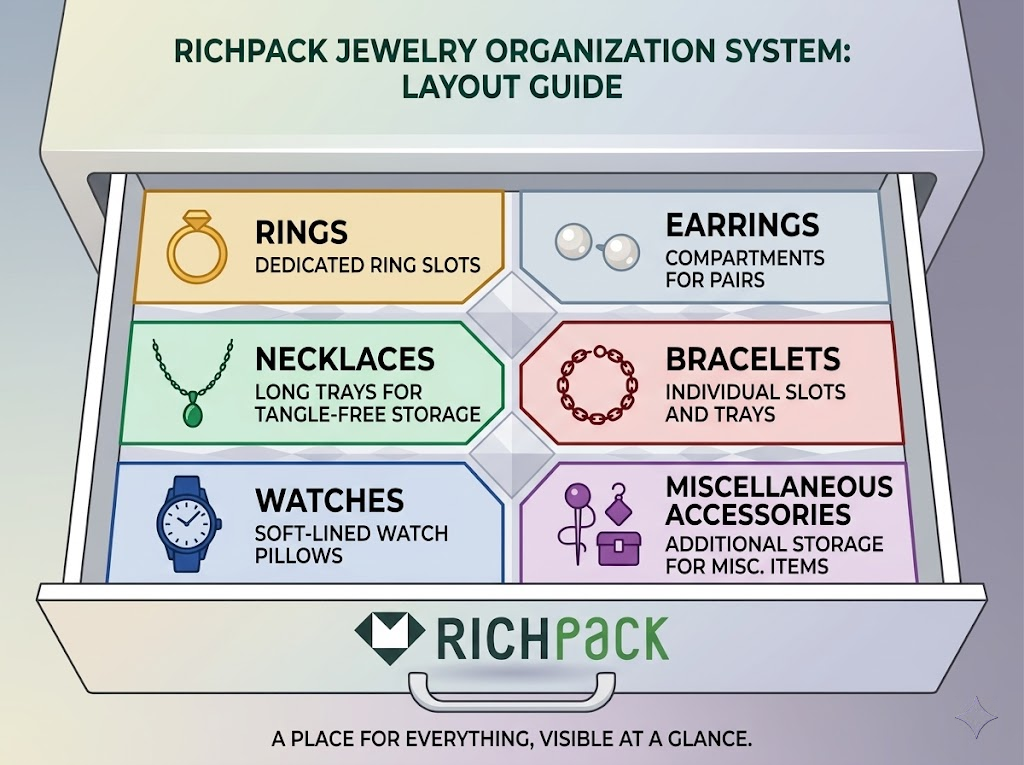
Once the tray is set, category handling becomes the difference between a tidy drawer and one that actually protects your collection over time.
Ring rolls keep bands separated, visible, and easy to remove without contact damage.
They work especially well for daily-wear rings because they shorten selection time and reduce unnecessary handling. Larger cocktail rings or high settings may need wider padded areas — not every ring belongs in a tight roll slot.
Earrings should stay in pairs inside shallow compartments with enough room for hooks, backs, and posts to rest cleanly.
This simple rule prevents the most common jewelry storage failure: separated pairs. For retailers, it also cuts down on handling mistakes during restocking and display resets.
Necklaces need room. Long compartments give chains space to lie flat and avoid twisting.
Fine chains should be the most isolated — they tangle the fastest. Heavier pendants should be placed so that the pendant lies flat and doesn’t pull against the chain when the drawer moves.
Bracelets and watches should not go into one open section together.
Clasps, edges, and harder metal parts can leave marks on nearby surfaces quickly. Use wider cavities, soft dividers, or separate compartments when possible. That extra spacing preserves finish quality over time.
One advantage of a tray system is that it supports rotation without a full reset.
Seasonal jewelry, event pieces, or slower-moving designs can shift to a secondary tray while your core collection stays in place. You’re adjusting access, not rebuilding storage every time the collection changes.
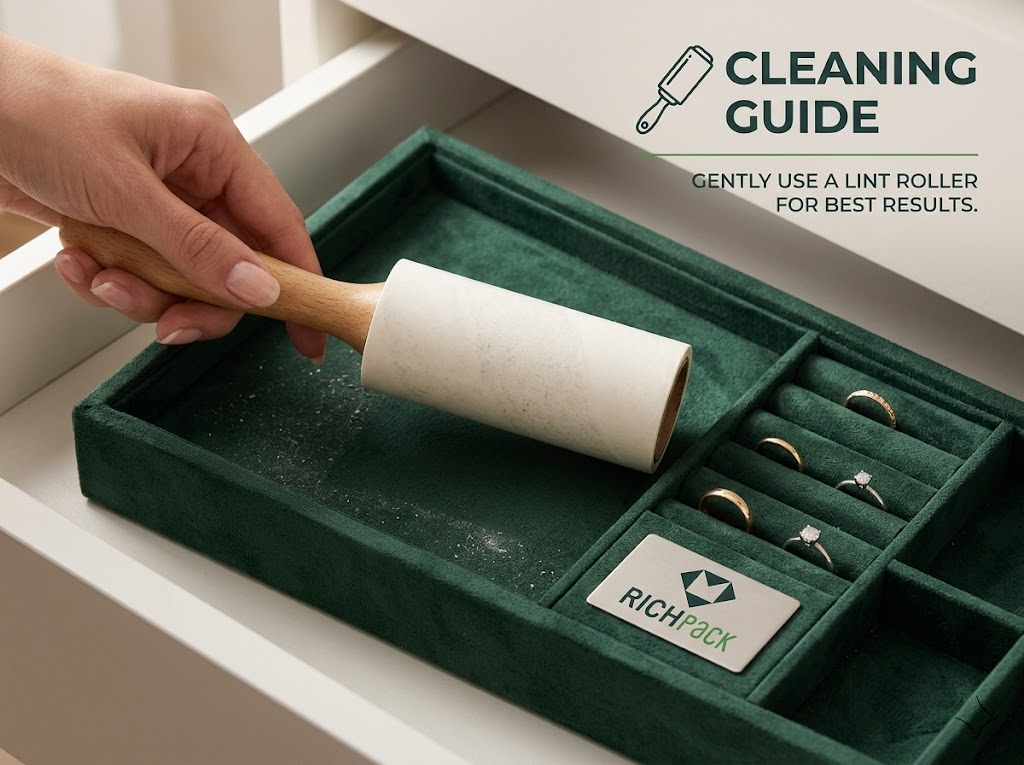
A drawer tray system is only useful if it stays clean and protective after the first week. These habits keep the structure working.
Use a soft brush, lint roller, or gentle hand vacuum to remove dust from velvet and felt.
Avoid aggressive scrubbing or soaking — that flattens the surface pile and weakens the protective finish. Light, regular cleaning is more effective than waiting until the tray looks heavily worn.
Jewelry should be reasonably clean before it goes into storage.
Oils, perfume residue, and moisture accelerate tarnish — especially for silver. Anti-tarnish strips or silica packets can help protect pieces that don’t get handled often. It also helps to keep very active daily-wear pieces separate from cleaner reserve items.
A tray insert should be replaced when the surface no longer protects well, the compartments no longer fit the collection, or the structure shifts too much inside the drawer.
Sometimes the tray isn’t damaged — the business or collection has just outgrown it. That’s still a valid reason to upgrade.
There is no universal size — dressers and vanity drawers vary in usable interior dimensions. The best approach is to measure the inside width, depth, and height before choosing a tray. A good fit minimizes wasted space and allows smooth opening and closing.
Yes, especially for fine jewelry, gemstone pieces, and premium presentation. Velvet improves perceived value, creates a softer contact surface, and gives the drawer a cleaner, more luxurious appearance than basic plastic or unfinished inserts.
Yes, if the drawer height allows enough clearance and the trays can still be lifted easily. Stackable systems work best when the top layer holds the most-used pieces and lower layers support secondary categories or seasonal rotation.
Use lined trays with velvet or felt surfaces, and choose compartment sizes that fit the jewelry closely. Sliding usually happens when compartments are too open, or the tray surface is too hard and smooth to grip the pieces.
Velvet is generally the best choice for fine jewelry — it combines soft contact, stronger visual presentation, and a more premium feel. Felt is also protective but simpler in finish. Acrylic is better for visibility than for protection.
Yes. Custom jewelry trays for drawers are widely used in retail stores, workshops, and branded storage systems. Businesses typically customize dimensions, compartment layouts, materials, and colors to match their products and display standards. Contact RichPack to explore custom tray options.
The goal isn’t to find a prettier box. The goal is to build a system that protects your jewelry, makes it easy to see, and makes daily access fast enough that people actually use it.
Drawer jewelry trays do exactly that.
For personal collections, they reduce clutter, prevent damage, and make mornings easier. For jewelry brands and retailers, they do something more: they create a cleaner, more premium way to store, handle, and present jewelry at every stage — from the workshop to the display floor to the customer’s hands.
If you’re ready to move from a basic storage setup to something that scales with your collection, drawer trays are the right place to start.

Just submit your email to get exclusive offers (reply within 12 hours)





 PREV
PREV