

 PREV
PREV

14K Gold Filled Jewellery: Packaging Design and Protection Strategies
2024-12-12
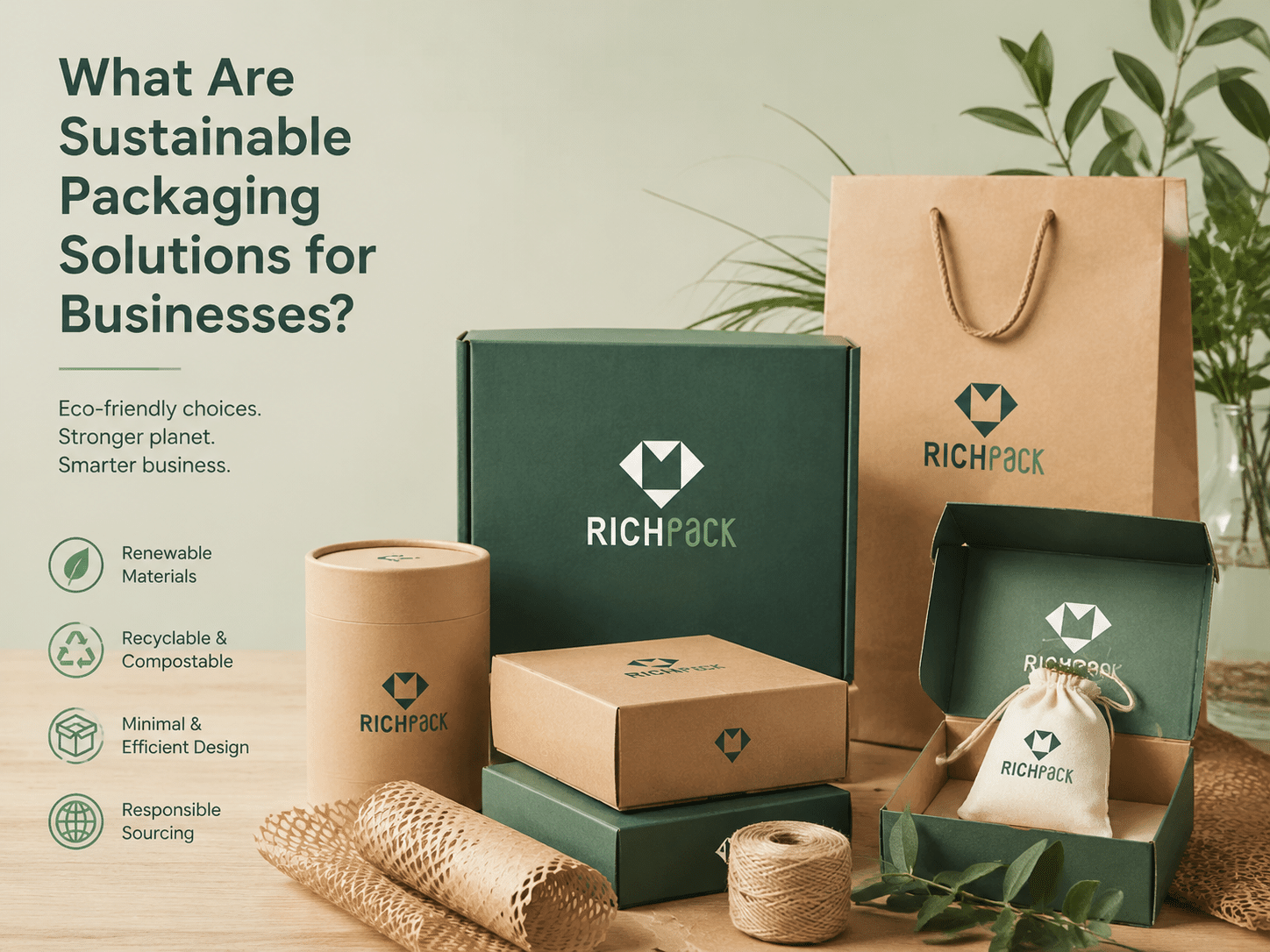



Most businesses do not need a greener-looking box. They need packaging that protects the product, keeps shipping under control, and still feels thoughtful when the customer opens it.
You feel the problem fast on a packing line. One carton is too large. One insert moves. Another looks eco-friendly in a render but fails the first drop test. That is why sustainable packaging should be treated as a system rather than a material trend.
Sustainable packaging means using fewer unnecessary materials, relying on responsible materials where they make sense, and still working in the real supply chain. For a business, it affects freight cost, damage rate, compliance risk, customer trust, and the moment a buyer opens the parcel.
If you are choosing sustainable packaging solutions in 2026, start with the product, the shipping route, the customer, and the end-of-life path. A compostable film, FSC paperboard box, molded pulp tray, reusable jewelry box, or right-size carton can all be the right answer in the right context.
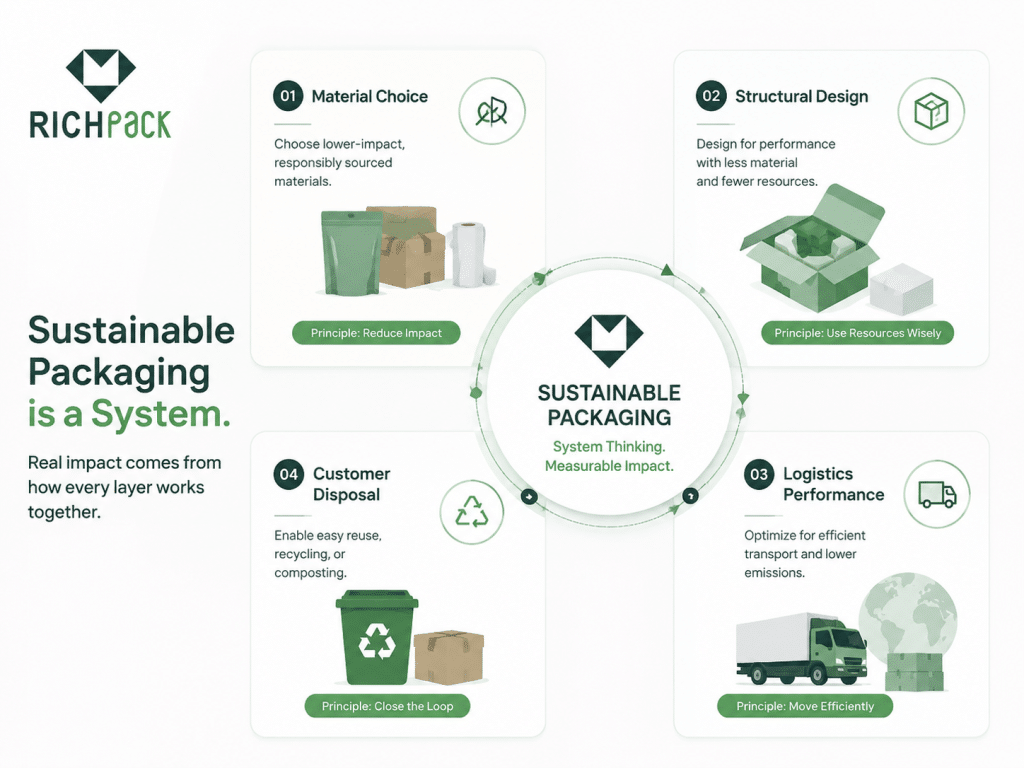
Before you compare materials, define the job packaging that has to be done. For businesses, sustainable packaging must protect the product, make customers feel confident, and reduce waste without creating a new operational problem.
That baseline matters because every later choice depends on it. Once the job is clear, every material becomes easier to judge.
Sustainable packaging is packaging designed to reduce environmental impact across its life cycle. It covers materials, production, transport, use, reuse, recycling, and disposal.
The U.S. Environmental Protection Agency connects packaging decisions with Sustainable Materials Management. That matters because packaging is not just trash after purchase. It is material, money, energy, and logistics tied together.
A business-friendly definition is simple: Sustainable packaging protects the product with the least practical waste, the clearest recovery path, and the most honest environmental claim.
That means a recyclable paperboard box can be sustainable. A reusable jewelry drawer box can also be sustainable. A compostable pouch can be sustainable only when the product, market, and composting access support it.
Packaging is too big to treat as a small brand detail. EPA data shows that containers and packaging generated 82.2 million tons of municipal solid waste in the United States in 2018. That was 28.1% of total MSW generation. The same EPA dataset shows that 30.5 million tons of containers and packaging were landfilled that year.
The pressure is not only about waste. It is also about delivery. The World Economic Forum reported that demand for urban last-mile delivery is expected to grow 78% by 2030, with related emissions rising by more than 30% in 100 cities if no effective interventions are made.
Customers feel that pressure in a simpler way. They notice oversized boxes. They notice plastic filler. They notice when a premium product arrives in packaging that looks careless. They also notice when an “eco” package fails, and the product arrives damaged.
That is why sustainable packaging touches more than brand image:
For DTC and e-commerce brands, the box is often the first physical contact with the customer. If it feels wasteful, the brand message breaks. If it feels flimsy, trust breaks faster.
Do not choose packaging by material alone. Choose it by job.
A good sustainable packaging decision answers five questions:
| Decision Factor | What to Ask | Why It Matters |
| Protection | Will it protect the product during real shipping? | Broken products create more waste than strong packaging. |
| Material | Is it recyclable, reusable, certified, or responsibly sourced? | Material claims need proof. |
| Fit | Is the package right-sized? | Oversized packaging raises cost and waste. |
| End of life | Can the customer dispose of it correctly? | Confusing disposal claims reduce real recovery. |
| Brand experience | Does it still match the product value? | Premium products need packaging that feels intentional. |
Here is the hard truth. The most sustainable paper option may fail in the real supply chain.
A thin mailer that reduces material but causes product damage is not a win. A beautiful rigid box with mixed plastic, magnets, foam, and coating may feel premium, but it can be hard to recycle.
The better path sits between both extremes.
Start with reduction, not replacement. Right-size the package, remove filler that has no job, simplify mixed materials, and then choose a better substrate. This order usually creates more impact than chasing a trendy compostable or plant-based material first.
For premium brands, the goal is not to make packaging look plain. The goal is to make every layer earn its place.
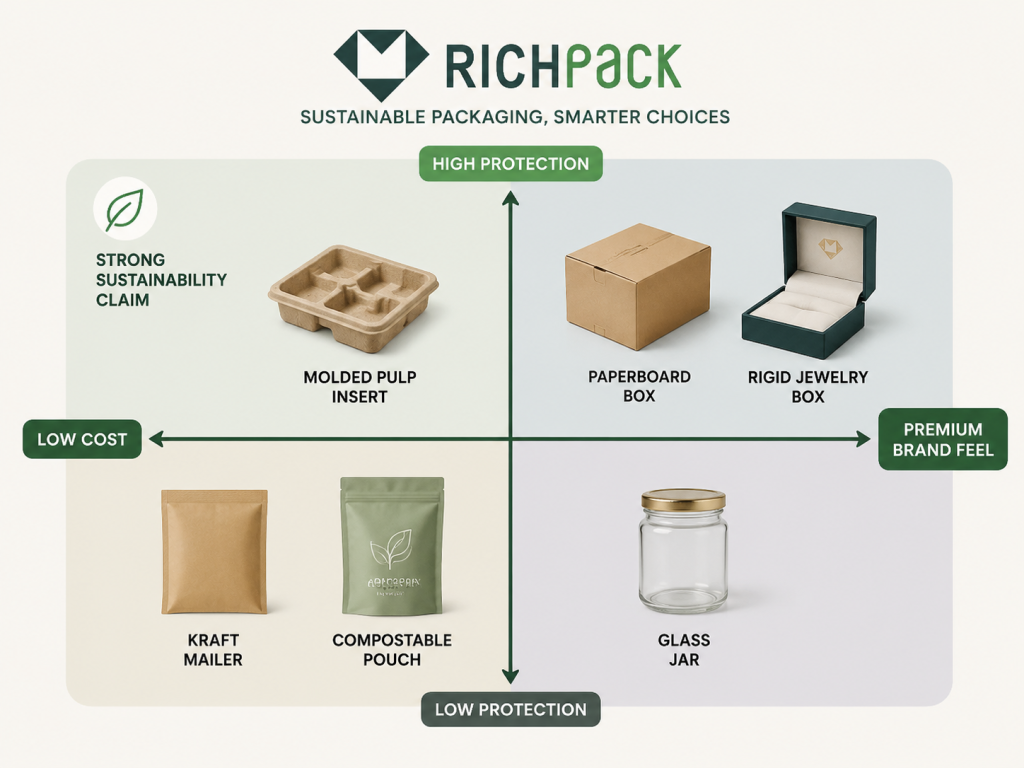
Most articles treat sustainable packaging solutions like a shopping list. That is not enough. A recyclable box, a compostable tray, and a reusable jewelry case solve different problems.
The goal is simple: match each solution to the job it can actually handle.
Recyclable packaging is often the most practical starting point. It includes paperboard boxes, corrugated cartons, kraft mailers, glass, aluminum, and some mono-material plastics.
For e-commerce and gift brands, paper-based packaging is usually easier for customers to understand. A paper box with paper fill feels simple. It also avoids the “what bin does this go in?” problem.
But recyclable does not mean automatically recycled. A material still depends on local recycling access, contamination, coatings, labels, and mixed-material design.
Use recyclable packaging when you need broad customer understanding and a simple recovery path.
Compostable packaging breaks down into compost under the right conditions. The phrase “right conditions” is the key.
Many compostable materials need industrial composting. If your customer has no access to that system, the packaging may end up in a landfill.
Compostable packaging works best for food service, takeout, produce, and event settings where compost collection is clear. It is less simple for global e-commerce brands shipping into many markets.
Do not write “compostable” on packaging unless you can explain where and how it should be composted.
Reusable packaging reduces waste by giving the package a second life. This can mean refill jars, returnable shipping totes, fabric pouches, metal tins, or premium boxes kept for storage.
For jewelry and gift packaging, reuse is a strong angle. A well-made drawer box or rigid paper box can become a storage case for rings, earrings, receipts, care cards, or travel pieces.
This is where premium packaging has an advantage. People rarely reuse packaging that feels cheap. They keep packaging that feels useful, beautiful, or sturdy.
Pro tip: design reuse into the structure. Do not just hope the customer keeps it.
Biodegradable and plant-based packaging includes PLA, CPLA, PHA, bagasse, cornstarch materials, molded fiber, bamboo fiber, mushroom mycelium, seaweed films, and compostable flexible films.
These materials sound exciting, and some are useful. But they also create confusion.
Plant-based does not always mean recyclable. Biodegradable does not always mean compostable. Compostable does not always mean home compostable.
Use these options when they match the product, disposal system, and customer education plan. Food packaging can be a good fit. Luxury jewelry packaging usually needs more testing before using these materials at scale.
Right-size packaging may be the most underrated sustainable packaging solution.
It means you use less material by making the package fit the product. The result can be lower waste, lower shipping volume, fewer fillers, and better storage efficiency.
This is a supply chain win, not just a design trend.
Illustrative micro-case study: A jewelry brand shipping small earrings in oversized cartons could redesign the system around a compact inner box, paper-based insert, and smaller outer shipper. In a controlled pilot, a 20% outer-carton volume reduction could lower dimensional-weight pressure, reduce filler use, and make damage easier to track. If the package also holds the product firmly, the brand may be able to target a damage rate below 0.5% on the tested lane. This example is illustrative and should be validated with real RichPack project data before publication as a customer case.
In RichPack’s experience, the first win is often not the visible gift box. It is the hidden fit between the inner box, insert, pouch, and outer shipper. When those parts match, the brand can cut filler, reduce movement in transit, and still keep the unboxing moment polished.
| Solution Type | Best For | Main Benefit | Common Risk |
| Recyclable packaging | E-commerce, retail, gifts | Easy for customers to understand | Coatings or mixed materials can reduce recyclability |
| Compostable packaging | Food service, events, produce | Strong waste story when composting exists | Needs correct composting access |
| Reusable packaging | Beauty, jewelry, premium gifts | Extends package life | Higher unit cost |
| Plant-based packaging | Food, cosmetics, niche products | Reduces fossil-based material use | End-of-life claims can confuse buyers |
| Right-size packaging | E-commerce and fulfillment | Cuts waste and shipping inefficiency | Needs careful product protection testing |
Material choice is where many brands waste money. They switch to a greener-looking material before checking product risk, shipping pressure, printing needs, and customer disposal behavior.
Do not ask which material is best. Ask which material is best for this product, this route, this price point, and this customer.
Paper and paperboard are the safest starting points for many brands. They are familiar, printable, widely used, and easy to shape into boxes, sleeves, inserts, cards, and wraps.
For premium gift packaging, paperboard can still feel high-end. The difference comes from thickness, structure, texture, embossing, foil alternatives, print control, and the way the box opens.
Choose FSC-certified or responsibly sourced paper when possible. Keep the structure easy to separate. Avoid unnecessary plastic windows if they do not improve the buying decision.
Molded pulp is useful when you need protection without plastic foam. It can form trays, inserts, and cushioning parts.
Corrugated board is strong for shipping. It works well for e-commerce cartons, outer shippers, protective layers, and bulk movement.
The supply chain view is clear: the insert and outer box should work together. If the outer carton is strong but the inner tray fails, damage goes up. If the inner tray is strong but oversized, the shipping cost goes up.
Design the full packaging system, not one part.
Bio-based materials deserve a closer look because competitors often list them as if they are interchangeable. They are not.
BioLeaderPack highlights sugarcane bagasse, cornstarch materials, PLA, CPLA, and food paper packaging as common biodegradable packaging options. TIPA-style compostable flexible films are often positioned for pouches and flexible packaging where brands want a plastic-like feel with a compostable end-of-life claim. The business question is not which one sounds greener. The question is which one survives the product, the channel, and the disposal system.
| Material | Performance Strength | Practical Limit | Best-Fit Use Case | Premium Packaging Fit |
| FSC or recycled paperboard | Strong print surface, familiar recycling path, premium textures | Weak against moisture unless coated | Jewelry boxes, sleeves, gift boxes, cartons | Very strong |
| Molded pulp | Good cushioning, plastic-foam alternative, formable inserts | Rougher surface, tooling needed, moisture sensitivity | Inserts, trays, protective packaging | Strong when finished well |
| Sugarcane bagasse | Renewable byproduct, heat-resistant, compostable under proper conditions | Moisture and oil resistance may need coating | Food trays, bowls, clamshells | Limited to luxury jewelry |
| Cornstarch materials | Moldable, useful for disposable formats | Water sensitivity and industrial composting dependence | Cutlery, plates, short-use food packaging | Low for jewelry |
| PLA | Clear, plant-based, useful for cold applications | Heat sensitivity above about 50 C, industrial composting needs | Cold cups, windows, and some films | Niche only |
| CPLA | Better heat resistance than PLA, stronger rigidity | Higher cost, less transparent | Hot-food cutlery and containers | Low for jewelry |
| PBAT/PLA compostable films | Flexible, pouch-like, good for some lightweight products | Composting access, barrier testing, and certification are needed | Compostable mailers, pouches, flexible wraps | Niche for outer bags |
| Reusable rigid paper boxes | Durable, giftable, high perceived value | Higher unit cost and more material | Jewelry, watches, premium gifts | Excellent |
For jewelry brands, the best sustainable material is usually not a food-service bioplastic. It is often a responsible paperboard structure, a reusable box, a molded paper insert, and a clean outer shipper that protects the product without waste.
Plastic is not always the enemy. Bad plastic use is the enemy.
Some products need moisture resistance, visibility, sealing, or hygiene performance. In those cases, recycled content or mono-material recyclable plastic may be more realistic than a weak paper substitute.
The key is honesty. If plastic is needed, reduce it, simplify it, and explain it.
For example, a beauty refill pouch may use less material than a rigid container. But the brand should verify whether the pouch can be recycled in its target market.
Glass and metal can feel premium and reusable. They work well for cosmetics, candles, fragrances, tea, confectionery, and some luxury gift sets.
The tradeoff is weight. Heavier packaging can raise freight costs and transport emissions. It can also increase breakage risk.
Hybrid structures need extra care. A box with paper, plastic, magnets, foam, ribbon, and laminate may look beautiful, but the customer cannot easily separate it.
For sustainable luxury packaging, fewer well-chosen materials usually beat many decorative layers.
Sustainable packaging design does not stop at the base material. Ink, coating, adhesive, lamination, foil, magnets, and window films also matter.
Water-based coatings, soy-based inks, low-migration inks, and recyclable-friendly finishes can reduce recovery problems. For food packaging, ink and migration rules need extra care.
For jewelry and gift packaging, the practical move is simple: use texture, structure, and clean print instead of heavy plastic lamination. The package can still feel premium without becoming a recycling headache.
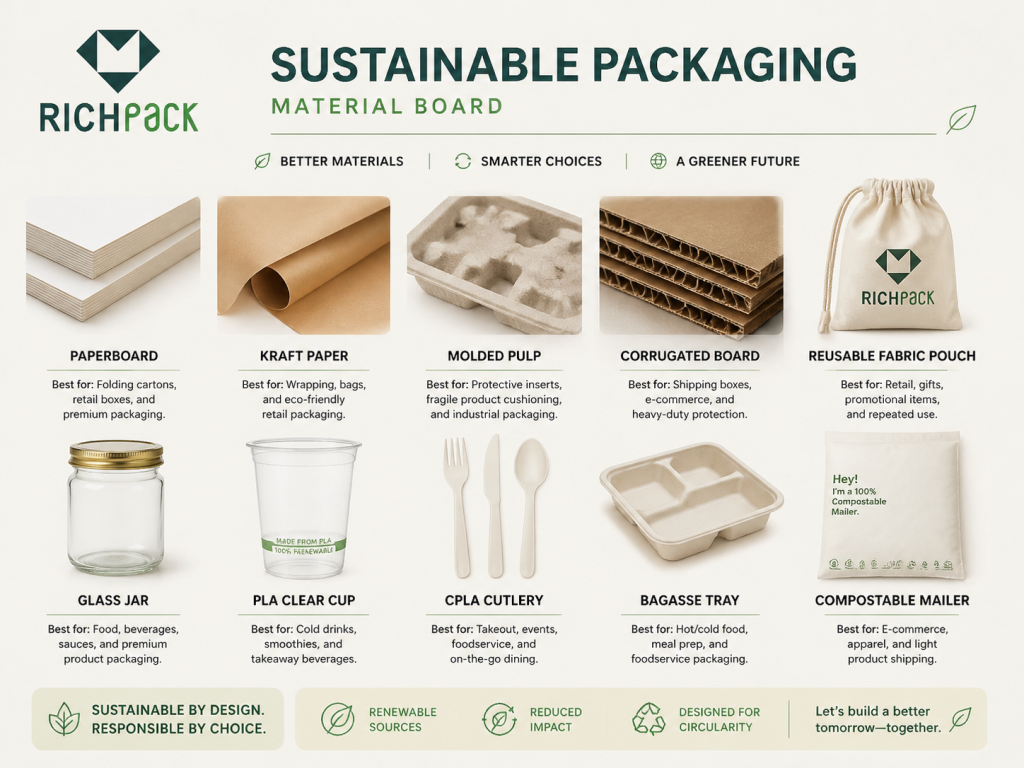
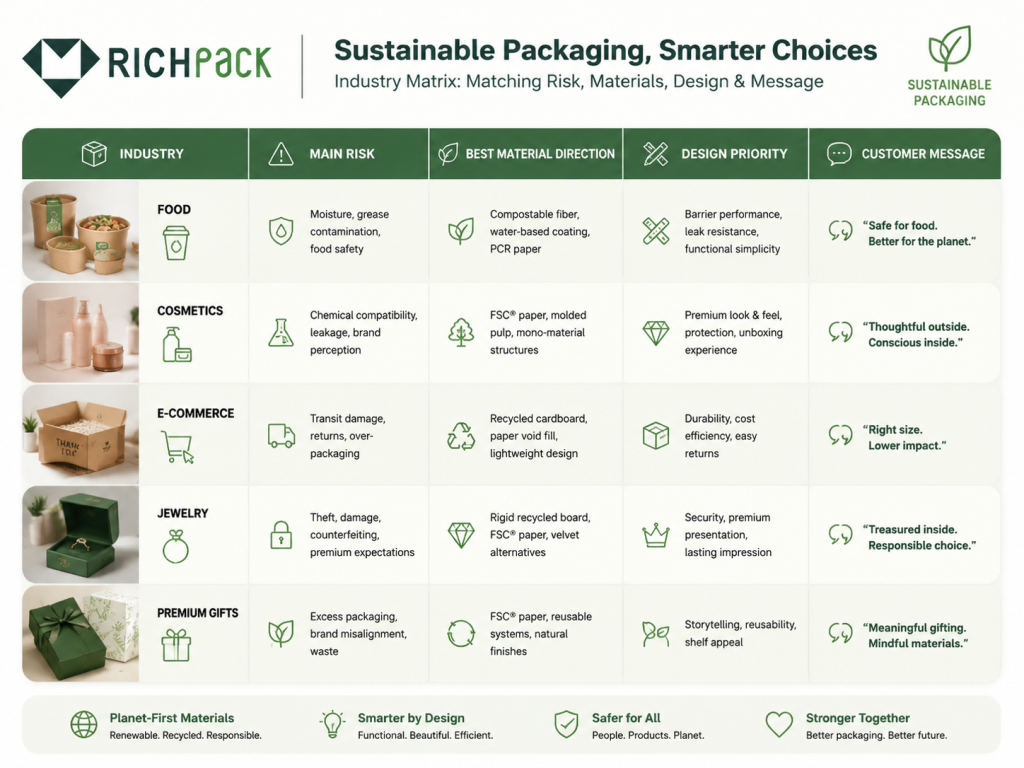
Sustainable packaging does not work the same way in every industry. Food packaging needs safety and freshness. Cosmetics need formula protection and shelf appeal. Jewelry packaging needs trust, protection, and gift value.
This is why copying another brand rarely works. Use industry context before choosing the package.
Sustainable food packaging has one rule before everything else: protect food safety.
A compostable container is not useful if it leaks, weakens, or affects freshness. A paper wrap is not better if it needs a hidden plastic layer that customers cannot separate.
Food brands should check grease resistance, moisture control, temperature exposure, labeling, and composting access. Bio-based options like bagasse, PLA, and CPLA may work here because the use case is short, visible, and often tied to food-service waste systems.
Use sustainable food packaging that can protect the food and tell the customer exactly what to do after use.
Sustainable cosmetic packaging has a harder job. It must protect formulas, resist moisture, look good on a shelf, and support brand trust.
Refill systems, glass jars, aluminum tins, PCR plastic, paper sleeves, and mono-material components can all work. The best choice depends on the product.
A skincare cream may need a barrier jar. A soap bar may work well in paper. A premium serum may use a glass bottle with a paperboard outer box.
Do not force one material across every SKU. Match the package to the formula and customer use.
E-commerce packaging lives in the real world. It gets stacked, dropped, sorted, scanned, returned, and photographed by customers.
This is where many brands learn the expensive lesson. A package that looks sustainable in a studio can fail in a warehouse.
Focus on:
Customer feedback often repeats one point: people dislike oversized packaging, but they dislike damaged products more. Seller discussions show a second pattern, too. Buyers may forgive a simple outer shipper, but the product presentation inside still needs to feel clean and intentional.
A DTC operator can use that insight immediately. Keep the transport layer lean and recyclable. Put the brand experience into the inner box, insert, card, and opening sequence.
Sustainable jewelry packaging must feel protective and giftable. A ring, necklace, or bracelet carries emotional value, so the package cannot look like an afterthought.
In RichPack’s experience, jewelry packaging fails when brands treat sustainability as a surface material swap. The real work is structural. The ring slot has to hold. The necklace channel has to prevent tangling. The pouch cannot scuff the finish. The outer shipper must stop movement without stuffing the box with filler.
A jewelry brand can use FSC paperboard, molded pulp or paper-based inserts, reusable rigid boxes, fabric pouches from responsible materials, and low-plastic decorative finishes.
The best jewelry packaging often follows this logic:
For high-end jewelry, this is where sustainable custom packaging earns its keep. It protects the product and the feeling around the product.
Premium brands need more than a stock eco box. They need a packaging system that protects margin, story, and customer experience.
For a jewelry brand, the packaging may include an outer shipper, rigid gift box, inner tray, pouch, polishing cloth, care card, warranty card, and branded insert. Each part can become more sustainable.
A strong custom route could look like this: FSC paperboard for the box, a molded pulp or paper-based insert for protection, a reusable drawer structure for storage, low-plastic finishes for decoration, and a care card that explains both product care and packaging disposal.
RichPack’s one-stop workflow fits this exact problem: high-end custom packaging from design to delivery. The value is not just making a box. The value is aligning concept, material selection, prototype, testing, production, global delivery, and brand presentation in one workflow.
That is the real upgrade from “eco-friendly packaging” to sustainable custom packaging.
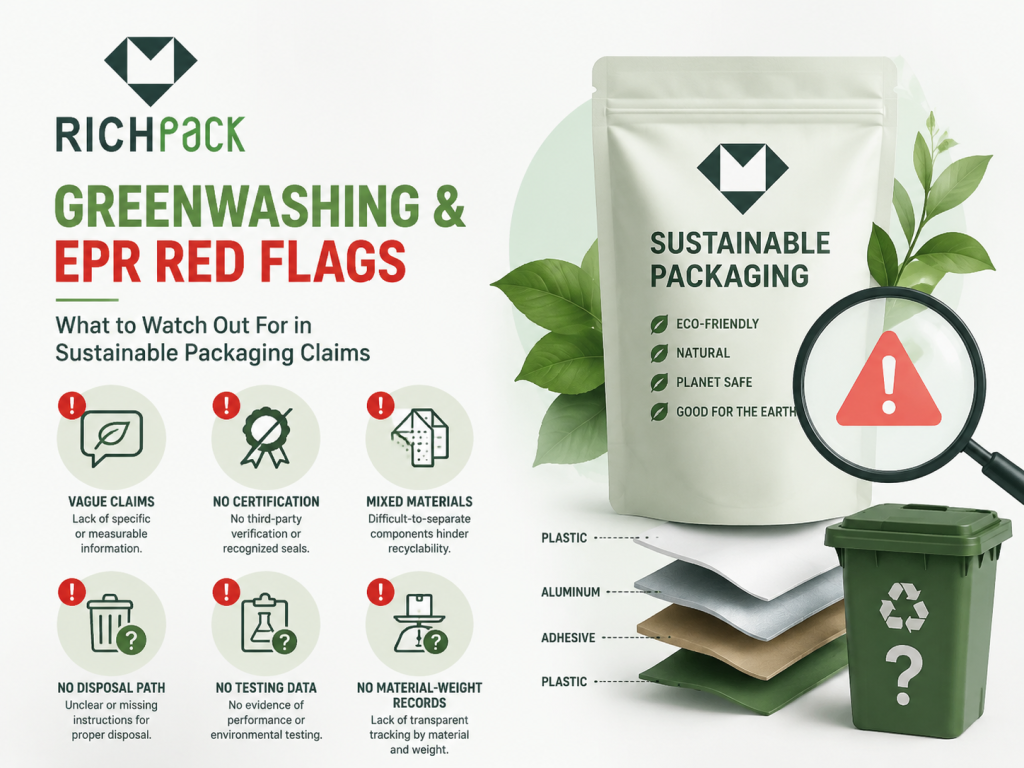
Greenwashing usually starts with vague language. Real sustainable packaging starts with documents, testing, and clear end-of-life claims.
Your supplier should not only sell you an eco option. They should prove what the material is, how it performs, and what the customer can realistically do with it after use.
A sustainable packaging claim needs proof. Without proof, it becomes decoration.
Ask for documents that match the claim. FSC certification supports responsible paper sourcing. PCR claims should show recycled content details. Compostable claims should name the applicable standard or testing basis. LCA or PLCA data can help compare environmental impact across the packaging life cycle.
Do not accept vague phrases like “eco,” “green,” or “earth-friendly” without details.
Good claim: “Made with FSC-certified paperboard and designed for paper recycling where facilities exist.”
Weak claim: “100% good for the planet.”
Extended Producer Responsibility, or EPR, makes producers financially or operationally responsible for packaging after use. The Sustainable Packaging Coalition defines EPR as a policy approach that assigns producers responsibility for end-of-life management. That can include funding, collection, sorting, processing, education, and reporting.
For outbound brands selling into Europe, this is not a soft branding issue. It can affect whether the packaging is easy to register, report, label, recover, and justify.
The European Commission states that the Packaging and Packaging Waste Regulation entered into force on February 11, 2025, and will generally apply from August 12, 2026. It covers all packaging and packaging waste, regardless of material or origin, and sets requirements for manufacturing, composition, and the reusable or recoverable nature of packaging placed on the EU market.
That changes packaging selection in practical ways:
| EPR Pressure | Packaging Decision: It Affects | What Brands Should Do |
| Producer fees | Material type and weight | Reduce unnecessary layers and track packaging weights |
| Recyclability rules | Coatings, laminates, windows, magnets | Avoid hard-to-separate mixed materials |
| Reporting | SKU-level packaging data | Keep material specs and supplier documents organized |
| Labeling | Disposal and sorting claims | Use market-specific language before printing |
| Reuse and recovery targets | Structure and durability | Consider reusable formats where the use case supports them |
If your brand sells jewelry, cosmetics, gifts, or e-commerce products into Europe, design for documentation before mass production. Keep paper certifications, material breakdowns, weight data, coating details, and supplier declarations in one place.
Use direct questions. You will learn fast.
Ask your packaging supplier:
This checklist turns a vague supplier call into a real sourcing review.
End-of-life claims cause the most confusion.
Here is the clean version:
| Claim | What It Means | What to Check |
| Recyclable | Can be processed into a new material | Local access, coatings, mixed materials |
| Compostable | Breaks down into compost under set conditions | Industrial vs home composting |
| Biodegradable | Breaks down over time | Time, conditions, residue |
| Reusable | Can be used multiple times | Durability, customer reason to keep it |
| Recycled content | Made with recovered material | PCR percentage and documentation |
Do not use these words as synonyms. They are not the same.
Your target market includes countries outside China, so the article needs a global mindset.
Packaging rules and recycling systems vary by country. EPR programs are gaining attention in the United States and are already more established in regions like the European Union and Canada, according to the Sustainable Packaging Coalition EPR Guide.
The EU also reports that 40% of plastics used in the EU are in packaging, half of marine litter is from packaging, and 186.5 kg of packaging waste was generated per person in 2022. Those numbers explain why regulators are moving from voluntary claims toward design, reporting, and recovery requirements.
For global brands, use flexible language. Say “recyclable where facilities exist” when needed. Keep disposal labels clear. Track market-specific rules before printing large runs.
Score suppliers before you compare prices.
| Score Area | What Strong Looks Like | Red Flag |
| Material proof | Clear specs and certificates | Vague eco wording |
| Design support | Can reduce material without hurting protection | Only offers stock options |
| Testing | Drop, compression, humidity, and fit tests | No performance data |
| Finish options | Recyclable-friendly inks and coatings | Heavy lamination by default |
| Global support | Understands export, labeling, delivery, and EPR documentation | No market knowledge |
| Brand fit | Can protect premium unboxing | Only talks about low price |
A cheaper supplier can become expensive if the packaging fails, ships late, or creates a claim risk.
The safest way to switch packaging is not a full redesign on day one. Start small, test hard, measure the full cost, and only scale what survives real shipping.
This plan is built for operators, procurement teams, and brand teams that need progress without chaos.
Do not replace every package at once. Start with one SKU, one collection, or one shipping format.
Pick the line where the change will be visible and easy to measure. For a jewelry brand, that might be a bestselling ring box or necklace gift set. For e-commerce, it may be the most common carton size.
A pilot keeps the risk small and the learning fast.
The smartest sustainable packaging plan starts with reduction.
Before you switch materials, remove what you do not need:
Then replace what remains with better materials.
This sequence matters because material swaps alone can hide waste instead of reducing it.
Sustainable packaging must survive the supply chain.
Test the package for drops, compression, vibration, humidity, scuffing, and real warehouse handling. Then compare total cost, not just unit cost.
Track:
In RichPack’s packaging development process, this is where attractive concepts either become real business packaging or stay as mood-board ideas. A thinner insert is not better if necklaces arrive tangled. A smaller carton is not better if the corner crush goes up. A paper coating is not better if it cracks during folding.
A package that costs $0.20 more but lowers damage and improves reviews may be cheaper in the full system.
Sustainable packaging should still feel like your brand.
For premium products, avoid the trap of making everything brown, plain, and flat. Kraft paper can work, but it is not the only sustainable look.
Use structure, texture, tight fit, clean typography, blind embossing, paper-based inserts, and reusable forms. These details can make sustainable packaging feel refined without adding waste.
For jewelry brands, the inside matters more than the outside. A simple shipper can protect the parcel. A polished inner box can carry the emotional value.
Recyclable, compostable, and biodegradable packaging are different end-of-life claims, not interchangeable sustainability labels. Recyclable packaging can be processed into new material where recycling systems accept it. Compostable packaging breaks down into compost under specific conditions. Biodegradable packaging breaks down over time, but the time and conditions can vary. Ask your supplier for proof and print clear disposal instructions.
No, sustainable packaging is not always more expensive; while unit costs may be higher, right-sizing can reduce overall freight, filler, storage, and damage costs. Measure cost per fulfilled order, not just box price. Right-size packaging is often the fastest way to save money and reduce waste at the same time.
The best sustainable packaging for jewelry brands is compact, protective, reusable, and premium enough to support gift value. Strong options include FSC paperboard boxes, reusable rigid boxes, molded pulp or paper-based inserts, fabric pouches from responsible materials, and low-plastic finishes. The goal is simple: protect the piece, keep the gift feeling, and make the package useful after purchase.
A packaging claim is real when it is backed by material specs, certificates, recycled-content data, compostability standards, LCA information, or supplier test reports. Vague words like green, natural, and eco-friendly are not enough. A strong claim tells customers what the package is made from and how to dispose of it.
Yes, sustainable packaging can look premium when structure, fit, texture, print control, and reuse are designed together. It does not need heavy plastic lamination or oversized layers. A well-built paperboard jewelry box with a clean insert can feel more expensive than a mixed-material box that looks busy and creates disposal problems.
E-commerce brands should start with the highest-volume package because that is where small improvements create the biggest operational impact. Check size, material, filler, damage rate, and customer complaints. Then remove excess material before replacing anything. Test one new structure in real shipping conditions. If it protects the product, lowers waste, and keeps reviews stable, roll it out to more SKUs.
EPR means Extended Producer Responsibility, a policy model that makes producers responsible for packaging after customers use it. For packaging teams, this can affect material choice, packaging weight, recyclability, documentation, labeling, and producer fees. Brands selling into Europe should prepare packaging data before mass production.
Sustainable packaging is not about looking greener than your competitors. It is about making a better packaging decision from material to delivery.
If the package protects the product, reduces unnecessary waste, supports clear claims, and still feels right for the brand, it is doing its job.


2024-12-12


2025-02-10
2025-03-07

2026-01-08

2025-02-25
2025-04-28

Amber Jewelry Packaging | Natural Elegance Meets Sustainable Packaging
View More
Adorable Cute Packaging for Cosmetics to Elevate Your Brand – Customizable Designs for the Cosmetic Packaging Market by Richpack
View More
Affordable Bulk Cosmetic Packaging Solutions for Wholesale Distributors | Perfect for Merchants Needing Custom and Large-Scale Packaging
View More
Affordable Custom Gift Boxes for Small Jewelry Shops | Budget-Friendly Packaging Solutions Custom Designs for Small Retailers
View More
Affordable Custom Jewelry Boxes for Large Orders | Cost-Effective Packaging for Jewelry Brands and Retailers Richpack
View More
Affordable Custom Jewelry Boxes for Independent Jewelers | Budget-Friendly Solutions with High-Quality Designs
View More

