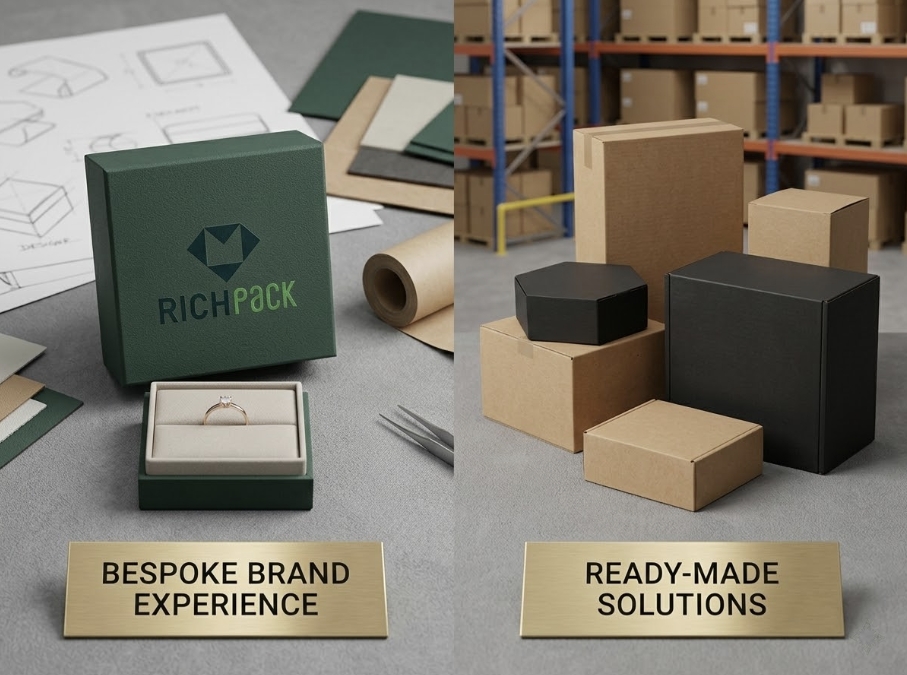



Custom packaging and stock packaging solve different problems.
If you pick the wrong packaging type, you will waste your packaging budget. It will also raise shipping costs, slow down order delivery, weaken brand image, and mess up restocking processes. However, the right packaging plan keeps your profit steady, boosts operational efficiency, and helps customers remember your brand well.
In this guide, RichPack compares these two packaging options from six key aspects. They are cost, suitability, delivery time, product protection, customer experience, and long-term supply chain management.
You can follow these steps to make your choice:
Custom packaging is a packaging system made to fit specific products, brand images, and unboxing experiences. It uses custom structures, materials, printing methods, and inner accessories, instead of only using standard, ready-made boxes.
Custom packaging is a special packaging plan designed around products, brands, and delivery methods. It is never just a simple paper box with a brand logo. It usually includes packaging structure, material selection, print design, inner lining shape, surface finishing, and the whole experience when customers see small details while opening the package step by step.
In real business projects, custom packaging matters much more than most teams think. Lego is a great example. Its value does not come from a single brick, but from how all parts fit the whole set perfectly. The design idea of custom packaging works in the same way.
Products like jewelry, beauty goods, gifts, and high-end direct sales items often have packaging that balances product texture, protection, and marketing value. For this reason, major brands do not only focus on the cost of buying boxes. They pay more attention to inner lining design, rigid box feel, magnetic opening and closing, soft-touch surfaces, gold-stamping details, and shipping efficiency.
Return to the basic function of packaging. Packaging does not aim for fancy looks blindly. It makes products feel high-quality, keeps goods safe during delivery, and builds brand value the moment customers touch the items.
Great packaging improves customers’ first impressions, boosts repeat purchases, and encourages people to share products with others. It also brings practical value to daily operations. Well-fitted packaging design stops products from shaking around, cuts down filler materials, and prevents unnecessary damage. This matters a lot for fragile goods. It softens shocks and protects edges from bumps effectively.
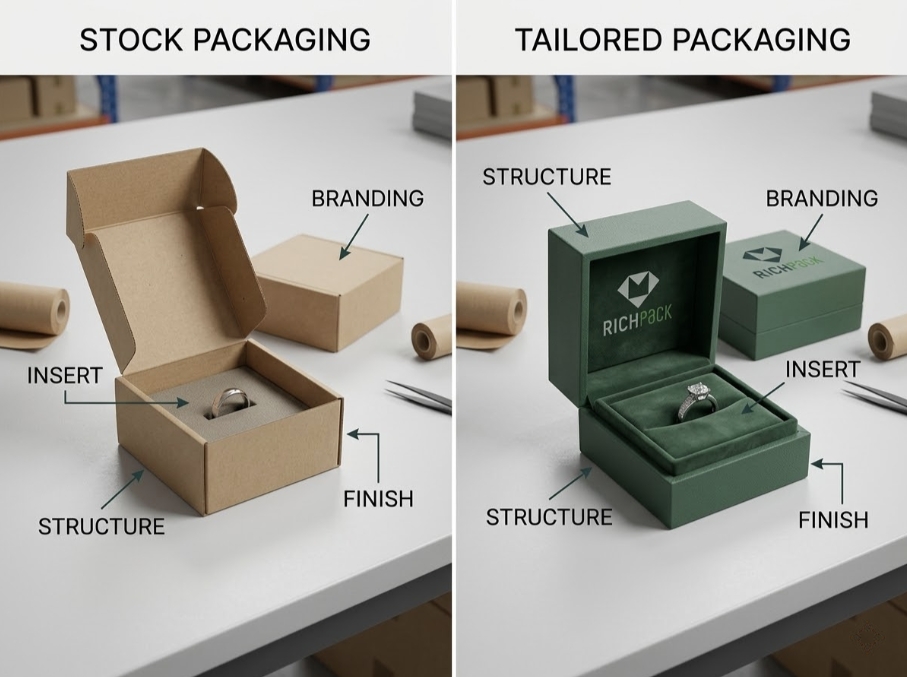
Nowadays, packaging styles update really fast. Most brands first choose custom boxes with a logo, yet this is only a basic part. A complete packaging solution includes rigid boxes, folded color boxes, shipping corrugated boxes, storage bags, box sleeves, tissue paper, inner cards, EVA inner trays, flannel storage bases, and overall outer box planning.
In the jewelry packaging industry, inner structures matter far more than people think. A necklace gift box may look fine in photos. However, poor inner design will cause many problems during shipping. The necklace chain may shift, the clasp may get caught, and jewelry may hit the box lid. All these issues will damage the products. Structural design is much more important than outer appearance.
Free choice acts as the core appeal. You can fully control colors, textures, base materials, surface processes, size ratios, opening display sequences, and exclusive brand visual elements throughout the whole process.
It also means you can adjust logo placement, unify Pantone color codes, and add embossing, gold stamping, intaglio printing, soft-touch film, ribbon styles, closure structure details, and layered printing designs. All these details boost brand recognition and get rid of boring uniform looks.
This is the key for many brands to quietly pull ahead in market competition. Ordinary stock boxes only rely on stickers for simple decoration. Custom full-set packaging designs leave deep brand impressions on customers. Such differences gradually show in social media sharing, gift-giving occasions, and the high-end feeling brought by the overall appearance.
Product fit determines the cost of custom packaging. In a custom packaging system, the biggest hidden advantage usually lies in structural fit instead of appearance decoration.
When packaging closely matches the product shape, businesses can cut down cushion filler use, reduce manual adjustments on packaging lines, and limit wasted space inside packages.
UPS and FedEx both charge shipping fees based on package volume. This means oversized boxes will greatly raise logistics costs for bulk shipping. Properly sized packaging also stops products from shifting inside boxes. Its tight structural design lowers scratches and breakage of fragile goods, and reduces after-sales claim risks.
It is undeniable that custom packaging also has drawbacks. Its upfront costs are higher than stock packaging. The early preparation work includes structural design, sample making, printing plate production, and multiple review processes. It also usually requires a higher minimum order quantity. This leads to a longer delivery time. If there is overseas production, complex surface processes, or repeated content revisions, the lead time will grow even longer.
In addition, supplier quality acts as a strict screening standard. Some custom packaging firms deliver decent printing results, but they still have issues with color consistency, inner page fitting accuracy, shipping durability tests, and mass production stability. This is why customized purchasing puts more focus on picking high-quality suppliers than buying ready-made stock packaging directly.
You can choose custom packaging when packaging does more than just hold products. It also works well if you want better display effects, tight product storage, higher perceived product value, or a consistent brand experience across all sales channels.
You need to know that custom packaging is not only for luxury brands. It is also a great choice for oddly shaped items, fragile goods, high-priced products, or when brand interactions strongly affect customer loyalty.
The importance of product packaging for high-end gift items is undeniable. Gifts like jewelry, watches, beauty sets, scented candles, and premium accessories win over buyers with perceived value. Most shoppers care about more than just the product itself. They also value the full unboxing experience.
Hard gift boxes with sturdy inner trays work far better than cheap packaging, even at a higher cost. They leave a good impression on customers before they even touch the item. Fine packaging highlights product quality, slows down the unboxing process, and lifts brand image. Tiffany built its iconic brand image with this exact idea. Even small brands can use this consumer mindset to gain an edge in the market.
Protection from custom packaging must always come first. If goods get broken, scratched, tangled, dented, or shifted during delivery, packaging choices will directly cut profits. High-quality inner parts cost more at first, but they reduce returns, reshipments, refunds, and bad reviews, and save total costs in the end.
Data from multiple fragile product lines of one brand shows that after using custom-fitted inner padding and stronger internal support, damage claim rates usually drop by 20% to 40%.
We have seen this issue many times with jewelry sets and boxed beauty tool products. Most workers only compare single-item costs and after-sales losses, and this way of calculating is not correct.
A reasonable cost calculation needs to include claim fees and labor costs for product replacements. Companies should use protective packaging designs to avoid losses ahead of time.
Products with unique shapes, various accessories, or mixed materials rarely fit standard packaging boxes. This leaves too much space inside, weakens product display, and adds extra work for manual packing.
Custom inner inserts do more than improve looks. They hold products in place, stop parts from bumping and wearing, and set a special spot for every small accessory. For gift boxes and bundled product sets, custom inner liners speed up packing work and greatly upgrade product quality and grade.
Packaging sends clear change signals for your brand. It works great for brand reshaping, new product lines, high-end item releases, and retail channel expansion. These moments are perfect for packaging redesigns.
Old, messy labels and plain, generic boxes look out of place and messy in style at this stage.
Custom packaging unifies brand visuals across all sales channels. It also helps customers easily accept a brand’s new positioning from the old one. This is just like how a website update builds more trust for online brands.
Experiences drive online sharing. Shopify points out that unboxing content keeps spreading across all social platforms, with billions of total views. Still, not every product package can go viral. It only shows that product packaging itself can act as a communication tool.
This matters a lot for DTC brands. Physical product delivery is one of the few parts brands can fully control on their own.
Unboxing designs with a strong sense of ritual, neat and fine inside accessories, and gift-box level packaging quality turn regular shipping packages into immersive moments. Customers will happily share these special experiences online.
We won’t sugarcoat custom packaging here. We will tell you the full truth.
Custom packaging brings real benefits for sure. Yet it also creates clear operational troubles. You should weigh all pros and cons wisely. Do not see it as a fancy upgrade just for high-end products.
Customization brings more options to your products. You can fully control the structure, colors, sizes, surface texture, printing styles, internal designs, and material choices on your own.
This lets your team create custom packaging that fits your products perfectly. You no longer need to make your products adapt to plain, universal packaging.
It also improves the customer experience. Better fitting, neater looks, and stronger visual recognition all upgrade the overall quality and appearance of your products. Such quality differences are especially noticeable for gift items.
Great packaging design cuts down resource waste. Reliable packaging partners can suggest proper cardboard grades, inner padding materials, sealing methods, and printing processes. They strike a good balance between budget and practical results. This is how experienced suppliers show their real value.
From the supply chain side, the best packaging is not the fanciest gift box. It should be easy to ship, quick to pack, and simple to store. It also keeps a steady quality for large repeat orders. This kind of packaging boosts overall operational benefits far beyond what most marketing teams expect.
The memory stacking effect works well in brand advantages. Unique brand colors, neatly combined logos, special touch crafts, and recognizable unboxing experiences all help customers remember your products later.
This point matters a lot in online categories with heavy product similarity and fierce competition.
Unlike noisy brand marketing from ticket platforms that chases attention on purpose, brand empowerment through packaging is more low-key and gentle. It influences customers the moment they get the product, instead of showing ads forcefully when people try to block ads.
Custom packaging requires higher upfront costs. It needs design research, sample making, plate printing, and approval checks. Brands also have to boost production quantities to cut unit costs. Unstable market forecasts will raise business risks even more.
Besides, custom packaging takes longer to deliver. The whole process includes mold creation, sample testing, plan revisions, mass production, quality checks, and shipping. Goods can only enter storage after all these steps. This is why planning is extremely important.
Not all suppliers have equal strength. The number of high-quality suppliers that can finish custom production with steady top quality is far smaller than what the market seems to show.
Some suppliers make nice samples, yet they often fail to keep consistent colors, stable foam density, good glue quality, and strong damage resistance during shipping in mass production.
Production capacity also matters a lot. If a company needs low minimum orders, fast production changes, or frequent design updates, full custom production will tie up large amounts of working capital in inventory early on. When capacity is locked too tightly, and market demand keeps changing, it will cause major business problems.
Stock packaging refers to finished packaging made in standard sizes. It allows fast purchasing and immediate use. This type of packaging focuses on low initial customization costs, short delivery times, and steady supply. It does not rely on highly customized structural designs.
It is ready-made packaging with fixed standard sizes and styles. Businesses can buy it quickly and put it into use right away. Companies do not need to develop packaging from scratch. They can simply pick from existing mature packaging styles.
Stock packaging works great for brands that need packaging fast. It is perfect for those who want to skip the long design and sample-making steps. It offers strong practicality and low buying barriers. Brands can also source these packages easily from many suppliers.
For most companies, choosing stock packaging is not a compromise. It is the best choice to fit their current business needs. Common examples include general packaging, kraft cartons, standard shipping boxes, plastic bags, laminated soft bags, and simple jewelry boxes. All of these fall under stock packaging.
Ready-made packaging comes in a wide range of types. Common styles include corrugated shipping boxes, kraft paper cartons, regular gift boxes, paper bags, composite sachets, jewelry cards, folding paper boxes, and courier envelopes. Most styles have standard sizes and fast delivery times.
This kind of packaging works well when product sizes fit standard market specs. Its benefits become even clearer if you need multiple backup suppliers for the same packaging style.
You can build brand texture with simple add-ons through minimalist design.
Plain boxes do not have to look the same. Use stickers, packaging sleeves, custom tape, inner cards, tissue paper, tags, and thank-you notes to create a light brand visual layer.
This method works great for small and medium brands. It improves overall packaging quality without spending money on full structure redesigns. It cannot match the effect of fully custom packaging systems, but it delivers about 60% visual improvement at a very low cost.
High efficiency and speed are its core strengths. Stock packaging makes style restocking easier and side-by-side comparisons simpler. It also helps brands find alternative suppliers quickly when products run out. It works perfectly for fast-moving consumer brands, seasonal marketing events, and urgent restocking needs.
From a supply chain view, stable and controllable performance is its hidden advantage. Standard sizes simplify demand planning, purchasing steps, and warehouse management. The standardized system keeps packaging supplies steady at all times.
Universal packaging has obvious drawbacks, and its biggest weakness is poor compatibility. Standard sizes rarely fit products perfectly. They often leave empty gaps, require extra filling materials, weaken packaging display effects, or let goods shift and shake during delivery.
Design limitations also cannot be ignored. Brands have fewer choices in materials, surface finishes, structural styles, and tactile textures. If a brand wants a high-end feel, regular stock packaging will quickly hit its quality limit.
Not all businesses need custom packaging. Stock packaging works best for new startups, product test launches, companies with frequent SKU changes, B2B shipping services, internal material transfers, and projects with tight deadlines or limited budgets.
If customer experience is not a top buying priority, delivery speed and flexible adaptability matter more than visual quality and texture.
You can choose ready-made stock packaging when time, cash flow, or business uncertainty matters more than brand uniqueness. This situation often happens to new brands, promotional product runs, short-cycle subscription services, and businesses with unstable product lines.
Stock packaging also works well when you need to control supply risks. The more suppliers you work with, the easier it is to switch and adjust packaging options.
Cash flow shapes the business choices of many new brands. If a company is testing products, checking market demand, or saving operating funds, stock packaging is usually the smarter pick.
You do not need to pay plate-making fees, order large custom runs, or pile up packaging inventory. It also stops leftover or damaged packaging from product updates.
For small new brands that need flexible options, this adaptability matters more than fancy packaging in the early growth stage.
Deadlines never wait for anyone. When launch dates draw near, goods get delayed, or event time slots stay fixed, fast-turnaround stock packaging is always the safest pick. It keeps product launches on track smoothly.
Many teams have learned this the hard way. They spend weeks checking packaging samples over and over, only to miss the best sales window. If a product misses its peak selling season, even the most beautiful packaging becomes useless.
Small-batch production requires flexible solutions. This low minimum order model matters a lot when market demands stay unstable, product styles update fast, or businesses are in the trial operation stage.
In-stock packaging styles allow small orders, quick market tests, and flexible business adjustments. Companies no longer need to stock up on large amounts of packaging supplies.
This benefit is especially key for new business owners. They prefer to tweak plans based on real market feedback instead of storing excessive inventory blindly.
Gift box styles update quickly. Most subscription businesses change box contents, item counts, and free add-on parts every month. Frequent product size changes make rigid custom packaging hard to fit.
In this case, using common, ready-made outer boxes with light brand custom parts works better than fancy fixed custom packaging designs.
Alternative plans matter a lot. When multiple suppliers offer products with standard specs, companies rely less on a single factory, production process, or approval step. This helps businesses deal with delayed deliveries, raw material shortages, and seasonal shipping bottlenecks.
From the purchasing side, flexibility acts as a key tool for risk control.
Stock packaging looks simple because it is simple.
That simplicity is a strength. It is also the source of most limits.
The biggest win is lower entry cost. You can order quickly, spend less up front, and avoid many setup charges tied to structural design and custom print prep.
Supplier choice is wider too. That gives buyers more leverage and often faster sourcing.
Execution stays easy. Many suppliers offer quick mockup tools or simple visual previews for labels and sleeves. That makes decision-making faster. Reorders are also easier because the format already exists.
A consistent standard format can also simplify receiving, stacking, and handling. That is useful for warehouse teams who care more about repeatability than display value.
This is where it weakens. Stock packaging rarely creates a memorable first impression on its own. Even when it looks clean, it can feel generic. That makes it harder to support premium positioning or differentiation.
For jewelry and gift products, this gap becomes obvious fast. The product may feel premium. The box may not.
Loose space costs money. If the package is too large, you often add paper, foam, or filler to control movement. That raises material use, adds packing steps, and may increase dimensional shipping cost.
This is one reason cheap unit cost can hide expensive logistics. The box looks cheaper. The shipment does not.
Manual steps add up. When teams need to apply stickers, labels, sleeves, cards, or extra insert parts by hand, packaging line time goes up. That can be manageable at low volume and annoying at scale.
It also creates more room for inconsistency, especially in cross-border fulfillment or third-party packing environments.
| Dimension | Custom Packaging | Stock Packaging |
| Upfront Cost | Higher due to design, tooling, and setup | Lower with minimal setup |
| MOQ | Often higher to optimize unit cost | Usually lower and more flexible |
| Lead Time | Longer because of sampling and production cycles | Shorter with ready inventory |
| Brand Impact | High control over identity and a premium feel | Moderate unless upgraded with add-ons |
| Shipping Efficiency | Better when right-sized and insert-led | Variable, often a weaker fit |
Do not compare the carton price alone.
Compare the full cost system. That includes setup, freight, filler, labor, storage, damage risk, and brand impact. This is where most surface-level articles stop too early.
Stock wins early. Ready-made packaging usually costs less to start because you avoid tooling, structural design, print setup, and large minimum runs. That makes it easier for new brands or volatile SKU mixes.
Tailored packaging costs more upfront, but that does not automatically make it more expensive overall.
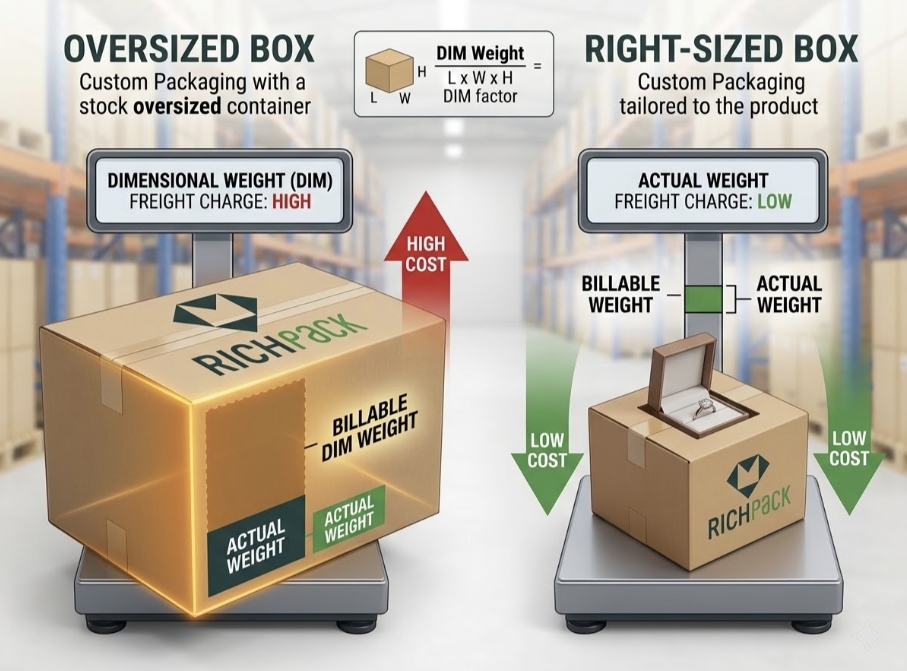
Parcel economics matter.
FedEx and UPS both use dimensional logic in shipping. A common formula is DIM Weight = Length × Width × Height ÷ DIM divisor. If your box carries too much unused space, you may pay more than expected, even when the board itself was cheap.
A better-fit format can reduce parcel size and filler. That matters for e-commerce brands shipping many small, high-margin items packaged by cube efficiency.
Packing materials, labor work, and warehouse storage keep raising hidden costs over time.
Large shipping boxes need more cushion fillers. They also require extra labor for labeling, adding protective covers, or brand decorations. This adds more working hours and labor costs.
Storage expenses cannot be ignored either. Bigger boxes take up more warehouse space. Too many packaging styles cause the same space waste. Suppliers rarely list these costs in their quotes, but businesses will face extra operating expenses later on.
Bad fit gets expensive. A package that lets the product move too much can raise damage rates, replacement costs, and customer frustration. This is especially painful in jewelry sets, glass, beauty tools, or premium gift assortments.
The right insert can lower those costs in a way a plain carton never can. That is not a designed theater. That is cost control.
Packaging affects how people judge quality, trust, and giftability. PwC consumer research keeps showing that presentation, sustainability signals, and perceived value influence purchase behavior more than many operators admit.
You cannot assign a perfect ROI to every packaging decision. You can still treat brand memory, repeat purchase, and social shareability as part of the return equation.
This is the practical answer for many brands.
You do not always need to choose between a blank stock box and a fully bespoke packaging system. A hybrid route often gives you the right balance of speed, control, and cost.
Use standard shippers outside, then bring the branded moment inside through inserts, tissue, cards, pouches, or a presentation box. This protects freight efficiency while preserving customer-facing impact.
For many jewelry brands, this is the most rational setup. One repeat pattern is stock outer mailers with custom velvet inserts inside, which helps keep MOQ in a lower band while still upgrading the unboxing moment and product protection.
If the budget is tight, begin with sleeves, custom tape, printed tissue, stickers, and insert cards. These touches upgrade perception without forcing a full redesign.
This is also a useful bridge for brands still validating color systems or messaging.
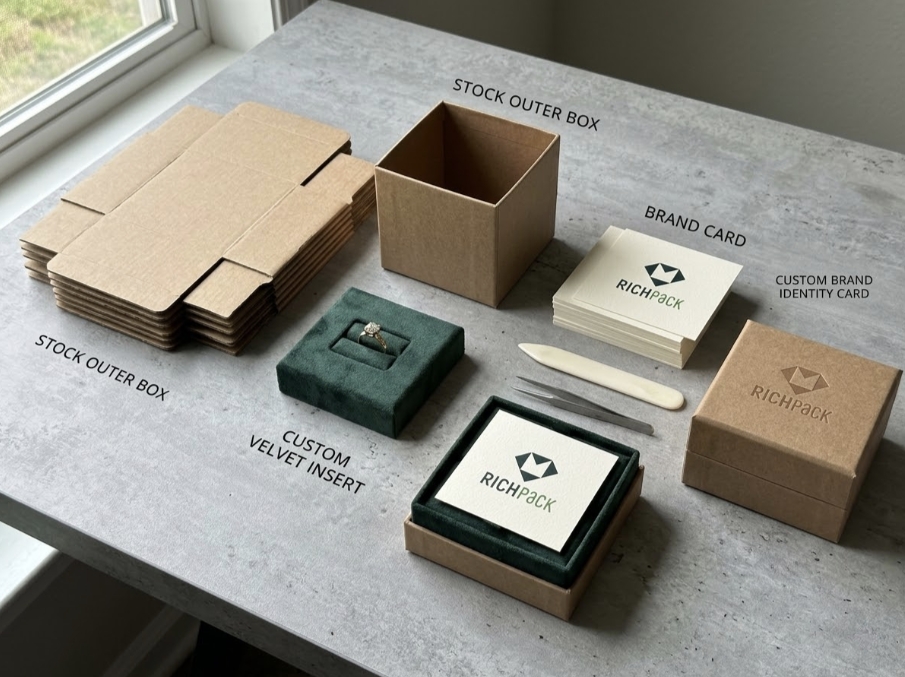
For delicate products, a better insert often delivers more value than a prettier outer box. It improves protection, controls product orientation, and can raise perceived quality at the same time.
That is one of the strongest low-regret moves in jewelry packaging.
Focus the budget where it counts. Not every SKU deserves the same packaging investment. Put the strongest design and finish into hero products, high-margin lines, PR kits, and giftable bestsellers.
That approach protects margin while still creating standout moments.
Upgrade in stages. A clean path looks like this:
Note: This is the most reliable upgrade path.
Do not ask which one is better. Ask which one fits your current product, customer, cost structure, and growth stage. That question produces better decisions.
Pick stock packaging when the budget is tight, the lead time is short, the demand is uncertain, or supply flexibility matters more than presentation. It is often the best option for launches, tests, promotions, and functional shipping.
Pick a tailored system when presentation affects conversion, the product needs an exact fit, or the brand depends on a premium experience. This is especially true in jewelry, gifting, beauty, and fragile categories.
Pick a hybrid route when you need a better customer experience but cannot justify a full redesign yet. It gives you a staged path instead of an all-or-nothing decision.
Score each option across six factors.
Best packaging decisions come from trade-off math, not from taste.
Before you ask for a quote, prepare the basics.
Yes, but not always from day one. It makes sense when presentation influences conversion, the product needs exact protection, or the brand is trying to move upmarket. If volume is unstable, start with a hybrid route.
Move when order volume stabilizes, product dimensions are clear, damage or filler costs are rising, or the brand needs a stronger customer experience to support growth.
Yes. Use better materials, cleaner labels, a smart sleeve, custom tape, strong insert cards, and well-chosen tissue. It will not behave like a fully tailored system, but it can look much stronger than a plain box.
It depends on structure, sampling rounds, print complexity, production location, and shipping method. A simple project can move quickly. A premium multi-component system can take several weeks or longer.
Jewelry usually benefits more from tailored or hybrid packaging because fit, presentation, and giftability matter more in this category. Inserts do heavy lifting here.
Sometimes. If it improves fit, reduces filler, and lowers parcel size, it can reduce freight cost. If it adds unnecessary bulk or decorative volume, it can do the opposite.
Prepare product dimensions, unit weight, SKU count, desired materials, branding files, quantity targets, target market, shipping method, timeline, and budget. Better inputs create better quotes.
All you need to do now is pick packaging from an operator’s view. Use the skills from this guide, not the mindset of regular customers.
Check your product status, restock speed, and real shipping conditions before you finalize any plan.
If you want custom packaging for your goods, feel free to reach out to our tech team. We offer full support for your needs.





 PREV
PREV