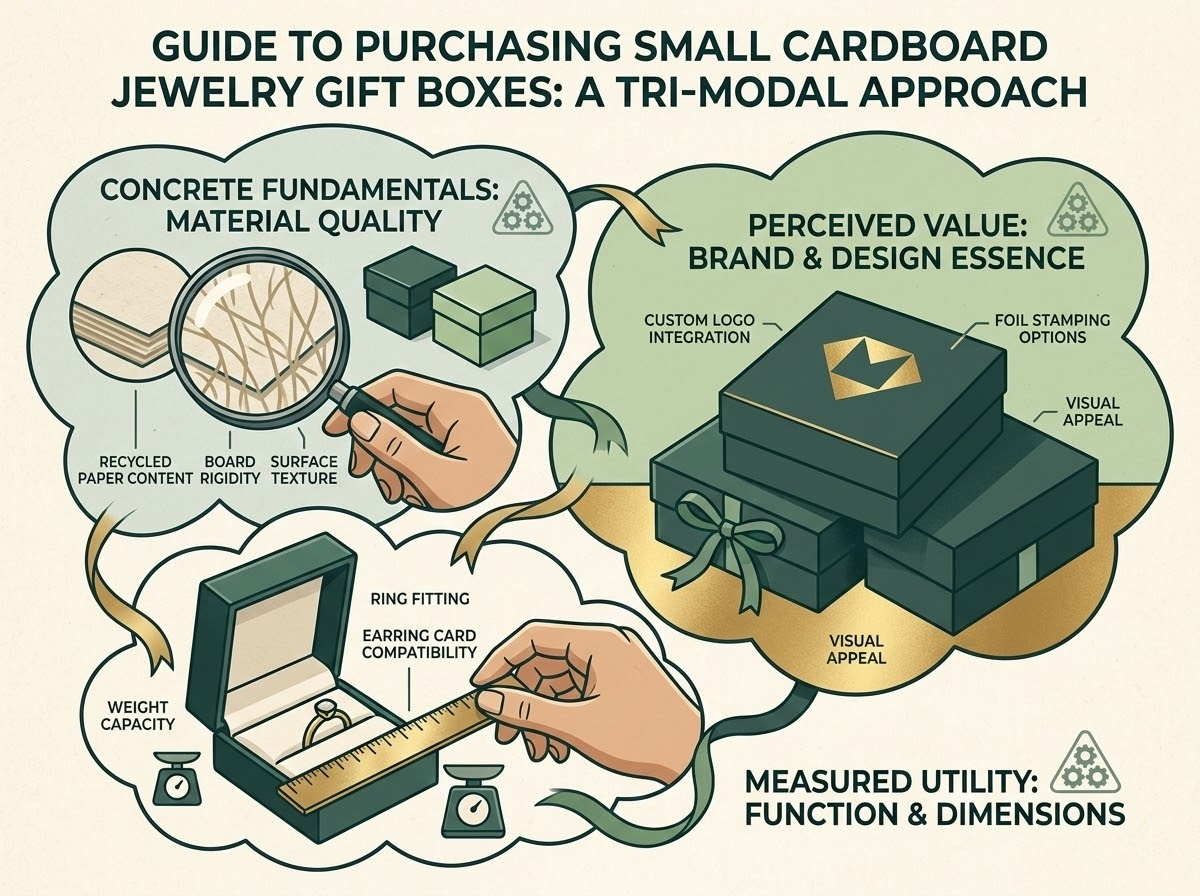


Your jewelry deserves a box that matches its beauty and value without breaking your budget.
Small cardboard gift boxes are part of most jewelry sales, like a ring in a velvet box. Earrings fit into a kraft sleeve for shipping, and a necklace sits in a cotton-filled box. This box creates the first impression for your client before they see the jewelry inside.
A 2024 study by Positive Luxury found that packaging affects 72% of shoppers in America. This fact is hard to ignore when you choose between a plain box and a custom option. A custom box helps your brand stand out.
This guide explains box styles, standard sizes, cardboard grades, and different insert types. In the next sections, you’ll learn about wholesale sourcing, custom printing, and eco-friendly options tailored for your brand. We’ll highlight common questions buyers overlook, so you can place your order and pay your deposit with confidence.
Many jewelry brands spend months on a design. They spend only twenty minutes on the box. This choice costs you money. It hurts the customer experience. A ring in a weak box can pop open during shipping. A pendant might rattle in a box that is too big. These small things tell a story. No amount of marketing can fix a bad first impression.
The good news is simple. Picking the right box is easy once you have a plan. The sections below show you what to check.
A customer feels the box first. The weight and texture show quality. The lid should lift smoothly. All these signs matter before they see the jewelry. A thin box that breaks in a bag tells a bad story. A firm box with a soft pillow feels much better.
Research from Credence Research valued the global jewelry box market at USD 4,347 million in 2024. They expect it to reach USD 6,134 million by 2032. This is a 4.4% growth rate. Brands now see the box as a tool to sell. It is not just a container.
Small sellers on Instagram and Etsy see this too. Photos of the box often get more saves than the jewelry. The box helps create content. It makes a memory for the buyer. A small spend on a box brings a big return.
Wood and metal boxes look good in photos. But they are heavy and cost a lot. They are also hard to brand. Plastic boxes can upset buyers who care about the Earth. Fabric bags are handy, but do not protect the pieces well.
Cardboard is the best choice for small items. It is light and cheap. It is strong enough for rings and earrings. You can add your logo with ease. Data from UPrinting shows paper and cardboard hit a USD 11 billion market share in 2024. This was 43% of the total market. Most brands use cardboard at every price point. They use it for budget styles and high-end sets.
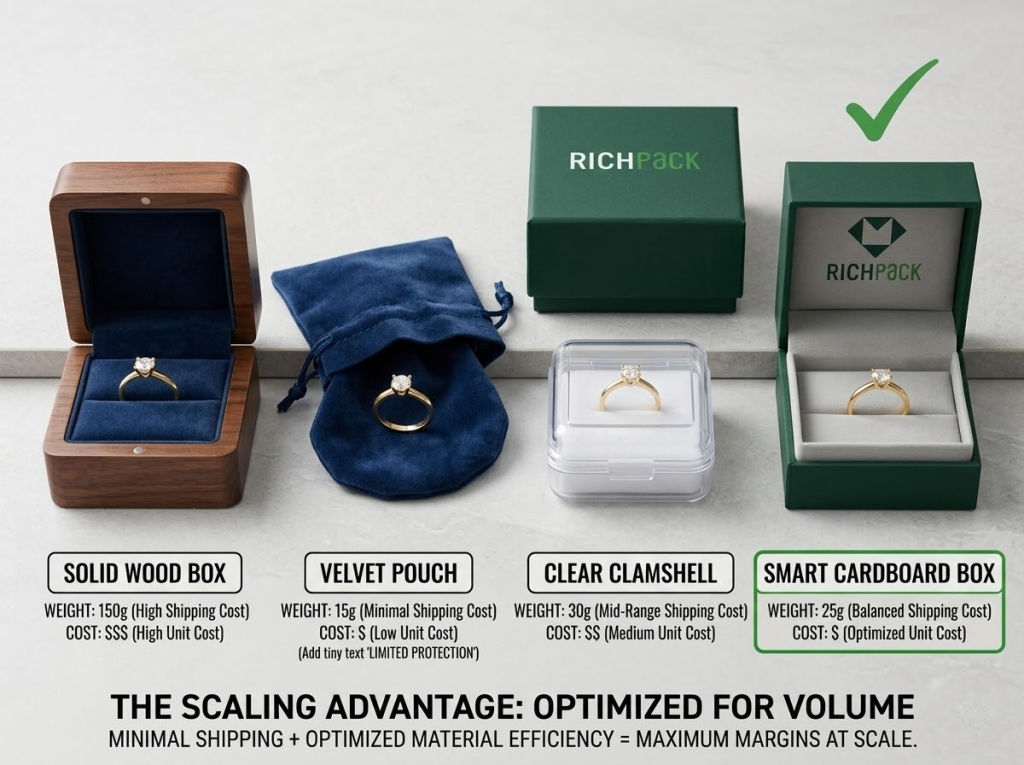
The biggest mistake is buying from photos alone. Two boxes can look the same in a picture. But they feel different in your hand. One might use a thick board. The other might feel thin. Your customers will feel that difference. They will notice it at your shop or when the mail arrives.
The second mistake is the timeline. Custom boxes take 15 to 30 business days. Do not wait until three weeks before a holiday. This causes a lot of stress. Plan your order early to stay safe.
The third mistake is the order size. Wholesale prices from a factory are low. But you must buy 500 or 1,000 units. If you are small, a local seller is better. They may offer sets of 100. This makes sense until your brand grows.
This guide helps four types of buyers:
Each part of this guide shows what matters for your brand. You can skip the parts that do not fit your needs.
Pick your box style before you choose colors or paper. The shape of the box dictates how a buyer sees your work. That first look is what stays in a customer’s mind. Using the wrong box for a ring or necklace is a big mistake. Good printing cannot fix a bad fit.
Four main styles work for small jewelry boxes. These include two-piece lids, hinged tops, slide-out drawers, and folding boxes. Each style fits a specific price point and jewelry type.
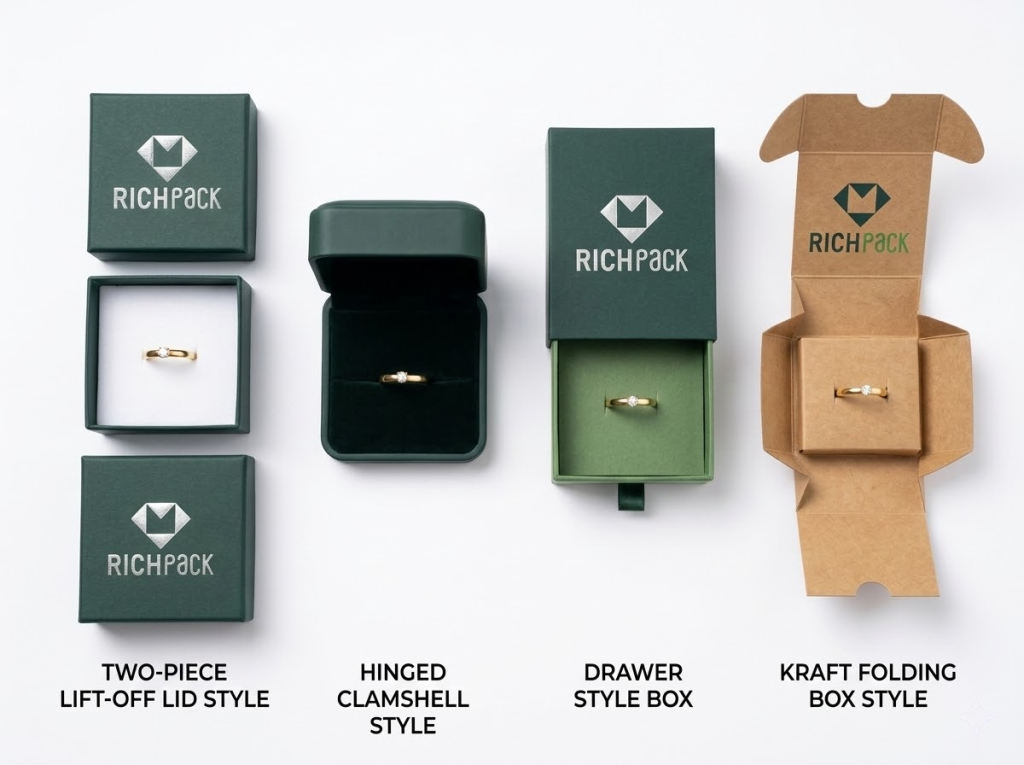
Most shops use two-piece boxes for jewelry. The lid slides over the base. The fit makes the box feel high-end. A tight fit keeps the box closed during shipping. A loose lid feels cheap to the buyer. Once a buyer sees a loose lid, they doubt the quality of the jewelry.
Two-piece boxes work for rings, studs, and small charms. Suppliers like JPI Display and Westpack sell these in many stock sizes. You can add foil logos or embossed patterns to the lid easily.
Standard stock sizes for this style include:
If you sell rings in different widths, do not use just one box size. A large box looks messy with a thin ring. Use two different insert sizes to keep your jewelry looking sharp.
Hinged boxes open like books. The lid and base stay joined at the spine. These feel more expensive than two-piece boxes. You do not have to hold a loose lid. Lifting a hinged lid feels like a grand opening.
This style works well for rings and matched earring pairs. It keeps the jewelry in a fixed spot. This is the best choice for high-end gifts that do not need extra wrapping.
The spine is the weak point of a hinged box. Low-quality boxes might crack after you open them a few times. Ask your supplier for a sample first. Open and close the sample twenty times to test the spine strength.
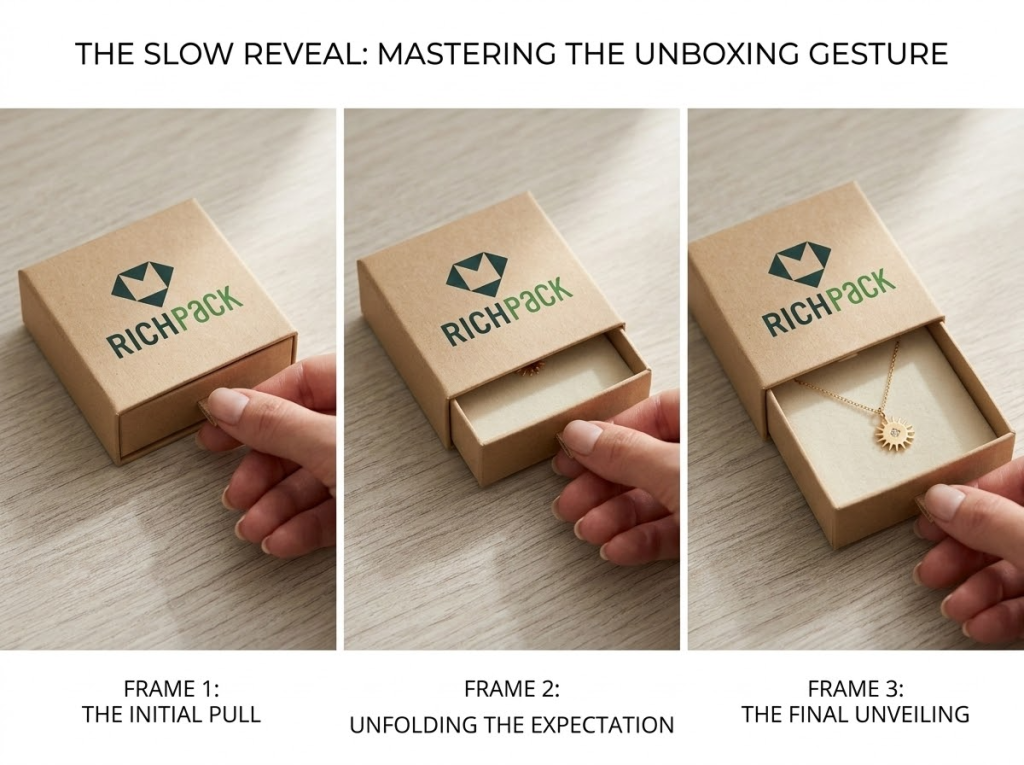
Boutique brands use drawer boxes to stand out. An inner tray slides out of an outer sleeve. This creates a slow reveal. It looks great in unboxing videos on social media. These boxes must fit perfectly. The tray should slide smoothly but not fall out.
Kraft paper drawer boxes look natural and minimal. Many artisan brands use them to save money. You can print your logo on the outer sleeve only. This keeps the inner tray plain and lowers your costs.
Folding boxes arrive flat to save space. You build them by hand when you pack an order. This helps if you work in a small studio or home office. It takes about 30 seconds to build each box. This works well for small shops but takes time for big brands.
Online sellers like these because they are light. They do not take up much shelf space. However, folding boxes show seams and edges. This can look less professional than a rigid box. Do not use these for jewelry priced over 150 dollars. They work best as an outer box for shipping.
The inside of the box sets the value of your jewelry. Three main inserts work for cardboard boxes.
First, pick a box style. Then, choose the right material. Many buyers fail to research board grades. Two boxes may look the same in photos. They feel different in your hand. This depends on board thickness and paper quality.
Learn about the material layers in a jewelry box. This helps you ask the right questions. You can compare quotes with ease. You will not regret your choice when the boxes arrive.
Most small jewelry boxes use chipboard. People also call this greyboard. It serves as the base layer. One side is grey. The other side is white or black. Chipboard stays stiff but light. This helps small boxes feel solid.
Suppliers measure chipboard in grams per square meter or gsm. They also use millimeters. A range of 1,200 to 1,500 gsm is standard for lid-and-base boxes. This is about 1.5 to 2 mm thick. Avoid board below 1,000 gsm. It feels thin. The corners crush too fast. Board above 2,000 gsm costs too much. It adds extra weight without helping the box.
Ask for both the gsm and the thickness. A 1,400 gsm board can vary in thickness. Fiber density changes the feel. Millimeter sizes clear up any doubt.
Workers wrap the core with surface paper. This is what customers touch. Here are common choices for small boxes:
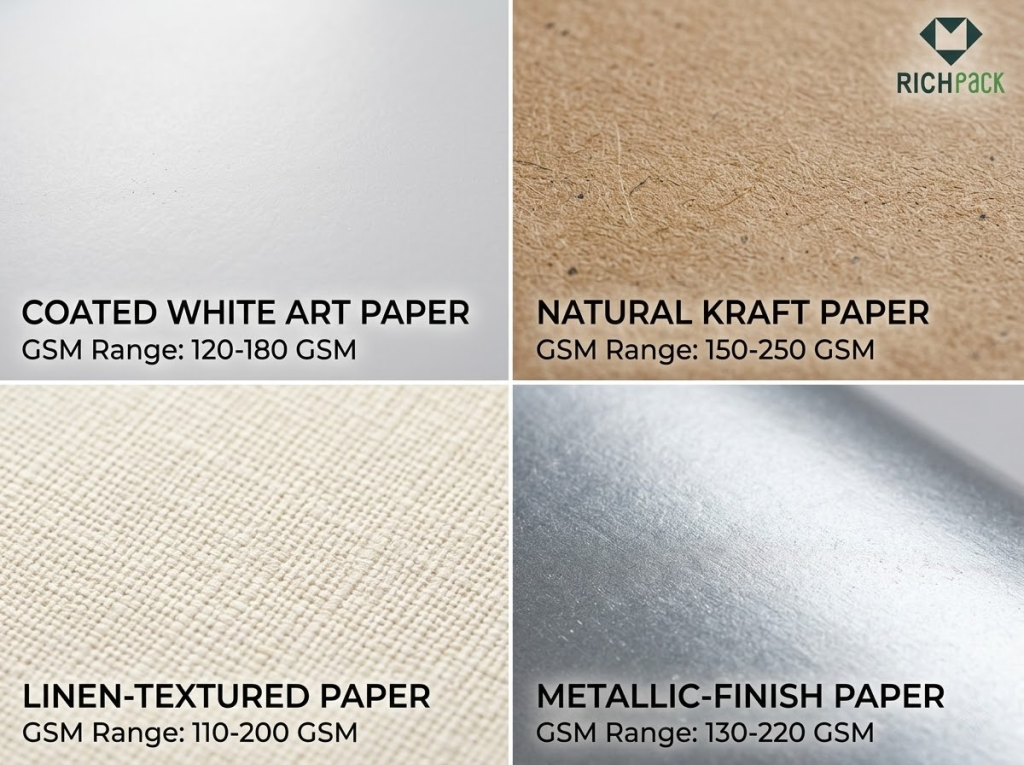
Recycled boxes are now a standard request. The word “recycled” means two different things. You must know the difference for your brand.
Ask your supplier for FSC or SFI labels. These groups check for fair fiber sourcing. You can check FSC numbers at the FSC Search website. This confirms the claim is real.
A 400 gsm paper differs from a 400 gsm board. Paper weight counts as a single layer. Board thickness comes from many layers. A 1,400 gsm chipboard is stiff. A sheet of 400 gsm paper is flexible. Check both stats for quality.
The printing method changes the look and the cost. This table covers the most common options:
| Printing Method | Best For | Setup Cost | Unit Cost at 500 pcs |
| Offset lithography | Full-color photography, gradients | High ($150–$400 plates) | $0.35–$0.65 |
| Flexographic printing | Simple 1–3 color logos | Medium ($80–$200) | $0.20–$0.45 |
| Digital printing | Short runs under 200 pcs | Low (none) | $0.80–$1.80 |
| Hot foil stamping | Logo accent, gold/silver shimmer | Medium ($60–$150 die) | $0.15–$0.30 (add-on) |
| Embossing/debossing | Tactile brand impressions | Medium ($80–$180 die) | $0.12–$0.25 (add-on) |
| Spot UV varnish | Gloss-on-matte contrast | Low–Medium | $0.10–$0.20 (add-on) |
Prices reflect typical supplier quotes for 2025–2026. Final costs vary with box size and quantity.
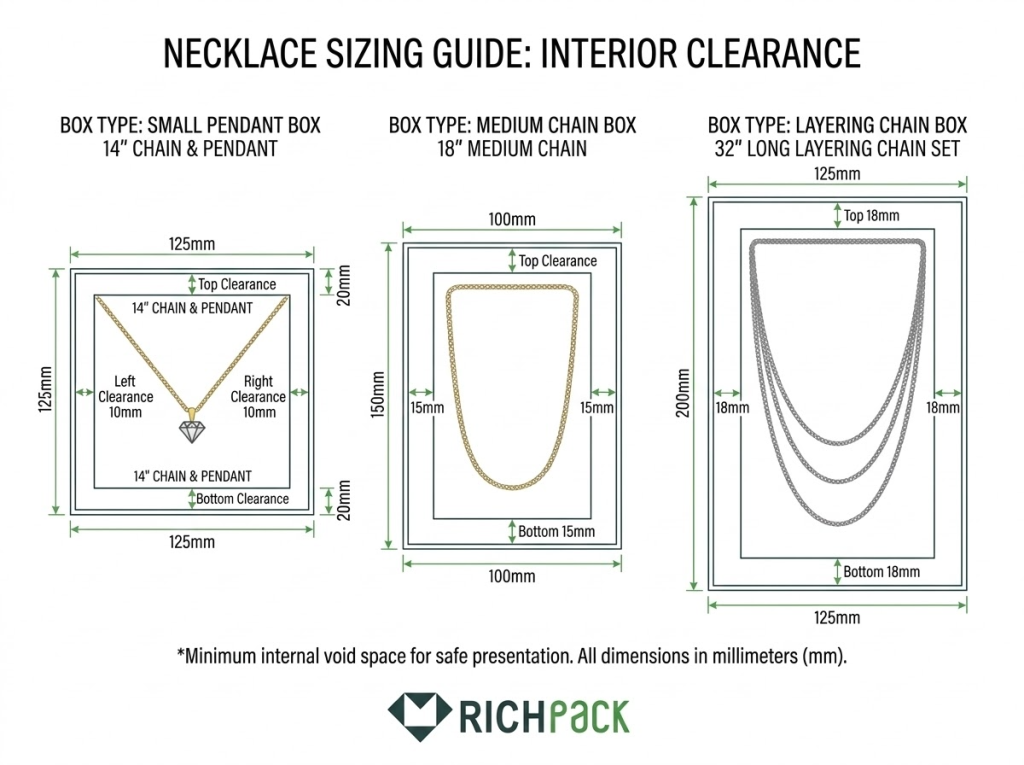
A box might look nice in a photo. It still might not fit your jewelry. These are two different things. Sizing errors happen often. They frustrate many sellers. You can avoid them easily. Just measure your items for thirty seconds before you buy.
Use the inside space for your math. Do not use the outside size. Thick walls take up room. They cut 3 to 6 mm from the inside. A 2-inch box has walls. The inside may only be 1.68 inches. Your pendant might not fit that space.
A big box lets a ring slide. The ring might hit the walls and get marks. Most ring boxes are 1.5 by 1.5 inches. This size fits a single stone. Use a 2-by-2-inch box for thick bands. The foam or velvet must hold the ring tightly. The stone should sit high. People want to see the gem when they open the lid.
First, measure the width of the ring band. Then, measure the height of the stone. These numbers show the space you need. Add a tiny bit of extra room on each side. Then, add the wall thickness. This gives you the size to order.
Small studs fit in a 1.5-inch box. Long earrings need more height. Use a 2-by-3.5-inch box for them. This stops the tips from bending.
Think about how you pack the items. Will you put them on cards at your shop? Cards need a specific slot size. Match the card size to the box inside. Many people forget this step. Ask your supplier to check all three sizes. Do this before you pay for the order.
Small charms fit in a 2-inch box. Use foam with a slot for the chain. Long chains need a long box. A 4 by 2-inch box works well. Deep foam keeps the chain from tangling.
Measure the longest part of your pendant. Add half an inch for extra room. This is your inside size. Then, find the outside size by adding the wall width.
Bracelets come in many sizes. A thin chain fits in a 3.5-inch box. A thick cuff needs a taller box. Rigid bangles must lie flat. Do not squash the foam.
People often forget the inside space. Ask for the inside size. Walls can take up half an inch. A 3.25-inch bangle will not fit if the walls are too thick.
You might sell sets of jewelry. A single box for all pieces looks great. Custom foam keeps items in place. This makes the gift look high-end.
Set boxes are often 4 by 6 inches. These need custom foam. This takes more time to make. Order them eight weeks early for the busy season.
Finding the right wholesale jewelry boxes takes more than looking for low prices. You must balance unit cost, order minimums, and lead times. Quality and reorder reliability also matter. One mistake in these areas can wipe out your savings.
The market ranges from local distributors to overseas factories. Local shops often sell in sets of 100. Factories usually require orders of 1,000 or more. Each source fits a different business stage. You must know which one matches your needs now.
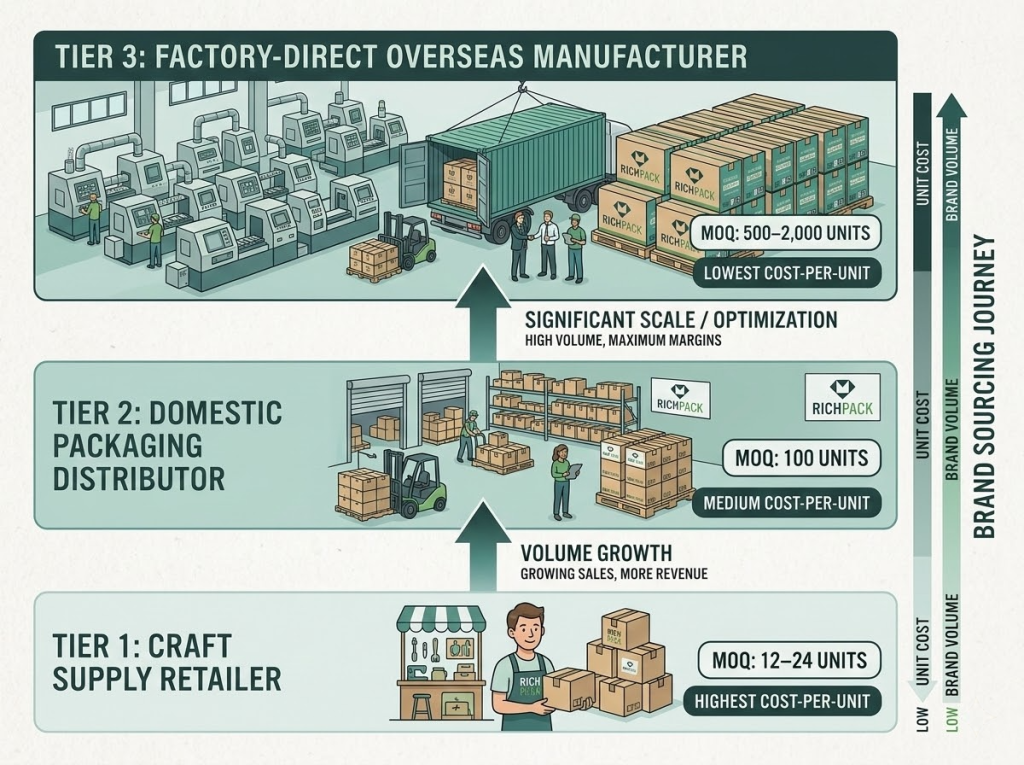
Buying from a factory usually requires 500 to 2,000 units per style. This lowers your cost per box. A box that retails for USD 1.20 might cost USD 0.28 to USD 0.45 at wholesale.
Local distributors offer wholesale prices for smaller orders. Many start at 100 units. Costs are higher than factory direct. However, shipping is faster. You also get easier returns and better communication.
| Monthly Box Volume | Recommended Sourcing Approach | Approx. Unit Cost | Lead Time |
| Under 50 boxes/month | Domestic distributor or craft supply | $0.75–$1.50 | 3–7 days |
| 50–200 boxes/month | US-based packaging wholesaler (100-unit MOQ) | $0.45–$0.80 | 5–10 days |
| 200–500 boxes/month | Factory-direct stock + domestic backup | $0.30–$0.55 | 3–6 weeks |
| 500+ boxes/month | Factory-direct custom + safety stock | $0.15–$0.40 | 6–12 weeks |
Sourcing from China offers the lowest costs. These factories also provide many custom options. Many top Chinese plants make boxes for luxury brands. They have great skills. The main challenges are long lead times and shipping. Talking through changes can also be hard.
US-based sourcing is faster. Shipping costs are lower, too. You can check samples quickly. Costs are higher. Still, it works well for brands that need to move fast. It also helps if you have limited storage space.
Many brands use both sources. They buy custom boxes from overseas for the main lines. Then, they keep a local stock of plain boxes. This helps with busy seasons or extra orders.
Most sourcing errors happen for one simple reason. Buyers fail to ask the right questions before paying a deposit. A vague supplier is a warning sign. Watch how they answer these points.
Avoid quotes that skip inside dimensions. Check for paper weight and board thickness together. Be careful if a “wholesale price” has no minimum order. This phrase means little without a quantity. Never skip physical samples. You must see them before a big order.
The 2025 market analysis from Credence Research shows many small players in this field. Global brands like Westpack A/S and Stuller Inc. compete with local factories. Quality changes a lot between suppliers. Samples are your best way to stay safe.
Custom printing turns small boxes into brand assets. Pick a branding style that fits your budget. Entry costs stay lower than you might think. You can move from stock boxes to custom prints in easy steps.
Labels work well for low budgets. Apply a clean label to a stock box for a professional look. This costs less than custom printing. Use matte black, white, or kraft boxes. These colors make labels stand out.
Foil and embossed labels add a high-end feel. Suppliers like Sticker Mule offer these with low minimum orders. This path provides the fastest way to brand your packaging. It serves as a good bridge to full custom runs.
Flexographic or screen printing marks the next level. Print a single-color logo or brand name. Setup costs stay low. You might pay between USD 80 and USD 200 for a plate. The cost per box stays small for orders over 500 units.
This style looks clean and high-end. Many jewelry brands use this simple model. A white box with a gold logo stamp feels classic. It shows you feel confident in your product.
Full-color offset printing gives you many design choices. Use brand colors and photos. This works for brands with a clear style. You need high volume to cover setup costs.
At 1,000 units, these boxes cost between USD 0.40 and USD 0.80 each. This price depends on the colors and size. At 5,000 units, the price drops to between USD 0.20 and USD 0.45. You pay for the plates once. Reorders cost much less.
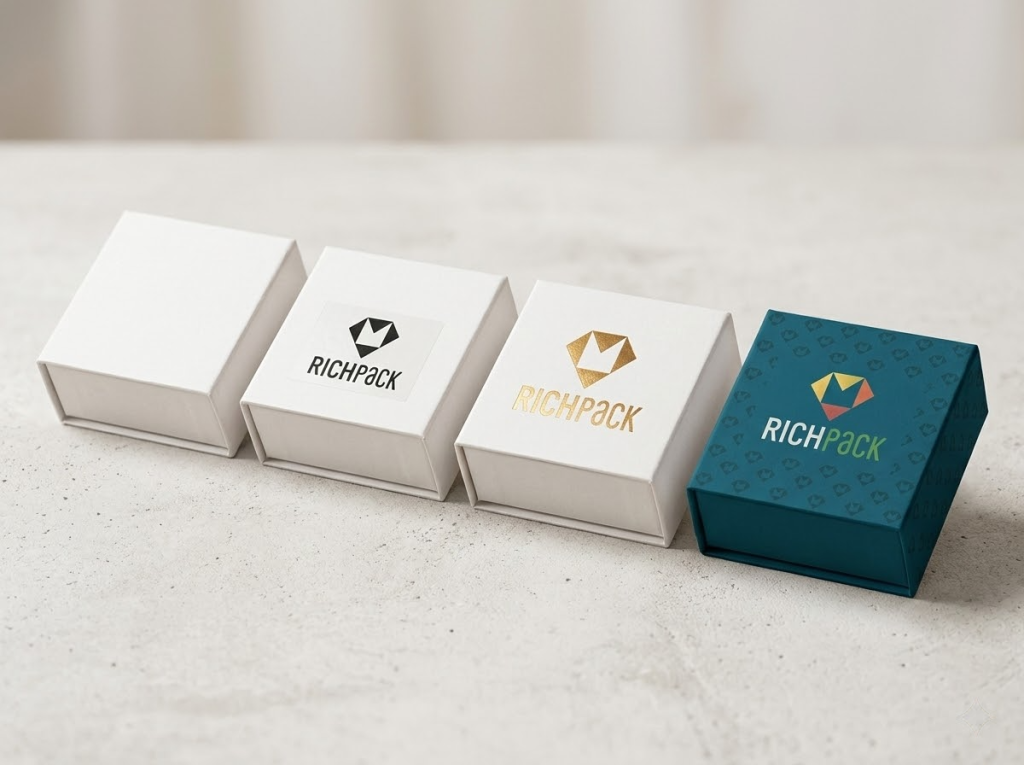
Customers touch the box first. This feels changes how they see your quality.
Ask if your supplier uses Pantone specs. Screen colors often look different on paper. Ink density and paper type change the look. Always ask for physical proof first.
Request a press proof before the full run. This adds a few days to your wait. It stops you from getting boxes in the wrong color. Keep the proof to check future orders.
Jewelry buyers now want green packaging. This is true in the US and Europe. It is a must for many. A 2025 report from Global Growth Insights shows a 53% rise in demand for green boxes. This trend will not stop soon.
People often use the term “eco-friendly” in a loose way. You must know what it really means. This helps you make buying choices that hold up to a check.
Most D2C and small jewelry brands now use recycled gift boxes. This is the new rule. Start with an FSC-certified board. Look for high recycled content. Most shops offer this at a fair price now.
Ask for the FSC number. Check it at FSC Search. This quick check proves the claim is real.
Old inks use oil. This is bad for the Earth. Soy inks use plant oil. They create less waste. Most large printers use them now. They often cost the same as old inks.
Water-based coatings look great. They work as well as the old types. Ask your shop if they use water-based finishes. This helps with recycling later.
Use less ink to help the Earth. A plain kraft box with a small logo works well. It uses fewer tools than a full-color box. This look also tells buyers your brand is green.
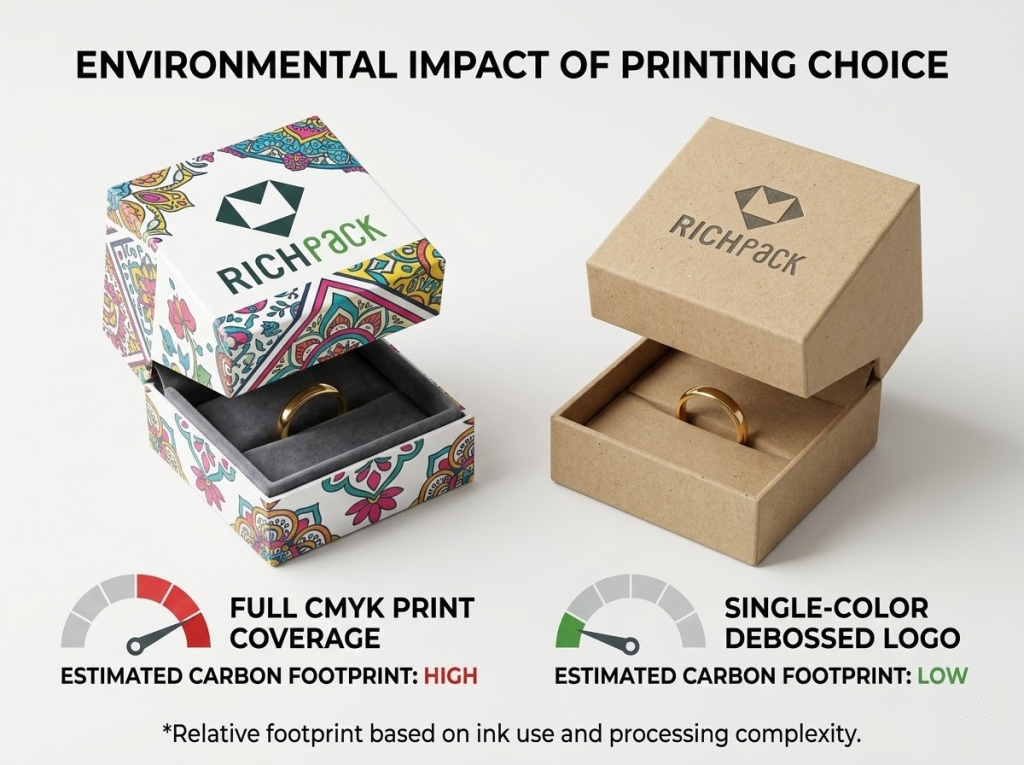
The FTC Green Guides help US brands. They show how to talk about the Earth. Do not use words like “green” alone. Give real facts instead.
Say “Made with 80% recycled fiber.” Or say “We use soy inks.” Buyers want proof. Vague words cause doubt. Some groups may even check your claims.
Finding the right match for style, material, and inserts is simple when you compare common orders. This list highlights six box types that most shops and D2C brands buy. These cardboard formats fit retail needs and gift sets well.
| Box Style | Best Jewelry Type | Price Range (500 pcs) | Custom Print Options | Eco Version Available? |
| Two-piece cotton-filled | Rings, studs, pendants | $0.28–$0.60/unit | Full-color, foil, emboss | Yes (FSC + recycled board) |
| Two-piece foam insert | Earrings, charms | $0.30–$0.65/unit | Full-color, foil | Yes |
| Hinged clamshell | Rings, earrings (premium) | $0.45–$0.85/unit | Full-color, foil, emboss | Yes |
| Drawer slide-out | Pendants, gift sets | $0.55–$1.20/unit | Sleeve print + plain inner | Yes |
| Kraft folding box | All jewelry (artisan) | $0.18–$0.45/unit | Single-color stamp or label | Yes (natural kraft) |
| Rigid setup box | High-value pieces, sets | $0.90–$2.50/unit | All options | Yes (FSC certified) |
Prices come from factory quotes for stock and custom styles for 2025 to 2026.
Buying custom jewelry boxes for the first time takes practice. You can handle the task by following a clear plan. These steps cover everything from your first ideas to the final delivery. I will show you where most buyers lose money so you can avoid those traps.
Clear details help you get fast and accurate price quotes. Know these specific things before you reach out to any factory:
Good suppliers always offer samples. Some charge USD 10 to USD 30 for custom sets. Stock samples are often free if you pay for shipping. You must see a physical sample before you pay for a full run. A sample shows the board thickness and print quality. It also shows how the jewelry fits inside. Photos cannot show these details. Avoid any supplier that refuses to send a sample first.
For custom prints, always ask for a digital proof. This layout shows where your logo sits on the box. If you order over 1,000 boxes, ask for a printed sample. Check the colors and spelling carefully. Make sure the logo size is right. Do not say yes if you see any errors. Fixing mistakes after the boxes are made costs a lot of money.
Cardboard boxes ship flat or already built. Flat boxes save space and lower your shipping costs. However, you must spend time building them later. Built boxes are ready to use but cost more to ship. Confirm how many boxes fit in one large carton. Check the total weight too. For overseas orders, ask for DDP terms. This means the supplier handles all shipping and taxes. DDP is the best choice for new buyers.
When your boxes arrive, check several random cartons. Do not just look at the top box. Check the colors and how the lids fit. Look for any crushed corners. Take photos of any damage right away. This helps you make a claim. Set a reorder point in your stock system. If you use 200 boxes a week and shipping takes four weeks, reorder when you have 800 left. This keeps your business running smoothly.
Most shops use 1.5 by 1.5 by 0.75 inches for rings. Pendants and studs fit in 2 by 2 by 1-inch boxes. Bracelets use 3.5 by 3.5 by 1-inch sizes. These match standard cotton-filled inserts. US distributors keep these in stock. Custom makers need orders of 500 units for other sizes.
Order minimums vary by supplier. Local sellers often price by the hundred. Some sell as few as 12 or 24 boxes. Overseas factories usually ask for 500 to 2,000 units per style. Custom prints may need 1,000 to 3,000 units. New brands should start with 100 boxes. This helps test the fit before a big buy.
Measure the length, width, and height of your jewelry. Add 0.25 inches to each side for a good fit. Choose a box that meets these new numbers. Get a physical sample before you buy in bulk. This step is vital. Check if the foam slots match your jewelry pieces.
Retail boxes do not protect jewelry during shipping. Mail carriers can crush them. Put the jewelry box inside a tough outer mailer. Use foam or paper to fill the space. Strong mailers keep the inner box safe. This looks good and protects your product.
The Forest Stewardship Council (FSC) tracks wood fiber. It proves the material comes from healthy forests. Recycled board uses old paper waste. A box can have both labels. Look for FSC marks with high recycled content. Use soy inks for the best green results.
Custom orders take 15 to 25 days for simple colors. Full-color boxes with foil take 25 to 35 days. Sea shipping from Asia adds 7 to 20 days. Air freight takes 3 to 7 days. Local suppliers deliver in 5 to 15 days. Add one week for proofing and delays.
Overseas factories set limits for each style. You cannot mix styles to meet one limit. Local sellers offer more choices. Some let you mix styles if you spend 150 or 200 dollars. Use local sources for small variety orders. Move to factories when your volume grows.
Use foam with a 45-degree slot for rings. This holds the band well. Deep cotton boxes also work. Use foam pads with two holes for studs. Drop earrings need foam with two long cuts. Use foam with a chain path for pendants. This stops the chain from tangling.
Small cardboard jewelry boxes are more than just a simple purchase. They represent your brand and your customer experience. The right choice depends on your jewelry type and order volume. It also depends on your brand goals and your schedule.
Start with your jewelry sizes. Pick a box style and an insert type. Choose your supplier based on your current sales volume. Use a local seller for speed and flexibility. Buy from a factory to save money on large orders. Get samples before you buy custom designs. Set reorder points so you never run out of boxes.
According to Global Growth Insights research data, it shows that the jewelry gift box market was worth USD 4.557 billion in 2025. This group expects the market to reach USD 6.256 billion by 2033. This shows a 4.6% growth rate each year. More brands are entering this market now. This means you face more competition for customer attention. Packaging is a low-cost tool to win that attention. It works best at the moment your customer opens the box.
You might need simple kraft boxes for an Etsy shop. You might need custom sets for a luxury launch. This guide helps you buy smarter and brand better. You can now give customers the unboxing experience they want.
Do you have questions about custom sizes or order minimums? Talk to a packaging expert about your specific jewelry line. They can help you with your exact needs. They will make sure your first impression is great.

Just submit your email to get exclusive offers (reply within 12 hours)





 PREV
PREV