

 PREV
PREV

14K Gold Filled Jewellery: Packaging Design and Protection Strategies
2024-12-12
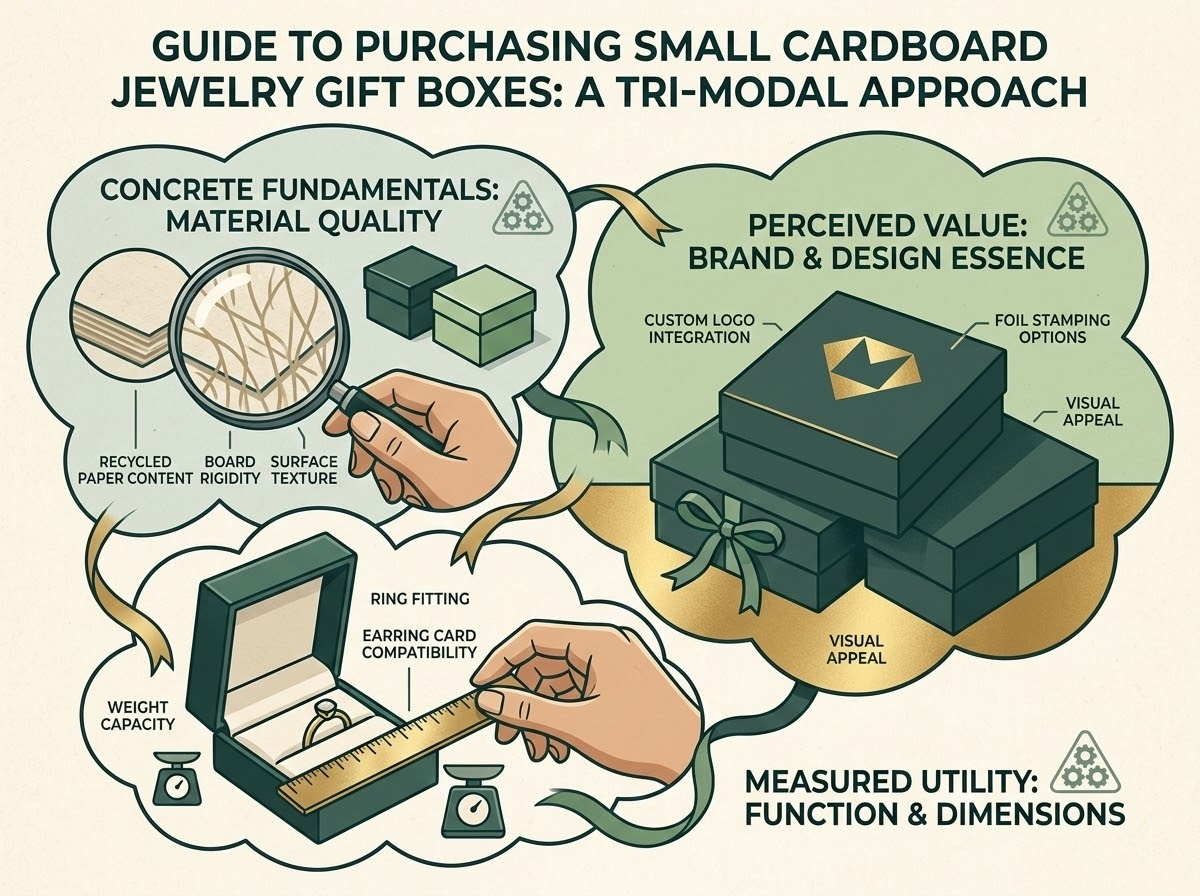



In 2026, one small jewelry box has four jobs. It must present the piece, hold it in place, carry the brand, and reach the customer without damage.
A box can look polished in a catalog. It may fail when the real jewelry goes inside.
The best Small Cardboard Jewelry Gift Boxes do four jobs at once. They present the jewelry and keep it in place. They support the brand and move through the sales channel without extra work.
A box that misses one of those jobs may look attractive in a catalog photo.
Use this buying order:
By the end, you should be able to compare stock and custom boxes. You should be able to prepare a clear request for quotation and approve a sample with less guesswork.
Choose the box around the jewelry, the customer handoff, and the delivery route. Color and logo come later. That order prevents the most expensive packaging changes.
| Your situation | Start with | Main risk | Best next action |
| New brand with changing demand | Stock box plus label or sleeve | Buying too many custom units | Test two sizes and one insert |
| Stable e-commerce collection | Custom two-piece or drawer box | Retail box crushed in parcel delivery | Test the box inside its shipper |
| Fine jewelry or proposal ring | Hinged or rigid setup box | Stone rub, weak hinge, poor first view | Approve fit with the real piece |
| Retail chain | Repeatable stock or custom program | Color and fit drift between batches | Keep a signed master sample |
| Corporate or event gifting | Set box with controlled cavities | Late artwork and mixed contents | Freeze the product list first |
| Packaging distributor | Modular range by jewelry type | Too many slow-moving variants | Standardize footprints and inserts |
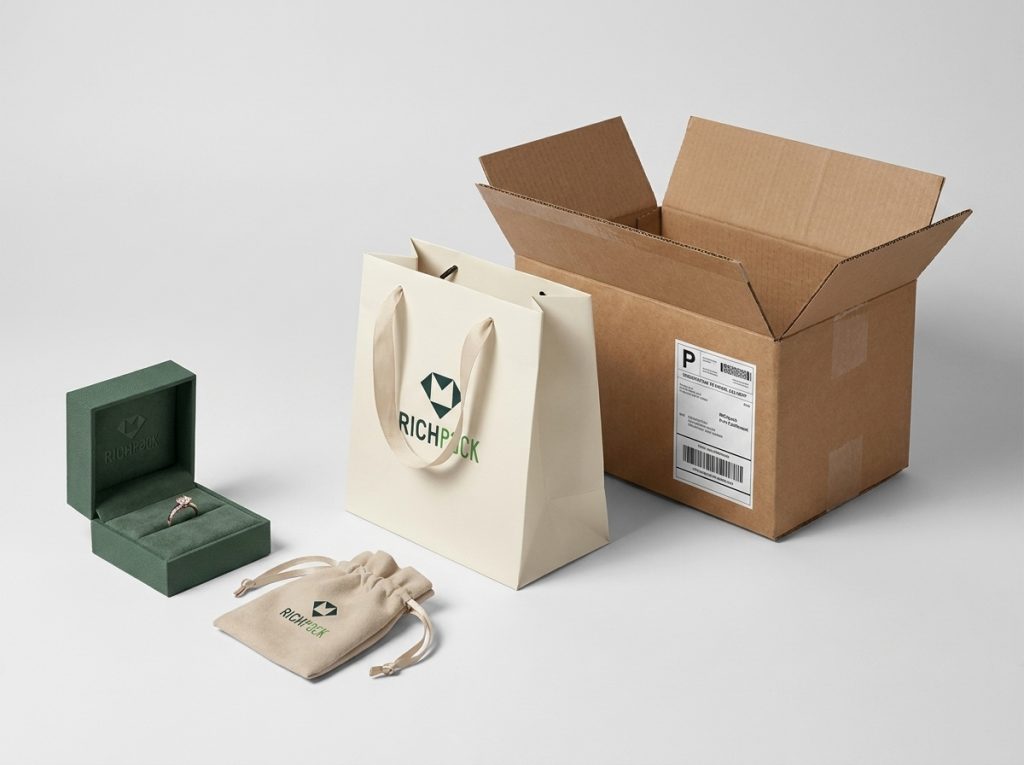
A jewelry gift box presents the product. A shipping box protects that presentation through sorting, stacking, vibration, and drops. One package rarely does both jobs well.
If a small cardboard jewelry box will travel by parcel, place it inside a suitable mailer or corrugated shipper. Control the empty space so the retail box does not move.
Test the product, retail box, cushioning, and shipper together. Distribution testing evaluates a product-and-package combination, not an empty box by itself.
Use RichPack’s guide to packaging jewelry for shipping when you define the outer shipper, cushioning, and parcel test.
Write down the jewelry type, largest dimensions, weight, setting height, chain length, clasp size, and display position. Use the real product or an accurate sample.
A ring with a high stone needs lid clearance. A pendant needs a chain path. Drop earrings need length below the card or fixing point.
A rigid bangle needs a cavity wide enough for its outside diameter. These facts define the box more reliably than a catalog label such as small, medium, or necklace size.
Retail staff value fast opening and a tidy counter. E-commerce teams need low storage volume and reliable parcel protection.
A luxury launch needs a slower reveal. An event program needs fast packing and clear product labels.
List where the box will be stored, packed, displayed, carried, shipped, and opened. A structure that feels elegant in a showroom can waste labor at a high-volume packing station.
Stock boxes reduce development time and let a brand test demand. Custom boxes control size, insert, color, print, and presentation.
That extra control adds artwork, sampling, tooling, minimum quantities, and production planning.
Start with wholesale jewelry box selection when demand is uncertain. Move to custom production when the product range, monthly use, and reorder pattern justify tighter control.
The insert controls the position, movement, removal, and the first view of the jewelry. It changes the required box height and wall clearance.
Approve the jewelry fit before placing a logo on the lid. A change from cotton to die-cut foam can alter the box depth. A taller ring slot can require more lid space. Artwork approved too early for revision.
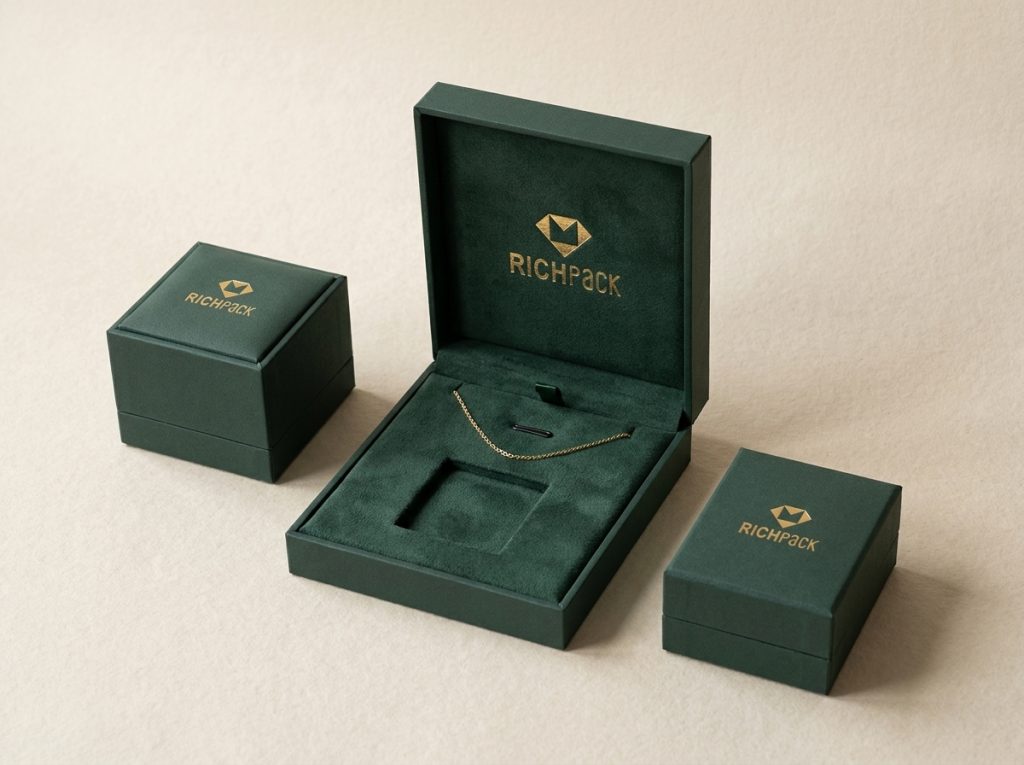
Box style describes how the package opens and holds together. It is separate from the board, wrap, insert, and decoration. Keep those choices separate when you compare samples.
| Style | Best fit | Main advantage | Watch for |
| Two-piece lift-off | Rings, studs, pendants, small bracelets | Simple, familiar, easy to source | Loose or overly tight lid |
| Hinged clamshell | Rings, earrings, premium gifts | Joined lid and controlled reveal | Spine wear and lid clearance |
| Drawer | Pendants, bracelets, sets | Strong reveal and sleeve branding | Drawer friction and pull strength |
| Folding carton | Lightweight jewelry, events, e-commerce kits | Ships and stores flat | Assembly time and visible seams |
| Rigid setup | Fine jewelry and gift sets | Firm walls and premium hand feel | Freight, storage, and higher complexity |
A two-piece box has a separate lid and base. It is a practical choice for small jewelry because suppliers can standardize footprints and offer several insert options.
Check the lid fit with the finished wrap applied. The lid should lift without pulling the base off the table. It should not fall away when the box is tilted gently.
Compare several samples because wrap thickness and production variation affect the fit.
A hinged box keeps the lid attached to the base. It works well when the opening action is part of the gift moment. It also helps when a loose lid would slow retail staff.
Open and close the sample repeatedly. Watch the spine, corners, lining, and area behind the hinge. Then place the tallest jewelry piece inside and close the lid slowly to check for contact.
A drawer box uses an inner tray and an outer sleeve. The moving tray creates a deliberate reveal and gives the sleeve a clean branding area.
The tray must move after the final paper, coating, and humidity exposure have changed its thickness. Check that it does not scrape, bind, or slide out by itself. If a ribbon pull is used, test its fixing point with repeated pulls.
Folding cartons are supplied flat or partly assembled. They reduce warehouse and inbound freight volume, which helps e-commerce sellers and event programs.
The tradeoff is labor. Time the actual folding, product loading, closure, and labeling process. A few seconds per box add up across a large campaign. Check whether tabs or raw edges weaken the intended presentation.
Rigid setup boxes are preassembled around a thicker board core. They provide firm walls and support more elaborate inserts, wraps, and finishes.
They occupy their full volume during freight and storage. Use them where the jewelry value, gifting context, or reuse plan supports the extra space and cost. A rigid box needs an outer shipper for parcel delivery.
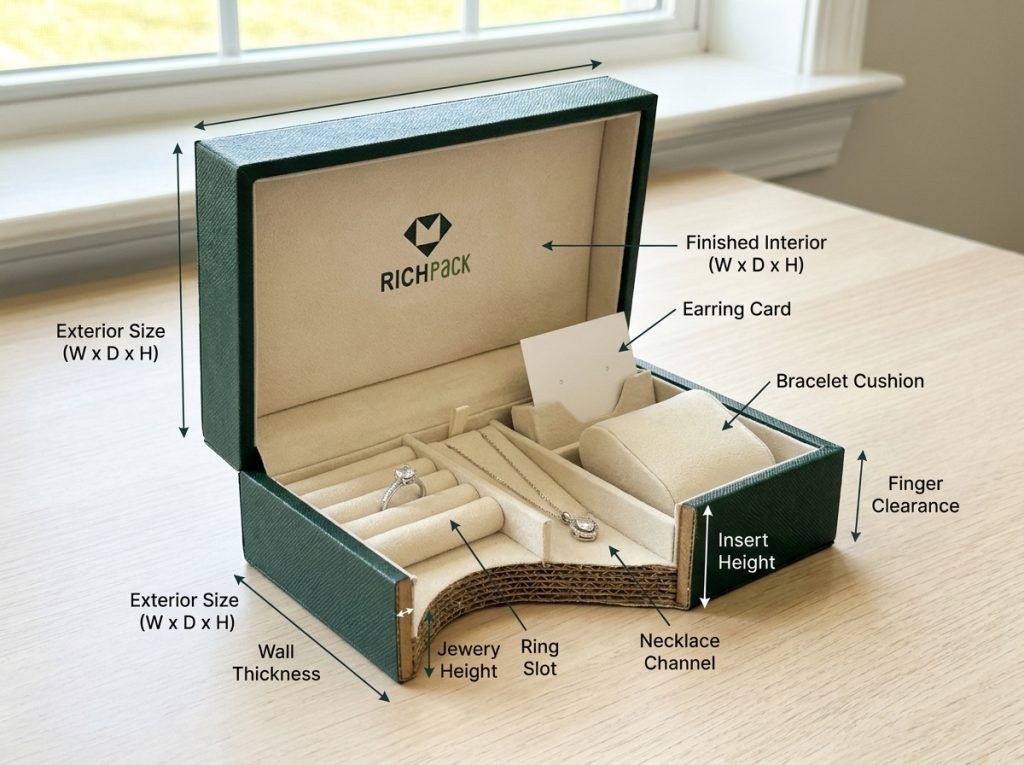
Use the finished inside dimensions instead of the exterior size alone. The board, wrap, insert, and lining reduce usable space.
Jewelry needs room for removal. A piece should not have to be pressed into place.
Before choosing a catalog size, review how to measure jewelry box dimensions. Record the largest product in each packaging family and the insert position it requires.
| Jewelry type | Measure | Insert must control | Common failure |
| Ring | Bandwidth, setting height, head width | Slot grip and upright angle | Stone touches lid |
| Stud earrings | Card or pair width, post length | Pair spacing and post clearance | Posts bend or cross |
| Drop earrings | Total drop, width, hook or post | Hanging length and separation | Tips bend or overlap |
| Necklace | Pendant size, clasp, chain length | Pendant position and chain path | Chain tangles under insert |
| Bracelet | Length, width, clasp, flexibility | Curve and end position | Bracelet shifts to one side |
| Bangle | Outside diameter, width, rigidity | Cavity diameter and depth | Bangle will not lie flat |
| Set | Every component and removal path | Separation and visual order | Pieces touch or hide each other |
Measure the setting height as well as the band. The insert should hold the ring without forcing a wide band into a narrow cut.
Close a clear or lightly marked sample lid over the ring and inspect the clearance. Check the tallest size and stone shape in the range. A box that fits a plain band may fail with a halo or raised setting.
Separate studs, hoops, drops, and earrings mounted on retail cards. They need different fixing points and depths.
For studs, confirm post and backing clearance behind the card or insert. For drops, keep the pair separated and leave space below the fixing point. Shake the closed sample gently, reopen it, and check whether the display position has changed.
The pendant and chain need separate control. A cavity that centers the pendant can leave the chain loose underneath.
Mark the chain path, clasp pocket, and removal point. The customer should lift the necklace without pulling the chain through a tight slot. For more details, review custom jewelry box inserts before approving the cavity.
Flexible bracelets can curve around a pad or sit in a long cavity. Rigid bangles and cuffs need enough width and depth to rest without pressure.
Measure the largest outside dimension and any raised clasp or stone. Leave finger access so staff and customers can remove the piece without scraping it against the box wall.
Sets need a visual order as well as physical separation. Decide which piece the customer should see first.
Place the other items where they remain visible and easy to remove.
Use a dimensioned layout and test every cavity with the actual set. If products may change, consider removable modules or a family of inserts that share one outer box.
A cardboard jewelry box is a layered product. The board gives it shape, and the wrap creates the visible surface.
The insert restrains the jewelry. The lining or top layer touches the piece.
Ask suppliers to name each layer. A phrase such as premium cardboard is not a complete material specification. RichPack’s guide to paperboard packaging for jewelry boxes provides a deeper board-selection path.
The structural board controls stiffness, edge definition, lid fit, and resistance to corner damage. Board names vary by region and supplier, so compare thickness, grade, density, flatness, and finished-box performance.
Press the sample corners and side walls with normal hand pressure. Open and close the box, then compare it with the approved reference. A raw material number helps, but the finished sample decides whether the construction works.
Wrap paper carries color, print, texture, and much of the customer’s first touch. Coated paper supports detailed print. Kraft and uncoated papers have a natural texture. Specialty papers can add linen, metallic, felted, or embossed effects.
Print and foil behave differently on each surface. A deep texture can break fine foil lines. An absorbent sheet can dull the color.
Request the chosen finish on the actual wrap. Do not approve it only on a smooth white proof.
Cotton fill is flexible and requires little or no custom tooling. It works for stock boxes and changing product assortments.
It gives less precise position control than a custom cavity. Small chains, earring posts, or narrow rings can move through loose fibers or sink into the fill.
For a deeper look at this option, see cotton-filled small jewelry gift boxes. Test the smallest item, not only the easiest product.
Die-cut foam creates slots, holes, chain paths, and cavities with repeatable geometry. Molded pulp forms a shaped insert with a paper-based appearance.
The material name does not settle jewelry compatibility. Check the top surface, exposed cut edges, odor, compression, color transfer, and removal action. Compare options by jewelry shape, movement risk, removal, and contact surface.
Velvet and microfiber soften the visible contact surface and create strong color contrast. Paper linings support a simpler material system and crisp print.
Check loose fibers around clasps and prongs. Rub a clean white cloth across dark linings and a dark cloth across light linings.
Sensitive materials need more care. This group includes silver, copper alloys, pearls, and plated pieces. Ask for a contact-material review. Test the finished, cured box instead of relying on a soft-touch description.
Marcus Zhou, RichPack’s Packaging Structure & Materials Engineer, writes, “Every design needs to strike the right balance between aesthetics, functionality, and safety.” Use that balance when you review the insert. It must hold the jewelry, show it well, and protect the contact surface.
Jewelers Mutual recommends keeping jewelry dry, separated, and protected from scratches and tangling. The retail box should support those conditions, but it should not make an unsupported anti-tarnish promise.
| Layer | Buyer specification | Sample check |
| Structural board | Grade, thickness, density, finished construction | Corner pressure, wall stiffness, lid fit |
| Wrap | Paper name, color reference, coating, texture | Print, scuff, foil, fold, color |
| Adhesive | Intended layers and curing condition | Odor, lifting, staining, warping |
| Insert | Material, dimensions, cavity or slot drawing | Retention, removal, compression |
| Contact surface | Lining or top sheet and color | Fiber, rub, scratch, transfer |
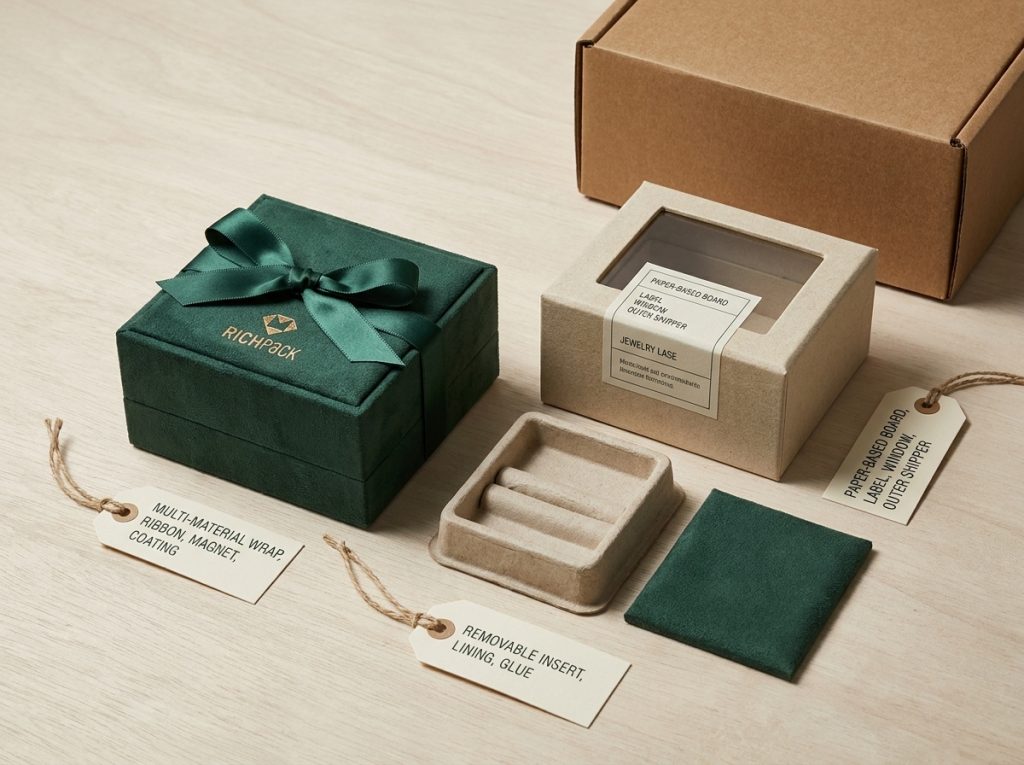
| Extra parts | Ribbon, magnet, label, window | Fixing strength and separation |
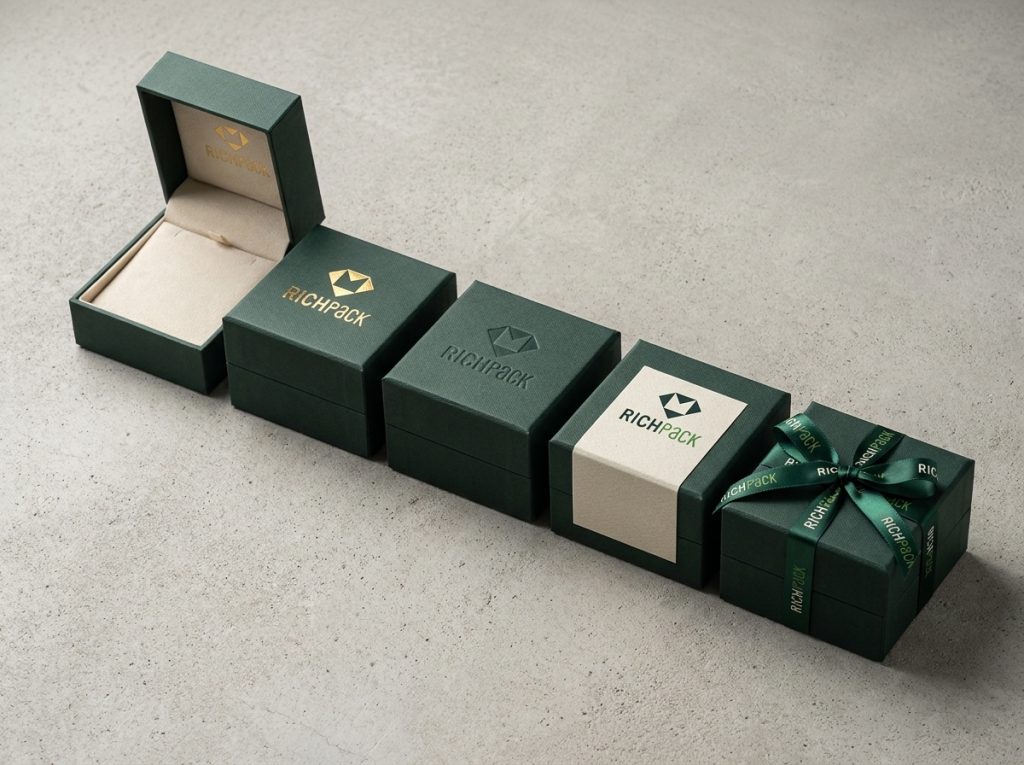
Branding works when it survives the material and the handling route. Choose the process after the box structure and wrap are stable. For a branded program, review custom jewelry boxes with logo wholesale before you approve artwork.
Custom small cardboard jewelry boxes do not need every finish. One controlled logo and a consistent color can create a strong result.
A clean insert may add more value than several decorative processes that compete for attention.
Ink-based printing works for simple logos, full-color graphics, patterns, instructions, and product information. The best process depends on quantity, artwork, substrate, and supplier equipment.
Approve the printed color on the production material. A screen proof helps with layout and spelling.
It cannot show the exact result of ink on the chosen paper, coating, and texture.
Foil stamping transfers a colored or metallic film with heat and pressure. It can create a bright logo without printing metallic ink.
Check fine lines, small counters inside letters, edges, and textured areas. Ask for the foil name, the artwork, position tolerance, and an approved physical sample. Rub the logo with normal handling pressure and inspect for breaks or lifting.
Embossing raises a design. Debossing presses it into the surface. Both depend on the die, pressure, paper, board support, and distance from folds or edges.
Keep fine details away from weak corners and moving folds. Approve depth and edge definition on the real box.
A flat artwork file does not show the tactile result.
Define color with a recognized reference, such as a Pantone code, when appropriate. Keep a physically approved sample as the production target.
The same ink can look different on white coated paper, brown kraft, black paper, and textured stock.
State the viewing condition and acceptable variation in the purchase specification. For reorders, compare the new sample with the retained master.
Do not rely on memory or a phone photo.
Labels, printed sleeves, belly bands, and ribbons can brand stock boxes without changing the core structure. They are useful for test launches, seasonal campaigns, or small assortments.
Count the added labor and materials. A low unit cost does not erase hand application, alignment errors, extra inventory, and slower packing. Test whether ribbons stay tied and whether labels lift on textured or coated surfaces.
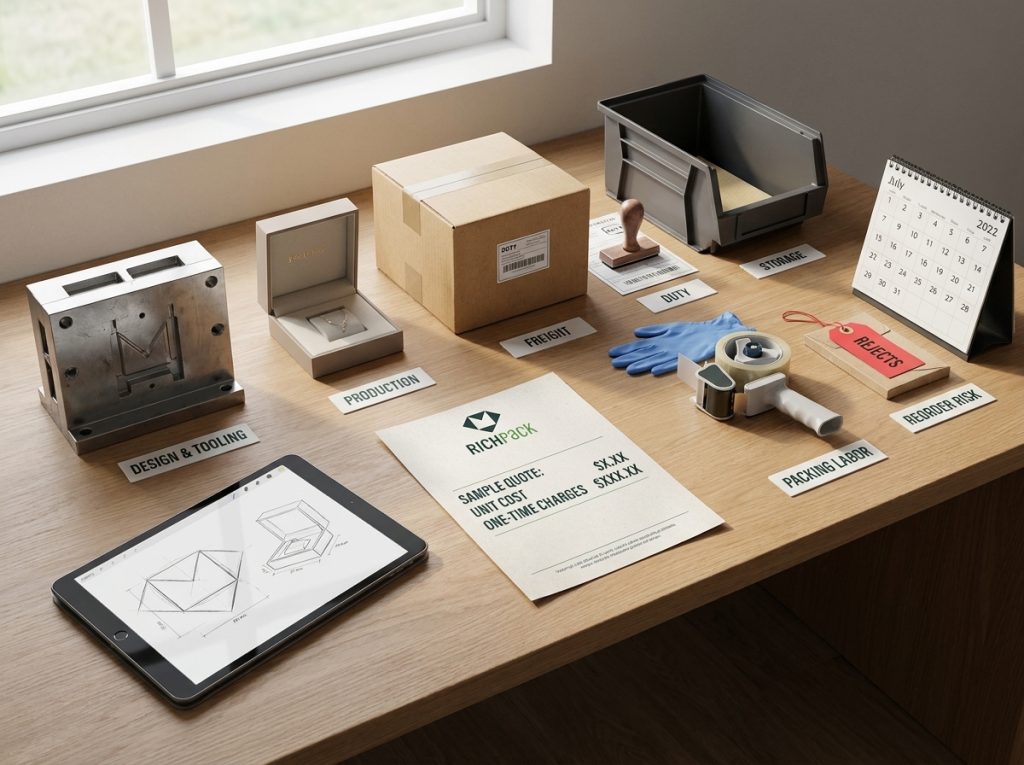
The lowest quote is not the lowest-cost program. Compare development, units, freight, duty, storage, packing labor, rejects, and reorder risk.
Wholesale, bulk, and custom buyers solve different production problems. Those labels do not imply one standard MOQ or market price. Each box specification creates its own material, tooling, labor, packing, and freight requirements.
Stock boxes remove most design and tooling work. They ship quickly, support small test orders, and provide a backup when a custom order is late.
Confirm case pack, available colors, interior dimensions, insert options, and reorder continuity. A stock product can change if the distributor changes mills, inserts, or suppliers.
Custom boxes give control over structure, dimensions, inserts, wrap, printing, and brand presentation. They work best when the product range and demand are stable enough to recover development work.
Review small jewelry gift boxes wholesale before comparing factories. Send the same specification and artwork to each bidder so the quotes describe the same package.
The main quote drivers start with finished size and structure. Board, wrap, insert, print, and decorative processes change the cost.
Assembly, quantity, quality rules, packing method, and delivery terms complete the quote.
A useful comparison separates one-time charges from recurring charges:
| Cost group | Examples | Buyer check |
| Development | Design, structural drawing, samples | Is it refundable or credited |
| Tooling | Dies, plates, molds, fixtures | Who owns it and how long is it stored |
| Unit production | Board, wrap, insert, print, labor | Is the specification identical |
| Packing | Inner bags, master cartons, labels | How many finished boxes per carton |
| Logistics | Freight, insurance, duty, brokerage | Which Incoterm and destination |
| Operations | Storage, assembly, labeling, picking | What labor and space are required |
| Quality risk | Rework, rejects, shortages, replacement freight | What remedy is written in the order |
Use the ranges below for early budgeting, not as a supplier quote. The compact rigid-box range assumes a small cardboard structure with a simple insert and limited decoration.
Keep the same size, insert, and finish when you compare suppliers. Ask each supplier to price the same build. That is the fair check.
Unit price is not landed cost. Freight, duty, labor, waste, and storage sit outside the factory number. Write each item down before you choose a quote.
Ask for the price of the box. Ask for the price of the insert. Ask for the price of the freight. Ask for the price of the carton.
Then add the one-time fees. Do not hide them inside the unit price. A clear quote is easier to check and easier to approve.
Larger sizes, premium linings, magnets, foil, hand assembly, low volume, freight, duty, taxes, and storage can move the final number.
| Package scope | Planning benchmark per unit | What moves the price |
| Custom folding carton | 0.50−0.50−2.50 | Board weight, print coverage, die, insert, and order volume |
| Compact custom rigid cardboard box with a simple insert | 0.80−0.80−2.50 | Box size, wrap, insert material, finish, assembly, and volume |
| Standard rigid jewelry box with premium insert or finish | 2.00−2.00−10.00 | Rigid board, velvet or foam, foil, magnets, and hand labor |
| High-end multi-layer luxury box | 8.00−8.00−25.00+ | Special structures, multiple layers, premium materials, and manual assembly |
The 0.80−0.80−2.50 compact rigid range is an industry planning estimate, not a RichPack fixed price. RichPack’s public pricing guide lists broader estimates of 0.50−0.50−2.50 for folding cartons, 2.00−2.00−10.00 for standard rigid boxes, and 8.00−8.00−25.00+ for high‑end luxury boxes. Use the lower compact range only when the box stays small, and the insert and finish stay simple.
For a deeper breakdown, use RichPack’s custom packaging cost guide.
MOQ is the supplier’s minimum production quantity for a defined specification. A case pack is the number of stock units packed or sold together. They are not the same.
Ask for the MOQ by size, color, insert, artwork, and finish. A supplier may allow several stock sizes in one purchase.
The same supplier may require a separate minimum for each custom structure or printed design.
Break lead time into design, sample, artwork approval, material preparation, production, inspection, and transport. Ask when the clock starts and which approvals stop it.
Build a reorder point from actual weekly use, production time, transport time, and safety stock. Keep a local or stock-box fallback if one late shipment could stop order fulfillment.
Landed cost is the total cost to place usable boxes at the packing location. It includes more than the factory unit price.
Compare the same destination, quantity, Incoterm, carton plan, currency, and delivery date. Compare shipping volume too.
Preassembled rigid boxes may cost more to ship and store than folding formats.
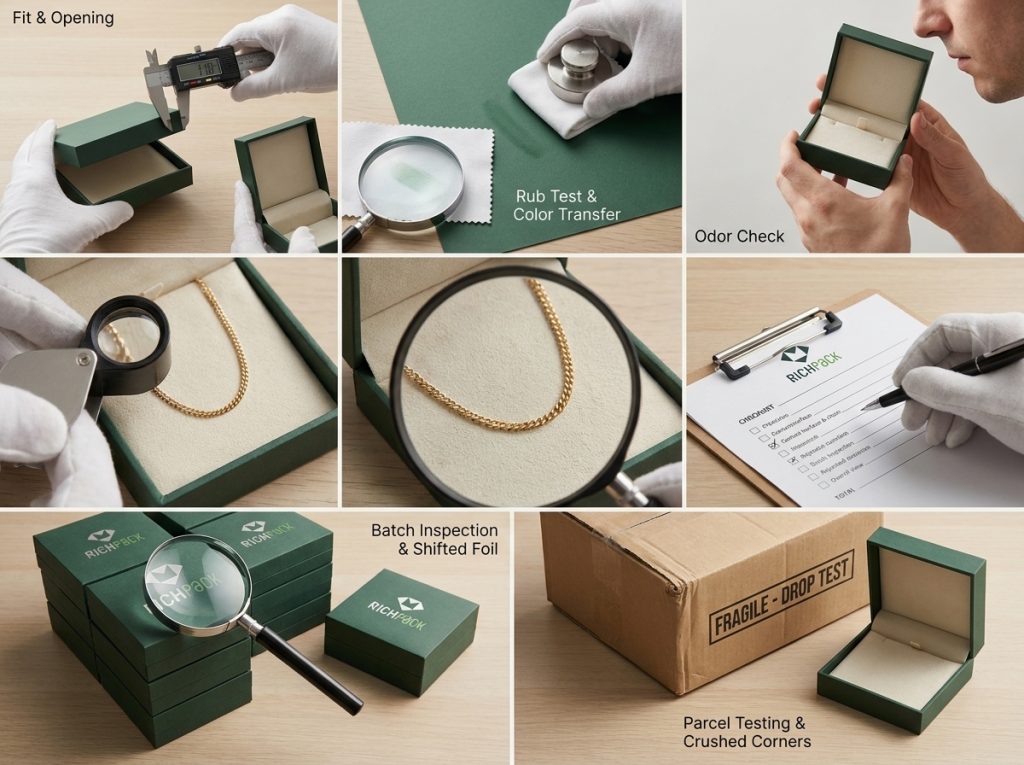
Approve a physical sample before production. Then turn it into a controlled reference.
Record the measurements, material names, artwork files, color targets, and test notes.
The sample should answer one question. Will this exact package work with the real jewelry, packing process, sales channel, and delivery route?
Load the largest, smallest, tallest, and most delicate products assigned to the box. Check every insert slot, hole, cavity, chain path, and removal point.
Turn the closed box through normal handling positions. Reopen it and record movement.
This simple test can reveal loose products and trapped chains. It also shows pieces that rotate away from the intended first view.
Open the lid or drawer with one hand and two hands. Check whether the base lifts or the drawer binds.
Also watch for a torn ribbon. The removal path should not force the customer to touch a polished surface.
Repeat the action enough times to reveal early wear. Watch wrapped edges, hinge areas, ribbon anchors, and corners. Record the result with photos and sample revision numbers.
Check logo position, spelling, color, scuffing, foil coverage, emboss depth, and coating consistency. Inspect flat areas, corners, edges, and moving folds.
Do a simple rub check using a defined cloth and number of strokes agreed with the supplier. The goal is not to invent a universal laboratory test. It is to make the approval repeatable.
Inspect the finished, cured box for odor, loose fibers, and rough-cut edges. Also look for exposed adhesive, color transfer, and hard contact points.
Place sensitive jewelry in the box for an agreed review period if the product or material warrants it.
Do not treat low odor, water-based adhesive, soft fabric, or FSC paper as proof of jewelry compatibility. They describe different properties. Use the jewelry box safety testing page to build a project-specific review.
Define the checks and the number of units or cartons to sample. Also define critical, major, and minor defects.
ISO 2859-1:2026 provides sampling procedures indexed by an acceptance quality limit for continuing lots. A buyer can use that framework with a qualified quality professional. The project needs an agreed sampling plan and acceptance limits.
Common checks include dimensions, lid or drawer fit, insert position, print, and foil. Inspect wrap seams, crushed corners, stains, odor, count, and carton labels too.
Keep the signed master sample available during inspection.
Pack the jewelry, presentation box, cushioning, and shipper exactly as the customer will receive them. Test the completed system for the intended route.
ISTA publishes several test procedures for parcel and distribution environments. Select the procedure with a qualified packaging or test laboratory. A pass on one configuration does not cover a larger product, a different shipper, a heavier set, or changed cushioning.
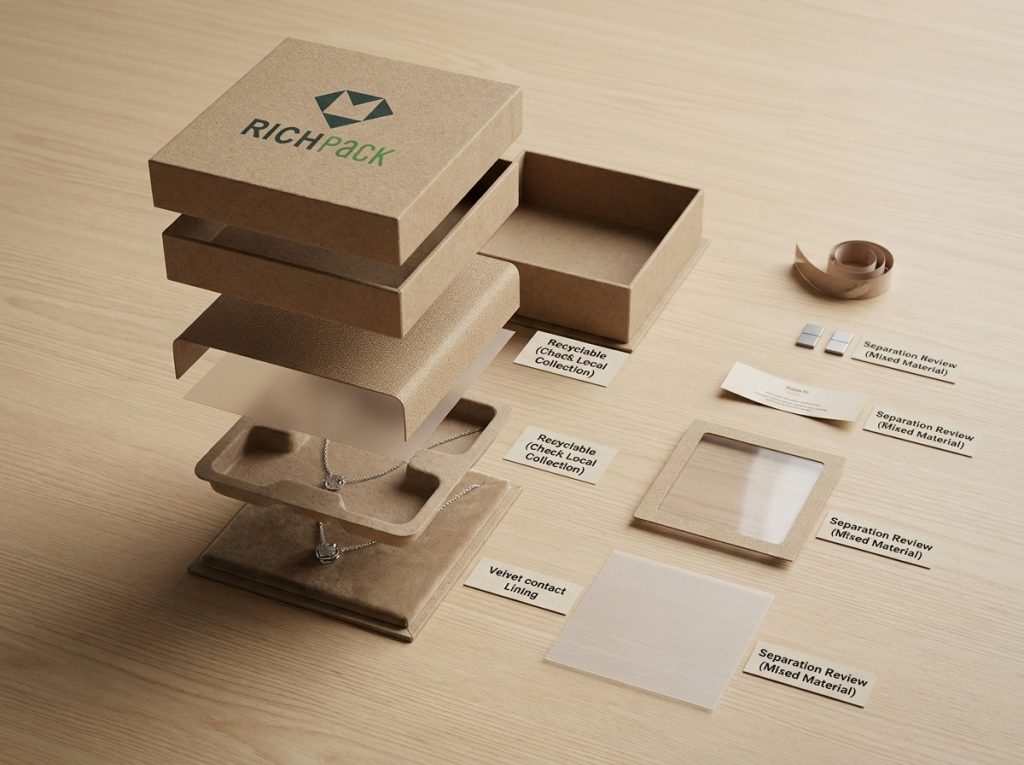
Start the sustainability review with the complete bill of materials. Board alone does not determine whether the finished box is recyclable, reusable, or easy to separate.
List the wrap, coating, ink, adhesive, insert, lining, ribbon, magnet, label, window, and outer shipper. Then check evidence and local collection conditions.
FSC chain of custody tracks certified forest-based material through the supply chain. FSC also explains the meaning of its finished-product label.
The label signals that the materials met chain-of-custody rules from sourcing to distribution.
Ask which organization holds the certificate. Check whether the proposed product is within scope and what claim will appear on the invoice or label.
FSC certification does not state the percentage of post-consumer recycled content. That information needs separate records.
State whether recycled content is post-consumer, pre-consumer, or a defined combination. Record the percentage and the component it describes.
The US Federal Trade Commission’s Green Guides address environmental marketing claims. Avoid broad recycled, recyclable, green, or eco-friendly statements when the evidence applies only to the board.
Other components may change the disposal route.
A paper box may include foam, fabric, magnets, plastic windows, metallic film, ribbon, or permanent adhesive. These parts can affect collection and recycling.
Ask whether the customer can separate the insert and decorative parts without tools. Simpler construction can reduce material variety, but the best choice must protect and present the jewelry.
Recyclable does not mean every customer can place the box in every local bin. Collection, sorting, and mill acceptance differ by country and municipality.
Use market-specific disposal wording. If a claim depends on removing an insert, ribbon, or magnet, state that condition. Review labels and instructions for each target market.
The European Commission states that Packaging and Packaging Waste Regulation 2025/40 entered into force on February 11, 2025. It applies to most packaging from August 12, 2026.
The regulation covers all packaging and packaging waste. It sets rules for manufacturing, composition, reuse, recovery, waste management, and prevention.
Brands selling into the European Union should review the finished packaging and their market role. They should also review labels, documents, and transition dates with qualified legal or compliance advisers.
Do not copy one generic supplier statement across all EU countries or product programs.
Keep supplier declarations, certificate details, material specifications, and invoices in one project record. Add test reports, artwork, and approved claim wording.
Connect each public statement to the component and evidence that support it.
For a deeper material review, see RichPack’s guide to eco-friendly jewelry packaging.
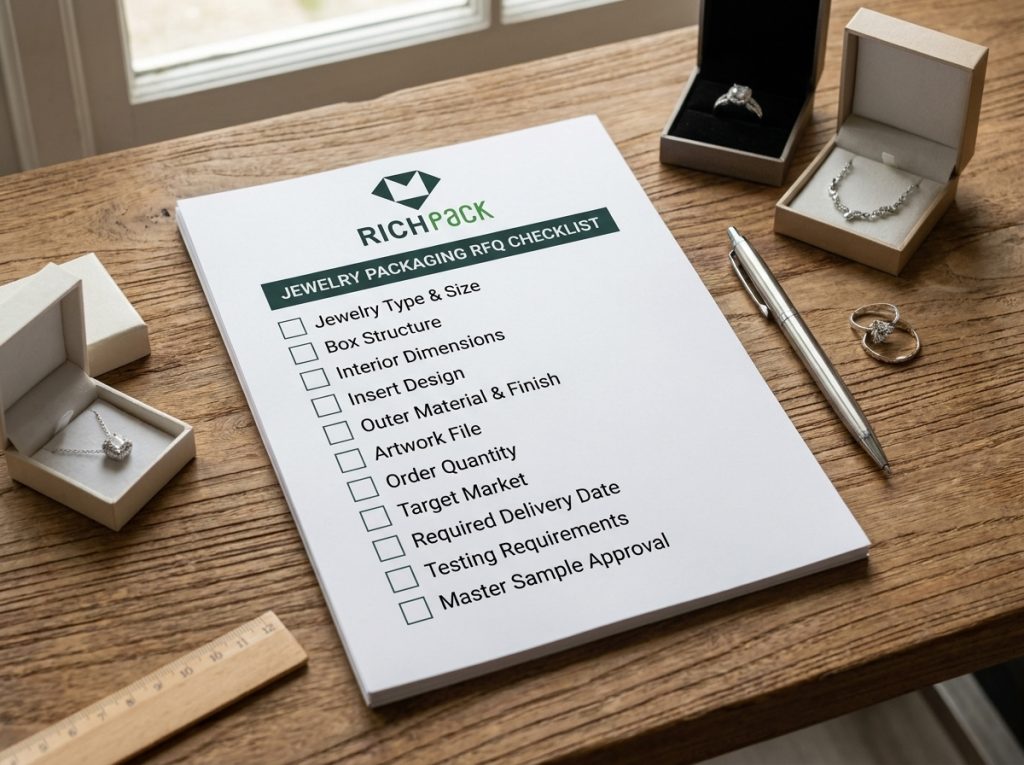
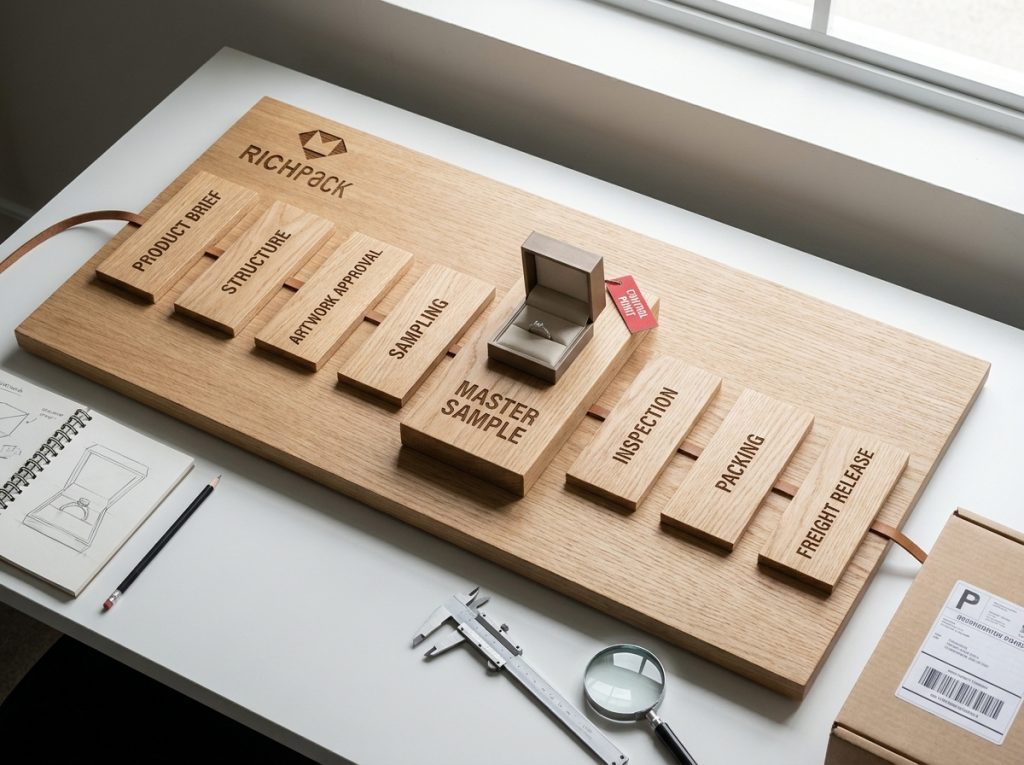
A controlled purchase record turns a good sample into a repeatable packaging program. Keep one project code and revision across quotes, drawings, artwork, samples, purchase orders, inspections, and reorders.
List every SKU or product family that will use the box. Record dimensions, weight, finish sensitivity, display position, monthly demand, sales channel, and target market.
Group products only after testing that they share the same box and insert. One outer box can sometimes support several inserts, which reduces packaging variety without forcing a poor fit.
Define the structure and the finished exterior and interior dimensions. Then record the board, wrap, color, insert, lining, print, and finish.
Add tolerances, packing method, carton marks, quantity, destination, and required date.
Attach dimensioned drawings and artwork files. Name each file with the project and revision. Avoid approving changes through scattered messages with no updated specification.
Send one request for quotation to every supplier. Ask each bidder to list all assumptions and alternatives.
The quote should separate one-time and unit charges. It should also state MOQ, sample path, production time, packing plan, Incoterm, and quote validity.
Do not compare a stock box with a fully custom rigid box as if price were the only difference. Match the scope first.
Approve the physical sample with signatures or a controlled digital record. Add measured dimensions, color reference, insert drawing, artwork revision, photos, and accepted exceptions.
Keep one sample with the buyer and one with the supplier when possible. The master sample becomes the reference for production and future reorders.
Confirm the final specification, purchase order, quantity, delivery term, production schedule, inspection plan, and remedy for nonconforming goods. Release only the approved files.
Keep design, sampling, production, inspection, and delivery in one record. That makes each approval traceable when the program moves from sample to repeat order.
Record actual use, damage, customer-service issues, packing time, and stock remaining. Set a reorder point before the safety stock is consumed.
For the next order, state whether it is an exact repeat or a new revision. Recheck materials, color, insert, carton plan, certificate scope, and market requirements before approving production.
Measure the jewelry and its display position. Choose a box by finished interior dimensions.
Include setting height for rings and post clearance for earrings. Record a chain path for necklaces and the outside diameter of rigid bangles. Approve the fit with a physical sample.
They work well as retail presentation boxes. Most need an outer mailer or corrugated shipper for parcel delivery.
Test the jewelry, insert, retail box, cushioning, and shipper as one system.
Cotton suits flexible stock programs, while die-cut foam gives more precise control. Molded pulp can support a paper-based appearance. Velvet, microfiber, or paper top layers change the contact surface and presentation. Choose by jewelry shape, movement risk, removal, material compatibility, and target disposal route.
Use stock boxes when demand, sizes, or branding change frequently. Use custom boxes when volume is stable.
Custom production makes sense when control over fit, insert, color, logo, and reorders can support the added work.
Send the same specification to each supplier. Compare development, tooling, unit production, packing, freight, duty, storage, assembly, quality terms, lead time, and reorder conditions. Do not compare unit price alone.
Some can enter paper recycling streams. The answer depends on coatings, adhesives, inserts, magnets, ribbons, labels, and local collection rules.
Review the complete bill of materials and use market-specific disposal wording.
Handmade boxes can work for prototypes, personal gifts, or limited craft runs. They are harder to keep consistent at business scale.
Repeat dimensions, clean wrap edges, stable color, fast packing, and matching reorders all require control. Test the design by hand. Move to stock or custom production when repeatability matters.
Buy Small Cardboard Jewelry Gift Boxes in the same order that the package works. Start with the jewelry, then choose the structure and usable interior.
Keep the brief clear. Keep the sample close. Keep the next order close to the sample.
Check the box. Check the fit. Check the cost. Then place the order.
Approve the insert and contact surface. Add branding after the physical design is stable.
Then compare suppliers by landed cost, sample quality, production controls, and reorder reliability. A clean quote and a controlled master sample give you a firm basis for the order.
For a custom program, send RichPack the product list, interior dimensions, insert needs, and artwork. Add the quantity, target markets, delivery location, and required date.
The design and production team can then move from concept to sample with fewer hidden assumptions.


2024-12-12

2024-11-26
2024-12-05
2025-08-18
2025-04-08
2025-04-21
Acrylic Ring Display Stands in Clear Acrylic | Transparent Ring Holder for Retail & Jewelry Showcase | Richpack
View More
Adorable Cute Packaging for Cosmetics to Elevate Your Brand – Customizable Designs for the Cosmetic Packaging Market by Richpack
View More
Affordable Custom Gift Boxes for Small Jewelry Shops | Budget-Friendly Packaging Solutions Custom Designs for Small Retailers
View More
Affordable Gift Packaging Boxes for Bulk Orders | Cost-Effective Solutions for Large Purchases | Customizable Designs Available
View More
Affordable Jewelry Display Stands for Independent Jewelers | Tailored for Small Retailers Seeking Elegant, Custom Displays on a Budget
View More
Affordable Sustainable Packaging for High-Volume Jewelry Orders | Perfect for Wholesalers Seeking Scalable, Green Solutions at Competitive Prices
View More

