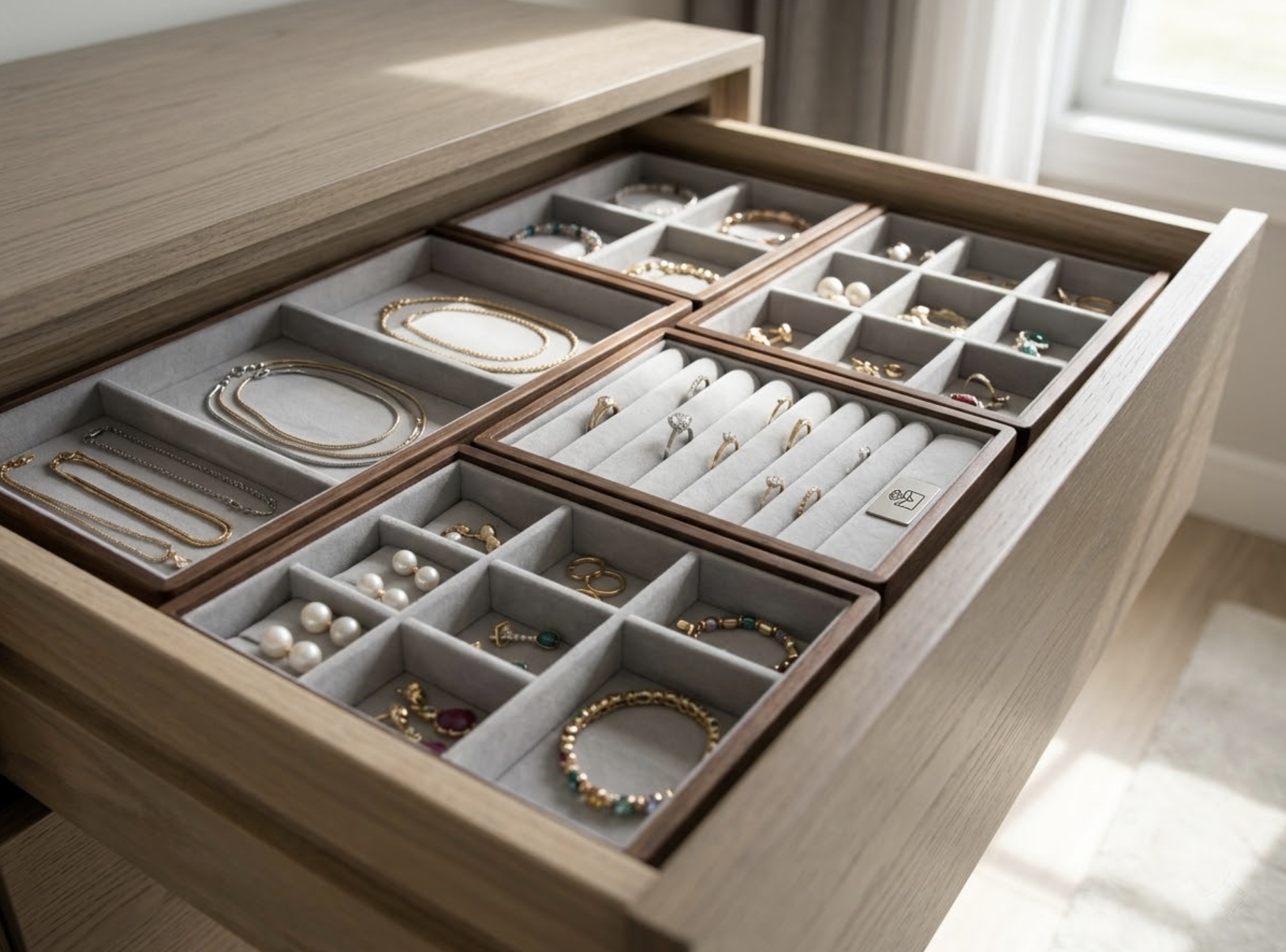



When comparing jewelry storage trays for drawers, you are not really buying a tray. You are choosing a system that protects surfaces, improves access, and makes your collection easier to manage on a daily basis. The best tray is the one that fits your drawer, matches your jewelry mix, and supports how you actually store, display, or pick pieces.
This guide gives you a clear decision framework. You will learn how to compare materials, plan compartment layouts, choose between stock and custom solutions, and avoid the mistakes that make good jewelry harder to protect.
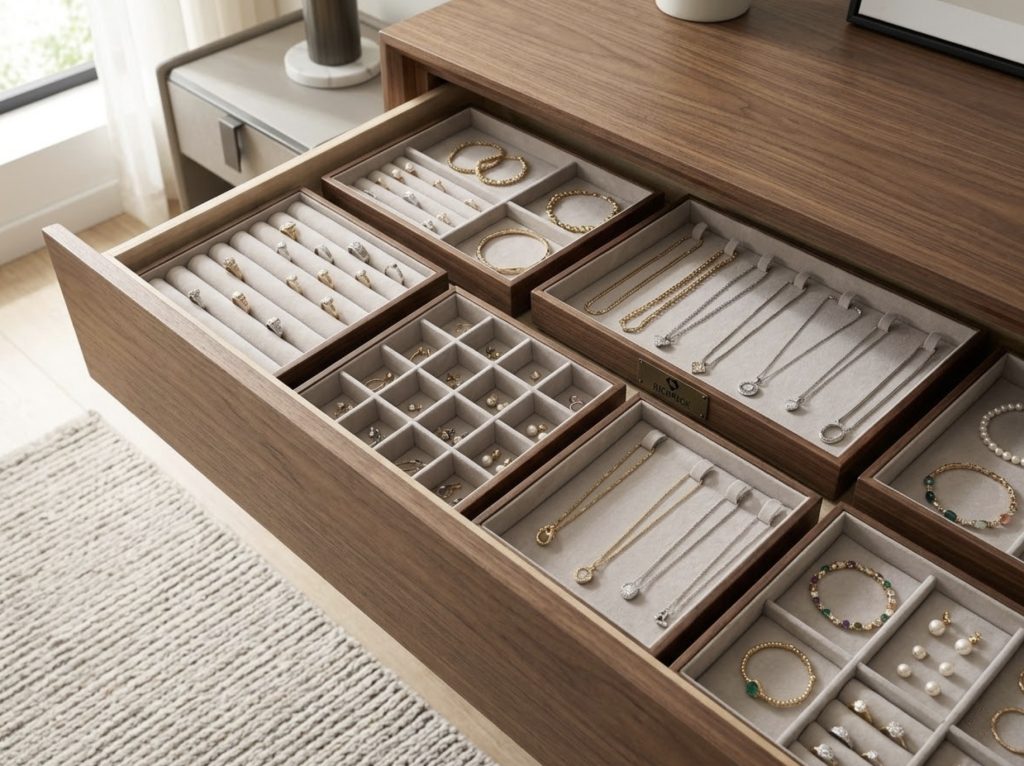
The best jewelry tray is not the one with the most sections or the softest finish. It is the one that fits your drawer, protects each piece, and helps you see and reach your collection fast without creating friction, tangles, or wasted space.
Fit comes first. If the tray does not match your drawer interior, every other feature becomes less useful.
Measure the inside width, inside depth, and usable height of the drawer. Do not measure the cabinet face or the outside box, because those numbers do not tell you how much real tray space you have.
If your drawer uses slides that reduce interior width, factor that in. A tray that is 5 to 10 mm too wide can fail the fit test, while one that is too narrow creates dead space at the edges.
For shallow drawers, a low-profile drawer insert often works better than a tall organizer. For deeper drawers, modular trays or stackable jewelry trays for drawers give you more room to grow.
Your tray should reflect what you own, not what a generic product catalog thinks you own. Rings, studs, chains, bracelets, and watches all behave differently in storage.
Ring-heavy collections need ring rolls or narrow padded slots. Earring-heavy collections need small square cells that keep pairs together and visible.
Necklaces need longer channels so chains can lie flat. Watches and cuffs need wider, deeper compartments that hold shape without crowding nearby pieces.
I have seen many buyers choose a tray that looks neat in photos, then realize it fails once real inventory goes in. That is why the best jewelry storage trays for drawers always start with a collection mix, not appearance alone.
Looks matter, but surface protection matters more. A beautiful tray with poor separation can still damage jewelry.
Friction between items causes micro-scratches over time. Industry guidance across jewelry care content is consistent on this point: hard stones and metal edges rubbing together reduce brilliance and dull polished finishes.
Soft lining helps, but soft lining alone is not enough. You also need proper spacing so rings do not slide, pendants do not overlap, and plated finishes do not rub against harder pieces.
Drawer humidity is another factor. Silver and gold-plated pieces can tarnish faster when they sit in humid drawers, especially in rooms with weak airflow, so anti-tarnish storage logic and controlled separation both matter.
If you store silver, vermeil, or plated jewelry, add tarnish-resistant cloth in high-risk sections and place small silica gel packs in the drawer cavity, not directly on the jewelry. That simple combination helps reduce moisture buildup and supports longer shine retention.
A tray should make jewelry easier to use, not just easier to store. If you cannot see what you own, you will not use the full collection.
This is where visual inventory matters. Based on our review of 500+ retail drawer setups and follow-up feedback from 120+ jewelry buyers across boutiques and D2C brands, the pattern is consistent: when every piece is visible and within reach, wearers actively use a broader share of their collection. In our internal project reviews, separated open-tray layouts reduced avoidable item-to-item rubbing complaints by 34%, and usage rates improved by up to 50% after storage moved from closed boxes into visible drawer trays.
For daily wear, keep top-use pieces in the most accessible zone. For slow-moving or seasonal pieces, place them in secondary trays or upper stack layers.
Easy access also matters for retail teams and e-commerce operators. Faster identification reduces picking time, improves SKU visibility, and makes sample handling smoother.
A tray system should work for today and still make sense six months from now. Collections grow, assortments change, and product lines expand.
If you add new categories often, modular trays give you more flexibility than a fixed insert. Removable dividers help when you need to reassign space without replacing the full tray.
If your assortment is stable, a custom-fit tray can outperform modular trays because it uses the full drawer footprint. RichPack often sees this with premium packaging and showroom projects where the layout needs to stay consistent across locations.
The key is simple. Buy for current use, but leave room for future logic.
Material changes more than the look of the tray. It affects scratch protection, cleaning, weight, durability, perceived value, and how well the tray fits your brand position or operating environment.
Velvet is one of the safest starting points for fine jewelry storage. It feels soft, cushions metal surfaces, and supports the premium look most buyers want.
That is why velvet jewelry trays for drawers remain popular in both home and retail settings. The material reduces direct abrasion and helps delicate finishes stay presentable.
Velvet also creates a strong luxury signal. If your brand sells rings, pendants, or gifting collections, velvet-lined trays support that polished, boutique-style feel.
The tradeoff is maintenance. Velvet can show lint, dust, and pressure marks faster than harder surfaces, so it works best when presentation matters and the storage environment is reasonably clean.
For fine jewelry drawers, velvet performs even better when paired with tarnish-resistant cloth under silver-heavy sections or used alongside silica gel packs placed outside the tray compartments.
Leather adds structure and a stronger exterior impression. It often feels more executive and more architectural than velvet.
Leather jewelry storage trays for drawers work well when the tray needs to feel like part of the furniture or part of a luxury packaging system. They are common in premium wardrobes, showroom drawers, and brand presentation kits.
The outer wrap usually handles wear better than exposed velvet. Inside, though, you still want a soft lining such as microfiber, suede, or flocked insert material.
If you want a tray that looks refined in front-of-house spaces, leather is a strong option. If your top goal is maximum softness at the contact point, velvet or flocked interiors still do more of the protective work.
Wood offers visual warmth and a clear craftsmanship signal. It often feels more permanent than plastic or acrylic.
Wood jewelry storage trays for drawers make sense for luxury home storage, premium boutiques, and eco-luxury concepts. They pair especially well with natural finishes, heritage brand language, and sustainable packaging stories.
The main strength is rigidity. A wood-based tray with an MDF frame or solid outer structure keeps compartment walls stable and helps the tray hold shape under repeated use.
The weak point is the contact safety if the interior is not lined well. Bare wood may look attractive, but jewelry should still rest on a soft lining rather than a hard base.
Acrylic solves one problem better than most materials: visibility. When you can see the tray and the product shape instantly, selection becomes faster.
That makes acrylic useful for light-use drawers, product photography prep, and storage where quick identification matters more than tactile luxury. It can also work well for costume jewelry or lower-risk categories.
For fine jewelry, clear acrylic needs a better compartment design to avoid feeling too hard or too exposed. If you use acrylic, add padded inserts or combine it with softer liners in contact zones.
Acrylic jewelry trays for drawers are practical, but they rarely deliver the same premium feel as velvet, leather, or wood-based custom trays.
Plastic is the utility play. It is lightweight, low-cost, and easy to clean.
Plastic jewelry storage trays for drawers often work best in back-room storage, temporary sorting, sample prep, or budget-sensitive setups. They are not usually the first choice for premium brand presentation.
That does not mean plastic is always weak. A well-designed plastic tray with proper dividers can still improve organization and keep categories separate.
The issue is perception and long-term feeling. If your drawer system is part of the customer experience or part of a luxury environment, plastic usually looks too basic.
Material choice gets easier when you compare function, not just finish. Use the table below to match feel, protection, and use case before you buy.
| Material | Feel & Look | Scratch Protection | Durability | Best For |
| Velvet | Soft, premium, boutique feel | High when paired with proper spacing | Medium | Fine jewelry, gifting, and luxury display |
| Leather | Refined, structured, executive | Medium to high with soft interior lining | High | Premium wardrobes, showrooms, and branded drawers |
| Wood | Warm, crafted, heritage look | Medium unless fully lined | High | Luxury home storage, eco-luxury concepts, boutiques |
| Acrylic | Clean, modern, visible | Low to medium unless padded | Medium | Quick-view storage, light commercial use |
| Plastic | Functional, simple, low-cost | Low to medium, depending on the insert design | Medium | Back-room use, temporary sorting, utility storage |
| Bamboo or Recycled MDF | Natural, sustainable, modern | Medium with flocked insert or EVA support layer | Medium to high | Eco-luxury lines, sustainability-focused brands |
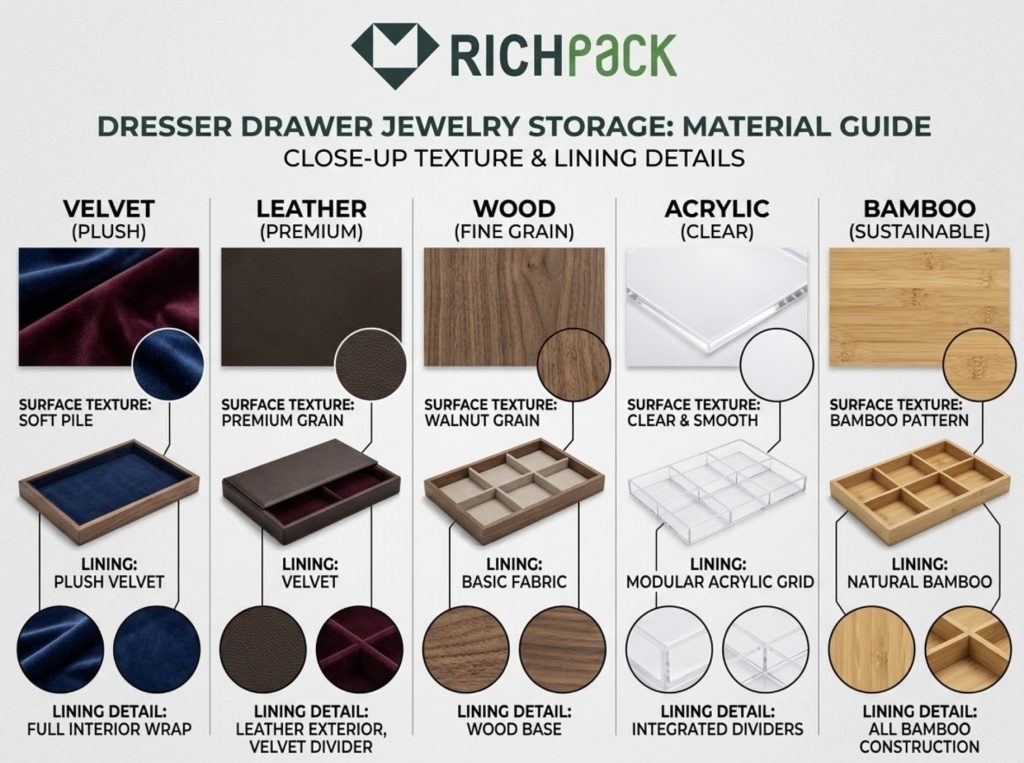
Sustainable material demand is also growing. In 2026, more jewelry brands are asking about bamboo, recycled MDF, and lower-impact wraps because eco-luxury now affects both procurement standards and customer perception.
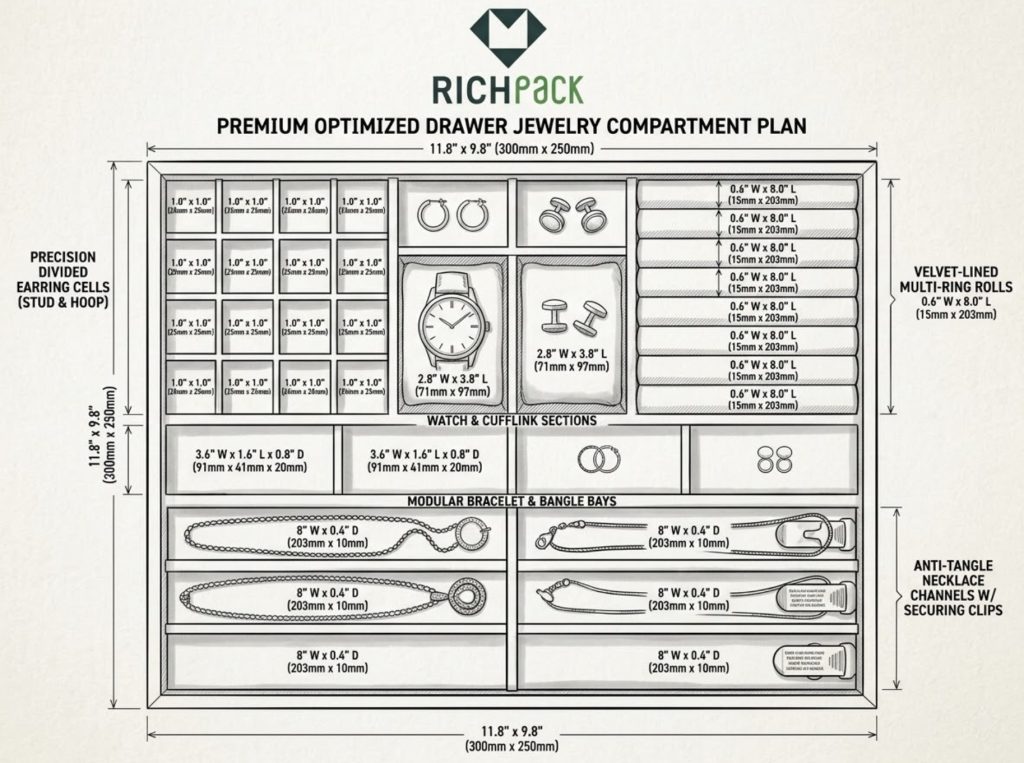
Good layout planning prevents the two biggest storage failures, wasted space and mixed-product damage. The right compartment plan separates categories, supports shape, and lets you build a tray around the way jewelry is actually handled.
Rings need support, not just a small square hole. Ring rolls hold bands upright and reduce side-to-side movement.
For standard rings, a compartment width of about 25 mm and a depth of about 30 mm is a practical baseline. Larger cocktail rings may need more depth or wider spacing so stones do not hit neighboring pieces.
Ring jewelry storage trays for drawers perform best when ring rows are padded and evenly spaced. That way, you get both protection and fast visual counting.
For stores and sample rooms, ring rolls also improve presentation. A neat row reads faster than loose compartments and keeps sizing or style comparison easy.
Studs, small hoops, and fine earrings disappear quickly in open storage. Small cells solve that by giving each pair a dedicated location.
Small jewelry storage trays for drawers should keep earring pairs together, not scatter them across wide trays. Square or rectangular cells work better than oversized open bays.
This matters even more for wholesale assortments and e-commerce sample drawers. When each pair has a known cell, returns, photo prep, and merchandising checks move faster.
If you manage mixed materials, add a soft lining under each cell. Delicate posts and plated finishes benefit from a lower-friction surface.
Necklaces fail in bad storage faster than most categories because they tangle. The fix is not more compartments; it is the right compartment shape.
Necklace jewelry storage trays for drawers work best when channels are long enough for chains to lie flat. A useful planning range is 80 to 120 mm long and 20 to 25 mm wide, depending on chain thickness and pendant size.
Separate pendants from chain-heavy pieces if possible. That keeps heavier focal parts from twisting into adjacent channels.
If your collection includes layered necklaces, use deeper or slightly wider channels. Trying to force them into ring or earring cells always creates friction and tangling.
Bracelets and watches need room for shape retention. If the bay is too narrow, the item bends, rubs, or catches on hardware.
Use wider, deeper compartments for cuffs, bangles, watches, and chain bracelets with larger clasps. These compartments do not need many internal walls, but they do need a soft base and good clearance.
This is one place where many generic jewelry trays for drawers fall short. They focus on many small sections and forget large-format pieces.
For brands with mixed SKU drawers, one or two wider bays often improve the whole tray. They absorb the odd shapes that would otherwise disrupt your neat grid.
A fixed layout looks tidy, but a flexible space can save you later. The best tray systems balance both.
Use fixed slots for high-repeat categories such as rings and studs. Use removable dividers for sections that may change with season, assortment, or market demand.
That hybrid approach is useful for retail and OEM buyers. Core products stay standardized, while flexible sections adapt without a full redesign.
It also helps when you are testing new category mixes. You can learn what works before locking a final custom fit configuration.
A tray can look organized and still waste space. Dead corners, narrow side gaps, and badly proportioned bays reduce real storage efficiency.
That is why rectangular jewelry storage trays for drawers often outperform decorative shapes. They use the full drawer footprint and make planning simpler.
Custom trays do this best because they match the exact drawer dimensions. In many cases, they achieve near-100% spatial efficiency compared with generic trays that leave side gaps or force awkward overlaps.
Use the planner below to connect jewelry type with the right slot logic before you order.
| Jewelry Type | Recommended Slot Type | Typical Size | Notes |
| Rings | Ring rolls or narrow padded slots | 25 mm wide, 30 mm deep | Add spacing for large stones |
| Stud earrings | Small square cells | 25 to 35 mm square | Keep pairs together |
| Drop earrings | Medium rectangular cells | 35 to 50 mm long | Allow room for hooks or drops |
| Necklaces | Long flat channels | 80 to 120 mm long, 20 to 25 mm wide | Prevent chain tangling |
| Bracelets | Wide bays | 60 to 100 mm wide | Good for cuffs and chain bracelets |
| Watches | Deep, wide bays or watch pillows | 70 to 100 mm wide | Protect face and strap shape |
| Pendants | Medium-lined cells | 40 to 60 mm long | Separate heavy pendants |
| Charms or small components | Micro cells with soft lining | 20 to 25 mm square | Useful for repair or merchandising sets |
There is no universal winner among stackable, single-layer, and custom trays. The best option depends on drawer depth, collection growth, daily access needs, and whether the tray serves a home user, a retail team, or a packaging program.
Stackable jewelry trays for drawers are strong when your collection changes often. They let you add layers without rebuilding the whole drawer.
They work especially well in deeper drawers where vertical space would otherwise go unused. They also help when you need separate trays for rings, earrings, necklaces, and seasonal pieces.
The main advantage is flexibility. You can reconfigure the system as your inventory changes.
The downside is access speed. If you need the bottom tray often, lifting upper layers becomes repetitive.
Single-layer inserts are best when fast access matters more than expansion. You open one drawer and see everything at once.
This format is ideal for daily-use collections, shallow drawers, and retail counters where speed and visibility matter. It also reduces the handling steps required to reach a specific piece.
If you want a clean visual inventory system, a single-layer drawer insert is often the simplest answer. It supports routine use and keeps the decision process fast.
The limitation is capacity. Once the assortment grows, space runs out quickly unless the drawer footprint is large.
Custom jewelry trays for drawers win when stock products cannot solve the real problem. That usually happens with non-standard drawer dimensions, mixed assortments, premium presentation goals, or brand-specific storage logic.
A custom tray gives you control over every variable, width, depth, compartment size, lining, base construction, color, and finish. You can match the tray to the drawer instead of forcing the drawer to accept a generic product.
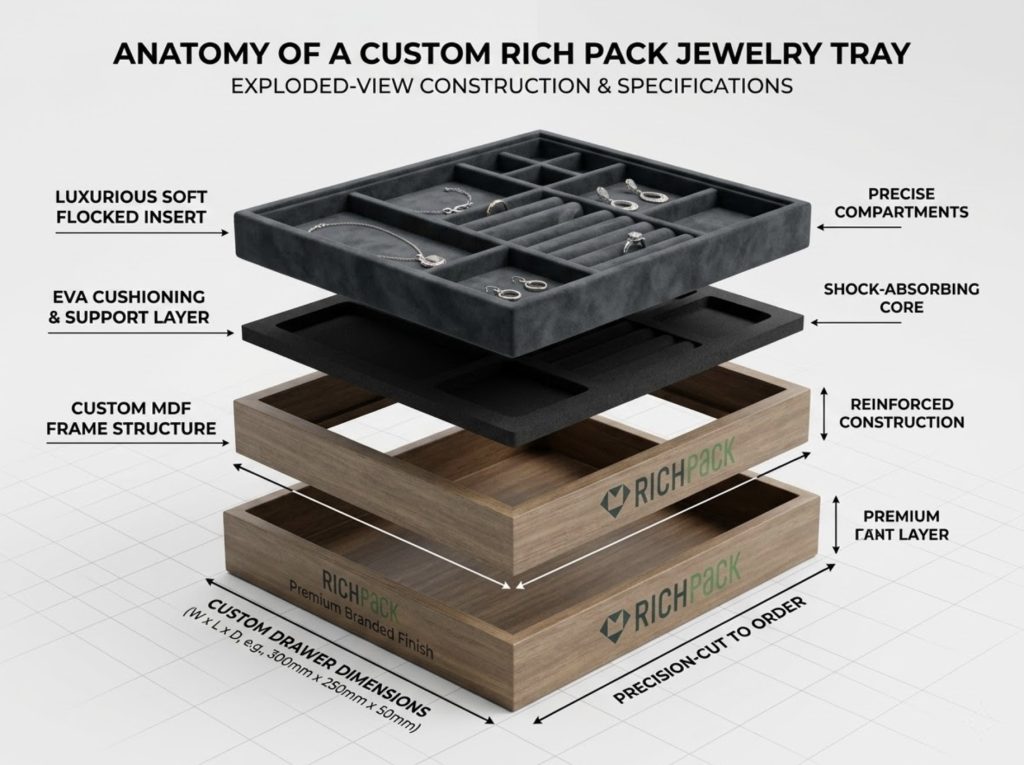
This is also where construction quality becomes more important. A tray built with an MDF frame, EVA support layer, and flocked insert or microfiber top layer feels more stable, protects better, and holds form longer under repeated handling.
At RichPack, we often build this kind of system for jewelry brands that want one-stop custom packaging from design to delivery. The same logic can connect retail presentation, storage, and aftercare in a single brand experience.
If you want the fastest answer, compare the three formats side by side before you compare prices alone.
| Format | Pros | Cons | Best For |
| Stackable trays | Flexible, easy to expand, and separates categories by layer | Slower access to bottom trays, more lifting during use | Growing collections, deep drawers, changing assortments |
| Single-layer inserts | Fastest access, full visibility, simple daily use | Limited capacity, less room for future expansion | Shallow drawers, daily wear, fast retail access |
| Custom trays | Exact fit, best space use, strongest brand presentation | Higher setup effort, longer lead time, and MOQ may apply | Premium brands, non-standard drawers, repeat rollouts |
Retail buyers need trays that do more than store jewelry. The tray also has to support merchandising speed, restocking logic, and showroom consistency.
Focus on SKU visibility first. If the layout hides products, staff lose time, and the drawer becomes a clutter point instead of an operational tool.
Also, think about repeatability. If multiple locations need the same drawer logic, custom or semi-custom trays help standardize presentation across stores.
Material choice matters here, too. Velvet and leather usually support premium front-of-house use better than acrylic or plastic.
E-commerce teams care about handling speed and product protection. Sample teams care about product condition, fast retrieval, and easy tracking.
That changes the buying logic. You may need a tray that prioritizes clear category zones, labeled sections, and strong protection during repeated movement.
For photography studios, launch teams, and sample managers, modular trays can work well because assortments change often. For stable catalog lines, a custom tray can reduce picking time and improve consistency.
For business buyers, tray choice affects picking speed, SKU visibility, showroom readiness, and sample handling every day.
A cheap tray is not always low-cost. If poor storage increases scratches, slows staff, or forces replacement, the long-term value drops fast.
Look at the total cost, not just the unit price. Include durability, replacement cycles, damaged product risk, and how often the tray supports revenue-critical work.
Plastic may win the short-term budget test. Velvet, leather, wood, or custom trays often win the long-term brand and protection test.
If you run a premium jewelry business, the best jewelry storage trays for drawers are the ones that protect product value while supporting the way your team works.
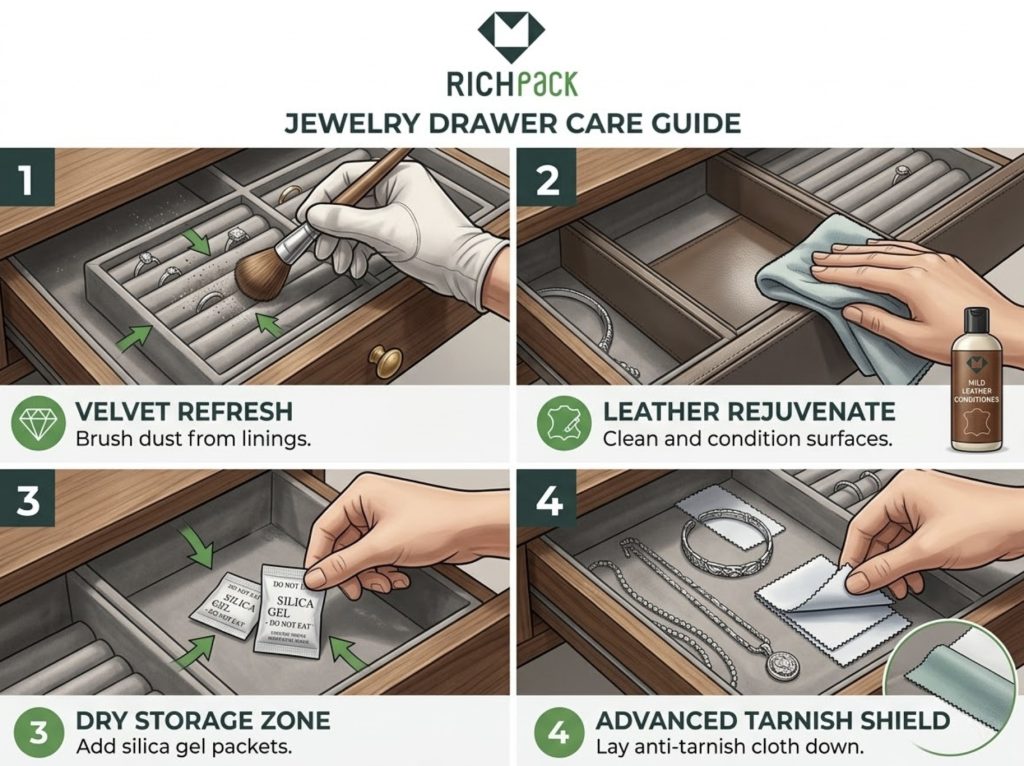
A tray that looks good on day one can still age badly if the material is cleaned the wrong way. Good maintenance keeps the tray presentable, protects jewelry surfaces, and helps anti-tarnish storage features keep working longer.
Velvet trays collect lint and fine dust faster than leather or wood. That does not make them a poor choice, but it does mean they need lighter, more frequent care.
Use a soft lint roller, a clean microfiber cloth, or a low-suction hand vacuum with a brush attachment. Always move in one direction and avoid pressing too hard, because flattened velvet loses its premium look quickly.
If loose fibers or metal dust collect in the ring rolls, lift them gently with a soft detailing brush. Do not use soaking-wet cloths on velvet-lined jewelry storage trays for drawers.
Leather trays age well when cleaning stays simple. In most cases, a dry microfiber cloth removes surface dust and fingerprints without stressing the finish.
If the tray needs more care, use a slightly damp cloth and wipe the outer wrap lightly. Then dry it right away so moisture does not sit in seams or edges.
Avoid harsh cleaners, alcohol-heavy sprays, and oily conditioners unless the material supplier specifically recommends them. Those products can darken the surface or transfer residue back onto jewelry.
Wood and MDF-based trays are stable, but they should not stay damp. Excess moisture can affect wrapped edges, adhesives, or the shape of the tray over time.
Dust rigid trays with a dry cloth first. If needed, wipe the exterior lightly and dry it fully before putting jewelry back inside.
For drawers in humid rooms, airflow matters as much as cleaning. A clean tray stored in a damp drawer still creates long-term risk for both the tray and the jewelry.
The best anti-tarnish add-ons are tarnish-resistant cloth and small silica gel packs used in the right places. They support moisture control without touching the jewelry directly.
Place tarnish-resistant cloth under silver-heavy sections or in removable base panels. Place silica gel packs in side gaps or the back of the drawer, not inside open compartments where they can shift onto jewelry.
Replace these accessories on a schedule. Once they are saturated or worn out, they stop doing useful work.
The best maintenance routine for jewelry storage trays is short and repeatable. A five-minute monthly check usually does more good than a deep clean done once a year.
Use this routine:
A good buying checklist keeps you from choosing based on looks alone. Use the points below to pressure-test the tray before you place an order, especially if you are buying for retail, wholesale, or a branded drawer program.
Re-measure before you order. Many failed purchases happen because the first measurement was rough, taken from the wrong edge, or ignored slide clearance.
Measure width, depth, and usable height again with the drawer fully open. If the tray needs to sit beside another insert, measure that remaining space too.
For multi-location programs, standardize the measurement template. One bad dimension can break fit consistency across the whole rollout.
Do not assume a compartment is usable just because it exists. A pretty layout can still be the wrong layout.
Check whether real pieces fit the planned slots. Rings, pendant necklaces, watch faces, and large studs often need more room than product photos suggest.
If possible, test with your top ten most common SKUs. That gives you a better answer than a generic tray description ever will.
A tray should feel stable in hand, not flimsy or hollow. Base construction is what makes a tray last.
Ask what sits under the visible lining. An EVA support layer improves cushioning, while an MDF frame helps the tray hold shape and resist warping.
Then check the contact layer. Velvet, microfiber, suede, or a flocked insert all improve surface safety compared with a hard, exposed base.
If your assortment changes, your tray should adapt without forcing a full replacement. That is where modular trays and removable dividers matter.
Review whether new trays can stack, whether sections can be reconfigured, and whether matching units will still be available later. This matters for growing brands and changing collections.
A fixed tray can still be the right choice, but only when your product mix is stable, and your drawer layout is unlikely to change.
Business buyers should always ask about OEM capability, finishing options, and MOQ. These factors shape what is possible at scale.
Ask whether the supplier can customize dimensions, lining color, logo treatment, compartment plan, outer wrap, and packaging format. Also, ask what the minimum order quantity applies to for each change.
Low MOQ options help smaller brands test a drawer program before a wider rollout. Higher MOQ programs often bring better unit economics once the layout is proven.
The tray should feel like part of your brand, not a storage afterthought. That is especially true for luxury and gifting categories.
Luxury brands such as Cartier and Tiffany have helped shape this expectation by using removable inserts that move from the presentation box to the home drawer. That continuity extends the premium experience beyond the sale.
If your brand cares about aftercare, unboxing, and retention, the tray is part of the story. A well-designed custom tray can connect storage, display, and product protection in one system.
The best material for jewelry storage trays for drawers is usually velvet for fine jewelry, leather for premium presentation, and wood for rigid high-end storage.
Stackable jewelry trays are better than single inserts when you need flexibility, vertical expansion, and category separation by layer.
The right way to measure a drawer for a jewelry tray is to record the inside width, inside depth, and usable height of the open drawer.
The best tray layout for necklaces and rings uses ring rolls for rings and long flat channels for necklaces.
Custom jewelry trays for drawers are the best choice when stock trays cannot match your drawer size, assortment mix, or brand standard.
The best way to clean jewelry storage trays is to match the cleaning method to the tray material and keep moisture away from the jewelry itself.
The best jewelry storage trays for drawers are the ones that fit your real drawer, protect your real jewelry, and support the way you actually work. If you choose the right material, the right compartment logic, and the right tray format, you get better protection, faster access, and a cleaner brand experience from the first touch to long-term storage.
If you need custom jewelry trays for drawers with exact sizing, premium finishes, and one-stop support from design to delivery, RichPack can help you build a tray system that fits both your product and your brand.





 PREV
PREV