Let’s be honest. If you don’t understand the physical properties of velvet fabric, printing on it will be a big problem.
Many people know that custom velvet ring boxes feel very high-quality. They make jewelry look more premium. But printing clear, long-lasting logos on this soft, thick fabric has always been very difficult.
Over the past 15 years, RichPack has worked with hundreds of brand clients. From our experience, we’ve seen too many beautiful brand designs turn into blurry, easily chipped failures. The main reason is that the pile height of the velvet doesn’t match the right printing process.
When you handle orders for thousands of wholesale custom velvet ring boxes, a small printing mistake isn’t just a look issue. It can mess up your supply chain. It can also make you lose time and profits.
I know many of you urgently need a packaging solution. It should both guarantee results and be stable and controllable. So in this guide, we won’t just give general advice. Instead, we’ll take a deep dive into velvet fabric. We’ll help you turn packaging from a purchasing problem into a brand asset.
Key Takeaways for Custom Velvet Ring Box Printing (TL;DR)
Based on our experience with thousands of wholesale custom velvet ring box orders, choosing the right printing process is really a game of “physical compatibility.”
Never try to fight the physical properties of velvet. Work with them, and you’ll get a perfect brand presentation.
The 30-Second Decision Rule
Before deciding on a process, RichPack usually asks clients three questions. These questions eliminate 90% of wrong options:
Velvet Type: Is it short-pile, high-pile, or flocked paper? High-pile velvet almost “swallows” all fine lines.
Logo Detail: Is it a simple line design, metallic finish, or full-color gradient? Complex tiny text on velvet is not just a challenge—it’s a disaster.
MOQ (Minimum Order Quantity): Are you in the trial order phase (<100 units) or ready for large-scale wholesale production? This directly determines how to split mold costs.
Optimal Solution Based on Order Size
Cost-effectiveness is the core of B2B decisions. Richpack’s recommendations based on order volume are as follows:
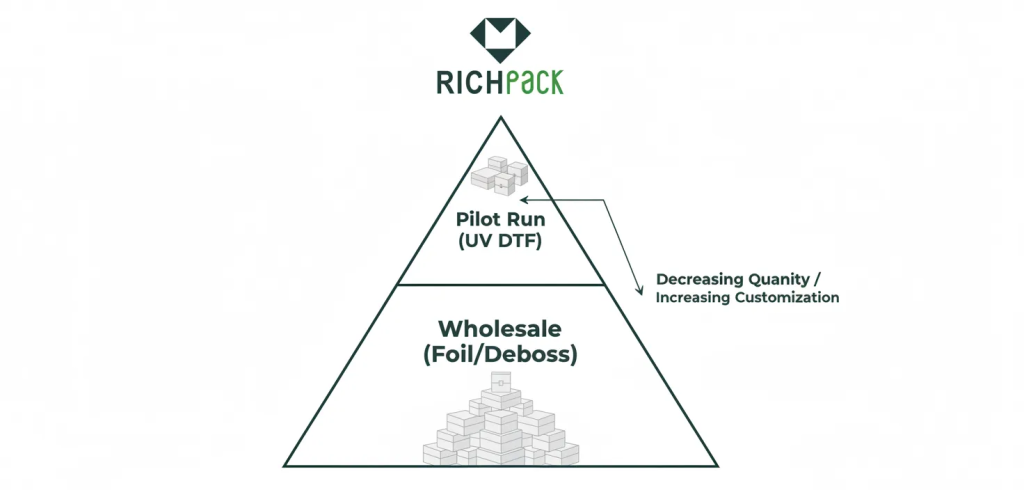
Low MOQ (100–499 units): UV DTF or Metal Badge is the first choice. Plate-making costs aren’t worth it at this stage. You need fast sampling and high clarity.
Mid MOQ (500–1000 units): Consider Screen Printing or a hybrid process. This is a balanced point. There is a plate fee, but the unit price drops significantly.
Wholesale (1000+ units): Choose Hot Foil Stamping or Debossing without hesitation. Molds are expensive, but the cost becomes almost negligible when split across large orders. And the quality is the most consistent.
Recommendation Based on Logo Style
Fine Lines & Micro Text: Avoid direct printing. UV DTF or Inner-lid Print are the only two solutions that preserve details.
Metallic Luxury Logo: Hot Foil Stamping is the best choice. If you want a more understated luxury look, the “Blind Emboss + Foil” combination creates amazing depth.
Full-Color / Gradients: Traditional screen printing can’t do this. UV DTF transfer, or the “Printed Wrap + Velvet Insert” design, is the best solution.
Best Pick by Priority
Luxury-First: Foil + Deboss, or directly use a Metal Badge. This is the top choice for high-end jewelry brands.
Speed-First: UV DTF. No mold is needed. Confirm the file today, and you can get a sample tomorrow.
Cost-First: Screen Printing + standard-sized public molds (such as the common 3.5cm Square Velvet Ring Box).
Eco-First: Blind Deboss. It uses no ink, no chemical foil, and fully meets FSC standards.
The 5 Files You Must Send Your Supplier (to Avoid Mistakes)
To avoid the disaster of “expected vs. actual product,” be sure to provide the following files before production:
Vector Artwork: Must be in .AI, .PDF, or.SVG format. JPG images will definitely have jagged edges when enlarged.
Pantone/CMYK Spec: On-screen colors aren’t reliable. Provide the specific Pantone color code.
Placement Diagram: Clearly state the logo’s size and position (including safe margins). Don’t make us guess.
Box Structure Info: Confirm if it’s a single-slot, double-slot, or special insert structure.
Tolerance Rules: Clearly state your acceptance criteria (such as allowed color difference ΔE value, hot stamping offset tolerance).
Understand Velvet Ring Box Materials Before Choosing a Printing Method
Before we examine your ‘canvas’ as engineers do, you might wonder if other materials offer the same tactile appeal. For a deeper look at different finishes, check out our comparison on jewelry packaging with velvety vs. soft fabric linings to see which offers the most premium feel for your brand.
We repeatedly emphasize a hard truth in our factory: not all velvet is the same.
When we talk about custom velvet ring boxes, the fabric you choose directly determines if the printing succeeds or fails. If you try to force fine logos onto high-pile velvet, the final result will definitely be blurry.
So, before confirming the printing process, we need to examine your “canvas” as engineers do.
What “Velvet” Means in Packaging
When handling customers’ wholesale custom velvet ring box orders, we usually divide the fabrics into four types.
Each reacts very differently to printing:
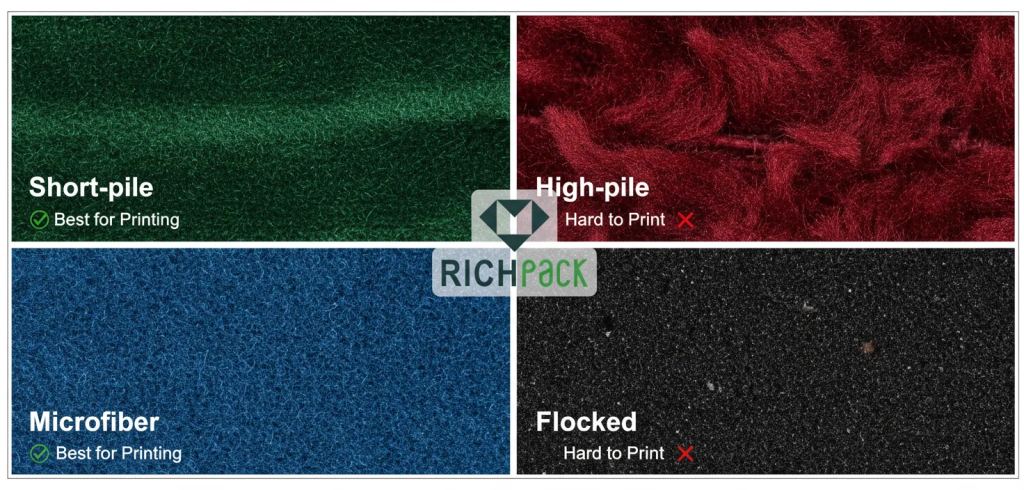
Short-Pile Velvet: This is the safest “all-rounder.” Its short, dense piles can hold gold foil well, giving the sharpest edges.
High-Pile Velvet (Long-Pile Velvet): It feels extremely luxurious and is a favorite for high-end jewelry. But it’s a nightmare for printing—its long piles cause jagged edges on gold foil prints.
Microfiber/Suede-Like: It has a smooth surface and feels like leather. It responds best to debossing, leaving clear, deep marks.
Flocked Paper: This is actually paper with sprayed-on绒毛. It costs less and is often used for large wholesale orders, but it’s not as wear-resistant as fabric velvet.
How Pile Height Affects Logo Clarity (Minimum Line Thickness Rules)
You can easily imagine the difference between writing on a neatly trimmed lawn versus writing in knee-high grass.
In fact, that’s exactly how pile height affects logos.
Our test data shows you should follow these rules to prevent blurriness from pile scattering:
For short-pile velvet: Keep line width at least 0.2mm or more.
For High-pile velvet: Increase line width to 0.5mm or wider.
If your logo uses very thin serif fonts, we usually suggest customers switch to metal badges or print the logo on the satin inside the lid—instead of struggling with direct printing on high-pile velvet.
How Color Choice Impacts Printing Visibility
Color is not just an aesthetic issue; it’s also a physical one.
Dark velvet (like the classic black velvet ring box) absorbs light strongly. If you use dull bronze gold foil, the logo may “disappear.”
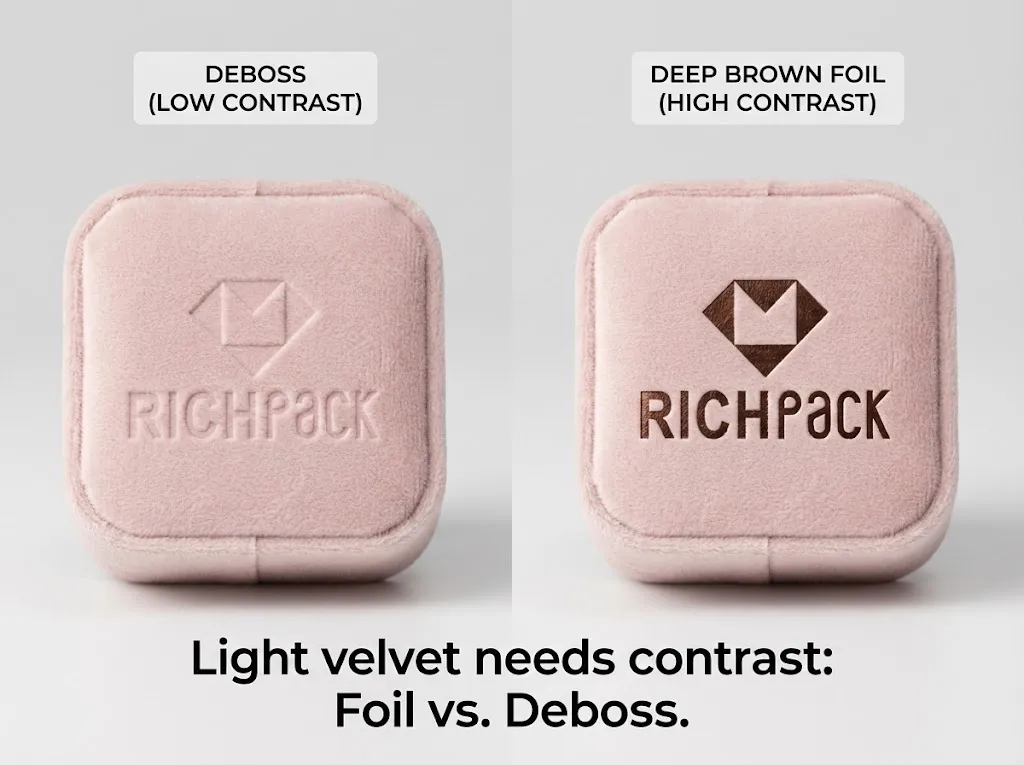
On the other hand, debossing on light-colored velvet (like pink or vintage velvet ring boxes) often looks less obvious than on dark fabrics, because there’s not enough shadow contrast.
Expert Tip: If you want a subtle design on dark fabric, combine debossing with clear varnish. This adds shine and makes the design more visible.
Substrate Under Velvet (Rigid Board Quality Matters)
The printing quality usually depends on the ‘frame’ under the velvet. Understanding how the fabric is applied to these frames is crucial for quality control. You can see our internal process in this step-by-step guide on how to line a jewelry box with velvet.
If the underlying greyboard has uneven density or is too soft, the box surface will collapse when the gold foil machine applies high pressure. This causes ugly wrinkles around the logo.
But in Richpack’s factory, we strictly control the board’s density and rebound rate.
For brands seeking stable wholesale supply chains, this “invisible” quality control is the key to ensuring 10,000 boxes look just like the first one.
Inserts & Interiors That Change the Printing Plan
We can’t forget the box’s internal structure. If you plan to print a logo on the inside lid, you must consider where the ring will sit.
We’ve seen cases where double-ring boxes had rings placed too high. When the box was closed, the rings rubbed the inside lid over time, wearing off the newly printed logo.
If you choose tall diamond ring styles, we’ll suggest adjusting the insert structure or moving the logo up to avoid the rubbing area.
When a Label/Plate Beats Direct Printing on Velvet
Sometimes, the best “printing” method is not print at all.
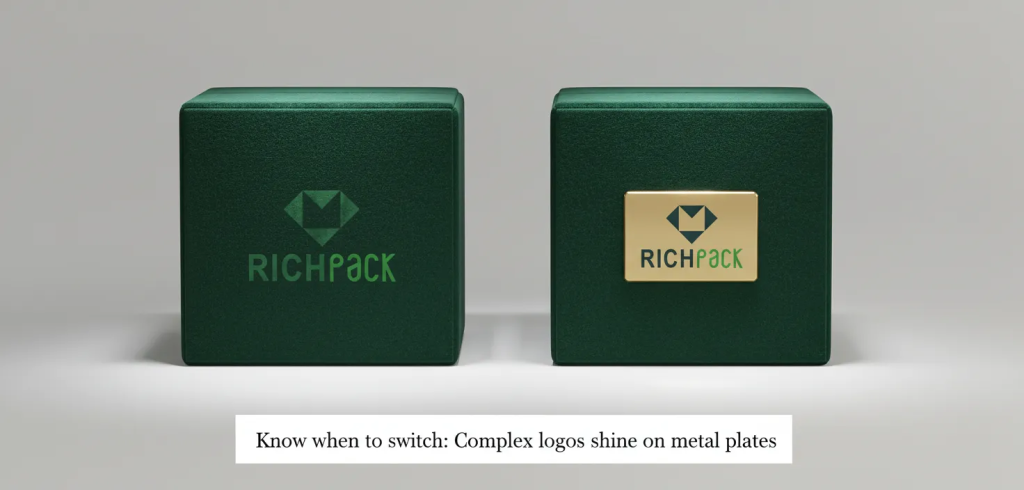
If your logo is extremely complex or has gradient colors, direct printing on velvet will not only have a low pass rate but also lack refinement.
In such cases, a custom metal logo plate or a vintage-style embossed hangtag often creates a more high-end “high-jewelry” feel than printing.
Printing & Logo Methods for a Custom Velvet Ring Box (Pros, Cons, Best Uses)
After handling tens of thousands of custom velvet ring box orders, we’ve concluded: There’s no perfect method. There’s only the method that best fits your current budget and design.
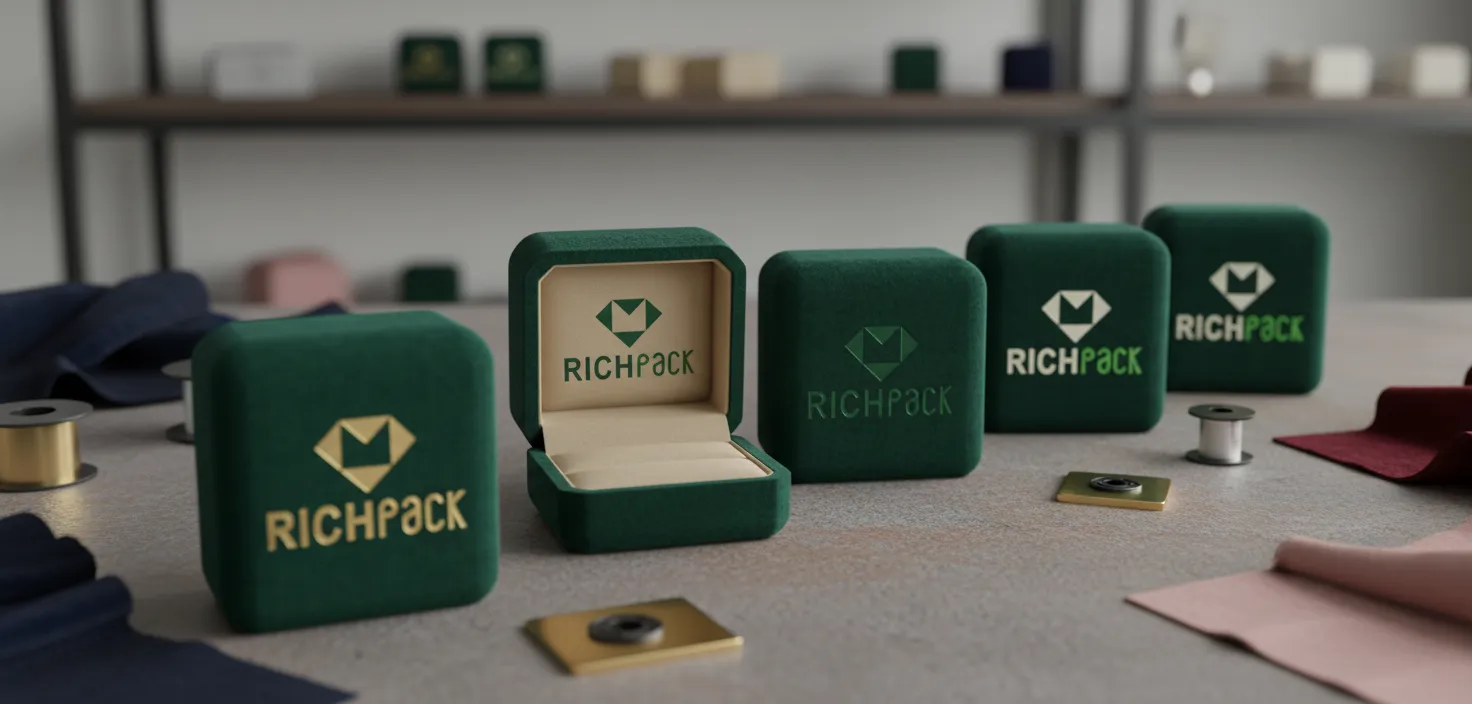
To help you save testing time, I’ve carefully put together this internal method comparison chart. It covers all major options, from traditional hot foil stamping to the newer UV DTF transfer.
Printing Method
Best For
MOQ
Cost Driver
Risk on Velvet
Durability
Hot Foil Stamping
Luxury metallic logos (Gold/Silver)
1,000+
Die Mold Fee
Small text blurring
High (if done right)
Blind Debossing
Minimalist / Quiet Luxury
1,000+
Die Mold Fee
Low visibility on dark velvet
Permanent
Screen Printing
Simple 1-color logos / Bulk orders
500+
Screen Setup
Fuzzy edges
Medium
UV DTF Transfer
Full-color / Gradients / Low MOQ
50+
Unit Price
Edge lifting
High (Scuff resistant)
Metal Badge
Ultra-Premium Branding
500+
Mold + Unit Price
Alignment issues
Very High
Hot Foil Stamping (Gold/Silver Foil)
This is the most popular choice on the market right now. It makes up 70% of our orders. It uses heat and pressure to press metal foil into the velvet fibers, creating a strong visual contrast.
Best For: Brands that want a classic, luxurious look—especially for gold or rose gold logos.
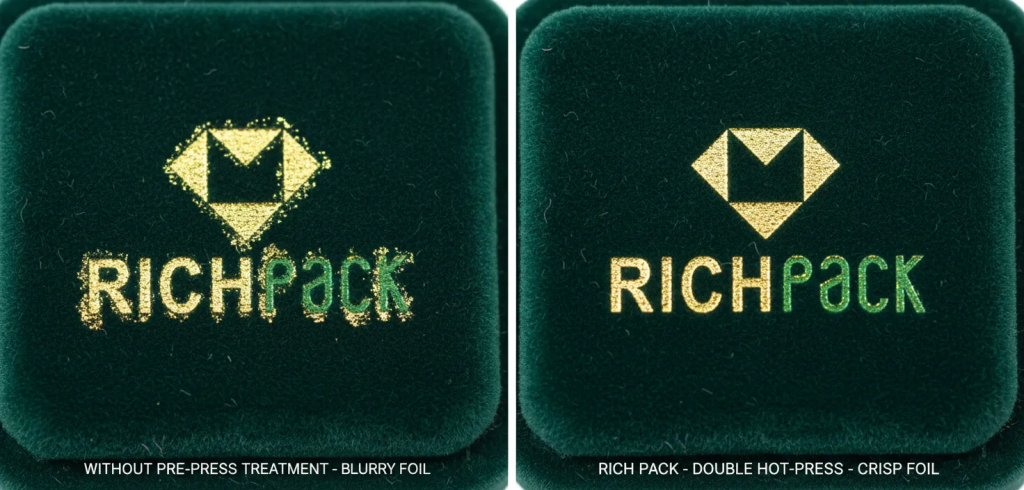
Velvet Risks: The biggest challenge is “smearing.” If your logo lines are too thin (less than 0.2mm) or the letter spacing is too tight, the heated metal foil can easily spread out. This causes the text to stick together.
Anti-Peel Tuning: At Richpack’s workshop, we do “pre-press” treatment on long-pile velvet. We flatten the fibers first, then do the foil stamping. This greatly improves adhesion and prevents gold flakes from falling off.
Debossing / Embossing (Blind Stamp)
If you like the current trend of quiet luxury, this will be your top choice. It doesn’t use any ink. It only uses heavy pressure to leave deep marks on the velvet surface. It uses light and shadow to show the logo.
Best For: Eco-friendly brands (no need for chemical foil) or minimalist designs.
Risk: Uneven depth. In the corner areas, the embossing/debossing depth may become shallower because the inner gray board has different support strength. We adjust the counter-die to fix this difference.
Expert Tip: Embossing or debossing creates permanent physical changes. It never fades. If you worry about scratches during shipping, this is the safest choice.
Screen Printing (Silk Screen)
To be honest, we don’t recommend direct screen printing on long-pile velvet—unless your logo is very bold.
Otherwise, the ink easily sticks to the standing velvet fibers. Not only will the edges look jagged, but the ink can also rub off easily.
Best For: Large-quantity wholesale orders with simple logos, or orders that need specific Pantone colors.
Ink Options: We usually suggest using eco-friendly water-based ink. It soaks into the fabric better than UV ink. This reduces the risk of cracking.
Not Ideal: Gradient colors or tiny text. If you must print these, check the next option.
UV DTF Transfer (Full-Color + Raised Gloss)
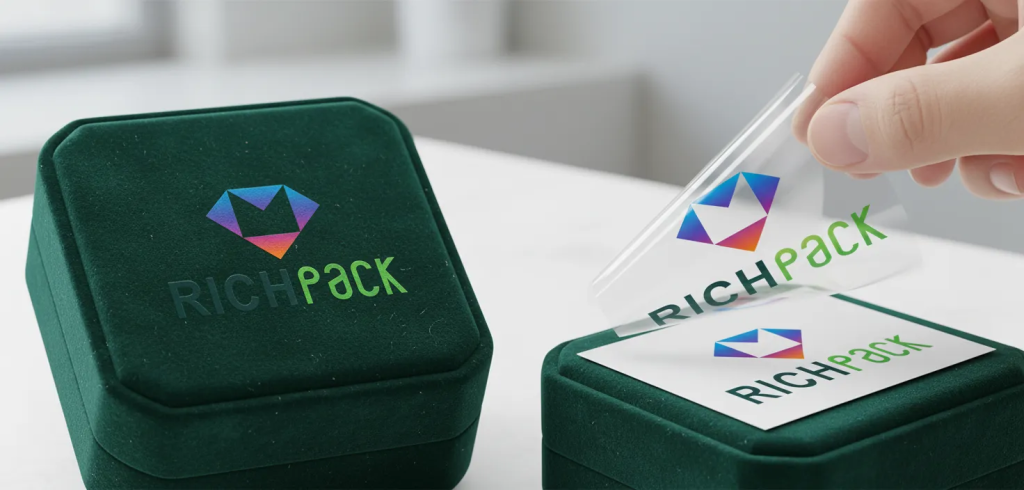
This is a new technology from the past two years. You can think of UV DTF (Direct to Film) as an industrial-grade, high-strength sticker. It can directly transfer full-color designs onto the velvet surface. It also has a crystal-like shine.
Best For: Multi-color logos, gradient designs, and small-batch trial orders (low MOQ).
Why It Works: It avoids the problem of “ink sinking into velvet fibers.” The design sits on top of the velvet.
Risk: Edge lifting. On ring boxes with sharp, rounded corners, the sticker edges may lift due to tension. We suggest using this method only on flat box lids.
3D Metal Logo Sticker / Nickel Electroforming Badge
If printing can’t meet your demand for luxury, adding a metal sticker is a much better choice.
Best For: High-end jewelry lines that can handle higher unit costs.
Cost Logic: Although the mold fee is higher, the brand premium it brings is huge.
Placement: You must reserve a debossed area in your design. Embed the metal badge into this area instead of sticking it directly on the surface. This prevents it from falling off and adds a more refined look.
If you’re really not sure which method to choose, we can combine them. This is an advanced trick that many competitors won’t tell you.
Foil + Deboss: First, create a deep deboss, then add foil stamping inside the recess. This not only protects the gold foil from scratches but also adds a 3D effect.
UV DTF + Deboss: For small-batch full-color orders, we can first press a recess, then stick the UV sticker into it. This perfectly solves the edge-lifting problem.
Printed Wrap + Velvet Insert: Use high-quality printed paper for the outer box (to tell your brand story). Use high-end velvet for the inner lining (to protect the jewelry). This is an excellent way to balance cost and user experience.
How to Choose the Best Printing Method (Decision Factors That Actually Matter)
Let’s set aside complicated technical terms first. Choosing a printing method for custom velvet ring boxes is really just a balancing act.
As your strategic packaging partner, we advise you not to make decisions based only on design drafts on the screen. If the most beautiful logo can’t be mass-produced, or if it causes a 20% defect rate, it will be a very bad design.
But at Richpack, we help brands evaluate the following seven aspects. This ensures your packaging meets both aesthetic standards and business logic.
Order Volume & MOQ (Setup Cost vs. Unit Cost)
This is purely a math problem.
For wholesale custom velvet ring box orders, don’t be scared off by one-time mold fees.
Small Orders (<500 units): If you only need 200 boxes, a $100 copper mold fee adds $0.5 to each box. In this case, UV DTF (no setup fee) or simple in-stock screen printing are smarter choices.
Large Orders (>1000 units): When your order reaches several thousand units, the mold fee per unit becomes almost negligible. At this point, Hot Foil Stamping not only has a lower unit cost but also works faster. It can significantly reduce your total procurement cost.
Logo Complexity (Line Thickness, Micro Text, Gradients)
This is where mistakes happen most easily. I’ve seen countless designers try to print 6px small text on velvet. The result is always a blurry blob.
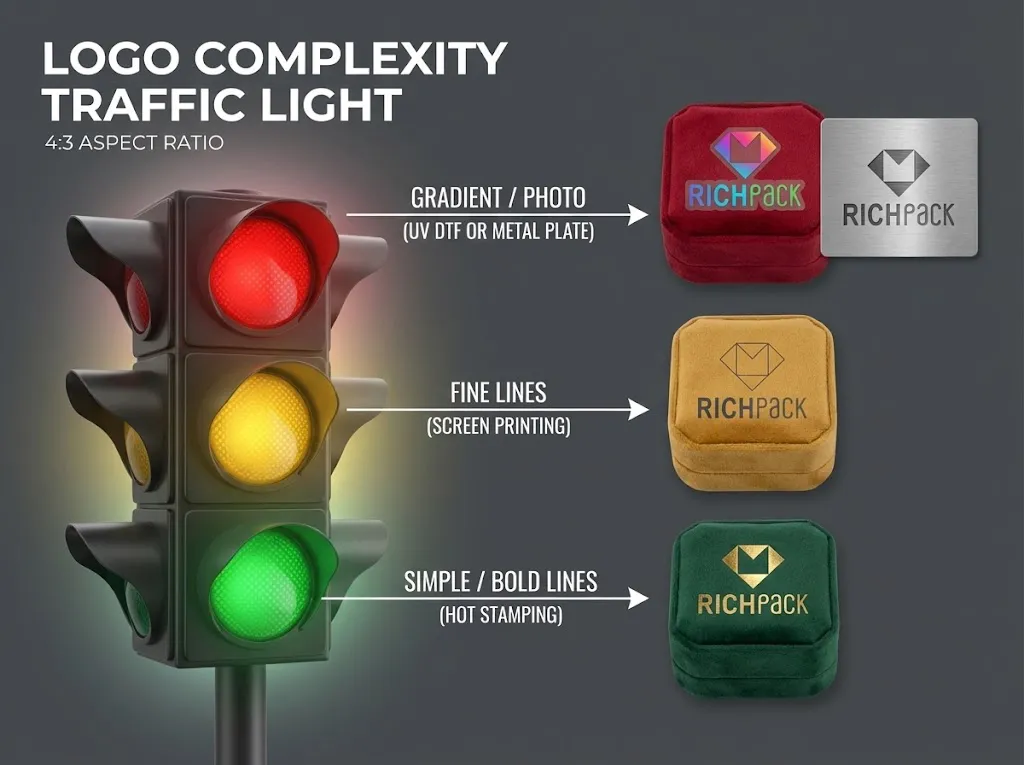
Simple Geometric Shapes/Thick Lines: Hot foil stamping and embossing work perfectly here.
Serif Fonts/Micro Text: If the lines are thinner than 0.2mm, we suggest you switch to a Metal Plate. Or you can print this information on the paper liner inside the lid.
Gradient Colors/Full-Color Patterns: Traditional hot foil stamping can’t do this. At this point, UV DTF Transfer is the only option that keeps colors highly accurate.
image – How to Choose the Best Printing Method for a Custom Velvet Ring Box?
Velvet Type & Pile Height (Sharpness vs. Softness Tradeoff)
There’s a tough physical tradeoff here: the softer the feel, the harder the printing.
High-Pile Velvet: It feels luxurious, but the long fibers lift the foil. This leaves gaps underneath and makes the foil easy to peel off.
Short-Pile Velvet: It feels a bit stiffer, but it’s the best surface for sharp logos.
If your brand prioritizes sharp logos, we suggest short-pile velvet. If you value a luxurious feel more, Blind Debossing is the safest process for high-pile velvet.
Your boxes may go through 30 days of sea shipping and rough sorting before reaching the final customer. A perfect logo print builds trust the moment a customer opens the box. To ensure that luxury look lasts as long as your jewelry, we’ve also prepared a comprehensive guide on how to clean your velvet jewelry box without damaging the delicate print or fabric.
Hot Foil Stamping Risk: Poor-quality hot foil often chips during rub tests.
Permanent Solution: If durability worries you, Debossing is a physical, permanent change. It’s not just scratch-resistant—it even looks better with use.
Supply Chain Tip: We usually run 3M tape tests and vibration tests before mass production. This ensures logos won’t fall off due to shipping vibrations.
Budget Ceiling & “Premium Look” Alternatives
A limited budget doesn’t mean you have to sacrifice quality. We once helped a new jewelry brand achieve a luxury look on a tight budget.
The solution was simple: Skip expensive metal plates. Use Blind Debossing (colorless embossing) with high-quality custom velvet ring box blanks. This quiet luxury style not only saved foil costs but also fit current minimalist trends. It made the perceived value far higher than the actual cost.
Lead Time & Sampling Cycles
Time is money. Different processes have very different sampling cycles.
Hot Foil Stamping/Embossing/Metal Plates: These need metal molds. Sampling usually takes 5-7 days. If you change the design, you’ll have to pay for new molds and wait again.
UV DTF/Digital Printing: No molds needed. Confirm the file today, and you can see the sample tomorrow. If you’re in a hurry to launch before Valentine’s Day or Mother’s Day sales, this is a lifesaver.
More and more European and American brands now require packaging to meet environmental regulations.
Traditional Risk: Some cheap hot foil papers may contain heavy metals.
Compliance Tip: Our supply chain uses eco-friendly materials that meet REACH standards. For extreme environmentalists, Blind Debossing is the perfect zero-chemical process. Or you can choose water-based ink screen printing.
How to Avoid Blurry Logos on Velvet Ring Boxes
Nothing is more frustrating than receiving 5,000 wholesale custom velvet ring boxes, opening the carton, and finding the logos as blurry as smudged makeup.
On Richpack’s quality inspection line, we found that 80% of printing flaws are not caused by machine errors. Instead, they happen because the design files conflict with the physical properties of velvet.
To get sharp printing results on this fuzzy fabric, you need to understand it like an engineer first—not just design for it like an artist.
Simply put, printing on velvet is like drawing lines on a lawn, not on a concrete floor.
When a hot stamping plate or screen presses down, the standing velvet piles fall over in random ways.
This causes two physical problems:
Pile Scattering: The piles block the edges of the logo, creating a jagged look.
Medium Collapse: For hot stamping, if the lines are too thin, the metallic foil won’t have enough adhesion area and will break. If the lines are too close together, the melted adhesive will spread out and blur the print.
5 Practical Fixes
To solve this problem, I’ve summed up 5 fixes that we’ve tested repeatedly in our workshop:
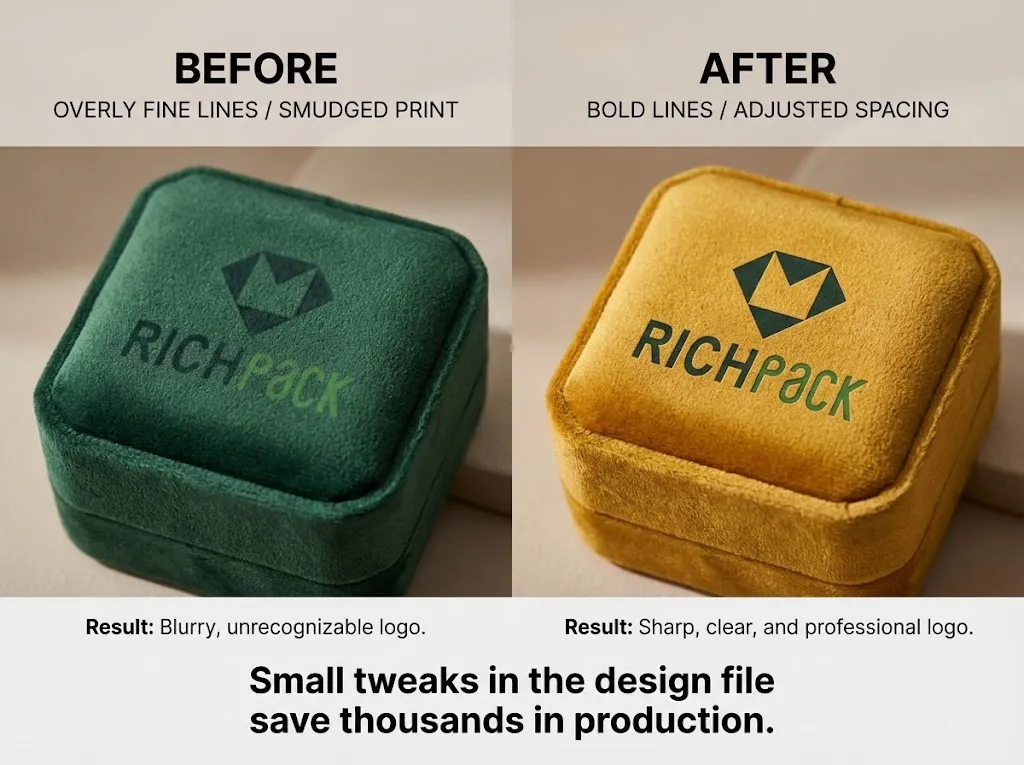
Thicken Lines (The 0.5mm Rule): Don’t fight physics. For custom velvet ring boxes, make sure all lines are at least 0.5mm wide. Those delicate, ultra-thin serif fonts that look great on screens will mostly disappear or break when printed on velvet.
Increase Negative Space: If your design has cut-outs, make sure the blank areas are large enough. The heat and pressure from hot stamping will push the surrounding piles toward the center. If the blank space is too small, your logo will turn into a solid gold block.
Boost Contrast: On dark velvet (like black or midnight blue), using high-shine metallic foil can visually hide small uneven edges. But on light-colored velvet, dark debossing often doesn’t work well.
Add Outlines to Micro Text: If you must print small text, add a thin, same-color outline to it. This increases the adhesion area and prevents the text from peeling off.
Move It Inside (Strategic Transfer): This is the smartest fix. If your logo includes a complex slogan or an establishment year (Est. 2026), don’t struggle to print it on the velvet outer lid. Instead, print it on the satin or paper insert inside the lid. That surface is smooth and will show every pixel perfectly.
How to Prevent Sample Color Difference & Mass Production Color Shifts (Proofing System)
When handling Wholesale Custom Velvet Ring Box orders, there’s a phenomenon I call “Screen-to-Velvet Shock.”
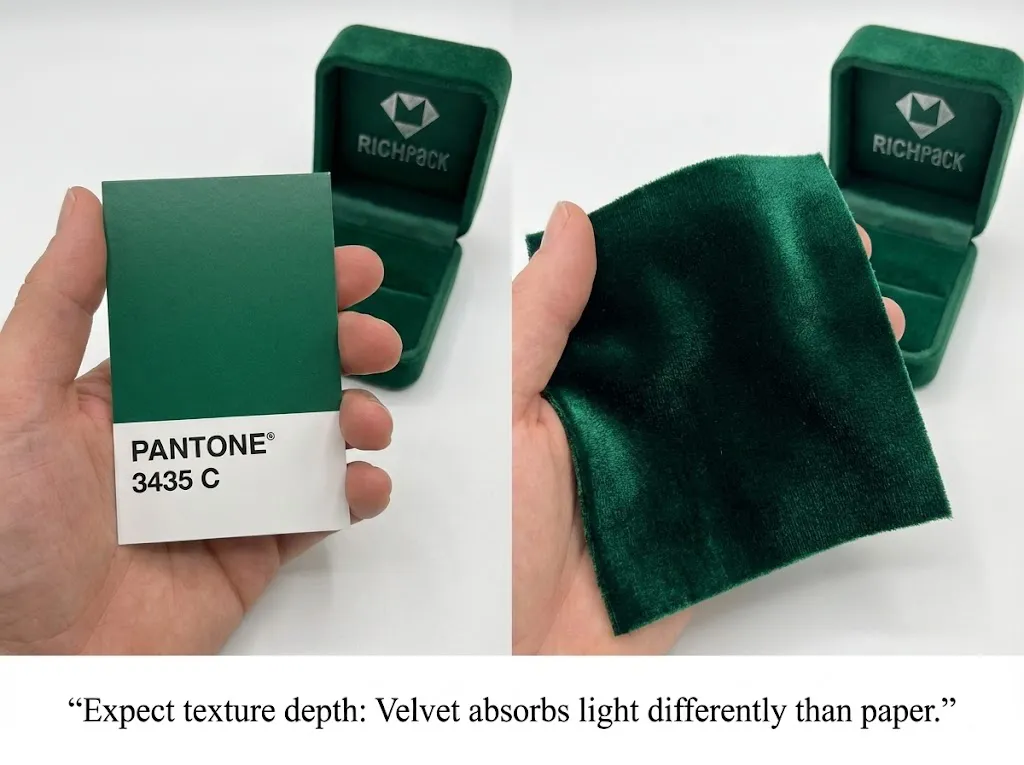
The perfect Tiffany blue you see on your MacBook might turn into a dull teal when printed on velvet. This happens because velvet is a reflective fabric. Its light-reflecting principle is completely different from that of a computer screen.
But as your strategic packaging partner, RichPack doesn’t just make boxes. We also manage your color expectations.
Below is our system to ensure 10,000 boxes match the 1 sample you approved perfectly.
The 3 Proof Types You Must Distinguish
Mixing up these three concepts in supply chain management causes most disputes. You must be clear about which one you need:
Digital Proof: Only use this to confirm logo placement and spelling. Never use it to check velvet colors.
Pre-production Sample (PPS): This is a physical sample made before mass production. For Custom Velvet Ring Boxes, this is the only standard you must hold, touch, and check under sunlight.
Golden Sample: This is the most important one. Once you approve the PPS, we will sign and seal it as the Golden Sample. The factory’s QC team will only start mass printing when they see this signed sample box.
Pantone vs. CMYK — When Each Is Safer
If your design uses specific brand colors, stop using CMYK values.
Velvet is a physical material. It’s usually colored through a dyeing process. CMYK is an ink formula for printing on paper. These two work on completely different principles.
Our Method: Please provide a Pantone (TPX/TCX) color code. This is a color standard made specifically for textiles.
Physical Difference: Remember, the same Pantone color code will look different when printed on matte paper versus dyed on shiny velvet. Velvet will look deeper because of light refraction.
Lighting & Perception Control (D65 + Photo Rules)
“Why does the photo from your factory show blue, but the goods I received are green?” This is a common complaint we hear.
This usually happens because of lighting (the metamerism phenomenon). In Richpack’s lab, we require the use of a D65 standard light box to check colors.
If you can’t visit the factory in person, we suggest you:
Don’t confirm colors under warm yellow office lights.
Ask us to shoot a confirmation video under natural light (near a window).
Include a standard white card in the photo as a white balance reference.
Color Tolerance Rules (ΔE Targets If Supported)
Let’s be realistic. Velvet dyeing is a chemical reaction, not a math calculation. Even top luxury brands allow small color differences between batches.
To manage your supply chain predictably, we suggest setting a Delta E (ΔE) value in the contract.
Generally, ΔE < 2.0 means the color difference is hard for the human eye to notice.
For Wholesale orders: If you are very sensitive to color, we can provide upper-limit and lower-limit samples. These will help you define the acceptable range for color depth.
Reorder Consistency Plan (Material Lots + Records)
The worst problem isn’t getting it wrong the first time. It’s when the color changes on your second reorder.
To keep your brand image consistent, we lock in material lots for long-term clients.
If you expect to need 50,000 boxes in the next year, we will suggest buying enough velvet fabric from the same batch at once and storing it in our warehouse.
This adds a little to your initial inventory cost. But it eliminates the risk of color differences on reorders 100%.
Customization Options That Change Printing Decisions
At Richpack, we often say, “Designs are 2D, but custom velvet ring boxes are 3D.”
Many brands create perfect logos on flat designs. But they forget the physical limits that a box’s shape, color, or opening style puts on printing. As your strategic packaging partner, we must point out these hidden issues before making molds. This ensures your design looks good and works well during mass production.
Below are four key customization areas we suggest you focus on when handling wholesale orders.
Popular Velvet Ring Box Variants
Different uses call for different logo styles.
Velvet Engagement Ring Box: These are usually very small (to fit in a pocket). For this style, I strongly suggest simplifying your logo. Keep only your brand’s initials (a monogram) or use blind debossing. Avoid complex gold stamping on small areas—there’s too much risk of glue overflow.
Vintage Velvet Ring Box: Vintage means needing a “time-worn” look. Shiny UV printing will feel out of place here. We recommend antique gold foil or deep debossing. These match the era’s style perfectly.
Double Ring Box: This style is wider. It’s a great chance to show your full brand name (not just an icon).
Shapes & Structures (The Curvature Trap)
Gold stamp plates are flat, but some boxes are round. This is the most easily ignored physical limit.
Square / Hexagon: Their top surfaces are flat—perfect for printing. You can safely use large-area gold stamping or UV DTF.
Heart / Round / Dome: If the box lid has a clear curve, the gold stamp plate can’t apply even pressure. This often makes the logo’s edges peel off because of weak pressure.
Pro Tip: For curved boxes, shrink the logo and place it in the flattest center area. Or use a metal badge instead—it fits curves better.
Colorways That Impact Method Choice
Color isn’t just about looks. It’s also about contrast physics.
Black / Midnight Blue Velvet Ring Box: These are ideal for showing gold or silver foil. The strong contrast makes your brand easy to recognize.
Pink / Beige / Cream Velvet Ring Box: Debossing often doesn’t stand out on light velvet (no shadows form). If your brand color is light, use dark foil (like coffee-colored foil) or screen printing. This ensures your logo stays clear.
Placement Decisions (Lid vs. Side vs. Inside Lid)
Don’t pile all the information on the box lid. Smart brands use space to create layers.
Outer Lid: Only put your core brand logo here. Keep it simple.
Inside Lid: This is the best spot for your slogan, founding year (Est. 20XX), or origin (New York / Paris).
Expert Advice: We usually suggest using satin or a paper insert for the inside lid. This fixes the problem of blurry small text on velvet. It also adds a “reveal” surprise to the unboxing experience.
“Smart” Add-Ons (QR/NFC)
Brands now want more traceability. So, more wholesale custom velvet ring boxes need digital features.
But printing QR codes directly on velvet doesn’t work—they can’t be scanned.
Solutions:
Print the QR code on a paper sticker at the box’s bottom.
Design a nice paper sleeve for the box.
Advanced Option: If your budget allows, we can add an NFC chip inside the velvet layer. Customers just tap the box with their phones. They’ll jump straight to your GIA certificate page or brand website. No printing is needed, but it delivers a top-tier tech experience.
FAQs
What Is the Best Printing Method for Fine Micro-Text Logos?
To be honest, printing small text directly on velvet is extremely risky.
If you insist on printing tiny text like “Est. 2026” on the outer lid of a Custom Velvet Ring Box, the velvet’s fuzz will scatter the ink. This will turn the text into a blurry blob of color. From my experience, for text smaller than 8pt, I strongly suggest a “strategic shift”:
Print on the Inside Lid: Use a satin or paper insert. These surfaces are smooth and can perfectly show every tiny detail of the text.
Use a Metal Badge: If you must display the text on the outer lid, a carefully etched metal badge will keep the small text clear and sharp.
Hot Foil vs. UV DTF: Which Is Better for My Brand?
The choice depends on whether you want texture or color.
Hot Foil Stamping: It’s the top choice for wholesale orders. It uses physical pressure to press gold foil into the velvet. The raised, textured feel is a sign of high-end jewelry. But it only works for single colors.
UV DTF: Choose this if your logo has gradient colors or complex designs. It can create full-color effects. But note that it’s just a film stuck on the surface. It doesn’t have the premium, integrated feel that hot foil stamping offers.
How Do I Avoid Blurry Logos on High-Pile Velvet Ring Boxes?
High-pile velvet is really bad for printing. The long fuzz lifts the hot foil, leaving gaps underneath. We usually use two physical solutions:
Increase Pressure and Temperature: At Richpack, we adjust the machine settings. We use high heat to flatten the fuzz in the printing area first. Then we do the stamping.
Switch to Debossing: Skip the gold foil. Go for colorless deep debossing instead. On high-pile velvet, the light and shadow from deep debossing are clearer and longer-lasting than hot foil stamping.
How Do I Prevent Pantone Color Mismatch Between Samples and Mass Production?
Velvet is a reflective fabric. It changes color under different lights. Design files on screens are often misleading. To ensure consistency, we follow a strict checking process:
D65 Standard Light Source: We check colors in our factory. We also take comparison videos of the products under natural light and send them to you.
Approve a “Golden Sample”: Once you confirm the Pre-Production Sample (PPS), we seal it. This becomes the only standard for production. During mass production, any product that differs from the Golden Sample by more than ΔE 2.0 gets rejected automatically.
What Is the Easiest Way to Lower Shipping Costs for Wholesale Velvet Box Orders?
Many customers are surprised when they pay shipping fees. Velvet boxes are light, but they take up a lot of space (they’re “bulky cargo”).
As your supply chain advisor, I suggest planning for shipping efficiency during the design phase:
Two-piece Packers: Use strong outer boxes (Packer Boxes). These let us stack the products more tightly. This reduces the space needed for shipping.
Custom Foam Trays: Ditch the traditional small white boxes for each item. Use high-density foam trays instead. This can cut the volume weight by about 30%. It will save you thousands of dollars in shipping costs directly.
Conclusion
In the end, choosing a printing process isn’t just about looking good. It’s about getting reliable results.
Before you place that order for 5,000 Wholesale Custom Velvet Ring Boxes, remember this: velvet is a “temperamental” fabric. You need to work with its physical properties, not against them. A perfect logo print builds trust the moment a customer opens the box. But a blurry gold stamp quietly reduces your brand’s value.
As your strategic packaging partner, Richpack has a simple goal: to make your supply chain as precise as your jewelry designs. We don’t expect you to be a printing expert. That’s our job.







 PREV
PREV