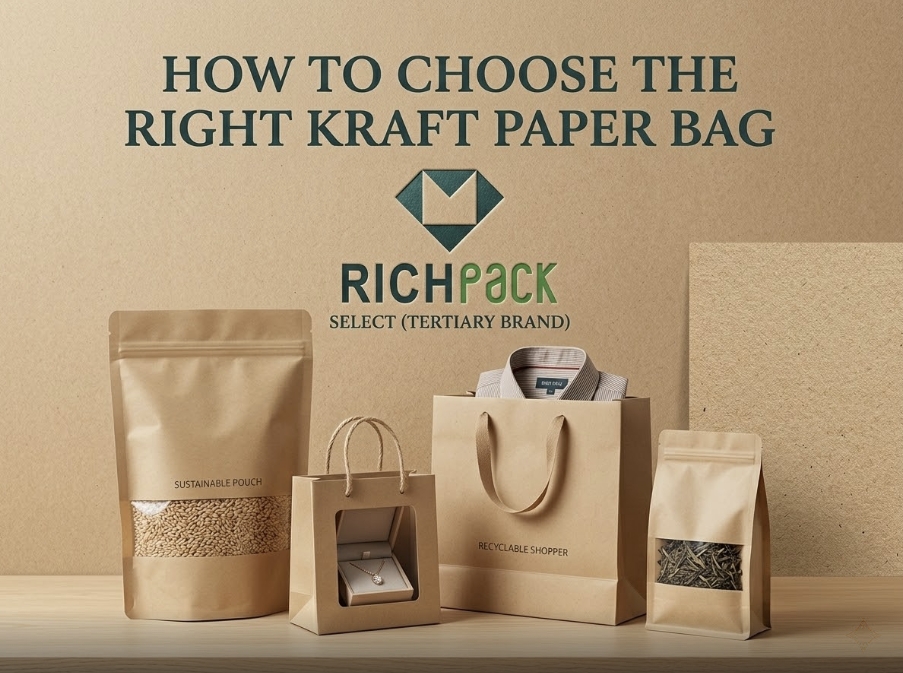



A kraft paper bag is only the right choice when it fits your product, your customer experience, and your supply chain. Pick the wrong one, and you get torn handles, wasted space, weak branding, color inconsistency, or costs that look cheap at first but rise after damage, reorders, and slower packing.
This guide shows you how to choose the right bag for retail, food service, gifting, and delivery. You will learn how to compare materials, GSM, handle load ranges, size, printing, sustainability claims, MOQ pricing tiers, and supplier terms, so you can buy with more confidence and fewer surprises.
Most buyers start with color, price, or a quick sample photo. That is backwards.
Start with the function first. A bag for a pastry counter does not need the same structure as one for a jewelry gift set, a supermarket order, or a boutique shopping experience. Like Lego bricks, the best result comes from choosing the right pieces before you build.
Different use cases create different pressure points.
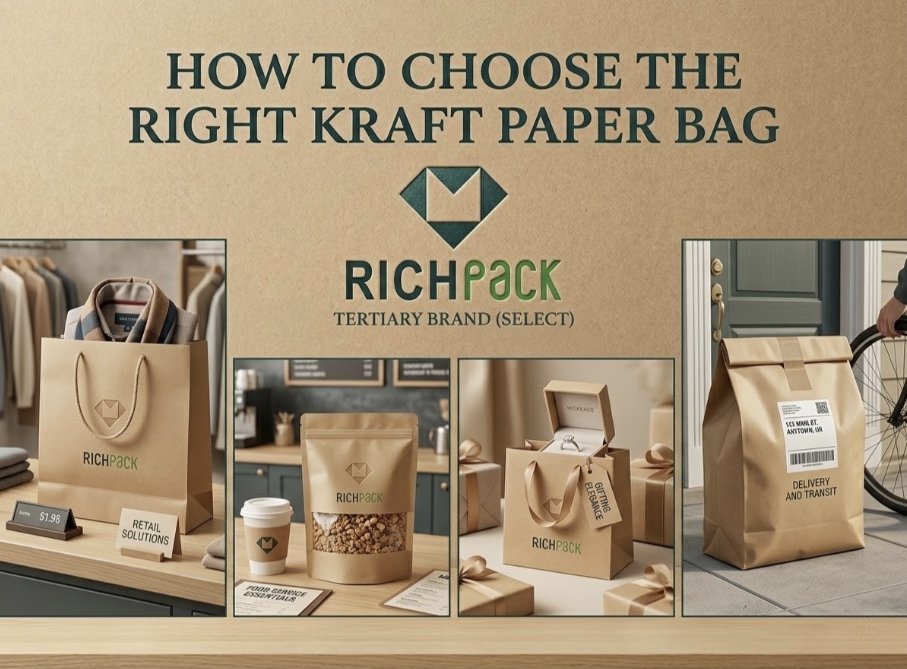
Retail buyers usually care about print quality, brand feel, and comfort in hand. Food service buyers care more about grease resistance, packing-station speed, and safe food contact. Delivery teams care about bottom stability, stackability, and the bag’s ability to withstand real movement.
If you sell gifts or premium products, kraft paper gift bags often need more visual impact than standard carry bags. If you run takeaway or grocery operations, the same bag has to move fast, hold weight, and stay reliable.
Product weight matters. Product shape matters more than many buyers expect.
A light but bulky item can still force you into a wider gusset. A compact but heavy item may need higher GSM, stronger bottom bonding, and better handles. WCI highlights how basis weight, gusset design, and flat-bottom construction shape real performance, not just lab numbers.
This short checklist helps you define the real job before you compare sizes, paper grades, or handles. If you skip this step, every later choice gets softer and more expensive.
That is the real brief for selection. Everything else comes after.
A bag can be a carrier. It can also be a brand surface.
If your main goal is low-cost daily transport, plain or lightly printed kraft may be enough. If your goal is memorability, gifting, or higher perceived value, custom kraft paper bags or personalized kraft paper bags make more sense.
Do not confuse premium look with premium performance. Brown Kraft can look natural and credible. White kraft can give you cleaner color reproduction. The right answer depends on what customers need to feel when they leave with the bag.
Use conditions change everything.
A bag that works in a dry boutique may fail in a humid takeout environment. A bag that looks good at the counter may soften, tip, or collapse in a car seat. Unlike the chaos people expect from airline baggage handling, your packaging should feel predictable from handoff to destination.
These condition checks help you see where a bag fails before you approve it. They are simple, but they catch most avoidable specification mistakes.
For products protected by better bag planning, you cut damage risk by better specification.
Price alone is a trap.
A cheaper bag can become an expensive bag if it tears, prints poorly, stores badly, or forces reorders. GreenWing makes this point clearly when it ties bag selection to total application needs, not just unit cost.
This cost list shows where buyers usually underestimate spending. The invoice is only one part of the real budget.
Here is the TCO logic in plain English. Brand A buys a cheaper bag at 0.18, sees a 3 percent break rate, repacks damaged orders, and places two rush orders in one season. Brand B buys a better-fit bag at 0.18, sees a 3 percent break rate, repacks damaged orders, and places two rush orders in one season. Brand B buys a better-fit bag at 0.23, keeps breakage below 0.5 percent, packs faster, and avoids emergency freight. Brand B pays more per unit and less per program.
Bold truth: the right wholesale bag is the one that performs at the lowest total cost, not the lowest invoice line.
Material sets the ceiling for performance.
If the paper grade is wrong, no finish or print trick will fix the core problem. This is where many buyers under-spec for cost or over-spec for image.
Brown Kraft is the default for a reason. It is strong, familiar, and carries a natural sustainability signal.
White Kraft works better when color accuracy matters. If your brand relies on clean contrast, a beautiful presentation, or a polished luxury look, white stock gives your print more room to work. Recycled kraft supports ESG goals, but buyers should not assume all recycled options perform the same way, as fiber length, recycled content ratio, and end-use demands still affect durability.
This comparison table works best when you are choosing the bag around visual goals, not around price alone. It helps you see where appearance, print clarity, and sustainability cues pull in different directions.
| Material Type | Best For | Strength Feel | Print Performance | Sustainability Signal |
| Brown Kraft | Grocery, retail, takeout, natural brands | Strong, practical | Moderate | Strong natural cue |
| White Kraft | Beauty, fashion, gifting, premium retail | Strong if virgin-based | Better color clarity | Depends on the source |
| Recycled Kraft | Eco-led brands, large-scale programs | Varies by fiber mix | Moderate | Strong ESG appeal |
GSM tells you how much paper mass sits in one square meter. Higher GSM often means a stronger, stiffer bag, but it is not the only thing that matters.
WCI explains that paper basis weight signals thickness and strength. LeKAC also notes that a 120g kraft bag can carry about 10 pounds comfortably in many cases, though real capacity still depends on size, glue, and handle construction. That is why you should treat GSM as a load band, not as a promise.
These working ranges help you set the first test band before you request samples. They are not universal guarantees, but they are practical starting points for buyer-side specification.
Problem and answer stay close here. Does higher GSM always mean a better bag choice? No. It only helps when the rest of the structure supports the load.
Real load is not a static load.
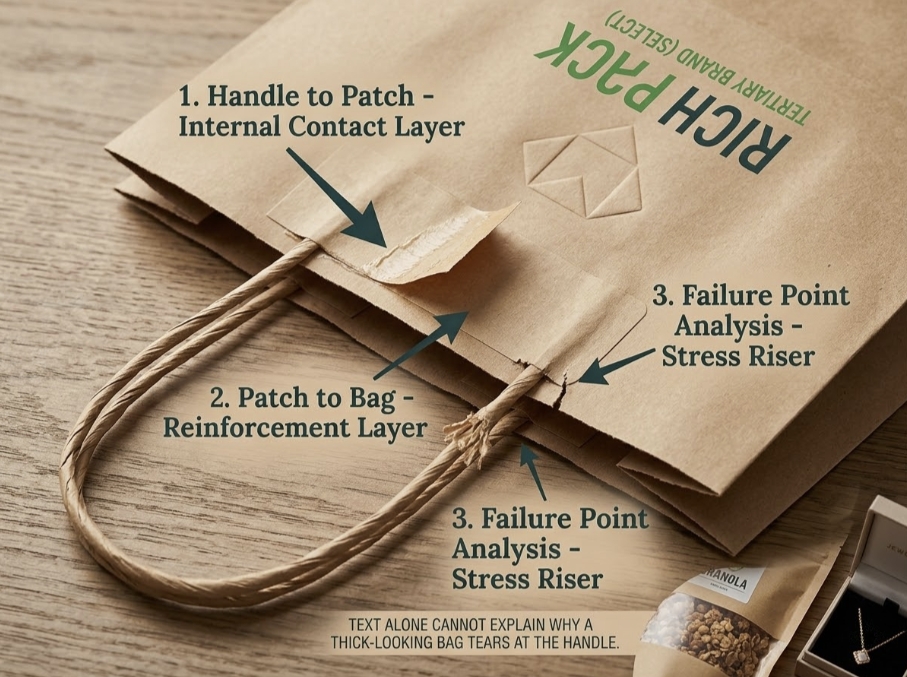
A bag may hold weight while sitting still, then fail when a customer lifts, swings, or turns with it. That is why handling attachment, bottom seal strength, and paper tear resistance matter as much as paper thickness.
This handle guide is more useful as a testing range than as a marketing claim. Use it to ask suppliers what they have actually validated under lift, swing, and repeated-carry conditions.
| Handle Type | Common Working Range to Test | Typical Use Case | What to Verify |
| Die Cut Handle | 2 to 4 pounds | Light retail, brochures, cosmetics | Reinforcement patch, edge tearing |
| Flat Paper Handle | 4 to 8 pounds | Grocery, bakery, takeaway | Adhesion area, comfort under short carry |
| Twisted Paper Handle | 6 to 12 pounds | Standard retail, mixed merchandise | Handle twist consistency, pull test |
| Cotton or PP Rope Handle | 8 to 16 pounds | Premium retail, gift, and heavier sets | Knot anchoring, hole reinforcement |
LeKAC points to peel strength tests, handle checks, and print placement controls as part of paper bag quality control. Those checks matter because the weak point is often glue or handle adhesion, not the panel itself.
Food service buyers have extra risk.
Standard Kraft can work for dry food or short carry times. It may fail when exposed to grease, steam, or moisture. Several food-focused suppliers stress that food applications often need grease resistance, barrier treatment, or food-contact-safe materials and inks.
This checklist matters because food-safe packaging is not one single claim. You need to separate paper performance, ink suitability, and final market compliance.
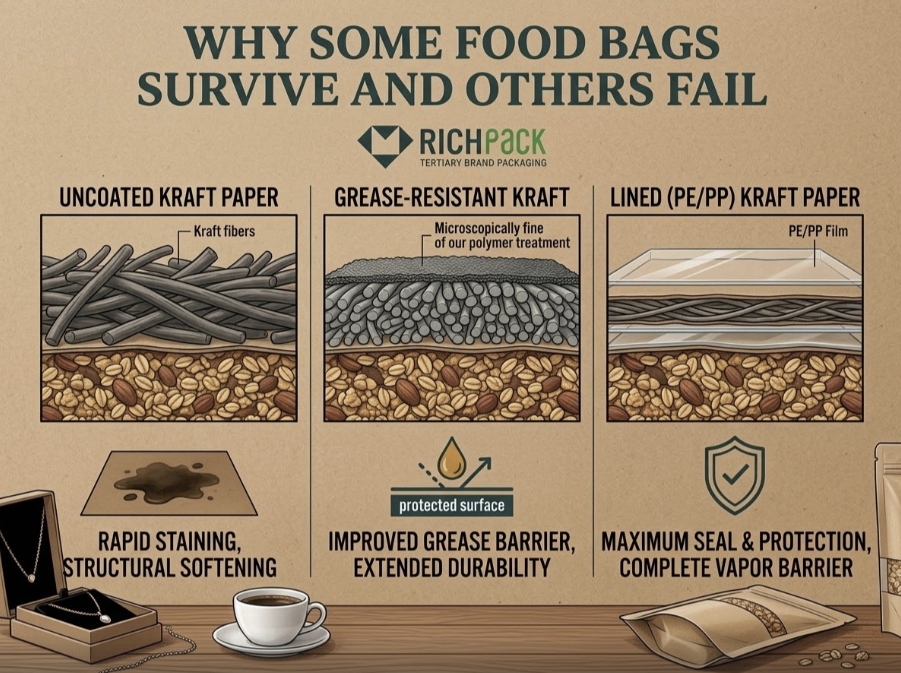
More expensive paper does not always create more value.
If your bag is used for quick grocery carryout, a premium finish may be a waste. If your bag supports gifting, boutique retail, or jewelry presentation, the paper feel can shape how customers judge the brand before they even open the product.
Use this rule when you balance the look against cost. Premium paper should only be added when the customer can feel, see, or remember the upgrade.
In my experience with premium packaging decisions, the best buying choice is usually the one that matches the customer’s moment. Not every bag needs luxury cues. The right ones should.
Structure drives usability.
This section is where buyers can save themselves from the most common complaint: the bag looked fine, but it felt wrong in real use.
Flat bags work for slim or lightweight products. Think cards, pastries, snacks, and small merchandise.
Square bottom and SOS bags stand upright. That makes them easier to pack, easier to stage on a counter, and more useful for takeaway containers or mixed retail orders. WCI and YBJ both surface this point, but most competitors do not explain how much packing speed improves when a bag stands on its own.
This comparison gives you the fast selection view most buyers need during early screening. Use it before you go deeper into handle and bottom testing.
| Structure | Best For | Main Advantage | Main Risk |
| Flat Bag | Slim items, bakery, light merchandise | Low material use | Poor for bulky items |
| Square Bottom Bag | Takeaway, mixed retail, boxed items | Better standing stability | More structure costs |
| SOS Bag | Grocery, food service, daily carry | Fast packing and shelf efficiency | Can look less premium |
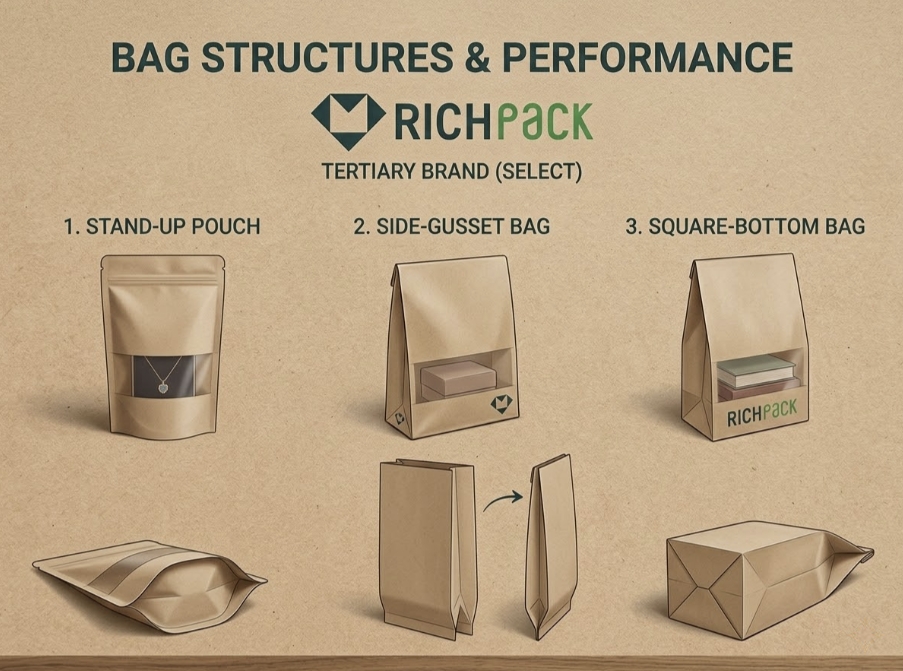
Handles change comfort, look, and cost.
Flat handles often fit grocery, food service, and value-driven retail. Twisted handles are common in kraft paper bags with handles because they balance comfort, cost, and carrying strength well. Rope handles usually feel more premium and suit luxury or gifting programs.
This table works best when you choose the handle based on actual use, not around visual preference alone. The right handle should match both the carrying load and the brand expectation.
| Handle Type | Best Use | Strength Feel | Brand Feel | Cost Level |
| Flat Handle | Grocery, takeout, and daily use | Good | Basic | Lower |
| Twisted Handle | Retail, takeaway, mixed-use | Good to very good | Balanced | Medium |
| Rope Handle | Gift, boutique, premium retail | Very good | Premium | Higher |
Do not pick rope handles just because they look upscale. They should support the product, the brand, and the price point.
Die-cut handles can look clean and modern.
They work best for lighter loads and brands that want a minimal surface. They are less forgiving in heavy-carry situations unless reinforced well. Add Printing mentions die-cut handles as a style cue, but buyers need the operating side too.
These checkpoints help you decide whether die-cut is practical or just visually tempting.
Heavy items fall from the bottom before buyers expect them to.
A reinforced base matters for groceries, bottles, larger gift sets, and multi-item packs. This is especially true when customers lift from one hand, and the load shifts sideways. In supplier-side tests, buyers often evaluate reinforced-bottom versions one full load band above the standard version because the base usually fails before the paper panel does.
This mini checklist helps you check the bottom as a structure, not as an invisible detail. That mindset reduces a lot of heavy-load failures.
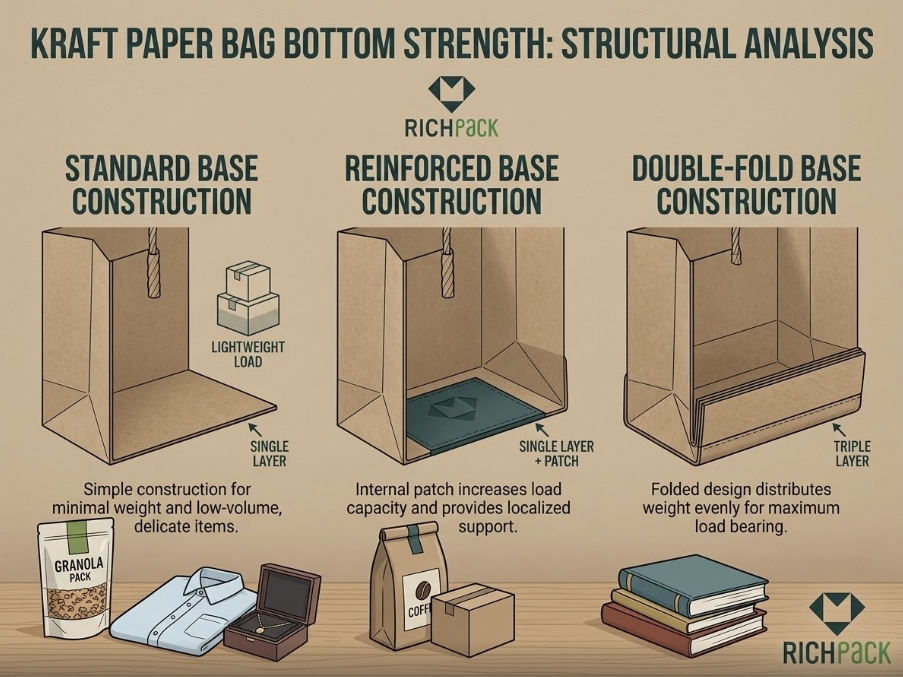
A window can help sell the item. It can also complicate recyclability, cost, and strength.
For bakery, confectionery, or display-led food packaging, a window often makes sense. For everyday carry bags, it may add little value. The Boxery highlights window bags for freshness display, which works when seeing the product supports trust or purchase intent.
Use this filter before you approve a window feature. If it does not improve trust or conversion, it usually just adds complexity.
Bad sizing creates silent waste.
The bag still gets used, but it costs too much, looks awkward, or fails under pressure.
Bag dimensions are not product dimensions.
Measure the product first. Then allow room for insertion, movement, and any extra components. DE Printed Box stresses accurate dieline and size data because small mistakes at this stage become expensive later.
This sequence helps you turn product measurements into workable bag dimensions without adding random extra space that weakens both presentation and cost control.
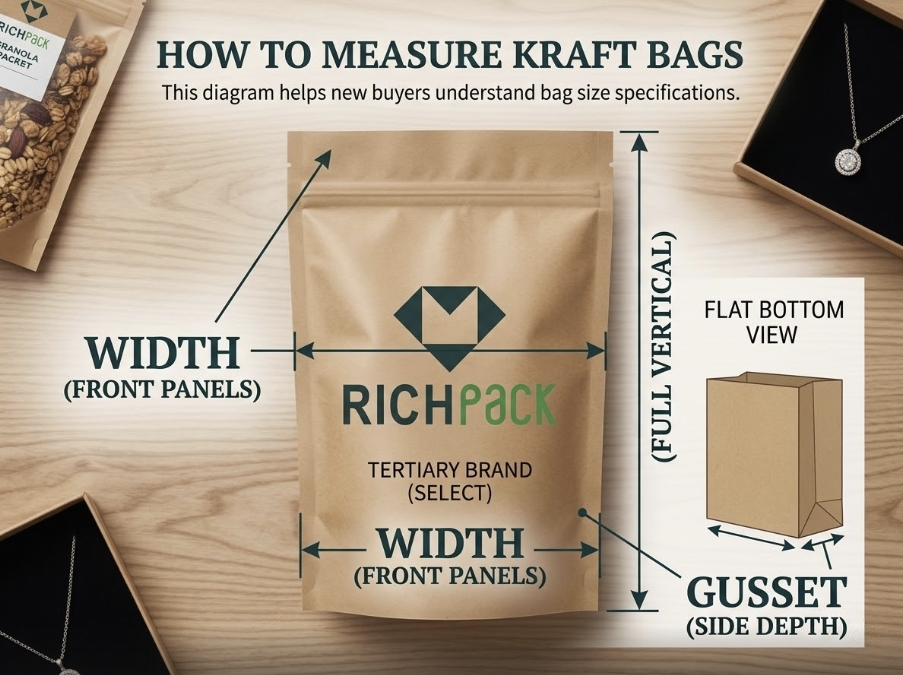
Premium presentation needs breathing room.
A jewelry item, folded garment, or gift product may fit the bag on paper but still look cramped with tissue, ribbon, cards, or inserts added. That is why kraft paper gift bags often need a little more volume than the product alone suggests.
This short add-on list helps you size for the real packout, not just for the core product sitting alone on a table.
Plan for the full packout. Not just the core item.
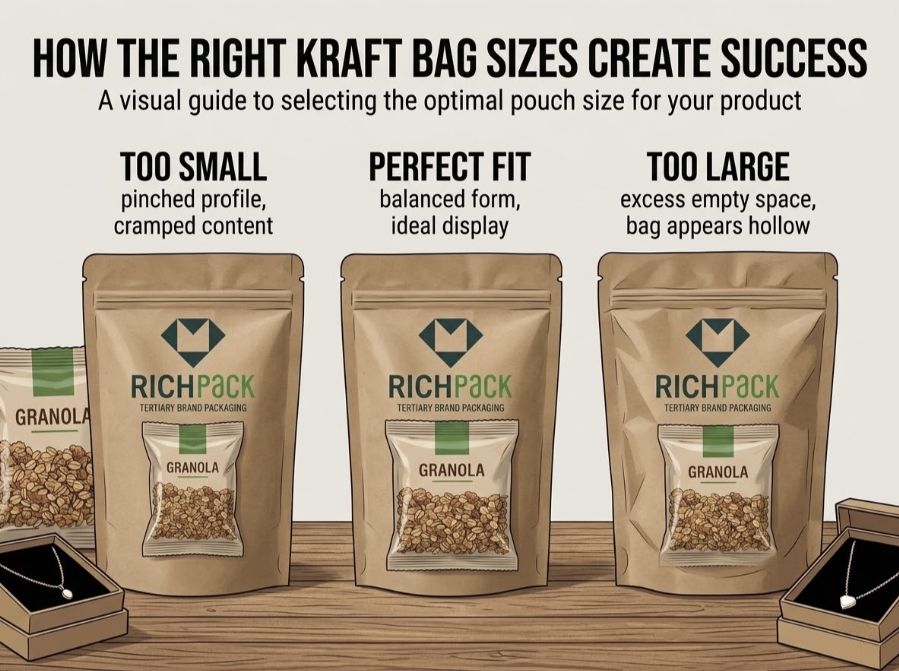
Bigger is not safer.
Oversized bags waste paper, reduce perceived value, and let products slide around. In premium retail, that loose fit can make the whole purchase feel cheaper. In food service, it can destabilize containers.
These are the three main reasons oversized bags quietly hurt performance even when they do not create obvious breakage.
A well-sized bag makes the product feel intentional. That matters for brand trust.
Do not choose one universal size unless your product mix is extremely simple.
Many businesses do better with a small size range, not a single bag. For example, one compact size for quick purchases, one medium for common orders, and one larger option for gift bundles or multi-item baskets.
This simple range model works well because it matches real basket behavior better than one-size planning. It also makes storage and reorder forecasting easier.
| Size Strategy | Best For | Main Benefit | Main Trade Off |
| One Universal Size | Very simple catalogs | Easy ordering | More waste and a weaker fit |
| Two Size Range | Small to medium product mixes | Better efficiency | Still limited to gift bundles |
| Three Size Range | Retail, gifting, mixed orders | Better fit and presentation | More SKU planning |
Testing beats guessing.
Ask for plain samples in two or three close sizes. Pack real products. Let staff use them. Watch how quickly items go in, how the bag stands, and how it looks in your hand.
This test list keeps the sample review practical. It is especially useful when internal teams care about different outcomes.
Printing turns a bag into media.
That is why custom kraft paper bags matter far beyond decoration. A good bag extends recall. A bad one makes the brand feel off.
Customization makes sense when the bag carries brand value, repeat visibility, or gifting impact.
If your bag only moves basic products from the shelf to the car, a stock option may be enough. If it appears in photos, social posts, event gifting, or premium retail, custom becomes more strategic.
This use-case split helps you decide whether customization creates real value or just adds budget.
This is especially true when your product category depends on presentation. Jewelry, cosmetics, fashion, and curated gifting all gain more from a well-planned branded bag.
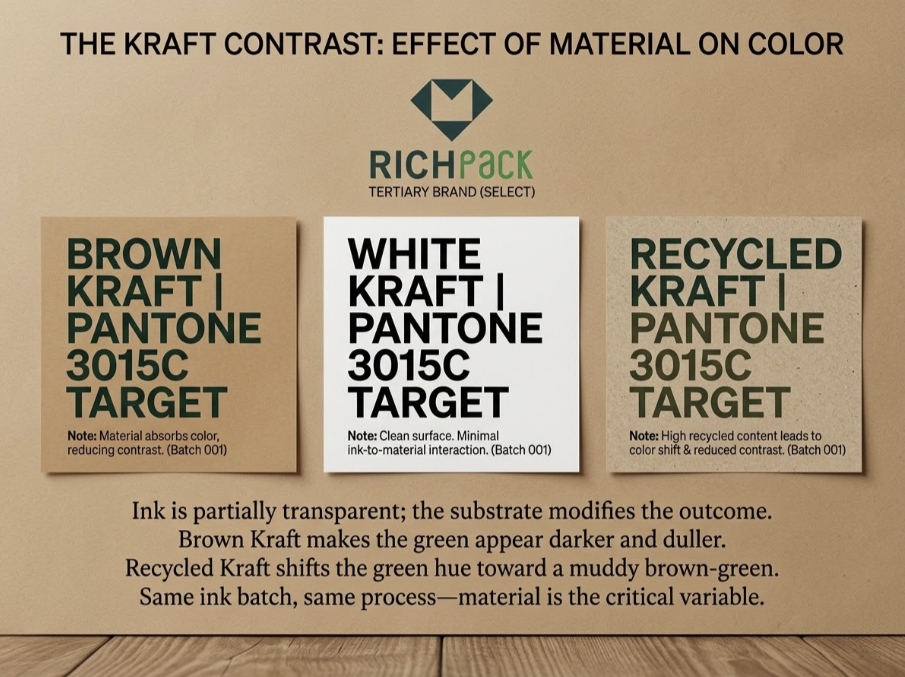
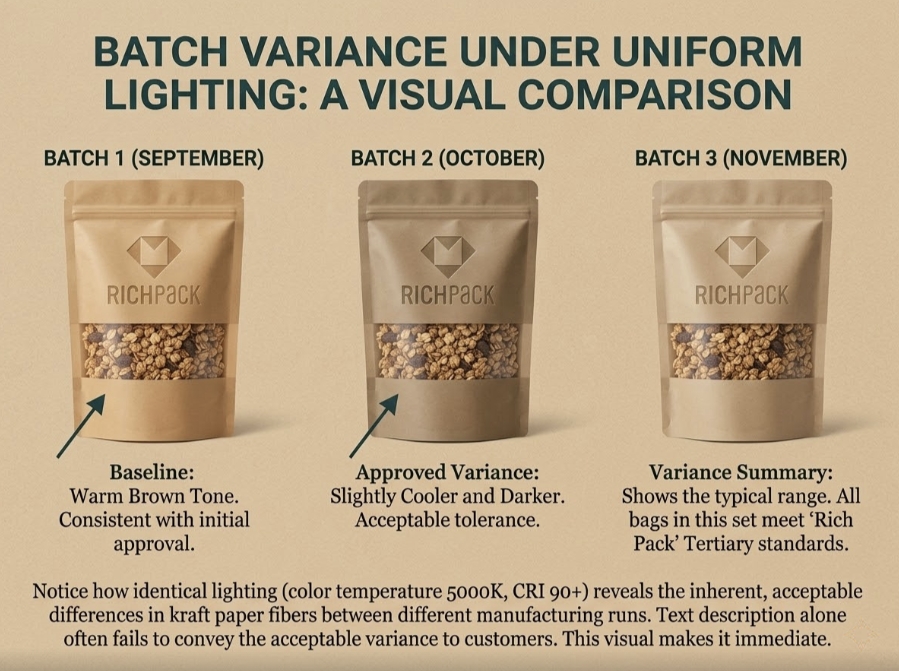
Kraft paper is not a blank white screen.
Brown stock absorbs and shifts color differently from white stock. DE Printed Box points out how file prep, CMYK choices, and printer-ready artwork affect results. That matters because rich color on screen can look muted once printed on natural kraft.
This method summary helps you match the print process to run size and design complexity before you start discussing artwork details with a supplier.
Do not over-design the bag. Clear branding beats crowded artwork.
Contrast matters more than complexity.
If you print on brown kraft, choose logo colors that stay visible on a warm, darker surface. Fine detail and low-contrast elements can disappear fast. Pantone matching and test proofs help reduce surprises, especially for brands with strict identity standards.
This is also where color variance between batches becomes a real B2B issue. Brown kraft can shift slightly by pulp source, recycled content, and production batch, so the same artwork can look warmer or duller from one order to the next.
These checks help control color risk before it becomes a production complaint.
Foil, embossing, matte texture, and gloss accents can work. They can also waste money.
Use finishes when they reinforce a premium moment, gift experience, or strong shelf presence. Skip them if the bag is mainly functional or disposable. Buyers usually get more impact from one clean upgrade than from three decorative extras competing for attention.
This ranking helps you prioritize high-visibility upgrades before low-visibility ones.
That often beats using too many decorative effects.
A shopping bag often outlives the store visit.
It may be carried through a mall, placed on a desk, reused at home, or posted online. That means the bag supports awareness long after the sale. This is where kraft paper bags with logo and personalized kraft paper bags move from nice extra to brand tool.
These brand cues tend to travel furthest in the real world because they stay visible during carry, storage, and reuse.
This is where many good bag ideas fail.
The sample looks fine. The quote looks fine. Then production, storage, freight, MOQ logic, or QC turns into the real problem.
A good quote comparison is never only about price.
When you review Kraft paper bags wholesale options, compare the full specification line by line. If two quotes are built on different paper, different GSM, or different handle construction, they are not real comparables.
This quote matrix gives you the minimum fields that should sit on the same spreadsheet before you decide which supplier looks cheaper.
| Quote Factor | Why It Matters |
| Paper type | Affects strength, look, and print performance |
| GSM or basis weight | Affects rigidity and carrying confidence |
| Size and gusset | Affects fit, waste, and appearance |
| Handle style | Affects cost, comfort, and failure risk |
| Printing method | Affects the color result and MOQ |
| Packing method | Affects storage and freight efficiency |
| Lead time | Affects launch timing and reorder safety |
| Sample policy | Affects approval confidence |
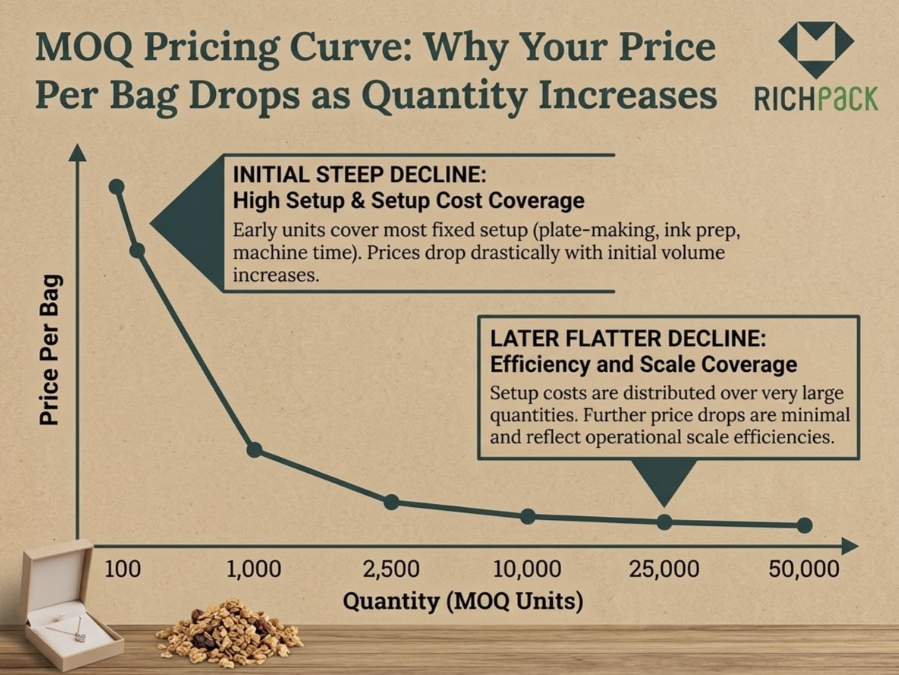
MOQ is not just a barrier to entry. It is one of the strongest levers behind your unit price.
Most suppliers price paper bags in tiers because plate setup, labor allocation, material planning, and freight efficiency improve as order volume rises. The curve is rarely perfectly linear, but it usually drops fast at the early tiers and slows later.
This tier model is a useful way to think about MOQ pricing before you negotiate. The numbers below are illustrative, but the curve shape is what matters most.
| Order Tier | Example Unit Price Pattern | What Usually Happens |
| 1,000 units | Highest price band | The setup cost spreads across a few bags |
| 3,000 units | Noticeable drop | Materials and labor are allocated better |
| 5,000 units | Stronger efficiency | Printing and handling assembly become more efficient |
| 10,000 plus units | Slower decline | Savings continue, but flatten compared with early tiers |
These variables shape the deal before production starts.
LeKAC notes that custom jobs often include a sample phase and can run roughly 8 to 10 weeks after approval, depending on the project. That is why buyers should ask early, not after design work is done.
This question set helps you lock the timeline before internal teams commit to launch dates or promotional windows.
Testing data is more useful than sales language.
Ask how the supplier checks glue adhesion, handle security, bottom seal strength, and print accuracy. LeKAC directly mentions peel strength and handle checks. That should not be a hidden detail. It should be part of supplier evaluation.
These are the most useful test questions to ask when you want proof instead of reassurance.
Do not accept vague green language.
Ask what the claim actually means. FSC chain of custody is different from a general eco-friendly statement. Recyclable in one market may not mean recyclable everywhere if coatings or mixed materials complicate recovery. Food-contact-safe claims also need support.
This short verification list helps you separate credible sustainability documentation from soft marketing language.
Unlike fake eco language that feels like spam pop-ups, real claims should come with documents.
Mistakes repeat because buyers work fast.
The fix is not more theory. The fix is a better filter.
A beautiful bag that fails in use damages trust.
Start with performance. Then improve appearance.
If the product is heavy, the base and handle system matter more than logo size.
This is one of the most expensive avoidable mistakes in grocery, beverage, and gifting categories.
One-size systems often create waste.
They also make small orders look underwhelming, and large orders feel forced. A short ladder is usually smarter.
Sustainability claims need evidence.
Ask for certification, material composition, and end-of-life guidance. Do not let marketing language replace procurement standards.
A sample test costs less than a production mistake.
Always test fit, carry comfort, print result, and real packing speed before you commit to volume.
If you only read one section, read this one.
Key action: define the use case, confirm the load, verify the structure, test the sample, and compare suppliers on full spec instead of price alone.
Write down the product type, weight range, quantity per order, and use environment.
That single step removes a lot of guesswork.
Match paper type, GSM, dimensions, and handles to how customers really use the bag.
Do not approve a bag until these four points make sense together.
Decide what the bag needs to communicate.
Then choose the simplest print and finish plan that gets you there.
If food safety, ESG, or quality assurance matter, get proof before the order moves.
This is not extra paperwork. It is risk control.
Lock in MOQ, lead time, sample rules, storage assumptions, and reorder timing.
That final step turns a bag order into a usable supply plan.
Kraft paper bags are recyclable in many cases, but the answer depends on the final structure, because plain paper bags usually recycle more easily than bags with plastic windows, heavy coatings, laminated surfaces, or mixed-material handles that complicate local sorting and fiber recovery.
Plain kraft bags are the safest recycling case. Once you add film windows, strong barrier layers, or decorative laminations, the answer becomes market-specific. Always check the local recycling stream and the actual materials used in the finished bag.
Kraft paper bag GSM is best when it matches the real load range, because very light bags may work at 40 to 60 GSM, standard retail often lands around 70 to 90 GSM, and heavier or more premium programs often move toward 100 to 120 plus GSM.
The key is that GSM alone does not decide performance. Size, handle type, glue area, and bottom construction can all move the safe working range up or down. Treat GSM as the first filter, then confirm with sample testing.
Kraft paper bags are strong enough for heavy items only when the full structure is designed for the load, because paper thickness, bag size, handle system, bottom reinforcement, and glue performance all matter more than a thick panel viewed by itself.
That is why buyers should ask for handle pull data, moving-load testing, and bottom-strength checks. A thick bag can still fail early if the handle attachment is weak or the base is underbuilt for the actual product weight.
Kraft paper bag handle type is best when it balances load, comfort, and brand feel, because flat handles suit value-driven carry, twisted paper handles fit most standard retail needs, and rope handles work better for premium programs or heavier gift-oriented packaging.
In practice, twisted paper handles are often the safest middle ground for retail. They usually deliver better perceived value than flat handles without moving all the way into the higher cost structure of rope handles.
Custom kraft paper bag order size is best when it fits your storage, your reorder cycle, and your MOQ curve, because the cheapest unit price tier can still become the wrong business choice if it locks you into slow-moving stock or ties up too much working capital.
Start with the smallest volume that gives you a workable unit cost after sample approval. If sales are uncertain, protect flexibility first. You can always scale after the first production cycle proves the bag performs well.
Choosing the right kraft paper bag comes down to fit, strength, presentation, supplier reliability, and total cost of ownership. When you match the bag to the product, the customer journey, and the real operating conditions, you get packaging that works harder for your brand and fails less often in the field.
Now use the checklist, test real samples, and buy with full specs instead of guesswork. If you are comparing options for retail, gifting, food service, or branded packaging, the right bag should make carrying easier and your brand easier to remember.





 PREV
PREV