



Product packaging is not just a container. It is a growth lever that shapes protection, brand perception, shipping cost, compliance, and customer experience.
If you want to choose the right product packaging, do not start with the box style. Start with the product, the channel, the risk level, and the outcome you want the package to create.
This guide uses the RichPack Framework to help you compare packaging materials, reduce dimensional weight, improve unboxing, and choose custom product packaging that works in the real world.
The best product packaging protects the product, supports the brand, and controls total landed cost.
Most brands start with appearance. That is the wrong sequence.
Product packaging must solve the function first. Then it must turn that function into stronger branding, cleaner logistics, and better customer trust.
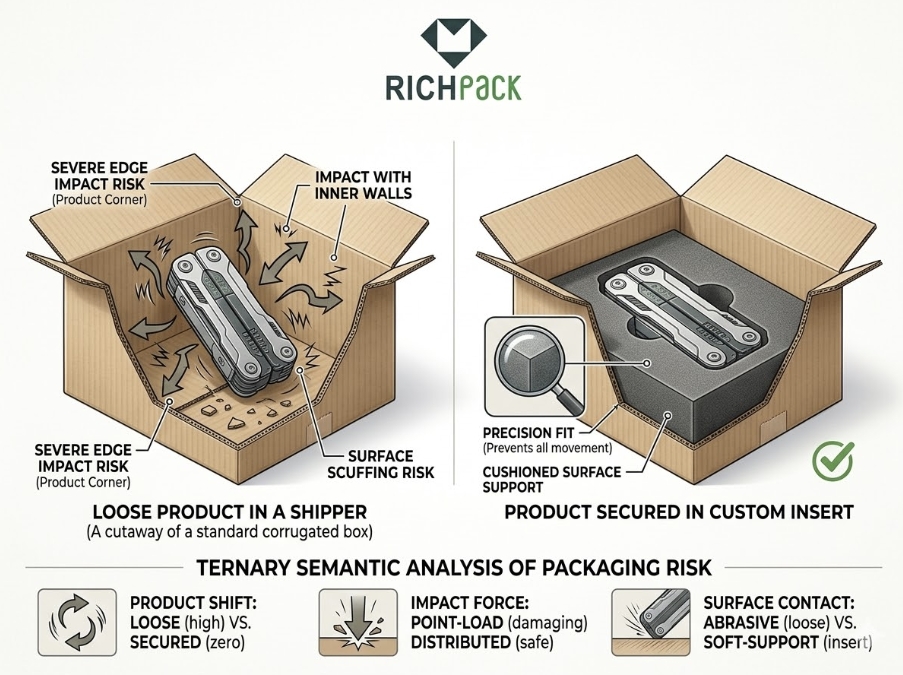
Protection is the first job. A package that looks premium but arrives dented, scratched, leaking, or loose has already failed.
List the real risks before you choose materials or finishes. Think about drop impact, moisture, compression, vibration, abrasion, tamper risk, and storage conditions. A jewelry box may not need oxygen barrier protection like food packaging, but it often needs a better insert strategy and tighter presentation tolerances.
Packaging sells before the product speaks. In retail, it controls the first impression. In e-commerce, it controls the unboxing experience.
That is why packaging design matters so much. A premium finish, clean typography, strong insert design, and accurate fit can raise perceived value fast. A weak structure can destroy that effect just as fast.
Retail product packaging, ecommerce packaging, and wholesale shipping packs solve different problems.
Retail packaging needs shelf impact, visual clarity, barcode access, and consumer trust signals. E-commerce packaging needs drop resistance, right sizing, low dimensional weight, and efficient fulfillment. Wholesale packaging needs stacking strength, pallet logic, and outer carton consistency.
Some packaging choices are creative. Others are legal.
Food packaging, cosmetics packaging, electronics packaging, and children’s products all create different packaging compliance requirements. The U.S. Food and Drug Administration treats food contact substances as a serious packaging checkpoint. That means material selection can become a regulatory issue, not just a design preference.
Do not judge a packaging format by unit price alone. Judge it by the total landed cost.
That means you must count material cost, freight, storage space, assembly labor, damage claims, returns, and rework. At RichPack, we recently helped a cosmetics brand move from oversized rigid boxes to custom-fitted corrugated mailers. That shift cut shipping damage by 14% and total freight cost by 22% without hurting brand presentation.
Sustainability matters. Performance still comes first.
The U.S. Environmental Protection Agency reports that containers and packaging generated 82.2 million tons of municipal solid waste in 2018, or 28.1% of the total. That makes packaging waste a real issue. Underperforming packaging is also a waste because it creates extra returns, replacement units, and duplicate freight.
Do not chase a greener packaging story if it increases breakage, returns, or repacks.
Do not ask which box style looks best first. Ask what the product needs, what can go wrong, and what kind of buying experience you want to create.
A few millimeters can change board grade, insert design, freight class, and packing efficiency.
Get exact product dimensions before you choose packaging supplies or approve a dieline. Heavier products need stronger structures and stronger inserts. Odd shapes often need custom product packaging or custom insert geometry instead of stock cartons.
Fragility is not only about cracks or breakage. It also includes scratches, scuffs, dust, tarnish, deformation, and finish damage.
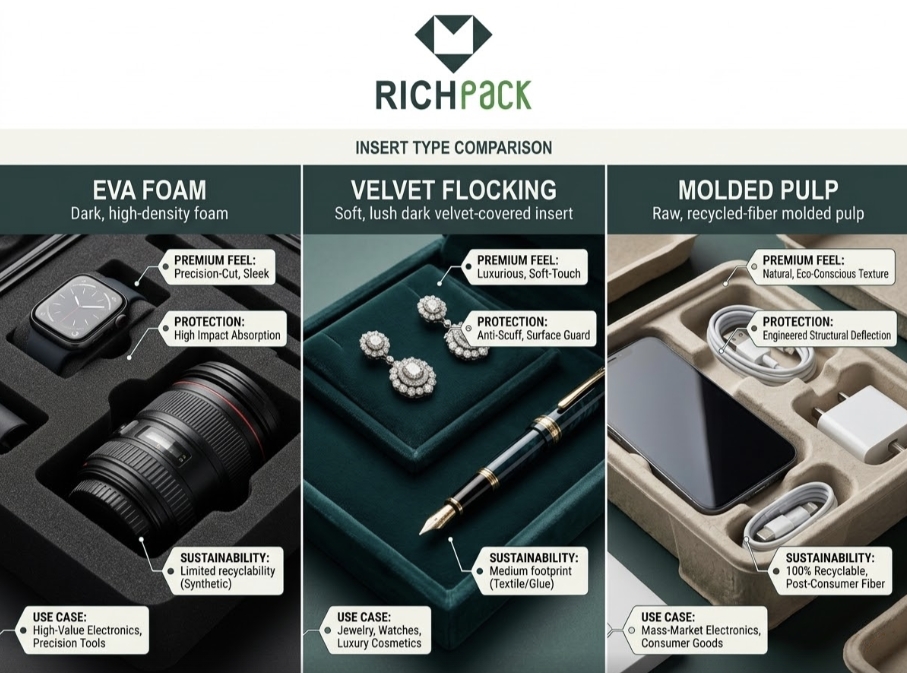
Jewelry packaging shows this clearly. A metal item may survive impact, but it can still feel defective if it rubs against the inner wall of the box. That is why EVA foam inserts, velvet inserts, and flocked trays matter more than many brands expect.
Barrier performance matters early for food, skincare, supplements, and moisture-sensitive products.
If oxygen, humidity, light, or aroma migration can hurt the product, flexible packaging, foil layers, seals, or specialty laminates may matter more than visual presentation. The best product packaging is not the prettiest structure. It is the most suitable structure.
Some products attract theft. Some products create liability. Some need visible tamper evidence.
Ask direct questions. Can the pack be opened and resealed? Does the item need a warning label? Does the channel require tamper-evident packaging? Does the buyer need proof that the product has not been handled?
Not every brand needs a dramatic reveal. Some brands need speed, efficiency, and lower cost. Others need gifting value, social media reach, and premium branding.
That is where positioning matters. A commodity product may win with clean graphics and efficient shipping. A luxury jewelry brand may need a slower reveal, stronger insert tension, and a more tactile material story for social sharing amplified by detail.
This is where many packaging projects get messy.
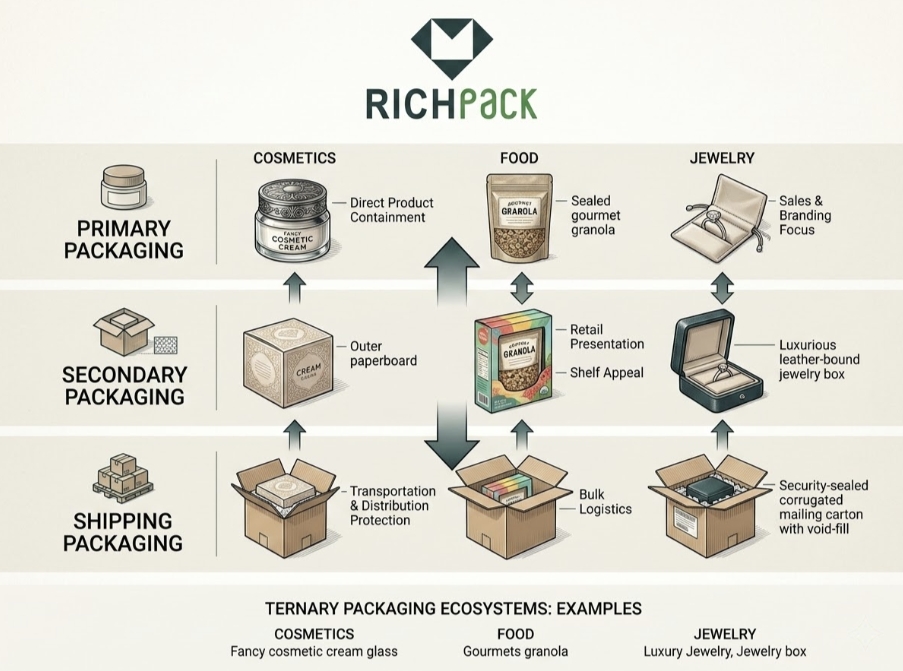
Do not force one layer to do all three jobs unless the product and channel really allow it. That usually creates overdesign, overspending, or underprotection.
There is no universally best packaging material. There is only the best option for your product, your sales channel, your risk profile, and your cost target.
Paperboard works well for folding cartons, sleeves, inserts, and many retail packs.
It prints cleanly, ships flat, supports strong product packaging design, and often aligns well with recyclable packaging goals. It is usually the right call when branding matters and heavy-duty protection does not.
Corrugated becomes the better choice when transit risk, stacking strength, and e-commerce fulfillment matter more.
Corrugated mailers and corrugated product packaging boxes are often the most practical starting point for DTC brands. They protect well, work with inserts, and can still look sharp with smart graphics and tight structural design.
Rigid boxes cost more. They also create a stronger premium signal.
That is why they appear so often in jewelry packaging, gift box packaging, premium electronics, and beauty packaging. The structure feels solid. The reveal feels deliberate. The product feels more valuable. When that premium lift matters, magnetic rigid boxes and other rigid formats can make sense.
Flexible packaging wins when weight, storage efficiency, shelf life, and freight efficiency dominate the decision.
Karlville highlights this clearly. Flexible packaging can improve shipping density and reduce logistics burden in ways rigid formats cannot match. For many food packaging and lightweight consumer goods brands, that changes the economics fast.
A smart insert can do more for product protection than a more expensive outer shell.
A well-designed insert controls movement, sets the reveal angle, improves presentation, and protects delicate finishes. In premium custom product packaging, the insert often creates the precision feeling that customers remember.
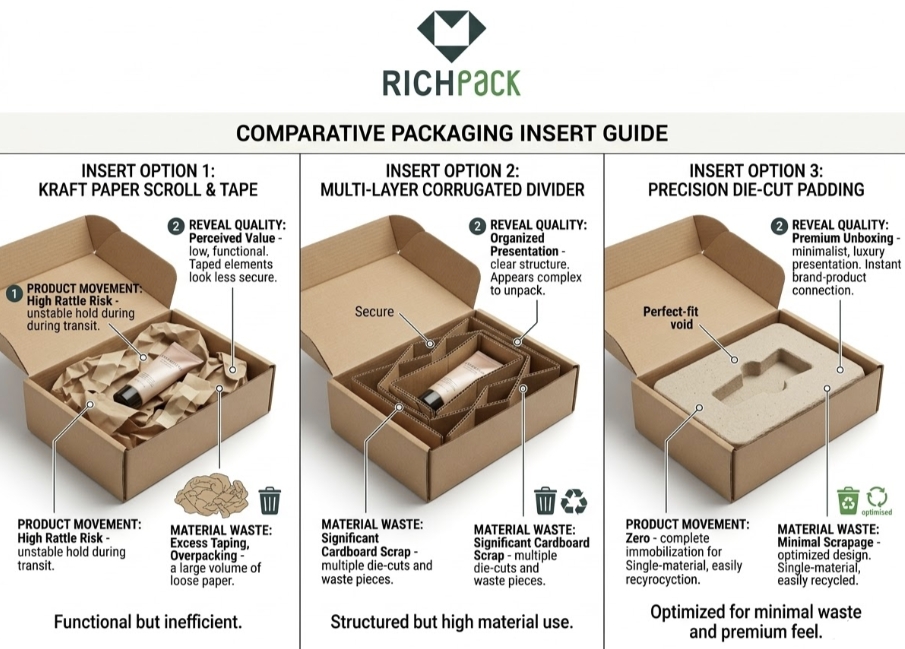
When comparing packaging materials, evaluate strength, branding potential, and sustainability at the same time. Paperboard works well for retail cartons, corrugated dominates shipping, rigid structures elevate luxury products, and flexible formats maximize logistics efficiency.
Use this table for a fast material comparison.
| Material | Best For | Strength | Branding Potential | Sustainability Reality | Notes |
| Paperboard | Folding cartons, sleeves, retail packs | Medium | High | Often strong | Great printability and shelf appeal |
| Corrugated | Shipping, ecommerce, wholesale | High | Medium | Strong in many markets | Better for protection and stacking |
| Plastic | Barrier, visibility, moisture resistance | Medium to High | Medium | Mixed | Strong function, higher environmental scrutiny |
| Glass | Premium liquids, skincare, and food | High barrier | High | Recyclable but heavy | Premium look, more breakage, and freight risk |
| Metal | Tins, specialty food, gift packaging | High | High | Often recyclable | Durable feel, higher cost in some formats |
Key points: Choose packaging materials based on product risk, channel, and total landed cost, not trend alone.
A beautiful mockup can still fail in the real world. Shipping, storage, handling, fulfillment, and merchandising decide whether packaging actually works.
E-commerce packaging must survive movement, drops, compression, and courier handling.
It also must control dimensional weight. Oversized packaging can increase dimensional weight shipping costs by up to 30%, depending on the carrier, carton size, and zone logic. That is why right-sizing matters so much for e-commerce packaging and packaging conversion efficiency.
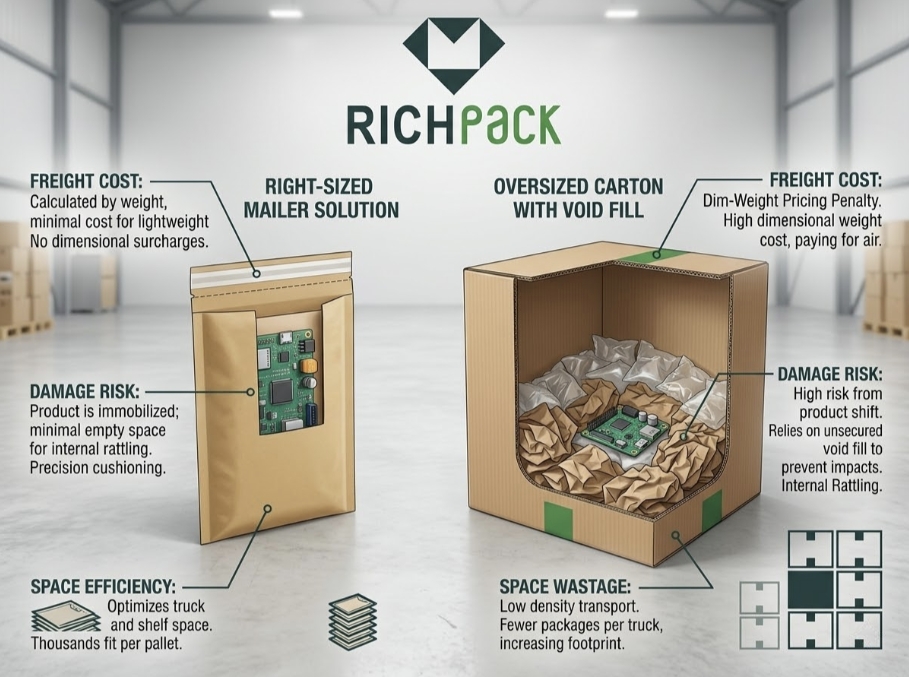
Retail packaging must win attention fast.
That means you need visibility, color control, barcode placement, shelf logic, and clear front panel communication. Good retail display packaging reduces decision friction and increases trust at the point of sale.
Wholesale shifts the packaging conversation from appearance to throughput.
Pallet fit, stack height, outer carton consistency, and warehouse handling start to matter more. A pack that looks fine at the sample level can still fail during distribution if the compression logic is weak.
Humidity, heat, cold, and long storage cycles can damage a package before the customer ever sees it.
Adhesives can fail. The board can warp. foils can mark. Soft touch lamination can scuff. Test packaging in the conditions it will actually experience, not only in the sample room.
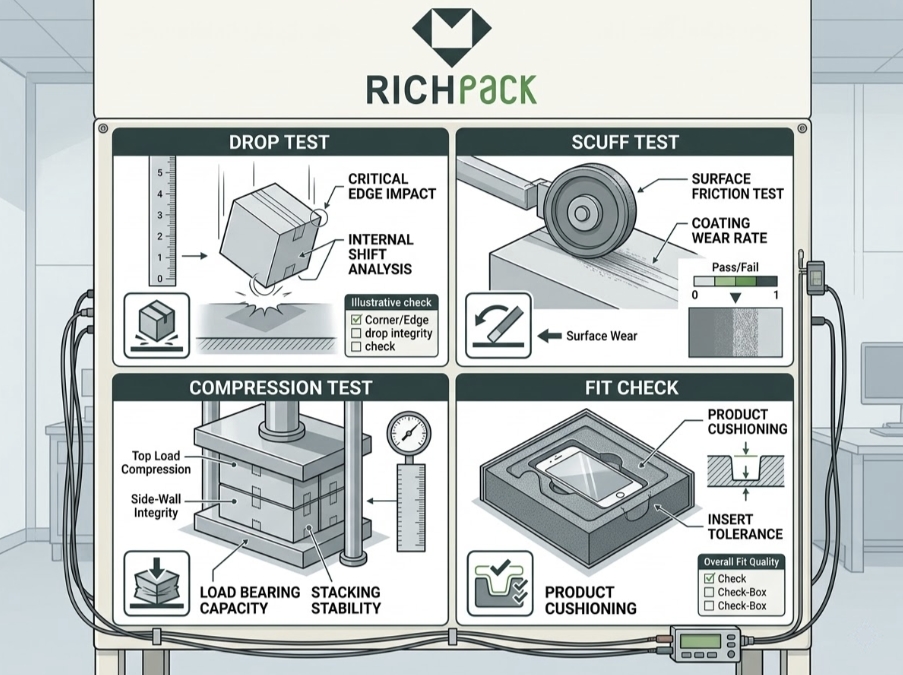
Prototype early. Test early.
Run fit checks, drop tests, scuff tests, stack checks, and trial pack-outs before mass production. If the product is high risk, move to formal packaging testing or ISTA-style simulations. That is a far better cost than fixing a failed launch later.
This is the tradeoff premium brands often underestimate.
A large, rigid setup box feels impressive. It also carries more air, more weight, and more freight cost. Like LEGO, the system works best when each component fits with intent. Do not make every panel bigger just to signal luxury.
Cheap packaging often becomes expensive packaging in disguise. Budget for performance, not just procurement.
Unit price is only one number. Landed cost is the real number.
You must count packaging materials, inbound freight, storage, assembly labor, outbound shipping, damage claims, returns, and replacement units. This is where smarter packaging engineering often beats cheaper material selection.
Flat-packed cartons usually save storage space. Rigid boxes usually cost more to store and ship.
Multi-part packaging can also slow fulfillment. Before you approve the structure, map the impact on labor time, storage density, and shipment volume.
Damage rate is a packaging cost. Reprint is a packaging cost. Customer disappointment is also a packaging cost.
If one structural adjustment cuts breakage even by a small percentage, it can recover costs faster than most percentage reductions. Not like airline baggage fees, which look small until every extra step compounds the bill.
Foil stamping, embossing, debossing, spot UV, and soft touch lamination can lift perceived value.
They can also increase lead time, material complexity, and defect risk. Use them where the customer will notice them most, such as lid tops, reveal surfaces, and first touch panels.
MOQ can make a package look affordable on paper and risky in reality.
Large runs lower unit cost but increase inventory pressure and cash exposure. If demand is still being validated, ask for a format that can scale in stages instead of locking into complex custom packaging too early.
Custom product packaging usually pays off when one or more of these are true.
Sustainable product packaging now shapes buying decisions. That still does not mean every sustainability claim is useful, safe, or honest.
The fastest sustainability win is usually less material.
Right-sizing, simpler structures, and fewer unnecessary layers often do more than vague eco language. This is one of the rare packaging changes that can improve both margin and waste outcomes.
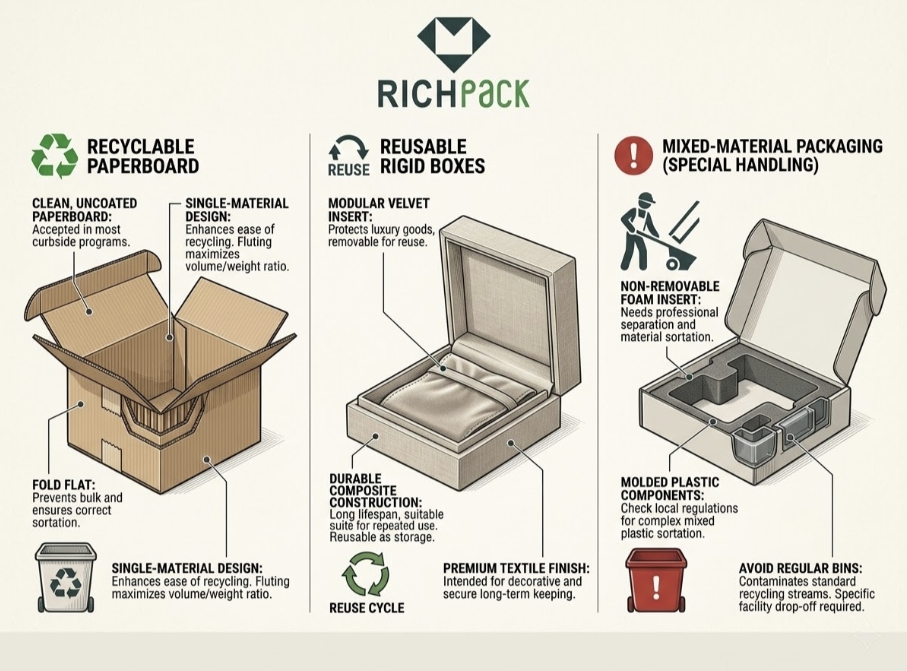
Recyclable packaging sounds simple. Real recovery systems are not simple.
Actual recyclability depends on local infrastructure, coatings, adhesives, laminations, and consumer behavior. A format can be technically recyclable and still fail in practice.
These terms appear everywhere in sustainable packaging discussions.
Use these terms accurately. Do not insert them into packaging copy unless the claim is documented.
This is where brands get careless.
If a package is recyclable only where facilities exist, say that. If the claim depends on separating materials first, say that too. Clear language builds trust faster than broad sustainability slogans.
Yes, but only if performance stays part of the decision.
A damaged product creates waste, too. So do returns, replacements, and repacks. The best path is not less packaging at any cost. The best path is enough packaging to protect the product with the lowest reasonable material burden.
Explain what changed and why.
Use concise material disclosures, disposal instructions, or QR-based details where needed. The Ocean Cleanup estimates that 1.15 to 2.41 million tonnes of plastic enter the ocean from rivers every year. Buyers do not want a lecture. They want proof.
Compliance mistakes are expensive because they appear late. One missing label line or unsupported claim can trigger rework right before launch.
Make sure the package has space for required product information, barcode placement, warnings, country of origin details, and retailer-specific requirements.
Do this before final artwork approval. Good product packaging design leaves room for operational reality.
Food packaging and cosmetics packaging need extra care.
Material safety, food contact substances, ingredient declarations, storage guidance, and warning language may all matter depending on the market. Do not guess here. Validate before material lock.
This article targets markets outside China. That means export packaging must be reviewed through a broader lens.
The U.S., EU, UK, Australia, and Middle East markets can differ on language, recycling marks, claims language, and retail labeling. Build this review into your packaging workflow early.
If you say recyclable, compostable, reusable, or food safe, make sure the claim can be defended.
Unsupported claims create trust risk and legal risk. Use objective wording and documented evidence.
Some products need tamper evidence. Some need warning language. Some need child-resistant logic.
This is where legal review, packaging engineering, and quality control must align before print files are released.
Before mass production, run one final check for artwork, dieline, color, finish, label content, barcode readability, and regulatory copy.
This simple review prevents expensive production mistakes and reduces downstream friction for quality assurance controlled by process.
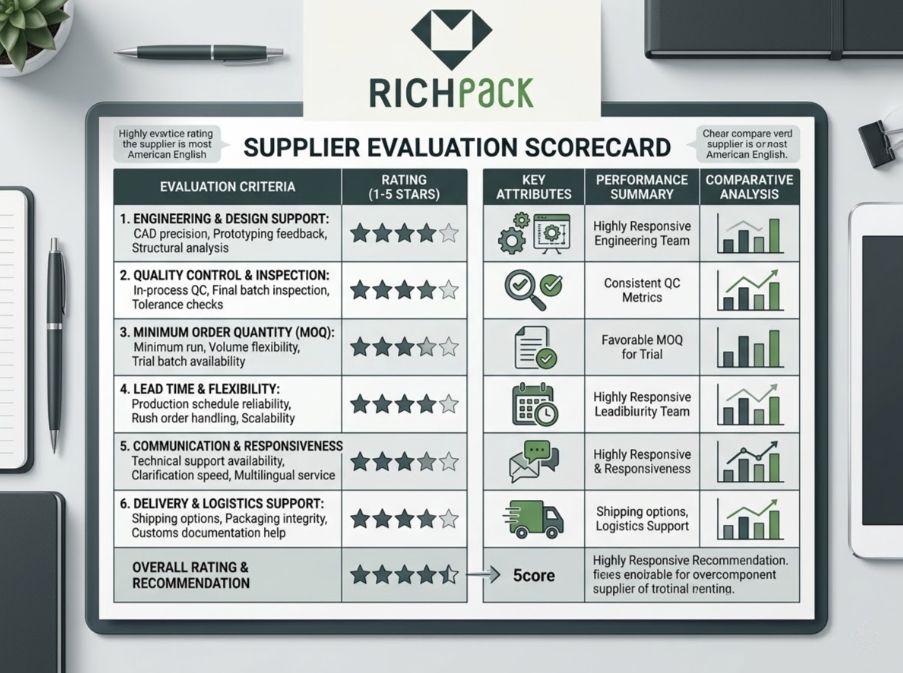
A supplier is not only a manufacturer. The right one helps you solve structure, finish, logistics, and production issues before they become expensive.
Ask whether the supplier can recommend board grade, improve insert fit, reduce shipping cost, or simplify a complex structure.
These answers show whether you are talking to a vendor or a real packaging partner.
Do not admire the sample. Inspect it.
Check color accuracy, glue lines, edge quality, scuff resistance, insert tension, opening feel, odor, and how the product sits inside. Premium product packaging fails when small details feel wrong.
A great package is still the wrong package if the supplier cannot support your launch plan.
Ask about minimum order quantity, sample lead time, production lead time, peak season capacity, and reprint speed. Then ask what happens when something goes wrong.
Quality control should never stay vague.
Ask about inspection checkpoints, tolerance control, finish checks, color consistency, and documented standards. Frameworks like ISTA 3A can shape shipping test expectations. Standards thinking matters here, even when your production format differs.
Good communication saves time. It also saves launches.
If revisions are slow, technical questions stay vague, or ownership feels weak, the problem is already visible. Not like cable company support, where slow answers are expected and tolerated.
This is where integrated support helps most.
When design, prototyping, inserts, manufacturing, and delivery planning sit closer together, you get fewer gaps and fewer expensive handoffs. At RichPack, this model often helps premium brands move faster with better packaging consistency.
| Supplier Checkpoint | What to Ask | Why It Matters |
| Structural support | Can you improve the fit and protection | Reduces damage and waste |
| Sampling | How close is the sample to production | Prevents quality surprises |
| MOQ | What is the minimum by structure | Affects cash flow |
| Lead time | How long for sample and mass production | Affects launch timing |
| QC process | What do you inspect and document | Affects consistency |
| Delivery support | Can you coordinate the packaging with the shipment | Improves execution |
If you only need one workflow, use this.
The RichPack Framework helps you choose product packaging by matching product risk, channel, cost, sustainability, and supplier capability in the right order.
List size, weight, fragility, surface sensitivity, shelf life, and theft or tamper risk.
Decide what must touch the product, what must present it, and what must protect it during shipping.
Choose packaging materials, inserts, and box style based on channel, risk, branding, and landed cost.
Run fit checks, drop tests, scuff checks, and shipping simulations before you commit to volume.
Validate landed cost, sustainability claims, label content, and legal requirements before print.
Confirm MOQ, lead time, QC expectations, and delivery flow before mass production starts.
Do not choose packaging by looks alone. Choose it by performance, brand fit, and repeatable execution.
The best packaging for fragile products combines a stable outer structure with a fitted insert that limits movement. Corrugated boxes, molded pulp, EVA foam, and velvet inserts can all work. The right option depends on weight, surface sensitivity, and shipping risk.
Choose rigid boxes when premium presentation, gifting value, and perceived quality matter most. Choose folding cartons when you need strong branding, lower storage costs, and better freight efficiency. The real answer depends on margin, channel, and customer expectations.
Custom product packaging cost depends on size, structure, material, insert design, finish, MOQ, and freight method. A simple carton can stay efficient. A rigid box with foil stamping, inserts, and multiple parts can cost much more. Always compare landed cost, not sample price alone.
Sustainable product packaging uses only the material needed, protects the product well, and avoids unsupported environmental claims. Recyclability, recycled content, FSC paperboard, right-sizing, and reusable formats can all help. The strongest solution balances waste reduction with real performance.
For e-commerce shipping, corrugated mailers, right-sized cartons, and protective inserts usually work best. The goal is to reduce dimensional weight, prevent damage, and keep pack-out simple. Packaging that survives courier handling without excess material usually performs best.
Your packaging is probably overdesigned if it adds cost, weight, space, or assembly time without improving protection, conversion, or customer experience. Watch for oversized boxes, too many decorative layers, and finishes customers barely notice.
Choosing the right product packaging means balancing protection, presentation, logistics, sustainability, and compliance at the same time. When you start with product risk, test under real conditions, and budget for landed cost instead of appearance alone, you make stronger packaging decisions.
Now use the RichPack Framework to find the weakest part of your current packaging system and fix that first. If you are planning a premium custom packaging project, start with the product risk profile, then build the structure, insert, finish, and supplier plan around that reality.





 PREV
PREV