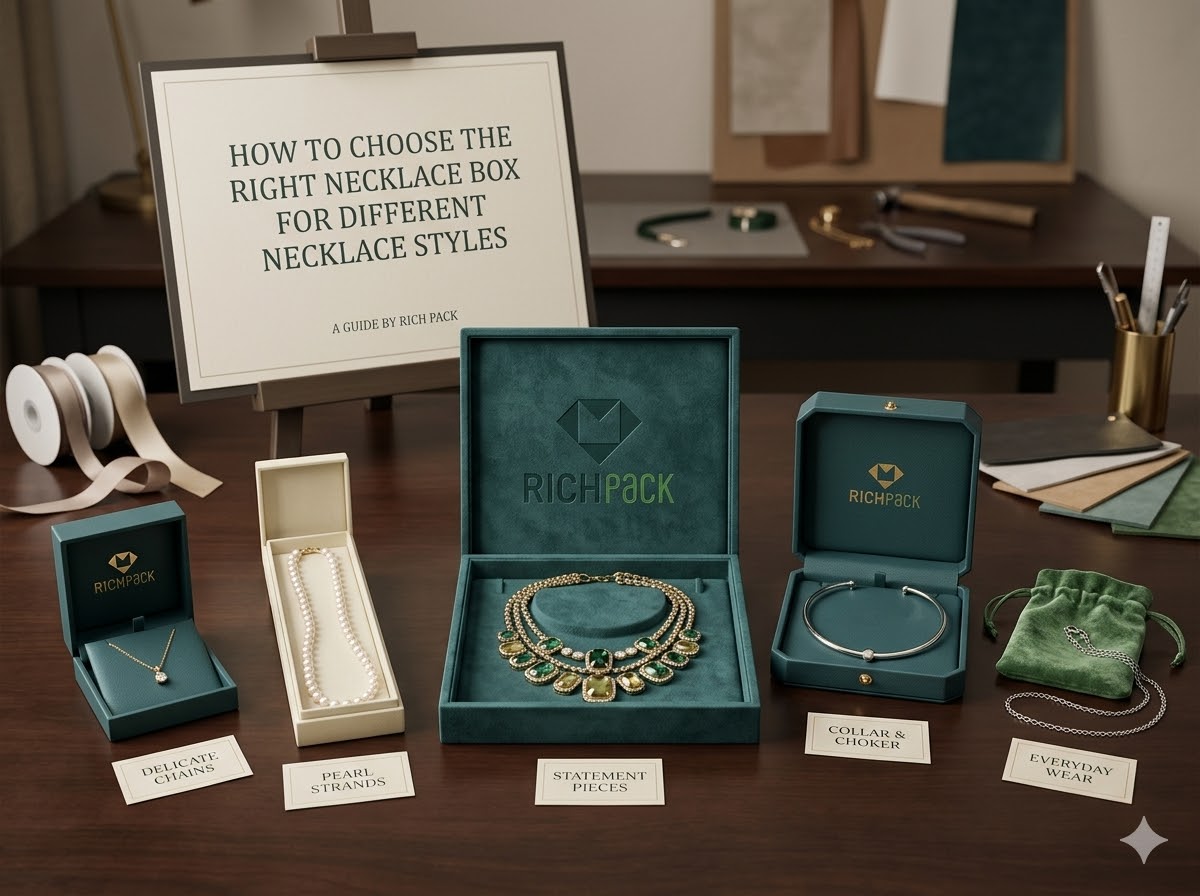



Choosing the right necklace box is not about picking the prettiest packaging. It is about matching size, insert design, material, and presentation to the necklace style inside.
If you sell chokers, pendant necklaces, pearl strands, or layered sets, one packaging format will not work for all of them. The wrong fit creates tangles, pressure marks, a cheap-looking presentation, and wasted shipping space.
This guide shows you how to choose the best jewelry box for necklaces, compare cardboard necklace boxes, plastic necklace boxes, and metal necklace boxes, and build a luxury necklace gift box that protects the piece and supports brand value.
You will also see where structure matters more than decoration, where internal dimensions matter more than outside dimensions, and why details like hook spacing, pouch depth, EVA foam insert, microfiber interior, and lid clearance decide whether a box performs well.
The right necklace box matches necklace length, pendant height, chain thickness, channel use case, and shipping risk. If the insert controls movement and protects the finish, the box works. If it only looks premium in a mockup, it fails in real retail and ecommerce use.
A good necklace box is not defined by decoration alone. Its real job is to keep the necklace stable, protect the finish, present the piece well, and support your brand position.
That is why jewelry brands should judge packaging by fit before appearance. Buyers do not complain because a box lacked embossing. They complain because the chain tangled, the pendant rubbed, or the insert looked flimsy on arrival.
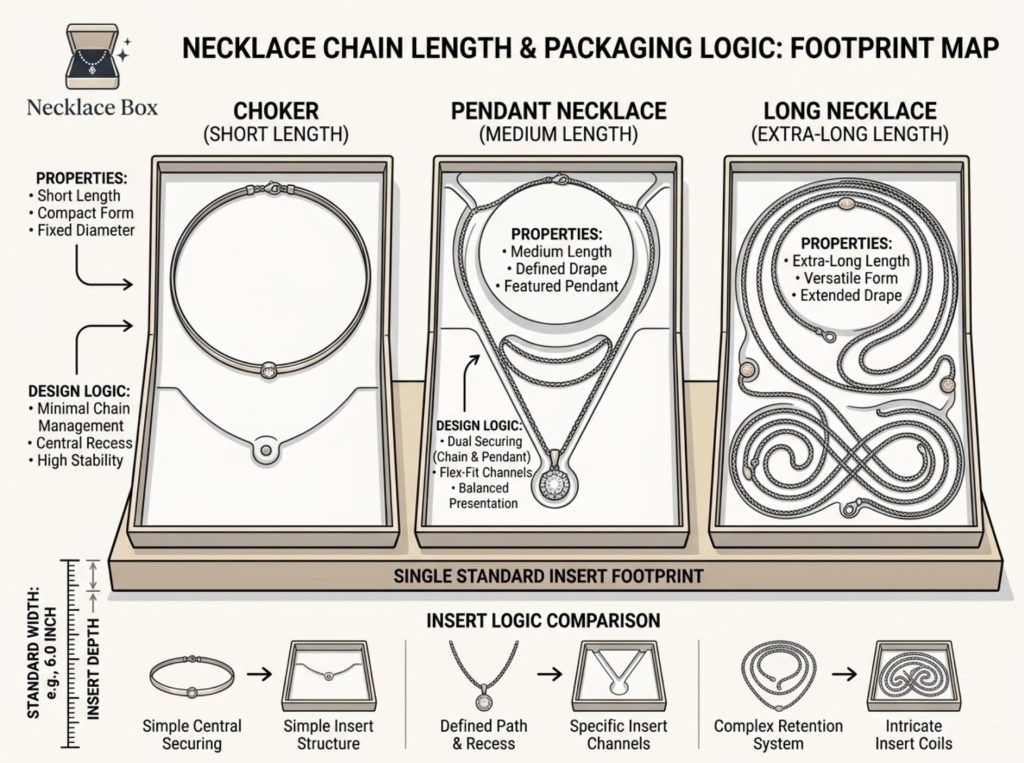
Length changes the packaging logic first.
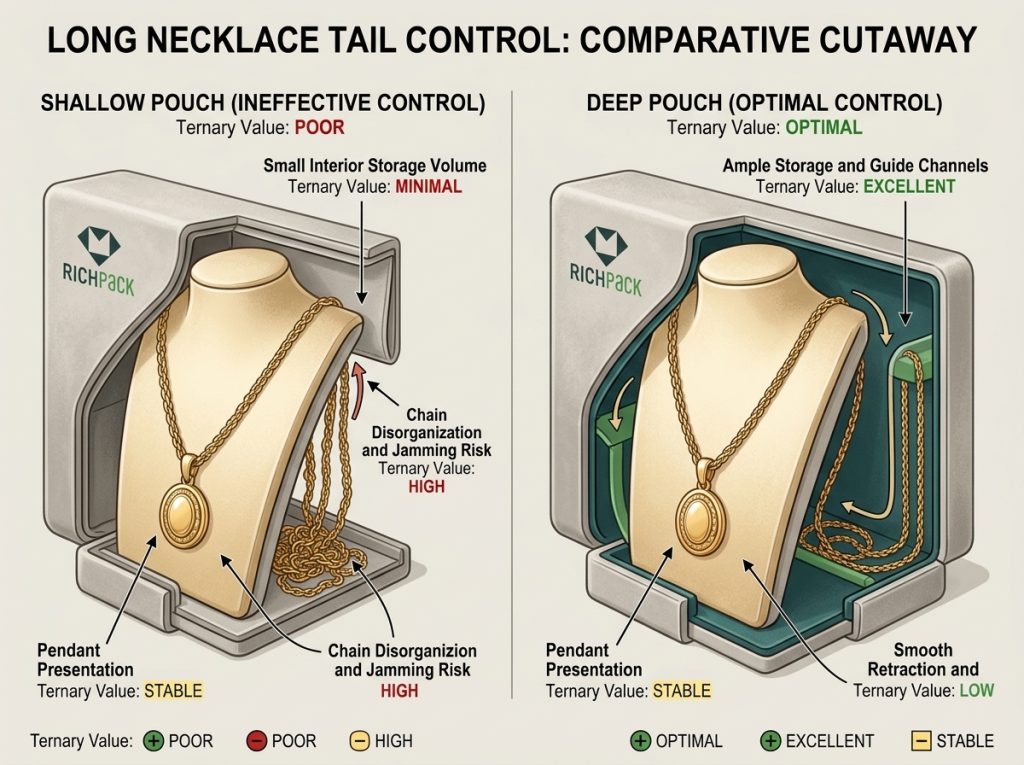
A short choker does not need the same internal layout as a 24-inch pendant chain. If you place a long chain in a shallow insert with weak tail control, the chain moves during transit and comes out tangled.
As noted by Noble Pack, necklaces often perform best in square or rectangular boxes with a roughly 7-to-9-inch footprint and about 1.25-to-1.5-inch depth when the product needs room to sit correctly. That does not mean every necklace needs a larger box. It means the internal layout must fit the chain path and retention points.
Pendant size is a structural issue, not just a styling issue.
A slim chain with a heavy center stone behaves very differently from a plain chain. The insert must hold the necklace without letting the pendant slide, flip, or press into the lid. Like LEGO bricks, small fit errors create larger failures when the whole packaging system locks together.
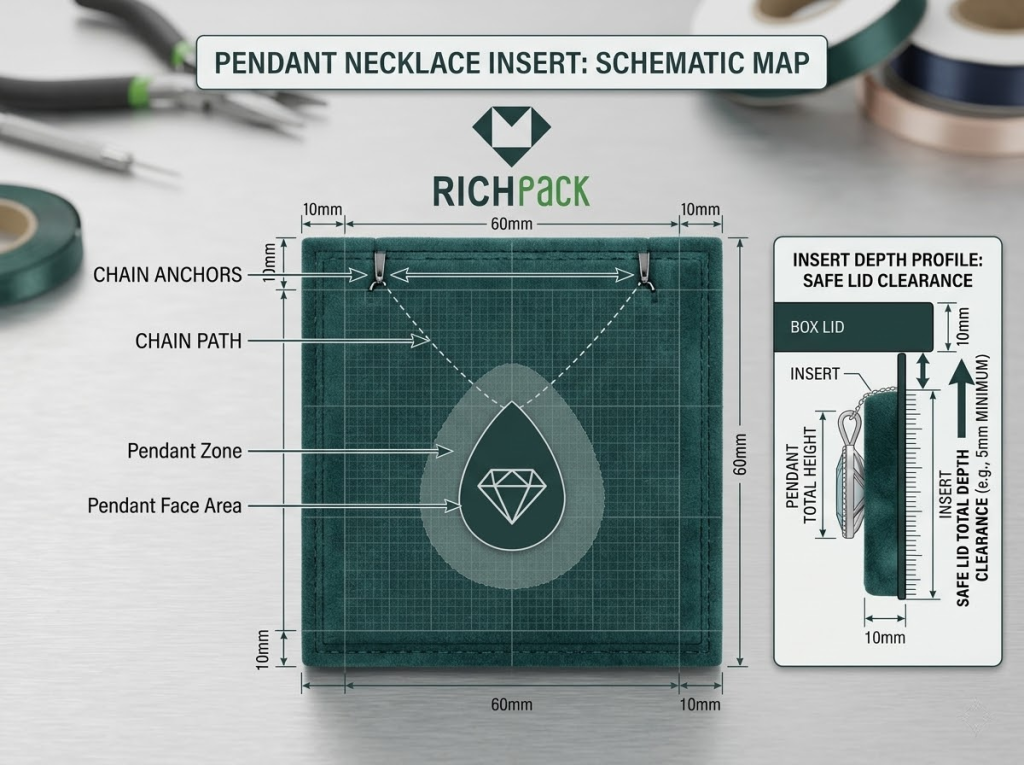
If the pendant face rubs against the lining, you risk scratches. If the lid pushes down on the pendant, you risk pressure marks, bent bails, and a poor reveal.
Heavy pendant necklaces need a wider pendant zone, a stronger insert grip, and more lid clearance.
Do not size by necklace category alone. Size by chain behavior.
Thin chains slip more easily. Thick chains need wider slots and smoother hooks. A bulky clasp can snag if the insert opening is too narrow or the hook angle is too sharp. Not unlike airport baggage conveyors, one pinch point can create a full failure chain.
Use these checks before approving the necklace box design.
Presentation changes the right packaging answer.
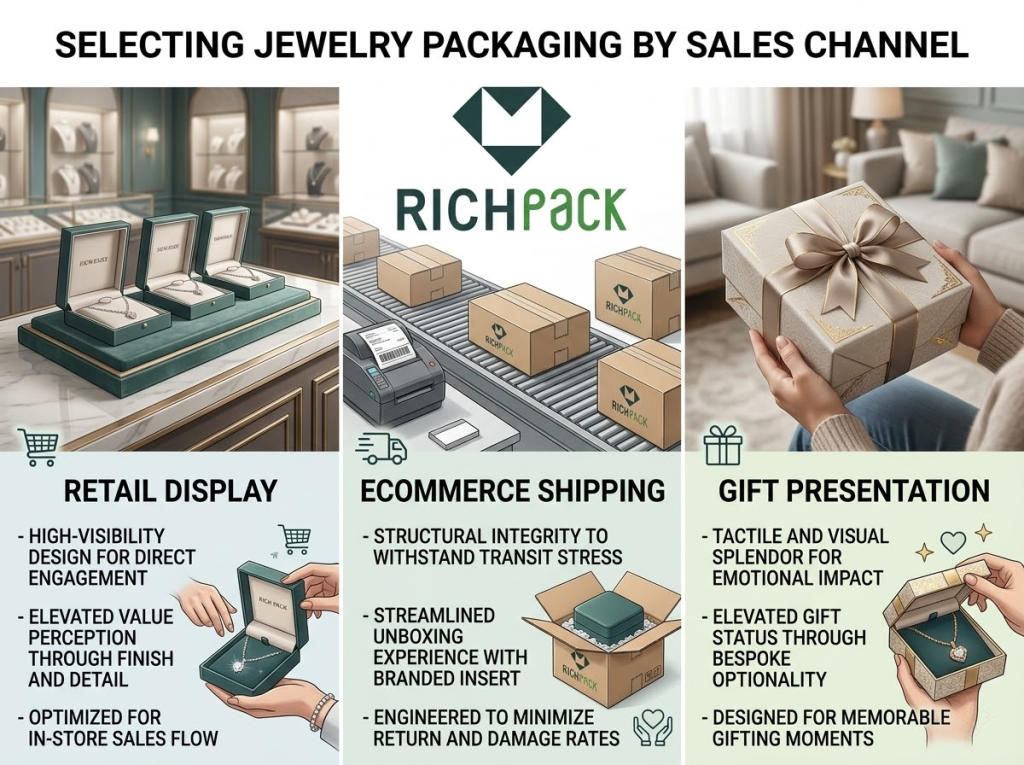
A retail display box must look clean in a lineup. A necklace gift box must create emotional value fast. An e-commerce box must survive vibration, carton compression, and repeated handling. Many brands fail because they choose one visual concept for every channel and ignore the actual use case.
Use channel-first logic.
The protection level should follow the shipping risk.
A boutique pickup order can use a lighter build. An international D2C shipment usually needs rigid walls, tighter inserts, better movement control, and stronger closure performance. RichPack’s necklace packaging guide gets this right. Anti-tangle performance only matters if it still works after real handling, not just in product photography.
Do not choose packaging by catalog beauty. Choose it based on failure risk.
If you sell globally, test for:
Different necklace styles need different insert architectures. Chokers need compact control. Pendant pieces need pendant zones. Long necklaces need drop management. Layered necklaces need lane separation. If you use one insert logic for all of them, product presentation and protection will break down fast.
This is the core decision.
The best necklace box depends on how the necklace sits, moves, and presents inside the box. Instead of sorting by packaging type first, sort by necklace style first.
Chokers usually perform best in compact boxes with a neat insert and shallow presentation depth.
Because the necklace is short, a large box makes it look underwhelming. A tighter structure improves perceived value and keeps the product from looking lost. That matters for minimalist luxury brands that want clean presentation.
Best structure choices:
Avoid oversized boxes for chokers. They increase space and reduce visual impact.
Pendant necklaces need controlled display and vertical clearance.
The chain must stay straight enough to look elegant, but the pendant also needs a safe zone that prevents pressure, spinning, and face rub. This is where a standard flat insert often fails.
Best structure choices:
As noted by RichPack’s purchasing guide, pendant protection depends on top anchoring and lower stabilization together. A nice-looking top slit alone is not enough.
Long necklaces are the easiest to tangle.
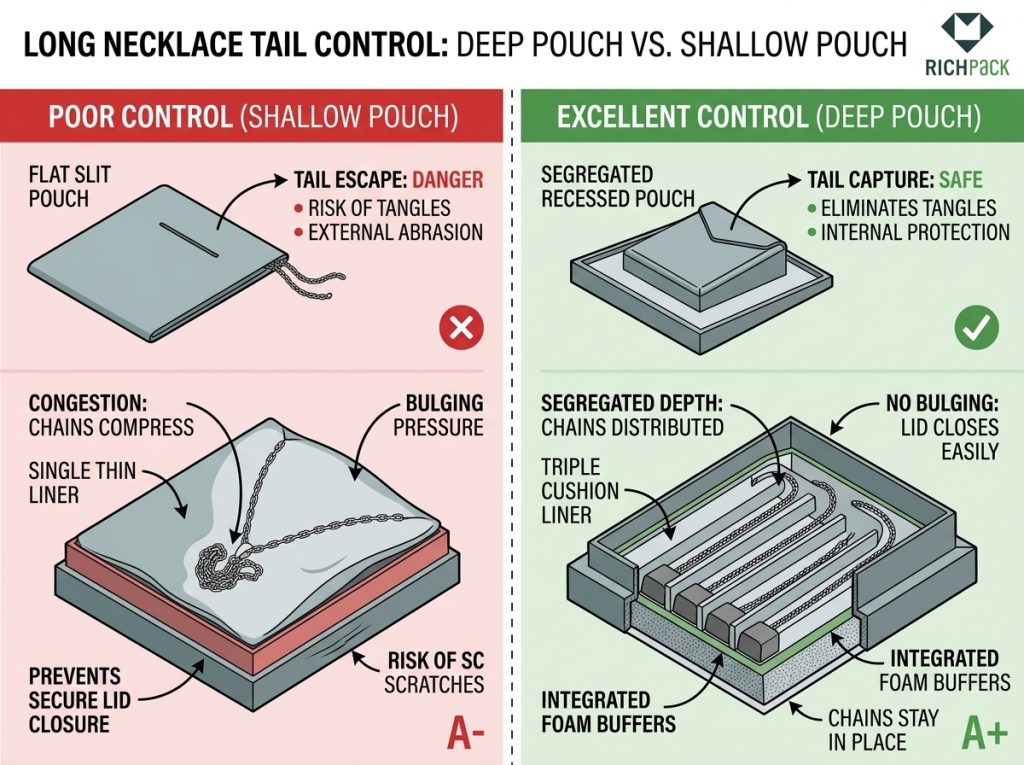
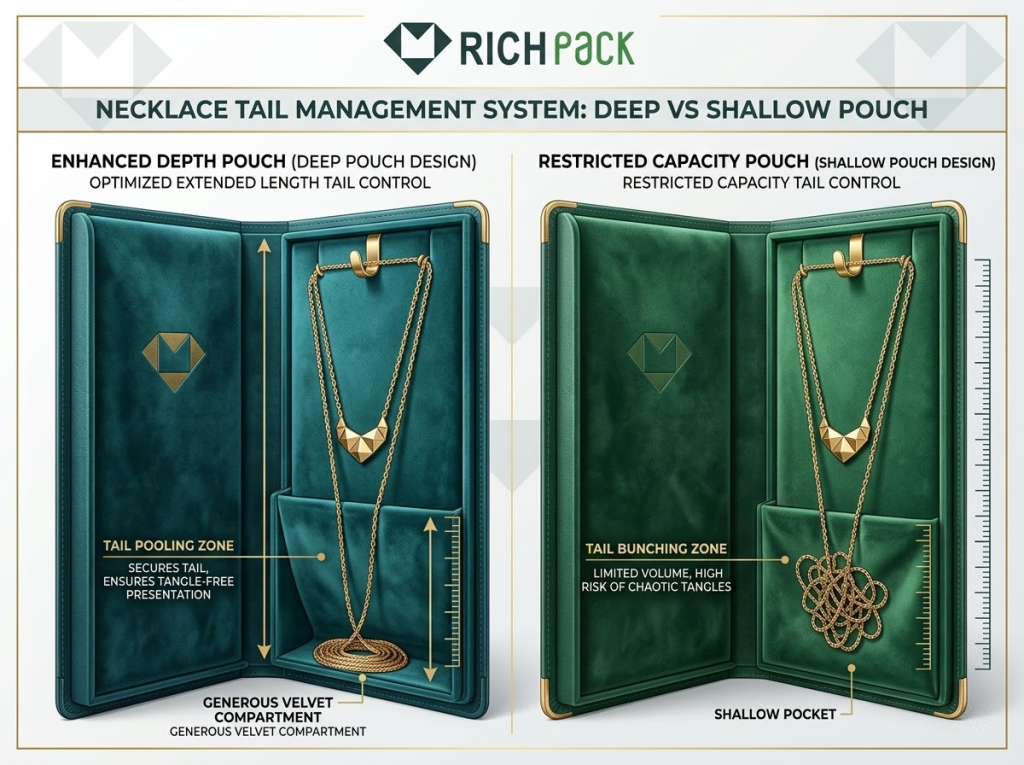
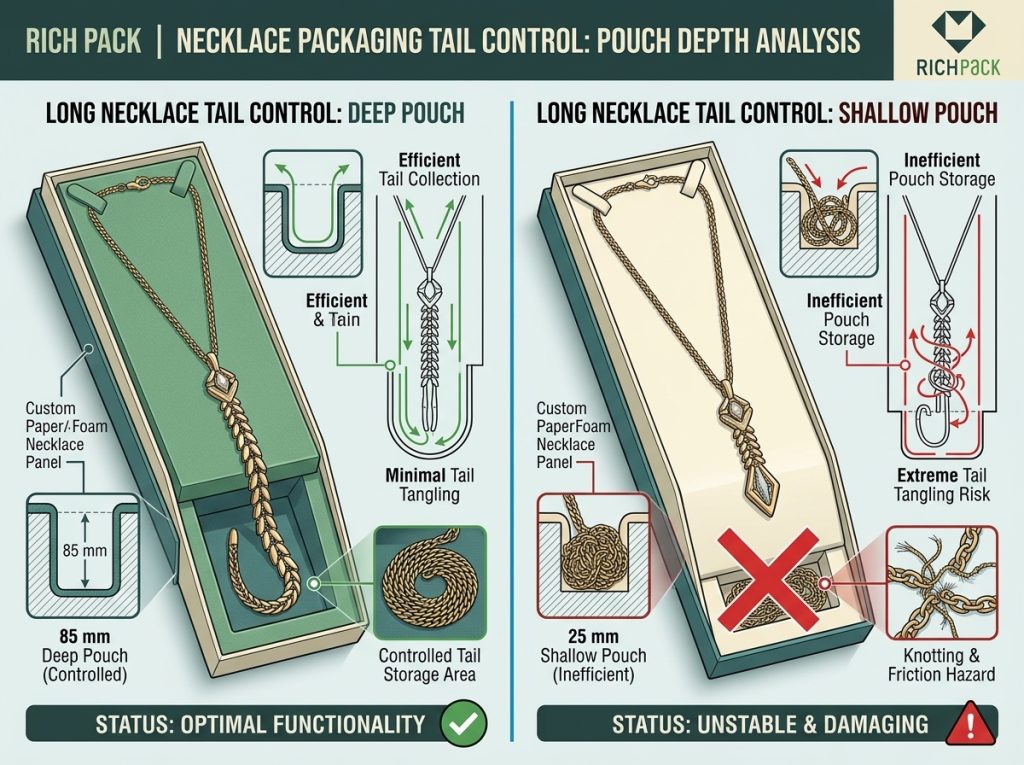
They usually need a hanging necklace jewelry box, a tall rail with a deep pouch, or another layout that controls both the top anchor and the loose tail. RichPack’s anti-tangle logic is useful here because the deep pouch matters as much as the hook. The tail must stay inside the pouch during movement.
Best structure choices:
Do not use a shallow pocket for a long necklace. It may look fine in a sample photo and fail in the first parcel run.
Layered necklaces need lane separation, not just more room.
One insert slot is not enough. Multiple chains create cross tension, overlap, and knotting during transport. This is why layered necklaces often need a custom insert even when the outer box looks standard.
Best structure choices:
If you only read one section, read this: layered necklaces should use dedicated lanes, separate anchors, and controlled drop zones. A bigger box without lane control does not solve tangling.
Pearls need soft contact and stable support.
They do not like hard pressure points or abrasive surfaces. A pearl strand may not tangle as badly as a long chain, but it can lose value fast if the insert presses unevenly or the lining sheds lint.
Best structure choices:
Do not use rough or cheap flocking for pearls. It can look premium online and behave poorly in real use.
Statement necklaces need structure more than softness.
Large centerpieces, multiple stones, and wider forms need a bigger presentation area and a stronger insert. If the box is too small, the necklace sits at odd angles. If the insert is too soft, the product shifts during transit.
Best structure choices:
A statement piece should open like a centerpiece, not like loose inventory.
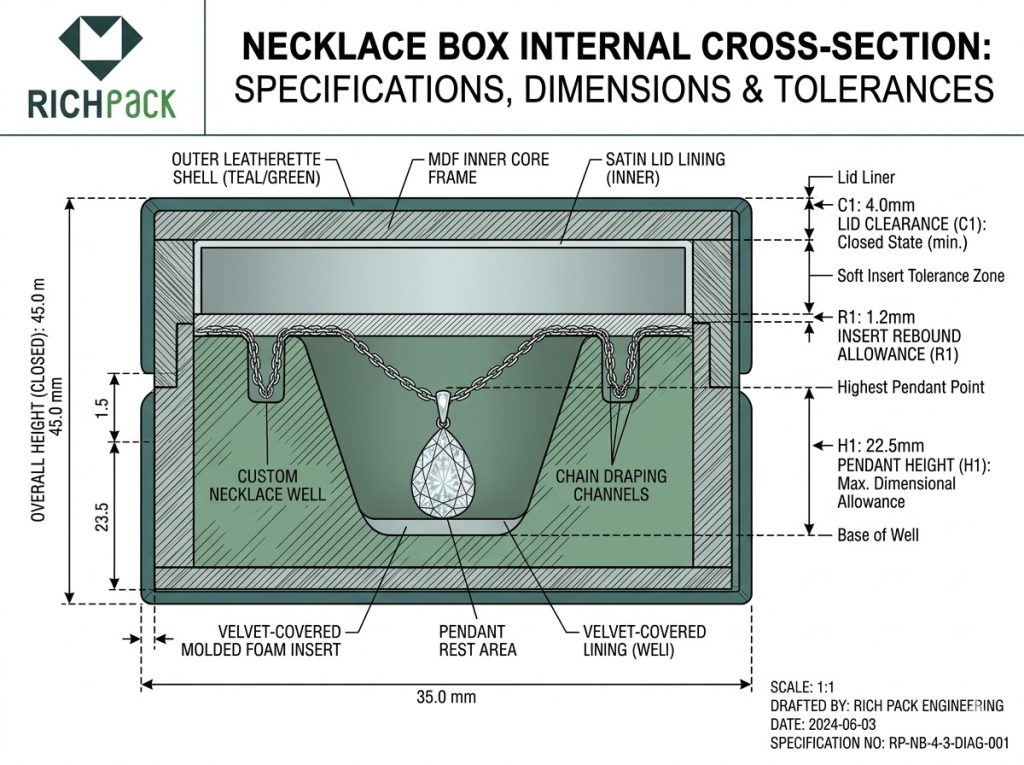
Internal dimensions matter more than outside dimensions. Hook spacing, pouch depth, insert firmness, and lid clearance decide whether a necklace box protects the piece or creates tangles, pressure marks, and poor presentation.
Size is not a number on the outside of the box. Size is how much safe, usable space exists after the walls, lining, and insert take their share.
That is why insert design often matters more than external dimensions.
Noble Pack makes a key point that many buyers miss. Internal dimensions matter more than external dimensions. The outside may look generous, but wall thickness, wrapped paperboard, EVA, and lining all reduce usable space.
Use this rule.
For many rigid paperboard boxes, a 1200gsm to 1500gsm wrapped board with a 2 to 3 mm insert top layer can reduce usable interior space more than buyers expect.
Do not approve samples based on exterior size alone.
Hook count is not the real capacity.
Spacing is the real capacity. If hooks sit too close together, chains cross. If the hook edge is rough, the clasp catches. If spacing ignores pendant width, products collide once the lid closes.
A good hook layout should account for:
In many custom programs, hook spacing below 8 to 10 mm becomes risky for layered or mixed-chain layouts.
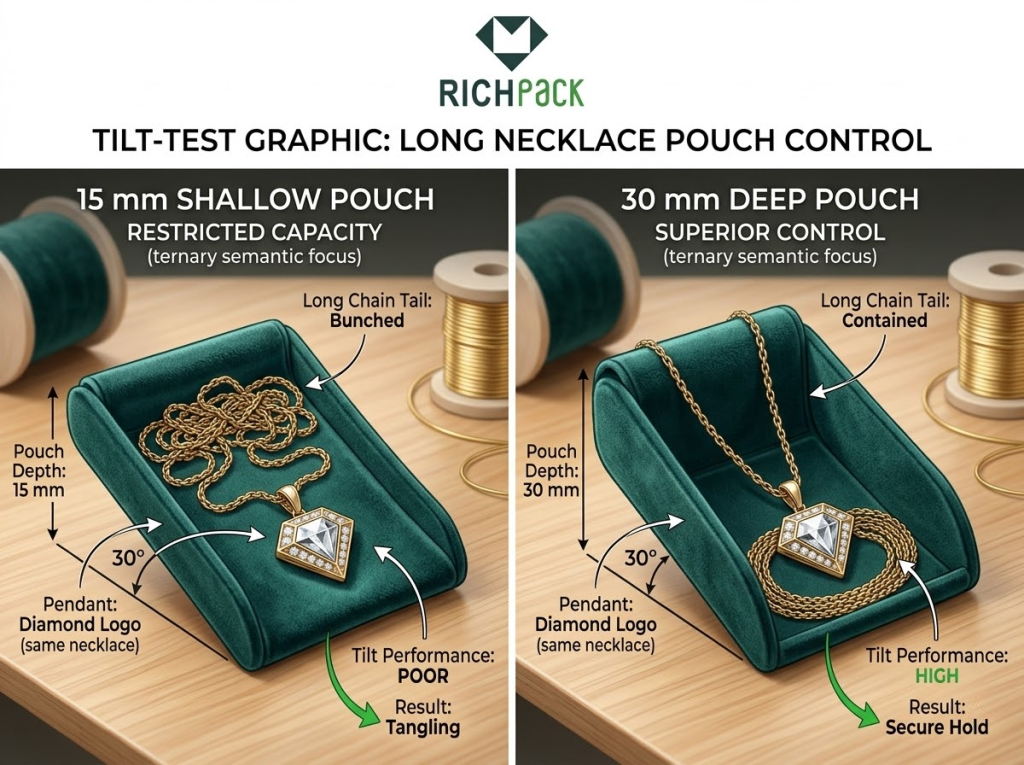
Tail control stops tangles.
A shallow pouch is one most common reasons long necklaces fail in transit. The chain tail slips out, moves across the insert, and wraps into knots. RichPack’s real-world tests highlight this well.
Best practice:
Soft is not always safer.
A very soft insert can let a heavy pendant move too much. A very hard insert can create pressure or abrasion. The goal is balanced firmness. EVA foam with a microfiber or velvet surface often works well because it combines structure and surface protection.
Common insert options:
| Insert Material | Typical Use | Strength | Risk |
| EVA foam insert | Heavy pendants, statement pieces | Strong support | Can feel too stiff if the top layer is thin |
| Microfiber interior | Premium plated jewelry, pearls | Low-lint, clean finish | Higher material cost |
| Velvet pad | Classic gift presentation | Familiar premium feel | Cheap grades can shed lint |
| Suede-touch lining | Soft contact and modern feel | Good visual warmth | Needs rub testing |
Lid clearance is one most overlooked specs in custom jewelry packaging.
If the lid closes against a raised pendant, the necklace may still fit, but it will not be protected. You need enough vertical room to protect the highest point without letting the whole product float.
A practical method is simple.
A necklace box with light is not always the right answer.
It works best for high-ticket gifting, proposal-style moments, limited-edition launches, and hero products where dramatic reveal matters. It is less useful for broad SKU programs, sustainability-first packaging, or brands that want minimalist elegance.
Use it when:
Skip it when it adds complexity without increasing perceived value.
Material choice should balance cost, perceived value, weight, print flexibility, and sustainability. Cardboard and rigid paperboard usually win for scalable jewelry brands. Plastic fits value or visibility-led programs. Metal Suits’ limited-edition keepsake packaging is more than a broad commercial use.
Material choice is brand strategy.
You are not choosing only between cheap and expensive. You are choosing between feel, durability, customization freedom, shipping efficiency, and long-term brand signal.
| Material | Relative Cost | Perceived Value | Weight | Sustainability Fit | Best Use Case |
| Cardboard necklace box | Low to medium | Medium to high | Light | Strong | Scalable retail and e-commerce |
| Rigid paperboard necklace box | Medium to high | High | Medium | Strong | Premium D2C and boutique programs |
| Plastic necklace box | Low to medium | Low to medium | Light | Weak to medium | Promotional or visibility-led packaging |
| Metal necklace box | High | High | Heavy | Medium | Keepsake, limited edition, premium gifting |
| Velvet or fabric-wrapped rigid box | Medium to high | High | Medium | Medium | Luxury presentation programs |
The cardboard necklace box is often the best mainstream option.
It balances cost, print flexibility, structure options, and shipping efficiency well. It can be built into folding cartons, rigid wrapped boxes, or drawer styles. It also supports stronger sustainability messaging than plastic-heavy formats.
For stronger premium programs, many brands step up to rigid paperboard in the 1200gsm to 1500gsm range with wrapped art paper and custom inserts. For lighter programs, folding carton grades can stay much lower while still supporting branded presentation.
Best for:
A plastic necklace box works best when visibility, lightweight handling, or lower-cost consistency matters most.
It can be useful for promotional packaging, value lines, or programs where transparency helps the product sell. The tradeoff is perceived value. Many premium buyers still read plastic as less luxurious unless the design is tightly controlled.
Best for:
A metal necklace box offers durability and keepsake value.
It can feel collectible, special, and gift-worthy. It can also feel heavy, expensive, and harder to scale. For most broad commercial programs, it is too much. For commemorative collections or premium gifting, it can make sense.
Best for:
Fabric-wrapped packaging creates instant premium cues.
Velvet, suede-touch, and textile wraps can make even a simple, rigid box feel elevated. The risk is quality inconsistency. Low-grade velvet can shed lint or transfer dye, especially onto polished metal or pearls.
Do not choose fabric wrap by photo sample alone. Check rub resistance, lint behavior, and long-term finish stability.
Rigid paperboard is one strongest choices for a luxury necklace gift box.
It gives you structure, finishing flexibility, and a polished open-and-close feel. It supports foil stamping, embossing, debossing, wrapped textures, and custom inserts without forcing the weight of metal.
For many D2C and boutique brands, rigid paperboard in the 1200gsm to 1500gsm range hits the sweet spot between luxury and scale.
Sustainable packaging should not look apologetic.
Recyclable paperboard, reduced-plastic construction, right-sized structures, and well-controlled printing can still look premium. The mistake is using sustainability as an excuse for weak fit, poor print quality, or flimsy inserts.
As noted across leading jewelry packaging suppliers, sustainability works best when it starts in the structure. That means right-sizing the footprint, reducing void space, and avoiding overbuilt packaging for low-value SKUs.
Luxury packaging does not come from extra decoration alone. It comes from precise opening motion, low-lint interior materials, disciplined logo finishing, color consistency, and a reveal sequence that feels controlled from first touch to final product display.
Luxury is a detail discipline.
Most buyers do not judge premium packaging by one feature. They judge it by how many small details feel intentional together.
The opening motion matters.
A rigid lid should align cleanly. A magnetic close should feel precise. A drawer box should slide smoothly without wobbles. These details turn packaging into a tactile brand experience.
If the movement feels loose or rough, the box loses value fast, even if the outside looks beautiful.
Lining quality shows up the moment the customer opens the box.
Low-lint microfiber and well-made suede-touch materials often protect jewelry better than cheap velvet. This is especially important for bright metal surfaces, gemstones, and pearl finishes.
Do not let the lining become the source of contamination.
Logo finish should match the brand, not overpower it.
Use foil stamping for sharp, premium contrast. Use embossing or debossing for subtle texture. Use screen print for simpler, more cost-efficient programs. The best choice depends on your identity, product price, and material base.
Unlike noisy fast-fashion packaging, premium jewelry packaging often wins with restraint.
Color builds recall.
A strong brand color system can make a box recognizable before the logo is read. That does not mean every necklace box should be bold. It means the exterior, interior, ribbon, insert, and print tones should work together.
Think in systems, not single surfaces.
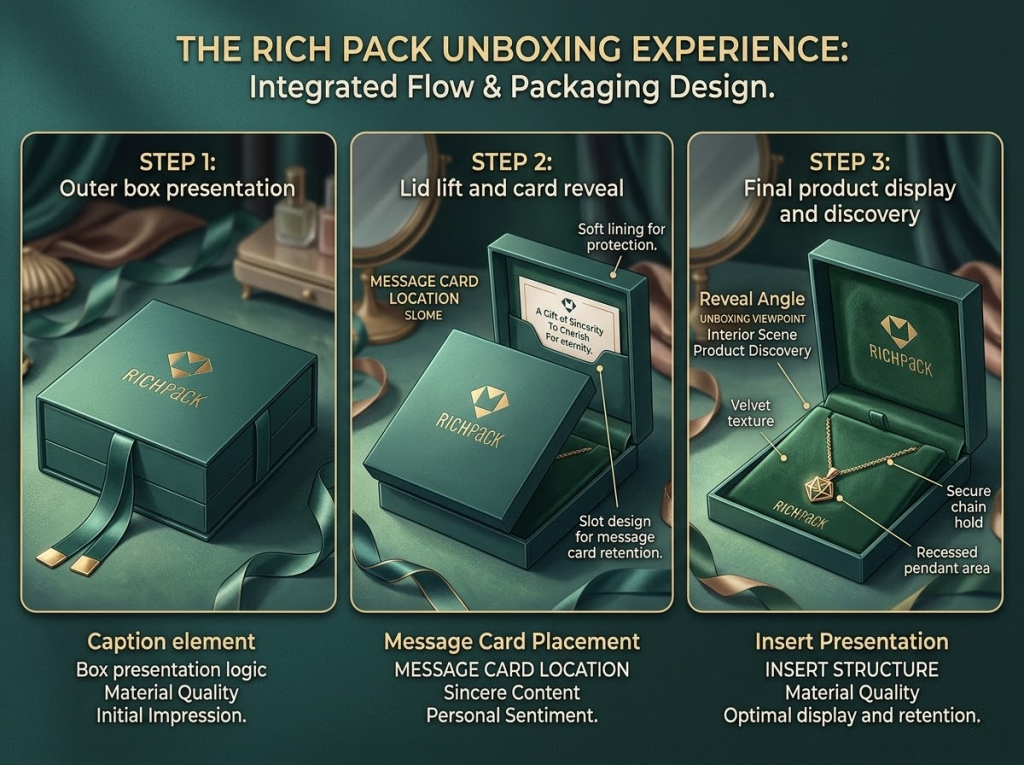
Customers notice the sequence.
They notice how the lid opens. They notice whether the necklace sits straight. They notice if the message card, tissue, or insert feels thoughtful. These are the moments that turn packaging into social media reach, user-generated content, and stronger premium perception.
More decoration does not always create more value.
Many luxury jewelry programs look stronger with fewer elements, better spacing, and cleaner materials. Overdesigned packaging can feel dated, especially in modern D2C branding.
Simple structure plus precise finish often looks more expensive than busy decoration.
The best jewelry packaging balances three things at once: product protection, visual presentation, and shipping efficiency. If the box looks luxurious but increases freight waste, transit damage, or storage cost, the packaging system is not working hard enough for the brand.
This is where procurement gets real.
The perfect-looking box fails if it destroys margin, ships poorly, or takes too much shelf space. Strong packaging programs balance protection, presentation, and cost discipline together.
Bigger does not mean better.
A right-sized box can still feel premium if the insert fits well and the reveal is controlled. Smaller external dimensions reduce storage cost, shipping volume, and secondary packaging waste.
This matters even more for brands shipping internationally.
E-commerce changes packaging physics.
The necklace will face vibration, sorting, stacking, and shock. A beautiful insert that only works in a showroom is not enough. Test the sample as if it were going through a rough parcel network, not a polished retail counter.
Check for:
Retail needs family resemblance.
When multiple boxes sit together in a display, consistent heights, coordinated finishes, and related silhouettes make the collection look more professional. As noted by Noble Pack, retail-ready dimensions and visual consistency help jewelry packaging support the display, not fight it.
That is one reason jewelry brands often create packaging families instead of isolated box designs.
Do not give every SKU the same packaging budget.
Entry items do not always need the same box as hero items. If you overbuild packaging for lower-margin products, you compress margin without adding enough customer value.
Instead, tier your packaging.
If the budget is tight, upgrade visibility-first products first.
Focus on bridal items, limited editions, influencer mailers, holiday gift sets, or pieces with strong social sharing potential. Those products get the biggest return from a premium presentation.
This gives you brand lift without rebuilding the full packaging system at once.
A flat mockup is not enough.
Request filled samples, transit samples, and real fit tests. Ask suppliers to pack the actual necklace or a matching dummy. Then check the details that usually fail first.
Use sample testing to validate structure, not just appearance.
A strong supplier brief should include necklace type, exact measurements, insert performance needs, finish specifications, transit requirements, MOQ, and lead time. If you only describe the look, the supplier still has to guess the structure, and that usually creates delays and sample waste.
Most packaging delays start with vague briefs.
If you want a supplier to build the right custom necklace box, you need product-specific information, not broad style descriptions.
Do not send one generic sentence like for necklaces.
Break the program down by style. Include chokers, pendants, layered pieces, pearl strands, or statement necklaces separately. Each category may need a different insert logic, even if the outer box family stays consistent.
Use real numbers.
Give chain length, pendant width, pendant thickness, clasp size, and any parts that create raised height. This helps the supplier build usable internal dimensions instead of guessing from photos.
Talk about performance, not just looks.
For example, say you need a deep pouch for long-chain tail control, a low-lint microfiber top layer, or an EVA-backed insert that holds a heavier pendant upright. That brief is far better than saying a premium velvet insert.
Set the visual system early.
Include the logo finish, target color references, print or foil method, and preferred texture. If the brand needs consistency across ring, earring, and necklace packaging, mention that now, not after sampling starts.
Always ask for real-use samples.
A visual approval sample does not tell you how the box performs under shipping stress. Ask for filled tests, movement tests, and, if needed, small pilot runs.
A beautiful design that misses the business model is still bad.
Confirm MOQ, tooling expectations, lead time, carton count, storage impact, and shipping efficiency before approving the final direction. These factors decide whether a packaging concept can scale.
The best necklace box for long necklaces usually uses a top anchor point and a deep pouch or hanging layout to control both the chain drop and the tail.
That structure keeps the chain from swinging and stops the tail from slipping loose during transit.
Yes. Layered necklaces usually need separate lanes, sleeves, or clasp anchors because a single flat insert allows chains to cross and knot.
That is why a larger box alone does not solve the problem.
A cardboard necklace box is usually better for premium branding, custom finishes, and sustainability goals, while a plastic necklace box fits lighter, lower-cost, or visibility-led programs.
The right choice depends on the perceived value, target, budget, and channel.
Use a necklace box with light for high-value gifting, proposal-style presentation, or hero-product launches where the reveal moment matters enough to justify the added cost and complexity.
For broad SKU programs, it is often unnecessary.
The right necklace box size depends on internal dimensions, pendant profile, insert depth, and chain path, not just outside measurements.
The box should fit the necklace securely without excess void space or lid pressure.
A luxury necklace gift box feels premium when the fit is precise, the lining stays clean, the opening motion feels smooth, and the finishes match the brand instead of overpowering it.
Small details usually matter more than extra decoration.
The best necklace box is the one that fits the necklace style, protects the finish, and supports your brand without wasting cost or space. Match structure first. Then choose insert, material, and finish based on channel, product value, and shipping reality.
Choose packaging by necklace behavior, not by box trend alone.
Now it is your move. If you are reviewing a new packaging program, start with your top necklace styles and test each one against real inserts before you approve the final box.





 PREV
PREV