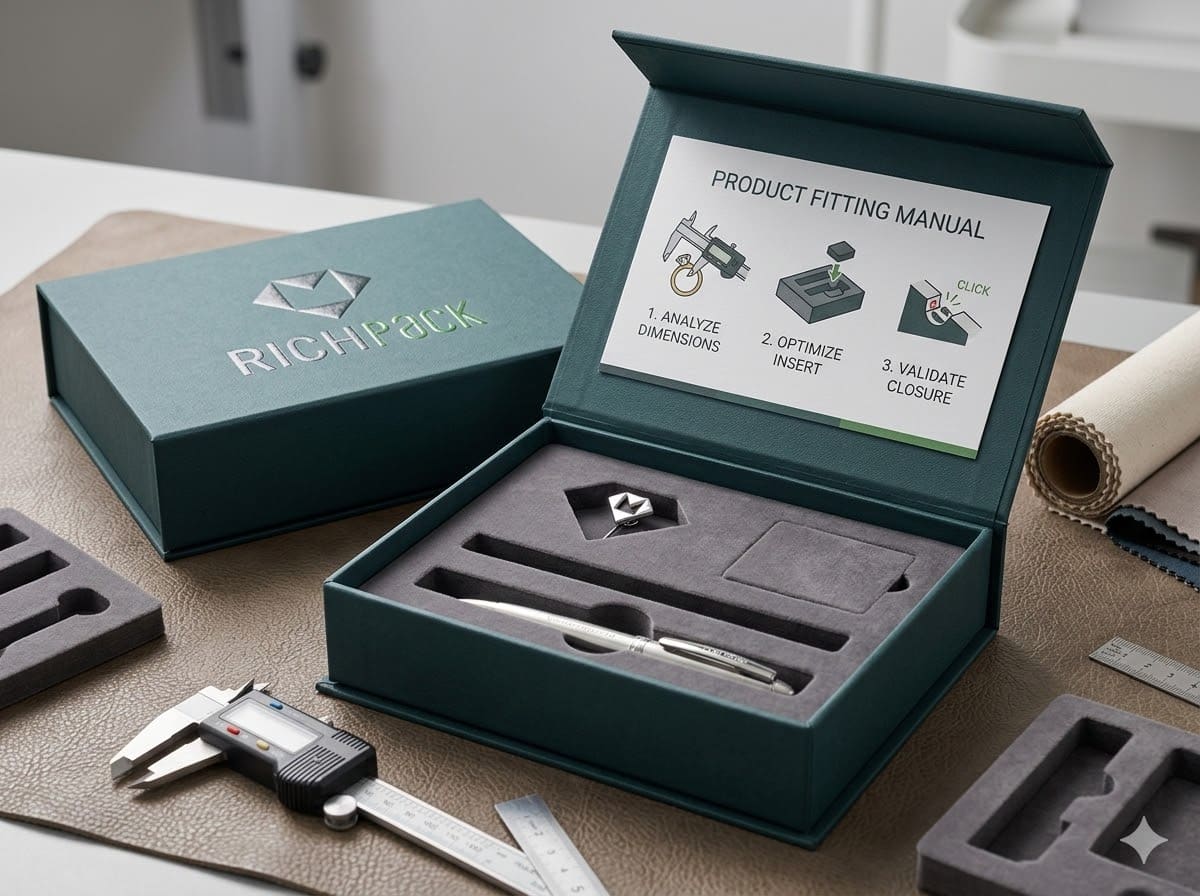



A premium box only works when the product fits it perfectly. If the item slides, tilts, rattles, looks buried, or feels squeezed, even a beautiful magnetic closure gift box loses luxury value fast.
That is why fit should come before finish. Before you choose foil stamping, soft-touch lamination, or ribbon pulls, make sure the box structure, insert, depth, and tolerance are built around the product itself.
In this guide, I will show you how to make products perfectly fit your magnetic closure gift box. You will learn how to measure the product, choose the right structure, build the right insert, control internal dimensions, and test everything before placing a wholesale order.
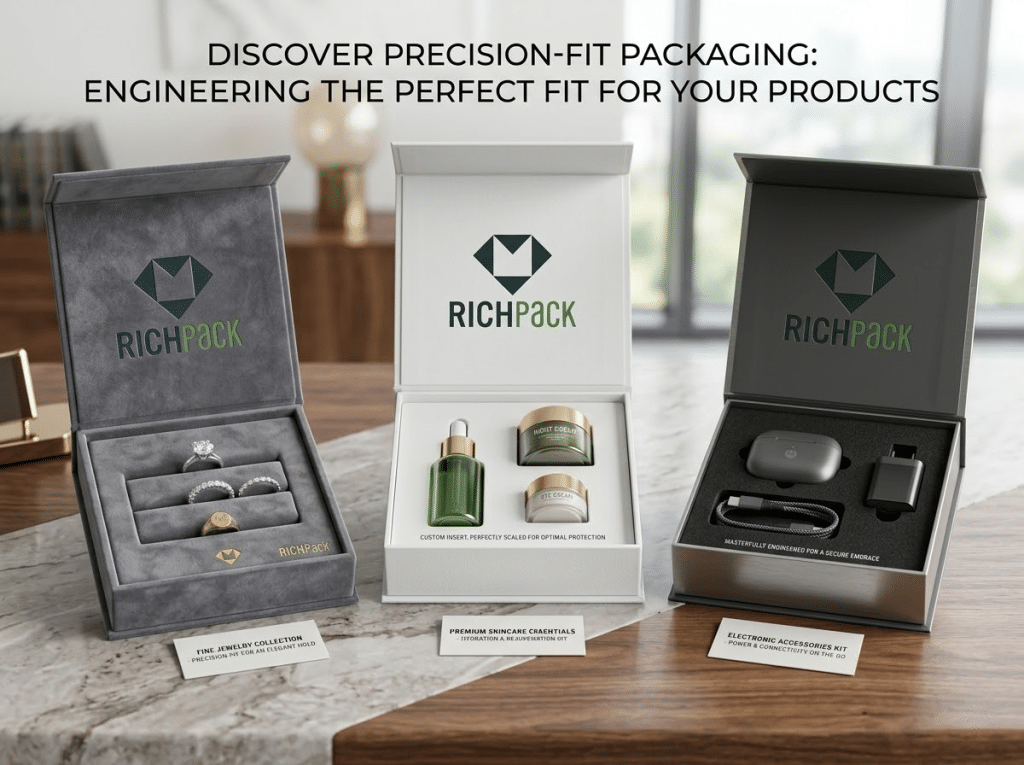
Many buyers treat fit as a technical detail. It is not. In magnetic gift boxes, fit affects protection, luxury perception, shipping safety, and even the unboxing experience.
A perfect fit makes the product look intentional. A bad fit makes the whole package feel generic.
When the product fits tightly inside the insert, it moves less during shipping and handling. That lowers the risk of scratching, chipping, breakage, and corner impact.
This matters even more for jewelry, glass bottles, electronics accessories, and any premium item with delicate surfaces. A magnetic closure gift box can look rigid and secure from the outside, but if the inside fit is loose, the product can still suffer damage.
The box protects the outside. The insert protects the product.
Luxury packaging depends on control. The product should sit straight, look centered, and feel visually balanced when the lid opens.
If the product appears too small for the box, the packaging feels wasteful. If it looks cramped, the box feels poorly planned. Both outcomes reduce perceived value.
A perfect fit helps the product look more expensive without changing the product itself.
A good fit improves the reveal. The customer sees the product in the right position, at the right depth, with the right spacing around it.
That is why luxury magnetic closure gift boxes often feel better than standard cartons. The lid opens cleanly, and the inside layout guides the eye straight to the product.
In my experience, the best unboxing moments come from layout discipline, not from adding more decoration.
A box that fits the product correctly is easier to pack, easier to stack, and easier to protect in master cartons. It also reduces the chance that the product will shift during long-distance freight.
This is especially important for custom magnetic closure boxes used in wholesale programs. If one box design has to survive warehousing, handling, and international shipping, internal fit becomes a supply chain issue, not just a design issue.
Fit problems often show up in transit before they show up in photos.
Customers notice loose packaging fast. If the product arrives tilted, rattling, or misaligned, the brand loses trust before the product is even used.
That is why fit is part of quality control. A beautiful box that makes the product look unstable does not support premium positioning.
A good fit lowers friction. It gives the customer one less reason to doubt the brand.
Well-fitted magnetic closure gift boxes are more likely to be kept and reused. That matters for jewelry boxes, keepsake boxes, PR packaging, and presentation boxes.
When the inside looks clean and intentional, the whole box feels worth keeping. That extends brand exposure after the first purchase.
Reusable packaging starts with structure, not with marketing copy.
The most common fit problem starts at the first step. Buyers measure the product too casually, then try to fix the mistake later with an oversized box or a loose insert.
Start with precise measurements. That gives every later decision a stronger foundation.
Measure the product in its real orientation inside the box. Use the version the customer will actually receive, not an early concept or approximate mockup.
Record length, width, and height in millimeters. That gives better precision for custom magnetic closure gift boxes and custom inserts.
If the product has a cap, lid, chain, cable, or removable part, measure the assembled form, not just the main body.
A product is not always a clean rectangle. A necklace has a chain movement. A serum bottle may have a pump. An electronics kit may include corners, cables, or charging heads.
Identify the highest point, the widest point, and the most fragile point. These details affect insert depth, clearance, and protection zones.
If you only measure the base form, the final fit can still fail.
Many products do not go into the box alone. They may need a manual, warranty card, cleaning cloth, ribbon pull, thank-you card, or spare part.
Plan for every item that must sit inside the box. If you add these later, the box often becomes too shallow or too crowded.
A premium layout should look complete, not overstuffed.
Tolerance is the planned difference between the product size and the insert cavity size. In rigid packaging, do not guess it.
Use a simple mapping first, then confirm it with a physical sample. In the table below, the gap measurement means the total allowance across one dimension, not per side. A 50 mm wide product with a 1 mm total gap needs a 51 mm cavity width.
| Insert style | Gap measurement | Practical prototype starting point |
| EVA foam cavity | Product dimension to cutout dimension | +0.5 to +1.0 mm total gap for a snug hold |
| Velvet or suede over EVA/card | Product dimension to wrapped cavity | +1.0 to +1.5 mm total gap to account for fabric thickness |
| Rigid paperboard insert | Product dimension to opening | +1.0 to +2.0 mm total gap for fold tolerance and easier loading |
| Soft sponge or compression insert | Product dimension to opening | 0 to -1.0 mm compression fit when rebound is needed |
If the product is heavy, slippery, polished, or fragile, stay near the tighter end and test the real sample. If the product has a soft pouch, shrink film, or protective sleeve, measure with that layer included.
For EVA inserts, ask the supplier what die-cut accuracy they can hold. Many EVA insert specs target around ±0.5 mm cavity accuracy, and that matters when the product has sharp edges or a premium finish.
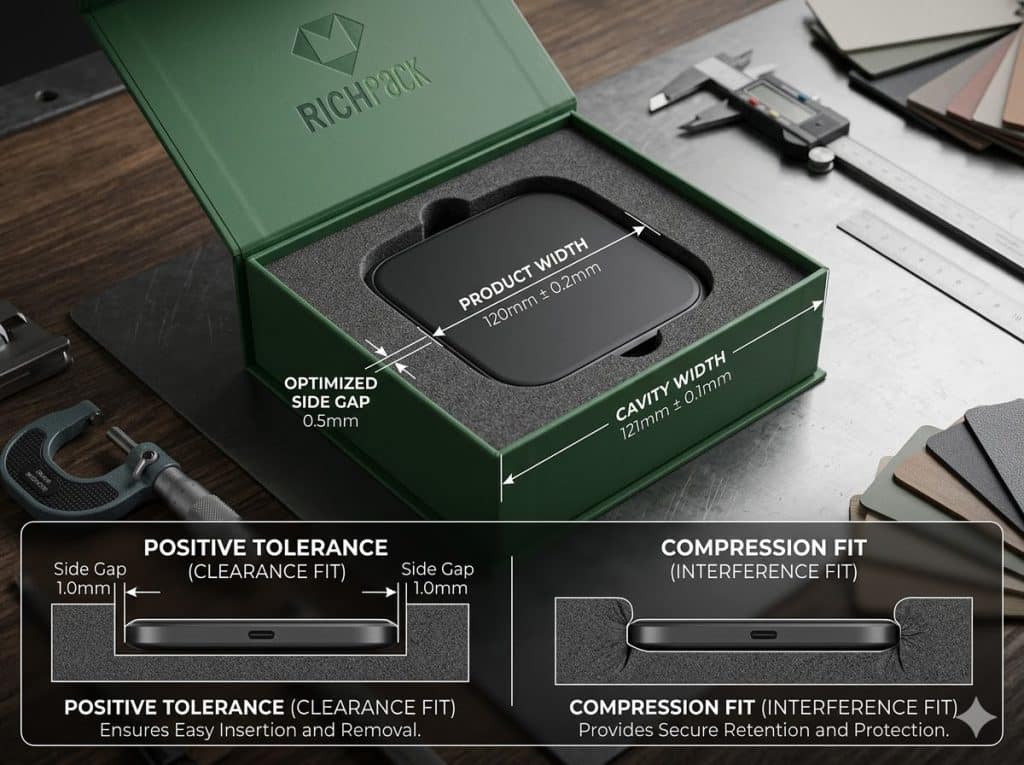
Many buyers focus on the outer box size because that is what they see in mockups. Real fit starts with internal dimensions.
The product fits inside the insert, and the insert fits inside the box. That means the internal base area and usable depth matter more than the outer shell.
Always build from the inside out.
The same product can fit very differently depending on how it sits in the box. A bottle can stand upright or lie flat. A jewelry set can be arranged in one row or on a layered tray. A device can sit centered or angled.
Orientation changes the dimensions, the reveal, and the insert style. It should be decided before the artwork is finalized.
A smart orientation reduces box size and improves visual balance at the same time.
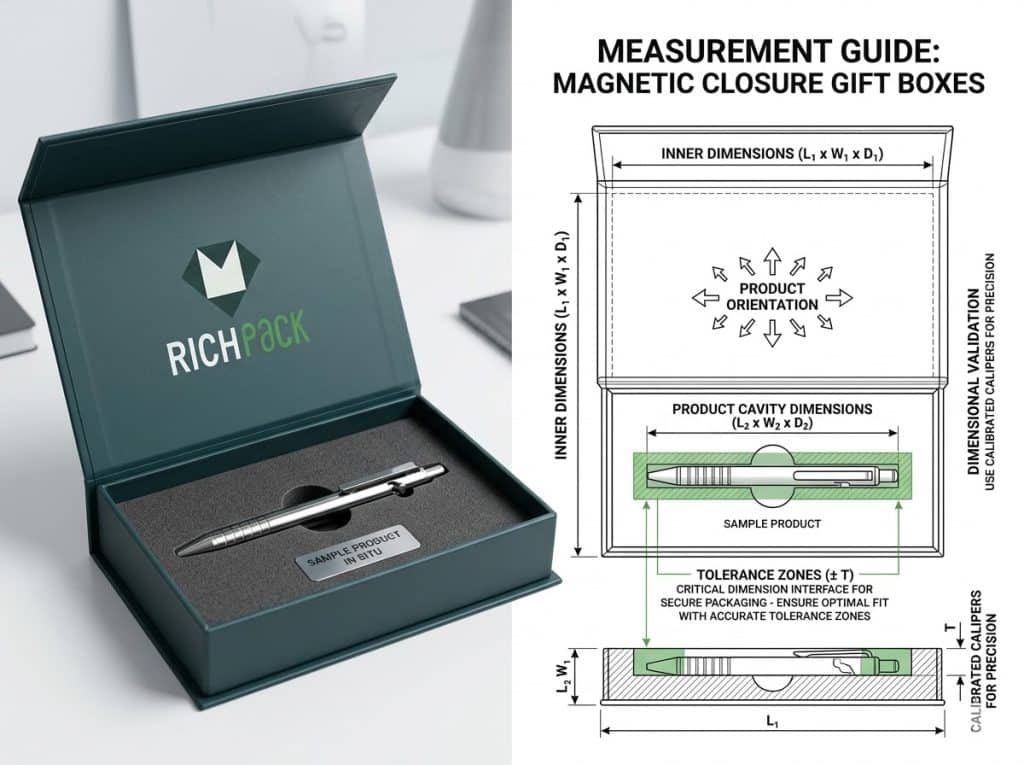
Fit is not only about size. It is also about the structure that surrounds the product. A good structure supports the product’s weight, category, and opening experience.
This is why two products with similar dimensions may still need very different magnetic gift boxes.
Rigid hinged boxes are one of the best choices when you want a steady, premium reveal. They work well for jewelry, watches, beauty sets, and premium accessories.
This structure helps the product stay visually anchored. It also pairs well with velvet, suede, EVA foam, and layered inserts.
If presentation is the priority, this format is often the strongest starting point.
Collapsible magnetic boxes are useful when storage and freight matter as much as presentation. They ship flat, which can reduce warehouse volume and transport costs.
They still need accurate insertion and panel alignment. A collapsible box only feels premium when it opens cleanly and holds shape after assembly.
For many magnetic closure gift boxes wholesale projects, this structure is worth comparing against standard rigid formats.
Book-style boxes open more dramatically and directionally. That makes them useful for launch kits, collector sets, PR gifting, and products with a strong storytelling angle.
If the product should be seen in a staged reveal, this format can improve the experience. It also gives more room for inner cover branding or a printed brand message.
This style works best when the product layout is deliberate and symmetrical.
A single product is simpler to fit than a kit with several components. Once you add two or more items, spacing becomes part of the design problem.
Skincare sets, jewelry collections, and electronics gift kits often need custom compartments, stepped depths, or layered trays. Without planning, the box can quickly become too large or visually messy.
A multi-product box should still feel calm when it opens.
Heavier items need a stronger board, a stronger insert support, and more attention to drop resistance. A premium bottle, metal accessory, or device can put real strain on the insert if the fit is too loose.
This is where EVA foam or engineered paper structures become more useful. The goal is to stop movement before it starts.
Do not ask a light insert to do a heavy job.
Small products often suffer from oversized packaging. A ring, earring set, or compact accessory can disappear inside a box that looks luxurious but feels empty.
The right answer is not always a bigger insert. Sometimes it is a smaller box with better internal proportions.
Smaller, tighter, and cleaner often feels more premium than larger and emptier.
If the box is the stage, the insert is the structure under the performance. It holds the product in place, controls the reveal, and protects the item where the outer box cannot.
For most premium packaging projects, insert choice is the real fit decision.
| Insert material | Relative cost | Protection level | Best-fit products | Sustainability profile |
| EVA foam | Medium to high | High | Electronics, glass, metal accessories, multi-part kits | Weak paper-based story, use when precision and shock control matter most |
| Velvet or suede wrapped insert | High | Medium | Jewelry, watches, keepsakes | Premium feel, but mixed materials reduce recyclability |
| Paperboard insert | Low to medium | Medium | Skincare sets, stationery, and lightweight accessories | Strong paper-based option |
| Molded pulp insert | Medium | Medium to high | Eco-forward beauty, candles, devices, accessories | Strong sustainability story and recyclable fiber structure |
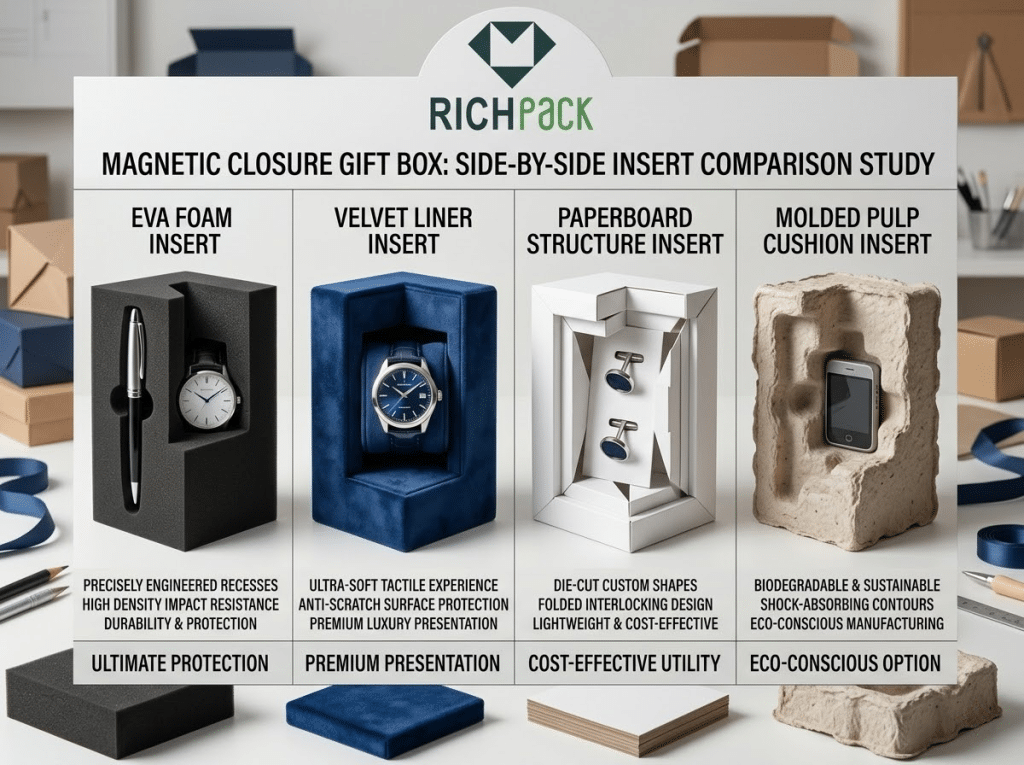
EVA foam is the best choice when the product needs a very controlled fit. It is strong for electronics accessories, glass products, tools, and premium gift sets with multiple hard components.
It supports sharp outlines and reduces movement during shipping. That makes it the right choice when protection comes first.
If the product is technical or heavy, EVA is the safest starting point.
Velvet and suede inserts are the natural choice for jewelry and other delicate luxury items. They add softness, reduce scratching, and help the product feel more giftable the moment the lid opens.
For magnetic closure gift boxes for jewelry, this pairing creates the strongest premium impression. The outer box brings structure. The insert brings elegance and control.
If the piece needs to feel precious, soft-touch insert materials win.
Paperboard inserts are a strong choice for skincare sets, stationery, lightweight accessories, and eco-conscious packaging programs. They keep the presentation clean while supporting a more paper-based material story.
This option is more budget-friendly than foam or textile-wrapped inserts. It also supports sustainability goals more easily.
The limitation is the support strength. Paperboard inserts need careful engineering when the product is heavy or fragile.
Molded pulp is the upgrade to consider when sustainability matters and the product still needs real structure. It is formed to the product shape, provides better protection than a simple folded card insert, and supports a stronger eco story than EVA.
It fits beauty jars, candles, small electronics accessories, and many secondary components well. It is less suited to ultra-smooth luxury jewelry presentation unless the pulp finish is refined enough for the brand standard.
If your buyer brief includes FSC-certified board, lower plastic use, or a more recyclable material mix, molded pulp deserves a sample round.

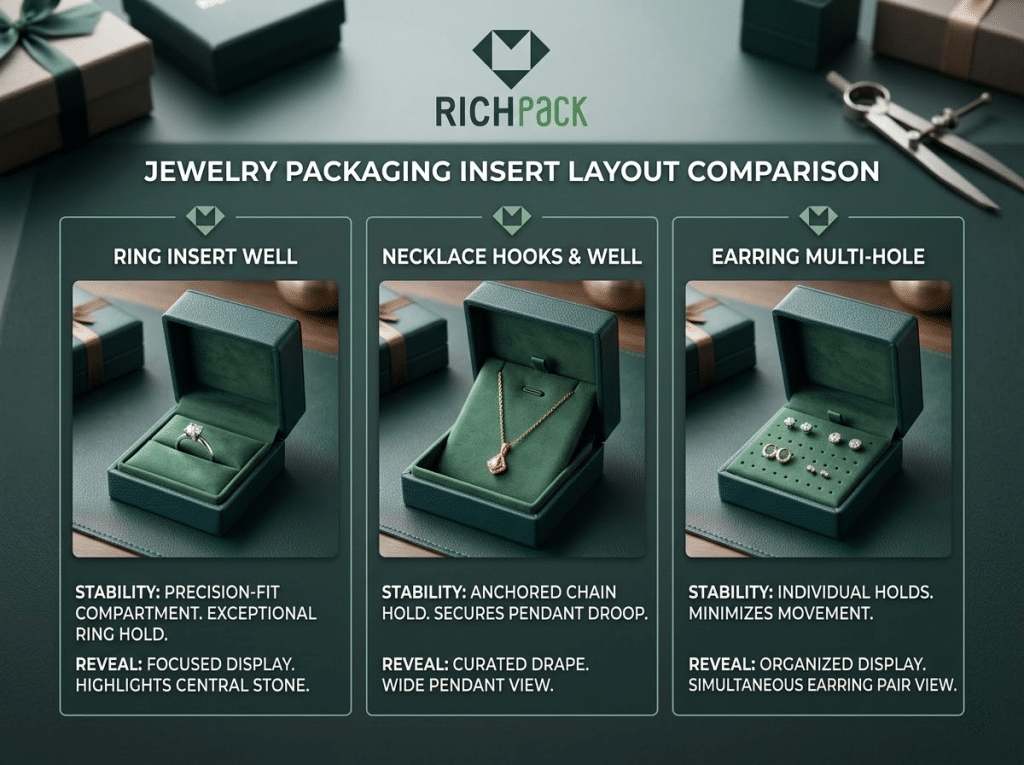
Jewelry needs precise positioning. Rings should sit upright or slightly raised. Necklaces need chain control. Earrings should not shift or snag. Bracelets need enough support to hold their shape without looking forced.
That is why jewelry packaging fit depends on more than box size. It depends on slot shape, surface softness, lift height, and visual spacing.
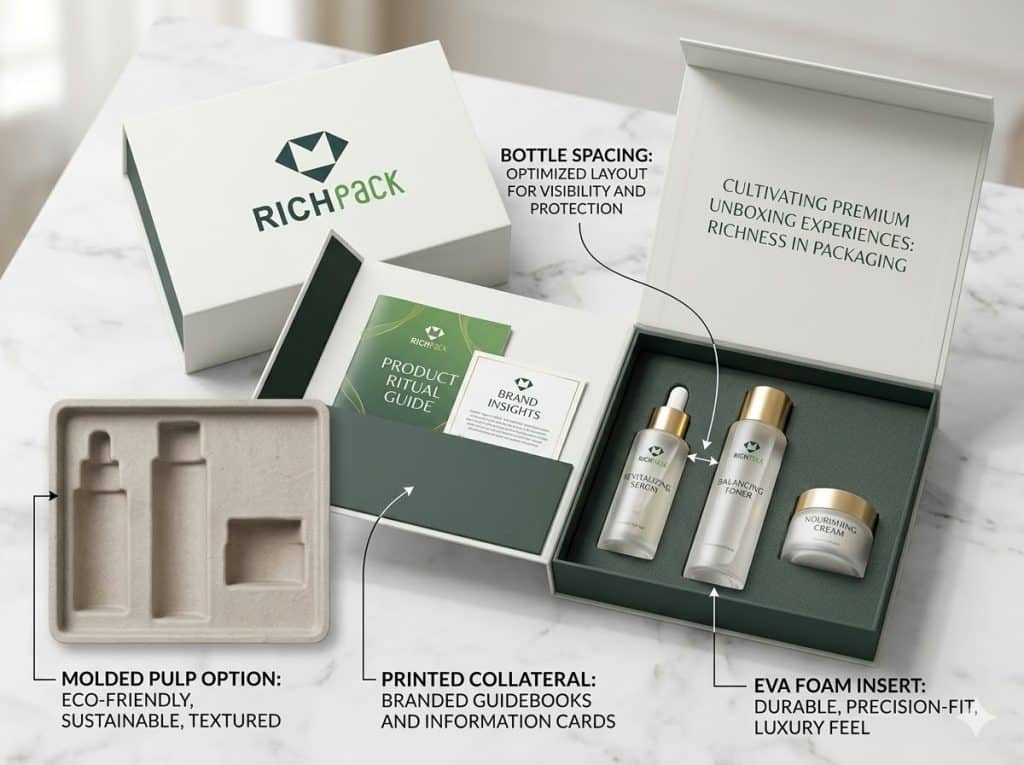
Beauty and skincare sets often combine bottles, jars, droppers, and small accessories in one package. That creates different fit needs than a single hero product.
Use inserts that hold each component securely while keeping the layout clean and easy to understand. The customer should not have to guess where each product belongs.
If sustainability is part of the brief, compare paperboard and molded pulp against EVA early instead of treating them as an afterthought.
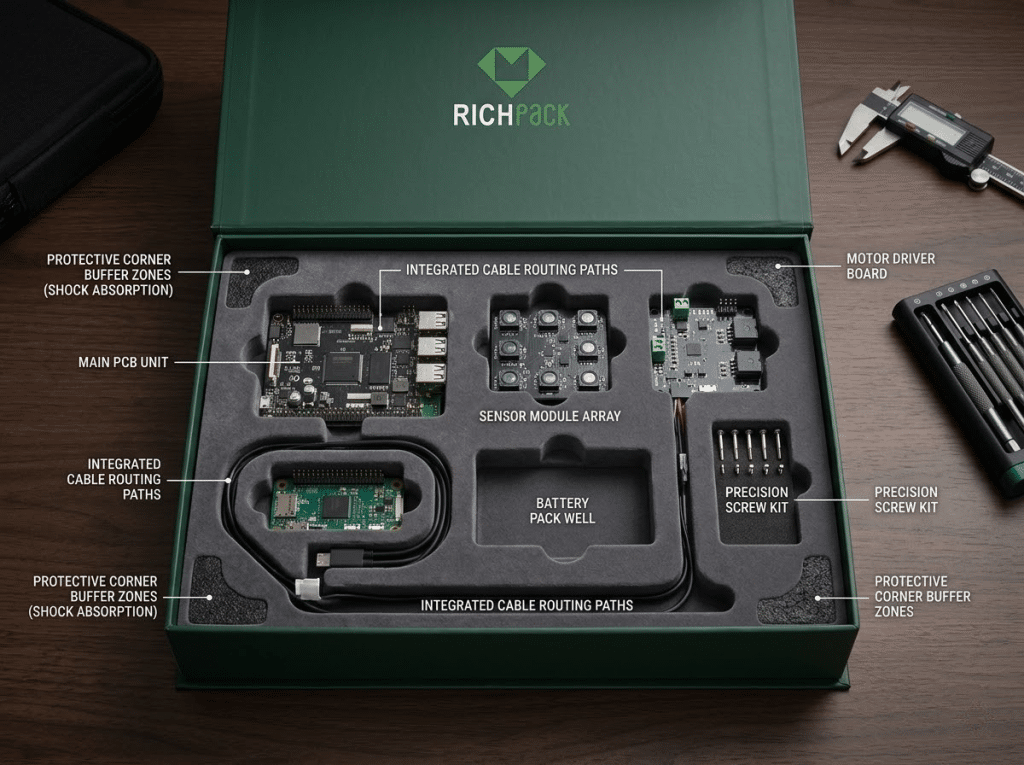
Electronics packaging needs accurate cutouts and stronger shock control. Chargers, earbuds, cables, and compact devices shift quickly if the insert is too loose.
This category benefits from EVA foam or engineered paper compartments. The inside should feel precise, not decorative.
If the product has multiple pieces, label logic, compartment spacing, and drop orientation all matter.
Once the product and insert are clear, you can build the internal box dimensions. This is where fit becomes physical rather than theoretical.
The goal is not maximum room. The goal is the right amount of room.
Use this formula path before artwork approval:
That sequence turns packaging fit into numbers instead of guesswork.
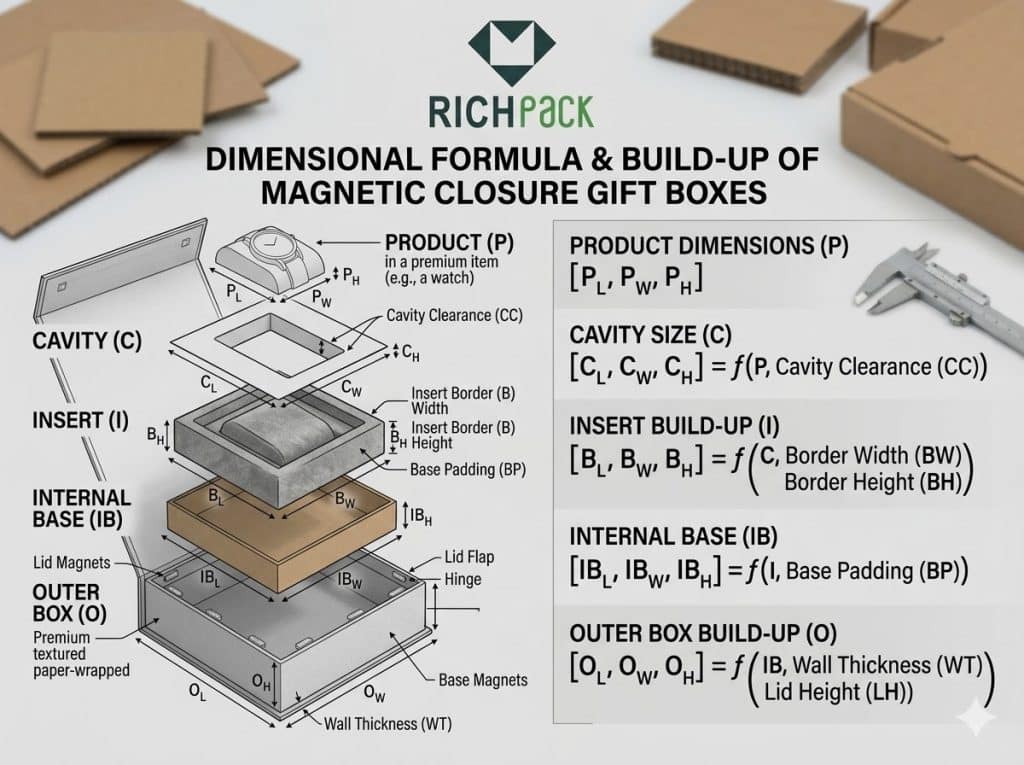
Leave enough space for the product to sit comfortably inside the insert and enough margin to avoid pressure damage. That space must reflect the inserted material and the product surface.
A polished metal item, a glass bottle, or a coated cosmetic container needs a different buffer than a paper-wrapped accessory. Clearance should be intentional, not guessed.
This is one of the smallest details and one of the biggest quality signals.
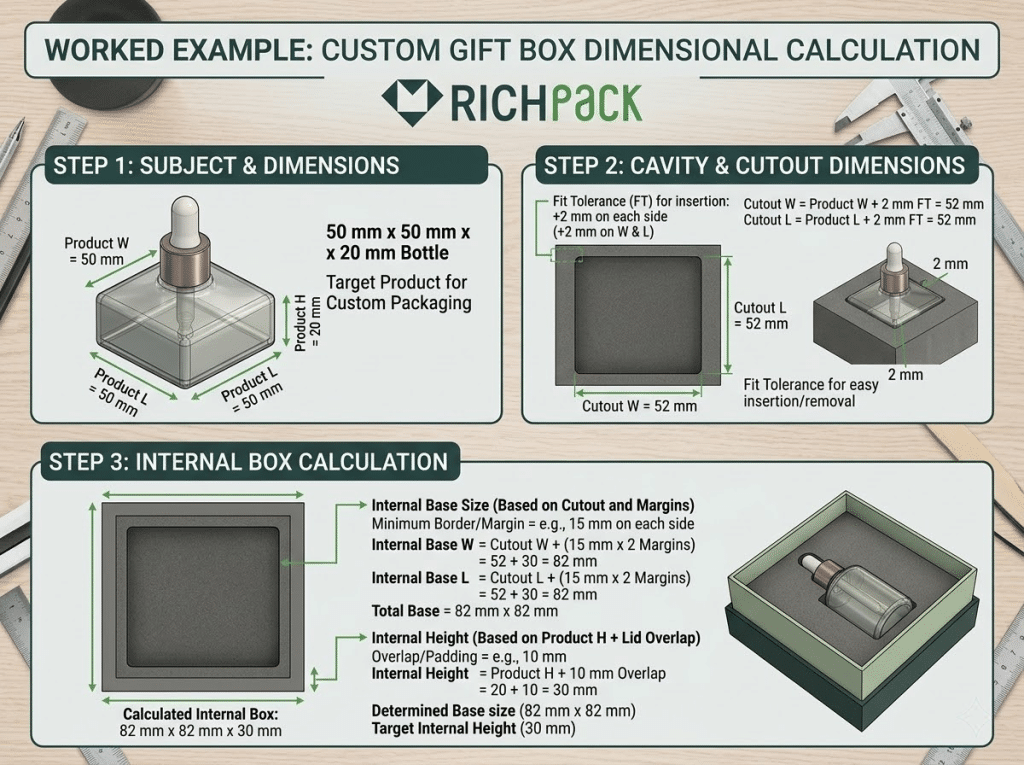
Fit Calculation Example
Example product: a perfume bottle measuring 50 x 50 x 20 mm.
Example insert plan:
Calculation:
So the box should start from an internal size of 82 x 82 x 30 mm before the outer board build-up is added. If the rigid board is about 2 mm thick per wall, the outer base will grow by about 4 mm in length and width before wrap allowances.
That single example is the difference between a vague, small perfume box brief and a production-ready starting point.
A magnetic closure gift box usually has a base depth and a lid depth that work together. If the lid is too shallow, the box feels awkward or unsafe. If it is too deep, the product reveal feels buried.
The right depth depends on product height, insert thickness, and desired opening experience. Jewelry benefits from a shallower and tighter reveal. Multi-product kits need deeper walls and a more layered structure.
Depth should support both protection and presentation.
Board thickness changes the final internal volume. Even if the outer box dimensions look correct, the usable inside space shrinks once the greyboard and wrap are built.
References reviewed for this project note that rigid magnetic box structures commonly use around 800gsm to 1400gsm board, depending on size and performance target. Do not stop at GSM alone. Ask the supplier for the actual board thickness in millimeters because that is what changes the finished size.
A simple rule helps here. If one wall is 2 mm thick, two opposite walls add about 4 mm to the outer length or width. That number becomes meaningful fast on small jewelry boxes.
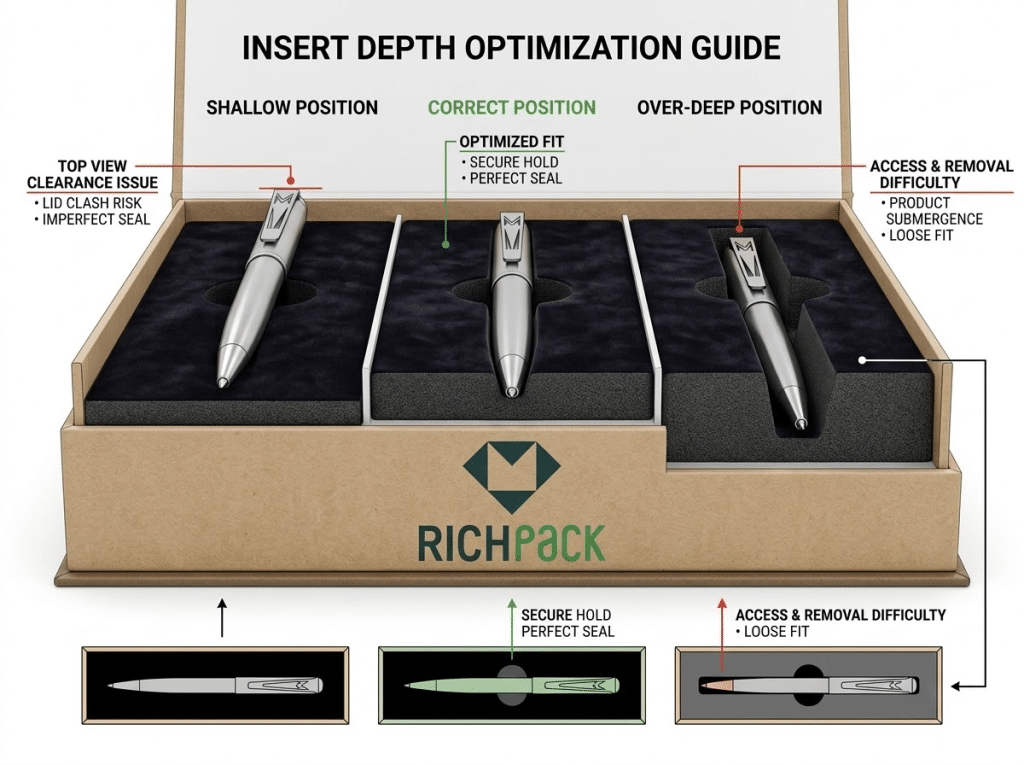
The insert should hold the product securely without hiding too much of it. If the product sits too deeply, it looks buried. If it sits too high, it rubs the lid or feels exposed.
This balance is especially important in luxury magnetic closure gift boxes, where the reveal must feel precise. The customer should see enough product to feel impressed, but not so much that the inside loses structure.
Fit is part engineering and part choreography.
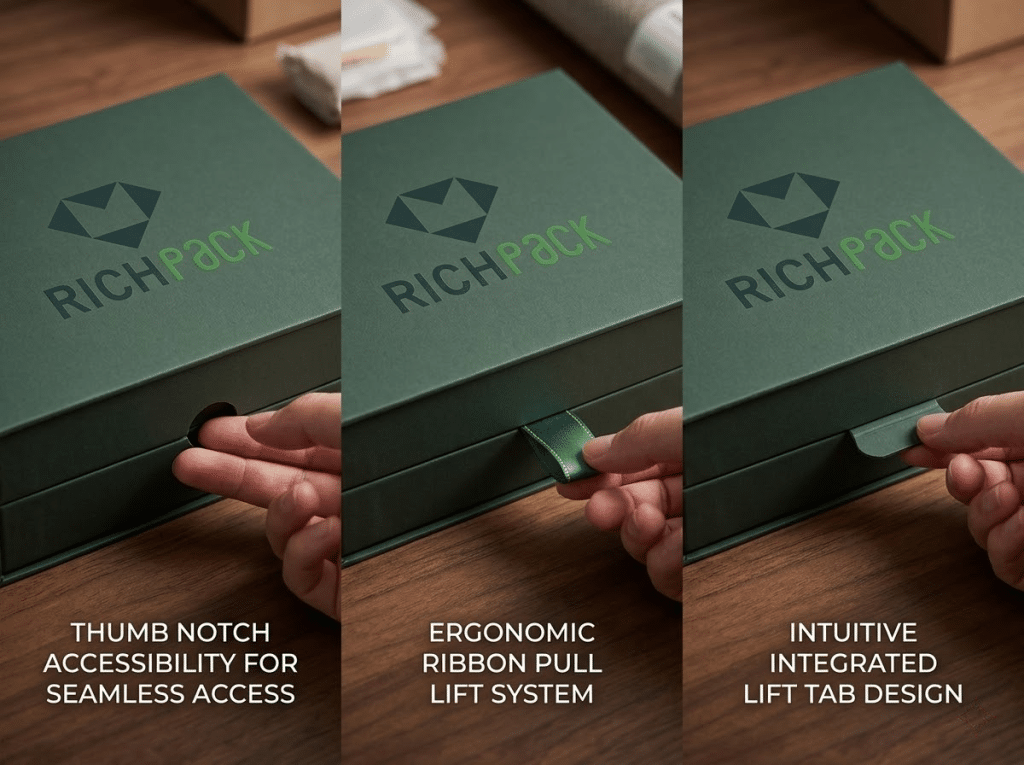
A perfect fit does not mean tight friction everywhere. The customer should still be able to remove the product without a struggle.
That may mean a thumb notch, ribbon pull, stepped insert, or a small lift point under the product. These details improve usability without making the fit look loose.
The best fit feels secure before removal and easy during removal.
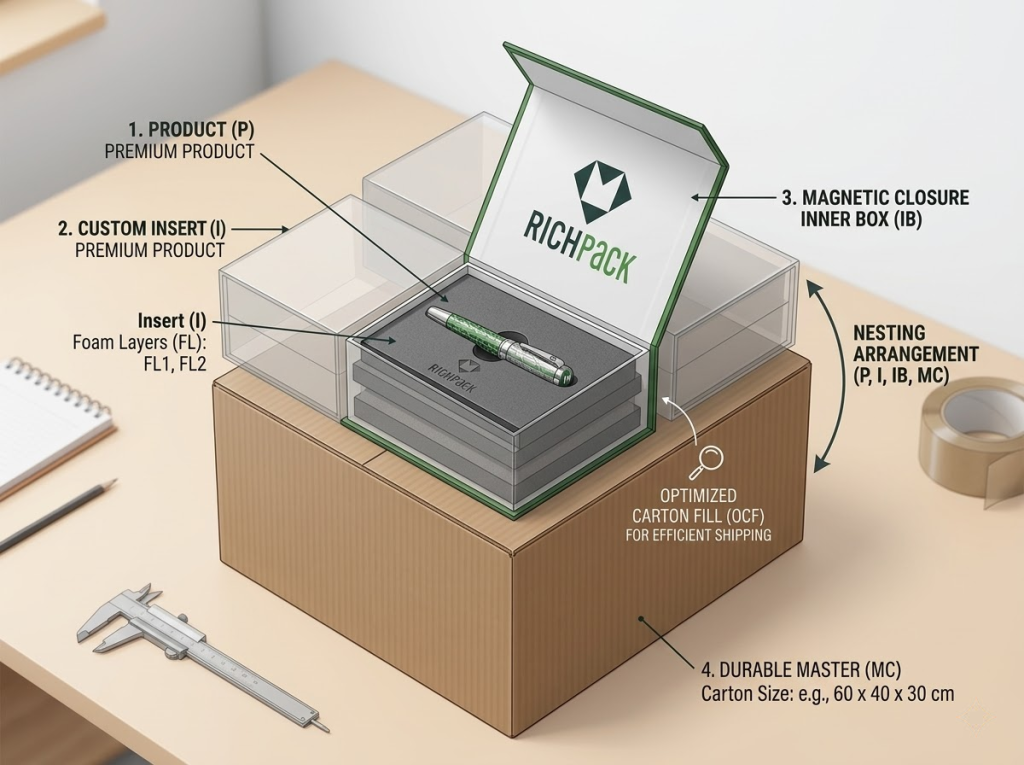
The product must fit the insert. The insert must fit the box. The finished box must then fit the outer carton efficiently.
This is where many wholesale buyers lose margin. They approve the primary packaging, then discover that the shipping carton is oversized, inefficient, or unstable in transit.
A well-designed magnetic closure gift box should work at both the retail level and the logistics level.
No matter how good the drawings look, fit should always be tested physically before mass production. This is one of the most important steps in the development of custom magnetic closure boxes.
Testing turns assumptions into proof.
A white sample helps you test the structure before final printing. It is useful for checking size, insert position, opening direction, lid depth, and general product fit.
This stage is about function. It is the fastest way to catch a proportion mistake early.
If the structure is wrong, do not move to finish the discussion yet.
A printed sample shows how the fit interacts with the visual finish. Surface details can change how premium the box feels, and the interior graphics may affect how the product is perceived inside the box.
This is also the right stage to check logo placement, reveal balance, and opening experience.
A design can be visually attractive and still feel wrong in the hand.
Never approve a fit sample without the actual product inside. Use the real SKU, the real accessory set, and the real insert orientation.
That is the only way to judge movement, visual balance, removal ease, and closure clearance accurately.
Packaging fit should always be tested under real conditions.
Gently shake the box. Open and close it several times. Place it in the shipping orientation. Review how the product behaves inside the insert.
If the product shifts, rises, tilts, or makes noise, the fit is not ready. This step often reveals problems that static viewing misses.
Small movement becomes big damage over long shipping distances.
Fit should be on the quality control checklist, not hidden inside the general appearance review. Check lid alignment, magnet closing feel, insert cut accuracy, product stability, and corner condition.
For magnetic closure gift boxes wholesale projects, consistency matters as much as sample quality. A great first sample means little if the production run drifts.
Premium packaging needs repeatable fit, not just one good prototype.
If the fit is not right, revise before the large order. That sounds obvious, but many buyers push forward because the artwork is finished or the deadline feels close.
Do not lock a bad structure because the visuals are done. It is cheaper to revise the fit than to explain premium packaging complaints later.
Scale only after the fit works.
Most fit problems are predictable. They happen when the buyer rushes measurement, guesses tolerance, or focuses too much on surface design.
These are the mistakes I would watch first.
Outer dimensions do not tell you enough. The product lives inside the usable interior space, not on the outside shell.
Always calculate fit from the inside out.
Bigger is not more premium. Oversized packaging often makes the product feel smaller and less intentional.
Luxury usually comes from proportion, not space.
A premium insert is not just decoration. It is the main system that stabilizes the product and controls the reveal.
If the insert is weak, the fit is weak.
Cards, manuals, pouches, charging cables, and cleaning cloths all take up space. If they are added late, the box often becomes crowded or badly stacked.
Plan the full contents from day one.
A sample can look correct and still fail with the actual item inside. Never approve based on empty box appearance alone.
Real product fit testing should be standard, not optional.
Foil, texture, and ribbon can improve a box, but they cannot fix a poor fit. If the inside is unstable, the outside finish will not save it.
Structure first. Finish second.
The answer depends on the product shape, insert material, and removal method. The goal is enough clearance for safe placement and removal, but not enough for visible shifting. A custom insert should hold the product securely without making it hard to remove.
Velvet or suede inserts are usually the best choice for jewelry because they improve presentation and reduce scratching risk. For some items, paperboard or hybrid insert structures can also work, but the fit must still control movement and support the piece properly.
Yes, they can be. A good collapsible magnetic box still needs strong panel alignment, accurate insert fit, and a clean opening experience. It is a strong option when brands want a premium presentation with better storage and shipping efficiency.
Check internal dimensions, insert accuracy, product movement, lid clearance, magnet feel, and shipping performance. For magnetic closure gift boxes wholesale projects, consistency across the full production run matters just as much as the prototype quality.
Yes, but only if the layout is planned carefully. Multi-product gift sets usually need custom compartments, balanced spacing, and a clear hierarchy inside the box. Without that planning, the box can feel crowded or disorganized.
That usually happens when the fit is off. The surface may look luxurious, but if the product sits too low, too loose, too tight, or out of proportion, the customer notices it immediately. Premium feel depends on internal fit as much as external finish.
If you want to make products perfectly fit your magnetic closure gift box, start with the product itself. Measure it accurately. Choose the right structure. Build the right insert. Then test the fit before mass production.
That process gives you more than protection. It gives you a cleaner presentation, smoother unboxing, stronger quality control, and better results from your custom magnetic closure boxes.
For jewelry, beauty, electronics, and other premium products, the best magnetic gift boxes are not just beautiful. They are engineered around the product from the inside out. If sustainability matters, apply the same fit logic to FSC-certified paperboard, paper-based inserts, and molded pulp where the product category allows it.





 PREV
PREV