

 PREV
PREV
5 Steps to Perfect Unboxing for Personalized Heart Bracelets
2024-11-19
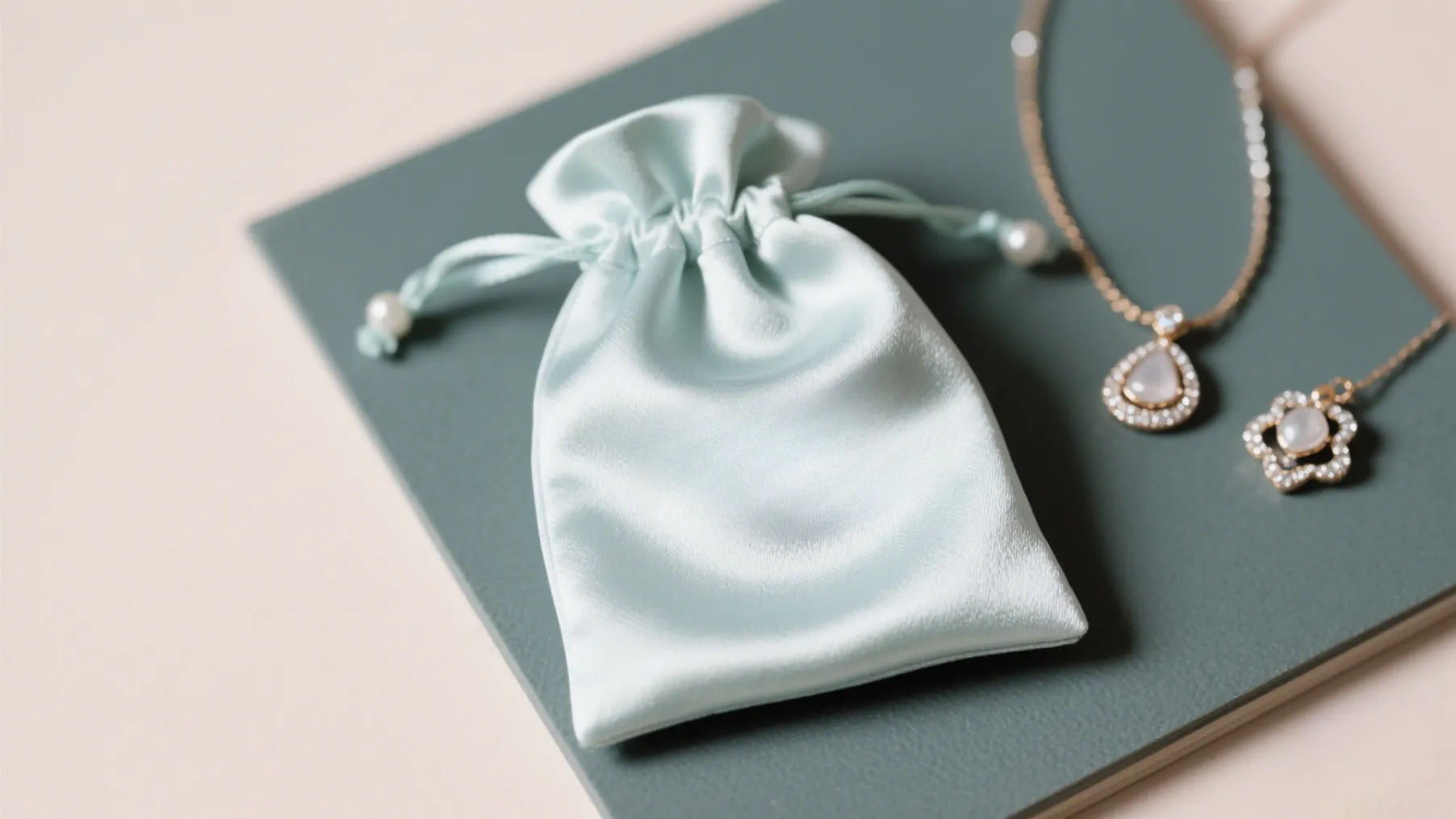



A pouch feels simple until the first bulk order goes wrong. The velvet sheds lint, the satin wrinkles in cartons, the drawstring cord slips, or the logo looks sharp on the proof but cloudy on the real fabric.
That is why jewelry pouches for wholesale should never be treated as a cheap add-on. They carry rings, earrings, pendants, bracelets, charms, travel sets, and gift programs through handling, shipping, storage, and the first customer touch.
The practical choice comes down to seven decisions: jewelry type, material, closure, size, logo method, order quantity, and sample approval. Get those right, and a pouch becomes a low-weight, reusable, brandable part of a larger jewelry packaging system.
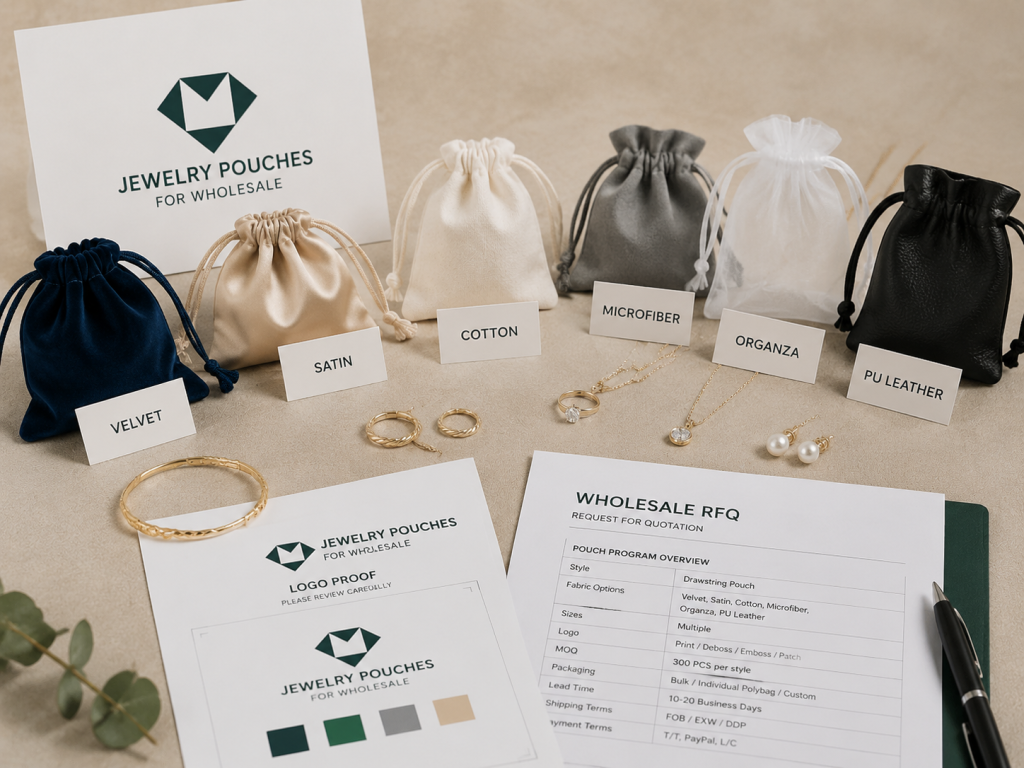
Wholesale jewelry pouch buying is the process of matching jewelry risk, brand position, order size, logo method, unit cost, and sample approval before production starts. The right pouch protects the item, speeds packing, fits the retail price, and gives the customer something worth keeping.
Most wholesale buyers can narrow the choice before requesting quotes. Start with the jewelry surface, then match the pouch material, closure, logo method, quantity route, and the cost ceiling your margin can actually carry.
The following table compares jewelry pouches for wholesale by jewelry type, pouch material, closure, size planning, logo route, and risk notes. Use it as a first-pass buying matrix before samples are made.
| Buyer Need | Recommended Route | Good Fit | Logo Method | Quantity Sensitivity | Main Risk |
| Rings and studs | Velvet or microfiber drawstring pouch | Small, high-touch items | Foil stamp or screen print | Low to medium | Lint or a tight opening |
| Delicate necklaces | Satin or microfiber pouch with card | Chains and pendants | Screen print or woven label | Medium | Tangling without an insert |
| Bracelets | Cotton, linen, or PU leather pouch | Wider items | Screen print, patch, or deboss | Medium | Poor sizing and seam stress |
| Travel jewelry sets | Microfiber zipper pouch | Mixed jewelry | Woven label or screen print | Medium to high | Scratches between pieces |
| Luxury gift program | Velvet pouch with box pairing | Premium rings, pendants, bracelets | Hot stamping or a metal charm | Medium to high | Pouch alone feels underbuilt |
| Event giveaway | Organza or cotton pouch | Charms, tokens, small gifts | Simple one-color print | High | Low perceived value |
| Hospitality and spa | Cotton or linen pouch | Amenities and jewelry-safe gifts | Woven label or screen print | High | Color transfer and odor |
Rings and earrings usually need small pouches with a soft inner lining and a clean opening. Velvet and microfiber are common because they cushion small surfaces and feel gift-ready.
Necklaces are more demanding. A drawstring jewelry pouch can work, but chains often need a card, loop, or folded insert so they do not knot during fulfillment.
Bracelets need width and seam strength. If the pouch is too narrow, the product creates pressure lines, bent corners, or a bulge that makes the gift feel improvised.
A value line can use cotton, organza, or simple satin if the stitching is clean and the drawstring closes reliably. The pouch should feel honest, not flimsy.
A premium line usually needs velvet, microfiber, PU leather, or a pouch paired with a rigid jewelry box. Buyers expect the package to slow the hand down before the jewelry appears.
For small test orders, stock pouches or stock pouches with a simple logo keep risk low. They are faster to approve and easier to reorder.
For repeat programs, custom fabric color, custom sizing, and a dedicated logo route make more sense. Fixed costs spread better once the design is used across several selling cycles.
Screen printing suits cotton, linen, satin, and some microfiber fabrics when the artwork is simple. Hot stamping looks refined on velvet and PU leather when the supplier controls heat, pressure, and foil selection.
Embroidery gives texture, but small letters can close up. Woven labels work well when the pouch fabric is hard to print or when a brand wants a consistent mark across pouches, bags, and textile accessories.
Retail handoff needs touch, color control, and a clean closure. The customer sees the pouch at the counter, so poor cord ends and crooked logos are hard to hide.
E-commerce fulfillment needs carton behavior. A pouch must survive packing, compression, dust, and movement before the customer handles it.
Pouches alone are enough for low-fragility items, sample programs, refill gifts, charms, lightweight earrings, and jewelry already protected by a card or sleeve. They also work well when shipping weight matters.
A pouch-only route works best when the jewelry is not exposed to bending, abrasion, or heavy movement. The pouch should still be tested with the actual jewelry, not a similar item from the sample room.
Pouches need boxes and inserts when jewelry has raised stones, thin chains, sharp posts, delicate plating, or high gift value. The pouch gives softness and reuse, while the box and insert control structure.
For a complete line, review custom jewelry pouches, custom jewelry boxes, and wholesale custom jewelry packaging sets together.
The best decision is often a matched set, not one isolated component.
A jewelry pouch is the soft layer in a packaging stack: it touches the product, carries the logo, controls small-item movement, and gives customers a reusable storage piece after checkout. It cannot do the job of a rigid box, but it can make the whole package feel warmer and more deliberate.
Wholesale jewelry pouches are soft, brandable protective packages used for jewelry storage, presentation, travel, retail handoff, ecommerce packing, and gifting. They reduce surface contact, add a tactile moment, and keep small items together after purchase.
A good pouch does several jobs at once. It protects the product, carries the brand mark, supports packing speed, and gives customers a reusable storage piece.
A pouch protects jewelry from light abrasion during picking, packing, retail handoff, and customer storage. It is not a hard shell, so it should not be asked to solve crush risk alone.
The lining matters as much as the outer fabric. A soft outside with a rough seam inside can still scratch plating or catch a chain.
The first touch sets the value cue before the jewelry appears. A soft velvet pouch says something different from a crisp cotton pouch or a translucent organza bag.
Presentation is not only about luxury. It is about whether the material matches the price point, jewelry category, and buying moment.
Customers often keep pouches long after the box is gone. That makes a pouch a small daily brand reminder, especially for rings, earrings, charms, and travel pieces.
Storage use depends on closure and interior behavior. A pouch that sheds fibers or tangles chains will not be reused for long.
Travel jewelry pouch demand is strong because customers want a soft, compact way to separate pieces. For wholesale buyers, that reuse value can justify a better material or an added divider.
If travel is part of the promise, test mixed jewelry inside the pouch. Earrings, chains, rings, and bracelets behave differently once the pouch is tossed into a handbag.
Some pouches support display as part of the sales ritual. A salesperson can place a ring pouch or earring pouch beside the item as the purchase is wrapped.
For open retail displays, boxes still do the heavier visual work. Pouches usually support the final handoff rather than replacing trays, stands, and cases.
Pouches speed packing when sizes are standardized. A fulfillment team can match SKU groups to pouch sizes and reduce decision time.
The danger is false simplicity. If one pouch size is forced across too many jewelry types, necklaces tangle, bracelets bulge, and earrings move around.
Gift programs need consistency across many recipients. Pouches help because they are light, compact, and easy to personalize with color, logo, or tags.
For corporate and hospitality gifting, ask how the pouch will sit with cards, gift boxes, ribbon, and shipping cartons. The full arrangement matters more than the pouch alone.
A branded pouch stays in drawers, travel cases, and nightstands. It can keep a small logo in view long after the purchase.
That memory only works when the pouch feels worth keeping. Weak cords, crooked seams, or a chemical smell turn a brand asset into clutter.
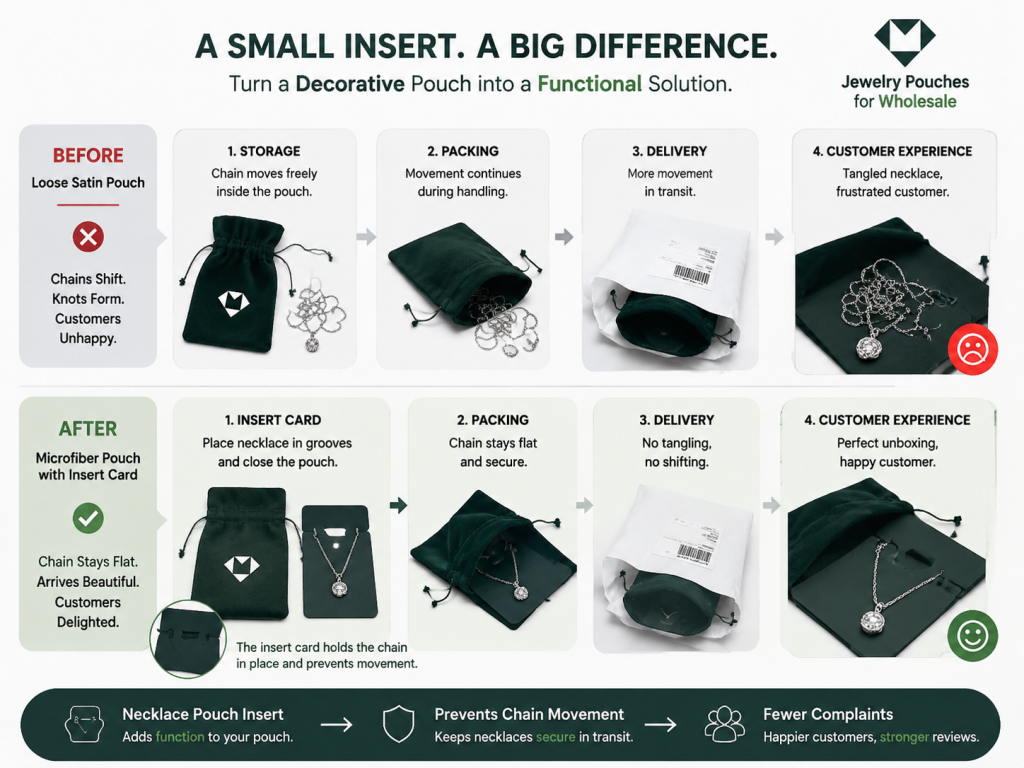
A packaging review team once showed us a simple problem hiding in plain sight. Their satin necklace pouch looked polished in studio photos, but the chains kept moving inside the pouch during parcel handling. Customer service tagged the issue as “tangled on arrival,” and the team estimated the complaint rate was about 15% higher on that SKU family than on boxed necklace sets. After switching to a microfiber pouch with an embedded card, the complaints dropped back to normal review volume.
Material choice sets the feel, failure risk, logo route, price band, and evidence of claims for a wholesale pouch program. Velvet can shed a dull brand image quickly, but microfiber may better protect plated surfaces. Cotton can look honest, while organza can look cheap when used for the wrong jewelry.
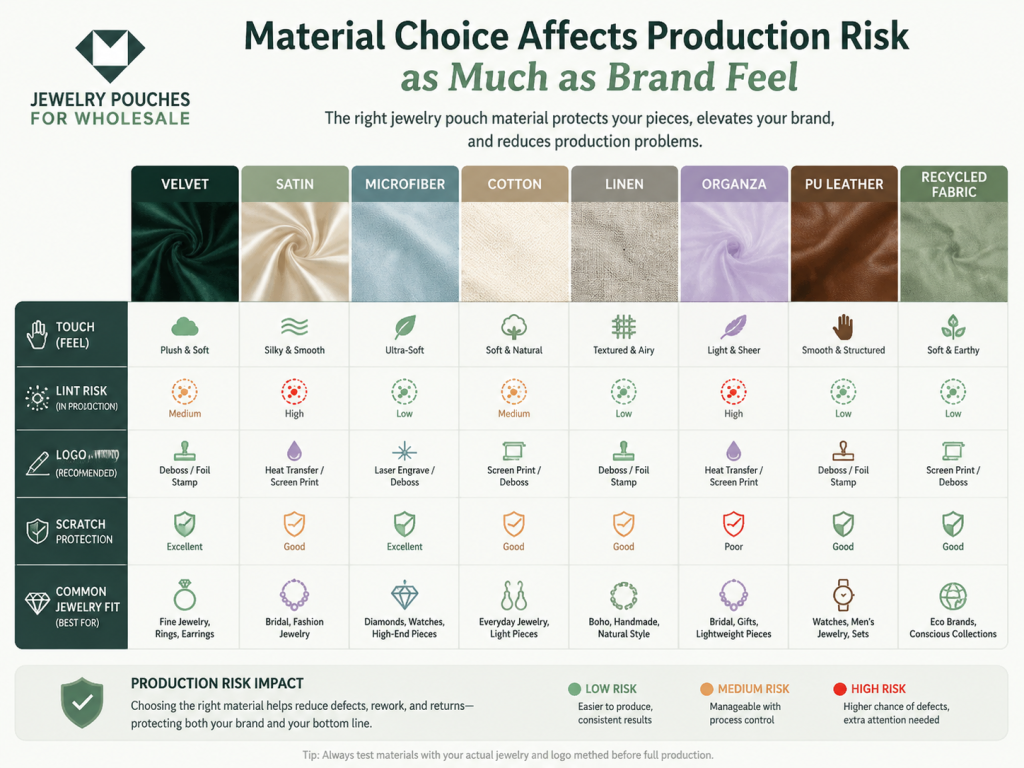
Material is the first visible choice, but it is also a production decision. It affects hand feel, scratch protection, logo clarity, lint risk, color consistency, price behavior, and reorder stability.
The table below compares common wholesale pouch materials by feel, protection, logo compatibility, jewelry fit, cost position, and bulk order risks. It helps buyers move beyond texture and into production reality.
| Material | Hand Feel | Protection Level | Logo Compatibility | Best Jewelry Fit | Planning Unit Cost | Bulk Order Risks |
| Velvet | Plush and soft | Medium to high | Foil, print, charm | Rings, earrings, pendants | 0.35−0.35−1.20/ea | Lint, nap direction, color shade |
| Satin | Smooth and shiny | Low to medium | Screen print, label | Earrings, pendants, gifts | 0.20−0.20−0.70/ea | Wrinkles, snagging, shine variation |
| Microfiber | Smooth and functional | Medium | Print, label | Travel, plated jewelry | 0.45−0.45−1.50/ea | Edge finish and cleaning claims |
| Cotton | Natural and casual | Low to medium | Screen print, label | Artisan jewelry, gifts | 0.25−0.25−0.90/ea | Shrinkage, dye variation |
| Linen | Textured and refined | Low to medium | Label, print | Natural or premium casual lines | 0.45−0.45−1.30/ea | Slub variation and logo detail loss |
| Organza | Sheer and decorative | Low | Simple print or tag | Event gifts, charms | 0.08−0.08−0.40/ea | Low protection and easy crushing |
| PU leather | Structured and polished | Medium | Deboss, foil, patch | Premium gifts, bracelets | 0.80−0.80−2.80/ea | Odor, cracking, coating consistency |
| rPET microfiber | Smooth and technical | Medium | Print, label | Travel and plated jewelry | 0.60−0.60−1.80/ea | Certificate scope and dye stability |
| Certified recycled fabric | Varies by source | Varies | Print or label | Brands with documented claims | 0.55−0.55−2.20/ea | Certificate mismatch and supply change |
Velvet is a pile fabric that gives jewelry pouches a plush touch and a premium look. It works well for rings, studs, pendants, charms, and small gift items.
The main risks are lint, nap direction, and shade change between dye lots. Ask the supplier to test the pouch against polished metal, plated jewelry, and dark cartons.
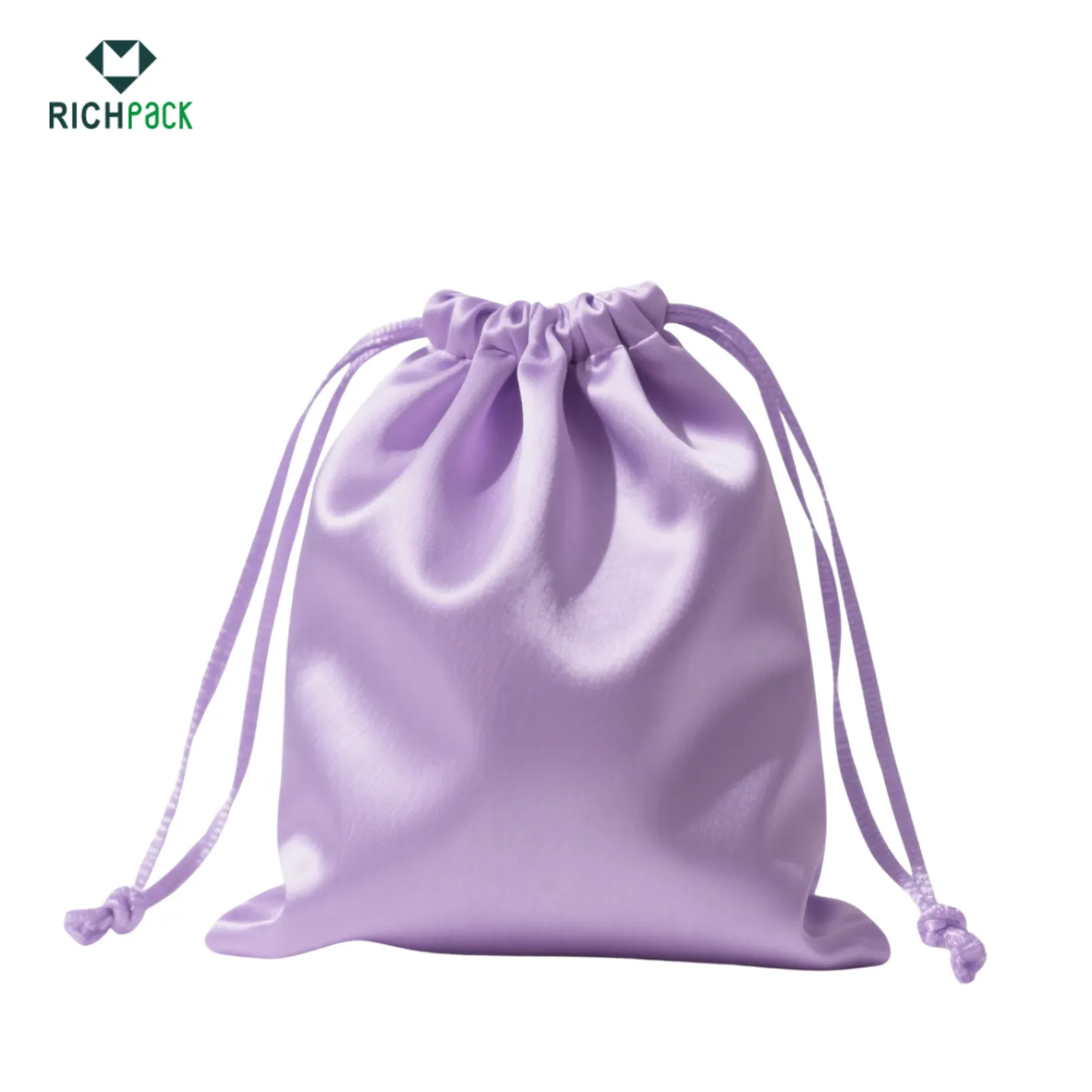
Satin is a smooth, glossy fabric that gives a pouch a dressier finish at a controlled cost. It is often used for earrings, pendants, and light gift programs.
Satin can wrinkle and snag. If the pouch is packed tightly, review carton compression and sample recovery after 24 hours.
Microfiber is a synthetic textile that can provide a smooth, low-abrasion surface for jewelry handling. It is useful when the customer may reuse the pouch for cleaning, storage, or travel.
Do not assume every microfiber pouch is jewelry-safe. Check seam edges, dye stability, and whether the material leaves residue on high-polish metal.
For North American and Western European launches, rPET microfiber is often the stronger choice when the brand wants a smoother hand feel and documented recycled content. Ask whether the recycled polyester applies to the pouch body, lining, cord, label, or all textile components.
Cotton gives a natural, approachable feel. It fits artisan jewelry, marketplace sellers, hotel gifting, wellness gifts, and brands that want a less glossy look.
Cotton printing is usually straightforward, but fabric weight and weave affect logo sharpness. A thin cotton pouch can look casual in a bad way when paired with high-value jewelry.
Linen gives more texture than cotton and can feel refined without looking shiny. It works well for natural, minimalist, or heritage-inspired jewelry brands.
The texture that makes linen attractive can also weaken small logo details. Use a woven label or larger mark when the artwork has thin lines.
Organza is a sheer decorative fabric used for low-cost gifts, charms, beads, and event handouts. It shows color and contents, which can be useful for quick sorting.
It offers very little protection. Do not use organza alone for plated jewelry, delicate stones, sharp posts, or items that may rub during shipping.
PU leather gives a pouch more structure and a polished surface. It can pair well with debossed patches, foil marks, or premium gift programs.
Check odor, coating flexibility, edge finishing, and cracking after bending. A good PU leather pouch feels controlled, while a poor one announces its cost immediately.
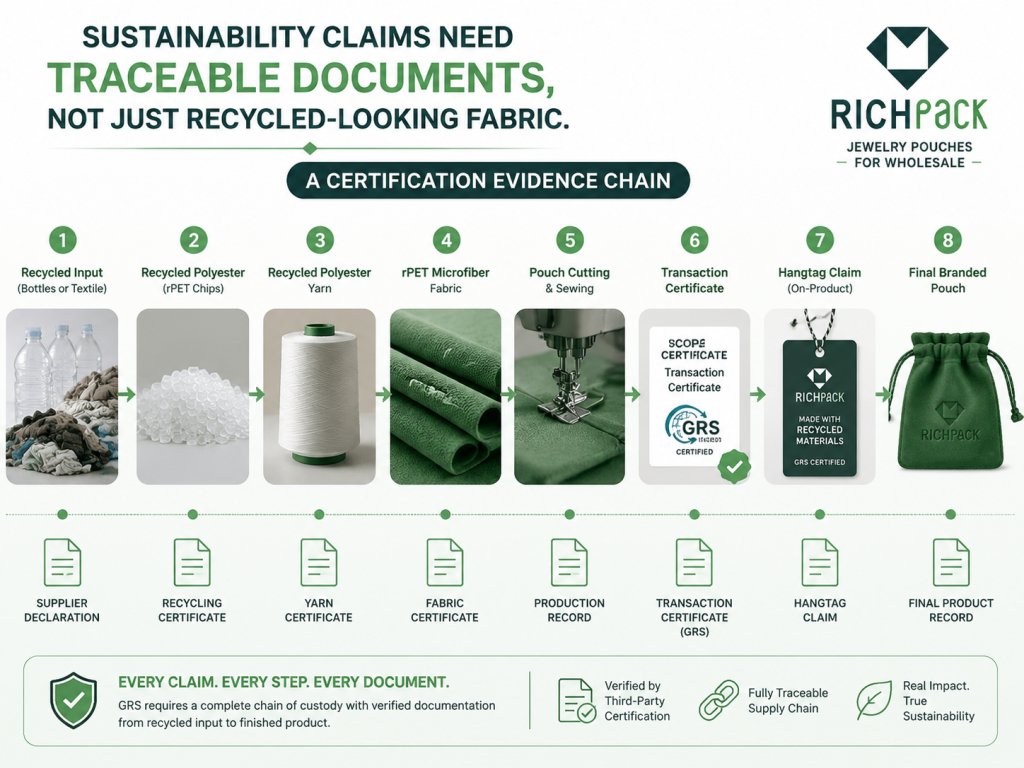
Recycled and certified fabrics can support responsible packaging claims when the documentation is real. The claim should match the actual fabric source, not a vague supplier promise.
GRS, the Global Recycled Standard, is useful because it tracks recycled material content through the supply chain and includes requirements around traceability, environmental practices, social criteria, chemical restrictions, and labeling. Public certification bodies describe GRS as applying to products with at least 20% recycled material content, while RCS can apply at lower recycled-content thresholds.
For pouch buyers, the practical question is blunt: which component is certified? A GRS-certified yarn claim is not the same as a finished pouch claim unless the chain of custody covers the right steps.
Ask for certificates, fiber content, transaction certificates when available, dye records, and claim wording before placing bulk orders. Unsupported environmental language creates risk for both compliance and customer trust.
A drawstring jewelry pouch is a soft bag closed with cord channels, usually chosen for small jewelry, fast packing, and gift-ready handoff. The charm is real, but so is the risk: weak cords, narrow openings, and loose knots can turn a pretty pouch into a packing-table headache.
Closure style controls how fast the pouch can be packed, how securely it holds jewelry, and how the customer opens it. A closure that looks charming in a sample can slow a packing line when ordered by the thousand.
A drawstring jewelry pouch is a soft pouch closed by one or two cords pulled through the top channel. It is the most common route for rings, earrings, charms, pendants, beads, and small gifts.
Check cord thickness, knot security, end finish, and whether the opening stays wide enough for fast packing. Weak cords are one of the easiest defects for customers to notice.
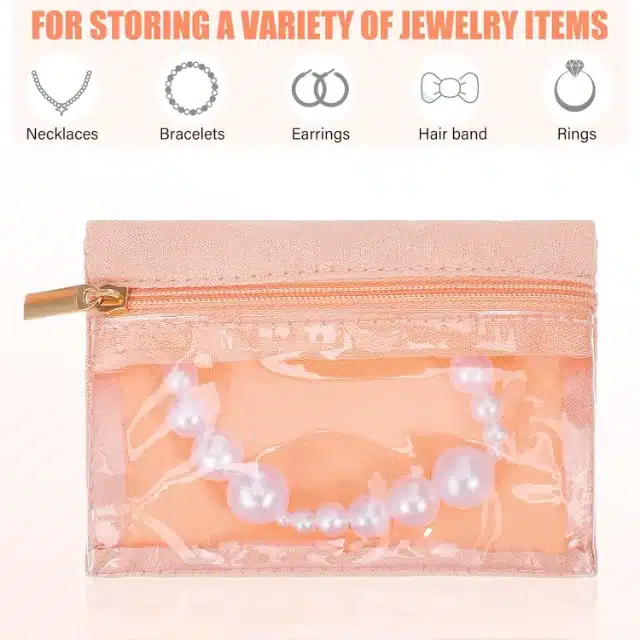
A zipper pouch gives better containment for travel sets and mixed jewelry. It can reduce the chance of items slipping out during movement.
The zipper must not scratch jewelry. Review puller size, tape color, stitching, and whether the zipper teeth sit away from delicate surfaces.
An envelope flap pouch gives a clean, flat look. It works for slim items, cards, chains on backing cards, and gift inserts.
Flaps need closure control. If the flap is too loose, items slide out; if it is too tight, packing slows down.
A snap button adds a clear open-close action. It can feel more secure than a simple flap and more structured than a drawstring.
Test snap force with the real jewelry inside. Too much force can press into delicate items, while too little force creates a loose package.
A fold-over sleeve works for flat jewelry cards, polishing cloths, or simple inserts. It is light and efficient when the jewelry is already held by a card.
It is not ideal for loose rings or bracelets. Without a defined closure, movement becomes the main risk.
Button and loop closures add a handmade or boutique feel. They suit natural fabrics and smaller runs where the closure becomes part of the design.
They need careful testing for packing speed. A closure that takes five extra seconds per pouch becomes expensive at wholesale volume.
A magnetic flap feels premium and easy to open. It is more common in structured textile or PU leather designs than in soft drawstring pouches.
Confirm magnet placement and jewelry compatibility. Magnets should not create pressure points or interfere with the item presentation.
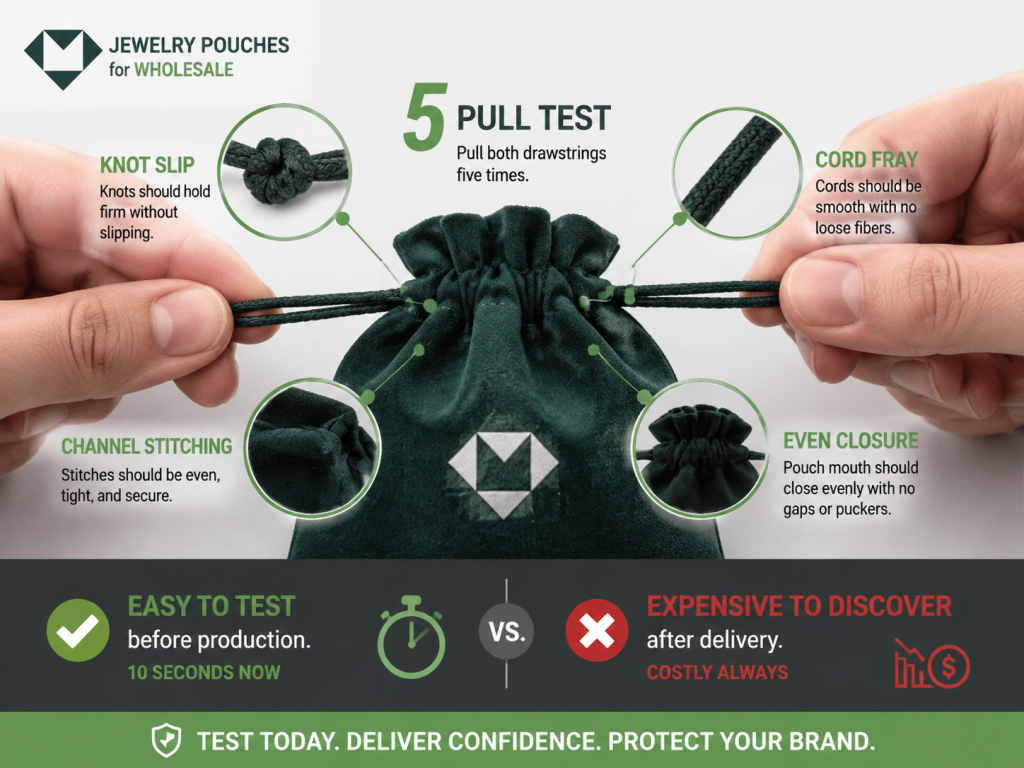
Cord quality should be checked before bulk production, not after cartons arrive. Pull the cord repeatedly, inspect channel stitching, and check knots after handling.
For a drawstring route, ask for cord material, diameter, end finish, and a simple pull test. A pouch can look good on the table and still fail in a busy packing room.
Small pouch sizing is not a flat measurement exercise. It is a movement-control problem. Rings need opening width, earrings need post protection, necklaces need chain control, bracelets need seam room, and travel sets need separation before they ever reach the shipping carton.
A small jewelry pouch should fit the jewelry without forcing it into corners or letting it move too freely. Size planning should start from product dimensions, insert needs, and how the pouch will be packed.
The table below gives practical size planning ranges for small jewelry pouch programs. Final dimensions should be confirmed with physical samples and real product sets.
| Jewelry Item | Typical Size Planning Range | Closure Recommendation | Insert or Card Need | Failure Risk |
| Ring | 2.5 x 3 in to 3 x 4 in | Drawstring or flap | Optional ring card | Tight opening or lint |
| Stud earrings | 2.5 x 3 in to 3 x 4 in | Drawstring or envelope | Earring card recommended | Posts catching fabric |
| Pendant | 3 x 4 in to 4 x 5 in | Drawstring or satin pouch | Pendant card helpful | Chain tangling |
| Necklace | 3.5 x 5 in to 5 x 7 in | Zipper, flap, or drawstring with card | Strongly recommended | Knots and abrasion |
| Bracelet | 4 x 5 in to 5 x 7 in | Drawstring, flap, or snap | Depends on shape | Bulging and seam stress |
| Charm or gemstone | 2 x 3 in to 3 x 4 in | Drawstring | Optional divider | Item loss or rubbing |
| Travel set | 5 x 7 in and larger | Zipper or divided pouch | Divider recommended | Mixed item scratches |
Ring pouches need a soft interior and enough opening width for fast packing. Small velvet and microfiber pouches are common because rings create a strong tactile moment.
Avoid overly loose sizing. A ring rolling around inside a large pouch feels careless and may rub against cord ends or seams.
Earring pouches work best with cards, especially for studs and hooks. The card keeps pairs together and prevents posts from catching fabric.
For earrings without cards, test whether hooks, backs, and posts snag the inner seam. A pouch that works for hoops may fail for studs.
Pendant pouches need enough depth for the pendant and chain. A simple drawstring pouch can work if the chain is secured first.
If the pendant has sharp edges or a raised stone, pair the pouch with a card or small insert. Surface contact should be controlled before shipping.
Necklace pouches are where many bulk orders fail. A chain can knot inside a beautiful pouch if it is not fixed to a card, loop, or fold.
For necklaces, treat the pouch and insert as one system. Do not approve the pouch sample without testing the actual chain length and clasp.
Bracelets need more width and seam strength than many buyers expect. Bangles, cuffs, and charm bracelets each create different pressure points.
Ask for a filled sample photo from the side. If the pouch bulges or the cord cannot close evenly, the size is wrong.
Charms and gemstones often use very small pouches. The risk is not only scratching, but also loss during handling.
Use a closure that stays tight after repeated opening. Small items should not slip through cord gaps or side seams.
Travel set pouches need separation. Mixed jewelry pieces should not be left to rub against one another in a single open cavity.
A zipper, divider, card system, or nested pouch set can improve usability. Test with the exact mix the customer will carry.
Sample size testing should include product insertion, closure speed, carton packing, and removal by hand. A size that looks right flat can feel wrong once filled.
Take photos of the same sample flat, filled, closed, and packed. Those four views reveal more than a measurement sheet alone.
Logo customization is where pouch design gets real. A clean vector file can still blur on velvet, sink into linen, crack on coating, or look too loud on PU leather. Choose the logo method after the material, not before it.
Custom jewelry pouches with logos need artwork decisions before fabric decisions are finalized. A logo method that looks perfect on cotton may lose detail on velvet or crack on a coated surface.
The table below compares logo methods by material fit, detail tolerance, durability, cost behavior, and sample checks. Use it before approving artwork for wholesale jewelry pouches.
| Logo Method | Best Material Fit | Minimum Detail Behavior | Durability | Cost Level | Sample Checks |
| Screen printing | Cotton, linen, satin, microfiber | Medium detail | Good with correct ink | Low to medium | Ink edge, rub test, color match |
| Hot stamping | Velvet, PU leather, and some satin | Larger marks work best | Good when the pressure is right | Medium | Foil coverage, heat marks, alignment |
| Embroidery | Cotton, linen, velvet | Small letters can close up | High | Medium to high | Thread density, puckering, back side |
| Woven labels | Most fabrics | Better for small type | High | Medium | Label color, stitch placement |
| Debossed patches | PU leather, structured textile | Simple marks | High | Medium to high | Depth, edge finish, adhesion |
| Metal charms | Premium pouches | Simple icon or initials | High | Higher | Weight, attachment, plating |
| Inside tagging | Cotton, linen, travel pouches | Small type possible | Medium | Low to medium | Placement and comfort |
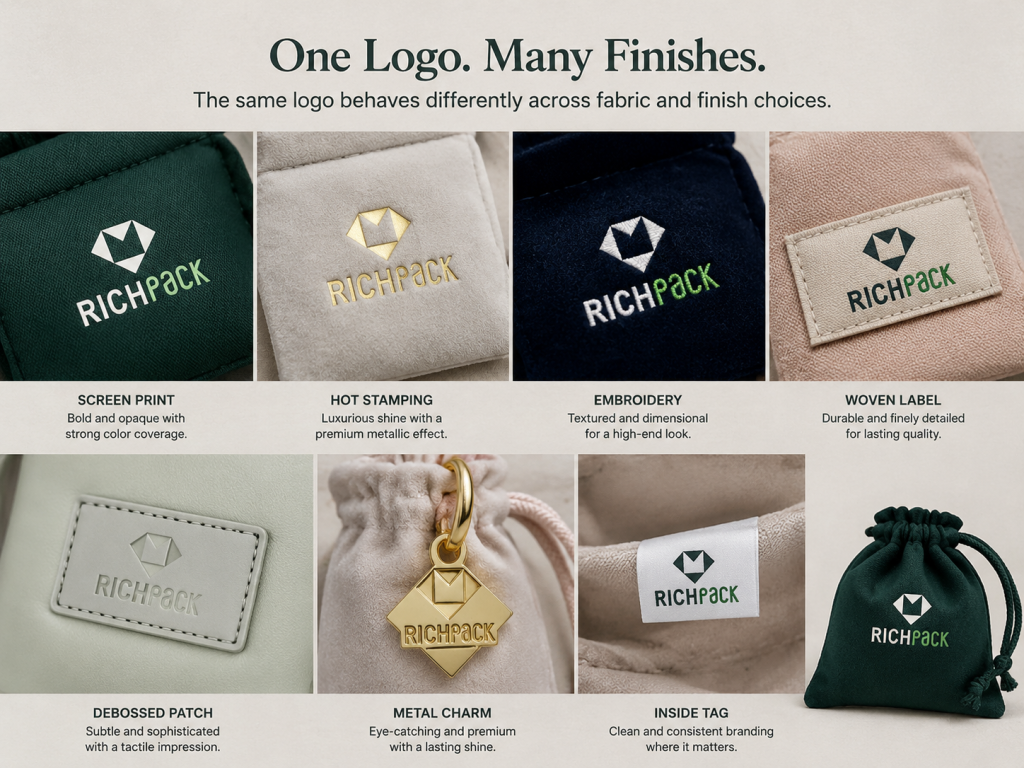
Screen printing applies ink through a screen to create a flat logo mark. It is practical for cotton, linen, satin, and many microfiber pouches.
Use simple artwork and confirm ink behavior on the actual fabric. Fine lines may bleed on textured weaves or look dull on plush surfaces.
Hot stamping uses heat and pressure to apply foil or pigment to the pouch surface. It can look sharp and premium on velvet and PU leather.
The sample should show even coverage, clean edges, and no heat damage around the mark. Metallic foil needs extra review under different lighting.
Embroidery adds thread texture and durability. It suits boutique, heritage, and natural fabric programs.
Small lettering is the danger. Ask for a stitched proof at actual size, not only a digital mockup.
Woven labels keep logo consistency across materials that are hard to print. They also work well when the same brand marker is used on pouches, bags, and textile packaging.
Check the label edge, color, stitch placement, and whether it irritates the jewelry surface. A label inside the pouch must not rub against plated pieces.
Debossed patches work well on PU leather and structured premium pouches. They give a quieter logo effect than bright foil.
The patch should be tested for adhesion and edge finish. Poor patch bonding looks worse than no logo at all.
Metal charms turn the pouch into a keepsake. They can work for luxury gift programs, limited editions, and membership gifts.
Weight and attachment must be controlled. A charm that swings into the jewelry or chips plating creates a preventable defect.
Inside tags are useful when the outside should remain clean. They can carry care notes, fiber content, or a secondary brand mark.
Placement matters. Tags should not catch chains or sit against polished jewelry surfaces.
Send clean vector artwork whenever possible. Include logo size, color reference, placement, clear space, and any minimum line requirements.
A useful artwork package includes:
Color matching should be reviewed under real light, not only on a screen. Fabric absorbs and reflects color differently from paper, metal, and coated boxes.
For multi-part programs, compare pouch fabric against jewelry boxes, gift bags, cards, and tags. RichPack teams often coordinate gift bags, cards, and tags with pouch colors so the final set feels intentional.
MOQ and cost planning should tell a buyer what the pouch will probably cost before the quote arrives. Use the ranges as planning anchors, not promises. Final pricing still depends on fabric, size, logo area, packing method, inspection level, and freight.
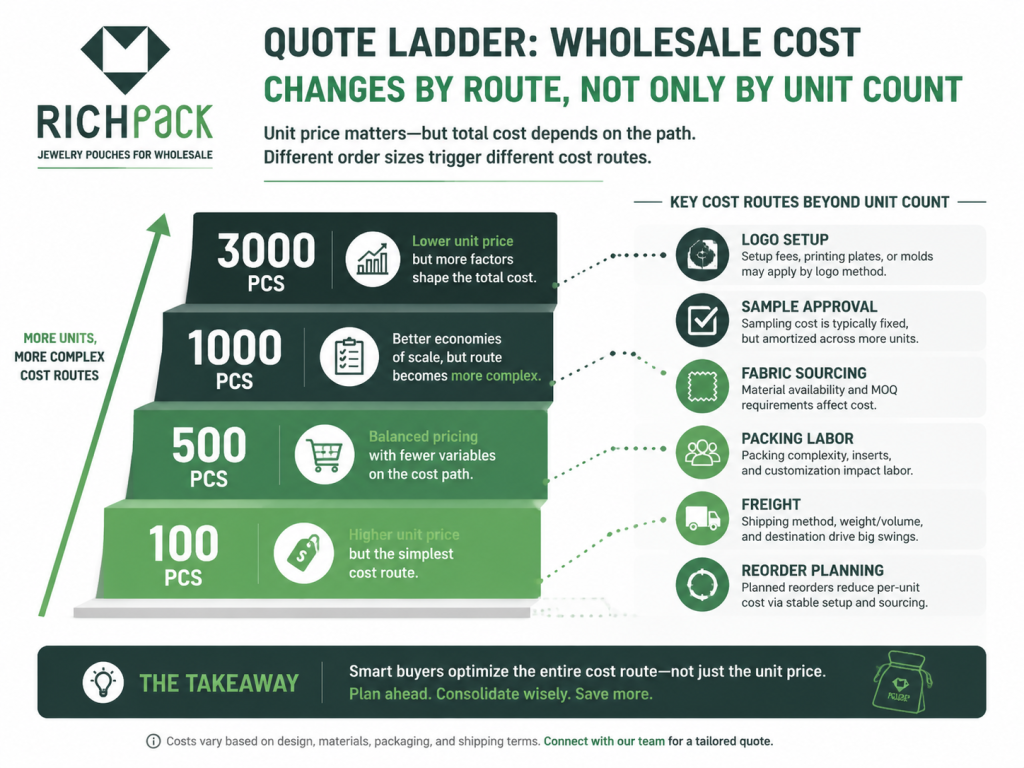
Wholesale pouch pricing changes because setup, sampling, fabric sourcing, logo tooling, packing labor, and freight do not move at the same rate. A cheap unit price can still become expensive if the order route is wrong.
The table below compares practical buying routes at common quantity bands. Use planning ranges only until a supplier reviews material, logo, pouch size, packing method, and destination.
| Order Quantity | Practical Buying Route | Planning Unit Cost | Likely Cost Behavior | Best Use | Risks | Buyer Action |
| 100 to 300 pcs | Stock pouch | 0.35−0.35−2.50/ea | Higher unit cost, low setup | Market test, samples, events | Limited color and size | Keep artwork simple |
| 300 to 500 pcs | Stock pouch with logo | 0.50−0.50−2.80/ea | The setup begins to spread | Small launches | Logo method limits | Request a physical proof |
| 500 to 1000 pcs | Semi-custom pouch | 0.80−0.80−1.50/ea | Better unit behavior | Growing jewelry lines | Fabric and logo mismatch | Test real jewelry in the sample |
| 1000 to 3000 pcs | Custom pouch route | 0.45−0.45−1.20/ea | Fixed costs spread better | Repeat programs | Color and QC consistency | Approve sealed production sample |
| 3000 pcs and up | Dedicated bulk program | 0.20−0.20−0.90/ea | Best planning leverage | Multi-SKU or seasonal runs | Inventory and freight exposure | Plan reorder calendar |
Stock pouches are existing sizes, colors, and materials available without deep customization. They are useful for testing, urgent events, and low-risk packaging refreshes.
The tradeoff is limited control. If the stock color or size changes later, the brand may need to adjust the packaging system quickly.
Stock pouches with a logo are a practical middle path. The buyer uses an available pouch and adds printing, foil, a label, or a tag.
This route is often the right first wholesale step. It gives a brand mark without the time and cost of a fully custom pouch.
Fully custom pouches may include custom size, fabric color, lining, closure, logo method, label, packing, and carton plan. They fit brands with repeat demand and clear packaging standards.
The risk is decision overload. Lock material, size, and logo in a controlled sample round before scaling.
At around 500 pieces, simple logo customization often becomes more practical than very small batches. The setup cost can be shared across more units.
That does not mean every supplier has the same minimum. Always ask what changes at 500 pieces for material, logo, carton packing, and delivery.
At around 1000 pieces, semi-custom and custom routes often become easier to justify. Buyers may gain more leverage on color, packaging, and logo.
This is also where defects become more expensive. A crooked logo on 50 pieces is annoying; a crooked logo on 1000 pieces is a launch problem.
At around 3000 pieces, bulk planning becomes a program decision. Fabric sourcing, dye lots, production scheduling, inspection, and freight planning carry more weight.
The buyer should think beyond one order. Reorder timing, seasonal color, carton space, and storage conditions all affect the final cost.
Setup charges, sample fees, logo tooling, and artwork proofing are fixed costs. They hurt small orders more because fewer units share the same expense.
Do not judge a quote by unit price alone. Compare the full landed cost and the quality controls included before approving a supplier.
Here is the math that buyers often miss. A $120 logo setup charge adds $0.40 per pouch at 300 pieces.
The same fee adds $0.12 at 1000 pieces and $0.04 at 3000 pieces. It feels painful in a test run and almost invisible in a repeat program.
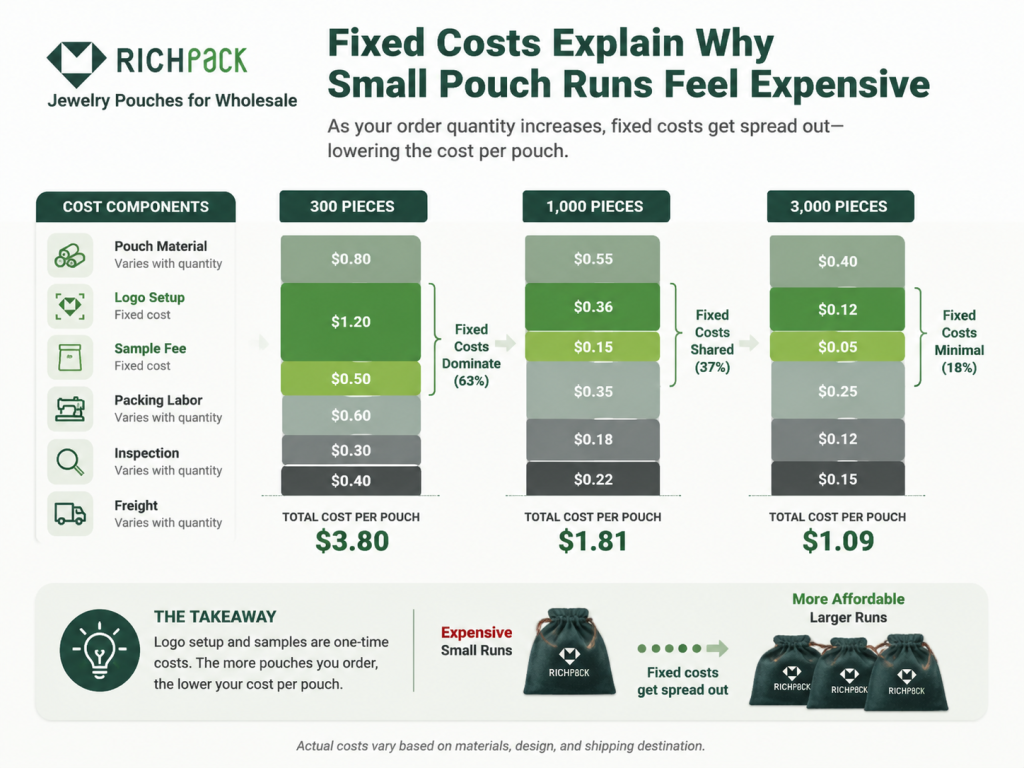
Pouches are light, but cartons still take up space. Fabric bulk, pouch thickness, inserts, labels, and individual polybags all affect freight volume.
Ask for carton dimensions, units per carton, gross weight, and packing method. Those details matter when pouches ship with jewelry boxes or full packaging sets.
A reorder strategy protects color, logo, size, and availability. Without it, the second order can look slightly different from the first.
Keep an approved sample, artwork file, fabric reference, carton specification, and inspection note. These records save time when the program scales.
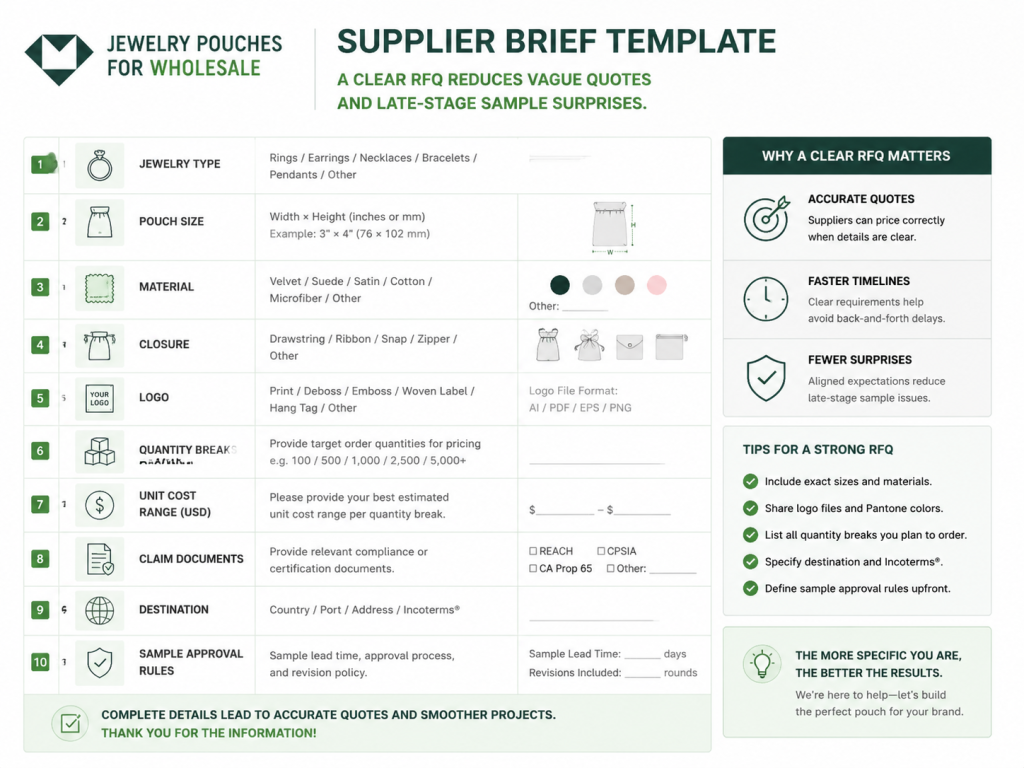
A jewelry pouch RFQ is a buying brief that turns taste into production facts: jewelry dimensions, material, closure, logo method, quantity, packing style, destination, test rules, and claim documents. The clearer the brief, the fewer surprises land on the sample desk.
A strong RFQ prevents vague quotes. The supplier should know what jewelry goes inside, how many pouches are needed, how the logo should appear, and how the pouches will be packed.
Copy the checklist below into a supplier email or sourcing form. Add photos, sketches, and physical jewelry measurements whenever possible.
List the jewelry type and actual product dimensions. Include ring height, earring post length, pendant width, chain length, bracelet diameter, or travel set contents.
If the jewelry has sharp posts, raised stones, plating, or delicate chains, say so. The pouch route depends on surface and movement risk.
State the first order quantity and expected reorder quantity. Suppliers need both numbers because sample decisions and material sourcing change with scale.
Give a required delivery window, but also ask for the realistic production calendar. Rush orders often remove useful review time.
Name the preferred material and acceptable alternatives. If you are unsure, ask for two or three options with clear reasons.
A good supplier should explain the tradeoff. For example, velvet may feel richer, while microfiber may perform better for travel and surface contact.
Specify drawstring, zipper, flap, snap, sleeve, button loop, or magnetic flap. If packing speed matters, mention that too.
Ask for closure samples if possible. Cord, zipper, snap, and flap behavior cannot be judged from a flat mockup.
Send vector artwork, logo size, placement, and color reference. If the logo has thin lines, ask the supplier which method can hold the detail.
Do not approve a logo route without a material sample. The same mark can behave differently across velvet, cotton, satin, and PU leather.
Provide a color reference and request a physical proof. Fabric color can shift due to light, weave, dye lot, and pile direction.
If the pouch must match boxes, bags, ribbons, or cards, send those references together. Color should be approved as a packaging family.
Clarify whether pouches are packed flat, stuffed, individually bagged, grouped by size, or packed with boxes and inserts. Packing method affects labor and freight.
For e-commerce operations, ask how the pouches arrive at the fulfillment desk. A beautiful pouch that arrives wrinkled creates extra handling work.
Tell the supplier where the pouches will be sold or shipped. Labeling, material claims, and documentation needs can vary by market.
For global programs, ask whether one specification can serve all markets or whether regional labels and claim wording are needed.
Define what must be approved before bulk production. Include material, size, logo, color, closure, packing, and jewelry fit.
A practical approval list includes:
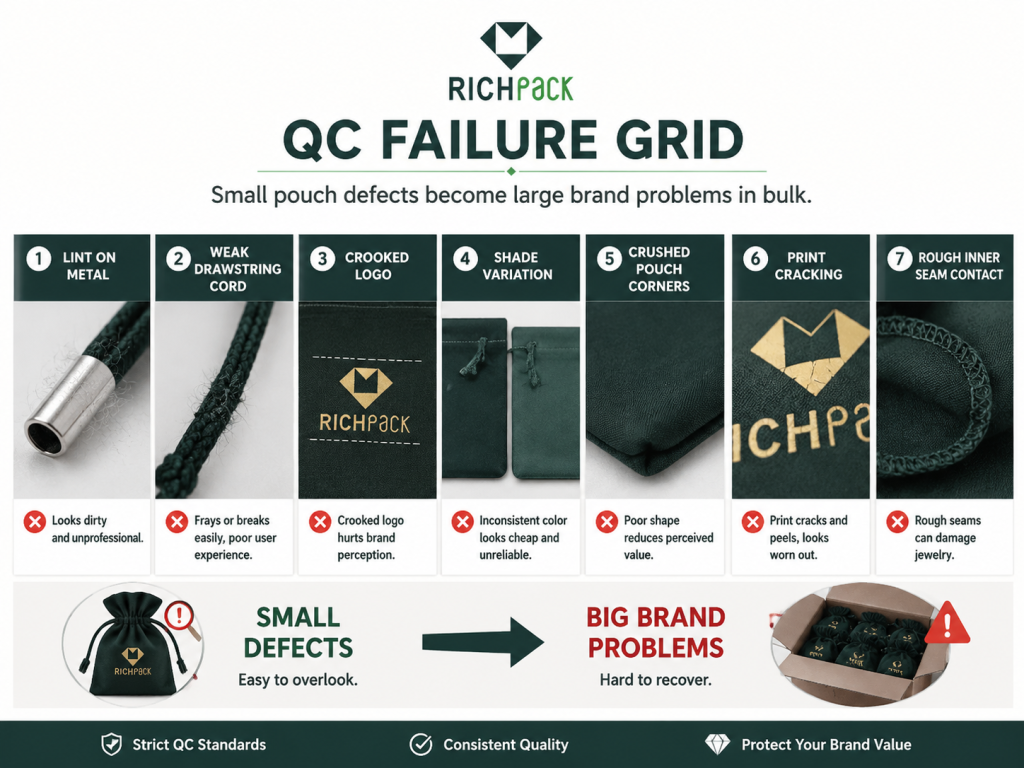
Quality checks turn one pretty sample into a safe bulk order. The point is not to admire the pouch. The point is to rub it, pull it, fill it, seal it, pack it, and ask whether 3000 identical pieces would still make the brand proud.
Bulk pouch defects are often small, but they show up everywhere once the order ships. A buyer should check fabric, smell, seams, cords, logo placement, jewelry compatibility, and carton packing before production is released.
The table below lists common defects, likely causes, sample tests, and supplier questions. Use it during sample review and pre-shipment inspection.
| Defect | Likely Cause | Sample Test | Supplier Question |
| Lint on jewelry | Velvet pile or poor brushing | Rub against polished metal | How is fabric cleaned before packing? |
| Odor | Dye, coating, adhesive, storage | Smell test after sealed bag rest | What material or process causes odor? |
| Crooked logo | Poor fixture or hand placement | Measure placement on 5 samples | What tolerance will production follow? |
| Weak cord | Low-grade cord or channel stitch | Pull test and repeated closure | What cord diameter and material are used? |
| Color variation | Dye lot or fabric direction | Compare under the same light | Can fabric be held from one lot? |
| Print cracking | Wrong ink or surface treatment | Bend and rub test | Which ink system is used? |
| Foil gaps | Heat or pressure mismatch | Inspect under an angled light | What foil and temperature were tested? |
| Seam failure | Weak stitch or tight sizing | Fill and pull the seam gently | What seam allowance is specified? |
| Jewelry scratching | Rough seam, zipper, tag, or charm | Pack real jewelry for 24 hours | Which surfaces touch the jewelry? |
| Crushed arrival | Carton compression | Review the packed carton photo | What carton strength is planned? |
Hands feel should match the brand promise and product price. A pouch may look acceptable in photos but feel thin, rough, or too stiff in hand.
Ask for touch feedback from the sales, packing, and product teams. Each team notices a different problem.
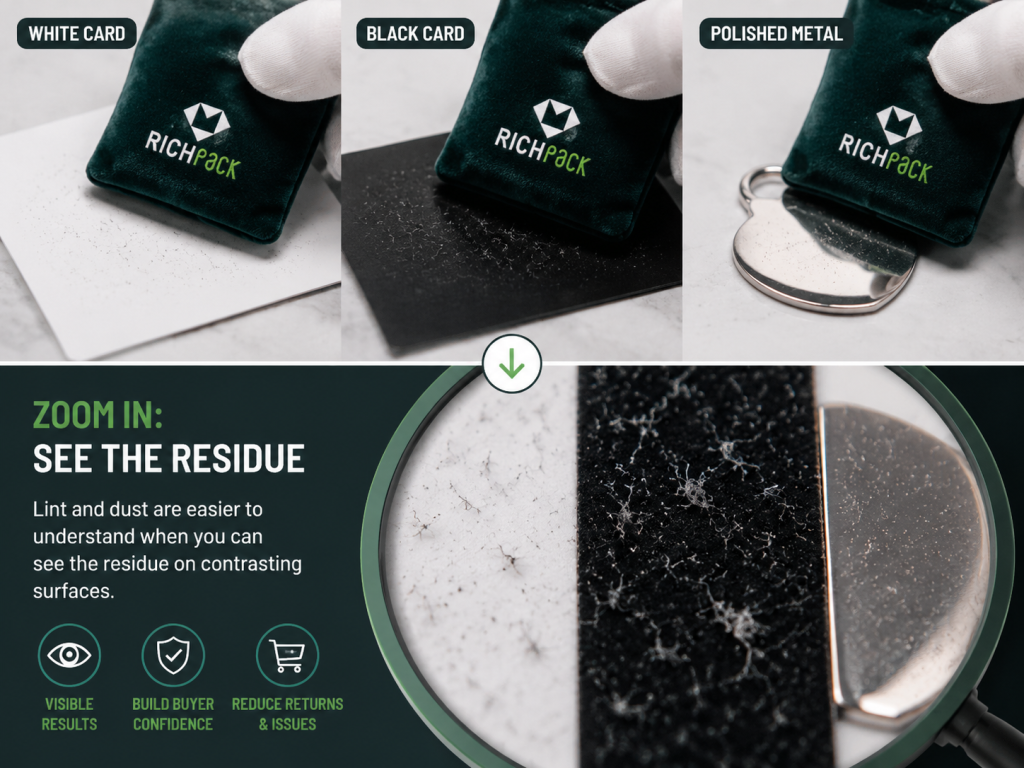
Lint is especially risky with velvet and dark fabrics. It can cling to jewelry, inserts, boxes, and customers’ hands.
Rub the sample against polished metal, a black card, and a white card. That simple test reveals residue quickly.
Odor can come from dye, coating, adhesive, storage, or sealed packing. Customers notice it as soon as they open the package.
Leave the sample sealed overnight, then open it again. If the smell is strong, ask for process changes before bulk approval.
Color consistency matters when pouches sit beside boxes, cards, bags, ribbons, or printed inserts. A slight variation can make a set feel mismatched.
Approve color under normal retail or home lighting. Screen approvals are not enough for fabric.
Cord strength affects both function and perceived quality. A cord that frays, slips, or unties makes the pouch feel disposable.
Pull the cords repeatedly and inspect the channel. Look for loose stitching, uneven gathering, and weak knots.
Seams carry the stress of filled pouches. They should be straight, clean, and strong enough for the actual jewelry.
Fill the pouch, close it, and handle it as a customer would. If the seam twists or strains, adjust the size or stitching.
Logo alignment should have a tolerance, not a guess. A few millimeters may matter on a small pouch.
Ask the supplier to confirm placement from the top edge, side edge, or center line. Review several samples, not one perfect piece.
Print and foil should survive normal handling. Bend, rub, and pack the sample before approval.
For hot stamping, check for foil gaps and heat marks. For printing, check cracking, edge bleed, and color shift.
Jewelry surface compatibility is the real test. The pouch should not scratch plating, catch chains, leave lint, transfer color, or press into stones.
Test the actual product inside the pouch for at least one day. If multiple jewelry types share the same pouch, test each one.
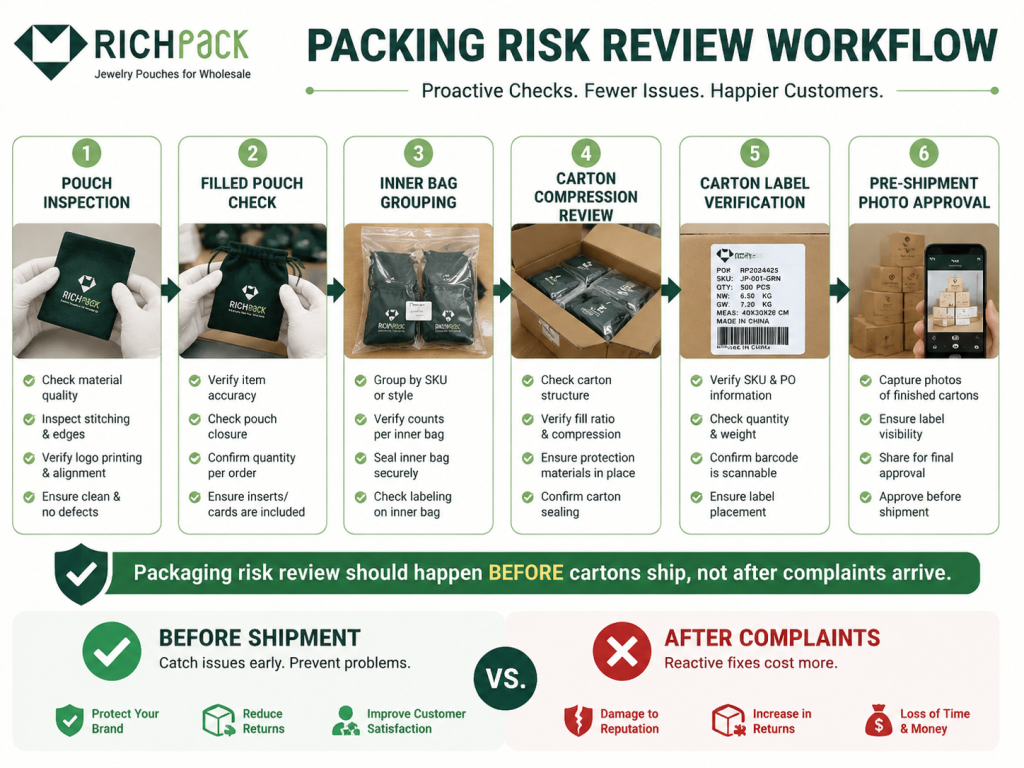
Carton packing affects wrinkles, crushing, dust, and shape. A pouch that leaves production clean can arrive poorly if packed too tightly.
Ask for carton packing photos before shipment. If pouches ship with boxes, inserts, and bags, review the whole packing plan.
A public FMCG packaging failure study on leaking non-dairy creamer packages reached a familiar conclusion: weak risk assessment and poor structural review can turn a design change into customer dissatisfaction. The category was not jewelry, but the lesson fits pouch programs. Packaging failures usually begin before the product leaves the factory.
Pouches win on softness, storage, weight, and reuse. Boxes win on crush resistance, display, and gift value. Most serious jewelry lines stop trying to make one component do everything and build a small system around the product.
Pouches and boxes solve different problems. A pouch is soft, light, reusable, and efficient, while a jewelry box gives structure, display value, and stronger protection.
For many brands, the best answer is not pouch versus box. It is pouch plus box, pouch plus card, or pouch plus gift bag, depending on product value and selling channel.
| Packaging Route | Best For | Strength | Weakness | When to Choose |
| Pouch only | Low-fragility items, samples, charms | Light and reusable | Limited crush protection | Cost and weight matter most |
| Box only | Rings, premium gifts, display | Structure and perceived value | Heavier and bulkier | Gift value and protection matter most |
| Pouch plus box | Premium jewelry and sets | Soft touch plus structure | Higher cost | Launches, gifting, luxury lines |
| Pouch plus card | Earrings, necklaces, pendants | Movement control | Needs a precise card design | Chains and pairs need order |
| Pouch plus bag | Retail handoff and gifting | Complete presentation | More components | In-store or event programs |
Pouches usually cost less to ship and store than rigid boxes. They are light, flexible, and space-efficient.
Boxes cost more but add structure and perceived value. The right choice depends on product value, protection needs, and customer expectations.
Boxes protect against crushing better than pouches. Pouches protect against light surface contact and help keep small items together.
For delicate jewelry, use both. The pouch touches the jewelry, while the box manages structure.
A pouch can feel premium when the material, logo, and closure are right. A poor pouch can also make expensive jewelry feel under-packaged.
Boxes create a stronger gift cue. If the jewelry is meant for a proposal, anniversary, luxury launch, or VIP gift, a pouch alone may not be enough.
Boxes help retail teams display and present jewelry more easily. Pouches support the handoff after the sale.
Some retail programs use pouches inside drawers or behind counters. The pouch keeps the piece protected until it enters the final package.
E-commerce shipping puts more stress on packaging. A pouch inside a mailer may not protect enough unless the jewelry is already secured.
A pouch with a box, insert, or protective mailer gives better control. Review the actual shipping stack before deciding.
Gift readiness depends on the whole presentation. A pouch alone can work for small sentimental items, but a boxed set often feels more complete.
For premium gifting, pair pouches with custom jewelry packaging elements such as boxes, bags, inserts, cards, and tags.
Pouches often get reused more than boxes because they are easy to store and carry. That gives them long-term brand value.
Reuse depends on quality. Customers keep soft, clean, useful pouches; they discard flimsy ones.
The strongest systems match each component to a job. A card holds the jewelry, a pouch adds softness, a box adds structure, and a bag completes the gift handoff.
For coordinated programs, review pouch design with the ultimate guide to jewelry packaging and product-specific box planning. That keeps the pouch from feeling disconnected.
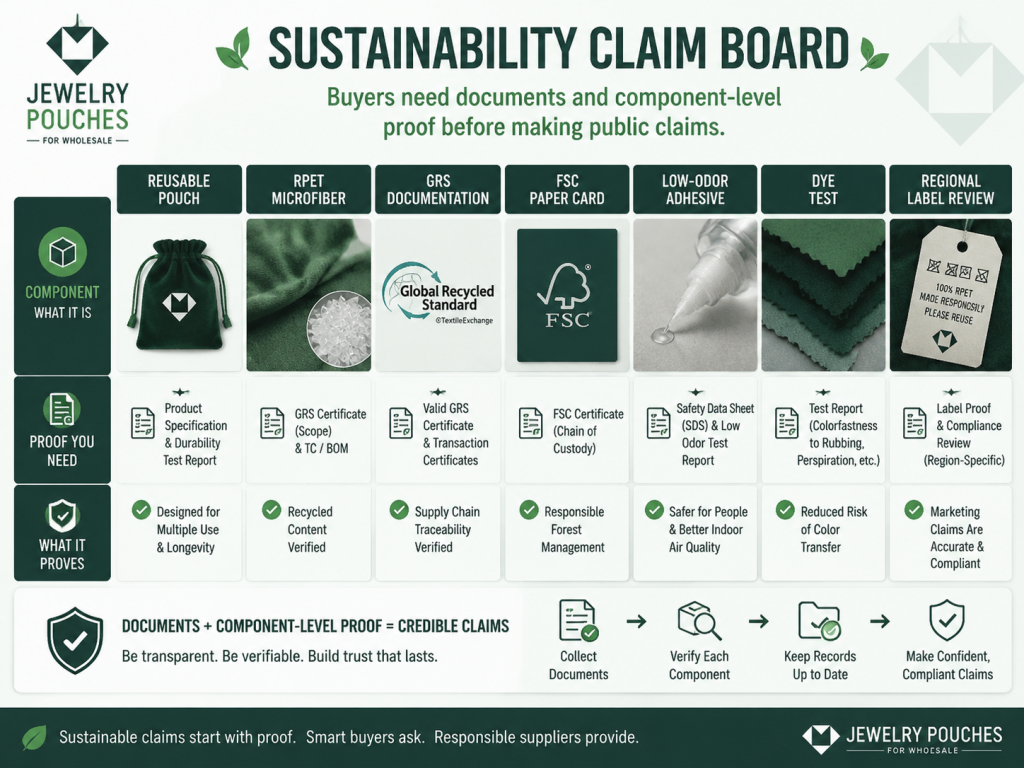
Sustainable pouch buying is an evidence-based problem. Reuse, recycled fiber, FSC paper pairings, low-odor adhesives, dye testing, and regional labels only matter when the documents match the finished pouch. A natural look is not proof. A certificate without a scope is not proof either.
Reusable packaging can support a better customer experience, but claims need evidence. A pouch is not sustainable just because it looks natural or can be used again.
Responsible sourcing decisions should be documented. Ask for material records, dye information, certificates when relevant, and claim wording that matches the actual pouch.
For planning conversations, expect certified or recycled textile routes to carry a premium over the simplest stock pouch route. A 10% to 25% planning premium is common for documented responsible materials in packaging programs, but the final number depends on fabric source, certification scope, dyeing, logo method, and order quantity.
Reusable claims should be tied to a real function. A pouch that customers keep for travel, storage, or cleaning has a stronger claim than one that falls apart after a few uses.
Avoid broad promises. State what the pouch does and what evidence supports the claim.
Cotton can feel natural and familiar, but fiber sourcing and processing still matter. Ask where the cotton comes from and whether documentation is available.
If responsible cotton is part of the brand story, request the exact certificate or sourcing record. Do not rely on a vague supplier note.
Recycled polyester can reduce reliance on virgin inputs when sourced and documented correctly. It also needs clear fiber content and supply records.
Ask whether the recycled content applies to the pouch fabric, cord, label, or only one component. Mixed claims create confusion.
Pouches are often paired with paper boxes, cards, tags, and sleeves. Paper components can use FSC-certified materials when the supplier has proper documentation.
If FSC paper is used, keep the certificate and product scope on file. The claim should match the actual paper part.
Adhesives may appear in labels, patches, inserts, or paired boxes. Low odor matters because jewelry packaging is opened close to the face.
Ask suppliers which adhesive systems are used when odor is a concern. Test sealed samples before approval.
Dye testing helps reduce color transfer and shade problems. Dark fabrics and bright colors need extra attention when they touch light jewelry cards or polished metal.
Request dye stability information when the pouch will contact jewelry directly. A small stain can become a customer complaint.
Labeling needs can vary by destination. Fiber content, origin marking, and claim language may need review before shipment.
For broad international programs, ask the supplier to flag documentation limits early. Fixing labels after production is slow and expensive.
Keep evidence with the product file. Certificates, test reports, approved claim wording, and supplier declarations should be stored with the artwork and sample records.
The evidence file should show what the mark means and where it applies. For example, a GRS logo on a hangtag should be backed by a certificate scope, a supplier name, a product category, and a transaction record when the supply chain requires one.
This protects future reorders. It also helps sales teams speak accurately about the packaging.
Different buyers buy the same pouch for different reasons. A procurement director wants control, a marketplace seller wants speed, a hotel operator wants polish, and a gift manager wants the whole kit to behave. The pouch has to answer the buyer’s real pressure.
Different buyers need different pouch programs. A procurement director, marketplace seller, hotel operator, and gift company manager may all buy jewelry pouches, but they judge risk differently.
The right route should match the buyer’s selling model, approval process, and reorder rhythm.
Procurement directors need stable specifications, approved samples, and reliable reorders. The recommended route is a semi-custom or fully custom pouch tied to a broader packaging standard.
The main risk is inconsistency across seasons. Ask the supplier how the fabric lot, logo placement, carton packing, and reorder records will be controlled.
E-commerce wholesalers need fast packing, SKU clarity, and predictable carton behavior. Standardized sizes and simple logo methods often work best.
The main risk is operational friction. Ask how pouches will be packed, counted, labeled, and prepared for the fulfillment desk.
Marketplace sellers often need smaller MOQs, quick turnaround, and a branded look without heavy tooling. Stock pouches with a logo can be a practical start.
The main risk is over-customizing too early. Ask which options can be reordered quickly if a listing starts selling well.
Gift company product managers need pouches that fit a theme, budget, and multi-item kit. The recommended route is a pouch planned with cards, boxes, fillers, and gift bags.
The main risk is a mismatch between components. Ask for a full kit sample, not only the pouch.
High-end hotel and spa operators need quiet luxury, clean hand feel, and consistent presentation. Cotton, linen, microfiber, or refined PU leather may work depending on the gift.
The main risk is odor, color transfer, or a pouch that feels too promotional. Ask for sealed samples and guest-use testing.
Startup buyers need a route that protects cash while still looking professional. Stock pouches with a simple logo or carefully chosen blank pouches can work for the first run.
The main risk is buying too many before the product-market fit is clear. Ask which pouch route can scale later without changing the brand look too much.
Event and corporate gifting teams need a clear delivery date, simple personalization, and consistent packing. Organza, cotton, satin, or microfiber may work depending on the value level.
The main risk is late approval. Ask for a timeline that includes artwork proof, sample review, production, packing, and delivery.
Distributor reorder teams need repeatable specifications and clean inventory control. The recommended route is a documented pouch program with SKU-level standards.
The main risk is silent substitution. Ask whether the material, cord, lining, logo method, and carton count will stay fixed across reorders.
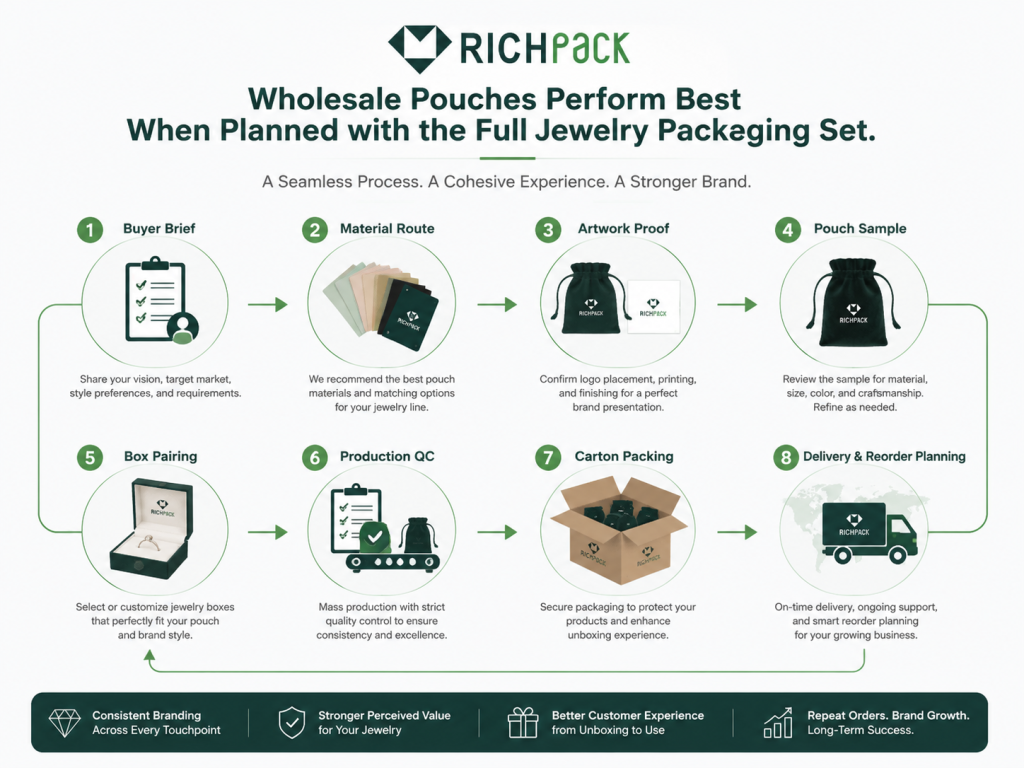
RichPack treats the pouch as one moving part in a larger jewelry packaging system. The work starts with the jewelry, then moves through material, logo, sample review, box coordination, packing method, quality control, delivery, and reorder support. That is how a pouch stops looking accidental.
RichPack builds wholesale jewelry pouch programs as part of complete jewelry packaging systems. That means pouches can be coordinated with boxes, inserts, cards, bags, tags, and shipping cartons instead of being sourced as a disconnected accessory.
This approach fits brands that need pouches to work across retail, ecommerce, gifting, hospitality, and distributor channels.
The planning starts with jewelry type, brand position, sales channel, and packing workflow. A pouch for a ring launch does not need the same structure as a travel set pouch or hotel gift pouch.
RichPack can help map the pouch to boxes, cards, inserts, and bags early. That avoids the common problem of a beautiful pouch that does not fit the rest of the package.
Material and logo choices are reviewed together. Velvet, satin, cotton, microfiber, organza, PU leather, and recycled fabrics each respond differently to printing, foil, labels, patches, and embroidery.
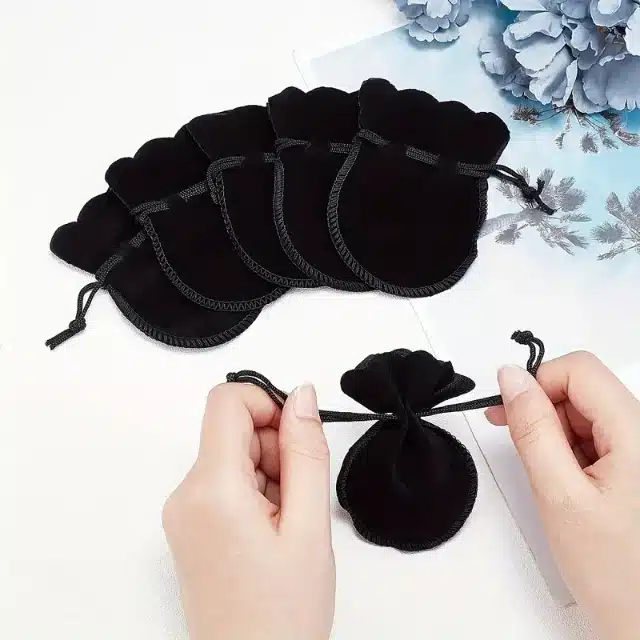
For brands comparing black velvet jewelry pouches with other materials, physical samples are the safest route. Touch, lint, and logo finish need to be seen in hand.
A sample room review should test real jewelry inside the pouch. The team should check fit, touch, closure, logo, color, lint, odor, and surface compatibility.
This is where many bulk issues can be caught cheaply. A sample desk is not just for approval photos; it is for finding failure points before production.
Box and pouch coordination controls color, size, insert position, and gift experience. A pouch may sit inside a box, next to a card, or inside a gift bag.
RichPack’s jewelry packaging sets help buyers coordinate those parts together. A matched set makes the final package feel designed rather than assembled.
Retail packaging needs presentation speed and tactile quality. E-commerce packing needs compression control, dust protection, and efficient fulfillment.
A strong pouch program considers both. The same pouch may need different packing rules for counter handoff and warehouse shipping.
Bulk production control should include fabric approval, logo placement tolerance, closure checks, seam review, packing method, and pre-shipment inspection. These details protect the final brand experience.
For buyers comparing suppliers, RichPack’s guide to jewellery pouch manufacturers and suppliers can help frame the evaluation. The best partner should explain the risk before the order is placed.
Global delivery planning includes carton size, freight method, destination requirements, and reorder timing. Pouches may ship alone or together with boxes, bags, cards, and inserts.
Ask for a packing plan before bulk production closes. Freight surprises are easier to prevent than fix.
Reorder support depends on records. Approved samples, artwork, color references, fabric notes, carton specs, and inspection records should stay with the program.
This is especially important for expanding brands. A second order should feel like a continuation, not a new experiment.
The best material depends on jewelry type, brand position, logo method, and shipping route. Velvet and microfiber are strong choices for rings, earrings, and polished pieces, while cotton and linen suit natural brands, and organza fits low-cost gifts.
For premium programs, PU leather or velvet paired with a box can create a stronger gift experience. Always test the material with the actual jewelry before bulk approval.
A small jewelry pouch often ranges from about 2.5 x 3 inches to 4 x 5 inches, depending on the jewelry. Rings and studs can use smaller pouches, while pendants and bracelets usually need more room.
Final size should be confirmed with the real product, insert, and closure. Flat measurements alone do not show how the pouch behaves when filled.
Drawstring jewelry pouches can work for necklaces when the chain is secured to a card, loop, or insert. Without that control, chains can knot during packing or shipping.
For delicate necklaces, test the pouch and insert them together. The drawstring should close cleanly without pressing the chain into a seam.
Custom jewelry pouches can reduce light abrasion when the inner surface, seams, tags, and closure are jewelry-safe. They cannot replace rigid protection against crushing.
For high-value or delicate jewelry, use a pouch with a box, card, insert, or divider. The goal is to control both surface contact and movement.
MOQ varies by supplier, material, logo method, size, and customization level. Stock pouches may be available in smaller quantities, while custom fabric, custom size, and special logo routes usually need higher quantities.
Ask what changes at 300, 500, 1000, and 3000 pieces. Those breakpoints often affect unit cost, sampling, color choices, and production control.
Compare the full offer, not only the unit price. Review material, size, logo method, sample cost, setup charge, packing method, carton details, freight, production time, and inspection steps.
A cheaper quote can cost more if it creates defects, delays, or mismatched packaging. Ask each supplier to explain what is included and what is not.
Jewelry pouches are better for lightweight storage, travel, simple gifting, and low-friction fulfillment. Jewelry boxes are better for structure, display, and high-value presentation.
Many brands use both. The pouch gives softness and reuse, while the box gives protection and gift value.
Check material feel, size, closure, logo placement, color, odor, lint, seam strength, cord strength, print or foil durability, and jewelry surface compatibility. Also, review how the pouch will be packed in cartons.
Use real jewelry during the test. A pouch that looks right empty may fail when filled.
Velvet often works well with hot stamping, simple printing, or charms when the supplier controls pile and pressure. Satin can use screen printing or labels, cotton works well with screen printing and labels, and PU leather suits debossing, foil, or patches.
The safest answer comes from material proof. Approve the logo at the final size on the actual pouch fabric.
E-commerce sellers should secure the jewelry first, then use the pouch as a soft protective and branded layer. Necklaces need cards or loops, earrings need cards, and delicate pieces may need boxes or inserts.
Pack pouches so they do not arrive crushed, dusty, or wrinkled. Review the mailer, box, tissue, insert, and carton plan together.
Jewelry pouches look small, but wholesale decisions around them are not small. Material, size, closure, logo method, quantity, packing route, and sample checks all affect how the customer experiences the jewelry.
The safest buying path starts with the product. Match the pouch to the ring, earring, necklace, bracelet, charm, or travel set first, then decide whether the pouch can stand alone or needs a box, insert, card, bag, or shipping structure.
For brands planning jewelry pouches for wholesale, the best results come from treating the pouch as part of a complete packaging program. RichPack can help plan custom pouches, boxes, inserts, cards, bags, sampling, production control, and global delivery so each component works together from first quote to reorder.


2024-11-19

2024-12-24
2025-02-21
This definitive guide covers everything from consumer psychology to supply chain management to help you create luxury jewelry packaging that drives real sales growth.

A men’s travel jewelry case combines sleek, compact design with organizational precision, ensuring that rings, watches, and cufflinks stay secure and scratched‑free on the go—perfect for any trip, whether business or leisure. Men often prioritize practicality and functionality, ensuring that their accessories remain safe and organized during trips. One such essential accessory is a men’s… Continue reading Jewelry Pouches for Wholesale: The Ultimate Guide to Materials and Bulk Purchasing
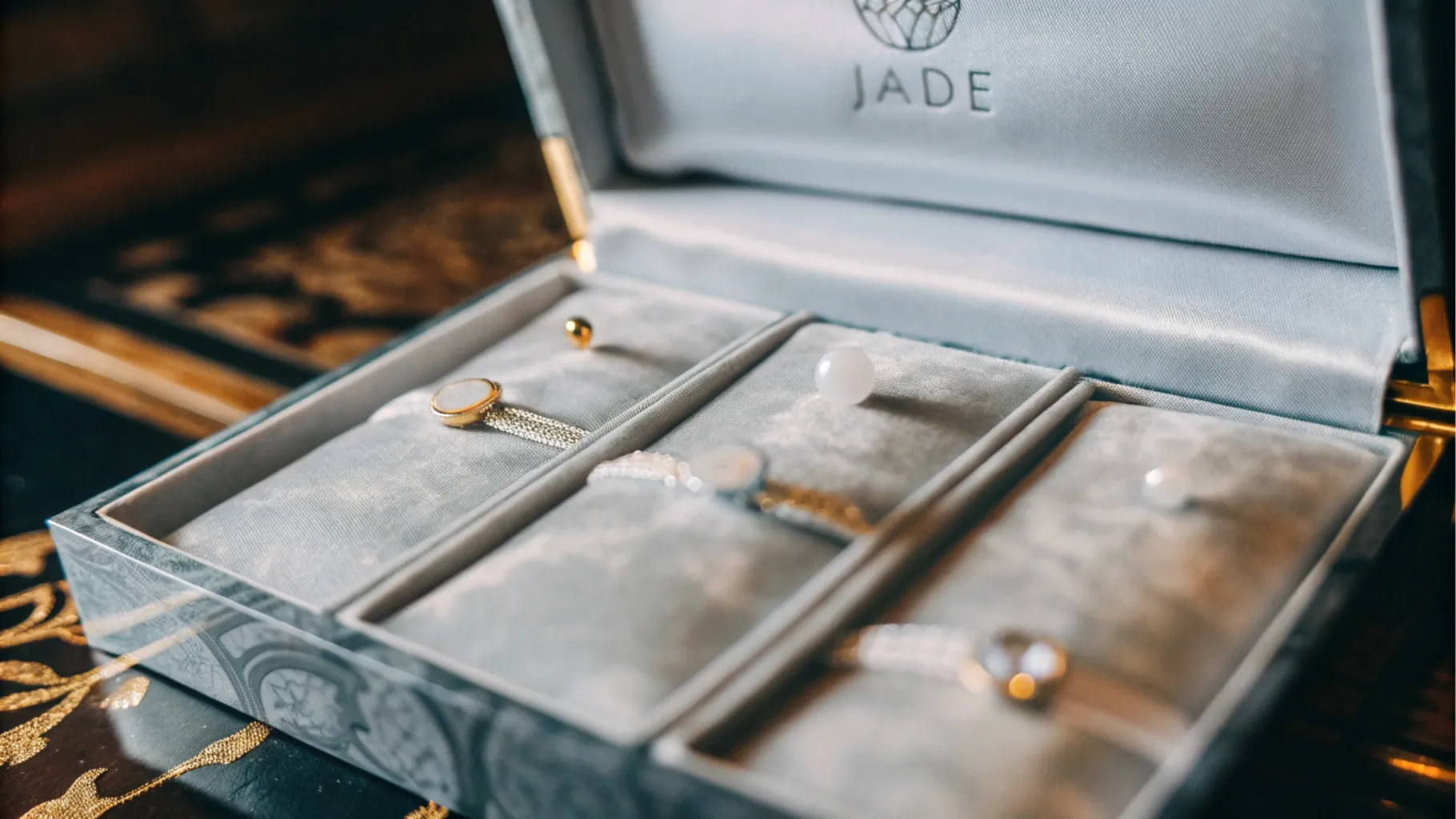
Richpack · How to Incorporate Luxury Elements into Jade Jewelry Packaging for High-End Pieces In 2032, the global luxury packaging market is expected to reach a value of US$28.23 billion highlights the growing demand for luxury packaging solutions. As a member of luxury jewelry packaging, jade jewelry packaging has received great attention recently. Richpack luxury packaging elevates the… Continue reading Jewelry Pouches for Wholesale: The Ultimate Guide to Materials and Bulk Purchasing
Black Velvet Jewelry Pouches | Soft, Elegant Storage for Jewelry by Richpack
Custom Zipper Pouches for Jewelry Packaging | Eco-Friendly Solutions with Personalized Designs
Customizable Silk Pouches with Luxurious Finishes | Premium Packaging for Jewelry Retailers Seeking Unique and High-Quality Presentation
Color Marble Packing Box Kraft Box 3layer Corrugated Paper Box
View More
Custom Jewelry Packaging for Artisan Jewelry Makers | Handcrafted and Personalized Solutions | Tailored for Small-Scale Brands
View More
Drawstring Jewelry Pouch with Pockets | Smart Design with Multiple Pocket
View More

