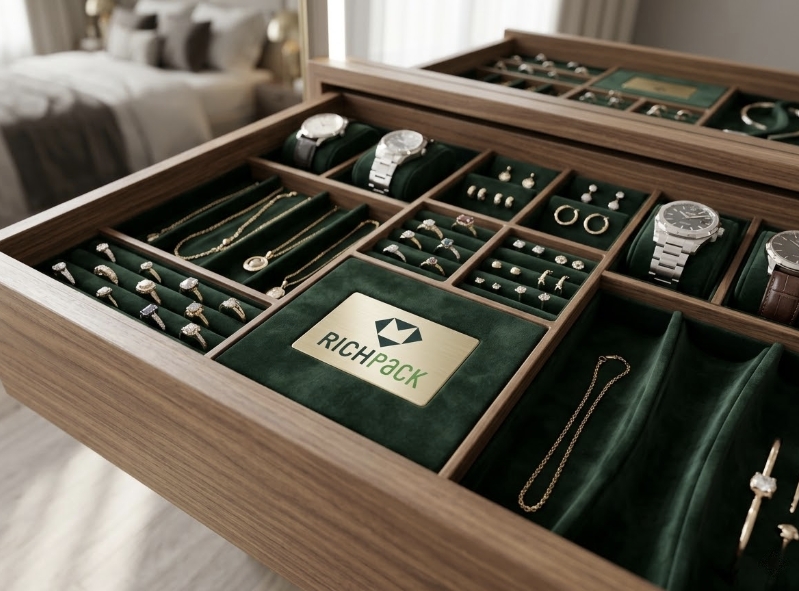


You should consider custom jewelry inserts for drawers when standard trays no longer protect your pieces well, no longer fit your drawer footprint, or no longer support the way your team sells, stores, or presents jewelry. In most real projects, the change happens when storage stops being a simple organizer problem and becomes a protection, workflow, and brand consistency problem.
For luxury retailers, high-end interior designers, and jewelry brand operations teams, this decision affects more than neatness. It affects retrieval speed, display quality, material wear, and the continuity between the product box, the drawer, and the in-store experience.
In this guide, I’ll break down the clearest upgrade signals, the best materials for different use cases, and the exact checklist to prepare before ordering.
The short answer is simple. Upgrade when your current tray system creates friction that now costs you time, space, product condition, or presentation quality.
That friction shows up in different ways. A retailer may feel it in slower client appointments. A design studio may feel it in drawers that look unfinished inside bespoke cabinetry. An operations team may feel it in slower resets and mixed SKU confusion. The common issue is the same. A generic tray is no longer aligned with the actual job.
Generic trays are built for average dimensions and broad use cases. Retail drawers are usually not average.
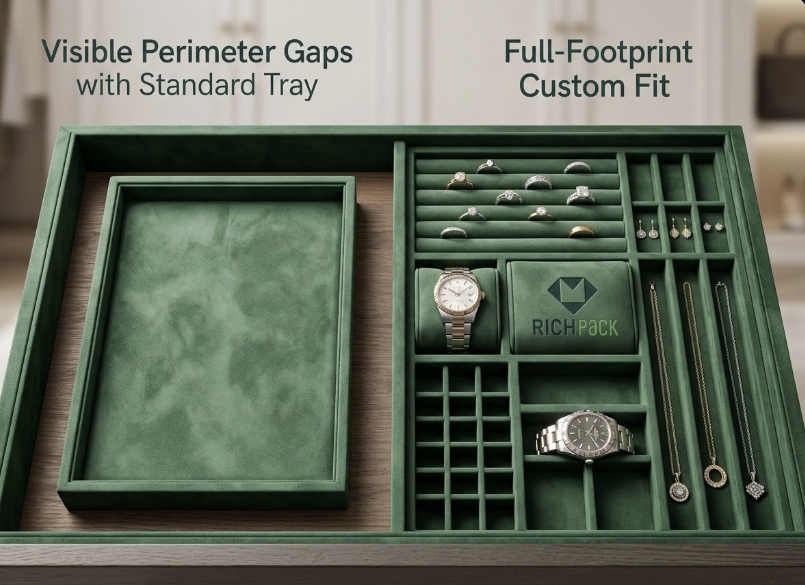
Once the drawer size, product mix, or visual standard moves beyond a basic setup, off-the-shelf organizers begin to fail. You see wasted edge space, uneven compartment sizing, and tray combinations that look patched together rather than designed with intent.
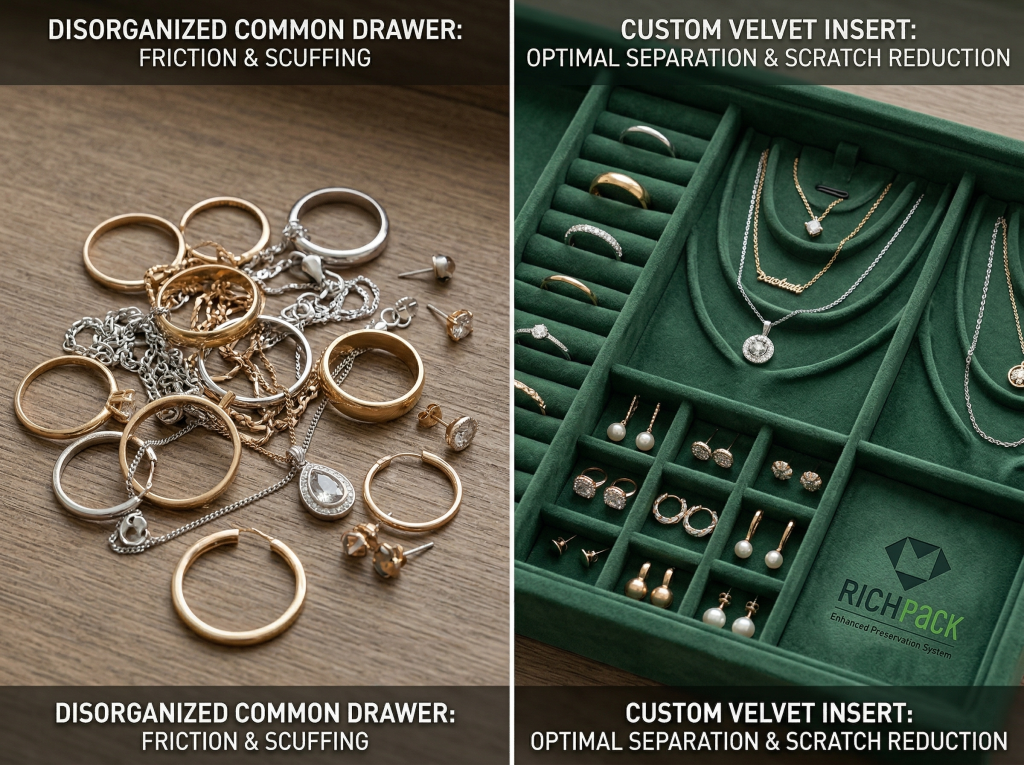
Protection is usually the first warning sign because product damage is easier to notice than a slow workflow. Chains tangle. Earrings drift. Watches sit too high. Rings share slots they should not share.
Wirecutter’s jewelry storage review notes that soft cloth and fabric-lined compartments help prevent scratching and can help protect against tarnish in certain setups. It also highlights that some glass-top storage should not sit near windows because light-sensitive stones and tarnish-prone metals can be affected by prolonged light exposure. That supports a basic principle I use in insert planning. Fine jewelry needs structure, separation, and the right lining, not just a place to sit.
The cost side also becomes real fast. Addicted2Decorating documented a custom drawer insert option rising above 500 USD, then compared it with a modified ready-made solution at 65.88 USD. The number itself is not universal, but it shows that the economic buyers are weighing in. Once damage risk, replacement, or rework time rises, the cost discussion shifts from tray price to total operating cost.
A practical rule works well here. If your team is repeatedly untangling chains, re-pairing earrings, or repositioning pieces before a client sees them, the tray is already underperforming.
Most teams do not notice workflow loss in one dramatic moment. They notice it as small repeated delays.
A few extra seconds to find a matching pair. A few extra touches to reset a tray after an appointment. A few extra checks before the display drawer looks right again. If a staff member repeats that pattern 20 to 40 times a day, the lost time compounds quickly.
That is why custom inserts often make sense before a business feels obviously disorganized. They reduce the number of touches needed to retrieve, return, count, and present the product.
Once a drawer is opened in front of a client, storage becomes presentation. At that point, the inside of the drawer is no longer invisible infrastructure.
A custom insert creates cleaner alignment, better spacing, and more controlled visual rhythm. For luxury retail, that shift matters because the drawer is no longer only storing product. It is a staging product.
This is one of the most overlooked relationships in luxury packaging. A brand may invest heavily in custom jewelry box inserts but still use random drawer trays in the showroom or fitting room.
That disconnect weakens the system. The box says premium. The drawer says improvised. When both insert types are designed together, the brand gains stronger continuity in color, lining texture, compartment logic, and presentation standards.
If you want a cleaner decision framework, use these seven signs. In my experience, once three or more show up at the same time, standard trays are usually close to their practical limit. Once five or more show up together, a custom program often becomes the better long-term choice.
| Sign | What It Usually Means | Why It Matters |
| Drawer gaps and wasted space | Standard tray size does not match actual drawer dimensions | You lose footprint and visual finish |
| Mixed jewelry types do not fit | Compartment logic is too generic | Pieces are harder to protect and retrieve |
| Scratches and tangling keep recurring | Separation is weak | Damage risk and handling time rise |
| Deep drawers feel inefficient | Vertical space is underused | A stackable system may work better |
| Team retrieval is slow | The layout does not match the workflow | Daily labor friction increases |
| The multi-location display looks inconsistent | Tray materials and formats vary by site | Brand presentation becomes fragmented |
| Luxury experience feels incomplete | Storage does not match brand standards | The client experience loses polish |
A tray that almost fits still wastes valuable retail real estate. Small gaps around the edges create dead zones and make a premium drawer look unfinished.
This is common in custom cabinetry and in drawers designed around store fixtures rather than standard organizer sizes. A full-footprint insert removes that wasted perimeter and makes the drawer feel built, not improvised.
Mixed collections break generic grids quickly. Rings, bangles, watches, pendants, cuffs, necklace sets, and statement earrings do not all need the same compartment depth or width.
If your team has to compromise every day because the tray was designed for a generic assortment, the tray is no longer supporting the collection. It is forcing the collection into the wrong structure.
If damage keeps coming back, that is usually a design signal, not just a handling problem. Necklaces need channels. Earrings need pairing logic. Watches need height control. Rings need more precise spacing.
Custom dividers solve those issues at the layout level instead of asking staff to compensate with extra care every single day.
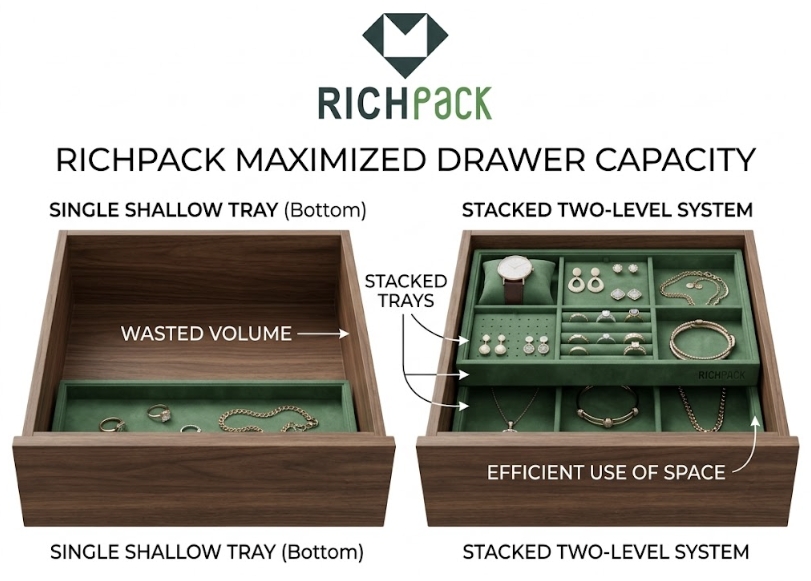
Deep drawers often look like extra capacity, but much of that capacity goes unused with a single flat tray. The lower half of the drawer becomes empty volume.
That is where Stackable Jewelry Trays for Drawers are often the better answer. They turn depth into usable, organized layers that are easier to scale by category or season.
A good drawer should shorten the path from the open drawer to the selected product. If team members still need to search, shift, and re-sort pieces before they can present them, the insert format is working against the workflow.
That matters in retail, in appointments, and in sample rooms. It also matters in back-of-house operations where fast resets keep the visual standard consistent.
One store may use black velvet trays. Another may use acrylic. Another may use beige inserts bought locally. That kind of variation seems small, but it changes how the brand is read.
A custom insert system helps standardize compartment logic, lining color, and tray profile across locations. That keeps the presentation tighter and easier to replicate.
Luxury buyers notice details that mass-market buyers often ignore. They notice softness, spacing, reveal, finish, and material coherence.
When the drawer becomes part of the client-facing moment, a generic organizer often feels too ordinary. A custom insert makes the inside of the drawer feel as considered as the product itself.
There is no single best material for every project. The right answer depends on the primary job of the insert.
If your main goal is a premium presentation, the material choice will look different from a project where the main goal is protection in transit. If your drawer is deep, the structure may matter more than the lining. If your assortment changes often, modularity may matter more than rigid perfection.
For many luxury drawer systems, velvet or microsuede is the best balance of protection and presentation. It provides a softer surface, a stronger premium signal, and better separation between polished items.
Wirecutter’s reviewed products repeatedly favor fabric-lined interiors for scratch prevention, and that lines up with what I see in premium projects. Soft lining is not a gimmick. It is one of the easiest ways to reduce direct hard-surface contact.
Foam is often the right answer when the project centers on shipping, fixed positioning, or impact control. That is why it appears so often in custom jewelry box inserts.
It is less persuasive in a luxury showroom drawer where tactile feel and visual softness are part of the brand language. Foam protects well, but it does not always communicate luxury as effectively as velvet-lined jewelry tray inserts for drawers.
Wood, MDF, and rigid board bases add structure and long-term stability. They are useful in wider drawers, heavier trays, and repeated-use environments where sagging or distortion would become a problem.
These bases work best when combined with a soft-touch top layer. Think of the rigid base as the engineering layer and the lining as the product-contact layer.
Acrylic can work well in modern interiors or visibility-first layouts. It gives a clean look and makes scanning fast.
Still, I would use it selectively. For highly polished jewelry, acrylic often needs careful pairing with softer contact points or very controlled compartment geometry. It is more of a visibility material than a cushioning material.
Use Stackable Jewelry Trays for Drawers when the drawer is deep, the assortment is growing, or the collection needs to be reorganized often. This format is especially useful for seasonal rotations, high-SKU assortments, and operations teams that need category-based tray layers.
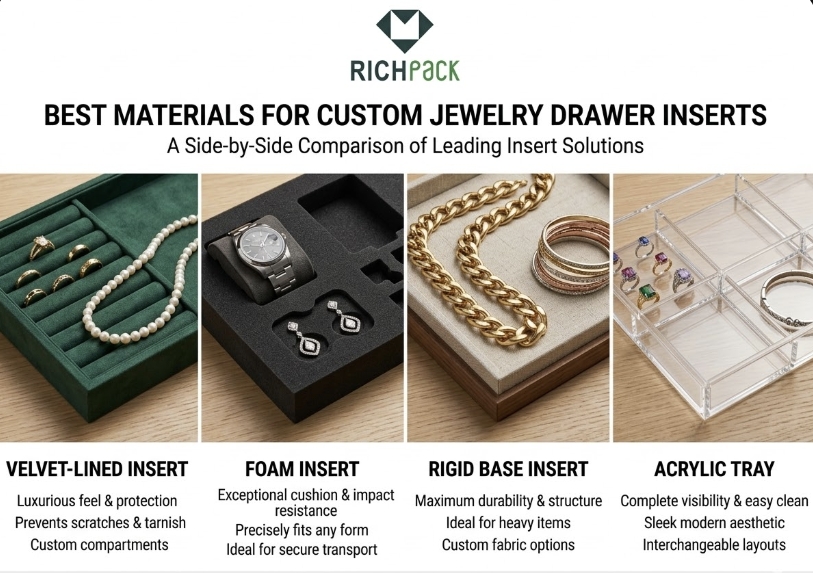
| Material / Structure | Best For | Main Strength | Main Limitation |
| Velvet or microsuede lining | Fine jewelry drawers, luxury presentation | Soft contact and premium look | Requires care to manage lint and dust |
| Foam insert | Shipping, fixed product positioning | Strong hold and shock support | Less premium for open drawer display |
| Rigid board or wood base | Large drawers and repeat-use trays | Better structural stability | Usually needs a soft lining layer |
| Acrylic tray | Minimalist layouts and quick visibility | Clean modern look | Less forgiving for delicate surfaces |
| Stackable tray system | Deep drawers and growing assortments | Uses vertical space efficiently | Needs clear category planning |
Custom inserts matter because they shape how the product moves through your system. That system includes storage, retrieval, display, reset, and client-facing presentation.
The upgrade is not only about making drawers look better. It is about making the entire handling environment more precise.
A better layout reduces touches. Fewer touches usually mean faster retrieval, cleaner resets, and fewer opportunities for misplacement.
Even a small gain matters. If a better tray layout saves 10 to 15 seconds per retrieval event and a sales or operations team handles 30 items a day, that can free up 5 to 7.5 minutes per person per day. Across a month, that becomes meaningful operational time, especially in client-facing environments.
The hidden cost of weak inserts is not always a dramatically damaged piece. More often, it is small repeated labor.
That labor may include untangling chains, checking for contact marks, re-polishing, rephotographing, or removing pieces from display because they no longer look fresh enough. A custom insert lowers that repeated friction by keeping categories more stable and contact points more controlled.
In luxury retail, a well-staged drawer helps the product feel more considered before the conversation even starts. That is powerful because presentation sets the frame for value.
A drawer with intentional spacing, soft lining, and clean category separation feels curated. A drawer with random trays feels improvised.
Scaling with random tray systems creates messy visual standards. One team improvises one way. Another team improvises another way.
A standardized insert system supports repeatable SOPs, more predictable training, and more consistent brand presentation across stores, showrooms, and sample rooms.
The best custom programs align the insert logic across packaging and storage. That means the same brand language can carry through a ring box, a drawer tray, a consultation drawer, and even a travel or archive system.
That kind of coordination strengthens entity signals around the brand as well. Instead of presenting packaging and storage as separate ideas, the brand starts to own a more complete premium handling ecosystem.
A custom solution is not always necessary. In some cases, standard trays are still the rational choice.
Yes. If the assortment is small, stable, and not heavily client-facing, standard trays can work well. The less the collection changes, the less valuable customization becomes.
Usually, yes. Pop-ups, short campaign sets, and temporary displays often benefit more from speed than from a perfect custom fit.
It can be. If the pieces are lower risk and the drawer is mostly internal, the return on a custom program may be low.
Often, yes. Many brands learn faster by validating a layout with modular trays first, then turning the winning format into a custom program.
Yes. Hybrid systems are common. Many brands customize the highest-value or most client-facing drawers first and keep standard trays in secondary or low-risk zones.
Before you request a quote, collect the information that will shape the design. A good project usually begins with measurement, assortment logic, and use case clarity rather than color selection.
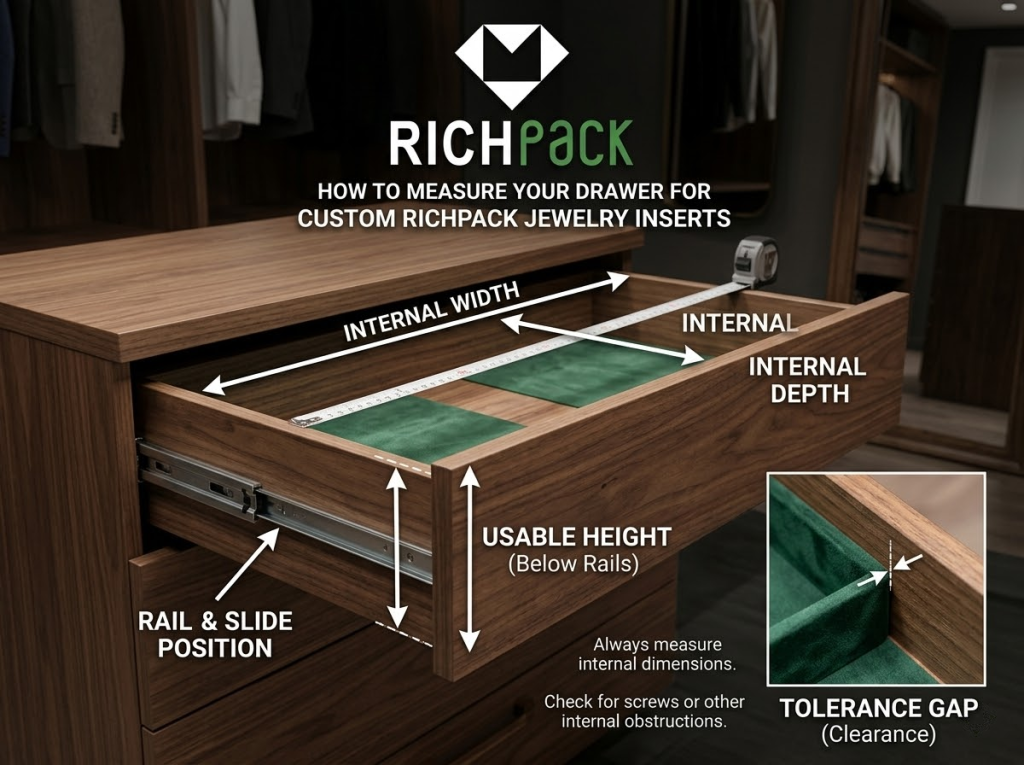
Measure the interior length, width, and usable depth. Then check for any rails, stoppers, inner lips, or hardware that reduce the usable area.
Also, allow a small tolerance so the insert can be removed without friction. In custom work, even a few millimeters can change how a tray feels in everyday use.
Do not just count how many pieces you have. Audit by category, size, height, and handling needs.
For example, measure long necklaces, wide cuffs, oversized hoops, pendants, and watches separately. These are usually the pieces that reveal whether a standard tray layout will fail.
A retail consultation drawer, a back-of-house inventory drawer, and a private dressing room drawer all need different priorities. One may prioritize speed. Another may prioritize protection. Another may prioritize visual harmony with cabinetry.
The more clearly you define the daily use case, the easier it is for a supplier to recommend the right insert structure.
Most buyers care about five things at once.
You do not need to maximize all five equally. You do need to rank them clearly.
Send lining color references, logo rules, material preferences, box references, store fixture references, and any existing packaging standards. The more visual context you give early, the less likely the final tray will feel disconnected from the rest of the brand.
A layout review catches wrong compartment proportions before they become expensive. It also helps you test whether the tray is truly optimized for your assortment, rather than just looking neat on paper.
Use this checklist before you contact a supplier.
A strong supplier should help you solve the system, not just sell you a tray. These questions quickly reveal whether the supplier understands luxury packaging, real-world drawer use, and long-term scale.
Ask whether they build both drawer inserts and custom jewelry box inserts. A supplier that understands both sides can create stronger consistency across packaging and presentation.
Ask whether they design from your actual assortment or from a generic compartment template. This matters most for mixed collections and luxury assortments.
Ask how they decide between velvet, foam, rigid board, acrylic, and stackable systems. A serious supplier should tie material advice to the use case, not just to what is easiest to produce.
Ask whether they can provide a layout sample, CAD review, or prototype before a full production run. This reduces risk and speeds up alignment.
Ask whether the system can expand to new assortments, deeper drawers, or additional locations. The best insert plan meets today’s needs without boxing you into tomorrow’s limitations.
Custom jewelry inserts are worth it for small brands when the jewelry is high value, the drawer is part of the customer experience, or the collection no longer fits standard trays without wasted space and repeated handling problems.
The best material for fine jewelry drawers is usually a velvet-lined or microsuede-lined insert over a stable, rigid base, because that combination balances soft product contact, structural support, and premium presentation.
Stackable Jewelry Trays for Drawers help by turning unused drawer depth into organized layers, which makes deep drawers easier to scale, sort, and update without burying product in one flat level.
Drawer inserts are built for in-drawer storage, retrieval, and display, while box inserts are built for packaging, transport support, and in-box product presentation. The two work best when designed as one connected system.
The first information you should send a supplier is drawer dimensions, usable depth, product categories, largest item sizes, daily use case, material preferences, and visual brand references, because those inputs shape both the layout and the material recommendation.
You should move to custom jewelry inserts for drawers when standard trays stop matching your drawer size, your product mix, and the quality of experience your brand now needs to deliver. The clearest signs are repeated protection issues, wasted space, slower retrieval, weak visual consistency, and deep drawers that no longer work efficiently.
If you are evaluating a custom program now, start with the buyer checklist in this guide. Once you define the dimensions, product categories, material priorities, and packaging relationship clearly, it becomes much easier to build a system that protects jewelry, speeds up handling, and strengthens the luxury presentation at the same time.

Just submit your email to get exclusive offers (reply within 12 hours)





 PREV
PREV