


 PREV
PREV
10 Creative Uses for Magnetic Gift Boxes
2026-05-19
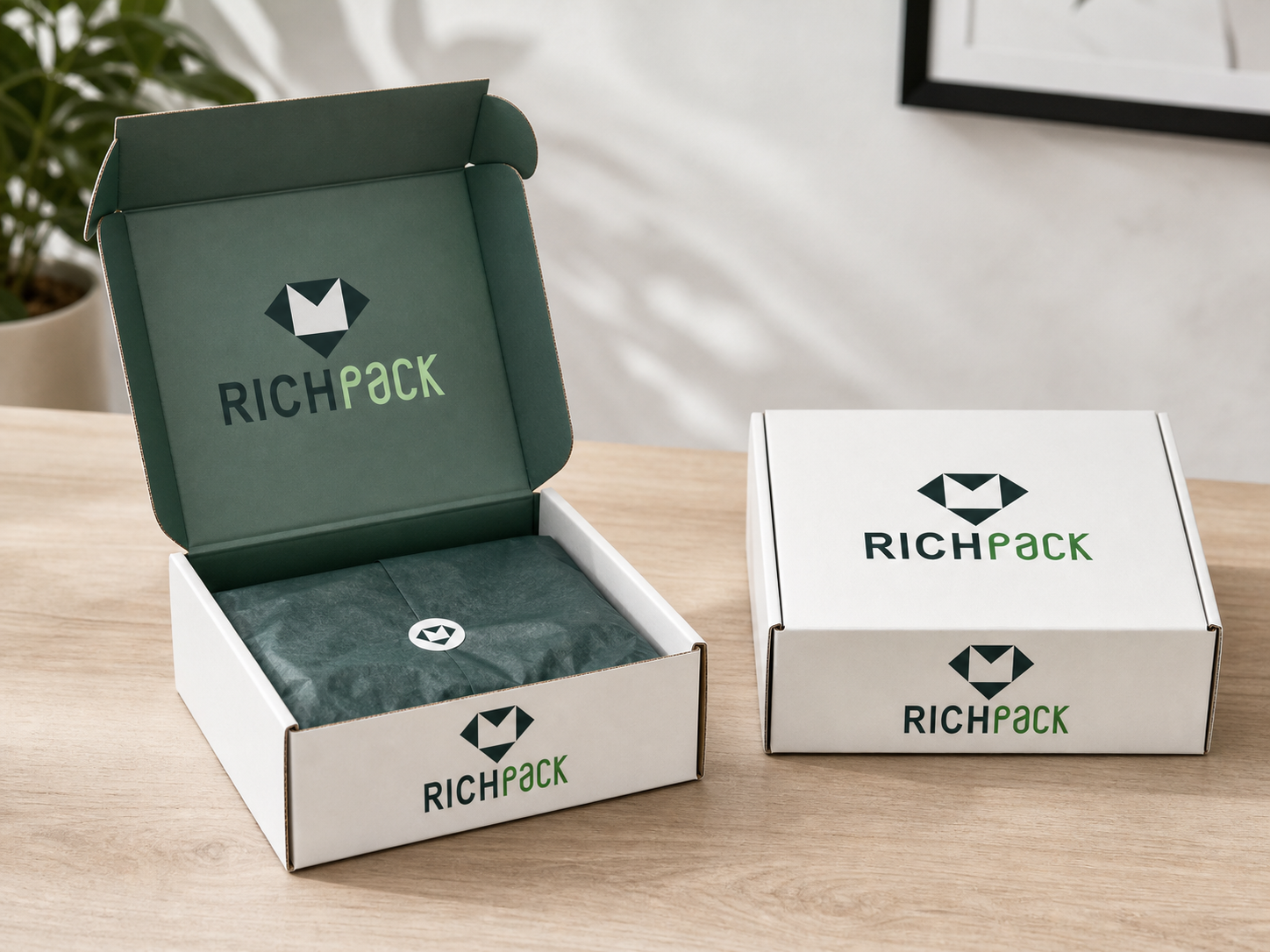



The sample looks sharp on screen. Then a packer folds it, the lid bows, and a necklace card slips under the insert. The carrier bills the parcel at a higher weight because one side is too long.
Custom mailer boxes often use corrugated board and a self-locking shape. The size and design fit a set product and delivery route. They suit small and midsize goods that need more shape and protection than a flexible mailer. A good mailer balances structure, fit, print, total cost, and proof from a packed test.
Start with the product, not the artwork. RichPack’s custom packaging project support can turn product data into a sample. The team can then build a production plan.
Before you ask for a quote, gather the item size, route, insert details, and print files. Add the material needs, order size, and target date.
A custom mailer box does two jobs. It carries the order and gives the customer a clean first view of the brand. Its folded walls, lid, and tabs form a small parcel that may close without tape, though some routes still need a seal.
A custom mailer box is a paper-based package cut from a flat blank and folded into a locking box. You can change its size, board, print, finish, insert, or opening steps. A stock box with new print changes the look, while a box built around the product changes the structure too.
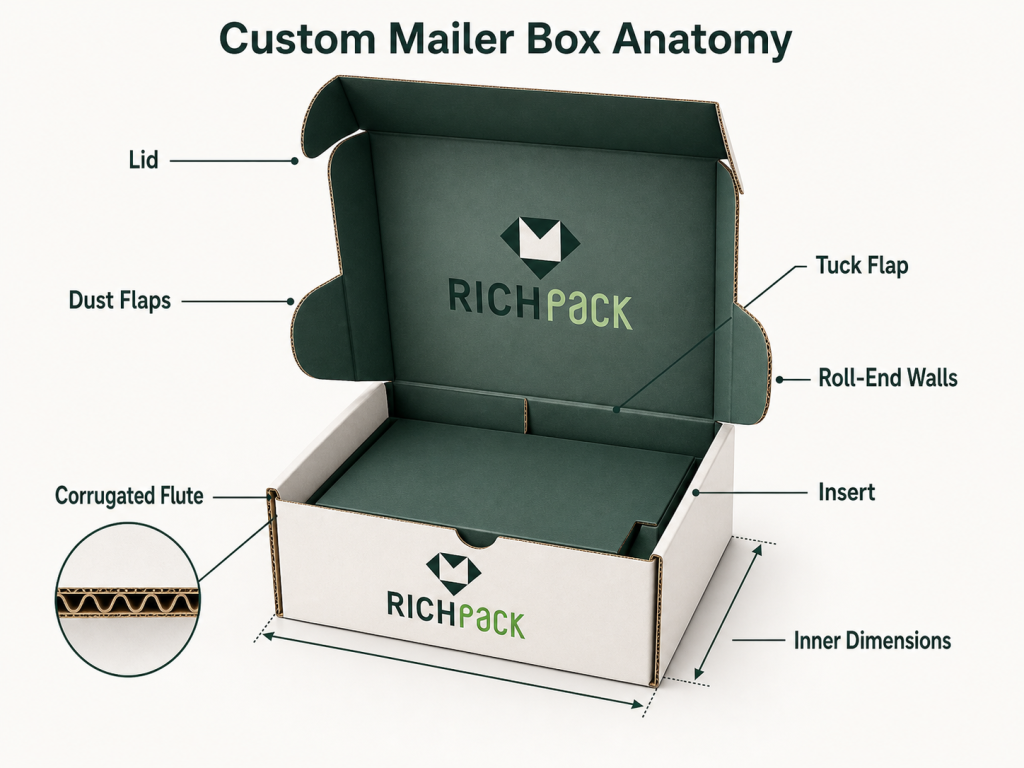
The lid often joins the back panel and tucks into the front. Side flaps or rolled walls make the edges stiffer and help the lid stay shut. A packer can form this one-piece box without taping four top flaps.
Test the lock with the full pack inside. An empty sample may close well, while a tight insert or tall product pushes the lid up.
Corrugated board has a fluted paper layer between liner sheets. The flute adds depth without much weight. The liners provide a print surface and resist punctures.
The board cannot do the whole job alone. Panel size, score depth, and grain direction affect strength. The tabs, insert, and product weight also matter.
Use this comparison to rule out a poor format before you pay for art, samples, or tooling. It compares structure, protection, brand space, packing work, and common uses.
| Decision factor | Custom mailer box | RSC shipping carton | Poly mailer |
| Structure | One-piece die-cut form with locking lid | Four-flap corrugated carton sealed with tape | Flexible film or paper envelope with adhesive closure |
| Protection | Medium to high when board and insert match the product | High and scalable for heavy or mixed loads | Low against crushing, higher against dust and light moisture |
| Brand surface | Full outside and inside panels | Good, but often used as a transport shell | Good for simple graphics, limited structural reveal |
| Packing work | Fast after the box is pre-folded | Requires forming and taping | Fastest for soft, nonfragile goods |
| Best fit | Branded DTC orders, subscriptions, kits, jewelry sets | Heavy, fragile, bulky, or multi-item shipments | Apparel and other flexible products |
A mailer favors a neat reveal and a compact parcel. An RSC carton gives more options for heavy or mixed loads. A high-value product may need both: a printed inner mailer and a plain outer carton for the hard part of the trip.
Choose a film or paper mailer for soft goods that can bend. It weighs less and stores flat, but it will not protect a ring box, bottle, or device from crush force. Choose corrugated board when the product must keep its shape or stay fixed in an insert.
A mailer works well when three facts line up. The parcel is small, and the product needs some crush protection. The opening order also matters. Jewelry sets, cosmetics, books, accessories, kits, and public-relations packs often fit this profile.
Check other formats before you lock the dieline. RichPack’s custom jewelry box options include mailers and rigid boxes. The range also covers drawers, pouches, and display packs.
A logo is one reason to use a mailer. The box can cut packing steps, hold products in place, and make each order look the same. It also gives design and operations teams one pack to check and repeat.
The outside helps a customer spot the brand, while the inside sets the first view of the product. Loose cards, exposed glue, or filler should not cover that view.
For jewelry, place the insert in the center and give it a clean pull point. Hold a necklace at more than one point so it cannot form a knot on the way to the customer.
Protection starts by stopping motion. A close insert keeps the item from building speed before a drop. It may work better than a large box full of tissue. Heavy or fragile goods may also need clear space at the corners, a product box, or a firmer insert.
Shake the packed sample by hand. If you hear or feel the product move, fix the fit before adding thicker board everywhere.
A self-locking box can remove taping and forming steps. The dieline still decides whether the job is fast. Ask three packers to build ten samples each, then time them.
Watch their hands. A flap that catches, a tab that tears, or a panel that needs a hard push will slow every order.
A right-sized mailer takes less room on a shelf, at the packing table, and in a delivery truck. Flat blanks also store better than boxes that arrive already formed. These gains vanish if the pack needs too much filler or a much larger master carton.
Measure the closed pack and the pallet load. Do not judge storage from the flat blank alone.
A stable design is easier to know at a glance than a busy one. Keep the main logo, color, type, and opening cue the same across sizes. Put short-term art inside the lid or on a sleeve.
This keeps the brand familiar and limits waste when a seasonal campaign ends.
One damaged order can lead to a replacement, a support ticket, more freight, and warehouse work. Log damage by box SKU, product, carrier, and route. That record shows where the real fault sits.
If one pack and route fail more than the rest, change that structure or insert first. Making every box stronger raises cost without proving it will solve the problem.
A paper box is not always easy to recycle. Plastic film, foam, magnets, large foil areas, and bonded parts may change its end path. Check the full pack, not the outer board alone.
Use disposal rules from each sales market. A paper claim means little if local sites cannot accept the finished mix.
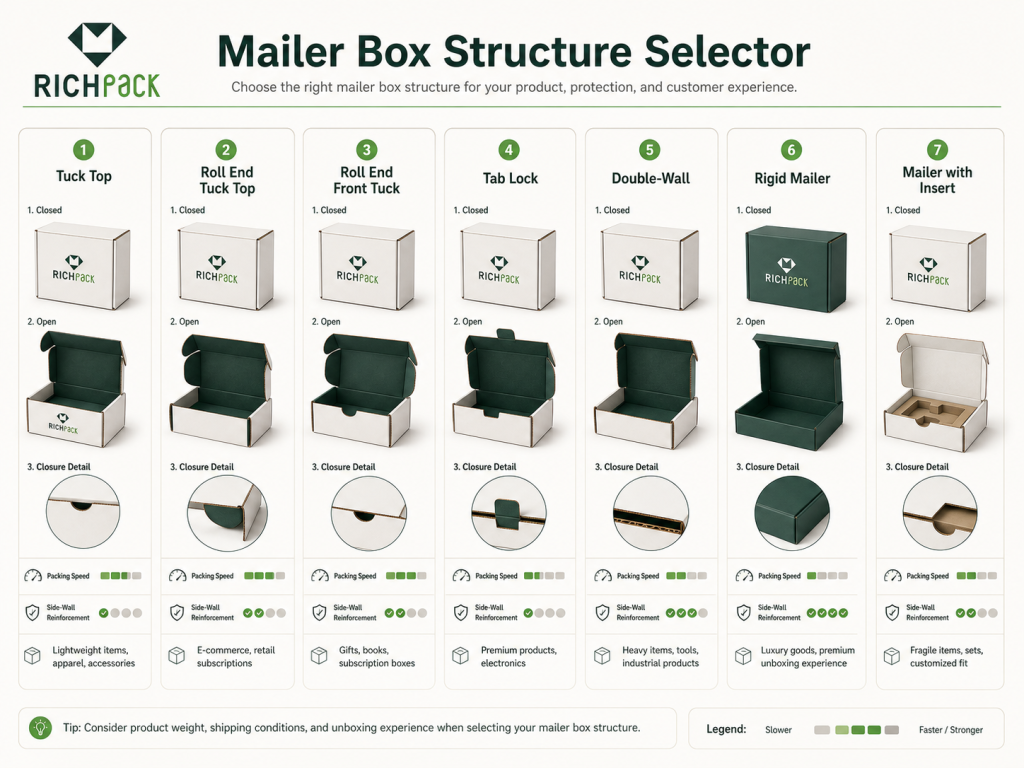
Pick the simplest structure that passes the packed route. The style changes how fast the box folds, how well it stays shut, and where a hit moves through the walls.
Use the table to make a short list, then test the exact size, board, scores, insert, load, and seal. A style name alone does not prove strength.
| Structure | Closure | Relative strength | Packing speed | Typical use |
| Tuck top | Front lid tuck | Medium | Fast | Light DTC products and gift sets |
| Roll end tuck top | Rolled side walls with top tuck | High | Medium | Subscription kits and glass containers |
| Roll end front tuck | Rolled walls with front locking flap | High | Medium | Apparel, books, accessories |
| Tab lock | Locking tabs | Medium to high | Fast | Compact electronics and product kits |
| Double wall | Reinforced side panels | High | Medium | Heavier or more fragile products |
| Rigid mailer | Wrapped chipboard construction | Medium without an overbox | Slow | Luxury presentation and PR kits |
| Mailer with insert | Any compatible shell plus retention system | Depends on system | Medium | Jewelry, sets, bottles, delicate components |
A tuck-top mailer has a hinged lid and a front flap. The style opens with little effort and works well for light goods. Close the sample five times and see if the flap stays in place.
Check the lid with a full insert. Add a label, seal, or tear strip when the route calls for a clear sign of prior opening.
Roll-end walls fold back over themselves. This gives each side more stiffness and some extra cushion. The top flap then tucks into the front.
This style can hold glass items or mixed kits, but it uses more board and takes more time to form. Measure that time with the same packers who will run the line.
This style pairs rolled side walls with a lock at the front. Its wide lid gives art room, and the built-up sides resist a side hit. The slots and tabs need close review.
A tight slot slows the line, while a loose one may open after the parcel shakes for hours. Check parts from more than one sample, since small die-cut shifts can change the fit.
Small die-cut tabs hold the panels or lid in place, reduce tape, and keep the box slim. Those tabs also carry stress at the fold.
Fold each sample five times and look for white lines, split layers, or torn corners. Pay close attention when the board has a high recycled content.
In a die-cut mailer, double wall often means side panels folded into two layers. It does not always mean double-wall corrugated board. The extra layers help the box resist side blows and top load.
Write the meaning in the quote request and include a photo or dieline so each supplier prices the same form.
A rigid mailer uses heavy board wrapped in print or specialty paper, so it feels dense and looks polished. Yet some rigid packs cannot travel alone through a parcel network.
If the rigid box is part of the product, protect it from labels, rain, scuffs, and belts. Use a tested outer shipper when the route can mark the sale pack.
An insert holds the product in a set spot and controls what the customer sees first. Paperboard, corrugated board, molded fiber, and selected foams handle different weights and surfaces. RichPack’s custom jewelry box inserts show the range of shapes and linings available. Build the shell and insert at the same time because a late insert change can make the box deeper.
CNC Machined Parts Packaging must control weight, hard edges, and surface contact. RichPack supports CNC machined parts and quick-turn prototypes. That service does not issue packaging quotes. Packs for those parts still need a separate brief and a physical sample.
Use Anti-static Inserts when electrostatic discharge could harm an electronic or machined part. Ordinary jewelry packs do not need them. For any insert, confirm fit, clean release, dust, rub, and movement with the real item.
Start with the load and route. Product weight, weak points, panel size, stack height, moisture, and handling all matter. A phrase such as “premium cardboard” gives a supplier no testable target.
Ask for the board build, thickness, rating, liner color, and recycled content. Get an approved sample too. Use the table to narrow the choice, then test the exact mill stock in the finished box.
| Material choice | Profile | Print surface | Relative strength | Best fit |
| E-flute corrugated | Thin and compact | Smooth for detailed graphics | Medium | Most branded parcel mailers |
| B-flute corrugated | Thicker and more cushioned | More visible flute texture | High | Heavier or more fragile goods |
| Kraft liner | Natural brown | Muted colors and strong dark ink | Varies by board | Natural brands and cost control |
| White-top liner | White exterior, kraft interior | Bright exterior color | Varies by board | Branded exterior with practical interior |
| Double-white liner | White exterior and interior | Bright printing on both sides | Varies by board | Premium interior reveal |
| High recycled-content board | Depends on furnish | Requires print and fold testing | Specification dependent | Circularity targets with verified performance |
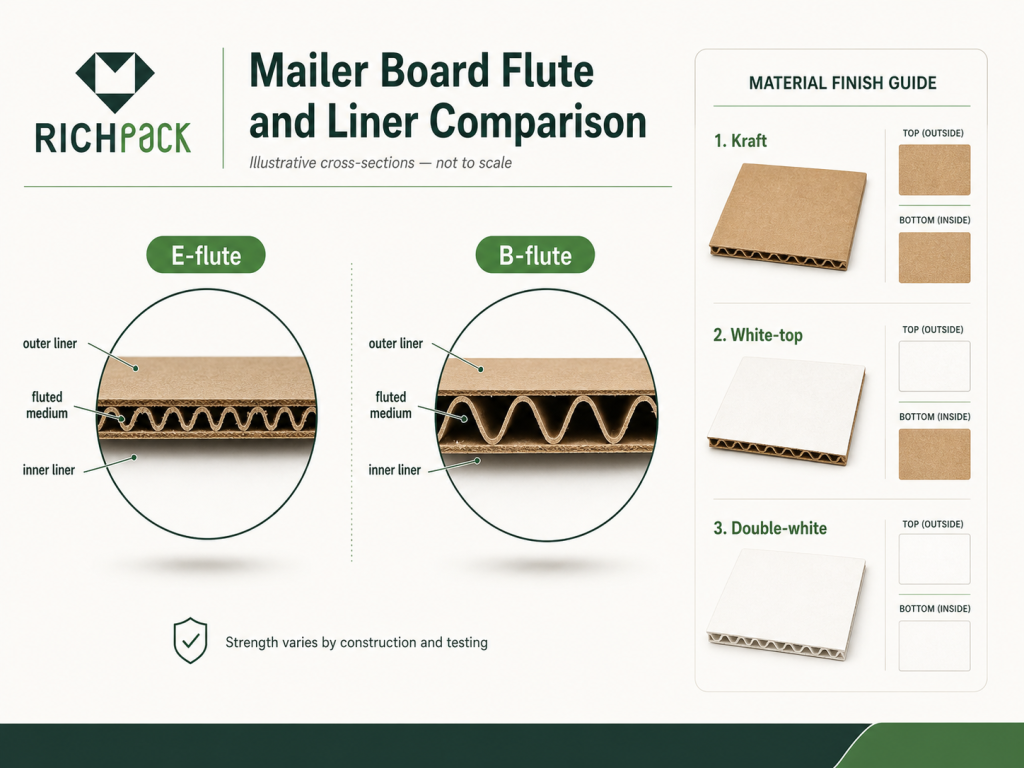
E-flute is thin, so it gives a mailer a neat edge and a smooth print face. It makes a sound first sample for jewelry, makeup, small gear, and kit orders. The name does not tell you the full strength.
Liner weight, fiber mix, glue, scores, and plant control can change the result. Compare finished samples, not loose swatches.
B-flute has a deeper wave than E-flute. It often gives more cushion and stronger edges, which can help with a heavier load or a rough route. The thicker edge also looks less refined and makes the folded box larger.
Print the real art before approval because fine type and small marks may look less clean over a deep flute.
Kraft liner has a brown face and works well with dark, simple print. White-top liner gives bright colors and photos a cleaner base. Color does not prove strength or recycled content.
Ask for fiber data and sourcing records apart from the color call, and treat them as two different checks.
Double-white board puts white liners on both visible faces. It gives the open box a clean look without covering brown kraft with a large ink field. It may also show dust and hand marks sooner.
Check the open flute edge, rub marks, and score cracks. Use normal warehouse handling, not gloves alone.
Edge Crush Test checks how the board takes load along its edge. Box Compression Test checks how a formed box takes top-to-bottom force. One ECT value cannot predict every finished box.
Size, holes, humidity, print, and folds all change the result. Set the test method and pass value with a packaging engineer.
Recycled content tells you how much recovered fiber is in the board. FSC certification tracks forest-based material through a controlled chain. The two claims answer different questions.
The Forest Stewardship Council ties its label to certified material and chain-of-custody controls. Review RichPack’s packaging material choices first. Then ask for a valid supplier certificate and the exact claim allowed on the order.
Wet corrugated board loses strength. Rain, high humidity, cold-pack sweat, and ocean freight can all raise this risk. A stronger liner, water-based coat, outer shipper, or better pallet wrap may help.
Do not add plastic film by default, as it may prevent scuffs and light water but make paper recovery harder.
The best size is not the tightest size you can draw. Choose the smallest inner space that protects the product. Make sure it still packs well despite normal shifts in the item and box. Size also affects storage, filler, and carrier charges.
Tools required
Measure the item in the exact form that will ship. Do not use a design file in place of the real product. Record its length, width, height, weight, hard points, weak spots, and expected movement.
For a jewelry set, place the ring box, earring card, care card, cloth, and return papers on the table. Pack them in the same order the line will use.
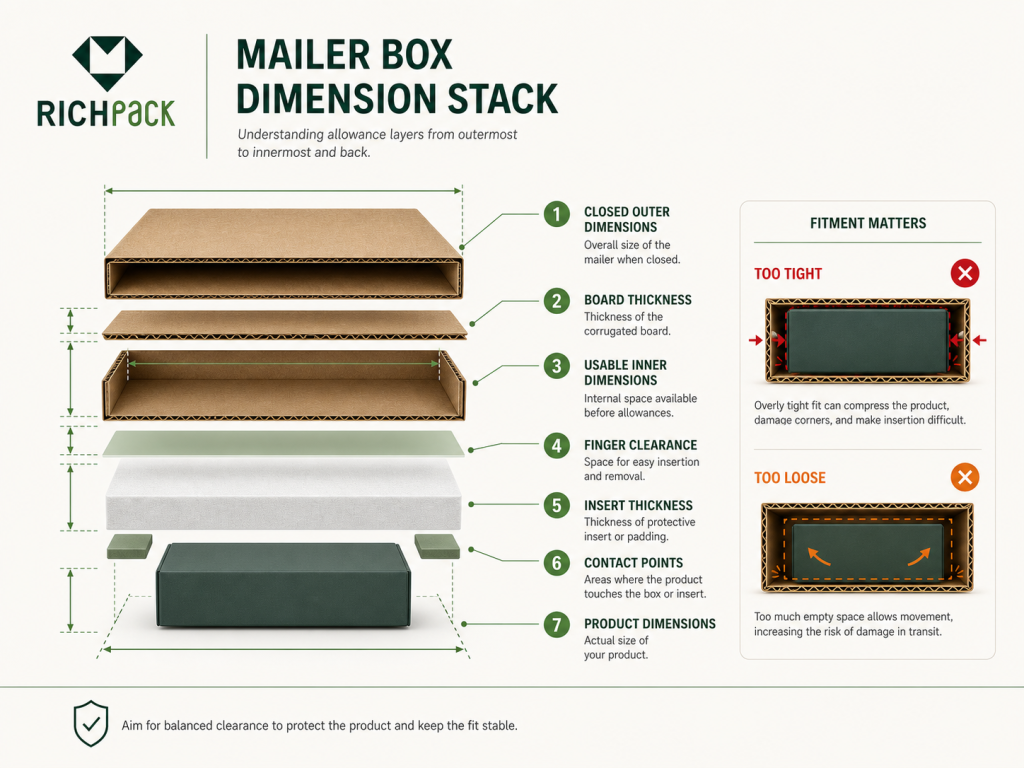
Product size is the space the item takes, while inner size is the usable room in the formed box. Outer size controls labels, freight, storage, and master cartons.
Label every number. A note that says “8 x 6 x 2 inches” is unsafe unless it specifies the order of the sides and whether the dimensions are inside or outside.
Leave room for the insert, fingers, board thickness, scores, and normal plant shifts. Too little room can crush the item or slow the packer, while too much lets it move.
Set the insert around the contact points first, then size the shell. Keep necklace chains away from raw corrugated edges, tight slots, and loose parts.
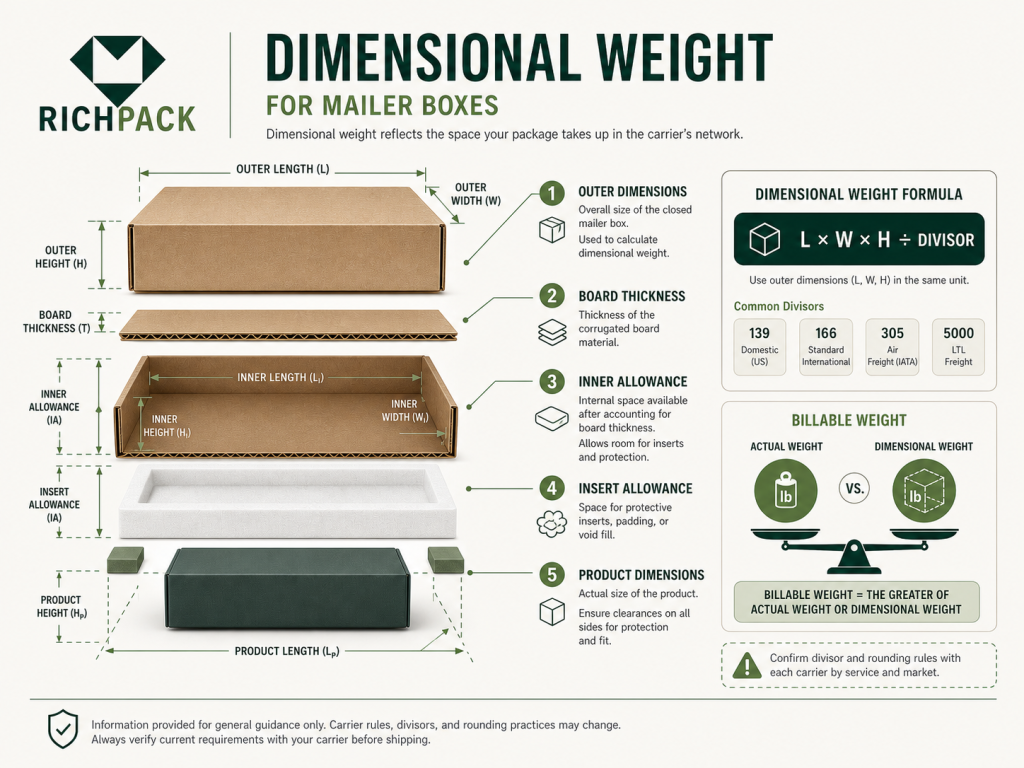
Dimensional weight uses parcel volume to set a billable weight. FedEx says its U.S. formula multiplies each rounded side in inches and divides the result by 139. The carrier bills the greater of dimensional and actual weight.
A 10 x 8 x 4 inch parcel gives 2.30 pounds before carrier rounding. Check the current divisor and rounding rules with FedEx or UPS. Use the correct service, origin, and destination.
A stock size can cut tooling and speed a small test run when the product fits well. A cheap box may need more filler or cross a carrier size break.
Price the full packed parcel. Compare the stock option with a custom die after you add filler, freight, and expected damage.
One box for every order sounds easy, but it often wastes space. Group orders by product size, pack shape, and frequency; two or three box sizes may cover most orders.
Give each box a SKU and a clear pack rule so staff does not have to guess which one fits.
A screen cannot show score drag, lid spring, insert grip, or the sound of a loose item. Ask for a plain structural sample before final print. Have the usual staff pack it, apply the real label, and measure the closed parcel.
Send the packed sample through a route that reflects normal use. RichPack’s packaging design and sampling can turn product data into a physical test.
Set the order of events: spot the brand, open the box, see the product, and dispose of the pack. A box can look good in a photo and still fail if cards and filler hide the item.
Choose one cue that stays clear under a label and after handling. It may be a logo, pattern, color block, or short line. Keep a plain zone for the shipping label and needed marks.
Move small type away from folds, tabs, and corners because those areas take the most wear.
Plan three views: the closed lid, the first open lid, and the product as it lifts out. Interior print should add something new rather than copy the outside. A care note or short thank-you line may do more than a wall of text.
Build the sample with every card and pouch in place. Open it at a normal table height and check what covers the product.
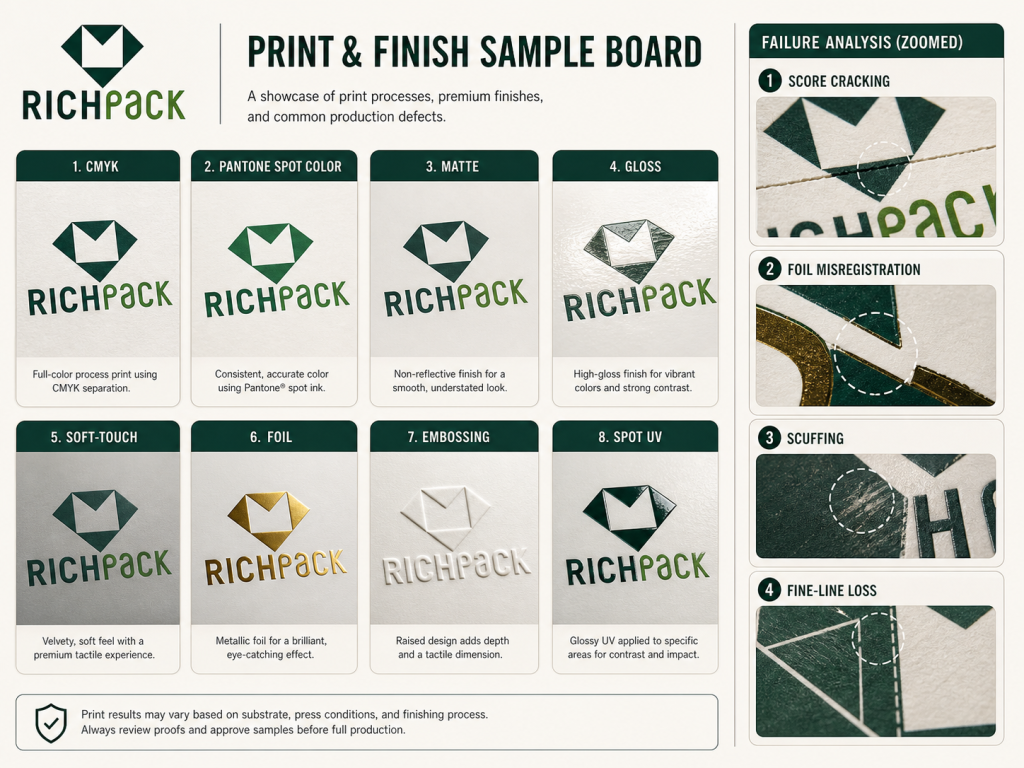
Give the printer vector files, logo limits, clear space, color targets, and a fair tolerance. The same CMYK values can shift with the board and press. A screen cannot settle a hard color call.
For a core brand color, approve a drawdown or printed proof under set light. Keep that signed sample as the batch reference.
CMYK mixes four process colors and suits photos, blends, and full-color art. Pantone spot colors use set ink references and can help with a small number of strict brand colors. The press and run size decide which route makes sense.
Ask which colors will use CMYK and which need their own ink. Review the answer on the chosen liner, not white office paper.
Matte cuts glare, while gloss makes color look richer and can resist light marks. Soft-touch adds a smooth feel but may scuff, cost more, or change the recovery path.
Handle final-grade samples with clean hands and with normal warehouse hands. Stack, fold, and rub them before you approve the finish.
Use one special finish to set a focal point. Foil adds a metal look, embossing raises the surface, and spot UV adds gloss to a set area. Each process has limits for line size and placement.
Keep fine details off folds because a small registration shift is easy to see on a shiny mark.
A QR code can lead to care, proof of origin, returns, or a campaign. Print a plain action beside it so the customer knows why to scan. Keep the page live after the launch ends.
Scan the code on the final board and coat under common light and angles. Do not use it as the sole place for facts the law says must appear on the pack.
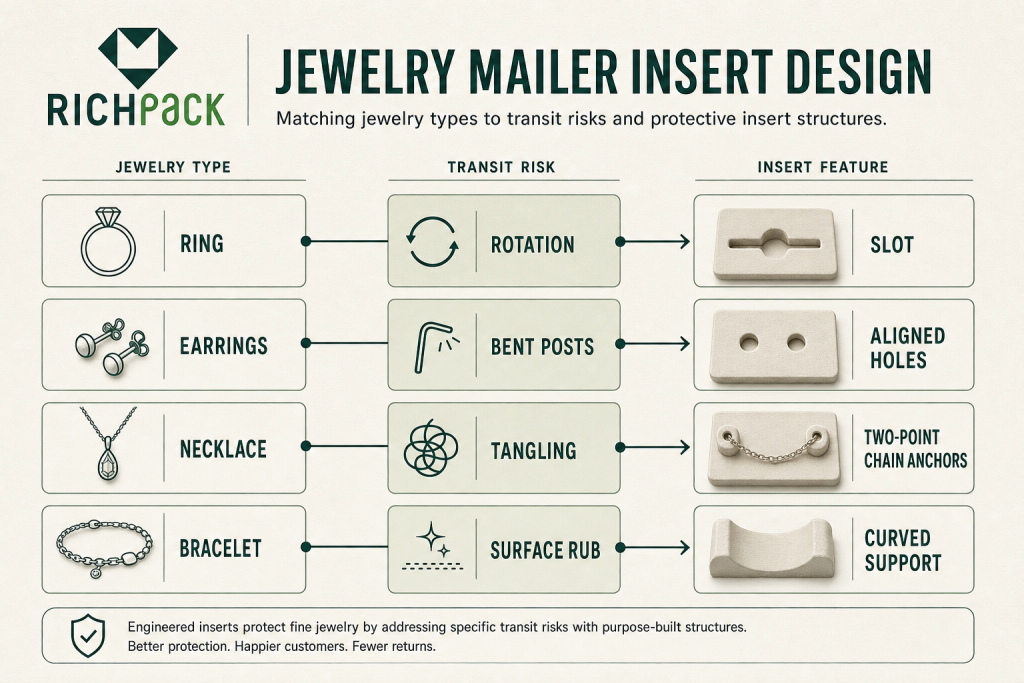
Match the hold point to the item because a ring needs firm upright support. Earrings need level holes or slots, while a necklace needs two or more chain anchors. A bracelet needs a curve that will not bend it.
The box, lining, logo, and insert should work as one pack. Check them on the same sample instead of approving each part alone.
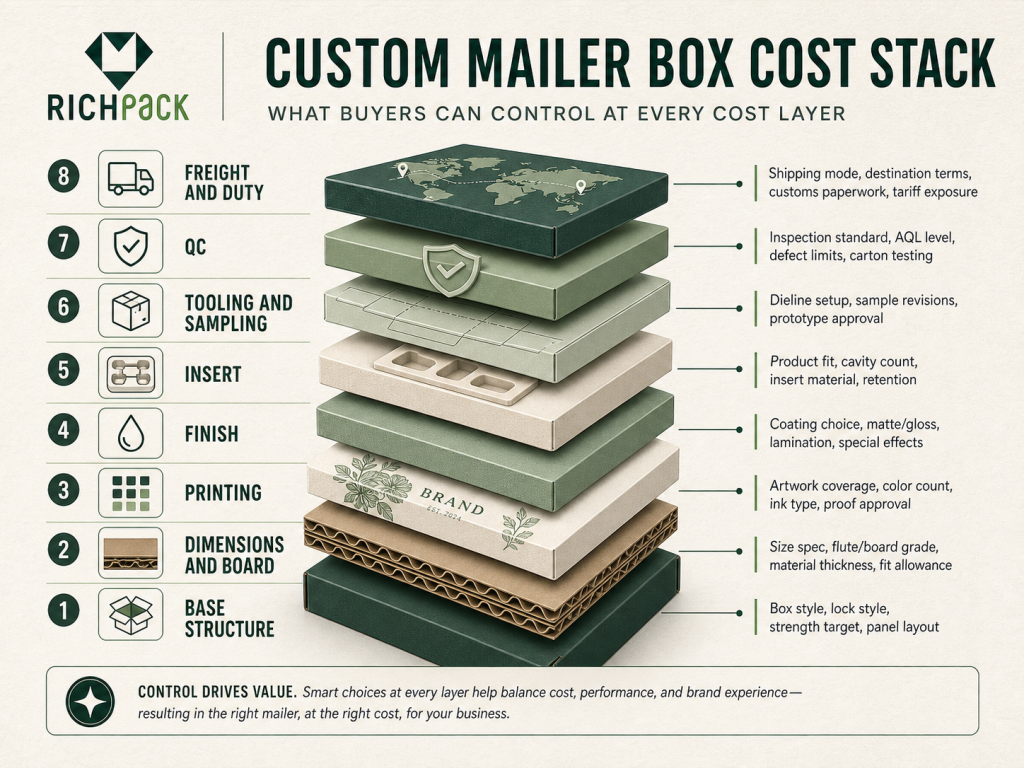
A quote comes from the full spec. The same box size can cost much more when the board, ink, finish, insert, run, checks, or freight change. Compare the same inputs across suppliers.
Use this table to find the large cost levers, then ask each supplier to show what the unit price leaves out.
| Cost driver | Relative impact | What changes the cost | Buyer control |
| Dimensions | High | Board area, die size, shipping cube | Right-size the packed product |
| Board and liner | Medium to high | Flute, fiber, strength, surface | Specify performance before appearance |
| Printing | Medium to high | Colors, coverage, press, inside print | Match process to artwork and volume |
| Finishes | Medium | Lamination, foil, embossing, spot UV | Use one finish where it creates hierarchy |
| Insert | Medium to high | Material, cuts, assembly, lining | Protect critical contact points |
| Quantity | High | Setup allocation and run efficiency | Compare total inventory risk, not unit price |
| Sampling and tooling | Low to high | New die, proofs, prototypes, testing | Reuse proven structures where fit allows |
| Freight and duty | High | Flat-pack cube, route, Incoterm, urgency | Quote landed alternatives before approval |
More board often means more cost and more freight. A small size change may also let a plant fit more blanks on a sheet or more cartons on a pallet. Ask for size options after the sample proves the needed clear space.
Do not remove protection to use less board because a cheaper box has no value if it raises damage.
Digital print has low setup and suits short runs or art that changes often. Flexo can make sense at higher volume with simple art. Offset can carry fine print, often on a sheet joined to corrugated board.
Compare color needs, run size, setup, speed, and finish fit because no one print method wins every job.
Each finish adds a step, setup, handling, and some risk of waste. Inserts add material and may add hand work, so ask for each item on its own quote line.
Then judge what it does, since an insert that stops returns may earn its cost. A hidden trim that goes straight in the trash may not. RichPack’s packaging cost case shows a cost review that keeps the quality target.
A die, print plate, color proof, plain sample, or lab test may show as a fee or sit inside the unit price. Ask who owns the tool and how long the plant will store it, then tie each tool to a dated dieline.
An old die and a new insert may look close on paper yet fail at the packing table.
The MOQ is the smallest run a supplier will make for a set spec. A low MOQ limits stock risk but puts setup cost into fewer boxes. A large run cuts unit cost but ties up cash and art. This low MOQ packaging case gives one startup example.
Compare 500, 1,000, and forecast-based runs with the same board and print. Keep the freight basis and overrun terms the same so you do not compare unlike quotes.
Landed cost covers the agreed cost to get usable boxes to the receiving point. It can include production, tools, samples, checks, freight, insurance, duty, and broker fees. Use one formula for every offer: Landed packaging cost = total project cost ÷ accepted usable units.
Then add packing time, storage, expected damage, and old stock. Those costs do not appear in the box price, but the business still pays them.
Flat boxes still take warehouse space, so plan demand by box SKU rather than by all orders added together. Record weekly use, lead time, route risk, safety stock, and dates when artwork must change.
A low unit price can turn into dead stock when one old claim or seasonal message makes a whole pallet unusable.
Right-size the box and use a clear color plan. Start with a stock form if it fits, then put one strong finish where the eye lands. Use less insert material, but keep it at the main contact points.
Freeze the spec on time to avoid new proofs, rush freight, scrap, and rushed choices from late changes.
Move from one signed check to the next. A note that says “looks good” does not set the color, fit, strength, allowed shift, or file version. Keep a record at each gate.
List the product size, weight, pack order, and target inner size. Add routes, carriers, annual use, and order size. Then record the board, art, print area, finish, and insert. Finish with claims, tests, due date, and delivery point.
A supplier can plan around the facts it can see. Missing route or insert data often comes back as a late price change.
A dieline is the flat drawing that marks cuts, folds, flaps, glue, and art panels. Approve the structure before final art. Then mark the top, front, inside, outside, and no-print zones.
Give each file a version and one owner. A name such as “final-final-v3” cannot control production.
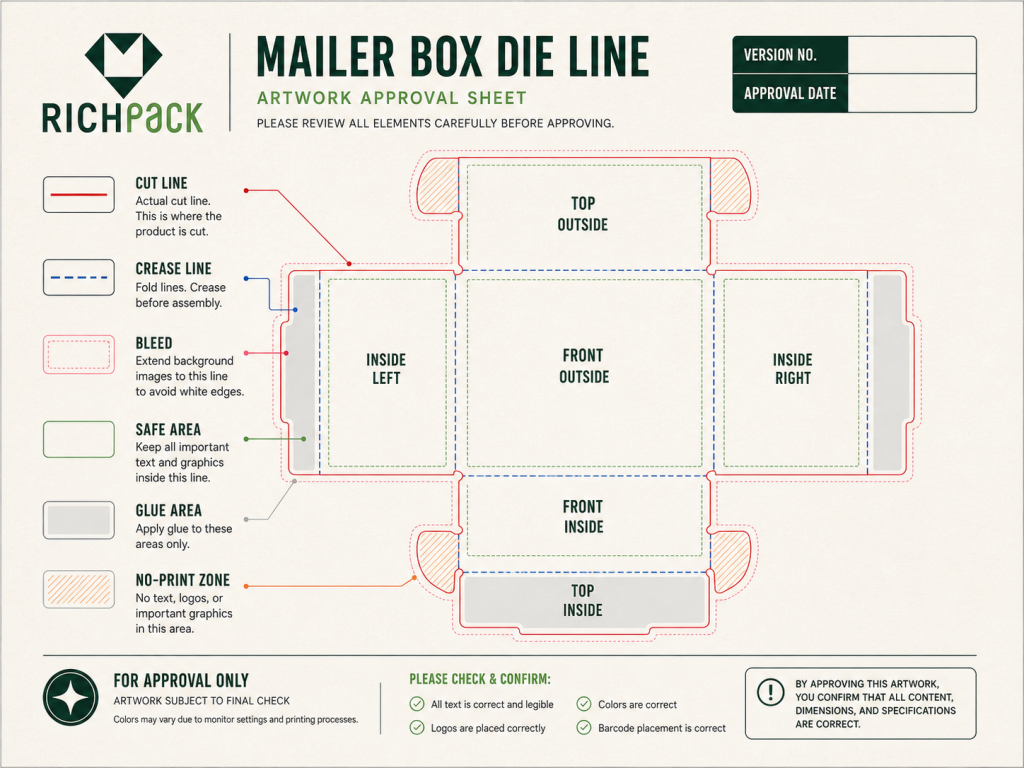
A plain sample checks size, fold, lock, insert, packing order, and product removal. It does not prove final color, so measure it and log any shift from the target.
Ask packers to build it, not designers alone, since they will feel a tight tab or awkward fold within five cycles.
A color proof checks art, position, text, codes, and expected color. A PDF on screen checks content, but it cannot copy the board shade or final coat. Use a press proof or a sample made with close materials for a strict color.
Sign and store the approved piece so the quality team has a real item to compare with the run.
ISTA 3A simulates parcel shipping for single-packed products. It covers packs at 150 pounds or 70 kilograms or less. The test includes standard, small, flat, and long packs. Use current ISTA test procedure guidance with a qualified lab or packaging engineer.
Set pass rules before the test. Cover the product, insert, lock, print, and the condition a customer would accept.
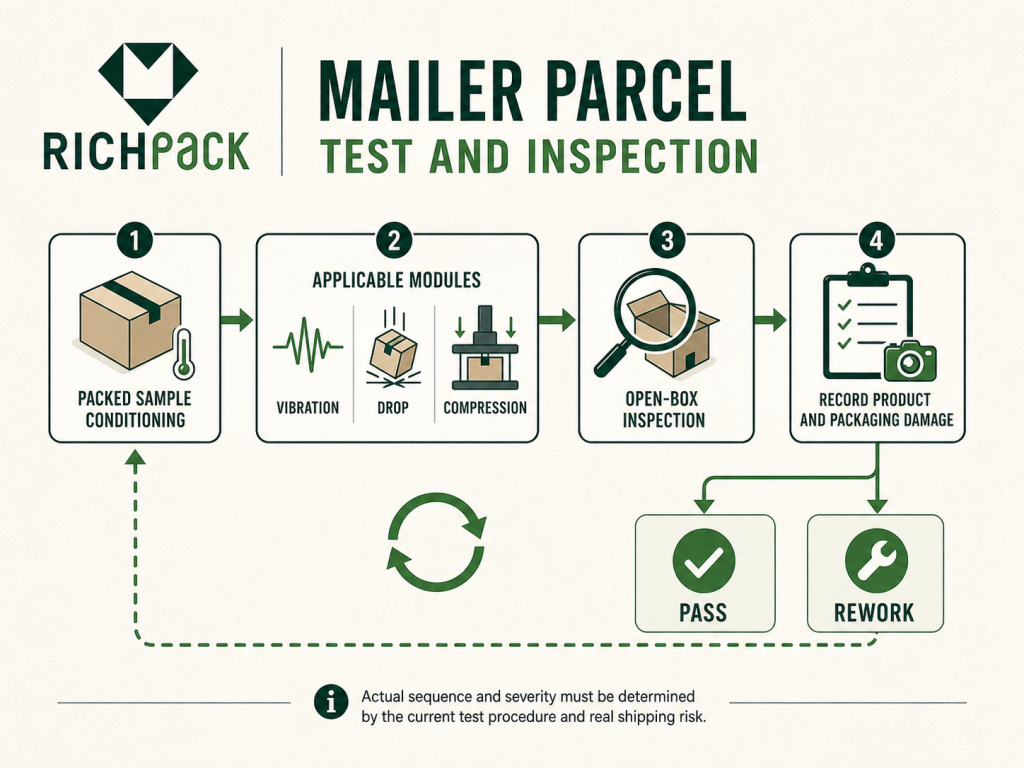
Inspect facts that a person can measure. Check inner and outer size, board build, print position, and color range. Then check the finish bond, scores, glue, tabs, and inserts. Record dirt, count, and carton marks too.
Set the sample plan and limits before production. “Good quality” does not tell an inspector when to pass or stop a lot. RichPack’s packaging quality controls outline the checks a supplier should connect.
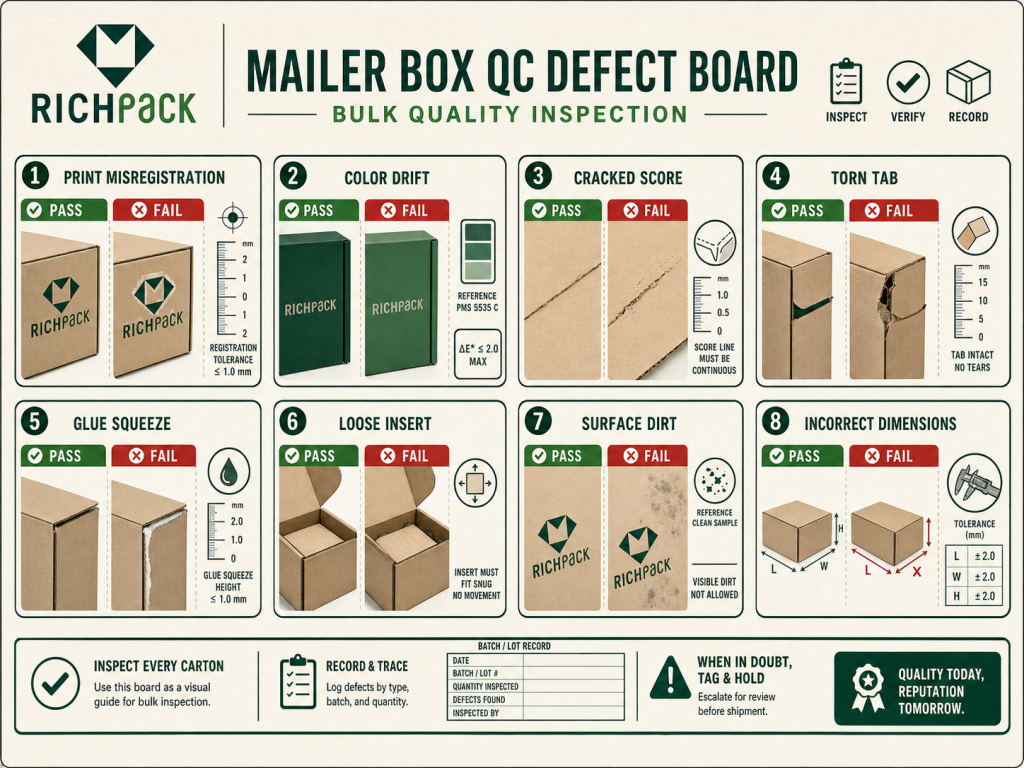
Split the schedule into design, samples, materials, print, forming, and checks. Add export work, transit, customs, and receiving. Set dates for art and sample decisions. Record the Incoterm, freight mode, pallet rules, master-carton size, and document owner.
The RichPack Instant Quoting Engine shows how fast a digital quote can feel. The engine does not provide packaging prices. A user can upload a 3D model and see pricing and lead time for supported parts. The tool also gives DFM feedback.
A mailer quote still needs box dimensions, route, material, and insert details. It also needs print, quantity, freight data, and a physical sample.
RichPack’s packaging distribution support links the quote, freight plan, and delivery steps.
Use demand and delay to set the trigger: Reorder point = average use during lead time + safety stock
Review the number when sales mix, route, lead time, or art changes. Store signed samples, dielines, check reports, and freight records under the box SKU.
Start with less material, known sources, a clear recovery path, and claims you can prove. Green ink and a recycle mark are not proof, so check each sales market before art approval.
A right-sized box can cut board, filler, storage, and parcel volume. Keep the old and new pack data so the change has a clear basis. Do not remove cushion until a packed test passes.
A second shipment often uses more material than a first pack that has enough protection.
State the percentage and whether the fiber came from consumers or from plant waste. Say if the number covers the whole board, one liner, or the insert. A broad “recycled” claim can hide a small share.
Test high recycled content in the exact box and climate. A supplier sheet cannot prove how the final pack will fold or stack.
FSC Chain of Custody tracks certified forest material from source to finished item. A plant that buys some FSC paper cannot place any FSC claim on any order. The certificate, product group, invoice, and logo use must all fit the job.
Check the certificate scope and date. Approve the allowed mark before the printer makes plates.
Ask how ink, coat, glue, label, foil, and film affect the planned waste stream. “Water-based” does not prove that the full pack is harmless or easy to recycle. The finished mix is what reaches the bin.
Use a simple material order. Make any customer separation step clear and easy without tools.
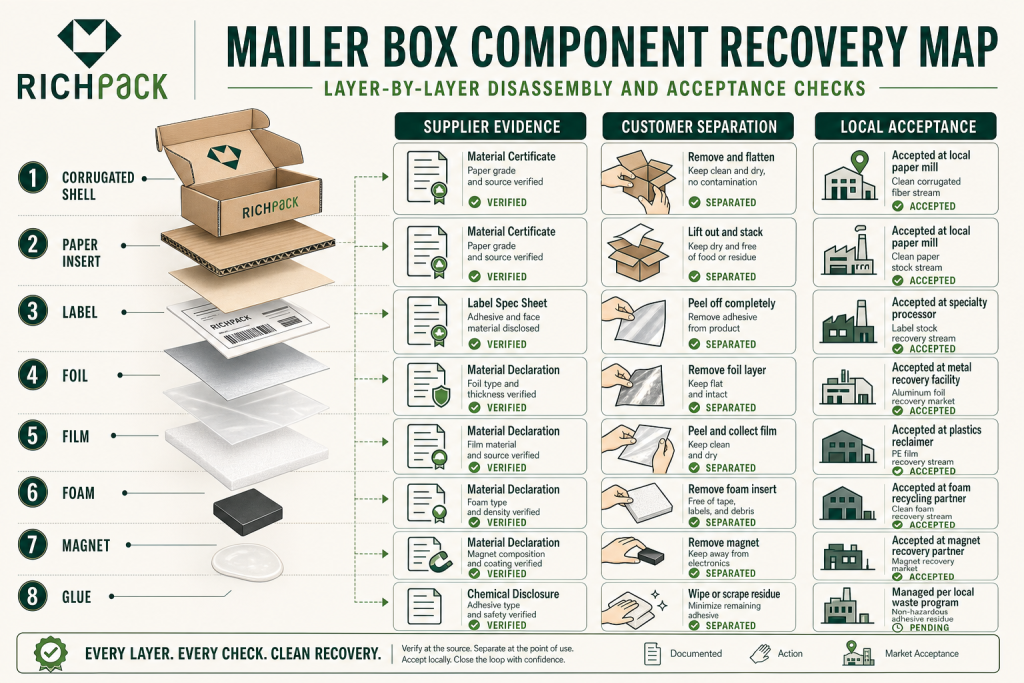
The U.S. FTC Green Guides set a 60 percent access test for recyclable claims. Below that level, the claim needs a clear limit. It must also say whether it covers the product, pack, or one part.
Check local access before using one global line, and keep the evidence with the approved art.
The EU Packaging and Packaging Waste Regulation took effect on February 11, 2025. The European Commission says it will apply in general from August 12, 2026. It covers packs placed on the EU market and sets rules for design, content, waste cuts, and recovery.
Get legal review for each sales plan rather than turning a general rule summary into a product claim.
Extended Producer Responsibility may call for sign-up, reports, fees, or set disposal marks. The duty changes by country and by the party that puts the packaged goods on that market. Build a country record before the art is final.
Track each part’s weight, material, claim, responsible party, label, and proof. Use version control when a rule changes.
A reuse claim needs a real second use and a box that lasts long enough. Recovery needs material that local sites accept and customers can identify. Parts should split without tools when the disposal note asks for separation.
RichPack’s paper packaging solutions can support material choices. The brand still must prove the claim in each place where it sells the pack.
Jewelry is small, costly, and easy to scratch or tangle. The mailer must hold the box, card, or pouch in place while parcel equipment turns it in every direction.
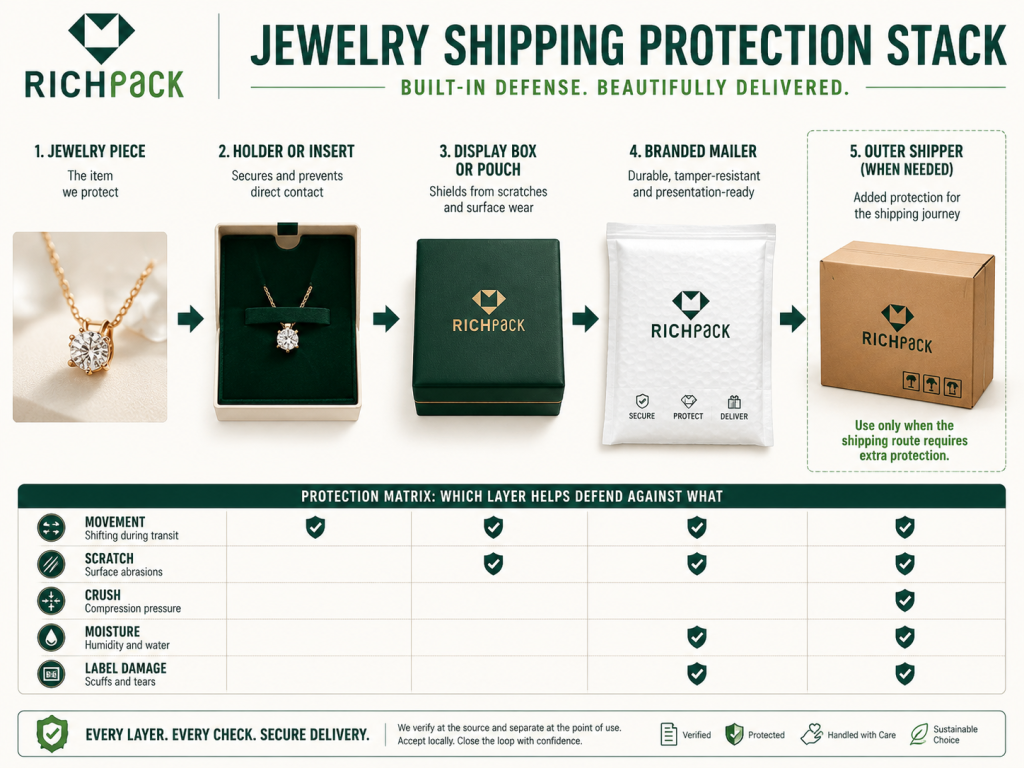
Use a fitted space for a ring box or level slots for earring cards. Keep posts away from rough board edges. Add a finger notch so the customer can lift the item without shaking the pack.
For a set of earrings, mark each place or use a lift-out tray so the order still looks right after transit.
Hold a chain at two or more points and keep the pendant away from clasps. A bracelet needs a set curve or a close pouch pocket, and loose paper should not slide under either item.
Turn the packed sample on every side. A design that needs an upright position will fail in a parcel system.
A gift set needs order without giving up packing choice. Modular pockets or a paperboard grid can hold set product mixes. Keep the heaviest part near the center and stop hard items from touching.
Print a short key under the lid if the set needs an explanation. This can remove a loose sheet from the first view.
Keep the shell and insert base steady when the product mix allows it. Change a card, sleeve, or inner print for the season to save tooling and keep the pack steps familiar.
Set an end date for the art and limit the run. A plain outer face may also draw less notice to jewelry in transit.
A public-relations kit may face a camera, a second courier, or hand-carry. Make the first open view clean, but secure the parts after that moment. Add a quiet way to close and pack it again when the kit will move more than once.
A rigid display pack may still need corrugated protection. A camera-ready lid does not prove courier strength.
The same box may go to a home, a store, or a pickup desk. Give staff clear rules for labels, seals, and outer packs on each route. Do not leave the choice to the last person at the bench.
RichPack’s coordinated jewelry packaging can match mailers with pouches, cards, trays, and bags.
Give every supplier the same inputs and ask for the same outputs. This makes price, skill, risk, and schedule easier to compare. It also cuts the number of assumptions that turn into sample changes.
Use the table as a handoff between design, brand, operations, legal, and supply teams.
| Brief section | Required inputs | Required supplier response |
| Product and shipment | Dimensions, weight, arrangement, fragility, routes | Recommended structure, size, and board |
| Structure | Inner size, closure, insert, seal, assembly target | Dieline, tolerances, sample plan |
| Brand and artwork | Files, colors, print coverage, finish, codes | Print process, proof type, color control |
| Sustainability | Fiber source, recycled content, recovery goal, claims | Certificates, component data, allowed claims |
| Commercial | Quantity tiers, forecast, delivery point, target date | MOQ, price basis, tooling, freight, lead time |
| Quality and compliance | Tests, inspection, labels, target markets | Test method, QC plan, documentation |
List every item, its position, size, weight, and weak surface. Add the route, carrier, climate, pack method, and common order mixes. Send a failed box or clear photos when you have them.
The supplier cannot design around a fact that the brief never provides.
State the usable inner size, box style, lock, and seal. Add the insert, fold method, outer size limit, and allowed shift. Mark each need as fixed or open to change. This gives the engineer room to lower cost without removing a real control.
For CNC Machined Parts Packaging, include part mass, hard edges, and finish class. Note any oil, residue, corrosion need, or ESD risk. Ask for Anti-static Inserts when the part needs ESD control.
Send vector art, fonts, color calls, and print faces, then add finish maps, codes, marks, and legal copy. Name the proof type and the person who can approve it. Ask the plant to flag small type and fine lines. It should also flag knockouts and tight registration before release.
State the material mix, recycled target, and certificate needs. List barred substances and parts the customer must split. Add the planned recovery route and exact claim, then ask for proof before the words go on the box.
Ask for quantity breaks, samples, tools, and overrun limits. Add payment terms, Incoterm, freight plans, and lead time. Record the quote term and tool ownership. Put each offer at the same delivery point and accepted unit count.
RichPack’s jewelry packaging manufacturing links the main factory tasks through one partner.
Set limits for size, board, print, color, and finish bond. Add fold, packing, test, sample count, carton mark, and record rules. Name the person who can accept a change. The supplier should not make that decision after production.
A mailer box is a one-piece die-cut pack with a hinged lid that often locks into itself. It suits small parcels and a branded first view. A standard shipping box often has four flaps and needs tape. It gives more size and strength choices for large or mixed loads.
Clean, dry corrugated mailers often enter a paper stream. Coats, films, inserts, labels, and glue may change that answer. Check local sites and tell customers how to split parts that use a different path.
A sound unit price needs a full spec. Size, board, print, finish, insert, run, tools, checks, freight, and duty all change the number. Compare landed cost per accepted box, then add labor, storage, damage, and old stock.
Some digital printers will make one box or a small run. That service is often closer to a print test than a full custom production order. Ask whether “no MOQ” covers a new size and structure or custom art on a stock box.
E-flute has a slim profile, so it prints well on small branded parcels and gives medium protection. B-flute may suit a heavier or more fragile item. The best board is the lightest tested build that passes the load, route, climate, and visual checks.
Measure the full pack, then build the insert and needed clear space around it. Make a sample and record the closed outer size for the carrier. Do not add the same half-inch gap to every side, since the item, board, insert, and plant limits set the right space.
Yes, corrugated mailers can carry print outside, inside, or on both faces. The board and press may add a pass, a new liner, or a printed sheet joined to the board. Approve the inner color first. Then test rub strength where the product and folded panels touch the print.
The schedule starts with the brief, engineering, sample, art, and proof. Materials, production, and checks come next, followed by freight, customs, and receiving. A repeat run with approved tools is faster than a new box.
The right mailer is not the thickest box or the lowest quote. Choose the smallest proven pack that holds the item still. It should fold without a fight and reach the customer in good shape. Its print should be clear, and its claims should fit the market.
Start with the full product and route, then choose the board and structure. Build the insert, check the outer size, and approve a physical sample. Compare landed cost, run a suitable parcel test, and set clear limits for the production batch.
That work turns custom mailer boxes into a repeatable part of shipping and brand care. RichPack can link design, sampling, production, quality checks, and global delivery. Bring product sizes, order quantity, markets, art, route, and delivery date. A complete brief gives the team what it needs to build a useful sample and a quote your buyers can compare.
2026-05-19

2024-11-26
2024-11-15
2024-12-04
2024-12-25
2026-03-24
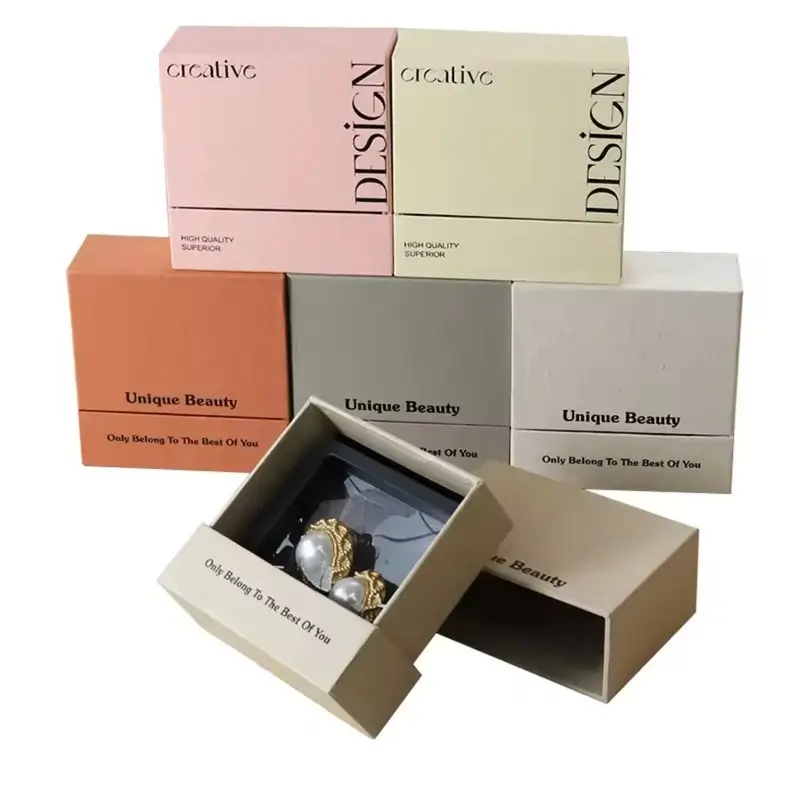
Branded and Sustainable Custom Eco-Friendly Jewelry Packaging with Brand Logo | Tailored for Jewelry Brands Needing Personalized and Green Packaging
View More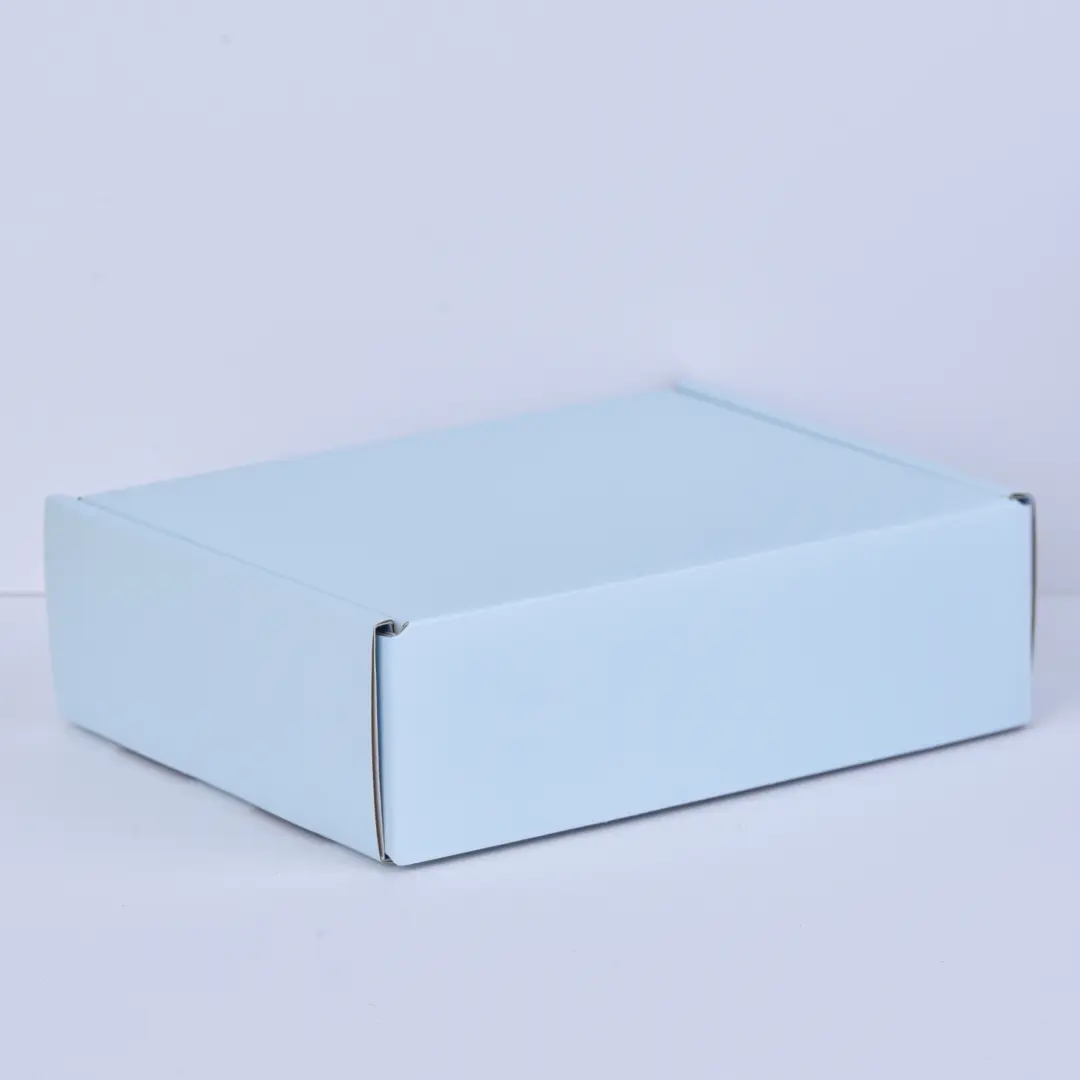
Light Blue Cardboard Shipping Boxes – 18x13x5.5cm Blue Mailer Boxes & Corrugated Tuck Top Box
View More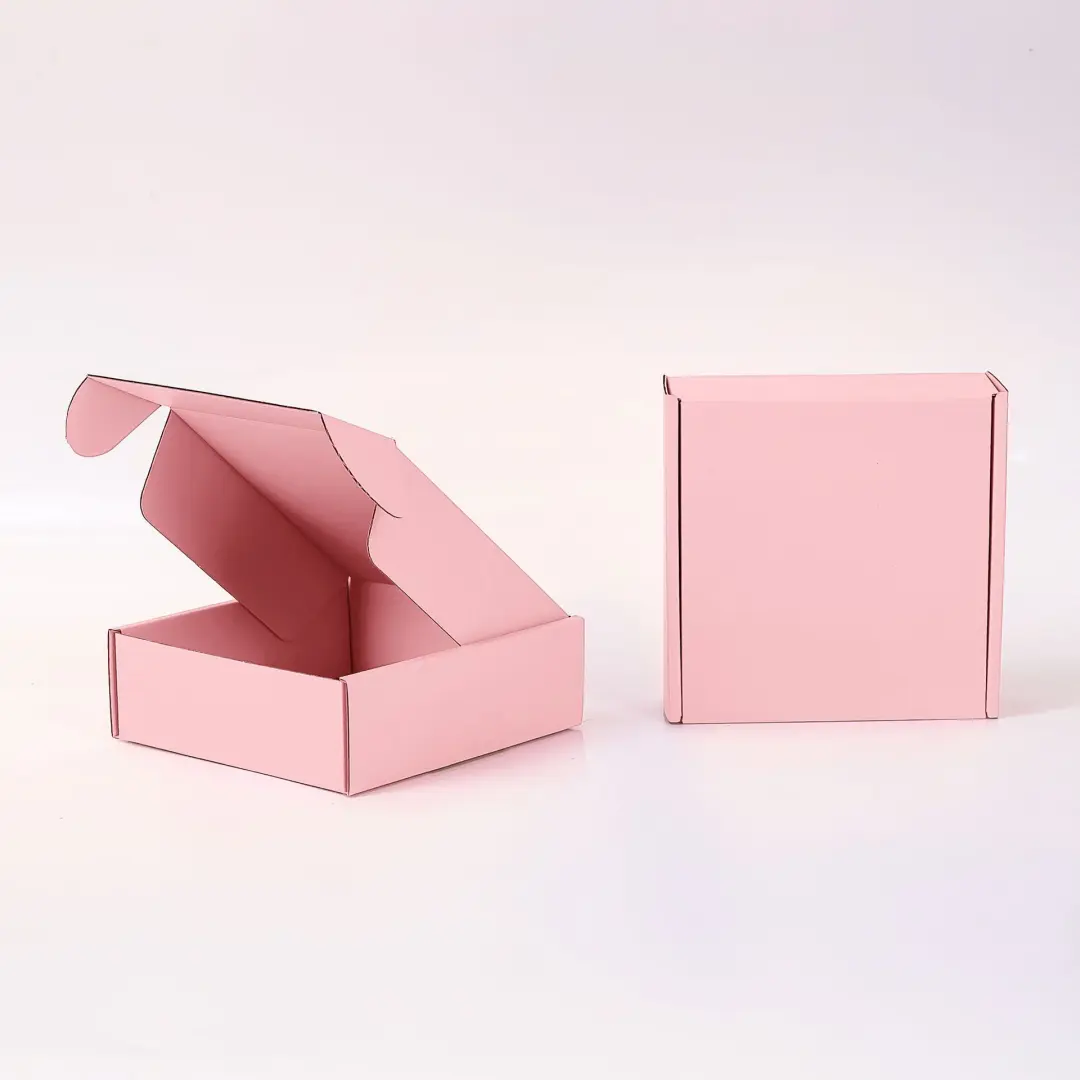
Pink Mailer Boxes – 15x15x5cm Pink Small Shipping Box & Large Pink Shipping Boxes
View More
Richpack Sustainable Eco-Friendly Custom Packaging for Sustainable Brands | Perfect for Jewelry Merchants Focused on Green, Ethical Packaging Solutions
View More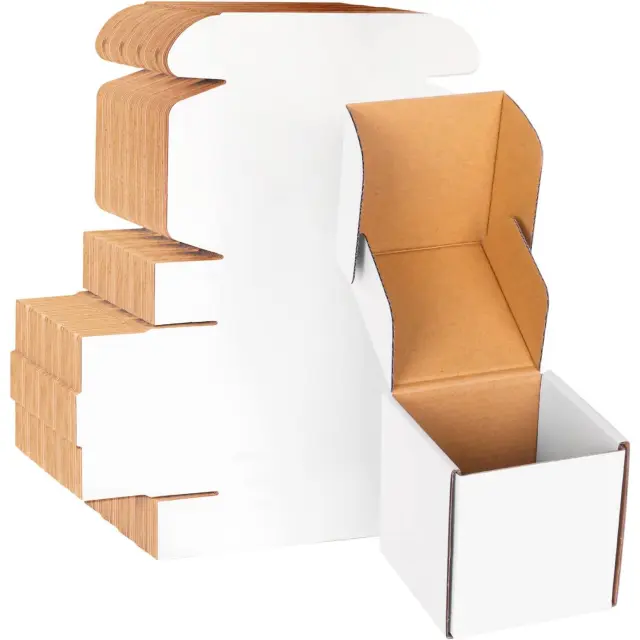
White Shipper Box | Custom Corrugated Packaging for Jewelry – Richpack
View More
Wholesale Chocolate Box for Gift | Customizable Gift Boxes for Chocolates for Birthday Wedding and Corporate Gifting Richpack
View More

