


 PREV


10 Creative Jewelry Packaging Ideas for Small Businesses
2026-07-28
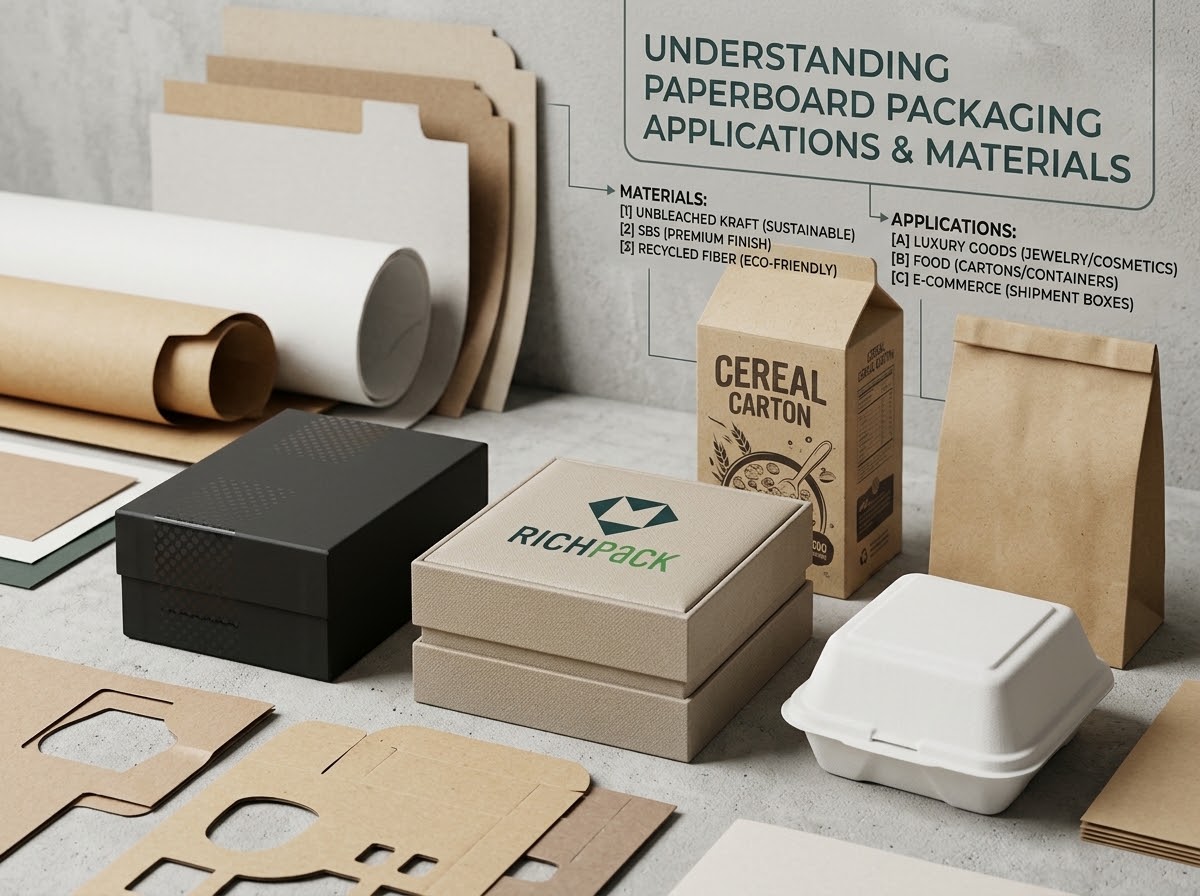



Paperboard packaging is a thick, formable paper-based material used when a package needs a printable surface, controlled folds, and a lighter structure than a corrugated shipping box. The material can become a folding carton, sleeve, insert, rigid box wrap, tube, or display component, but each format asks something different from the board.
The practical choice starts with the job. A cosmetic carton needs a clean print face and accurate folds. A jewelry box needs a stable structure, a fitted insert, a soft contact surface, and enough clearance for the lid. An e-commerce pack may need a separate corrugated outer shipper even when the presentation box is paperboard.
The American Forest & Paper Association describes paperboard as a strong, lightweight material made from wood pulp or recycled paper pulp. The Paperboard Packaging Council adds the structural distinction between folding cartons and rigid boxes. Those two ideas set the scope here: material source, board grades, packaging applications, finishes, jewelry matching, sustainability boundaries, and the sample checks that turn a material choice into a production brief.
Paperboard packaging is a package made from a thick paper-based sheet that can be printed, cut, scored, folded, wrapped, or formed. It works well when a brand needs a controlled shape and a clear graphic surface, but it is not automatically a substitute for every corrugated, plastic, metal, or barrier structure.
Paperboard is made from cellulose fibers that are formed into a sheet, often in one or more layers. Compared with ordinary paper, it has more body and stiffness. That extra structure lets a converter cut a dieline, add score lines, fold panels, and hold a carton shape.
The sheet has a job on both sides. One face may carry the main artwork, coating, foil, or window. The back face may support folding, gluing, printing, or contact with another component. A board that looks suitable from the front can still fail at a fold, glue tab, edge, or closure if the full construction is not checked.
The word paperboard describes a material family rather than one universal recipe. Fiber source, number of plies, caliper, density, coating, moisture exposure, and conversion method all affect the finished package. For that reason, a supplier brief should name the finished structure and use case instead of asking for “paperboard” alone.
These terms overlap in everyday speech, but they point to different buying decisions. Use the table to decide whether the first need is a printable presentation surface, a folding structure, or protection during transport.
| Material term | Basic construction | Common packaging job | Main strength | Boundary to check |
| Paper | Thin, flexible sheet | Wraps, labels, tissue, lightweight bags | Easy to print and fold | Usually needs another structure for a box |
| Cardstock | Heavier printing stock, often used for cards and light covers | Cards, sleeves, light inserts | Smooth print surface | May not provide enough stiffness for a loaded carton |
| Paperboard | Thick solid paper-based sheet, single or multi-ply | Folding cartons, sleeves, inserts, displays | Printability, scoring, forming and moderate stiffness | Grade and finished structure control performance |
| Corrugated board | Linerboards bonded to a fluted medium | Shippers, mailers and transit protection | Crush resistance and cushioning from the flute | Bulkier and usually less suited to fine retail finishes |
The term cardboard is a catch-all in consumer conversations. Some people use it for paperboard, while others mean corrugated board. Ask for the construction drawing or board specification before comparing supplier quotes. The same word can describe a retail carton in one conversation and a shipping case in another.
Folding cartons are cut and scored from a flat sheet. They ship flat, use space efficiently, and can carry detailed graphics on a shelf. The converter must control crease depth, fold sequence, glue tabs, panel alignment, and the final fit around the product.
Rigid or set-up boxes use a thicker structural core covered with a printed paper, fabric, or leatherette wrap. The core holds the shape while the wrap carries much of the visual finish. This format suits small high-value products when the opening action, box presence, and reuse matter.
Sleeves add a printed outer layer around a tray, carton, or product. Windows expose a product area, while paperboard inserts can separate pieces, create a viewing angle, or stop movement. Tubes and cores use wound layers to create a cylindrical structure for products, displays, and industrial materials.
For jewelry brands, the format changes the material brief. A folding carton may work for a light presentation pack. A rigid box may need a greyboard core, a wrapped exterior, and a fitted insert. RichPack’s custom jewelry boxes are the relevant next step when this material decision needs to become a box, insert, and brand brief.
Paperboard earns its place when the package needs a clean printed face and a controlled shape. Its flat surface supports artwork, product information, barcodes, color fields, and finishes such as foil or embossing. Its sheet form also supports die cutting, scoring, folding, and nesting many cartons in one production layout.
The material can reduce bulk compared with a rigid plastic or metal package, but the result still depends on the grade and structure. A small folding carton may be easy to store and ship flat. A rigid box can use more board and ship as a three-dimensional object. The right comparison includes the complete package, not just the raw sheet.
Paperboard also gives designers room to control the first view. A sleeve can hide or reveal a product. A window can show a stone or a label. An insert can set the product at a fixed height. These effects come from the board, the cut pattern, the inner component, and the finish working together.
Paperboard is a poor stand-alone answer when the product needs high crush resistance, a strong moisture barrier, heavy cushioning, or a route-specific shipping test. A display carton can look strong on a shelf and still need a corrugated outer shipper for parcel delivery.
The product weight and route matter more than a generic material label. A small cosmetic carton, a watch box, and a packed hardware item do not place the same load on a fold, corner, or closure. If a package will pass through parcel networks, test the full pack-out with the product, insert, void space, and outer protection.
The same boundary applies to contact and barrier claims. A coated board may resist a particular exposure, but the coating, adhesive, product, temperature, humidity, and local requirements must be checked together. Treat “waterproof,” “food safe,” or “protective” as claims that need a defined grade and test scope.
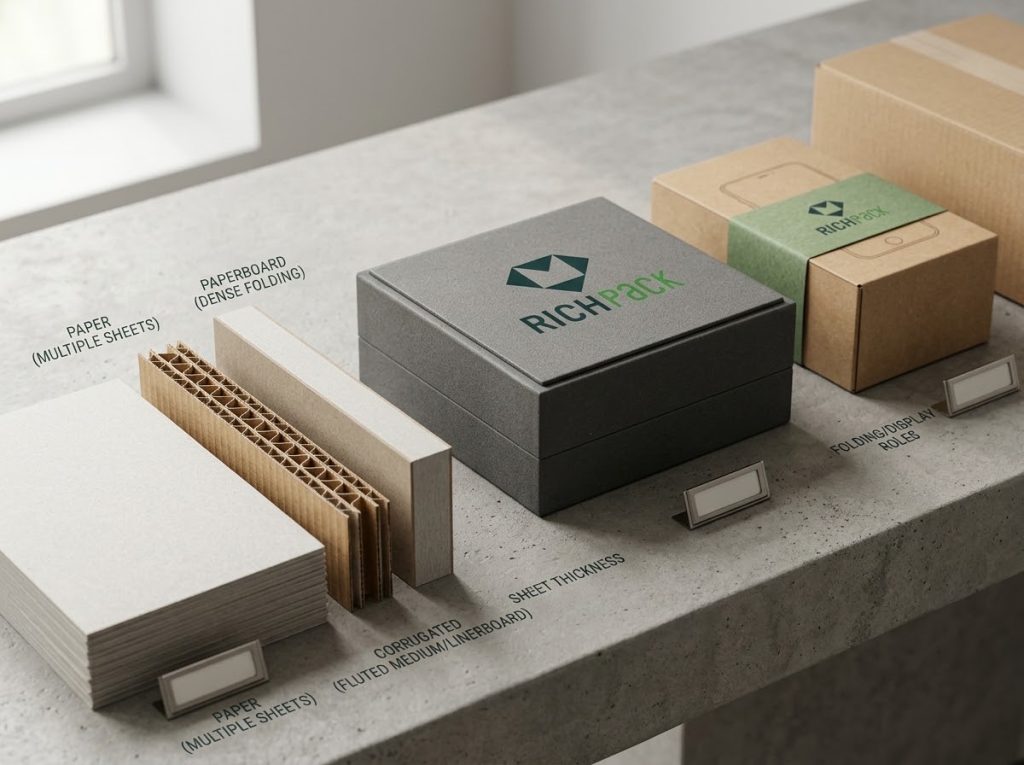
Paperboard is a material system, not a color or a single gsm number. Fiber source, layer construction, surface treatment, and conversion each change the finished package, so the material decision should follow the product, structure, route, and approval method.
Virgin fiber comes from newly processed wood pulp. Recycled fiber comes from recovered paper streams. A blended furnish combines sources to balance surface, stiffness, resource use, cost, or a stated recycled-content target.
Fiber source affects the board, but it does not answer every performance question. The final result also depends on refining, layer design, moisture control, coating, caliper, and conversion. Ask the supplier to identify the fiber source and the claim it supports. Do not turn a recycled-content statement for one board into a claim about the entire package.
For a jewelry package, fiber source is only one layer of the decision. A greyboard core may provide the shape. A printed wrap may provide the visible surface. A velvet or microfiber lining may touch the piece. Magnets, adhesives, foam, and paperboard inserts can all change the final material profile.
Hardwood and softwood fibers have different shapes and lengths, which can influence surface formation, bonding, tear behavior, and stiffness. A mill may use them in different layers or blend them to reach a target board profile.
That relationship is useful for understanding a specification, but it is not a universal formula. A longer fiber does not make every finished box stronger in every direction. Box size, grain direction, creases, corner construction, wrap tension, product weight, and moisture exposure still matter.
When comparing two grades, ask what the fiber mix is meant to achieve and where the evidence comes from. Then check a finished sample. The sample reveals fold cracking, edge behavior, surface smoothness, and fit more clearly than a material name alone.
Many packaging boards use more than one layer. A top ply can support a bright print face. A middle layer can add bulk or stiffness. A back layer can support folding, gluing, or a secondary print surface. The layer roles vary by grade.
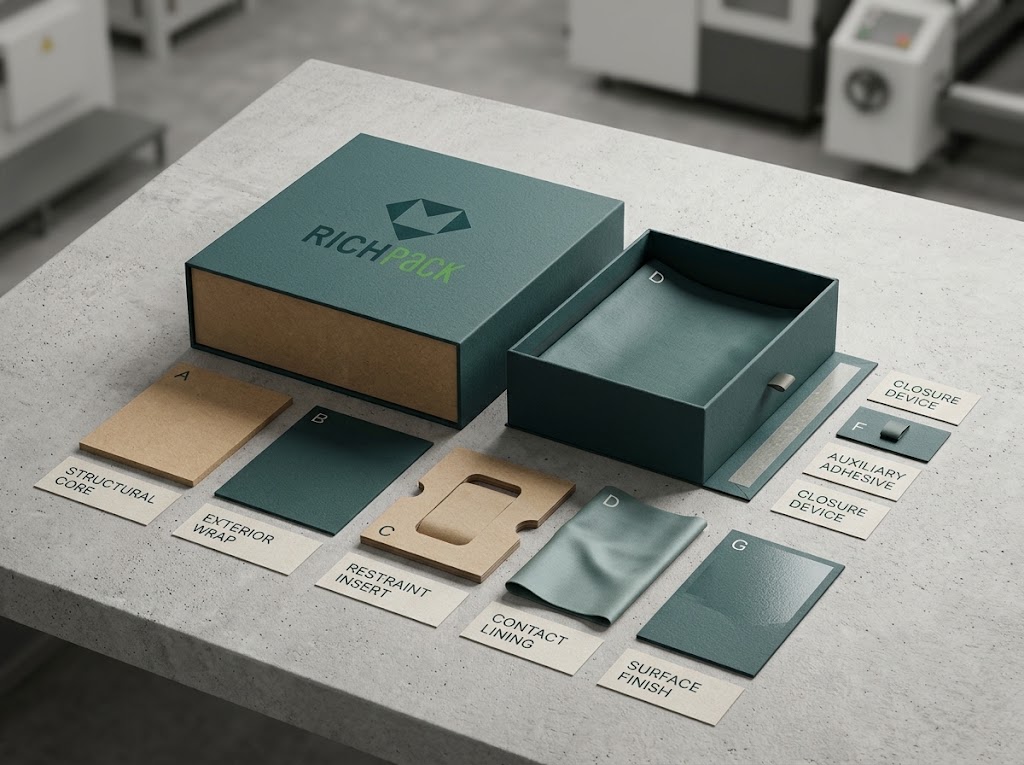
It helps to separate the whole package into functions:
This separation prevents a common sourcing mistake. A paperboard wrap is not the same as the greyboard core underneath it. A soft lining is not the same as an insert that controls movement. Each part needs its own specification and approval check.
Caliper describes sheet thickness. Grammage describes mass per area. Density connects mass and volume. Finished wall thickness describes what the customer actually holds after board, wrap, adhesive, folds, gaps, and hardware are combined.
These measurements answer different questions. A heavier board may add body, but the finished wall can still feel weak if the structure is too large or the corners are poorly formed. A lighter board may work well in a small carton when the dieline, product weight, and route are controlled.
Specify the inside dimensions first when the product must fit. Then define the board, wrap, insert, clearance, and tolerances that create the finished outside dimensions. Keep the sample and drawing together so a change in board caliper does not quietly reduce the product space.
Coatings can improve brightness, smoothness, ink holdout, gloss, rub resistance, or a defined barrier property. Sizing and other additions can change how the fibers respond to moisture or liquids. Laminates and films can add a strong visual or protective layer, but they may complicate separation and recycling.
The correct question is not “Is this coating good?” Ask what the coating must do, how it will be applied, how it affects printing and folding, and what happens at end of life. A coating that helps a beverage carrier may be unnecessary for a dry jewelry sleeve. A premium finish may also change the crease, glue, odor, or rub result.
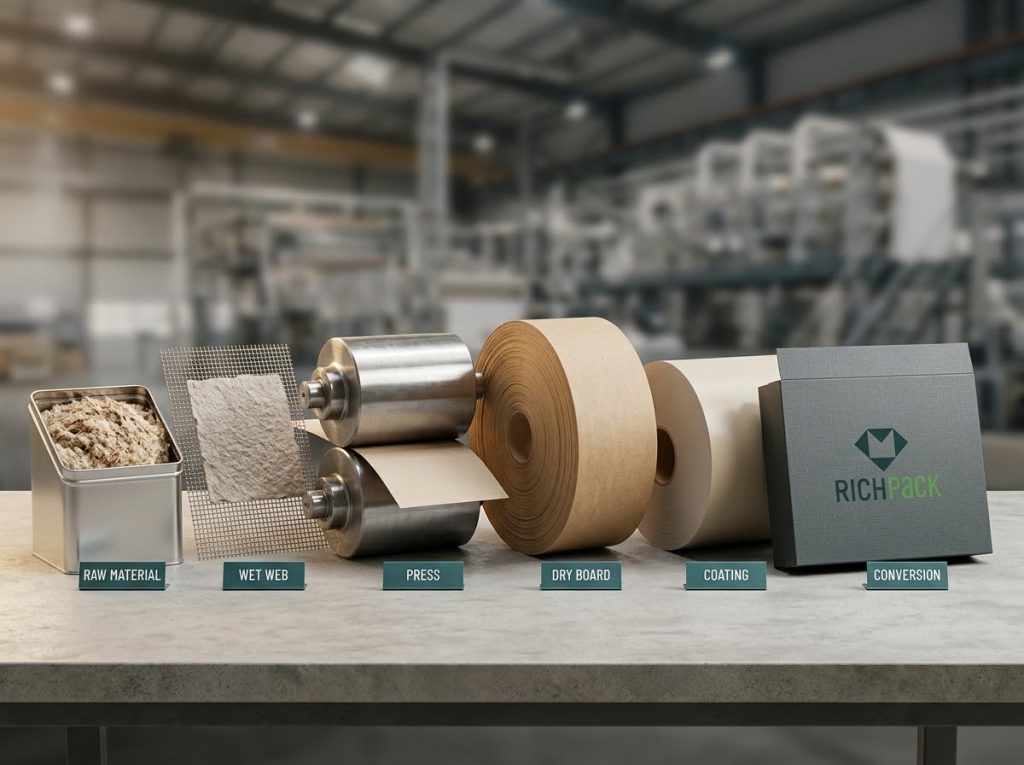
Paperboard generally moves through a connected sequence:
The mill and converter may be different suppliers. That matters when a conversion problem appears. A carton that cracks at the fold may need a board, grain direction, crease, or dieline review. A rigid box with a loose lid may need a core, wrap, clearance, or forming review. The finished sample connects those decisions.
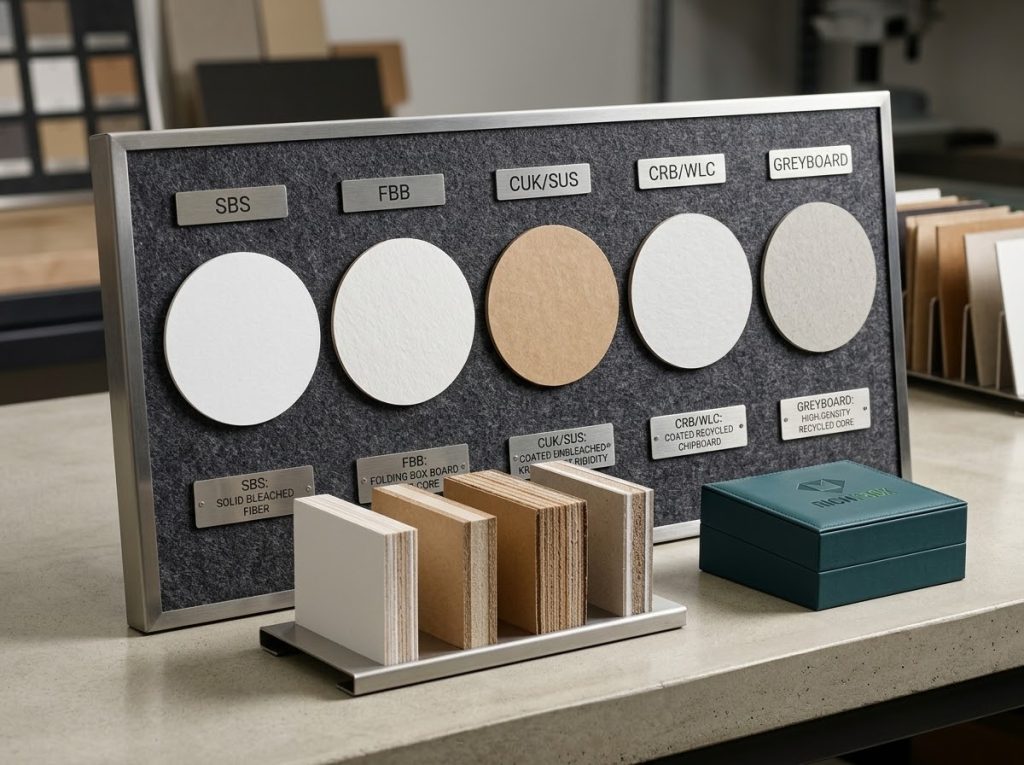
There is no single best paperboard grade. Start with the job the finished pack must perform, then compare the print face, fiber source, fold behavior, natural appearance, core stiffness, surface treatment, and route. The grades below are common decision points, not a complete worldwide taxonomy.
Solid Bleached Sulfate, or SBS, is a bright white paperboard grade made from bleached fiber. Its smooth face supports detailed graphics and controlled color work, which is why it appears in many premium, cosmetic, pharmaceutical, and food packaging discussions.
SBS is useful when the artwork needs a clean base, and the package depends on a precise printed face. It can support coatings and decorative finishes, but the final result still depends on the selected grade, caliper, ink system, crease, and handling route.
Do not treat the name SBS as proof of a particular food-contact approval, recycled-content level, or moisture barrier. Those claims belong to the exact product specification and market. Ask for the technical sheet and the intended use before writing a compliance statement.
Folding Boxboard, or FBB, is a multi-layer board used in many folding carton applications. Its construction can balance a printable surface, low weight, and the stiffness needed to hold a scored shape.
FBB becomes a practical choice when the carton must fold cleanly, ship flat, and present a controlled face at retail. The finished dieline matters. A board can look suitable on a flat swatch and still crack at a tight crease, lose shape around a large panel, or resist a fold sequence that the design requires.
Ask the supplier for the board caliper, grain direction, recommended crease settings, and a finished sample. This is more useful than comparing FBB and another board by name alone.
Coated Unbleached Kraft, often discussed with Solid Unbleached Sulfate or SUS, keeps an unbleached fiber character that can show as a brown or natural base. The long-fiber positioning and natural appearance make it useful for beverage carriers, heavier retail packs, and brands that want a kraft signal.
The base color changes the print result. A color printed directly on brown kraft will usually look more muted than the same ink on a white coated face. A white ink layer can create a brighter base under selected artwork, but it adds a print step and must be approved on the actual substrate.
Use CUK/SUS when the natural face and structural brief work together. If the package needs bright color matching, fine skin tones, or a highly reflective finish, compare a coated white board and a kraft proof before committing.
Coated Recycled Board is made with recovered fiber and often has a lighter print face over a darker or mixed back. Different markets use related names such as CRB, CCNB, or WLC. The exact construction varies, so the supplier’s specification should control the final description.
This family can suit cereal, dry goods, household products, and other packs where recycled fiber and cost matter. The white top face can support graphics, while the back color, surface smoothness, and moisture behavior may differ from a virgin white board.
The buying question is not simply “How much recycled content does it have?” Confirm the stated percentage, measurement basis, coating, print consistency, and whether the full package includes non-paper parts. A recycled board claim belongs to the specified board, not automatically to the insert, wrap, closure, or outer shipper.
Greyboard and non-bending chipboard are common structural materials for rigid or set-up boxes. Their job is to create a stable core that does not fold flat like a folding carton. A separate wrap can then carry the print, texture, foil, or fabric surface.
This division matters for a luxury jewelry box. The greyboard core controls the walls, lid, corners, and base. The wrap controls the visible color and touch. The insert controls the jewelry. A good-looking wrap cannot correct a core that twists, a corner that opens, or a lid that rubs.
The Paperboard Packaging Council describes non-bending chipboard as a body stock for rigid boxes used with small luxury goods, including jewelry. Treat that as a structural use example, not as proof that every chipboard grade suits every box size or route.
Containerboard is designed for corrugated constructions. Linerboards form the outer faces, and a fluted medium creates space and crush resistance between them. That structure answers a different problem from a smooth paperboard face used for retail presentation.
An e-commerce program may use both. The presentation box can use paperboard for branding and opening experience. A corrugated outer shipper can handle the route, void space, and stacking conditions. Separating those jobs often gives the buyer more control than forcing one board to do everything.
Metallic faces, laminated boards, film-backed surfaces, and other specialty constructions should be treated as combinations of substrate and finish. They can change reflectivity, color, surface feel, glue behavior, fold cracking, and end-of-life handling.
Request a physical sample before approving a specialty board. Check the printed color at the intended light source, the edge after cutting, the fold after scoring, the finish after rubbing, and the bond where the surface meets the wrap or insert. A digital render cannot confirm those results.
| Grade or family | Typical visible face | Main structural or visual role | Common application direction | Questions to verify |
| SBS | Bright white, smooth | Detailed graphics and premium surface | Cosmetics, pharma, food, luxury cartons | Exact coating, contact approval, fold and finish |
| FBB | White or light printable face, multi-layer body | Lightweight folding stiffness | Folding cartons and consumer packs | Caliper, grain, crease and panel size |
| CUK/SUS | Natural brown or coated kraft face | Natural appearance and strength-oriented positioning | Beverage carriers and heavier retail packs | Color base, white ink, coating and moisture |
| CRB/CCNB/WLC | White top with recycled or darker back | Recycled-fiber positioning and everyday carton use | Dry goods, household and cereal packs | Recycled-content basis, print consistency and back face |
| Greyboard/chipboard | Usually grey core, wrapped in another material | Rigid box body and stable walls | Set-up boxes, displays and book-style structures | Core thickness, wrap, corners and lid clearance |
| Containerboard/corrugated | Liner faces with visible flute in an edge view | Shipping, stacking and route protection | Mailers, shippers and outer cases | Flute, liner, compression and route test |
| Metallic/laminated specialty | Reflective or film-backed face | Decorative impact or a defined barrier | Premium presentation and special effects | Adhesion, fold, rub, disposal and sample approval |
Use jewelry boxes by material as a starting point for a product-facing material conversation, then return to the actual box structure and insert brief. A collection page can show options, but a sample still decides whether a selected combination fits the product.
Paperboard packaging appears across food, beauty, healthcare, electronics, household goods, retail, gifting, and jewelry because it can combine a printable face with a controlled shape. The correct application depends on product weight, contact or barrier needs, display job, opening action, and route.
Food and beverage packaging uses paperboard for dry-food cartons, frozen-food packs, snack containers, sleeves, trays, and beverage carriers. The board may need a clean print face, a foldable structure, a barrier layer, or a carrier geometry that handles the product load.
Do not transfer a general paperboard description into a food-contact claim. Approval depends on the exact board, coating, ink, adhesive, product, market, and conditions of use. Ask for the relevant documentation and jurisdiction before presenting a package as approved for direct contact.
The structural choice also changes handling. A dry cereal carton, a frozen-food carton, and a beverage carrier place different demands on creases, moisture exposure, top loading, and stacking. The application tells you which board and test questions to ask.
Cosmetics, personal care items, and pharmaceutical products often need a clean printed face, several information panels, controlled opening, and a strong shelf presence. Paperboard can support cartons, sleeves, inner cards, and multi-part presentation packs.
The visual surface may need a coating, foil, embossing, or a soft-touch effect. Those finishes should be reviewed with the artwork, small type, barcode contrast, and opening method. A surface that looks good on a large panel can make small text harder to read or create rub marks at a tight fold.
Pharmaceutical and healthcare packs add another boundary. Product-contact, tamper evidence, traceability, and regional labeling requirements must be checked for the exact product and market. Paperboard is the structural and graphic material, not proof that the full pack meets a regulated use.
Small electronics, cords, stationery, toys, tools, and household items can use paperboard when the pack needs retail presentation and moderate structure. The product weight, sharp edges, accessories, and drop exposure decide whether the carton needs a fitted insert, a stronger board, or a separate shipper.
An insert can prevent a cable from moving into a fold. A divider can stop accessories from scratching a surface. A paperboard tray can set the product at the height needed for a window or shelf view. These parts often matter more than a general claim that the board is “strong.”
For heavier items, compare the complete pack-out. The outer package must support lifting, stacking, and route handling without transferring the full load to a single fold or glued tab.
Retail packaging uses paperboard as a communication surface as much as a container. A carton can hold product information. A sleeve can create a color block around a neutral tray. A window can show the product. A display card can position small items at a fixed height.
The design brief should state what the shopper must see first. That decision affects the window size, print face, board direction, insert height, and shelf footprint. It also affects whether the package opens in the store, on a counter, or only after purchase.
Paperboard supports these changes through die cutting and scoring, but every opening and cut removes material from the structure. Review large windows, narrow bridges, hanging holes, and long unsupported panels on a physical sample.
E-commerce creates two related packaging jobs. The inner pack presents the brand and protects the product during normal handling. The outer pack manages the delivery route, void space, labels, stacking, and impact exposure.
A paperboard presentation box may need a corrugated mailer around it. The outer pack may need a paperboard insert, molded fiber component, or other restraint to stop the box from sliding. The correct combination depends on the product, order configuration, route, and test plan.
Keep the inner and outer specifications separate. If a supplier changes the inner board, outer shipper, filler, or closure, the full pack-out should be reviewed again.
Jewelry makes the material decision more precise. A ring needs a fixed slot. A necklace needs a hook or channel that limits tangling. A watch needs a pillow or cradle that supports weight without crushing the strap. A multi-piece set needs compartments and a clear opening sequence.
The paperboard box provides the structure and brand surface, but the insert and contact material control much of the product experience. The box also needs enough lid clearance to prevent a stone, clasp, or raised component from rubbing.
Use jewelry boxes by use to organize the product conversation by ring, necklace, earring, bracelet, watch, or set. The next decision is still physical: measure the product, choose the restraint, check the contact surface, and approve the complete pack-out.
| Application | Primary packaging job | Likely structure | Material questions | Failure to avoid |
| Dry food | Hold product and carry information | Folding carton or tray | Contact, barrier, fold and stacking | Unverified contact or moisture claim |
| Beauty/personal care | Present product and information | Carton, sleeve or insert | Print face, finish, opening and rub | Poor small-type contrast or scuffed finish |
| Pharma/healthcare | Protect and communicate regulated information | Carton with inserts or tamper feature | Market rules, traceability and fit | Treating generic board as regulatory proof |
| Electronics/household | Hold product and accessories | Carton with divider or insert | Weight, edge protection and route | Product movement and accessory scratches |
| Retail display | Control first view and shelf position | Carton, sleeve, window or display card | Cut bridges, window, print and shelf load | Weak unsupported panels |
| E-commerce | Separate presentation from route protection | Inner paperboard pack plus outer shipper | Void, stacking, impact and pack-out | Using display board as the only shipper |
| Jewelry | Fix, protect and present small high-value pieces | Folding carton, rigid box, insert and lining | Geometry, contact, clearance and removal | Movement, tangling, lid rub or poor access |
Paperboard applications are broad, but the selection logic is consistent. Define the product job first, then choose the board, structure, insert, finish, and outer protection that can meet it.
Structure controls how a package bends, holds, opens, and travels. Finish controls how the surface prints, feels, reflects light, and survives handling. Choose them as one system because a board that suits a flat carton may behave differently after wrapping, scoring, laminating, or adding hardware.
Folding cartons begin as flat sheets. A dieline defines the panels, tabs, cuts, scores, locking features, and glue areas. The board must bend along the score without cracking, springing open, or losing the shape needed for filling and closing.
Flat shipping is a major advantage. Many cartons can be nested, packed, and shipped before final assembly. That can reduce storage volume, but it moves work to the filling site. The buyer must plan assembly, glue curing, opening sequence, and the point where the carton receives its product load.
Check the crease on a decorated sample, not only on a blank. A coating or foil layer can change the behavior at a fold. Small type near a crease can break or become hard to read. A window or large cutout can reduce the strength of a panel. The die line, board, finish, and pack-out need one approval record.
Rigid set-up boxes use a structural core that stays in shape, then add an exterior wrap. The core may be greyboard or another non-bending board. The wrap may be printed paper, textured paper, fabric, or a leatherette-style surface, depending on the confirmed specification.
The core sets the box walls and corners. The wrap controls the visible face and must turn cleanly around edges without lifting, bubbling, or exposing an uneven seam. A lid needs enough clearance to open without rubbing the wrapped wall or the insert.
This structure suits many premium small-goods and jewelry presentations because the box feels stable when opened. It also takes more material and usually ships as a three-dimensional object. Compare the finished pack, storage space, and route instead of comparing the core board alone.
RichPack’s jewelry box styles can help organize a discussion about drawer, hinged, two-piece, and other presentation structures. The final choice still depends on the product dimensions, insert, closure, and sample result.
A sleeve can provide the main brand surface while a tray or box holds the product. This split lets the inner structure stay simple while the outer layer controls color, information, and first view. The sleeve must still fit without catching on corners or shifting during handling.
Windows create a direct visual connection to the product. They also remove material from the panel and add a film, adhesive, or edge condition that needs checking. Inspect the window edge, film clarity, bond, and the way light falls on the product.
Paperboard inserts can divide pieces, create a raised platform, form a card slot, or hold a product in a fixed location. The insert is a restraint component, not just a printed accessory. Its cut edges, contact points, compression, and removal action should be reviewed with the product.
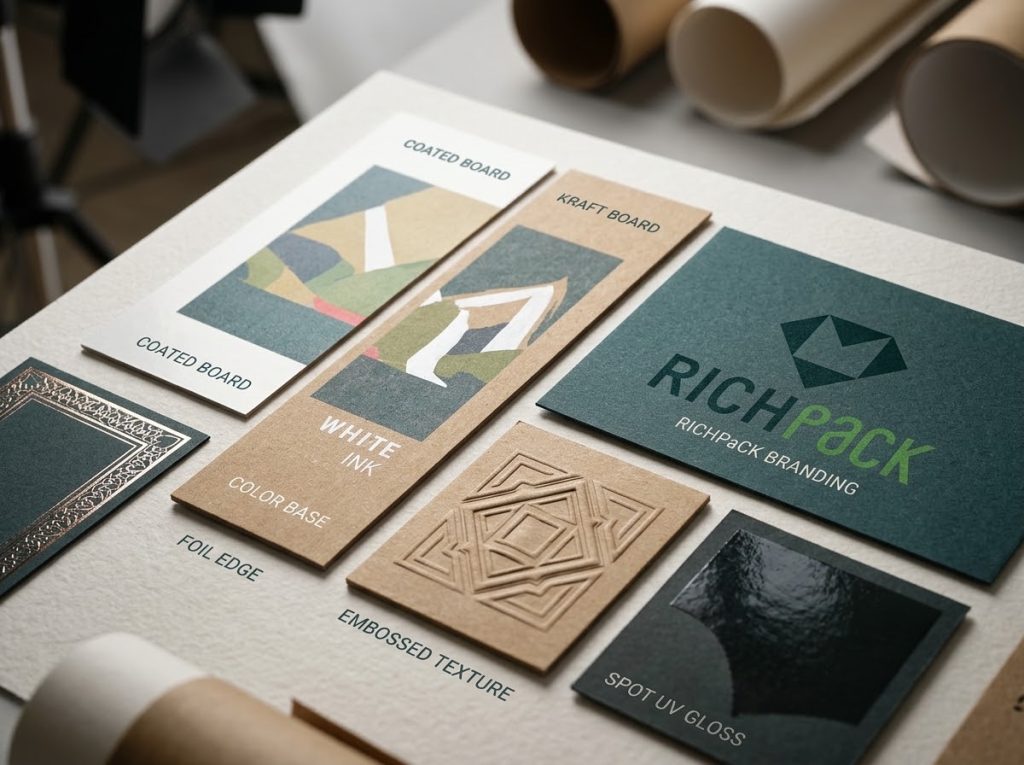
A white coated face gives artwork a neutral base. An uncoated kraft face adds a natural color that becomes part of the design. The same ink recipe can look different on each base, so a screen proof or a white-paper proof cannot approve the final result.
If the design needs bright color on kraft, a white ink layer may be used beneath selected areas. That layer adds a production decision. Check the white ink coverage, registration, small text, edges, and the visual difference between coated and uncoated areas.
PrintNinja describes coated paperboard as a surface that works well with offset inks and uncoated kraft as a material that produces more earthy, flatter colors. Use that distinction as a sampling prompt. It is not a fixed color formula for every press or ink set.
Foil adds a reflective layer. Embossing raises a design. Debossing presses a design into the surface. UV coating can add gloss or contrast to selected areas. These effects change the surface, but each also introduces limits around line weight, texture, coverage, fold position, and rub.
Fine foil lines can break on a rough wrap or a tight corner. A deep emboss can distort a nearby fold. Spot UV can create a different friction level when a sleeve slides over a tray. The right approval sample includes the actual board, artwork, finish, cut, fold, and closure.
Treat finish as a controlled visual and physical choice. Ask what the finish is meant to do, where it sits, how it will be handled, and which defect would reject the sample.
Films and laminates can protect a surface, change gloss, or provide a defined barrier. A window can reveal the product. Both add another layer to the construction and can affect folding, gluing, edge appearance, and disposal.
Mixed-material construction needs an end-of-life question as well as a production question. Can the added layer be separated? Does the adhesive stay attached during collection? Does the window film change the local recycling route? The answers depend on the exact construction and local facilities.
Do not write “fully recyclable” from a paperboard face alone. Record the board, coating, film, window, adhesive, insert, closure, and local collection assumption before making a complete-pack statement.
Auxiliary parts can change the result of a good board selection. An adhesive can create odor, lift at a seam, or affect a wrapped corner. A magnet can change the lid fit, add weight, or create a hard contact point. A ribbon, pull tab, or metal component can change the opening force and the package’s end-of-life path.
Review these parts on the finished sample. Open and close the package repeatedly. Check the seam, lid rub, corner lift, closure alignment, odor after the box has been closed, and the way the product sits after opening.
Jewelry packaging is chosen by movement, contact, removal action, and first view. Paperboard may form the box or insert, but the insert and lining decide how the piece sits and how the customer reaches it. The fit must be checked with the actual jewelry shape, not with a generic product category.
Rings need a slot or channel that holds the band while leaving the stone, halo, or raised setting clear of the lid. The slot should support the ring without forcing it so tightly that removal becomes awkward.
Stud earrings need a post path and a backing arrangement. The card or insert must keep the pair aligned while avoiding pressure on the post or the visible face. Check whether the customer can remove the earring without dragging it across the lining.
For both products, check slot depth, opening width, stone clearance, removal force, and the way the product looks when the lid opens. A small change in insert height can alter the first view and the lid gap.
Hoops and drop earrings need more vertical room than a flat stud. A hanging card, hook, or shaped insert can keep the piece visible, but the piece must not swing into the lid or neighboring compartment.
Check the longest dimension, hanging point, movement path, and clearance above the earring. If the package travels, test the closed box after movement. The goal is to prevent tangling, rubbing, and a piece that arrives in a different position from the approved sample.
Necklaces create a tangling problem because a chain can move even when the pendant stays in place. A hook, channel, card, or separate pouch can limit the chain path. The display should show the pendant without forcing the customer to pull the chain through a tight opening.
Check the chain length, hook position, pendant thickness, window or viewing angle, and removal path. If the necklace uses a delicate finish, inspect the contact surface and any cut edge near the chain.
RichPack’s custom jewelry box inserts are the relevant internal path when the packaging discussion moves from board selection to slots, pillows, cards, or lining. The insert specification still needs the product dimensions and a physical fit sample.
Bracelets and bangles need a support that follows the curve or holds the piece in a controlled position. A flat insert can work for some products, while a pillow, channel, or shaped compartment may work better for a larger or rigid bangle.
Check the inside circumference, width, clasp position, surface contact, and compression. A soft lining can reduce scratching, but it does not automatically stop movement or tarnish. The closure must also leave enough height for the bracelet and its support.
Watches place more load on the insert and base. A pillow or cradle must support the case and strap without crushing the strap or allowing the watch face to touch the lid. The box wall and base must remain level when the watch is removed and replaced.
Check case size, strap thickness, pillow compression, lid clearance, hinge action, and the outer protection used for delivery. A heavy piece can expose a weak corner or loose insert that a lighter sample does not show.
A set needs more than several individual slots. The compartments must create a clear visual order, keep pieces from touching, and allow the customer to remove one item without disturbing the rest. The lid, insert height, and opening angle control the first view.
Use a pack-out sample with the actual number and mix of pieces. Check the spaces between compartments, the product sequence, accessory cards, and any pouch or sleeve added to the set.
RichPack’s personalized jewelry boxes can be a useful next step for brands comparing material, color, and logo directions. The collection does not replace a product-specific insert drawing or a fit approval.
Tarnish control is a chemistry and exposure question. Hydrogen sulfide and other environmental factors can affect silver. A soft textile may reduce scratching and improve touch, but it is not automatically an anti-tarnish technology.
If a package needs an anti-tarnish claim, identify the active insert or layer, the test method, the exposure time, and the humidity or storage scope. Keep that claim separate from the lining’s softness, color, or fiber name.
For any tarnish-sensitive piece, inspect the material contact, adhesive cure, closed-box odor, storage condition, and test record. If no test exists, write the requirement as pending and avoid a protection guarantee.
| Jewelry type | Restraint | Contact surface | Clearance check | Sample failure to watch |
| Ring | Slot or shaped channel | Soft lining or approved insert surface | Stone and lid gap | Tight slot, tilted ring, stone rub |
| Stud earring | Post card or pair insert | Low-friction contact area | Post and backing room | Post pressure or pair misalignment |
| Hoop/drop earring | Hook, card or hanging insert | Soft edge and stable hanging point | Vertical swing space | Tangling or lid contact |
| Necklace/pendant | Hook, channel, card or pouch | Smooth chain path | Pendant and chain path | Tangle, snag or poor removal |
| Bracelet/bangle | Pillow, channel or shaped support | Soft contact with controlled compression | Curve and clasp room | Movement, pressure or loose fit |
| Watch | Pillow or cradle | Soft, stable contact | Case, strap and lid gap | Pillow compression or face rub |
| Multi-piece set | Dividers and dedicated compartments | Separate contact areas | Mixed-piece height and opening angle | Pieces touch or removal order fails |
| Sterling silver | Verified restraint plus approved contact/active layer | Test-defined material system | Closed storage and exposure scope | Soft fabric treated as tarnish control |
For deeper vertical planning, RichPack’s jewelry packaging guide can sit beside this material decision. Keep the material, insert, and test requirements tied to the actual jewelry.


Evaluate the complete packaging bill of materials, not only the paperboard face. A responsible decision records the fiber source, coating, laminate, insert, lining, adhesive, magnet, closure, local collection path, and supplier evidence behind each claim.
Start with the exact board specification. Ask whether the board uses virgin fiber, recovered fiber, or a blend. Ask how the stated recycled content is measured and which component it describes.
The answer should stay attached to the board named in the specification. If a folding carton uses a recycled board but also includes a laminated window, foam insert, textile lining, and magnetic closure, the full pack needs a separate review. One material statement cannot describe every part.
For a jewelry program, record the structural core, wrap paper, insert board, lining, and outer shipper separately. That list makes it easier to see where a change in one part affects the full sustainability claim.
Coatings and laminates can improve print, gloss, moisture resistance, or surface feel. They can also make separation harder or change the route accepted by a local collection system.
Ask four practical questions:
The answer may differ by country and by the exact combination of board, film, adhesive, ink, window, and insert. Use conditional language when the collection path has not been verified.
A paperboard box can still contain several non-paper parts. Foam may hold a ring. Textile may line a tray. Magnets may close a lid. Adhesive may bond a wrap or a window. These parts affect sourcing, separation, odor, recycling, and the way the customer handles the package.
The material list should name those parts before a supplier is asked to support an environmental claim. It should also show whether a part is removable, replaceable, or permanently attached.
RichPack’s biodegradable jewelry box options can be reviewed as a product-specific reference, but any “biodegradable,” recycled-content, or certification statement must be checked against the current product specification and market conditions.
Renewable refers to the source being replenished over time. Recyclable refers to whether a material can be collected, processed, and made into another product through a relevant system. Biodegradable describes a breakdown process that depends on the material and conditions. Reusable describes a package that can be used again for a practical purpose.
These terms are not interchangeable. A renewable fiber may sit inside a laminate. A recyclable board may be attached to foam and a magnet. A biodegradable material may require a specific industrial environment. A rigid jewelry box may be reused, but that does not prove that every part is recyclable.
Write the claim at the level the evidence supports. If local collection, separation, or test conditions are unknown, state the open field and ask the supplier or local program for confirmation.
If a supplier mentions a certification, record the certificate name, holder, scope, issue date, expiry date, covered material, and chain-of-custody or site information that applies. A logo or a product-page sentence is not enough to establish the scope.
The same rule applies to “food safe,” “low odor,” “non-toxic,” “anti-tarnish,” or “fully recyclable.” Each phrase needs a defined material, condition, test, market, or document. If that evidence is not available, keep the statement as a question in the procurement brief.
Commercial fields affect the material choice because a board that works for a small sample may require a different process at production scale. Ask the supplier for the minimum order quantity, sample route, tooling or plate charges, production lead time, capacity window, packing method, and change-notice process.
These are not published RichPack facts in the current evidence package. Treat them as fields to confirm for the project. The same boundary applies to customer results, quality rates, delivery promises, certifications, and price.
Start with the product and route, then choose the grade and structure, and then approve a physical sample. A board name alone cannot protect a product or guarantee a finished result.
Write down the product dimensions, weight, fragile points, opening action, display channel, delivery route, and outer pack before asking for a board recommendation. For jewelry, add the exact piece shape, clasp, stone height, chain length, watch case, or set configuration.
A product that sits in a store may need a different first view from one shipped in a parcel. A gift box may need a slower opening action and a more tactile wrap. A repeat e-commerce order may need a lighter inner pack and a stronger outer shipper.
Start with the product space and the movement that must be stopped. Define the inside length, width, height, clearance, insert location, lid gap, wall thickness, and tolerance. Then confirm how the board and wrap create the outside dimensions.
Avoid using one gsm value as the whole specification. Board density, caliper, fold direction, core construction, box size, product weight, and route all affect the result. The supplier should show the material and finished structure on the same drawing.
Choose the grade with the print face, color base, coating, finish, fold, adhesive, and end-of-life question in the same conversation. A white board may simplify color matching. Kraft may support a natural look but need white ink for selected colors. A laminate may protect the face but change recycling or glue behavior.
Ask for a printed proof on the actual board. A screen image can guide the artwork, but it cannot approve reflective foil, kraft color shift, surface gloss, edge cracking, or print registration at a fold.
The insert should hold the product without making removal difficult. Check slots, channels, pillows, cards, dividers, lining, contact pressure, movement, odor, and lid clearance. The insert and box must be approved together because a change in one can make the other fail.
For a paper drawer box, the pull action also matters. The drawer should open without scraping the wrap or forcing the insert against the side wall. RichPack’s paper drawer box example can serve as a structure reference while the project team defines its own product fit and finish requirements.
Keep a sample record with the board name, caliper, coating, artwork version, color proof, finish, dieline, insert, closure, and approval owner. Check the printed face under the intended light, the fold after forming, the surface after rubbing, the odor after the box is closed, and the closure after repeated use.
For jewelry, inspect the product after it has been inserted and removed several times. Look for fibers on clasps, edge contact, slot stretching, chain movement, stone rub, lid interference, and changes in the first view.
Test the complete pack-out. Include the product, insert, inner box, filler, outer shipper, labels, and any accessories that travel with the order. The test method should match the route and risk. Do not present an ISTA, ASTM, or other test result without the actual report and scope.
If the paperboard pack is only the presentation layer, make the outer protection a separate approval item. A strong retail finish cannot compensate for a shipper that lets the inner box move or absorb a direct corner impact.
Freeze the approved board, wrap, finish, insert, closure, dimensions, artwork, tolerances, and inspection method. Label the physical golden sample and connect it to the drawing and approval record.
When a supplier changes a board mill, coating, lining, adhesive, magnet, or dieline, compare the new sample with the golden sample before production. This record protects the repeat order from silent changes that alter color, fit, odor, friction, or disposal.
RichPack’s personalize custom jewelry boxes resource can support the artwork and branding discussion. Keep the approval record focused on the actual material, structure, product fit, and sample result.
| Supplier question | Why it matters | Evidence to request | Approval gate |
| Which board grade, caliper, fiber source and coating will be used? | Defines the material system | Technical sheet and current sample | Board and face match the drawing |
| How will the board behave at the crease, corner and glue tab? | Prevents fold and assembly failures | Dieline, crease guidance and formed sample | Fold, corner and bond pass inspection |
| What happens to color on this face? | Controls artwork approval | Printed proof on actual board | Color and small type are readable |
| What are the insert and contact materials? | Controls movement, friction and odor | Insert drawing, lining sample and material notes | Product fits and removes cleanly |
| What non-paper parts are included? | Controls full-BOM sustainability and handling | BOM with foam, textile, magnet and adhesive | Parts and disposal claims are bounded |
| What MOQ, lead time and change notice apply? | Controls procurement risk | Dated commercial and change-control record | Project owner approves the plan |
| What route and outer protection will be tested? | Separates display from transport performance | Pack-out and test plan | Complete pack-out is approved |
| Which sample becomes the golden sample? | Controls repeat orders | Signed sample record and revision code | Production references the same version |
Paperboard packaging is packaging made from a thick, formable paper-based sheet. It can be printed, cut, scored, folded, wrapped, or formed into cartons, sleeves, rigid boxes, inserts, tubes, and display components. The correct grade depends on the product, structure, surface, and route.
Cardboard is an everyday catch-all term. Paperboard usually means a solid paper-based sheet used for cartons, sleeves, inserts, and presentation structures, while corrugated board uses liners and a fluted medium for shipping and crush resistance. Ask for the construction specification before comparing the two.
The Paperboard Packaging Council commonly groups four grades as Solid Bleached Sulfate, Coated Unbleached Kraft, Coated Recycled Paperboard, and Non-Bending Chipboard. Commercial packaging also uses FBB, WLC or CCNB, greyboard, containerboard, and specialty constructions. The right choice depends on the finished job, not the label alone.
Common uses include food and beverage cartons, beauty and pharmaceutical packs, electronics and household products, retail sleeves and displays, e-commerce presentation packs, and jewelry boxes. The product weight, contact or barrier needs, opening action, display job, and route determine the final structure.
Paper fiber may be recyclable, but the complete package depends on coatings, laminates, windows, foam, textiles, magnets, adhesives, and local collection facilities. Ask which parts can be separated and which local system supports the claim. Do not treat one recyclable board as proof that the whole pack follows the same path.
There is no universal best grade. Choose the structure, core, wrap, insert, lining, closure, and outer protection around the jewelry shape, movement risk, contact surface, opening action, brand finish, and delivery route. Approve the complete pack-out with the actual ring, earring, necklace, bracelet, watch, or set before production.
Paperboard packaging works when its material, structure, finish, product restraint, and route are planned as one system. Start with the product job, compare the grade and surface, separate the presentation pack from the outer shipper, and approve the finished sample rather than a material name alone.
For jewelry, the key checks are specific: slot or hook position, contact surface, movement, lid clearance, removal action, closure, odor, and any anti-tarnish test scope. For every market, keep renewable, recyclable, biodegradable, and reusable claims separate, and record the full bill of materials.
If your project needs a timing plan for custom jewelry packaging, RichPack’s custom jewelry packaging support is the next commercial step. Bring the product dimensions, target structure, material references, artwork, quantity, delivery route, sample requirements, and approval owner. MOQ, lead time, certification, and performance remain project fields to confirm.
2026-07-28


2025-02-18

2026-06-24

2026-05-25

2025-07-03

2026-05-15

Artisan Chocolate Boxes – Delectable Chocolates Encased in Artisanal Boxes, a Sweet Luxury
View More
Charming Suitcase Gift Boxes | Unique Mini Suitcase Gift Boxes for Special Occasions and Creative Packaging Custom Service at Richpack
View More
Custom Proposal Ring Box Light Ocean Blue Velvet | Bulk & Custom – Richpack
View More
Elegant Flip Top Gift Boxes with Magnetic Catch – Adding a Touch of Sophistication
View More
High-end Signature Collection Packaging | Featuring Unique Designs and Premium Materials
View More
Richpack Affordable and Eco-Friendly Low-Cost Sustainable Jewelry Boxes for Wholesale Customers | Perfect for Large Volume Orders Focused on Green Initiatives
View More

