

 PREV
PREV
10 Best Monthly Gift Boxes for Women
2025-09-01
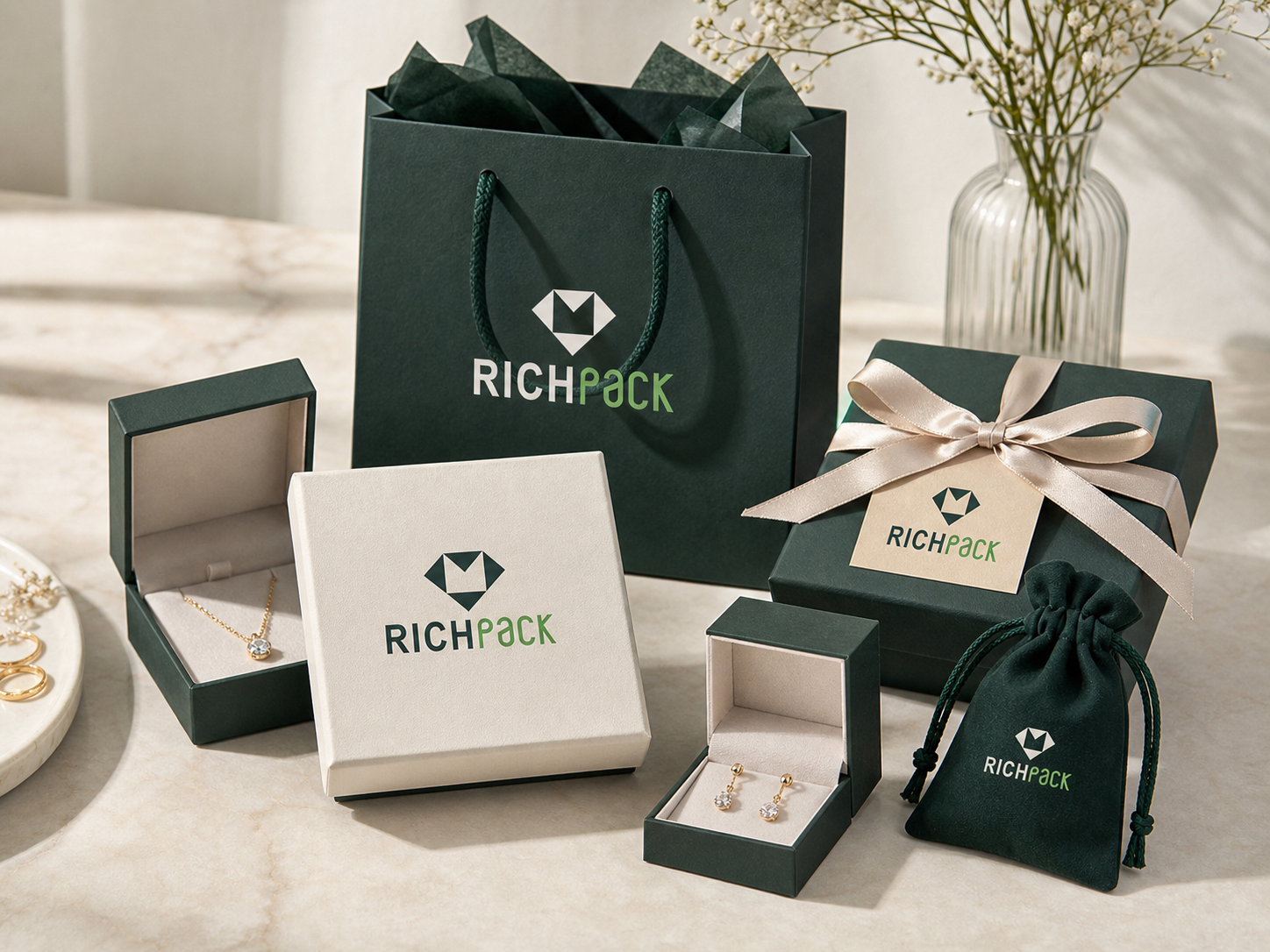



Necklaces get shipped neatly arranged, yet arrive all tangled up. Even eye-catching matching labels won’t help once earring posts bend. You need to understand that high-quality packaging first holds jewelry securely; building brand image is only the second priority.
In the following, we will share 10 comparison points covering cost budgets, protection levels, compatible jewelry types, sales channels, brand display methods, and common risks.
You will also learn:
We believe that after reading, you can select a practical packaging plan based on your existing product line, budget, and sales channels. You will also know which tests you need to finish before confirming samples and placing bulk orders.
Small jewelry packaging serves four functions: storing jewelry, fitting sales channels, matching packaging processes, and showing brand style.
In the table below, we compare cost levels, protection performance, jewelry compatibility, applicable sales channels, brand customization options, and major risks for you. Please note that cost levels are only for relative reference. Quotations are affected by packaging size, order quantity, materials, printing, inner accessories, shipping fees, and labor costs.
| Idea | Budget Level | Protection | Best Jewelry Types | Best Channel | Branding Upgrade | Main Risk |
| Branded cards | Low | Light | Earrings and pendants | Retail and pop-ups | Printed color and logo | Scratching or bent posts |
| Fabric pouches | Low to mid | Light | Rings, bracelets, pendants | Retail and gifting | Logo print or embroidery | Lint and direct contact |
| Kraft drawer boxes | Mid | Medium | Rings, earrings, small sets | Retail and online orders | Sleeve and color system | Drawer friction and coatings |
| Minimalist rigid boxes | Mid to high | High | Fine jewelry and gifting | Retail and online orders | Signature color and foil | Too much decoration |
| Magnetic box and pouch | High | High | Hero pieces and sets | Gifting and launches | Full custom system | Size and freight volume |
| Custom inserts | Mid to high | High | Product-specific jewelry | Every channel | Branded lining or pull tab | Poor fit across products |
| Care cards | Low | None alone | All jewelry | Every channel | Brand voice and support code | Too much text |
| Seasonal sleeves | Low to mid | Depends on core box | Gift sets | Holiday and corporate gifting | Replaceable graphics | Seasonal stock |
| Shipping box with reveal layer | Mid | High in transit | Online orders | Online orders | Branded inside print | Dimensional weight |
| Limited-edition shapes | High | Depends on insert | Hero products | Launches and gifting | Distinct structure | Tooling and storage |
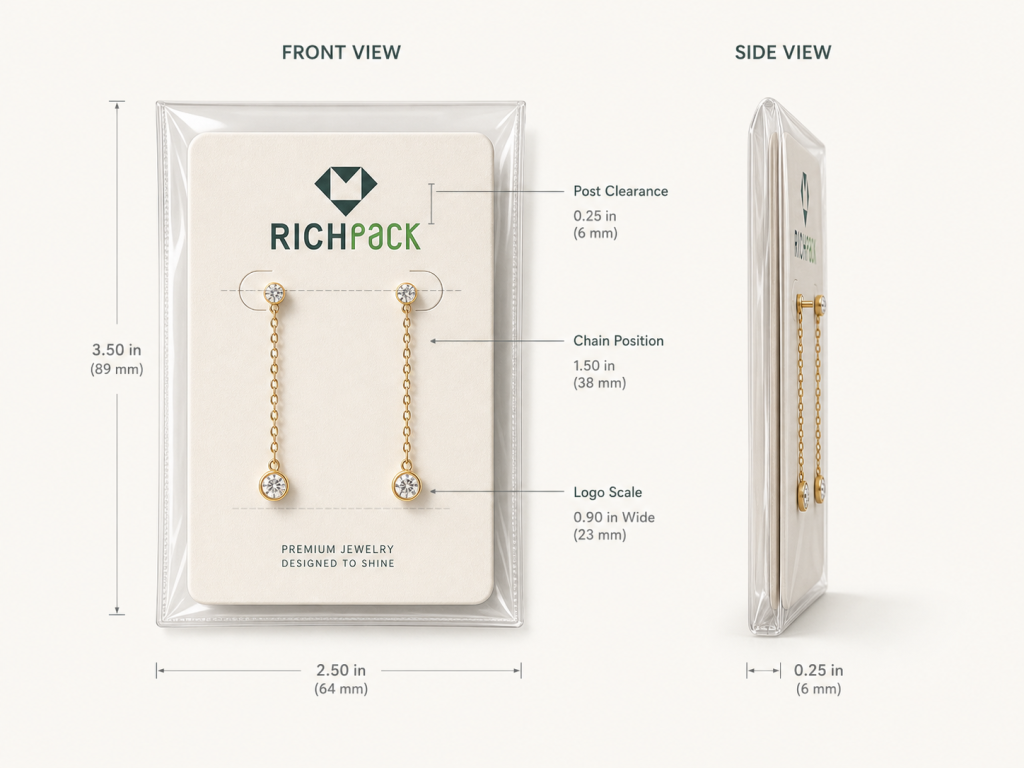
Branded cards are a low-cost option for earrings and small pendants. The card creates a clear display area, while the outer sleeve protects jewelry from dust, fingerprints, and repeated handling.
However, the card size and cutouts must match the actual jewelry. Before confirming the sample, check the following points:
Please avoid placing an oversized logo on a small card. A logo may look balanced on a computer screen but occupy too much space on a two-inch card, making the jewelry less noticeable.
Card packaging works well for retail hooks, pop-up stores, and fast order packing. For shipping, you still need a rigid outer box or padded mailer because a card and sleeve cannot resist heavy pressure.
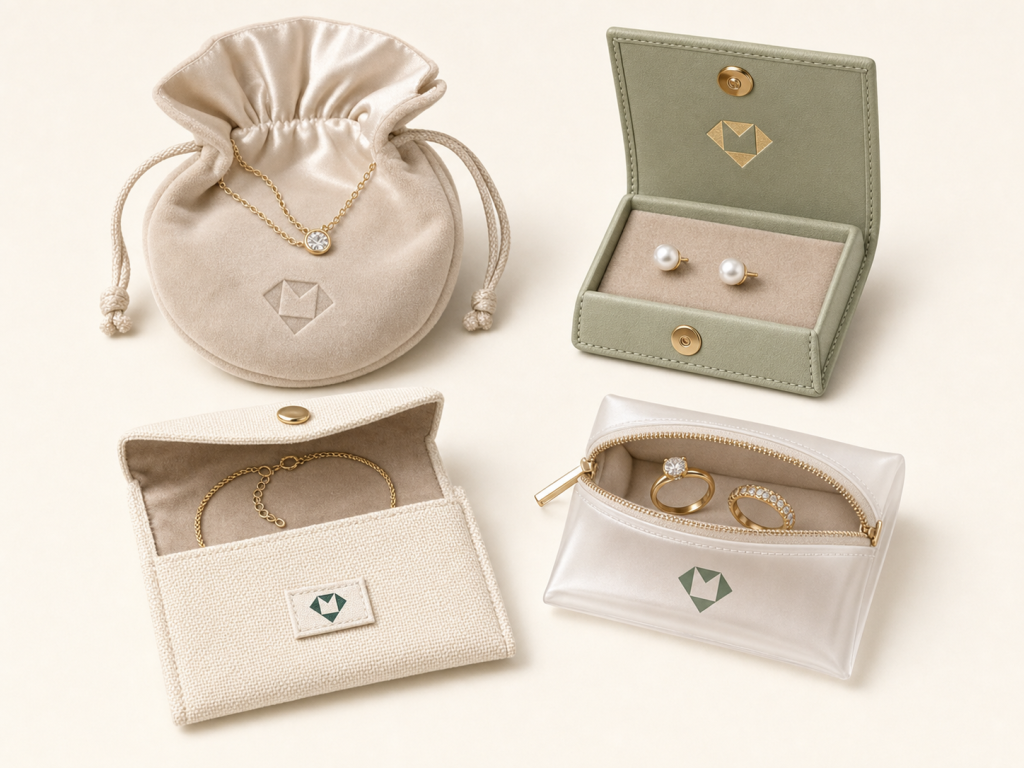
Fabric pouches are easy to carry and can be reused for daily jewelry storage. Adding your logo also keeps the brand visible after customers remove the original shipping package.
You should not select a pouch by fabric name alone. Check the inner contact surface, loose fibers, color transfer, and whether hard cord ends may scratch polished metal.
For example, a dark velvet-touch pouch may look attractive in photos but leave visible fibers on pale jewelry or inserts. You can find this problem early by rubbing the fabric with a white cloth and checking one fully packed sample.
If one pouch contains two pieces, use separate pockets or a small divider card to stop direct rubbing. Basic pouches suit rings and smooth bracelets better than fine chains with thin clasps.
For logo display, you can choose printing, a woven label, or light embroidery. Keep the logo size controlled, and test the finished pouch with plated jewelry, silver, pearls, and soft stones before approval.
A kraft drawer box creates a clear pull-out opening experience. By adding a replaceable outer sleeve, you can update the design for holidays, weddings, product launches, or wholesale clients without ordering a completely new box.
This structure also reduces inventory risk. You can continue using the main box and replace only the thin sleeve when a campaign ends.
A kraft look does not prove that a pack is recyclable or responsibly sourced. FSC says its labels apply to the forest-based content in a product. The label type names certified, recycled, or controlled-mix content.
Please note that windows, coatings, magnets, foam pads, and glued fabric may affect local recycling. You need to judge the complete packaging structure rather than the kraft paper appearance alone.
You also need to test drawer clearance after the supplier adds wrapping paper and the insert. Paper, glue, and board thickness may cause scraping, so open the sample with one hand, tilt it, and repeat the test after normal room storage.
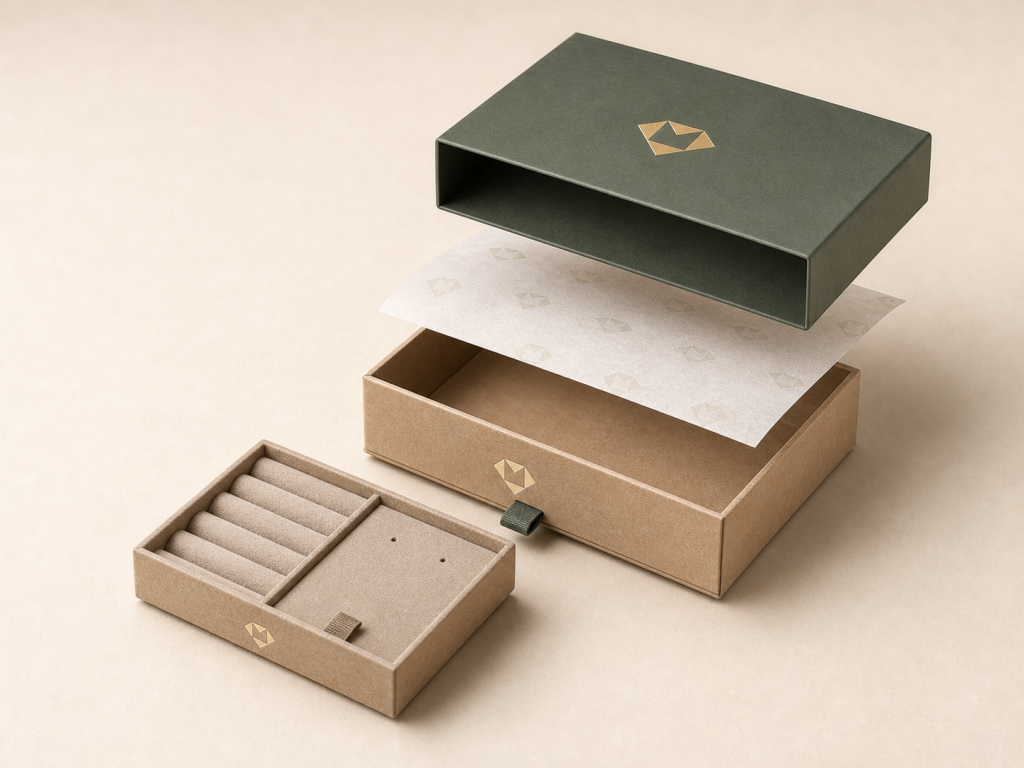
Minimalist custom jewelry boxes work best when every element has the right scale. A clean lid, one stable brand color, and a fitted insert often look more professional than combining large logos, foil, ribbons, and several textures.
Because minimalist packaging uses fewer decorative elements, production defects become easier to notice. You should check:
Do not approve the final color from a screen. Coated paper, uncoated paper, soft-touch film, and fabric reproduce the same color differently, while deep green, navy, burgundy, and warm neutrals may also shift in product photos.
If you need matching colors across boxes, pouches, cards, and paper bags, prepare a physical color sample for each material. Store all approved samples with the reorder file instead of relying on one digital color value.
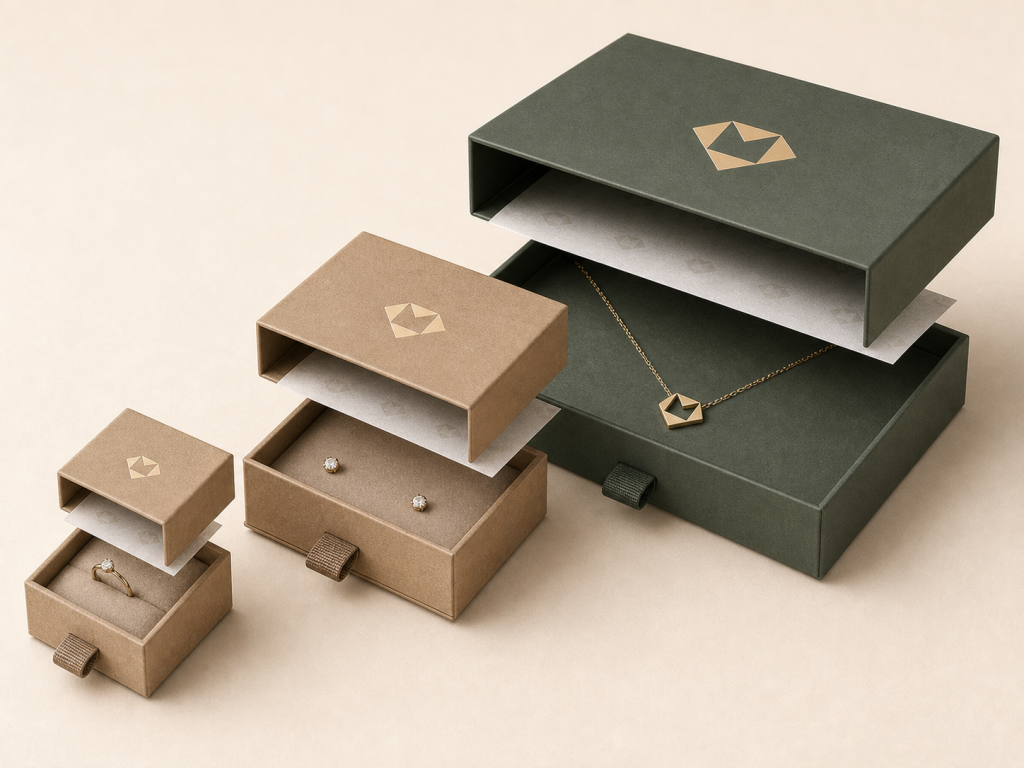
A magnetic box with a travel pouch is suitable for hero products, jewelry sets, launch gifts, and press packages. The rigid box supports presentation, while the pouch gives customers a smaller storage option for later use.
However, this combination can become bulky. Thick walls, deep inserts, wide flaps, and oversized shipping cartons increase storage and freight space. FedEx defines dimensional weight as a pricing method based on package volume and density.
You should measure the fully closed package rather than the flat drawing. Then compare it with your standard shipping cartons because even five extra millimeters may reduce the number of boxes packed in one case.
Test magnetic closure strength after placing both the jewelry and pouch inside. The flap should close smoothly without pressing a raised pendant; otherwise, packing staff will need to adjust every order by hand.
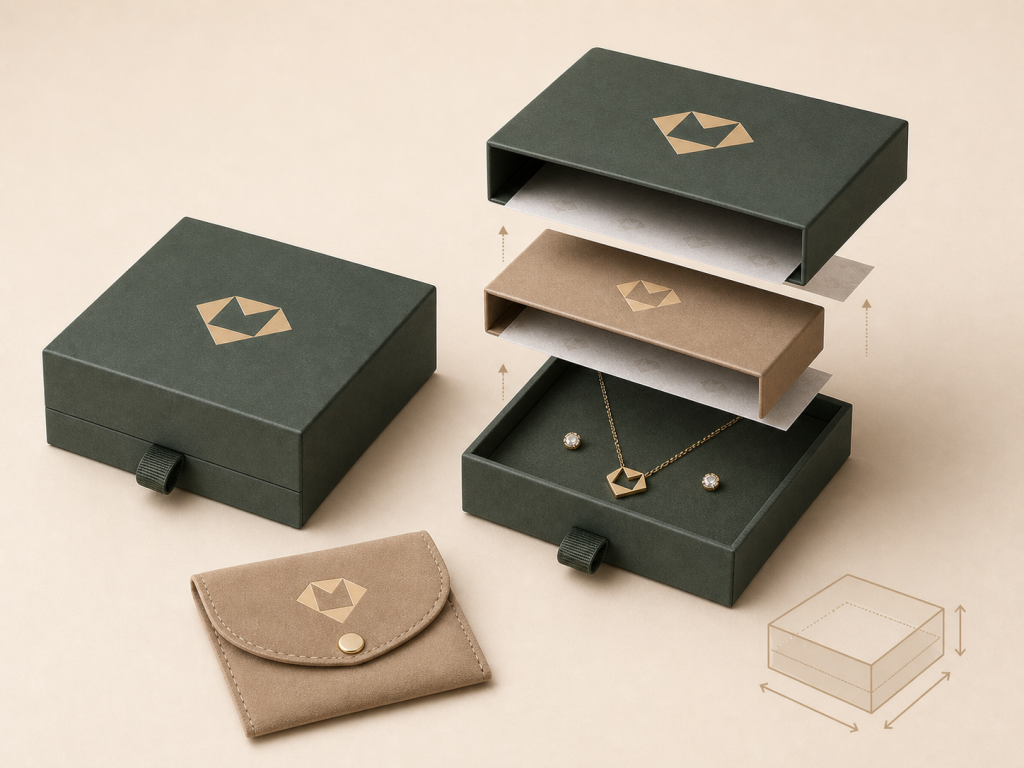
A custom insert fixes each jewelry piece in a planned position. It controls movement, prevents unwanted contact, supports easy removal, and determines what customers see when they open the box.
An insert with loose cavities can cause several problems: pendants move away from the center, thin rings lean, earring backs touch the box wall, and bracelets rub against nearby pieces.
Match custom jewelry box inserts to the piece, not the product name:
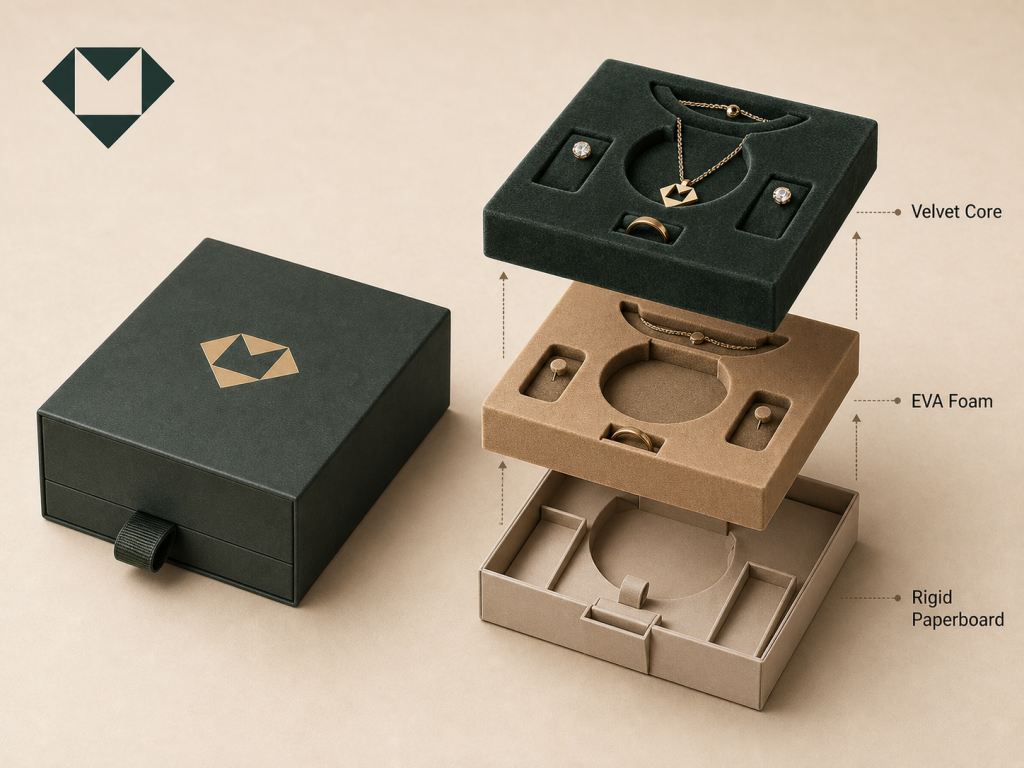
Insert performance depends on both the structural frame and the surface material. Velvet, EVA foam, and rigid paperboard each provide different levels of grip, cushioning, and presentation.
| Insert Material | Structure and Feel | Best Fit | Engineering Strength | Main Risk | Sample Check |
| Velvet over a shaped core | Soft pile over foam or board | Rings, earrings, pendants, gift sets | Softens contact and hides cut edges | Long pile can catch prongs, shed, or hide small stones | Rub with a white cloth, press the piece in and out, inspect fibers under prongs |
| EVA foam | Closed-cell foam cut to shape | Rings, studs, pendants, watches, heavy pieces | Springs back after light pressure and gives firm side grip | A tight cut can mark plating or make removal hard; a loose cut will not hold | Check cut size, pull point, compression after storage, and movement after a shake test |
| Rigid paperboard | Folded or layered board with slots and tabs | Earring cards, chains, light pendants, low-profile sets | Stays flat, prints well, and uses folds to guide the piece | Gives little shock cushion by itself; raw edges may rub metal or chain | Check slot edges, fold strength, chain path, board bend, and fit inside the box |
Velvet mainly works as a soft contact surface, while hidden foam or paperboard creates the shape. We recommend short-pile velvet for small prongs because long fibers may catch, shed, or cover small stones.
EVA foam provides strong side grip when the cutout matches the product size. It works well for rings, studs, pendants, watches, and heavier pieces, but you should add a finger notch or pull tab for easy removal.
Rigid paperboard is thin, flat, and easy to print. Slots and folded tabs can guide earrings and chains without adding much thickness, but heavy rings and raised stone settings need an extra soft pad or support layer.
For higher protection, you can combine materials: rigid paperboard creates the frame, EVA holds the product shape, and velvet covers the contact area. Please remember that extra layers also add glue, thickness, and recycling challenges, so test the complete structure.
When testing inserts, use the most difficult products in your range, including the longest chain, thickest clasp, smallest ring band, largest setting, and most complex earring back. Testing only easy products cannot prove that the insert fits the whole collection.
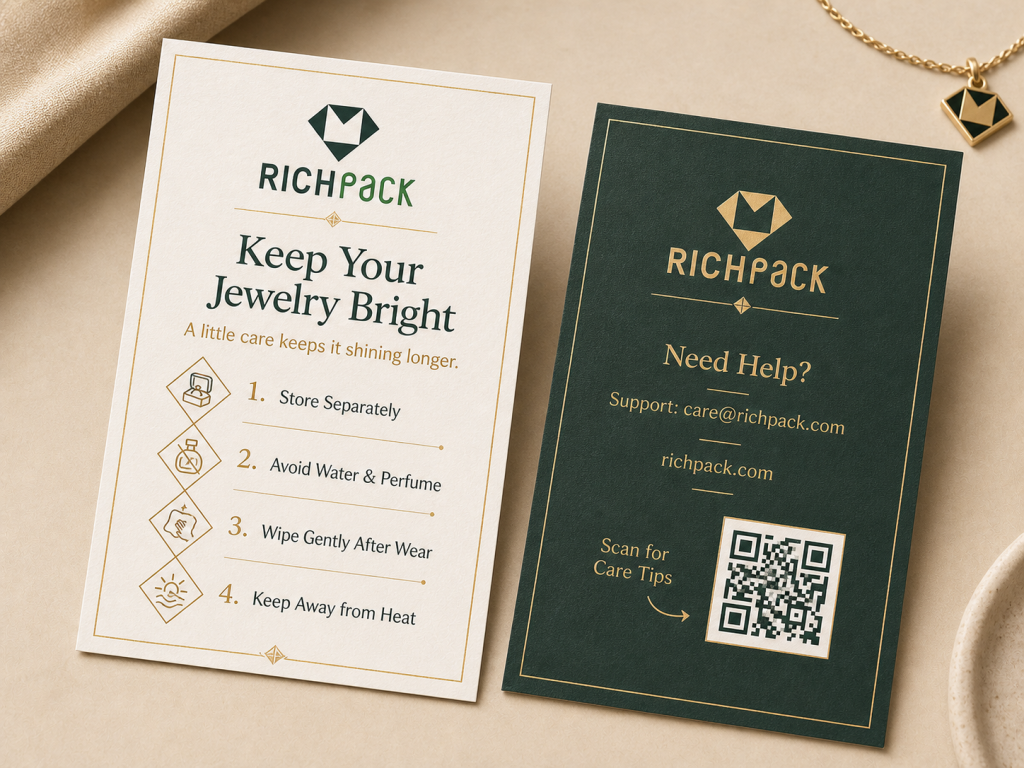
A care card can thank the buyer, answer basic care questions, and point to support without adding a second loose card.
Use the questions your team hears most. Keep the front warm and the back useful:
Do not give the same care note for every metal, pearl, plating, or stone. Water, perfume, cleaners, and polish affect them in different ways. Name the material each instruction covers.
Six-point type does not feel premium, so cut the copy. RichPack’s thank you card ideas show more ways to pair a short note with useful help.
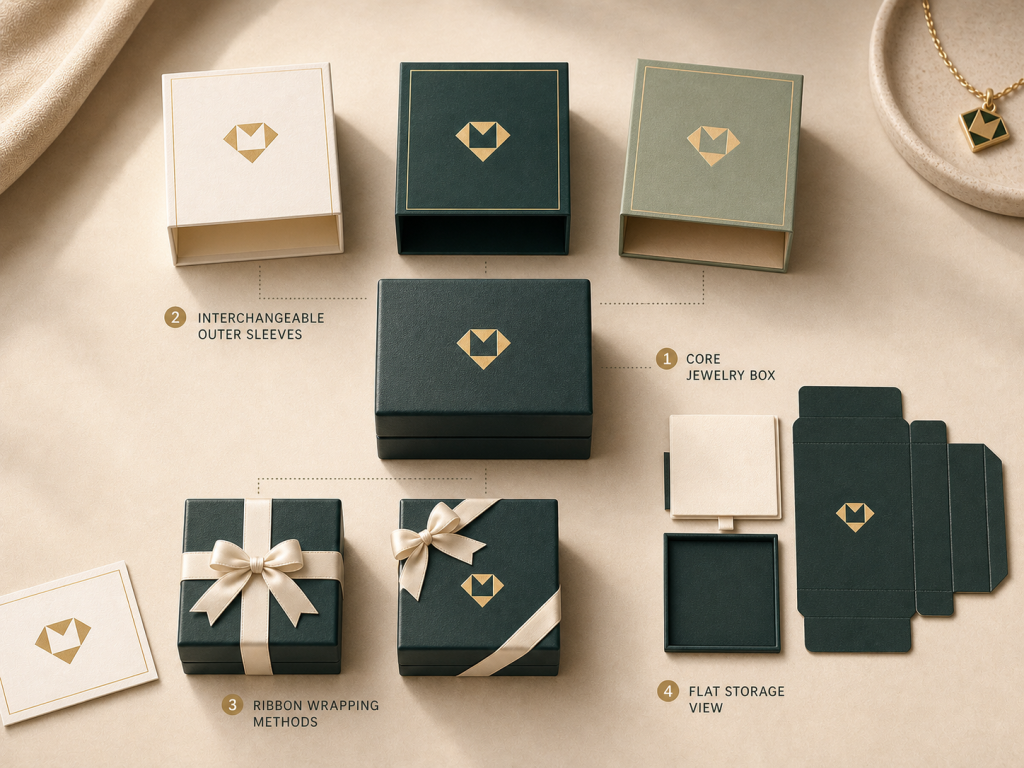
Seasonal packs become risky when the whole box expires with the date. A core box with a new sleeve, ribbon, or card can change its mood without a full rebuild.
This route suits holiday gifts, weddings, company gifts, and short launches. It also lets a trade buyer add an outer brand layer while the box and insert stay the same.
Keep each add-on easy to store and fast to use. A ribbon that takes 90 seconds to tie may feel charming in a sample review. At 500 orders, it becomes a packing delay.
Vendors put it plainly: the pretty extra works when staff can repeat it under pressure.
Pack the final box inside its shipper because wide knots can crush and metallic print can rub off. A loose sleeve can also slide away from the box.
Write down the sleeve direction and ribbon length because a reorder should not depend on one packer’s memory.
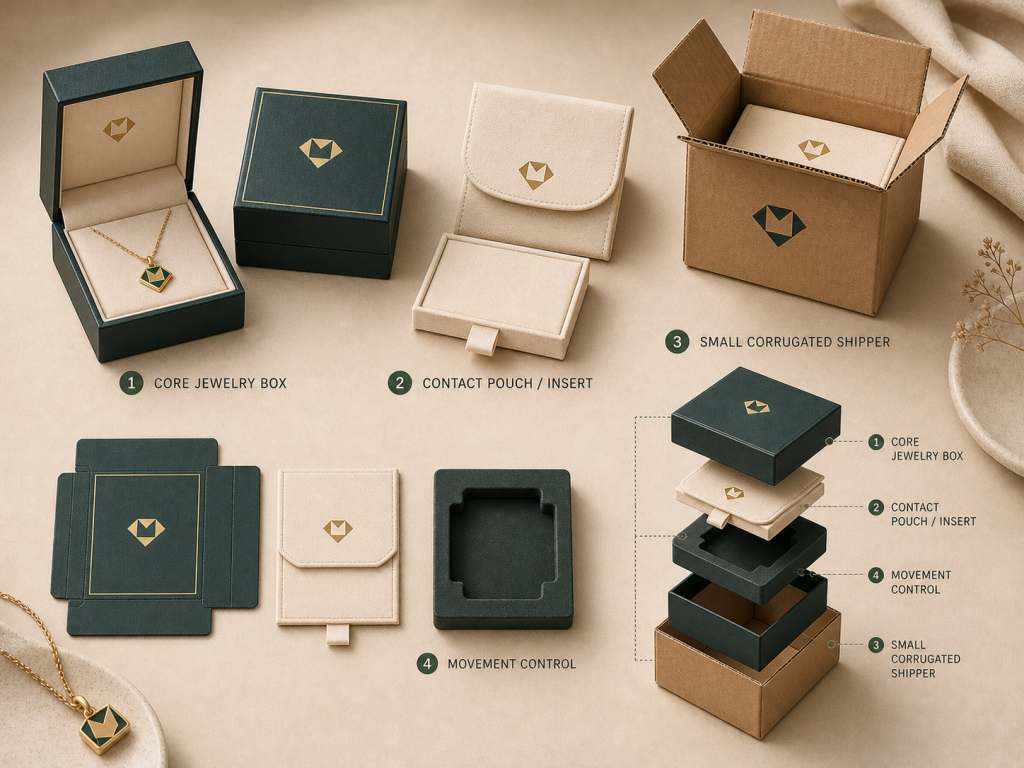
Online orders need three layers with different jobs. The contact layer stops rubbing and movement, the display layer carries the brand, and the outer shipper takes dirt, pressure, and rough handling.
A pretty gift box needs an outer shipper because corners dent, lids shift, and labels mark the finish. Rain or a dirty belt can spoil the first view.
Put the display pack in a small corrugated shipper and control the open space. The jewelry should stay still in its insert, and the box should stay still in the shipper.
RichPack’s steps to package jewelry for shipping explain the layer order in more detail.
For harder routes, choose a test plan that matches the real trip. ISTA offers set lab tests for packaged goods. It also allows project tests for a set route or risk.
A test name means little if it does not match your parcel route.
Shoppers do not talk like engineers. They say the chain came tangled, the parcel crushed the gift box, or the pack felt wasteful. Those three comments point to three fixes: better grip, a stronger shipper, or less space.
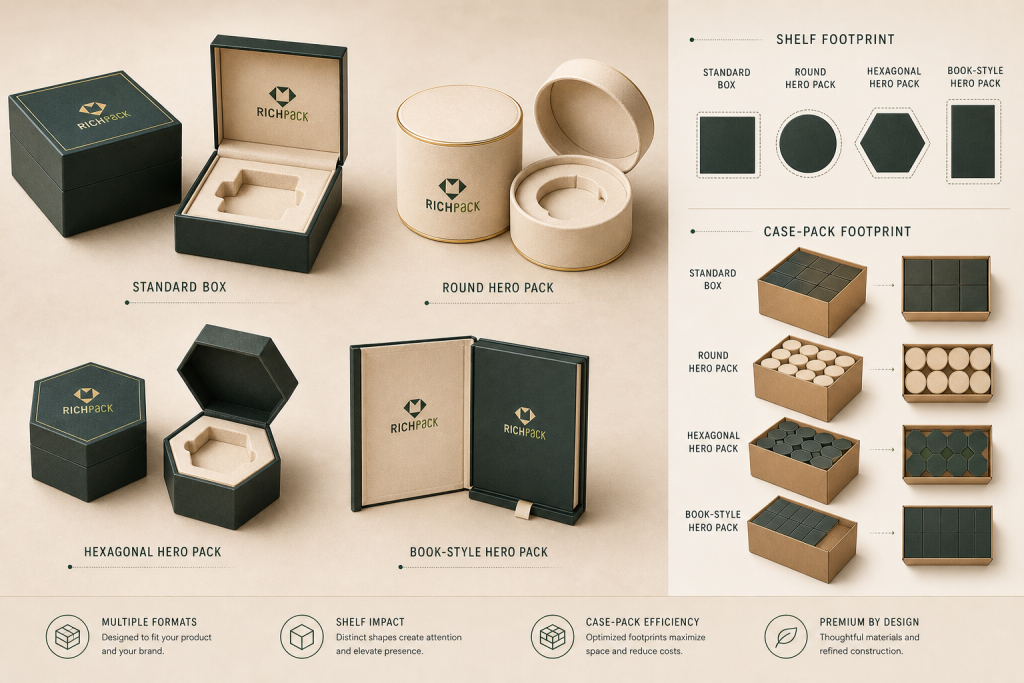
A round, hexagonal, book-style, or shaped box can give a hero product its own outline. Use it for a stable line or a short run, not every item in the range.
Odd shapes bring extra work. They can waste board, slow hand packing, leave gaps in shipping cases, and need a new insert. Some also roll, tip, or form an unstable shelf stack.
Test the full route before you order:
A bold shape should solve one brand problem. It should not create five packing problems. Keep the box drawing, insert drawing, case count, and packing photos with the approved sample.
The right choice depends on the jewelry, the route, and how steady demand has become. Start with the failure that would cost trust, then choose the simplest pack that stops it.
Put the piece on the table before you discuss color or foil because a heavy signet ring should not use the same pack plan as a fine chain.
Write a short failure list for each item:
Test the first finished sample by shaking it lightly, opening it flat and at 45 degrees, removing the piece, replacing it, and packing it in the shipping layer.
A flat proof cannot answer those questions.
Here is a common sample-review pattern. A brand approves a necklace box from photos. After a short shipping test, the longest chain tail drops behind the insert.
The fix is often a second chain slot or a hidden pocket. A larger box would add space but would not control the chain.
One core box can serve more than one channel. The outer layer and packing method may still need to change. Store staff needs speed; online orders need firm grip and a shipping shell.
| Channel | Primary Need | Useful Format | Watch For |
| Retail store | Display and fast handling | Rigid box, drawer box, card, or pouch | Price labels, shelf size, restocking speed |
| Online order | Transit protection and compact size | Fitted display pack inside a corrugated shipper | Movement, crushed corners, dimensional weight |
| Pop-up or trade event | Light transport and quick packing | Cards, folding boxes, or pouches | Table clutter, stock order, packing time |
| Gifting and wholesale | Matching sets and batch delivery | Core box with sleeve, ribbon, or custom card | Hand work, matching parts, late changes |
A pack that looks good in photos may slow a store counter, while a pack that stacks well in a stockroom may feel plain as a gift. Decide which moment carries the most risk.
Budget packs look cheap when the fit is loose, damage appears, or each order looks different. Stock parts can look polished when the size is right, and the brand details stay under control.
The table compares four buying paths. It shows the best starting point, brand control, stock risk, and the work needed to approve each route.
| Path | Best Starting Point | Brand Control | Inventory Risk | What to Approve |
| Stock | Testing a new line | Low | Low | Size and insert fit |
| Branded stock | Building brand consistency | Medium | Low to medium | Logo scale and color |
| Semi-custom | Growing hero products | Medium to high | Medium | Sleeve, card, insert, and finish |
| Fully custom | Stable demand and premium position | High | Higher with an oversized order | Box drawing, material, color, insert, sample, and reorder file |
For a first range, spend on the parts that stop failure:
Small jewelry gift boxes can be a sound base while demand is unclear. Add a card, sleeve, label, or pouch before paying for a new structure.
A low quote can hide setup, freight, packing time, storage, damaged stock, and old seasonal packs. Compare the landed cost of a usable pack, not the box price alone.
Branded jewelry packaging is a set of choices you can repeat. The logo is one part, while color, type, touch, opening order, card voice, and product position do the rest.
You do not need a large mark on every part. A logo on the lid, pouch, insert, card, tissue, and shipper can make the pack feel noisy. Choose one lead brand moment.
For custom jewelry boxes with a logo, build a small approval board:
A buyer portal can hold the files, but the portal is not the spec. Name and date the approved version, then tie it to the real sample.
Buyers get angry when a reorder “matches the file” but not the box they signed off six months ago, and a clear version record prevents that argument.
Move past stock when the current pack causes the same problem again and again. Common signs are poor fit, steady reorders, a stable hero line, strict color needs, gift projects, or repeat shipping damage.
Treat stock and custom packaging as stages:
Before you ask for a quote, gather product size, weight, item count, order volume, sales channel, insert needs, brand files, destination, and delivery date. Those facts help a supplier price the job you mean to buy.
Approve the structure, fit, color, logo, odor, opening feel, shipper size, and packing method on a real sample. RichPack’s low MOQ packaging for startups case is one staged route. Your products and shipping path still need their own testing and sign-off.
When a pack spans five products, two inserts, more than one print method, and three delivery points, packaging design support can keep the work linked. Artwork, structure, samples, production, and shipping all need the same approved facts.
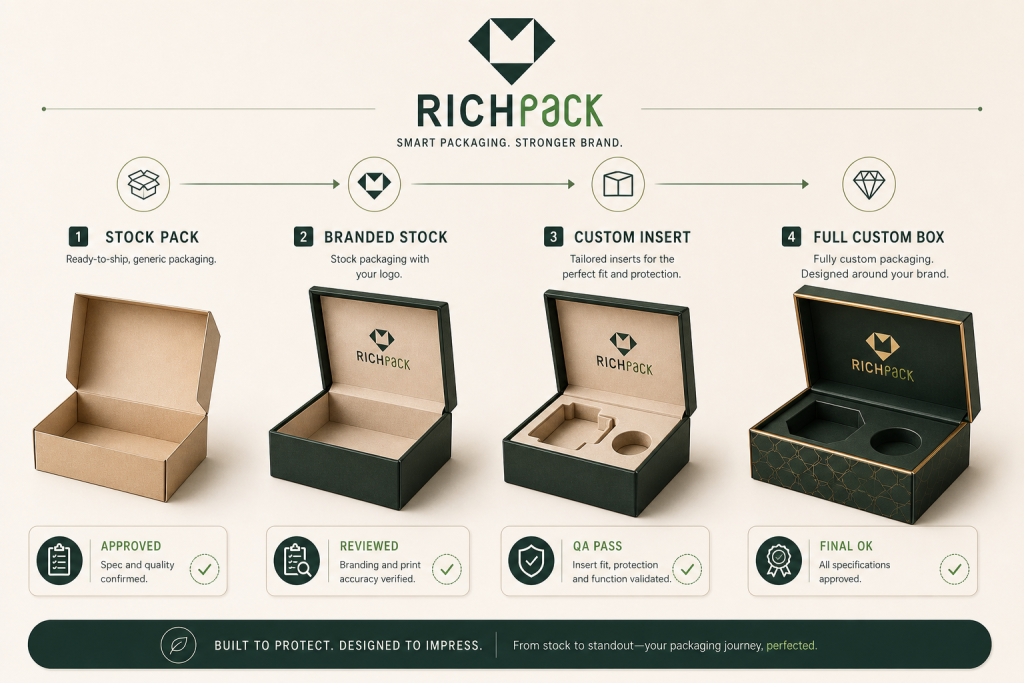
The best first pack fits the jewelry, stops movement, and lets you reorder without locking up too much cash. Start with a well-sized stock box, card, or pouch. Add a brand sleeve, label, or care card, then move to a custom structure after demand is steady.
Spend first on fit, clean materials, one brand color, a small logo, and a clear card. Skip extra trim until the pack opens well and protects the piece. Steady quality looks better than clutter.
Include what helps the buyer receive, store, and care for the piece:
Loose gifts, scent, and confetti can add dust, waste, and allergy risk. Add an item when it has a clear job.
Stop the jewelry from moving in its holder. Protect the display box, then put it in a small corrugated shipper. Test the closed parcel with the heaviest and most delicate pieces in the range.
Order custom packs when demand is steady, and stock packs keep causing fit, color, damage, gift, or reorder problems. You also need enough sales and product data to approve sizes, volume, inserts, material, and delivery needs. Custom work buys control, so name the part you need to control.
The strongest jewelry packaging ideas for small business owners are not always the most complex. A card can beat a rigid box when staff needs speed. A pouch can beat a drawer box when the buyer needs travel storage.
A custom insert may matter more than either one when a chain keeps moving.
Choose one core pack first. Add sleeves, pouches, cards, or a hero shape when each part has a job. Keep product sizes, material samples, artwork, the real sample, limits, packing photos, the check method, and the reorder version together.
When your brand needs matched box sizes, custom inserts, controlled colors, and linked production across markets, a custom packaging project can carry the approved details through design, samples, production, and delivery.


2025-09-01

2025-08-18
2024-11-27
2024-11-26
2026-07-15
2025-03-14
Adorable Small Rectangular Gift Boxes – Perfectly Sized for Delicate Tokens of Affection
View More
Affordable Custom Gift Boxes for Small Jewelry Shops | Budget-Friendly Packaging Solutions Custom Designs for Small Retailers
View More
Amber Jewelry Packaging | Natural Elegance Meets Sustainable Packaging
View More
Beautiful Butterfly Box Gifts | Deluxe Butterfly Gift Boxes for Special Occasions and Unique Presentations Bulk Order Options from Richpack
View More
Bespoke Handcrafted Wooden Jewelry Trays with Custom Engravings | Tailored Display Solutions for Suppliers and Retail Businesses Needing Custom Manufacturing
View More
Bespoke Jewelry Packaging for Independent Jewelry Stores | Tailored Designs for Unique Branding Small Quantity Options
View More

