

 PREV
PREV

2026 Jewelry Brand Custom Packaging Stations: Which Warehousing Firms Are Worth Choosing?
2025-09-03
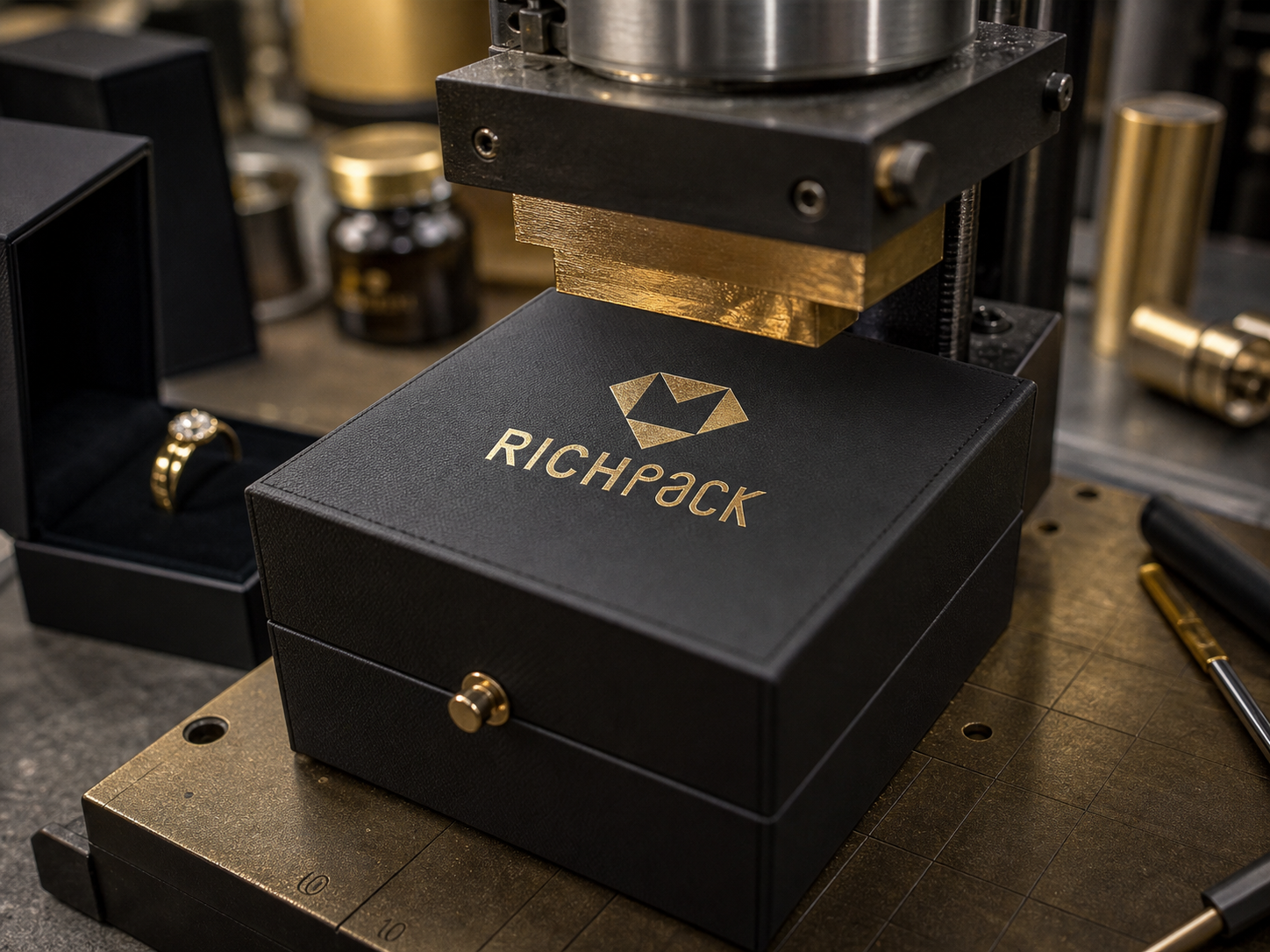



A foil logo can look sharp on screen and broken on a jewelry box. The file may be clean. The real problem often sits in the physical stack: the die, foil grade, wrap paper, heat, pressure, and press setup did not agree.
Foil Stamping is a finishing process that transfers a thin decorative layer onto a surface. Hot foil uses a heated die and pressure. Cold foil uses patterned adhesive, while digital foil uses a toner or varnish image instead of a traditional stamping die.
You will get the full process, a method comparison, material rules, defect fixes, and a purchasing checklist. A logo program may cover custom jewelry boxes with logo, cards, pouches, and bags. Approve the whole material and process stack, not a foil color in isolation.
A 2026 technical comparison from Arkay reports cold-foil production speeds of 50 to 60 meters per minute on coated stock. That figure does not make cold foil the automatic winner. It shows why run length, substrate, coverage, and press configuration belong in the same decision.
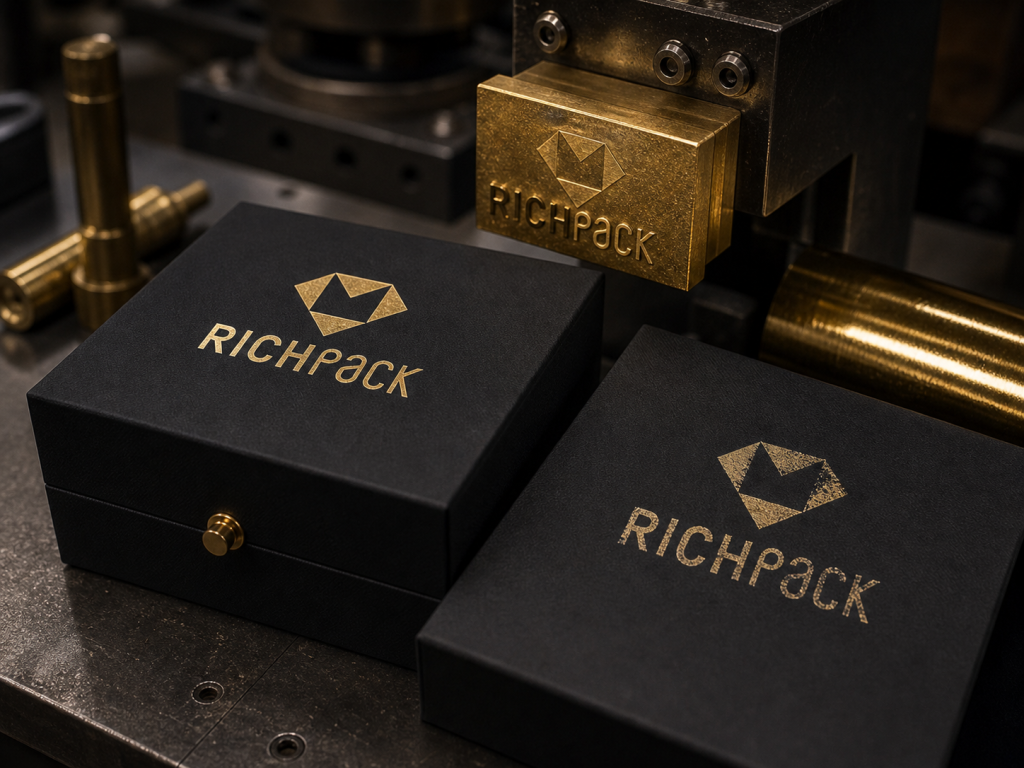
Foil stamping moves a decorative film from a carrier onto a chosen area. The transferred layer can look metallic, matte, colored, pearlescent, transparent, or holographic.
The process is often called hot stamping, foil blocking, or foil printing. Those terms overlap in everyday use, but the production method matters more than the label.
Traditional hot foil stamping presses a heated metal die against foil and a substrate. Heat helps the decorative layer release from its carrier, while pressure brings that layer into firm contact with the surface.
The result is dry and opaque. It does not behave like liquid ink, and it can leave a slight impression where the die strikes the material. That small physical detail is one reason hot foil feels different in the hand.
A clean result depends on six connected parts:
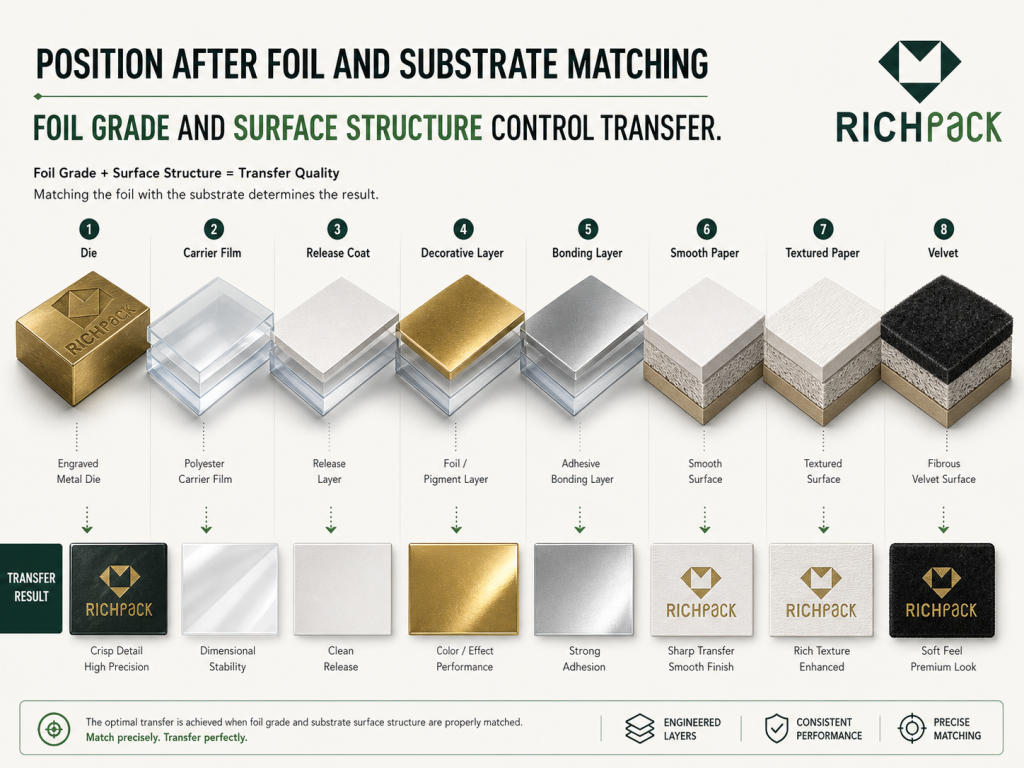
Stamping foil is a layered transfer product, not a sheet of solid gold or silver. Foilco describes a carrier and release system that lets selected decorative layers leave the film under controlled conditions.
A simplified foil construction contains:
That final layer is easy to overlook. A foil that works beautifully on coated paper may transfer poorly to soft-touch film, textured paper, or fabric. The shade can be correct, and the grade can still be wrong.
Metallic foil reflects light as a continuous surface. Move the box, and the logo changes from dark to bright. Metallic ink contains reflective particles, so it looks softer and less mirror-like.
Hot foil may also leave a shallow impression. A skilled packaging design support team can use that depth on purpose. Too much impression can bruise paper, expose texture, or distort a wrapped panel.
Buyers often approve gold by looking at one front-facing photograph. That is risky. Review the sample under diffuse light, warm retail light, and a low side angle. Reflective color changes with the viewing angle and base color.
Foil is usually the stronger choice when a small logo needs crisp opacity on dark stock. Metallic ink is often easier for fine printed detail, gradients, and designs that do not need a mirror finish.
| Decision point | Foil stamping | Metallic ink |
| Reflection | Bright and directional | Softer particle sparkle |
| Opacity | Strong on many dark surfaces | Depends on the ink film and substrate |
| Tooling | Hot foil needs a die | Uses a printing plate or digital process |
| Fine gradients | Limited | More practical |
| Tactile effect | May leave an impression | Usually flat |
| Best jewelry use | Logo, border, monogram, small accent | Pattern, text field, tonal illustration |
A common failure starts with the wrong question: “Which gold looks richer?” Ask what the design needs to do. A mirror logo and a shaded gold illustration are different production jobs.
Foil stamping transfers a surface layer. Embossing raises the material, while debossing presses it down. A combination die can add foil and relief in one coordinated image, though the tool and make-ready become more demanding.
Foil plus embossing works well for a crest, seal, or restrained monogram. It is less forgiving near a wrapped edge or on a panel that already has uneven support beneath it.
The finished logo hides a chain of production decisions. If one link changes between the sample and the main run, the result can drift even when the artwork stays unchanged.
Put foil on its own vector layer. Use a named spot color, solid shapes, and a placement view that shows the artwork against the final dieline.
Check these details before a die is made:
A raster logo may look smooth at normal size and still produce a rough die edge when enlarged. The supplier should receive the original vector file, not a screenshot pulled from a slide deck.
The die turns the artwork into a physical stamping surface. Magnesium is often used for less demanding or shorter work, while copper and brass can offer longer life or stronger detail control. The right choice depends on run length, image geometry, press, and supplier practice.
Press preparation matters just as much. Operators mount the die, align the sheet or component, set the foil path, and build a make-ready beneath the substrate. Make-ready corrects uneven contact across the image.
A logo that is clean on the left and broken on the right often points to contact or support, not bad artwork. That is why experienced press operators adjust one variable at a time and keep the last good pull on the table.
The foil grade must match the surface chemistry and texture. A smooth-coated wrap gives the die broad contact. An uncoated or linen-textured wrap contains peaks and valleys that can interrupt a fine edge.
The same rule applies to jewelry box packaging with lamination, flocking, paint, fabric, or a metal plate. Ask the converter to identify the exact foil reference and substrate lot on the approved sample. “Gold 12” without a manufacturer, grade, or swatch is not enough for a reliable reorder.
Heat helps the release and bonding layers respond. Pressure creates contact. Dwell gives the transfer time to occur, while press speed changes how those three variables behave together.
There is no honest universal temperature for every foil job. Even a published starting range can fail when the surface coating, die area, press, backing, or foil grade changes. Treat supplier data as a starting window, then validate on the actual component.
More heat is not always the fix. Excess heat can fill counters, soften edges, or make foil release outside the intended image. More pressure can bruise the wrap or crush a soft board.
The carrier pulls away after the strike. Decorative material remains only where the system created enough controlled contact and bonding.
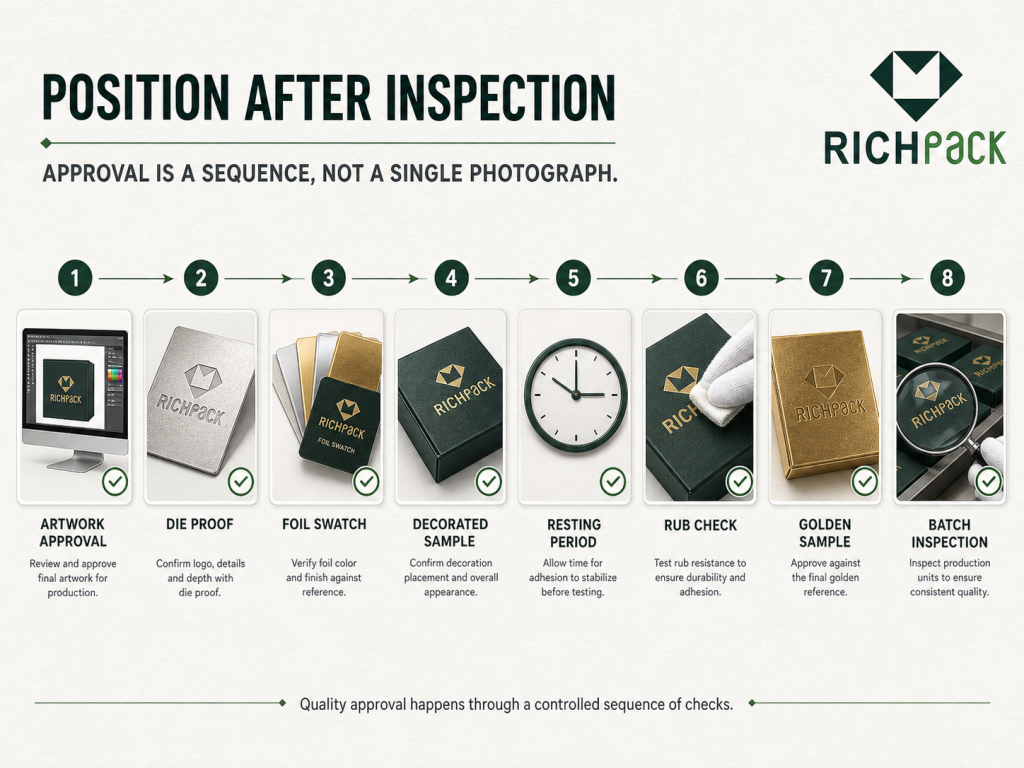
Inspection should cover more than shine:
The last point saves trouble. A beautiful sample proves the process can work once. A production standard explains how it must work repeatedly.
All three methods can create a metallic effect. They use different transfer mechanisms, so they solve different production problems.
Hot foil uses a heated die and pressure. It gives strong opacity, a crisp mirror surface, and often a slight tactile impression.
This method is a natural fit for a restrained logo on a rigid jewelry box, ring box, card, or paper sleeve. The die creates a fixed setup cost, but the finish can remain stable over a planned production run when the surface and press settings are controlled.
Cold foil prints an adhesive image and then laminates foil onto that adhesive. The decorated sheet can move through an inline printing system, which makes cold foil attractive for more extensive coverage and faster folding-carton work.
Cold foil is strongest on smooth-coated stock. It can also support printed color over the metallic area. A hand-wrapped rigid box may favor hot foil on the wrap. The structure determines whether decoration happens before or after conversion.
Digital foil uses a toner or varnish image as the receiving layer. It removes the conventional metal die and supports variable names, short trials, or rapid visual prototypes.
That flexibility is useful during a launch. It does not mean the digital sample predicts a later hot-foil run perfectly. The two methods can differ in edge character, impression, reflectivity, and adhesion.
FSEA groups hot, cold, toner-based, and varnish-based foiling as distinct routes with different paper, overprinting, and run-length strengths. The choice should follow the job, not a generic luxury hierarchy.
| Factor | Hot foil | Cold foil | Digital foil |
| Image creation | Heated die | Printed adhesive | Toner or varnish image |
| Traditional die | Yes | No | No |
| Tactile impression | Often slight | Usually flat | Flat or raised by the system |
| Large coverage | Possible but demanding | Strong fit | Depends on equipment |
| Variable data | No | Limited by the print route | Strong fit |
| Textured paper | Often more adaptable with testing | Usually favors smooth stock | Equipment dependent |
| Short prototype | Tooling can be costly | Usually production-oriented | Strong fit |
| Typical jewelry role | Rigid box logo and premium accent | Printed sleeve or carton field | Names, samples, limited runs |
Choose hot foil when you want a dense, tactile accent and can justify tooling. Choose cold foil when smooth-coated stock, broad coverage, inline speed, or overprinting drives the job. Choose digital foil when variation and short-run learning matter most.
A practical guide to choosing the right finish should compare the finished structure, not loose swatches. Foil on a flat sheet can behave differently after wrapping, folding, gluing, and repeated opening.
Color is only one foil attribute. Release behavior, bonding chemistry, effect layer, carrier, and intended substrate can change the result.
Metallic gold, silver, copper, and rose gold remain common because they create a clear directional reflection. The tone beneath the foil can still affect the edge and overall color impression.
Do not approve a metallic shade from a screen. Ask for a physical swatch on the production surface, then record the supplier, family, grade, and reference used.
Pigment foils provide opaque nonmetallic color. Matte foils lower reflection, while gloss foils create a polished color surface without the same metallic appearance.
Tone-on-tone work can be more useful than obvious gold. Matte black foil on black paper, for example, appears as the box turns. The effect is quiet, but it demands clean edges because contrast comes from light rather than color.
Holographic foil diffracts light into changing colors. Pearlescent foil gives a softer shift, and transparent effects can add gloss without covering the base color.
Use these finishes with restraint around fine jewelry. A large holographic field may become the first thing a customer sees. That is usually the wrong hierarchy for a diamond, pearl, or polished metal piece.
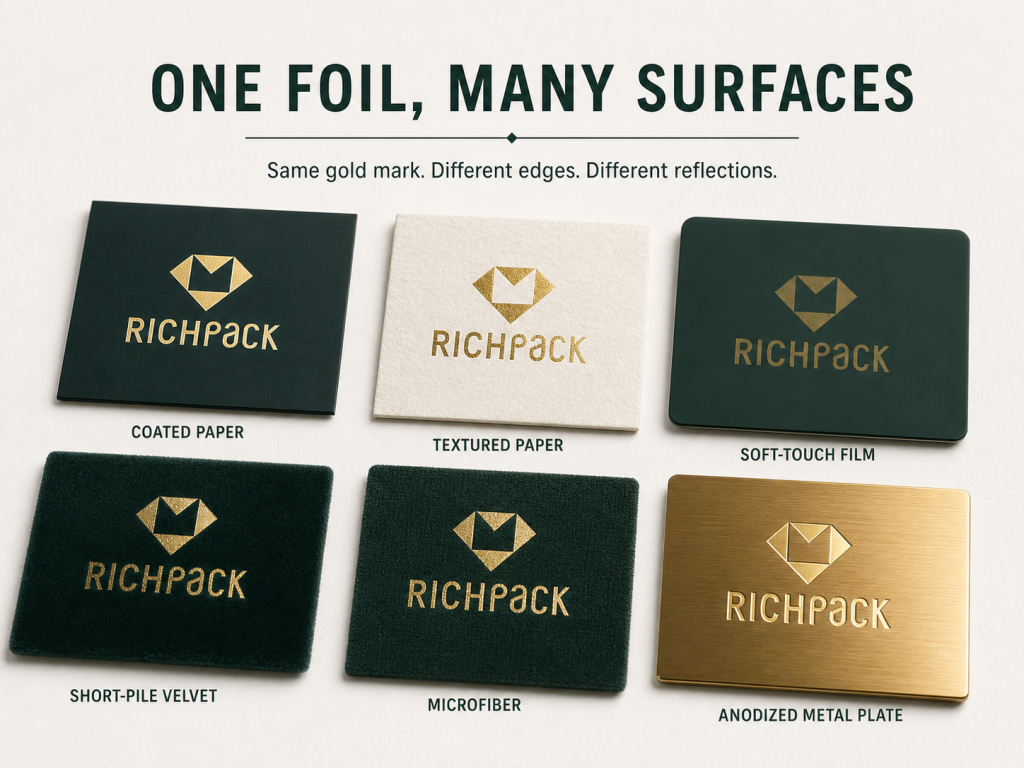
Smooth-coated paper gives the die broad contact and helps produce sharp edges. Uncoated paper absorbs light and may create a calmer contrast, but its open surface can demand a suitable foil grade.
Texture changes the job again. A fine linen grain can add character around a broad monogram, yet it may break a hairline border. The right response is not to flatten every texture with pressure. Adjust the artwork, foil, die, or surface choice.
Soft-touch film can carry a beautiful foil mark, but fingerprints, slip agents, coating variation, and surface contamination can affect transfer. Test the actual laminate and allow the sample to rest before judging adhesion.
Velvet is less predictable. Pile bends under the die, then springs back around the stamped edge. Delicate artwork changes the printing method for a custom velvet ring box.
Better options may include a broader logo, short-pile fabric, an inner-lid mark, or a metal badge.
Metal plates introduce another stack: base metal, surface treatment, cleaning, decoration system, and post-process inspection. Oil, polish, and fingerprints can ruin an otherwise compatible process.
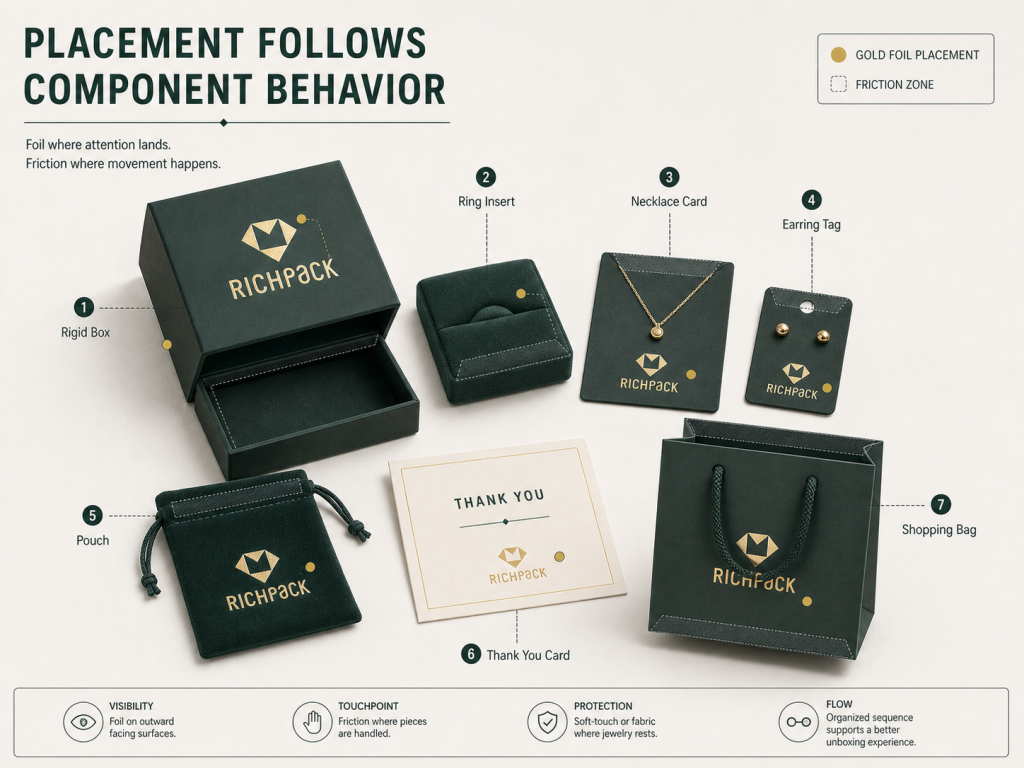
Jewelry packaging turns a generic print finish into a component system. The foil may appear on the retail box, insert, pouch, card, tag, bag, and sleeve, but each surface handles heat, pressure, and friction differently.
Rigid boxes offer a stable presentation surface, yet the wrap can hide seams, board joints, and hollow areas. Keep critical foil away from a wrapped corner unless the converter has proven that location on the finished structure.
The insert matters too. A tall ring or raised setting can touch an inside-lid logo every time the box closes. Moving the mark or changing custom jewelry box inserts may solve a wear problem that no new foil grade can fix.
Long necklace boxes expose alignment over a wider distance. A thin border that looks straight on a small ring box can reveal skew on a long lid.
Bracelet packaging adds curved pieces, chains, and clasps that may shift during transit. Foil belongs where hands see it without putting it directly in a repeated friction path.
Small cards reward simplicity. Tiny reversed text, a punched hole, and a foil border can compete for very little space.
Set a safe distance from holes and cut edges, then approve the decorated card after die cutting. If the set includes branded thank-you cards, compare the metallic shade across both stocks rather than assuming one reference will look identical.
Pouches flex, fold, and rub in use. A clean first impression does not prove long-term durability.
Test the logo after the pouch has been opened, tied, compressed, and handled. Working jewelers often care less about a flawless sample photo than whether the mark survives the first few real packing cycles.
A coordinated set does not require foil on every component. Repetition can make a premium detail feel cheap.
Use one dominant foil moment, then let color, typography, paper, and structure carry the identity elsewhere. When you personalize jewelry packaging, record separate approvals for the box, card, pouch, and bag because each base material changes the reflected result.
| Component | Useful foil role | Main risk | Approval action |
| Rigid box lid | Primary logo | Uneven support or textured wrap | Review finished box, not flat paper |
| Ring box inner lid | Secondary mark | Contact with raised jewelry | Close and cycle the actual product |
| Necklace card | Small logo or border | Long-edge skew | Measure several cut cards |
| Earring tag | Compact brand mark | Hole and edge crowding | Approve after punching and cutting |
| Pouch | Broad simple logo | Flex and pile movement | Rub and cycle the finished pouch |
| Shopping bag | Repeated brand cue | Crease and handle placement | Review assembled bag under load |
Good foil artwork is not merely clean artwork. It anticipates how a rigid die will contact a specific surface.
Create one vector layer per foil color. Name the layer clearly and show its position on the final dieline.
Avoid gradients in traditional hot-foil artwork. If a gradient is essential, consider overprinting, cold foil with color, digital enhancement, or a different finish.
Fine positive lines may break. Small reversed spaces may fill. Both failures can happen in the same logo.
Ask the supplier for artwork limits tied to the chosen die, foil, surface, and press. Then test the smallest critical feature. A broad brand name may pass while the tiny registered mark beside it disappears.
Large solids make every pressure difference visible. Pinholes, texture, trapped air, and weak contact have nowhere to hide.
Break a broad field into a pattern, border, or smaller focal area when the surface fights the process. That adjustment can reduce foil use and produce a cleaner result without making the design feel less premium.
Folds, corners, wrapped edges, drawer paths, and magnetic closure areas move or compress. A flat artwork proof cannot reveal those stresses.
Overlay the foil layer on the structural dieline. Add the actual jewelry height, insert profile, opening path, and hand-contact points to the review.
A digital rendering approves position and proportion. A decorated structural sample approves reflection, edge quality, impression, adhesion, and interaction with the box.
The packaging manufacturing record should capture:
This feels fussy until a reorder arrives six months later. Then the record becomes cheaper than memory.
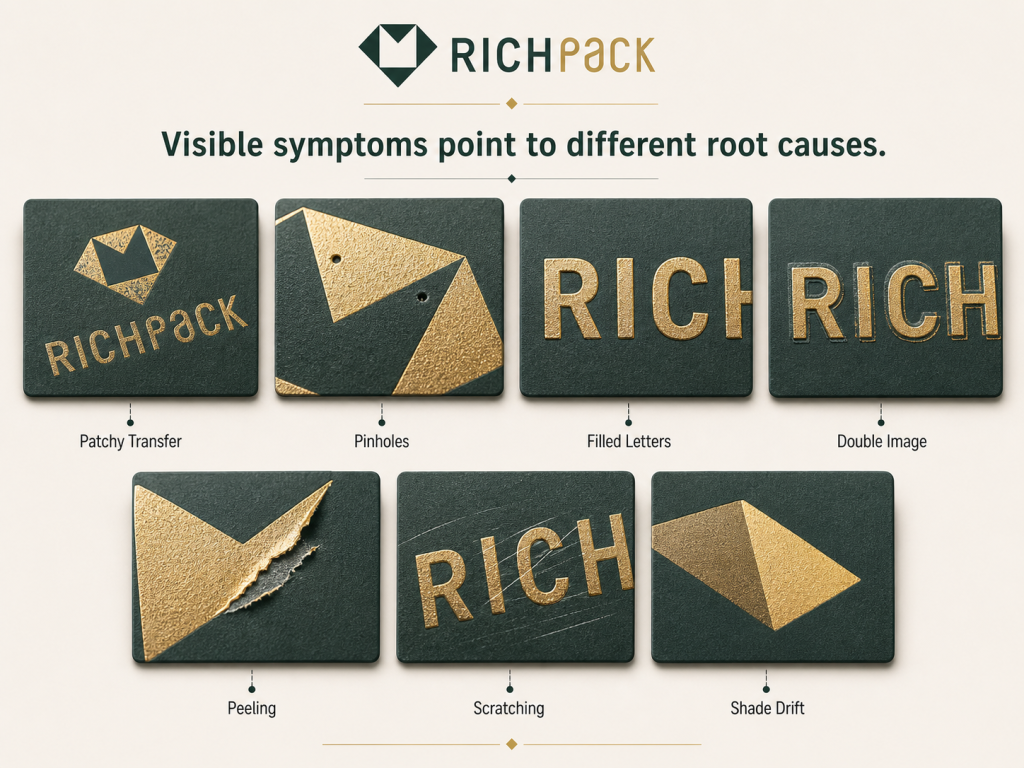
Foil defects leave clues. Read the visible symptom first, then change one process variable at a time.
Broken areas can come from low contact, insufficient activation, rough texture, the wrong foil grade, or uneven make-ready. Dirt on the die can create repeated voids in the same position.
Do not jump straight to more heat. Compare where the defect repeats, inspect the surface, and test pressure support before changing the full window.
Filled counters and bridged gaps often indicate excessive release, heat, pressure, or dwell. Dense artwork can also leave too little open space for clean separation.
The fix may be graphic rather than mechanical. Open a counter, increase spacing, or reduce the solid field instead of forcing the press to reproduce geometry the stack cannot hold.
A second image can come from movement during the strike, unstable feeding, or poor fixtures. A second pass may also miss the first position. Long components and hand-positioned pouches amplify this risk.
Measure against a physical datum, not the edge of a cropped photograph. For multi-pass work, approve the order of operations and an allowed registration limit.
Poor adhesion can start with contamination, an incompatible surface coating, or a foil grade that does not bond well to the substrate. Immediate thumb rubbing is not a complete test.
Let the decorated piece rest under agreed conditions, then perform a repeatable rub or tape check suited to the material. The goal is not to invent a universal test. It is to make the buyer and supplier perform the same test.
Reflective foil can appear different when the angle, lighting, base color, or surface texture changes. Actual shade drift may also come from foil lots or substrate lots.
Keep one approved sample and one documented limit sample. Compare production pieces under the same light and angle. Review other jewelry packaging finishes when foil cannot suit the surface or friction condition.
| Visible defect | Likely cause family | First check | Buyer verification |
| Patchy transfer | Contact, texture, activation, foil match | Defect position and make-ready | Compare several pulls |
| Pinholes in solids | Surface, debris, pressure support | Die and substrate cleanliness | Inspect a full solid area |
| Filled small text | Excess release or tight geometry | Counters and spacing | Compare against approved proof |
| Double edge | Movement or second-pass registration | Fixture and feed | Measure from the fixed datum |
| Peeling | Contamination or bonding mismatch | Surface and foil grade | Check after resting |
| Scratching | Friction or low durability | Handling path | Cycle finished component |
| Apparent shade drift | Light, angle, base, or lot | Controlled viewing setup | Compared to the physical standard |
Foil cost is not just foil consumption. Tooling, setup, press time, positioning, spoilage, sampling, and additional passes can matter more than the decorative film itself.
A hot-foil die and press setup are fixed costs for a given artwork and position. Quantity spreads those costs across more pieces.
Variable costs rise with:
A cheap quote can hide a vague approval standard. If the logo matters, ask what happens when the edge is patchy, the position drifts, or the foil lot changes.
Ask who owns the die and how long the supplier stores it. Confirm whether a reorder uses the same tool, whether storage is included, and what changes force a new die.
Artwork size and position matter. Moving the same logo from the lid center to an inside panel may require new tooling. It may also require a different fixture, even when the graphic does not change.
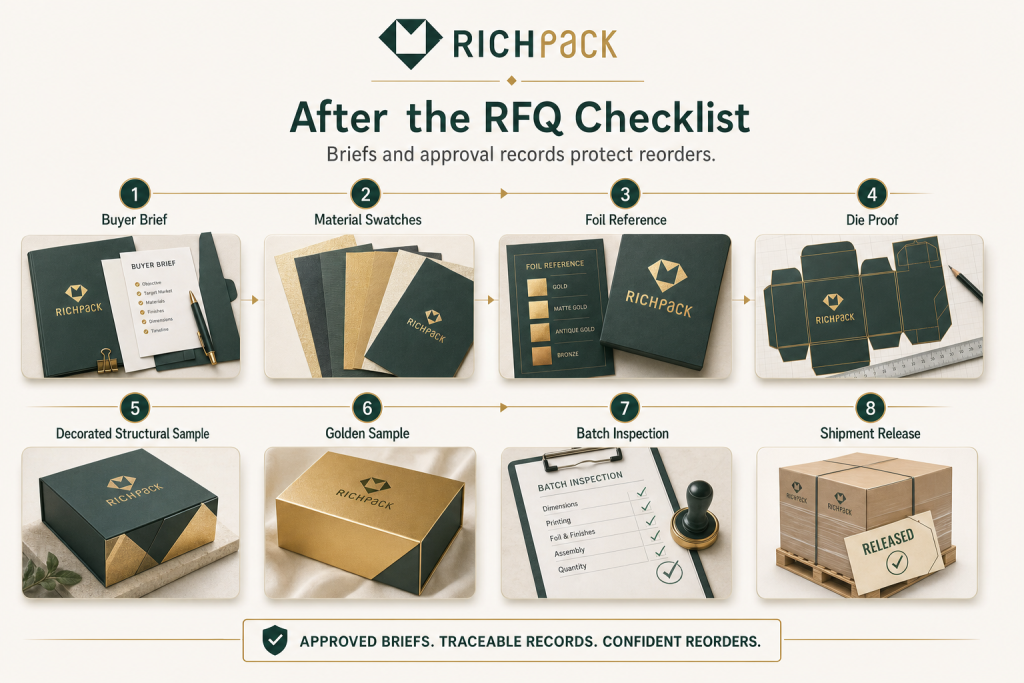
A color swatch, flat die proof, decorated structural sample, and production golden sample answer different questions. Combining them into one vague “sample” line creates confusion later.
A public RichPack luxury jewelry box design case lists a run of at least 5,000 pieces and a three-week lead time for that specific project. Treat it as one disclosed project, not a universal benchmark. Structure, materials, finishing passes, approval speed, and logistics can change any new schedule.
The calendar begins before the press starts. Artwork approval, foil availability, die making, substrate procurement, structural sampling, registration trials, correction rounds, production, inspection, and shipment all consume time.
Multi-color foil adds passes and registration work. A textured or unfamiliar surface adds testing. Late artwork changes can reset the die step.
A useful request for quotation removes guesswork. Send the supplier:
No. Foil stamping transfers a decorative layer. Embossing reshapes the substrate, though a combined process can apply foil and relief to the same image.
Hot foil uses a heated die and pressure. Cold foil uses a printed adhesive image and lamination, often in an inline printing route on smooth-coated stock.
Paper, paperboard, some films, leather, cloth, selected fabrics, and other prepared surfaces can accept foil. Compatibility depends on the exact foil grade, surface, equipment, and process window, so the final component needs testing.
The quote depends on die and setup cost, foil area, number of passes, substrate, quantity, registration, manual handling, sample rounds, and inspection standard. Ask suppliers to separate fixed tooling from per-unit production cost.
The answer depends on the full package, not the decorative layer alone. Paper recovery can be affected by laminates, magnets, foam, fabric, adhesives, and local collection rules. Ask for evidence tied to the final construction and target market rather than accepting a broad claim about foil.
Foil Stamping works when the artwork, die, foil, surface, heat, pressure, dwell, and inspection plan operate as one controlled stack. The attractive part is the shine. The valuable part is repeatability.
Before production, lock the substrate, physical foil reference, artwork size, position, sample stage, defect limits, and test method. Put those details on the approval record. Do not leave them in an email thread or in someone’s memory.
RichPack can combine decoration review with box structure, insert fit, material sourcing, sampling, manufacturing, and international delivery. Start with the jewelry, the finished component, and the approved surface standard, then build the custom gift boxes around a result that production can repeat.


2025-09-03

2025-02-20
2025-06-15
2024-12-13
2025-04-04

2026-01-04
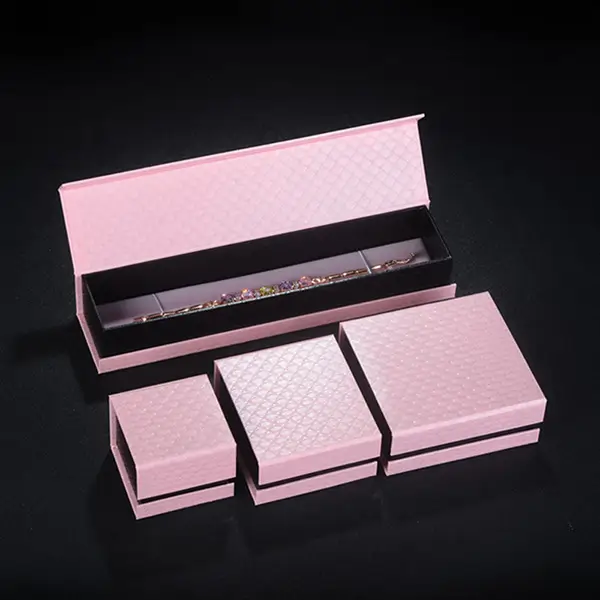
Affordable Custom Jewelry Boxes for Independent Jewelers | Budget-Friendly Solutions with High-Quality Designs
View More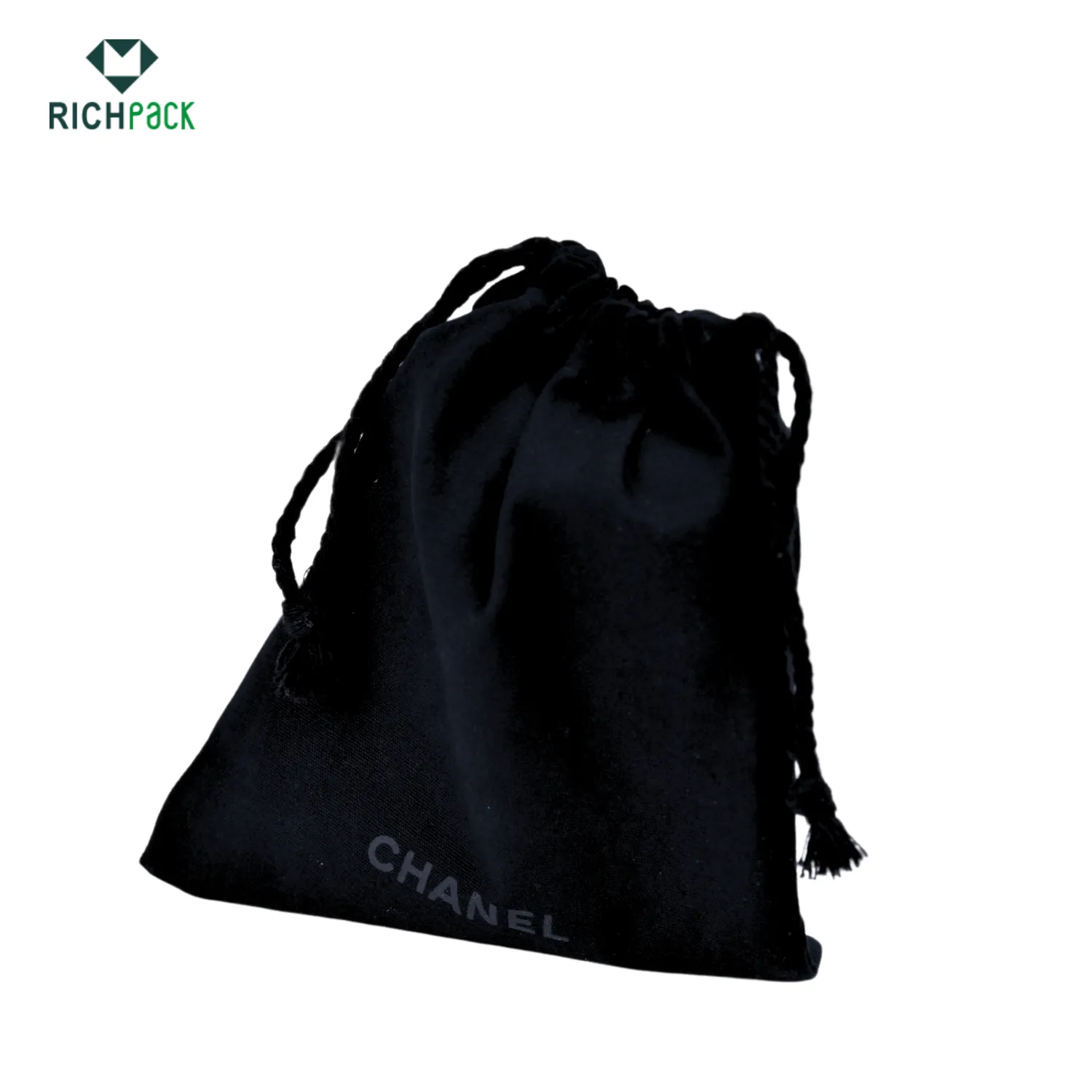
Bespoke Custom Jewelry Pouches for Protecting Your Jewelry | Customized Pouch Design
View More
Birthday Gift Packaging – Artful Wraps, Making Gifts Visual Treats on Birthdays
View More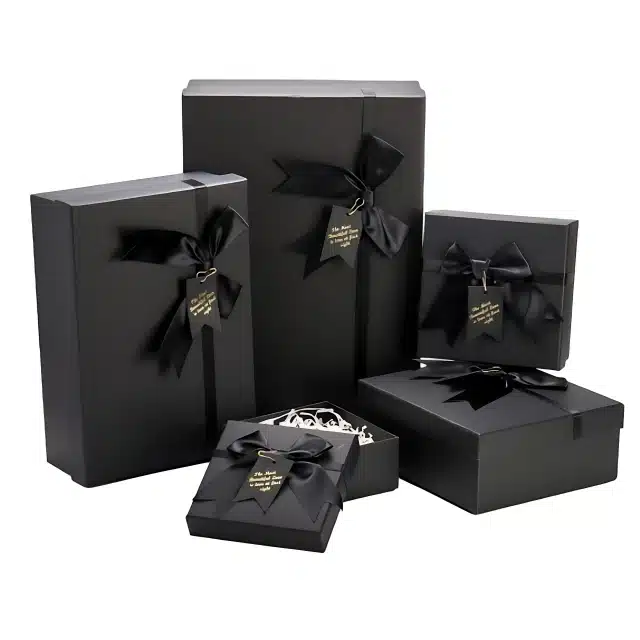
Black Gift Box Packaging – Practical, Branded Jewelry Boxes for Retail | Richpack
View More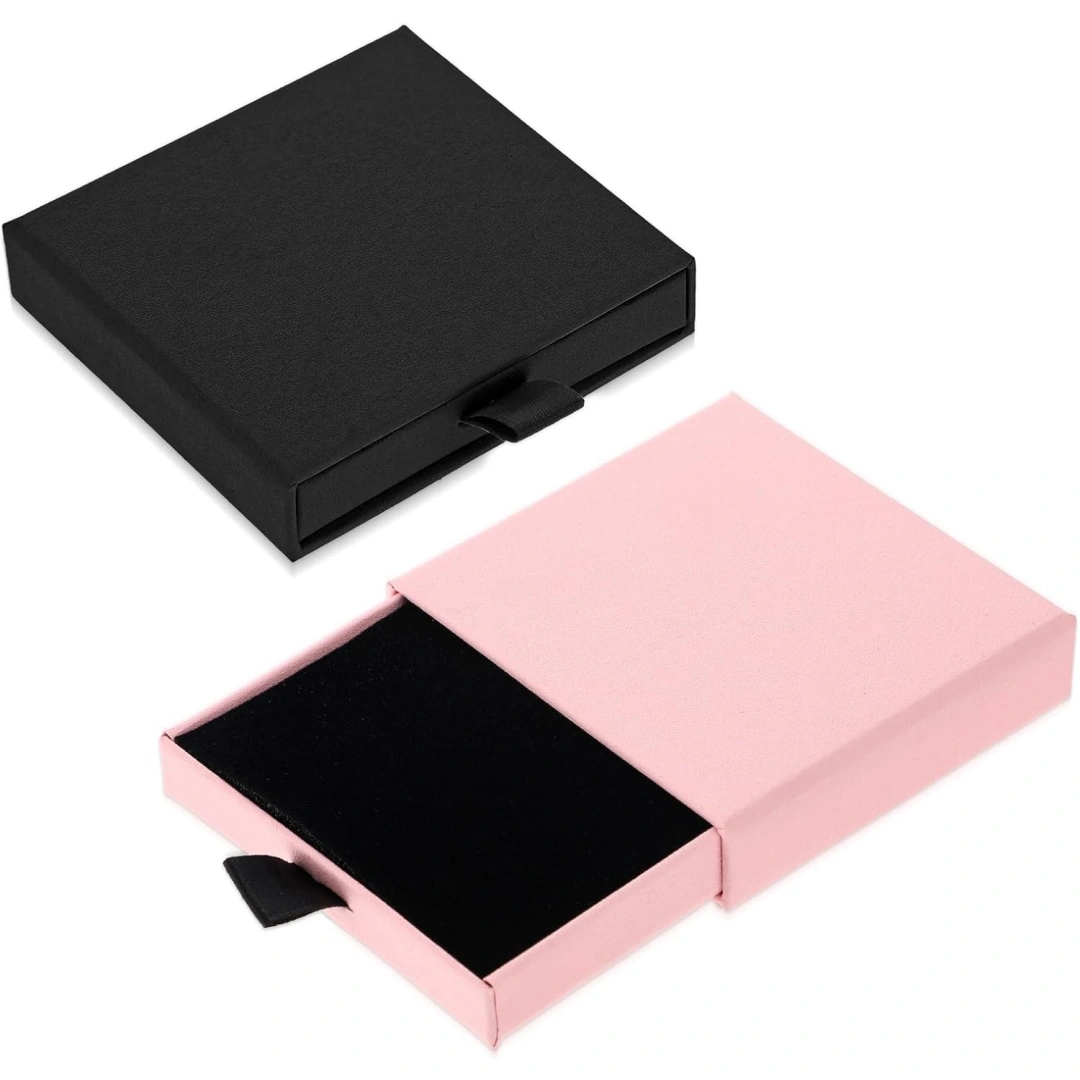
Bracelet Gift Box in Pink Thick Cardboard | Elegant Bracelet Packaging Box for Retail and Wholesale | Richpack
View More
Bulk Gift Boxes for High-Volume Buyers with Custom Branding | Cost-Effective Solutions for Wholesale Purchases
View More

