

 PREV
PREV

Is a Custom Light Engraved Wood Ring Box Worth It in 2026 for Your Brand?
2026-01-13




A jewelry brand can approve a beautiful box and still lack evidence for the EU, where a customer may ask who made the packaging and what each component contains. They may also ask for the technical documentation that proves it meets the requirements. The set may include board, paper, foil, glue, magnets, foam, velvet, ribbon, tissue, a pouch, a bag, and a shipper. PPWR treats the full set as one controlled packaging system.
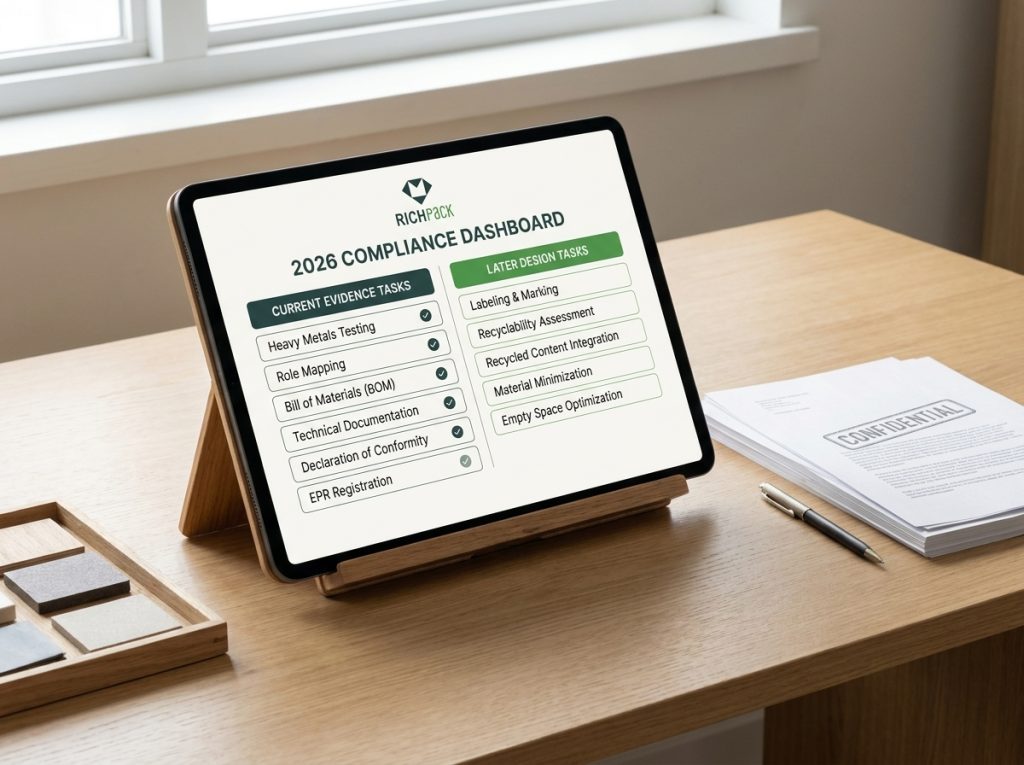
As of August 15, 2026, Regulation (EU) 2025/40 has been in force since August 12, 2026. Start with the legal roles and the components in each packaging type, then collect evidence and build the technical documentation. That documentation supports the EU Declaration of Conformity, while many requirements on design, labels, recycled plastic, and space start later.
General e-commerce guides stop at cartons, mailers, and pallets. Jewelry teams must also classify dust bags, counter displays, keepsake boxes, bonded inserts, and the space used to frame a small high-value product. The outer shipper and the presentation box can face different PPWR tests.
You should finish with four useful outputs. These are a component-level bill of materials, a legal-role map, a supplier evidence request, and a dated file for each packaging type. Brands planning new custom jewelry boxes should build these records during design and sampling. Do it before mass production locks the material stack.
Legal note: PPWR is EU law that applies in each Member State. National EPR systems, local enforcement, other product laws, and contract facts still matter. Ask qualified counsel for a final view in a given country.
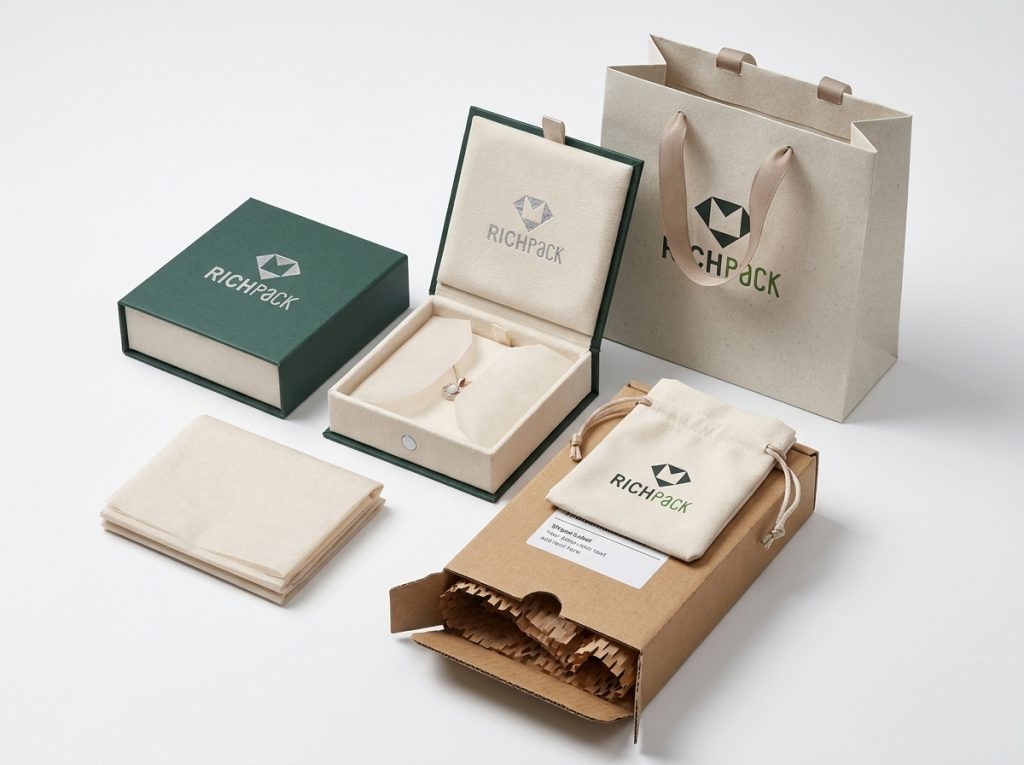
PPWR replaced the old EU packaging directive and covers packaging placed on the EU market. The packaging may be empty or filled, and it may be made in the EU or imported. Its material does not remove it from scope.
August 12, 2026, did not start every future target. It made the main regulation apply. For jewelry packaging, start with roles, substance evidence, packaging identifiers, supplier records, the technical documentation, and the declaration.
The European Commission says the rules start in phases. That point prevents a common error. A 2030 design rule is not a universal port test in 2026.
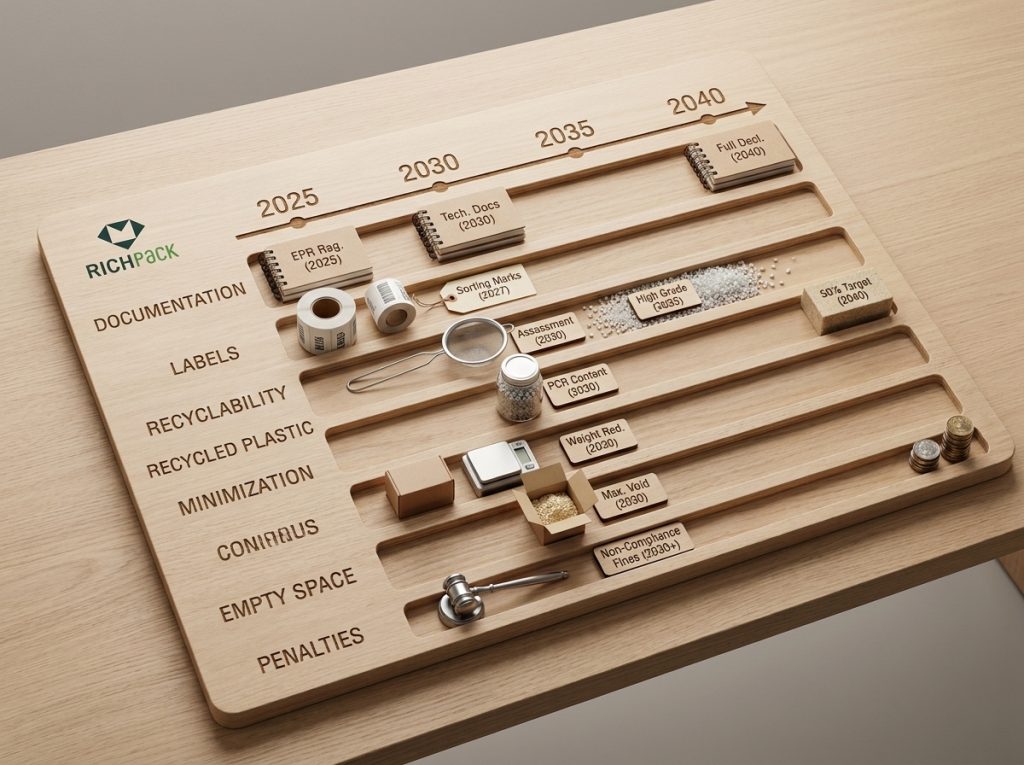
The main EU material label starts from August 12, 2028, or a later date set by the final acts. Rules on packaging size and weight begin in 2030, along with the 50 percent empty-space cap for grouped, transport, and e-commerce packaging. Recyclability design grades also start in 2030 under the act-based timing, while the recycled-at-scale test follows from 2035.
Minimum recycled plastic content is a 2030 and 2040 issue. It is not a blanket August 2026 limit. A jewelry brand should still collect plastic-part data now. Material changes, tools, samples, and supplier checks take time.
| Requirement | Main Date | Jewelry Packaging Action |
| PPWR general application | August 12, 2026 | Assign roles and build evidence files |
| PFAS limits | August 12, 2026 | Apply only where packaging is food-contact |
| Harmonized material label | August 12, 2028 or later trigger | Reserve artwork space and track implementing acts |
| Reusable packaging label | February 12, 2029 or later trigger | Use only for a real reuse system |
| Design for recycling | January 1, 2030 or later trigger | Simplify and separate component materials |
| Plastic recycled content | January 1, 2030 or later trigger | Record plastic weight and resin evidence |
| Packaging minimization | January 1, 2030 | Document why each layer is needed |
| E-commerce empty space | January 1, 2030 or later trigger | Right-size shipping packs |
| Recycled at scale | January 1, 2035 or later trigger | Check actual collection and recycling routes |
| Recyclability grades A or B | January 1, 2038 | Remove grade C designs |
| Higher plastic recycled content | January 1, 2040 | Plan long-term plastic substitutions |
A CE mark on a product does not prove that its packaging meets PPWR. EU lawmakers chose not to use CE as the PPWR signal. It could confuse product requirements with packaging requirements.
This matters for watches, smart jewelry, lit displays, and other goods that may carry CE marks. Link the product documentation and packaging documentation. Keep them as separate records.
PPWR does not create one broad certificate that a brand can buy and file away. Annex VII uses Module A internal production control. The manufacturer checks the packaging, builds the technical documentation, controls production, and signs the EU Declaration of Conformity.
A laboratory, adviser, scheme, or packaging supplier may help. They can test materials, make calculations, or draft part of the documentation. The manufacturer still owns the declaration.
Ask a service firm what evidence it will give you. A good answer names the packaging types, components, test methods, drawings, supplier records, risks, and declaration fields. A weak answer offers a logo or certificate with no link to Annex VII.
The scope reaches past the main box. The rigid box, insert, lining, pouch, paper bag, tissue, sleeve, sticker, shipper, and fill may all be packaging components. Fixed and loose components can both affect the recyclability assessment.
Treat a branded box handed to the buyer as sales packaging when its job is to contain, present, or deliver the jewelry. Treat a custom jewelry display case kept by the retailer as a fixture candidate. Check who keeps it after the sale and whether it remains shop equipment.
A long-life storage case sold with the piece needs another test. Ask if it is an integral part of the product and needed to contain or preserve the jewelry throughout its life. Then ask if the case and jewelry are meant to be used or disposed of together.
List each item that holds, guards, moves, ships, or shows the jewelry. Record its intended use, who keeps it, how long it is used, and why it is in or out of scope.
The PPWR manufacturer is not always the factory that cuts and wraps the box. Article 3 can place that role on a firm that orders a pack or packed product under its own name or mark. The Commission’s 2026 guidance points to the brand and the party with design control.
For branded jewelry, the brand should check if it holds the manufacturer role under PPWR. The answer can change with the sales route, trade marks, company size, supplier site, and a micro-enterprise exception.
An EU micro-enterprise has fewer than 10 people, measured as annual work units, and an annual turnover or an annual balance-sheet total of no more than EUR 2 million. Partner and linked firms can count toward those totals. A small website or a low order volume does not prove micro-enterprise status.
The manufacturer role exception is narrow. When a qualifying micro-enterprise has packaging made under its own brand and the packaging supplier is in the same Member State, Article 3 can place the manufacturer role on that supplier. A jewelry seller that buys boxes from another Member State or outside the EU should not assume the exception applies.
A separate Article 29 relief can remove certain reuse-target duties. The operator must be a micro-enterprise and make no more than 1,000 kg of packaging available in that Member State during the calendar year. The relief does not erase chemical, documentation, EPR, or national registration duties.
The manufacturer must meet Articles 5 to 12 where they apply. It must run the conformity assessment, build the technical documentation, and draw up the EU Declaration of Conformity. It must also control mass production. The shipped batch must match the approved sample.
Article 16 gives packaging and material suppliers a clear data role. A supplier must give the manufacturer the records needed to prove that the packaging meets the requirements.
Do not stop at the question, “Is this PPWR compliant?” Ask for the board grade and wrap paper. Ask for the ink, coat, foil, glue, magnet, insert, and fabric. Add recycled content, part weights, test reports, and the specs used.
A supplier can also help make the design simpler. Compare jewelry packaging materials while the dieline and sample are still open. A good fix may remove one hard layer. It does not need to add another certificate.
An EU importer may place only compliant packaging on the market. Before the sale, it must check four points. The manufacturer ran the conformity assessment, built the technical documentation, used the right labels, and supplied the required records.
The importer must also give its name and contact data in the right form. It keeps a copy of the declaration. It must be able to supply the file for five years for single-use packs and ten years for reusable packs.
An importer should not accept a file that says only “jewelry box.” It needs a type code and a bill of materials. The file must match the exact pack in the shipment.
A distributor has a duty of care. Before the sale, it checks the key ID, label, and EPR points. If it sees a sound reason for doubt, it should stop. Sales can resume after the issue is fixed.
This role matters to wholesalers that hold stock from many plants. Two boxes may look the same but use different foil, glue, inserts, or lining. Keep the source and batch clear.
The EPR producer is a different role from the PPWR manufacturer. In broad terms, it is the party that first supplies the packaging or packaged goods in a Member State. It can also be the party that unpacks goods without being the end user. Article 3 gives the full test.
Article 44 calls for sign-up in each Member State where the producer first supplies the pack or packed goods. The new register has its own start plan. Current national EPR laws and systems still matter.
One EU EPR number does not close the task. Build a country table instead. Name the seller, importer, sales route, local agent, number, EPR body, report period, and packaging weight by material.
Online platforms and fulfillment firms have check duties under PPWR. Article 45 tells platforms to get producer sign-up data and a self-check before they allow a relevant offer. Fulfillment firms also get and review producer data.
Before listing, a covered marketplace must get the producer’s registration number for the consumer’s Member State and a self-certification that EPR duties are met. It must make its best efforts to check that the data is complete and reliable.
A fulfillment provider gets the same registration and self-certification data when the service contract starts. If the data remains wrong or incomplete after a request to fix it, the provider must suspend the affected service. It must also store, handle, pack, address, and dispatch goods without harming packaging compliance.
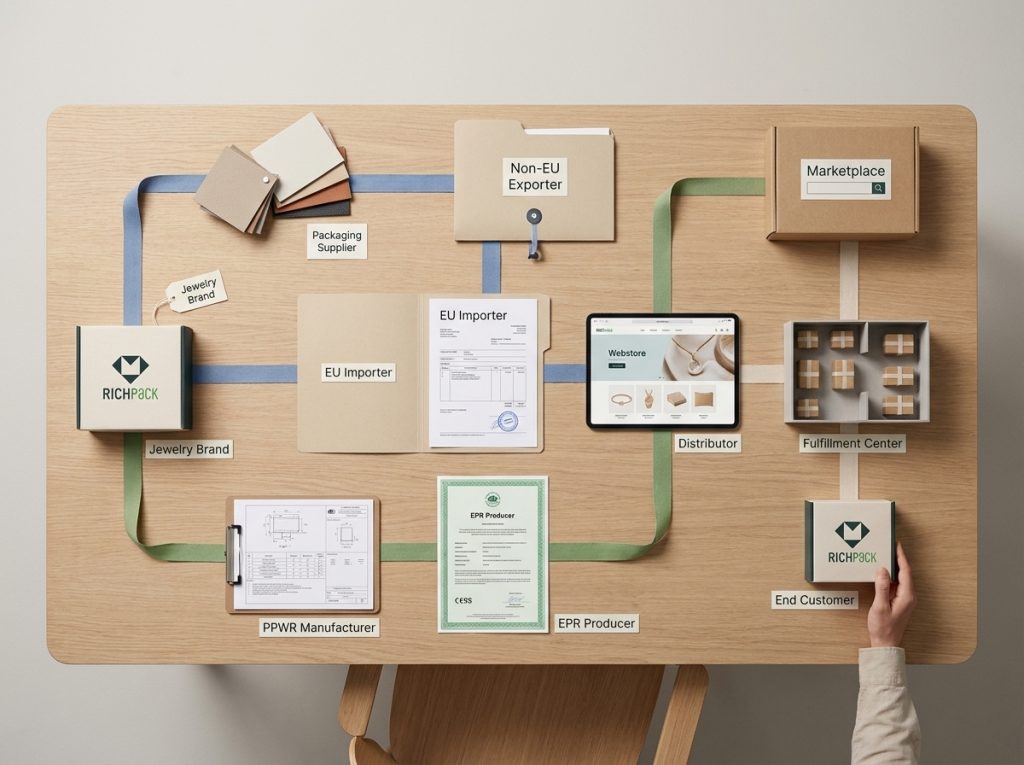
Map the real sales route. Direct sales, an EU importer, a market site, a dealer, and a local warehouse can move the duty to different parties.
| Supply-Chain Event | Legal Check | Party That Can Stop the Flow |
| Brand approves a branded jewelry box | Identify the PPWR manufacturer and any micro-enterprise role shift | Brand, supplier, or importer |
| Packaging supplier changes foam, foil, glue, or lining | Update component evidence and conformity review | Manufacturer or importer |
| Goods enter the EU | Check declaration, technical documentation, identity, and labels | Importer or customs authority |
| Jewelry is first supplied in a Member State | Identify the EPR producer and complete local registration | Producer, authority, or EPR body |
| Product is offered on a marketplace | Provide registration number and EPR self-certification | Online platform |
| Stock enters a fulfillment center | Provide reliable producer registration data | Fulfillment provider |
| Wholesaler resells the pack | Check identifiers, labels, and known compliance gaps | Distributor |
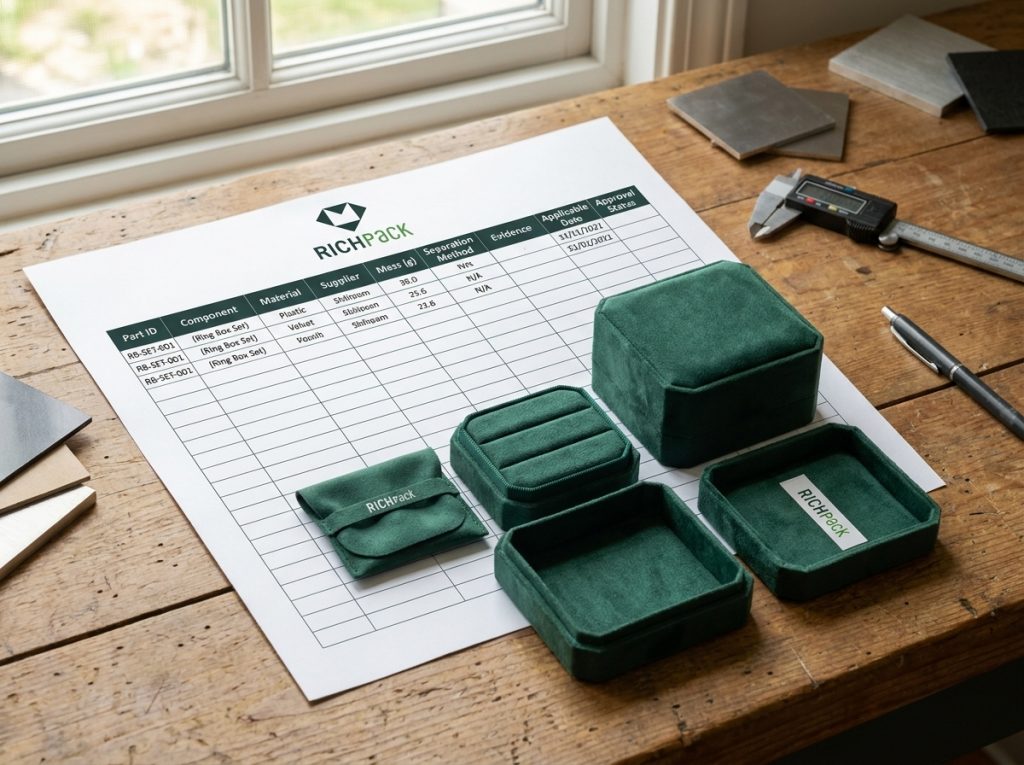
Start with the box shell. Record the board type, weight or thickness, recycled claim, wrap, ink, coat, foil, glue, magnets, hinges, and loose trim.
A rigid jewelry box can hide many layers under one order line. An invoice may say “paper box.” It may not show the film, metal foil, hot glue, or EVA insert.
Use a component table. Link each layer to a supplier, specification, weight, and evidence file. Review eco-friendly packaging materials for jewelry for ideas. Then replace broad labels with the exact production specification.
The insert guards the jewelry and shapes the first view. It may also pose the hardest recycling question. Paperboard and molded fiber may fit a paper route better than bonded foam and cloth. The final answer still depends on the design, waste system, and future EU rules.
Record the insert core, grade, cut, glue, cover cloth, and dye. State whether a user can remove it by hand. A custom jewelry box insert also needs a stable part number. A supplier may change the foam or lining while the box looks the same.
Compare rigid and flexible insert options for protection. Then ask one rule-based question. Can the buyer or sorter remove the insert with no tools and little residue?
A custom fabric jewelry pouch can be packaging, a product accessory, or part of the product. The Commission’s guidance says a dust bag intended to store a product through its lifetime is not packaging. Packaging wrapped around that dust bag can still be packaging.
For a jewelry pouch, record whether the buyer is expected to keep it for long-term storage. Note whether it protects the piece and whether it is sold or listed as an accessory. If its job ends after presentation or delivery, keep it in the packaging BOM.
Words such as velvet, microfiber, satin, cotton, and suede-touch do not name the full material. Ask for the fiber or resin. Add any back layer, coat, print film, cord, zip, snap, and dye.
If the pouch is packaging and the brand calls it reusable, record the reuse system. A soft bag that a buyer can keep does not meet Article 11 on that fact alone. Define the intended reuse, number of uses, care method, return or refill route, and end route.
Give paper bags, handles, patches, tissue, stickers, and ribbon their own BOM lines. A paper bag may use cotton, paper, or man-made rope. It may also use metal or plastic eyelets.
Use custom paper bags as a design source. Record the handle joint and finish as separate parts. A coated bag and a plain kraft bag should not share one file.
Tissue and stickers may look small. They can still change the waste route or green claim. Record their material and weight. Do this even if a future rule may exempt a small plastic part.
Jewelry brands add clear sleeves, seal bags, films, shrink wrap, and plastic labels to paper packs. These parts may drive the 2030 recycled-plastic check.
Article 7 excludes a plastic component below 5 percent of the full packaging weight from its recycled-content targets. That limit applies to Article 7. The component still belongs in the BOM. It may still affect chemicals, labels, and recyclability.
Record the resin, thickness, weight, recycled share, coating, glue, and supplier evidence. A film may only guard the box inside the plant. Test a paper sheet, loose sleeve, or process change in its place.
The e-commerce shipper, mailer, tape, label, corner guard, and fill belong in the packaging inventory. From 2030, grouped, transport, and e-commerce packaging will face a 50 percent empty-space cap. Article 24 sets the timing and method.
Use custom e-commerce packaging to fit the outer shipper to the jewelry box. Measure the unused shipper volume after the sales pack is inside. Air cushions, paper fill, bubble wrap, and foam count as empty space in the Article 24 calculation.
Do not apply the 50 percent ratio to every gap inside a retail jewelry box. Article 24 targets grouped, transport, and e-commerce packaging. The retail box still faces Article 10 minimization, and both rules need review when one pack performs both jobs.
Jewelry is small, but its retail box may need room for safety. Prove the need with drop, shake, crush, or fit tests. A luxury claim does not support a large shipper on its own.
Article 5 limits four heavy metals in packaging or a packaging component. They are lead, cadmium, mercury, and hexavalent chromium. Their combined level must not exceed 100 mg/kg. The requirement can reach ink, coatings, pigments, metal trim, eyelets, foil, and plastic.
The technical documentation needs evidence. The law does not call for the same laboratory panel on each low-risk component. Base the test plan on the material, color, supplier control, past reports, process changes, and reliability of the records.
Ask the supplier to name the test sample and method. A report for “paper packaging” may not cover a new foil color, coat, magnet, or lining. It may not cover a second plant.
The PPWR PFAS limits apply to food-contact packaging. One named PFAS has a 25 ppb limit in targeted analysis, while the sum of targeted PFAS has a 250 ppb limit. Total PFAS, including polymeric PFAS, has a 50 ppm limit, and more evidence is needed when total fluorine is above 50 mg/kg.
Most jewelry boxes are not food-contact packs. Do not order a broad PFAS test only because a viral list says each export pack needs one.
The answer changes if the gift set holds food, chocolate, or an edible item. It also changes when a part is made to touch food. Name the use first, then set the test scope. Other chemical laws or buyer lists may still cover fluorinated coatings.
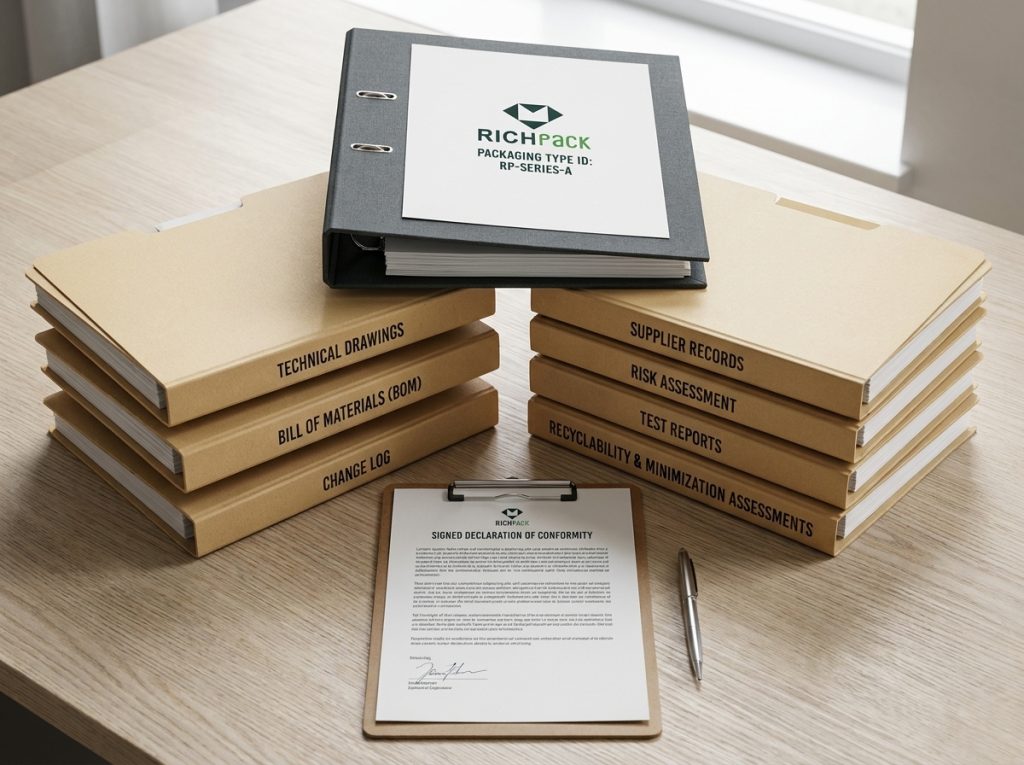
Annex VII calls for technical documentation that lets an authority assess the packaging. Add a clear description and intended use, followed by the design, manufacturing drawings, and component materials. The file also needs explanations, standards, specifications, test reports, and the required assessments for recyclability, packaging minimization, and reuse.
A one-page supplier declaration is rarely enough for complex luxury packaging. It can support the technical documentation. It must link to the drawings, materials, packaging type, and production controls.
Keep the file easy to use. A folder with 200 files and no labels is not ready for an audit.
Article 39 and Annex VIII set the form of the declaration. It identifies the packaging, manufacturer, and authorized representative where needed, and it states who assumes legal responsibility. It also lists the EU law and technical specifications used, then records the place, date, name, role, and signature.
The declaration belongs to a packaging type. A ring box, necklace box, pouch-only format, paper bag set, and e-commerce set may need their own identifiers. A controlled family may work when each variant is clear.
Keep single-use packaging records for five years after market placement. Keep reusable packaging records for ten years.
The manufacturer needs a type, batch, serial number, or other clear identifier. Small packaging may not have room. In that case, the data can go in an accompanying document.
The manufacturer must also give its name or mark, postal address, and digital contact when it has one. Small jewelry packaging has little space. Plan the data location before artwork approval.
Use a code that links the finished pack to its BOM and file issue. RB-25-BLK-V3 works only if the team can read it. The code should lead to the box style, size, color, material, and batch.
PPWR does not erase national EPR work. Name the EPR producer for each sales route and country. Check the current sign-up, EPR body, report method, pack groups, and material weights.
Article 44 sets a shared register model. National registers follow a start plan tied to the Commission Act. Current national pack laws may already require sign-up and reports.
| Market | System Anchor | Jewelry Seller Action |
| France | Citeo is an approved eco-organization for packaging EPR; ADEME issues the unique identifier through SYDEREP | Keep the Citeo contract or other approved eco-organization record, ADEME IDU, declarations, and current Triman or Info-tri artwork basis |
| Germany | LUCID is the national Packaging Register | Register in LUCID, sign a system participation contract where required, and keep LUCID and system volume reports consistent |
Do not treat the names as the same type of system. Citeo is a producer responsibility organization. LUCID is a public register. A marketplace request is a work signal, not the full legal test.
By February 12, 2027, each Member State must set its PPWR penalty rules. It must also tell the Commission. The penalty must work, fit the breach, and deter it.
The same year also brings EU and standards work. Watch the official acts. Do not rely on an old one-page timeline. Record the source and review date for each due date.
The shared EU material label starts on August 12, 2028, or 24 months after the final acts take force. Use the later date. Those acts will set the symbols, form, and way parts are shown.
Save a clear art zone now, most of all on small ring boxes and pouches. Do not invent an EU label before the final specs exist.
The law allows digital routes in some cases, such as small packs. An online sales page may also need the data before the buyer pays.
Reusable pack labels start on February 12, 2029, or 30 months after the final act takes force. Use the later date. The label tells users that the pack can be reused. A QR code or other data tool gives details on the system and return points.
This asks for more than “keep me” inside a box. The brand needs a real reuse plan. It needs a route for repeat use or return. It also needs evidence that the pack stays safe and works.
Several key design rules will be met in 2030. Packs must meet the recycling design rules and reach grade A, B, or C under Article 6. Plastic parts may need a minimum share of used plastic under Article 7. Article 10 also calls for the least weight and size needed for the job.
The 50 percent empty-space cap also reaches grouped, transport, and online sales packs under Article 24. Later EU acts will set parts of the math and test method.
For packs due in 2027 or 2028, add a 2030 design gate. Late changes to tools, art, inserts, and contracts cost more. Make the parts easy to split now.
From 2035, packs must also be recycled at scale under the Article 6 timing. A pack can look easy to recycle on a desk and still fail. It needs a real route for take-back, sorting, and recycling.
This point matters for luxury packs with board, cloth, foam, magnets, foil, and glue. A list of material names does not prove a real waste route.
From 2038, packs will need recycling grade A or B in most cases. Grade C cannot be the long-term plan.
In 2040, the recycled-plastic targets rise. Other plastic packs reach 65 percent under Article 7. The final result still follows the math rules, carve-outs, and later changes.
Put these dates in the source plan now. A long-life jewelry pack may go through several new versions before 2040.
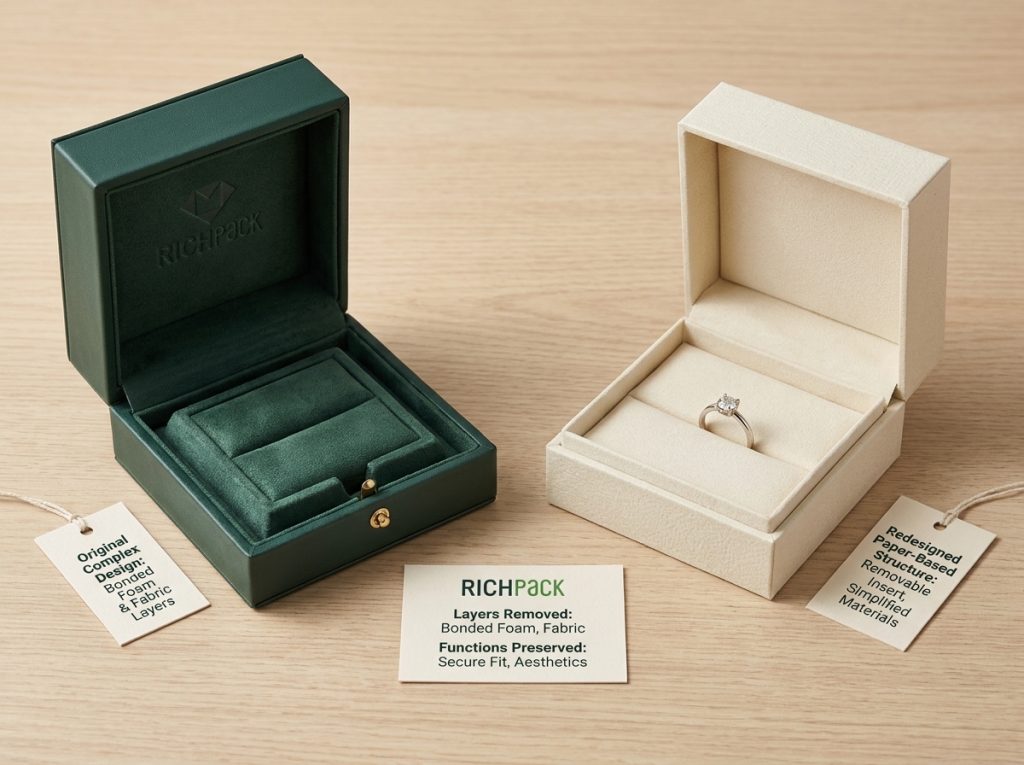
Each bonded layer adds a question. Can it be split off? Can it harm the main waste stream? Does its weight change the pack group or recycled-plastic math?
Start with the function of each component. The board holds the shape, the insert holds the jewelry, the lining guards the surface, and the finish carries the brand. Remove a layer when another component already performs the same job.
Review sustainable materials for gift boxes as a full build. Do not judge the pack by the name of its outer paper.
Article 6 treats fixed and loose parts in set ways. The check covers the full pack. Its parts must work with real take-back, sorting, and recycling steps.
A loose insert may be easier to sort than cloth fixed to foam. A magnet or ribbon can also be made easy to remove. The final tests will come from EU acts. Avoid firm grade claims before those methods are set.
Make the split steps clear. A buyer should not need a knife or a solvent. A part that takes several minutes to remove is not simple to sort.
By 2030, the manufacturer or importer must cut pack weight and size to what the job needs. The law targets false bottoms, double walls, and extra layers used only to make a product look larger.
Separate the two space tests. The cavity inside a sales box falls under Article 10 minimization unless that box also serves as grouped, transport, or e-commerce packaging. The outer shipper faces the Article 24 limit of 50 percent empty space.
An oversized lid, false bottom, or deep platform can fail the minimization test even when the outer shipper passes its ratio. A close insert, neat lid gap, clean print, and smooth opening can create a luxury feel in a smaller pack.
Record why the jewelry needs space. It can stop a pendant from rubbing, guard a stone, leave room for a finger, clear a watch crown, or preserve the intended display angle. Link each reason to a drawing or test.
The insert belongs in the green brief. It may hold more resin, cloth, and glue than the box shell.
Compare molded fiber, folded board, loose pads, and simple cloth builds. Ask the supplier to prove the recycled source and share it. It should also prove that each batch stays the same.
A 100 percent recycled claim for the wrap does not describe the full pack. Name the part and the share.
Make a plastic weight table. Weigh each film, foam, tray, coat, window, label, and man-made ribbon. Name the resin and the evidence for its recycled share.
Article 7 may exempt a plastic part below 5 percent of the full pack weight from one recycled-content rule. The plastic is still there. It still affects the design, claim, and waste route.
Check each part against the final EU rules and the real local waste system. A paper shell does not make a bonded foam and fabric insert recyclable.
Reusable packs must be made and sold for many use cycles. They must stay safe and work. They must allow care or repair and still be easy to recycle at the end.
A strong box that a buyer keeps can add value. That fact alone does not prove Article 11 reuse. Define the system, user, number of uses, return or refill route, care method, and end plan.
The premium sustainable jewelry packaging case shows a common design trade-off. A luxury look and a simpler material stack can pull in different ways. Use the case for ideas, then build evidence for the real project.
Give each pack type a unique ID. It should link the finished pack to the drawing, BOM, supplier, tests, declaration, and file issue.
Do not use only a collection name. One range may have many sizes, inserts, colors, finishes, and plants.
Annex VII asks for the design, shop drawings, and part materials. Keep the dieline, build drawing, size, limits, material notes, and part weights.
The BOM should show the pack as sold or sent. Add the extras and shipper when they form part of the set under review.
Link each supplier file to a BOM line and issue. Useful evidence can include a material spec, chemical note, recycled-share record, source record, test report, safety sheet, and process note.
Evidence has levels. A signed note for one part is stronger than a web claim. A current lab test on the real material may be stronger than a broad note. State why each record is enough.
Annex VII includes test reports where needed. Choose tests from the risk and the rule. Do not buy a fixed bundle by default.
For a current jewelry pack, chemical evidence may be the first legal test needed. Pack tests can also prove why you need a material, wall, insert, or open space.
Record the sample code, material issue, color, supplier, date, lab, method, result, and pass decision. A report with no sample link can become useless after a part change.
The technical documentation must include a sound review of the risk of failure. Use a plain risk list.
Score the chance of bad material data, banned chemicals, silent part changes, weak recycled evidence, hard separation, too much space, poor tracking, and false claims. Add an owner and due date. High-risk calls for stronger evidence, a test, a new design, or legal review. State the reason why the risk is low.
Annex VIII asks for a declaration number and manufacturer details. It also asks for the pack ID and a short description. Add the EU law, standards, or specs, any body used, and the signature data.
The local authority must be able to read the declaration. Control each translation. Make sure the signer can take on the legal duty.
Do not ask a supplier to sign as the manufacturer unless the role check supports it. A supplier can sign its own notes and give evidence. It does not need to take the brand’s role.
Article 15 calls for controls that keep each batch in line. A change to the design, material, supplier, standard, spec, or process may call for a new check.
Add change notice terms to the order and quality deal. Control changes to paper grade, recycled share, coat, ink, foil, glue, magnet, foam, lining, ribbon, film, and plant.
Approve the master sample against the controlled BOM. A visual match is not enough when an inner part has changed.
Ask for the sales and trade name of each material. Add its make-up, grade, thickness or paper weight, mass, coat, color, glue, and source.
For a mixed material, ask for the layer build. “Velvet insert” and “coated paper” are not full names.
Ask for evidence on each part for the four heavy metals. Add other chemicals tied to the material, use, or buyer list. State the limit and name the exact part.
For PFAS, state whether the pack will touch food. Do not send a food-pack PFAS rule to each jewelry-box supplier with no food use.
Ask for the recycled share and its source. State whether it comes from used goods or plant scrap. Ask for the math, source trail, mass-balance method, and evidence dates.
Mass-balance accounting is a controlled bookkeeping method. Recycled and virgin feedstocks can mix in one process, while audited records allocate the eligible recycled share to output claims. It does not prove that each molecule in one insert came from recycled feedstock.
The PPWR method for calculating and verifying recycled plastic content is due by December 31, 2026. Until the final act is available, record the scheme, audit, allocation rule, site, period, and claim used by the supplier.
Keep paper and plastic claims apart. Article 7 sets a minimum for plastic packs. A recycled-paper claim uses a different evidence path.
Ask how the parts split and what glue or coat stays on them. Ask which take-back, sort, and recycling route the supplier assumes. Use the answer as an input. It is not a final EU recycling grade before the rules are set.
Ask for a second build with fewer materials. Ask the supplier which trim layer causes the most plant and waste trouble.
Each sample needs a code that matches the quote, BOM, and test order. Take photos and record the weight. Keep the real sample when you can.
If the supplier changes the insert or foil, give the next sample a new issue. Keep the old record.
Require written approval before a change to a controlled material, part, source, or process. Set the notice time. Name the records that need an update.
A silent part swap can break a declaration fast. Cheaper foam, new glue, or a new coat may look the same in a photo.
Close the supplier request with a signed file list. Show each file, part, issue, date, and firm.
AI can sort the request, compare files, and flag blank fields. It cannot invent a material, test result, sign-off, EPR number, or legal view.
| Supplier Request | Minimum Useful Response |
| Component list | Part number, name, mass, material, supplier |
| Heavy metals | Scope, method, specimen, result, date |
| PFAS | Food-contact basis and applicable result |
| Recycled content | Percentage, source type, calculation, evidence |
| Drawings | Controlled revision and dimensions |
| Change control | Signed notification commitment |
| Declaration support | Evidence index tied to packaging type |
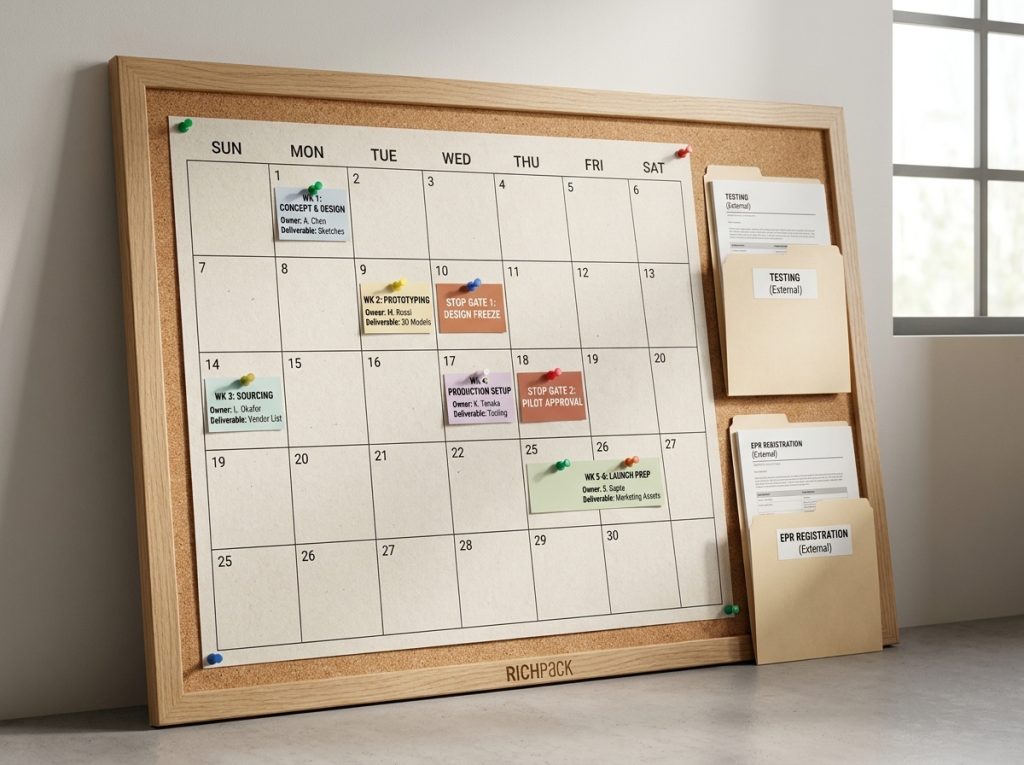
Freeze the current pack list. Add all EU goods, pack versions, markets, import routes, and suppliers.
Give each pack a type ID. Start with the pack that has the most sales or risk. Do not try to fix every SKU at once.
Map the PPWR manufacturer, supplier, importer, dealer, EPR producer, market site, and warehouse firm for each route. Record the legal basis and open questions.
Send role questions to counsel or the EU partner in charge. Do not let the box plant set the full legal map by default.
Send the component evidence request to suppliers. Make a gap table. Mark records as received, missing, old, broad, or in conflict.
Check high-risk parts first. These may have a strong color, metal finish, plastic, coats, glue, unknown makeup, or a new source.
Choose the tests and design fixes. Test the real material issue when supplier evidence is weak or the risk is high.
Review the 2030 risks at the same time. A small fix now can prevent a second sample round.
Build the Annex VII file. Add the BOM, drawings, use, role map, specs, risk list, test reports, and checks that apply.
Draft the declaration from Annex VIII. Check the pack ID, languages, signer, and storage site.
Approve the pack type, declaration, and plant controls. Add a supplier change notice, goods-in checks, and a set date for legal review.
Build a short team board with status, evidence gaps, markets, and design needs. Keep legal, green, buying, pack, and plant teams on the same issue.
PPWR does not set one EU-wide fine of 6 percent of yearly sales. Article 68 tells each Member State to set penalties by February 12, 2027. The penalty must work, fit the breach, and deter it.
National rules can differ. Check each country where the pack is sold. Tie any fine claim to a named law and date.
A CE mark may cover the product under another EU law. It does not prove that the pack meets PPWR.
Use the PPWR declaration and technical documentation for the pack. Link the product and pack records when both sets of rules apply.
The Article 5 PFAS limits apply to food-contact packs. Most jewelry packs do not have that use.
You may still need heavy-metal or other chemical evidence. A buyer’s spec or another law can add more rules.
Article 44 uses sign-up in each Member State where the producer first supplies the pack or packed goods. Current national systems and local agents remain part of the task.
A group can keep one data system. It cannot assume that one number covers each sales country.
AI can turn a packaging BOM into a gap list, draft a supplier email, compare report fields, or prepare a declaration form. It cannot measure lead, cadmium, mercury, chromium, or PFAS, and it cannot create a valid laboratory report. It also cannot complete a government registration without approved access and review.
Use AI to sort the work. Use skilled people and real evidence to make the call.
Yes. PPWR covers packaging placed on the EU market, including imported packaging and packaged goods. A box plant outside the EU does not remove the duty. Identify the manufacturer, importer, and EPR producer for the actual sales route.
The PPWR manufacturer takes the legal duty and signs the declaration. An approved agent may perform allowed tasks under a written order. A brand may be the manufacturer when it orders the pack or packed goods under its own name or mark. Check the small-firm rule and the sale facts.
No. A micro-enterprise has fewer than 10 annual work units and turnover or a balance-sheet total of no more than EUR 2 million. The status can shift the manufacturer role in a narrow supplier setup and can support an Article 29 reuse-target exemption below 1,000 kg in a Member State. It does not cancel EPR, chemical, documentation, or national registration duties.
No one test pack fits every box. The technical documentation needs enough evidence. Use supplier records, a risk check, specs, math, and lab reports. Order a test when the law, material risk, evidence gap, buyer rule, or part change calls for it.
They can. Add a pouch or insert when it holds, guards, moves, ships, or shows the jewelry as part of the pack. Record loose and fixed parts, even when a user can remove them.
Not by default. Article 24 sets the 50 percent ratio for grouped, transport, and e-commerce packaging. The cavity inside a retail presentation box still faces Article 10 minimization. Review both rules when the same box also performs a shipping or grouped-pack function.
The shared EU material label starts on August 12, 2028, or 24 months after the final acts take force. Use the later date. Reusable pack labels use a separate February 12, 2029, or later test. Read the final acts before you change art.
A supplier or EPR body may help with sign-up when local rules and a written order allow it. First, name the EPR producer in each Member State. Then check that the agent, number, reports, and fees cover the right pack and sales route.
Keep the technical documentation and EU Declaration of Conformity for five years after a single-use pack enters the market. Keep them for ten years for a reusable pack. Store records by pack type and issue so an authority can find them.
The fastest sound PPWR path starts with the packaging you sell. List each component, identify the manufacturer and EPR producer, and collect current supplier evidence. Close chemical and traceability gaps, then build the Annex VII file before you sign the declaration.
Do not change a jewelry box because a broad list says each future rule applies now. Protect the 2026 shipment with current evidence. Then use the same BOM to plan for 2028 labels and 2030 design rules.
RichPack can help with component choice, box design, samples, specs, and evidence handover. The brand, importer, EPR partner, lab, and legal team still own their own calls.


2026-01-13

2026-08-02
2025-05-07

2025-11-18

2025-07-21

2026-05-19
Acrylic Ring Display Stands in Clear Acrylic | Transparent Ring Holder for Retail & Jewelry Showcase | Richpack
View More
Affordable Bulk Jewelry Display Stands for Wholesalers | Perfect for Large-Scale Suppliers Looking for Reliable and Cost-Effective Jewelry Display Solutions
View More
Affordable Sustainable Packaging for High-Volume Jewelry Orders | Perfect for Wholesalers Seeking Scalable, Green Solutions at Competitive Prices
View More
Anniversary Gift Wooden Jewelry Boxes with Personalized Engraving | Elegant Custom Keepsakes for Wholesale Suppliers Richpack
View More
Bangle Boxes for Secure and Stylish Storage | Perfect for Retail Displays and Gifting Solutions Richpack Trade Pricing
View More

