

 PREV
PREV
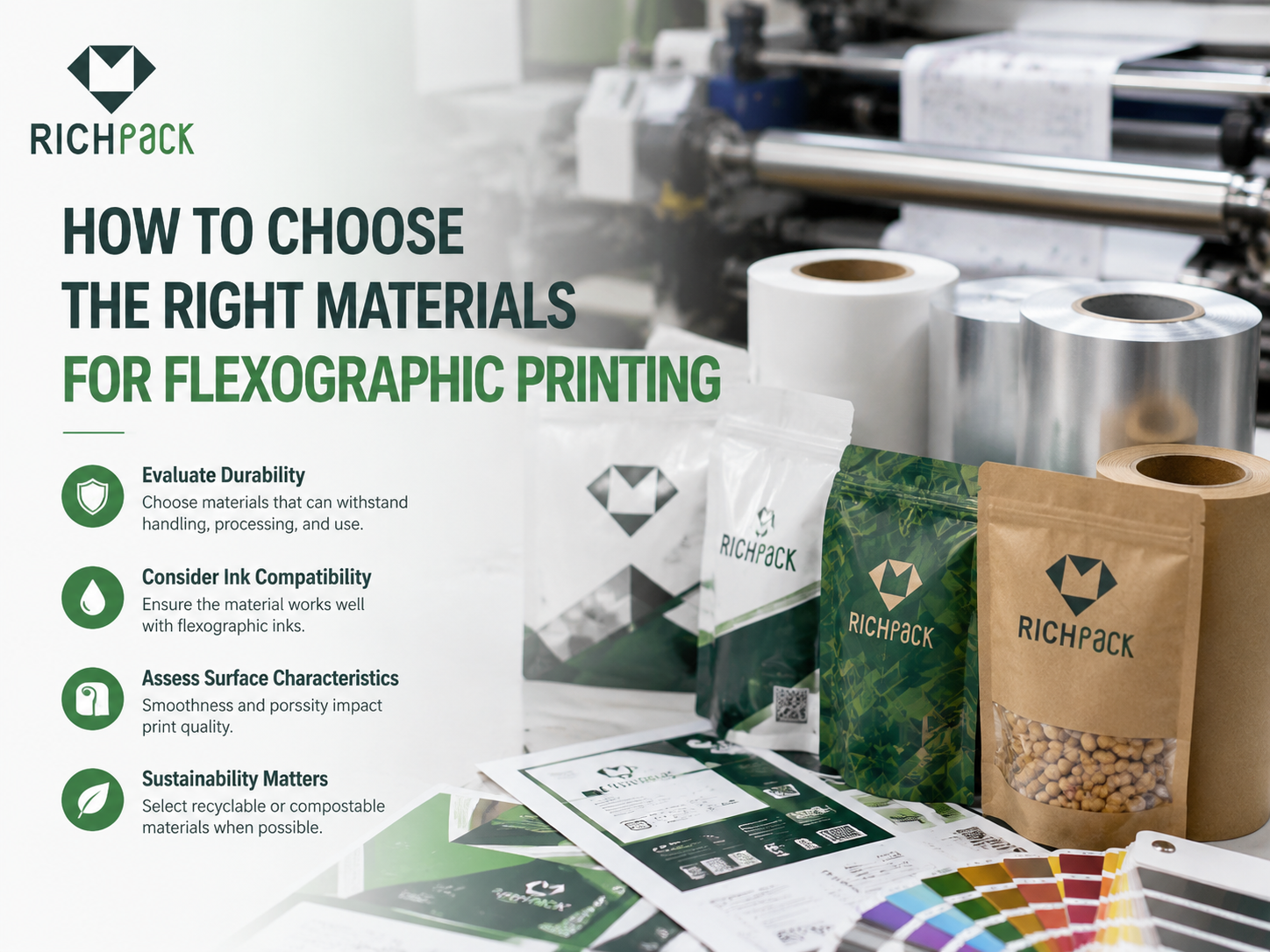
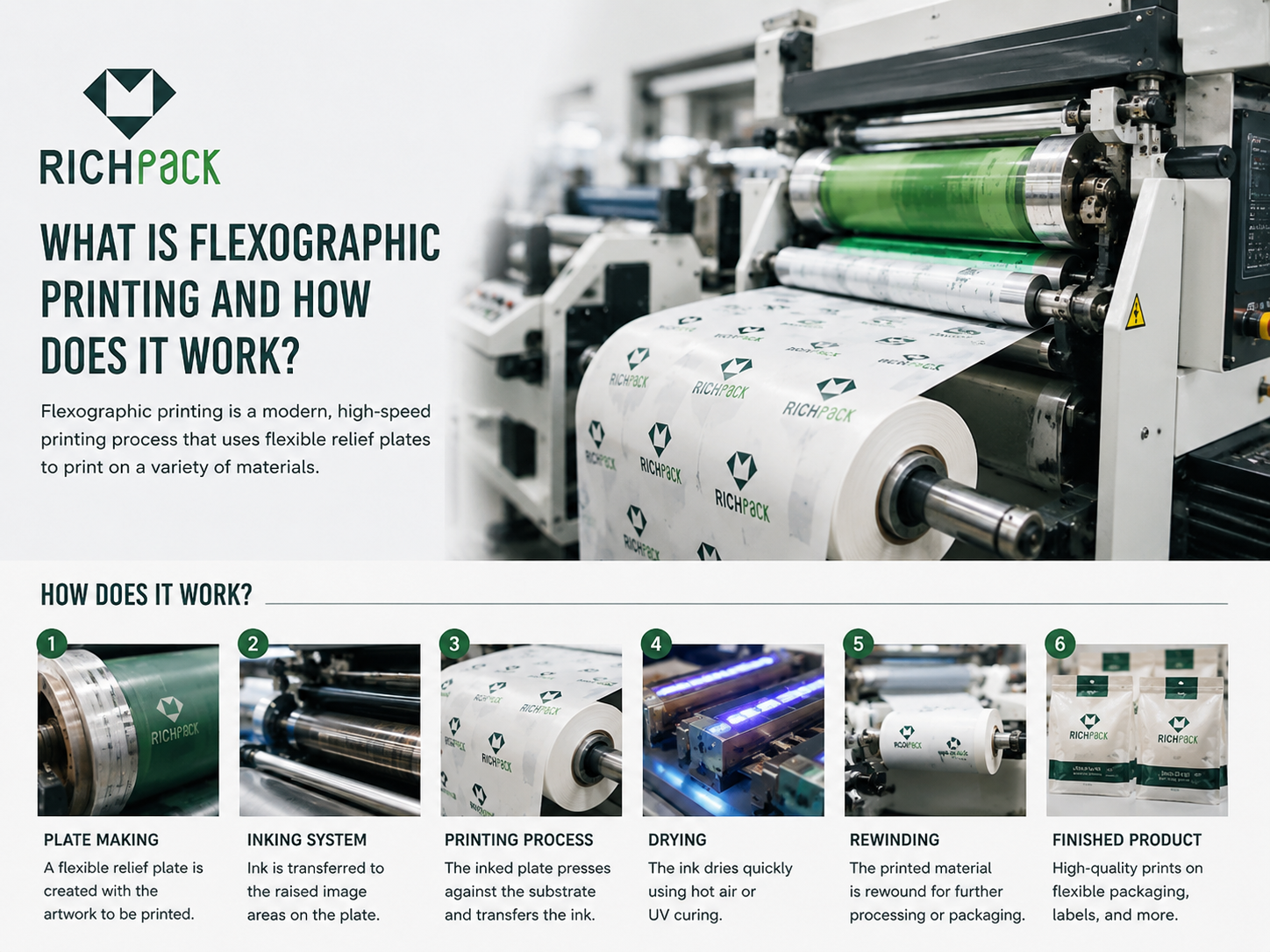
How to Choose the Right Materials for Flexographic Printing
2026-06-22
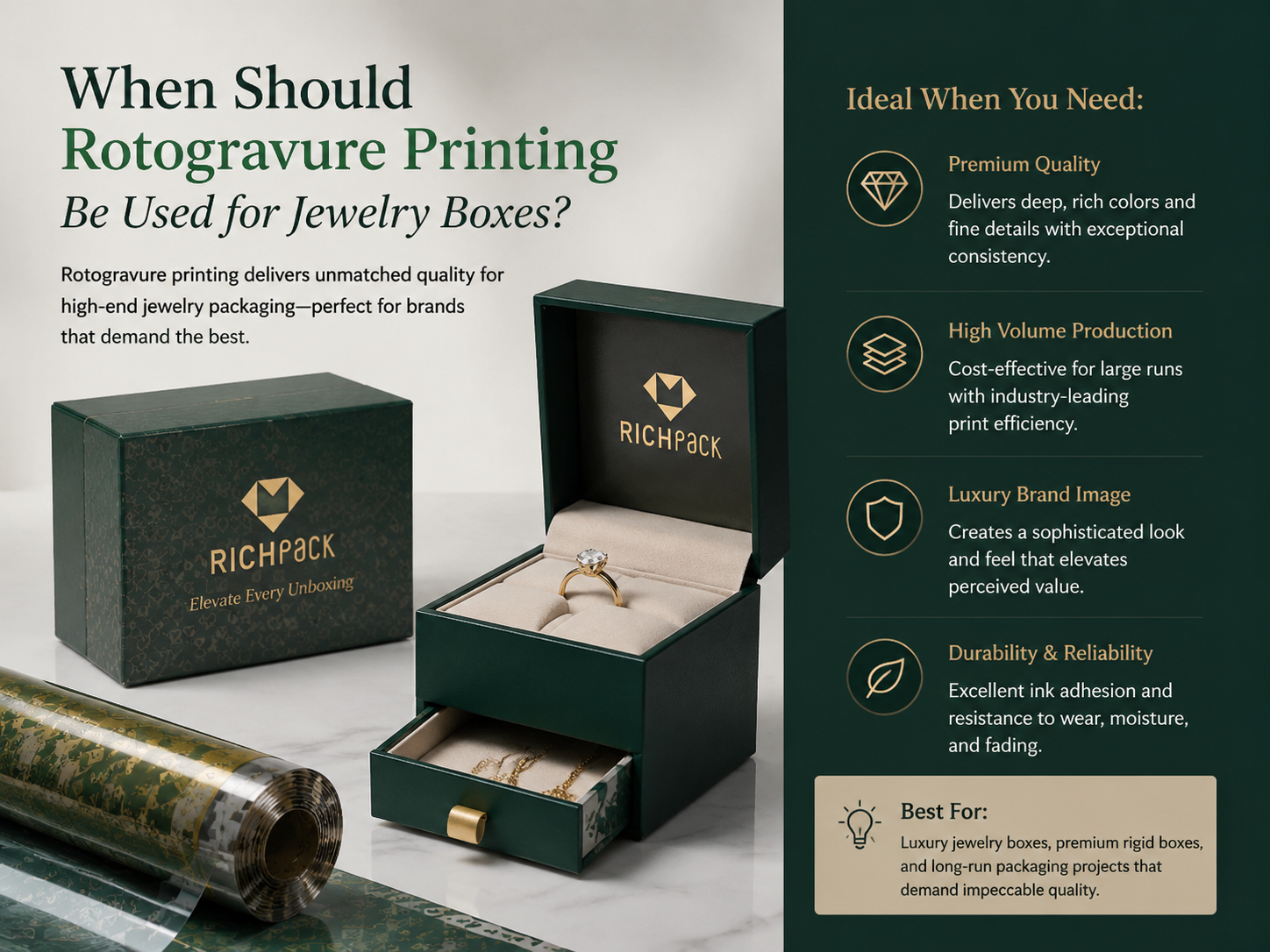



A jewelry box can lose trust before the clasp opens. One weak gradient, one dull brand color, or one scuffed logo can make a $2,000 necklace feel underdressed.
I am going to walk through what rotogravure printing promises on jewelry boxes, where it can break down in real production, who it suits, and who should stay with flexo, digital, offset, screen printing, or foil for now.
The short version: gravure is worth considering when a jewelry brand needs stable artwork, long repeat runs, fine image detail, and tight color control on paper wraps, sleeves, inserts, liners, or coordinated gift packaging. It is not the best first move for a small launch, a seasonal test, or a design that may change after the first sample.
For jewelry teams, the real question is not whether gravure looks premium. It does. The better question is whether the design, volume, substrate, and approval process can carry the fixed cylinder cost without locking the brand into old artwork.
If your team is planning a branded box family, start with the money page for custom jewelry boxes with logo wholesale and use the framework below to decide whether gravure belongs in the first production brief or in a later scale run.
Use gravure for jewelry boxes when the same approved artwork will repeat across high volume, when the printed area carries the brand story, and when color drift would damage the launch. Avoid it when the order is still exploratory, the design has many versions, or the box needs tactile decoration more than photographic print.
The fast rule is simple. Gravure rewards commitment. Digital and flexo reward movement.
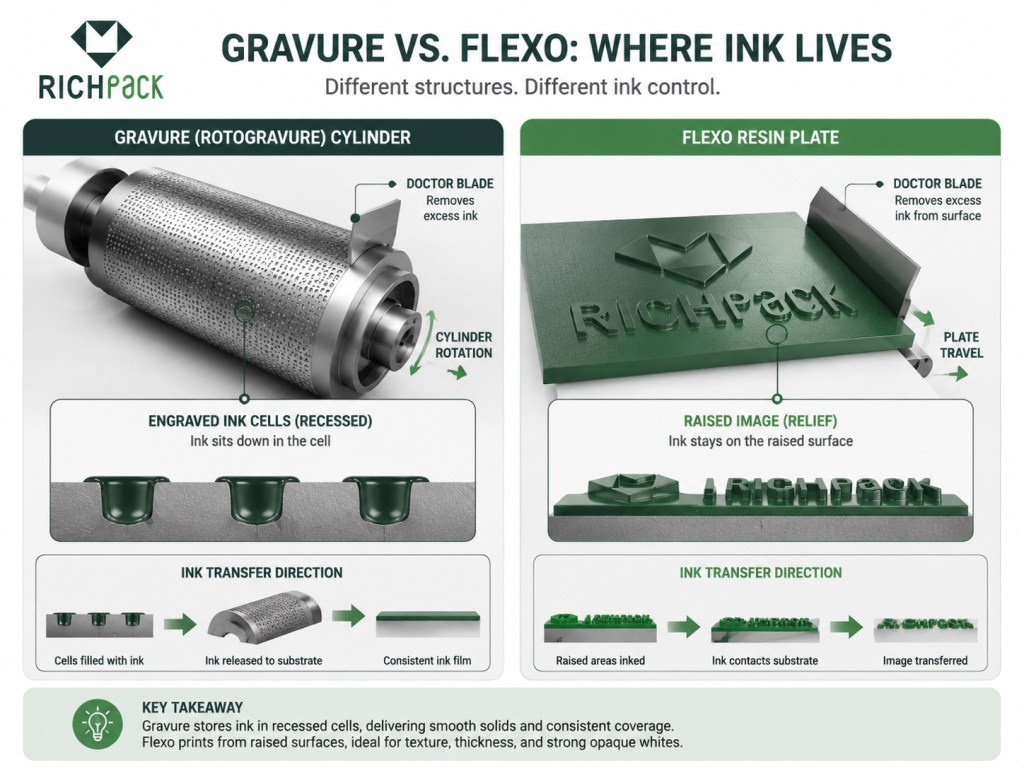
Gravure is an intaglio process. The print image sits inside tiny cells engraved into a metal cylinder, and those cells hold measured ink before transfer.
That cell structure explains the method’s strength. It can lay down controlled ink volumes for smooth gradients, dense color, small details, and consistent repeat work. Global Rotogravure Association describes the press action as ink filling cells, a doctor blade wiping the surface, and an impression roller pressing the web against the cylinder.
For jewelry packaging, the method is most useful on printed wrap papers, paper sleeves, cartons, pouch laminates, certificate envelopes, care card systems, and decorative liners. It is less direct for velvet, suede, thick leatherette, and highly textured rigid surfaces.
Choose gravure when five conditions line up:
A jewelry boxes program with one hero pattern across ring boxes, necklace boxes, sleeve wraps, and shopping bags is a stronger fit than ten micro collections with different artwork.
Gravure fails when the brief still moves. It also fails when buyers use it to solve a problem that belongs to finishing, structure, or insert design.
Do not choose it just because the word sounds premium. A hot foil logo, blind emboss, screen printed texture, or soft-touch coating may do more for a jewelry box than a costly engraved cylinder.
Short launches, influencer capsules, regional copy tests, and last-minute holiday art usually fit digital or flexo better. Those methods let the team change copy or visual details without rebuilding cylinders.
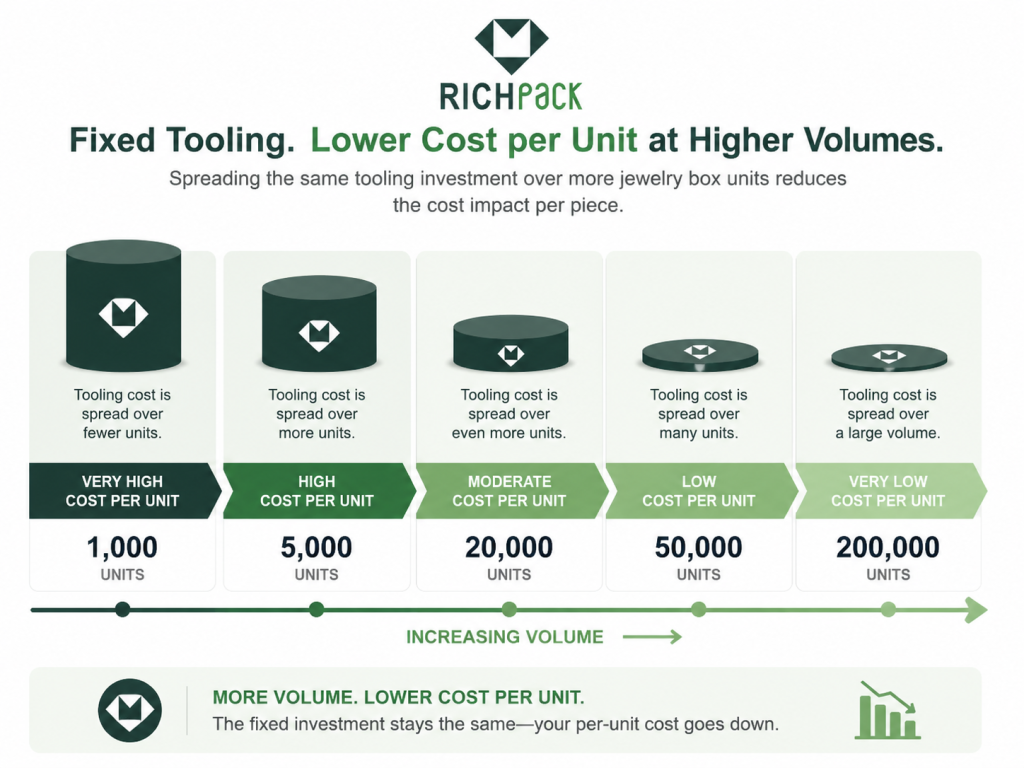
The most practical breakpoint is not one universal MOQ. It is the point where the cylinder cost per unit becomes small enough to stop hurting the landed packaging cost.
Use this planning model before requesting a quote:
| Same Design Quantity | Cylinder Cost Behavior | Good Fit for Gravure | Buyer Note |
| 1,000 to 5,000 units | Fixed cost feels heavy | Rare | Use digital for proof of market |
| 5,000 to 20,000 units | Borderline | Sometimes | Check the color value and repeat the plan |
| 20,000 to 50,000 units | More workable | Often | Best for one stable design |
| 50,000 units and above | Cost spreads well | Strong | Reorders improve the math |
| 200,000 units and above | Very efficient | Very strong | Best for long brand programs |
Public packaging suppliers often place gravure in the high-volume lane because cylinders cost money before a single box is finished. One current flexible packaging benchmark lists cylinder tooling at about 120 to 200 per cylinder, with one cylinder per color. Treat that as a market signal, not a RichPack quote.
The design must be locked before the cylinder stage. One country-specific legal mark, QR code, metal purity claim, or address change can force a new cylinder for that color station.
For jewelry brands, that risk is easy to miss. A ring box sleeve may look final until the retail team changes the care copy, the distributor asks for a local language line, or the compliance team adjusts a recycling claim.
If those details are not settled, keep the gravure out of the first run. Use a lower-tooling method, prove the system, then move stable artwork into gravure when repeat demand is real.
The difference between flexo and rotogravure printing matters because jewelry packaging often mixes a premium appearance with changing collections. Flexo and digital are not low-class choices. They are different tools for different risk profiles.
Use gravure when quality ceiling and repeat economics matter most. Use flexo when the substrate range, speed, and cost balance matter. Use digital when artwork flexibility and lower setup risk matter.
Gravure uses engraved metal cylinders. A multi-color job needs separate cylinders, so setup can be the highest early cost.
Flexo uses flexible plates. Digital usually avoids plates and cylinders, which makes it attractive when a brand is still testing artwork, messaging, or SKU count.
The buyer should ask for the tooling cost as a separate line. If it is buried inside the unit price, reorder math gets muddy fast.
Gravure has a high ceiling for rich color, smooth tonal work, and repeatable graphics. It is strong when a brand needs the same deep black, champagne tone, or soft gradient across a long run.
Flexo has improved a lot and can be excellent for many package types. Digital can look very strong in normal retail conditions, but it may not match gravure when the job depends on tiny gradients, exact spot color behavior, and very long repeat consistency.
Ask the supplier for a production proof of the actual material. A PDF proof can look perfect and still misbehave on ivory paper, soft-touch film, or a coated sleeve.
Gravure punishes late change. If the artwork changes after engraving, cost and time both move.
Digital handles versioning better. It suits founder notes, regional copy, limited collections, holiday capsules, and small batch packaging where each variation matters.
Flexo sits between the two. It still has tooling, but it is often more forgiving than gravure for medium runs and many paper packaging formats.
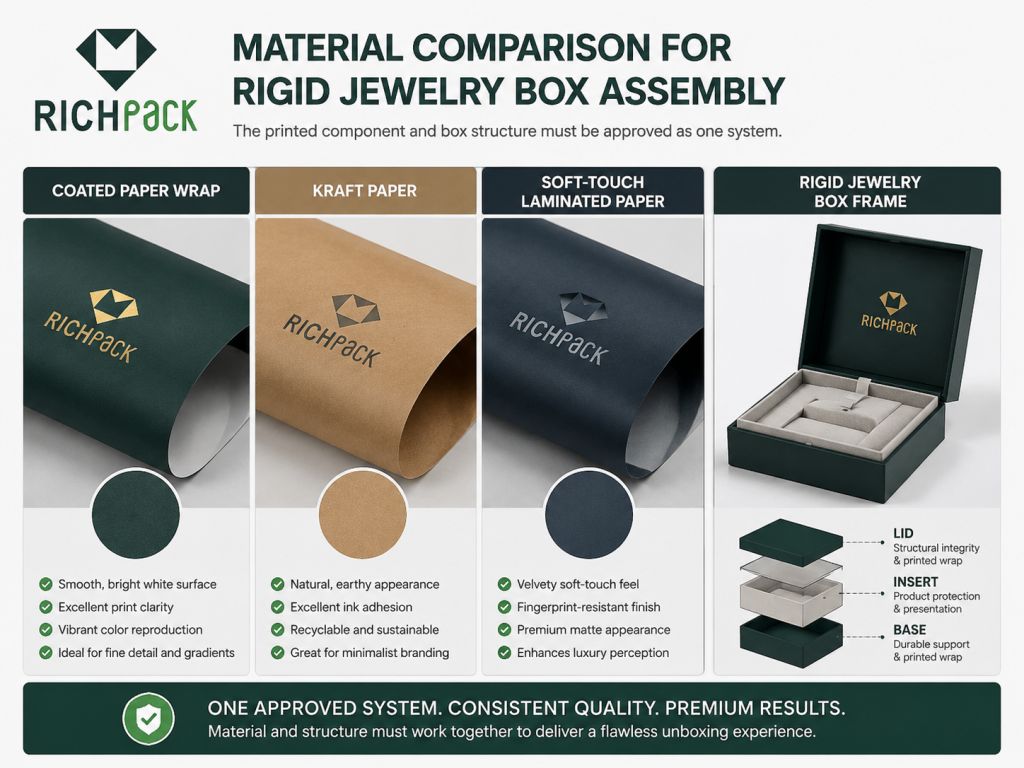
Gravure is most natural on web-fed substrates such as coated paper, film, laminates, and wrap papers. A rigid jewelry box may use a gravure printed wrap, and then the printed material is mounted onto a board.
Direct printing onto thick assembled boxes is a different challenge. Screen printing, foil stamping, UV, pad printing, or offset may serve those surfaces better.
A full package design brief should separate the printed substrate from the box structure. That keeps the print choice honest.
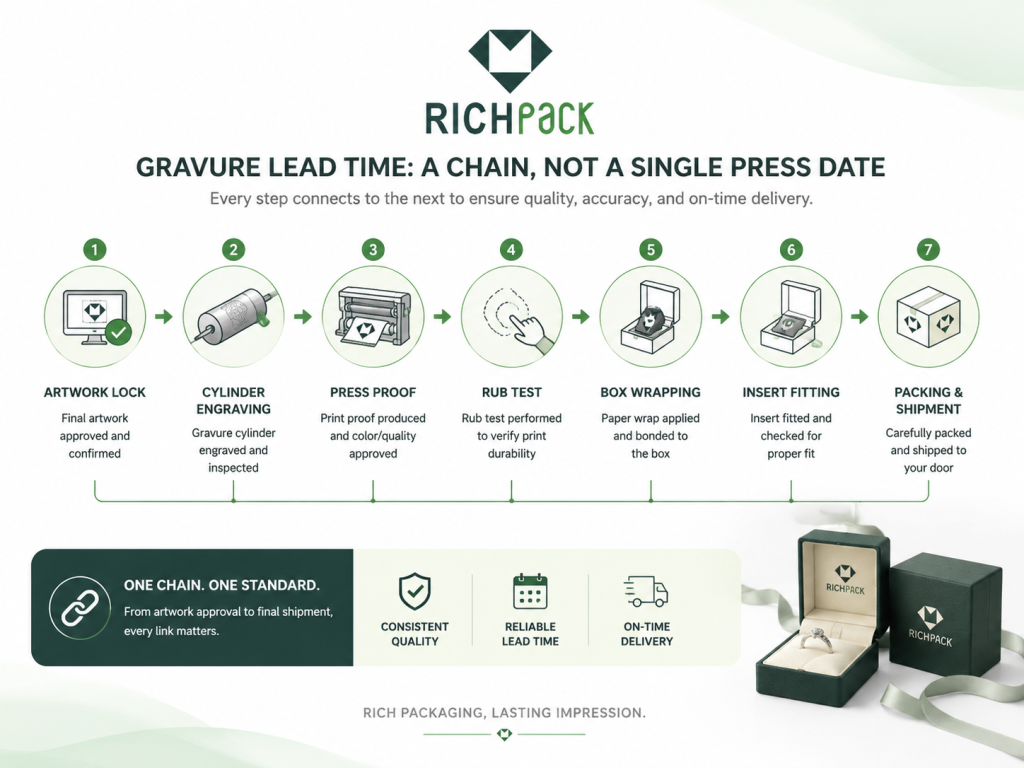
New gravure work adds cylinder engraving time. Current supplier guidance in the packaging market often places new cylinder lead time in a two to four week range, though the real schedule depends on cylinder count, proofing, plant load, and shipping route.
Digital can move faster because it avoids cylinder engraving. Flexo can be faster than gravure for many repeat commercial jobs, but plates and prepress still need planning.
For a jewelry launch, lead time is not just print time. It includes artwork lock, material arrival, proof approval, finishing, assembly, insert fitting, carton packing, and export checks.
Jewelry packaging has a different decision pattern from food pouches or general consumer goods. The printed box is not just a container. It is part of the retail price signal, the gift moment, and the buyer’s memory of the brand.
Gravure deserves attention only when the print carries that value at scale.
A first launch can use gravure if the brand already has wholesale demand, one locked design, and a clear reorder path. This is common when a jewelry manufacturer supports a retailer’s private label program or a brand relaunch has confirmed store placement.
If the team is still choosing brand color, tagline, insert copy, or QR destination, wait. A beautiful cylinder can become expensive scrap if the design changes two weeks later.
For founder-led brands, a better path is often digital for the first market test and gravure for the second or third order.
Gravure fits repeat collections where the box graphic becomes part of the brand code. Think of a consistent paper wrap on ring boxes, a printed sleeve for necklace boxes, or a coordinated gift box pattern repeated across channels.
This is where custom projects matter. The printed artwork should be planned with the insert, closure, ribbon, display tray, and outer carton, not treated as a surface afterthought.
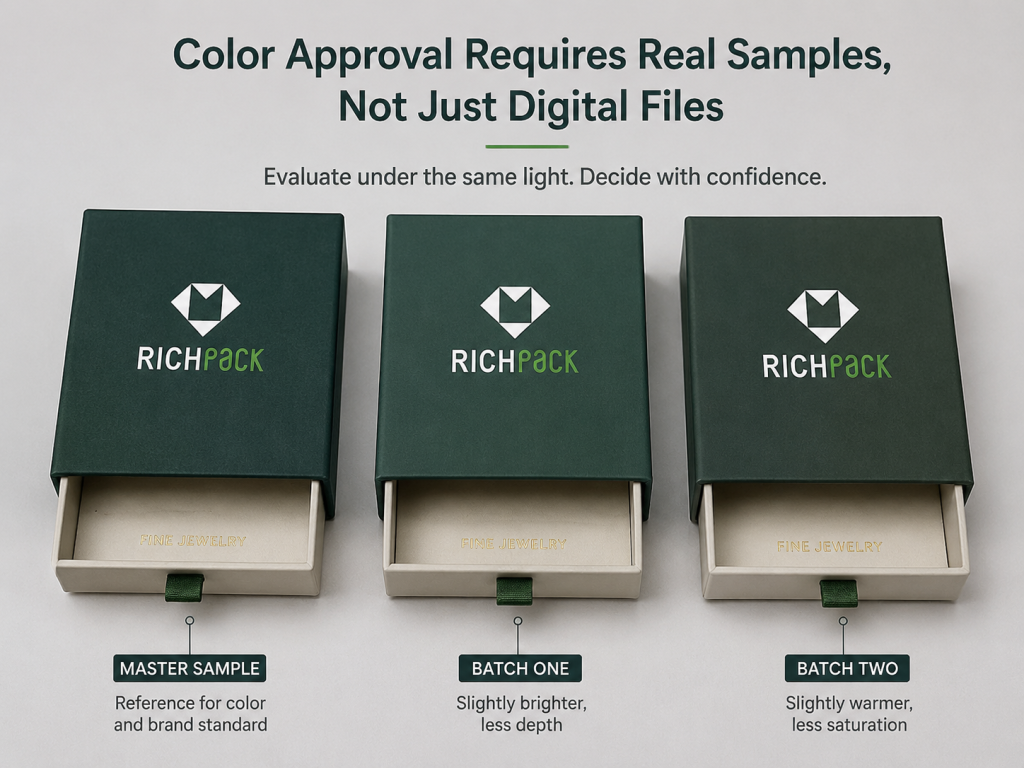
Repeat programs also make color control easier to judge. The team can approve one master proof and then hold every reorder against it.
Many jewelry designs rely on quiet gradients: pearl gray to silver, blush to ivory, black to charcoal, or warm beige to champagne. These tones can be band or shifted if the method is wrong.
Gravure is strong at smooth tonal transitions because cell volume controls ink density. That is why it has long been associated with photographic and high-density reproduction.
If the box design uses flat one-color marks, foil stamping may be enough. If the wrap carries a soft photographic campaign image, gravure moves higher on the list.
Rigid jewelry boxes often start with a board, wrap paper, glue, and precise assembly. Gravure may print the wrap or sleeve material before it becomes part of the box.
That use case is more realistic than trying to print directly onto an already assembled velvet box. The method belongs early in the material flow, before wrapping, cutting, and assembly.
For sleeve-heavy systems, link the print decision to packaging manufacturing planning. The wrap, glue, fold, crease, and surface finish can all affect the final look.
Brands selling outside China often need a one-box family to serve North America, Europe, the Middle East, Southeast Asia, and Australia. Color drift across batches can make the same collection feel uneven.
Gravure can help when the job has one stable global artwork file and tight color references. It is not magic, though. The supplier still needs controlled ink, stable substrate lots, and proof records.
The best brief includes Pantone targets where needed, CMYK values, viewing conditions, tolerance notes, and a signed master sample.
A good gravure job starts before the press runs. The buyer has to lock the right details, test the right surface, and ask the supplier for proof that matches real jewelry packaging conditions.
The goal is not to make the supplier fill out more forms. The goal is to prevent the sample from being passed on a desk and failing in a warehouse, a boutique drawer, or a gift bag.
Artwork lock means every visible and regulated detail is final. That includes logo size, color values, copy, barcode, country mark, recycling claim, insert note, care card text, URL, QR code, and any trademark line.
Use one master file. Do not let the sales deck, design file, and production file drift apart.
A small copy change can become a cylinder change. Buyers should treat approval like a production contract, not a casual design review.
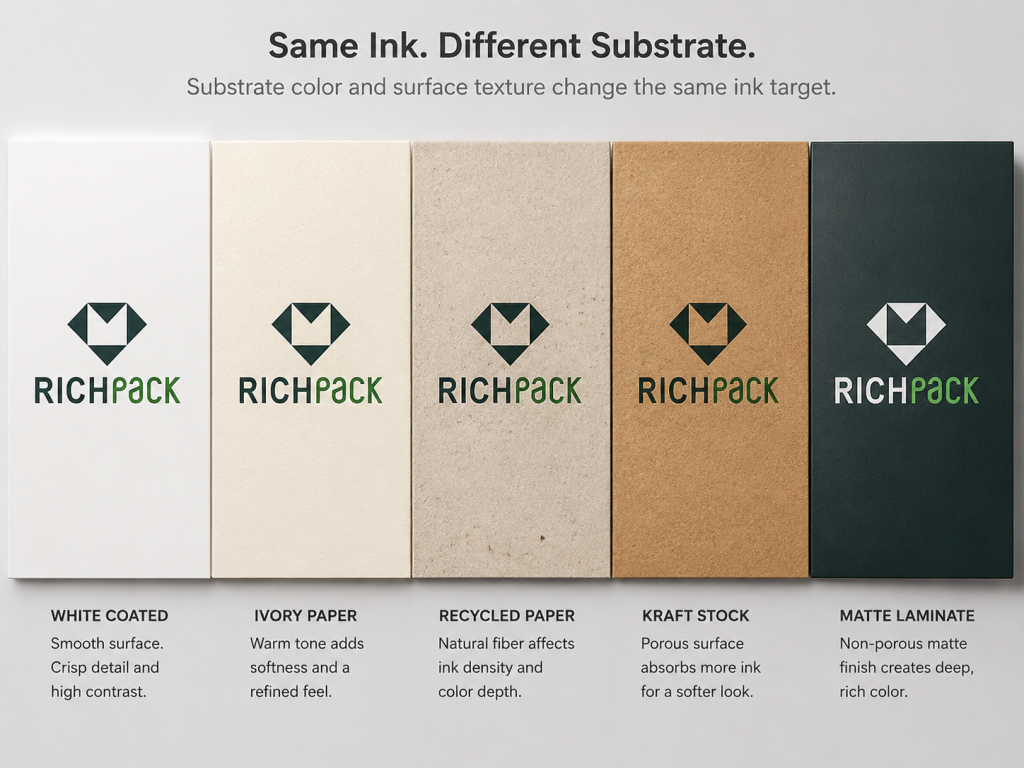
Substrate changes can alter color, gloss, drying, adhesion, and scuff behavior. A print that looks right on coated white paper may look warmer on ivory paper or flatter under a matte coating.
For jewelry boxes, test the actual paper wrap, sleeve stock, liner, or laminate. If the job uses FSC paperboard or recycled content, ask whether the certified option changes absorption, shade, or surface smoothness.
RichPack’s material planning pages are a useful starting point when the print decision has to match velvet, paperboard, leatherette, kraft, or specialty wraps.
A cylinder proof should answer three questions:
Do not approve a loose printed sheet if the final part will be folded, glued, laminated, wrapped around a board, or rubbed against velvet inserts.
The proof needs to follow the box journey.
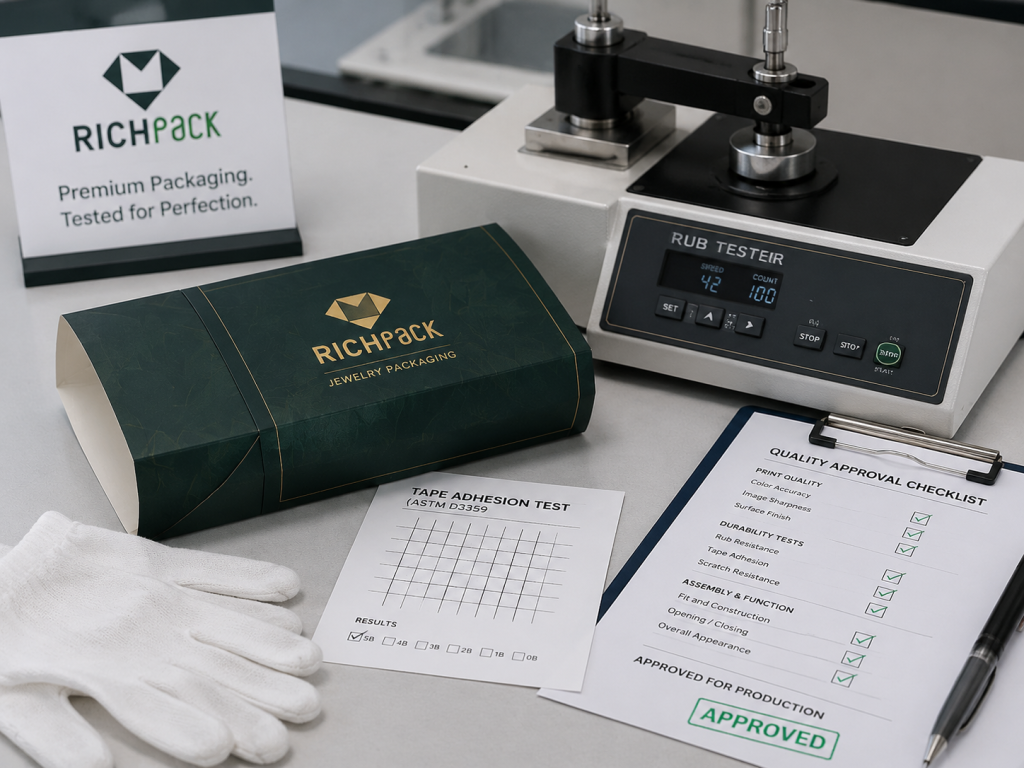
Jewelry boxes get handled more than many buyers expect. They slide into drawers, sit inside gift bags, move in cartons, rub against inserts, and pick up fingerprints during retail inspection.
For printed materials, ASTM D5264 covers abrasion resistance using a Sutherland Rub Tester. ASTM D3359 covers tape methods for rating coating adhesion. ISO 2836 covers the resistance of printed materials and inks to agents such as liquids, solvents, varnishes, and acids.
Your supplier does not need to run every standard for every order. But the brief should name the stress that matters: dry rub, wet rub, tape lift, fingerprint resistance, alcohol wipe, or carton scuff.
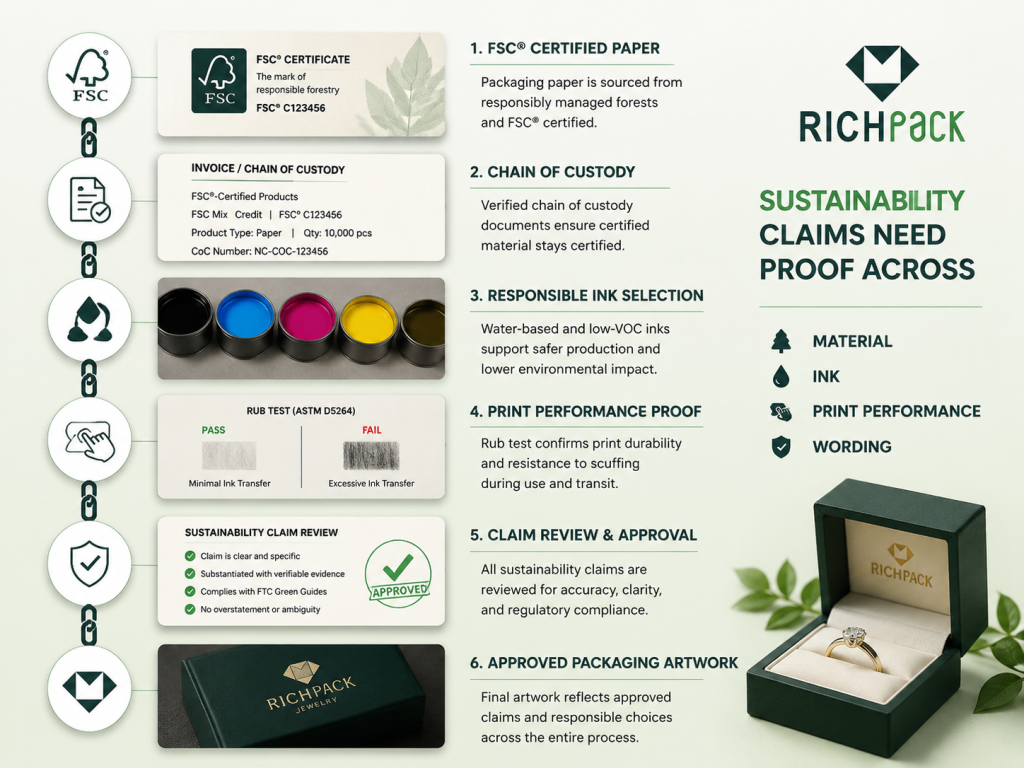
Sustainability claims need proof. If the box uses FSC-certified paper or controlled forest-based material, the chain-of-custody paperwork must support the label and any trademark use.
FSC explains that chain-of-custody certification verifies processes for producing and trading certified products. For a jewelry brand, that means supplier documents, invoice language, and approved label use should back the claim.
Ink choice belongs in the same review. Water-based gravure ink is technically available, and major ink suppliers offer water-based and solvent-based gravure systems for different print applications. The hard part is not the label on the ink bucket. The hard part is drying speed, adhesion, rub resistance, color strength, and compatibility with coatings or lamination.
Soy-based ink is often a better-known sustainability option in offset and paper printing. Eco-focused packaging suppliers commonly treat water-based and soy-based inks as strong choices, but they also point out that the best option depends on the printing method. For a gravure jewelry box wrap, ask the supplier whether the proposed ink is water-based, solvent-based, bio-based, low migration, or energy-cured, then test it on the actual substrate.
Do not let a green icon become a legal risk. Print claims only after certification, wording, ink family, drying behavior, and label placement are cleared.
Gravure is not expensive in the same way for every buyer. The cost feels high when volume is low, artwork is unstable, or the print only covers a minor visual detail.
The same method can feel efficient when the box family repeats for years.
Use a simple cylinder model before asking for a final quote. If an eight-color job needs eight cylinders and each cylinder costs 120 to 200 in a public supplier benchmark, tooling costs around 960 to 1,600 before production.
Spreading $1,200 of tooling across 5,000 units and it adds $0.24 per unit. Spread it across 50,000 units, and it adds $0.024 per unit.
At 200,000 units, that same tooling becomes $0.006 per unit.
That math changes the decision. The method is not only about beauty. It is about whether the brand can use the same beauty for long enough.
MOQ should be tied to the same artwork, not just total packaging count. Ten designs at 5,000 units each do not behave like one design at 50,000 units.
Ask suppliers to quote by design, color count, substrate, and reorder plan. A mixed order can look large on a purchase order and still be weak for gravure economics.
If the brand needs low volume with many variants, use custom planning for structure and digital or flexo for early print runs.
Reorders are where gravure can shine. If the same cylinder set is reused, the fixed tooling has already been paid for, and the unit price can improve.
That benefit only exists if the artwork stays the same. If every reorder changes a seasonal mark, distributor line, or QR destination, the buyer keeps resetting the cost.
For long brand programs, store the cylinder record, master proof, substrate code, ink references, and approval photos in one production file.
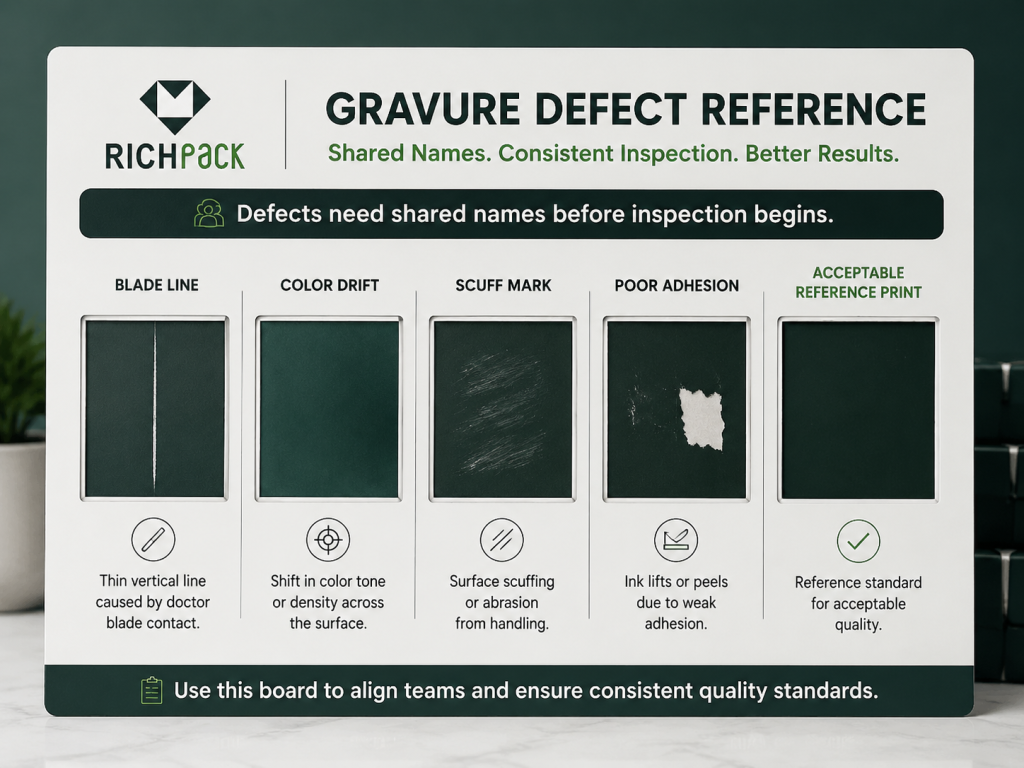
Common gravure failures include doctor blade lines, ink contamination, clogged filters, damaged blade edges, cylinder roughness issues, color drift, poor adhesion, and weak scuff resistance.
TKM Group notes that positive doctor blade lines can come from ink impurities, clogged filters, doctor blade damage, or copper and chrome finishing issues. That is a production problem, not a design taste issue.
A buyer cannot inspect every press variable. A buyer can require clean proof records, defect limits, and a hold point before full production.
Use the numbers below as a planning start, not a universal promise. A high-jewelry brand may demand tighter limits, while a kraft seasonal sleeve may allow more variation because the material itself is uneven.
| Defect or Variable | Suggested Starting Tolerance | How to Check It | Buyer Action |
| Critical brand spot color | ∆E00 under 2.0 | Spectrophotometer under agreed light | Hold shipment if a side-by-side mismatch is visible |
| CMYK process color | ∆E00 under 3.5 for CMY and under 5.0 for black | Press the color bar and the live artwork area | Recheck neutral and pastel areas by eye |
| Batch-to-master drift | ∆E00 under 2.0 for hero box areas | Compared to the signed master sample | Approve against the master, not the memory |
| Foil-to-print registration | Within 0.25 to 0.5 mm of the visible logo zones | Magnified ruler or inspection grid | Tighten for small logos and serif type |
| Doctor Blade line | None visible at normal viewing distance | Angled light and flat sample board | Stop and clean the ink system before a full run |
| Dry rub on printed sleeve | No visible logo break after agreed rub cycles | ASTM D5264 or supplier rub method | Change coating, cure, or ink system |
| Tape adhesion | No material lift in critical printed zones | ASTM D3359 style tape check | Rework the surface treatment before |
X-Rite describes common print production tolerances around Delta E 2000, including tighter values for CMY than black. For jewelry packaging, the brand color area matters more than the color bar alone. Measure both.
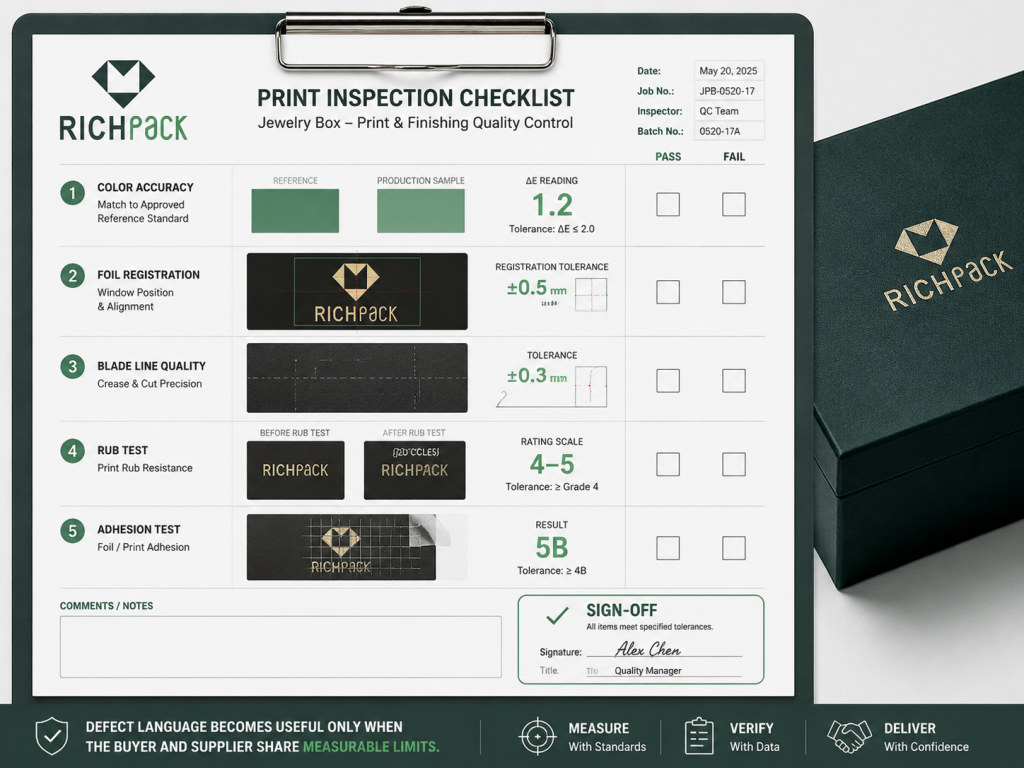
A strong supplier brief turns a vague premium request into an executable order. It should include:
For launch planning, RichPack’s quality and custom jewelry box insert pages help connect print quality with the interior fit and inspection process.
Use this part when the team has a real box brief, not just a style preference. The right answer comes from the relationship between volume, artwork stability, print surface, finish stack, and approval risk.
The matrix below turns those variables into a practical first choice.
Gravure is strongest when the design is stable, and the volume is large enough to spread the tooling cost. This fits global jewelry box sleeves, repeat ring box wraps, and coordinated gift packaging for a long-running collection.
Use it when the brand color is part of the price signal. A luxury black that shifts gray, or a champagne tone that turns yellow, can weaken the whole unboxing moment.
Pair the method with a signed master sample and a reorder file.
Use digital or offset for early launches unless the buyer has confirmed demand. Short runs need freedom.
A first run may reveal that customers prefer a warmer liner, a smaller logo, a different QR code, or a more restrained pattern. That learning is valuable. Gravure can wait until the learning becomes a standard.
For small batches, connect the print choice to wholesale small jewelry gift boxes and packaging tests before scaling.
Many variants weaken the gravure case because each design may need separate cylinders. A brand with ring, bracelet, necklace, bridal, men’s, and holiday variations may look high volume in total but low volume by design.
Digital handles versioning better. Flexo can work if the variations are controlled and the substrate suits it.
The buyer should count artwork families, not just boxes.
Jewelry boxes often combine print with foil, emboss, deboss, soft touch, spot UV, ribbon, inserts, and magnetic closures. Gravure may handle the printed wrap, but it does not replace every finish.
Use gift boxes and eco choices planning to decide which layer should carry the premium signal. Sometimes foil on a calm paper does more work than full-coverage print.
Foil stamping after gravure needs its own approval path. The ink must be dry, the coating must accept foil cleanly, and the registration window must be realistic for the logo size.
The finish stack should feel intentional, not crowded.
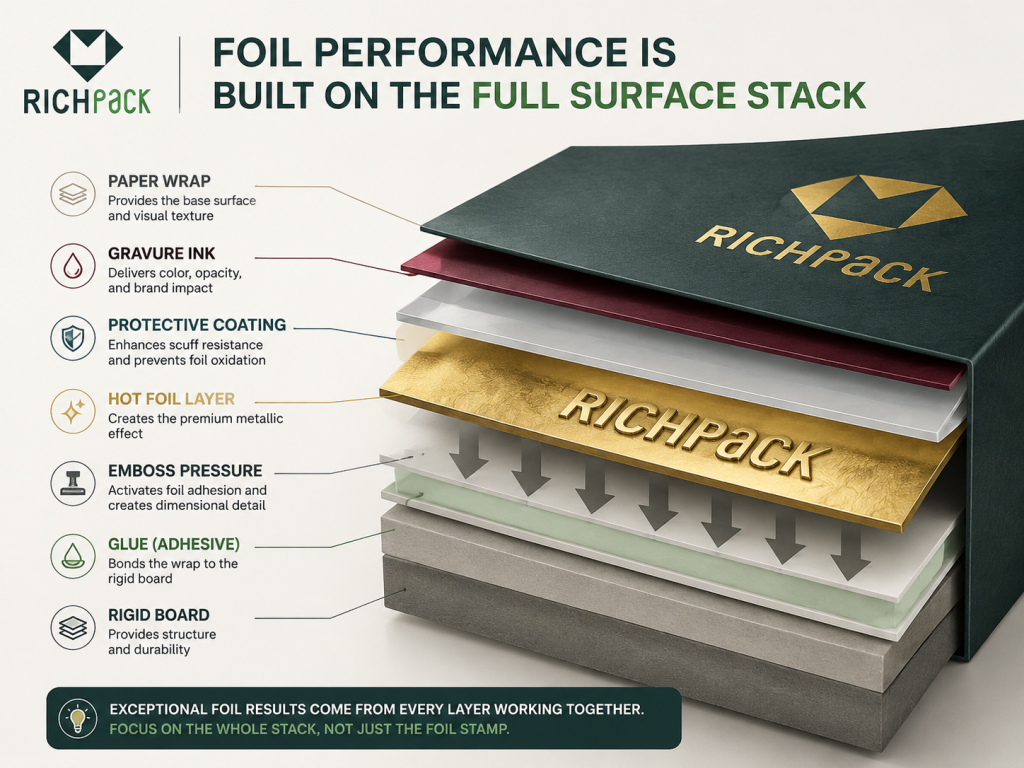
Sustainable paper programs can use gravure, but the paper choice must be tested. Recycled fibers, kraft tones, and certified materials can change ink absorption and color appearance.
A sustainability claim should not fight the print goal. If the brand wants a natural paper look, let the material show. If it wants photographic color, choose a smoother surface that can hold the design.
For paper-based launches, review paper packaging solutions before locking the print method.
Knowledge graph map
| Entity | Relationship | Buyer Value |
| Engraved cylinder | Holds measured ink cells | Supports repeat color and fine detail |
| Doctor blade | Removes excess ink | Reduces surface flood and controls transfer |
| Paper wrap | Carries printed artwork | Links print choice to rigid box assembly |
| Master sample | Defines acceptance target | Prevents batch approval by memory |
| Rub test | Simulates handling stress | Protects the logo and sleeve appearance |
| FSC claim | Requires chain proof | Reduces claim and label risk |
| Water-based gravure ink | Lowers solvent burden when validated | Supports sustainability without skipping performance tests |
| Foil registration window | Aligns metallic detail to print | Keeps logos and borders sharp on premium boxes |
| Reorder file | Preserves production memory | Improves repeat cost and color control |
It is an intaglio print method that uses engraved cylinder cells to carry ink to a substrate. The press fills the cells, wipes excess ink from the cylinder surface, and transfers controlled ink to paper, film, or laminate under pressure.
For jewelry boxes, the method is usually used on printed components such as wrap paper, sleeves, liners, bags, or coordinated gift packaging rather than directly on thick assembled boxes.
Flexo uses flexible relief plates and is often practical for many packaging substrates, medium runs, and faster changeovers. Gravure uses engraved metal cylinders and usually makes more sense for long, stable runs where color control, fine detail, and repeat consistency carry the value.
A jewelry brand with many variants often starts with flexo or digital. A mature brand with one global box pattern may move to gravure.
Rotogravure printing jobs can work for small brands only when demand is already proven, and the artwork will not change. Most small jewelry brands should test with digital, offset, screen, or flexo first.
The risk is not only cost. The bigger risk is locking the wrong design too early.
Usually, the better path is to print the wrap, sleeve, liner, or paper component before assembly. Direct printing on a finished rigid box may be limited by thickness, texture, shape, and handling.
For assembled surfaces, ask about screen printing, foil stamping, UV, pad printing, or offset transfer methods.
Approve it under real conditions. Check the actual substrate, final color target, finish stack, rub resistance, adhesion, fold behavior, glue interaction, and box assembly result.
The approval sample should include the printed component after it has passed through the same finishing path as production.
Recommend another method when the order is small, the design may change, the artwork has many variants, or the premium signal comes from foil, texture, structure, or insert fit rather than full-coverage print.
A careful supplier protects the buyer from over-specifying. The best print method is the one that makes the box look right, arrives on time, and stays repeatable.
Start with ∆E00 under 2 for critical brand colors on hero areas, then validate that number against a signed master sample. Process CMYK areas may allow a wider range.
Common print-control guidance often allows about ∆E00 3.5 for CMY and 5 for black.
Do not rely only on the color bar. Jewelry boxes use soft neutrals, champagne tones, and muted gradients where small shifts show quickly.
Yes, but it needs testing. Water-based gravure ink can support lower-solvent goals, yet drying, adhesion, rub resistance, and coating compatibility must pass on the actual paper wrap or sleeve.
Soy-based ink may be attractive for paper packaging, but it is more common in offset-style conversations. The supplier should confirm whether it fits the gravure system, not just the sustainability story.
Gravure can create the printed base under a foil logo, border, or pattern, but foil stamping still depends on surface energy, coating choice, drying, pressure, temperature, and registration. A rich printed wrap can fail if the foil sits on a coating that blocks clean transfer.
For small jewelry logos, ask for a foil-over-print sample and inspect registration within 0.25 to 0.5 mm in the visible logo zone.
Gravure belongs in jewelry packaging when the brand is ready for commitment. It works best for stable, repeatable, high-volume artwork where fine detail, smooth tonal color, and batch consistency protect the perceived value of the box.
It is not the default answer for every premium box. Short runs, changing artwork, many variants, textured assembled surfaces, and finish-led designs often need digital, flexo, offset, screen printing, or foil first.
Use rotogravure printing when the design has earned its cylinder. Before approving it, lock the artwork, test the actual material, set Delta E targets, review cylinder proofing, check foil and rub risk, and connect the print method to the full box structure. RichPack can help turn that decision into a production brief through contact and a full custom packaging review.


2026-06-22

2026-05-29
2024-11-13
2026-01-25

2026-04-02
Beautiful Butterfly Box Gifts | Deluxe Butterfly Gift Boxes for Special Occasions and Unique Presentations Bulk Order Options from Richpack
View More
Bespoke Personalized Jewelry Storage Solutions with Custom Inserts | Tailored Storage for Jewelry Merchants Needing Unique and Branded Displays
View More
Black box with lid for jewelry | Matte black rigid packaging box with lid | Custom sizes and bulk orders at Richpack
View More
Branded Jewelry Packaging with Eco-Friendly Materials | Sustainable Packaging for Retailers | Customizable for Brand Identity
View More
Card Thank You Card | Solid Premium Paper Stock | Professional Jewelry Inserts | Richpack Wholesale
View More
Chic Richpack Bridesmaids Boxes, handcrafted, filled with pampering goodies for your squad
View More

